
- Free modem and anti-virus software
- No contracts and unlimited data
- Bundle with TV to save more
- Speeds up to 7 Gbps**
Quick Utility Facts
- Call Oncor if you have a power outage or see a line down, but you’ll need to shop for a provider to supply your electricity.
- The cheapest electric plan in Dallas is 6.5¢ /kWh from APG&E.
- Natural gas service is provided by Atmos Energy
- AT&T Fiber is the fastest option for internet, but Spectrum is the most widely available.
- The cheapest internet plan in Dallas are $30.00/month from Spectrum.
- Trash, recycling, and water are provided by the City of Dallas
Top 47 Electric Providers in Dallas

- 6.7¢ /kWh
- 100%
- 60 days
- 12-36 Months
- Committed to Renewable Energy

- 10.5¢ /kWh
- 3-100%
- 60 days
- 1-36 Months
- Highest Trustpilot Rating 4.7/5 ★

- 6.7¢ /kWh
- 3-100%
- 60 days
- 12-36 Months
- Best for Straightforward Contracts

- 6.7¢ /kWh
- 9-100%
- 60 days
- 8-24 Months
- Best for High-Usage Homes

- 6.5¢ /kWh
- 6-100%
- None
- 1-36 Months
- Best for Low Rates

- 6.6¢ /kWh
- 29-100%
- 30 days
- 12-36 Months
- Best for Long Term Value

- 6.6¢ /kWh
- 9%
- 30 days
- 12-36 Months
- Low Rates. No Hassles.

- 6.7¢ /kWh
- 30-100%
- 60 days
- 4-36 Months
- Best for Short-Term Leases

- 6.7¢ /kWh
- 30%
- None
- 12-24 Months
- Free Pet Benefits

- 6.8¢ /kWh
- 100%
- 30 days
- 3-36 Months
- Texas Focused Green Energy
- 6.8¢ /kWh
- 24%
- 30 days
- 12-36 Months
- Flexible Contract Lengths

- 6.8¢ /kWh
- 100%
- 30 days
- 3-36 Months
- No Hidden Fees, Fair Pricing

- 7.1¢ /kWh
- 35-100%
- 90 days
- 36 Months
- Best Free Nights Plan

- 7.2¢ /kWh
- 100%
- None
- 3-36 Months
- 100% Solar-Powered Electricity

- 9.3¢ /kWh
- 24%
- 90 days
- 12-36 Months
- Get Rewarded for Higher Usage

- 9.7¢ /kWh
- 31%
- 60 days
- 12-36 Months
- Popular Bill Credit Plans

- 9.9¢ /kWh
- 31%
- None
- 11-60 Months
- FREE Nights Plan Available!
- 9.9¢ /kWh
- 31%
- None
- 11-60 Months

- 10.1¢ /kWh
- 26%
- 30 days
- 6-12 Months
- Best for No-Deposit / Prepaid

- 12¢ /kWh
- 26-100%
- 90 days
- 3-36 Months
- Proven Leader in Clean Energy

- 12.6¢ /kWh
- 26-100%
- None
- 9-24 Months

- 13¢ /kWh
- 100%
- None
- 3-24 Months
- 100% Renewable Energy

- 13.1¢ /kWh
- 25-100%
- None
- 12-36 Months
- Earn Free Electricity Every Month
- 13.5¢ /kWh
- 9-100%
- 60 days
- 12-24 Months
- Support Veterans & First Responders

- 13.6¢ /kWh
- 24%
- 90 days
- 0-36 Months
- Best for Smart Home Tools & App

- 10.1¢ /kWh
- 100%
- None
- 3-18 Months
- Customer Service That Counts

- 14¢ /kWh
- 24%
- None
- 12-36 Months
- Best for Apartments

- 14.3¢ /kWh
- 100%
- 90 days
- 1-36 Months
- 100% Renewable Plans

- 6.6¢ /kWh
- 35%
- None
- 6-15 Months

- 8.9¢ /kWh
- 6%
- None
- 1-60 Months

- 8.9¢ /kWh
- 6%
- None
- 1-60 Months

- 9.1¢ /kWh
- 100%
- None
- 12 Months
- Renewable Energy Option

- 10.9¢ /kWh
- 26-100%
- None
- 1-36 Months

- 11¢ /kWh
- 26-100%
- None
- 1-36 Months

- 11.3¢ /kWh
- 33-100%
- None
- 3-36 Months

- 11.4¢ /kWh

- 11.5¢ /kWh
- 25-100%
- None
- 3-36 Months
- 11.8¢ /kWh

- 12¢ /kWh

- 12.3¢ /kWh

- 12.6¢ /kWh
- 100%
- None
- Month to Month
- Renewable Energy Option

- 12.9¢ /kWh

- 13.9¢ /kWh
- 14¢ /kWh
- Renewable Energy Option

- 16.6¢ /kWh



Electricity across Dallas is delivered physically by Oncor Electric Delivery, which owns and operates the power lines, poles, and digital meters, while handling emergency outage restoration across the region. Because Texas operates a deregulated retail electricity marketplace across the Oncor service territory, you have the right to shop for an independent Retail Electric Provider (REP) to secure a fixed-rate or green energy supply contract. Oncor bills a separate, state-approved delivery charge, consisting of a fixed monthly fee ($4.06 per month) alongside a volumetric usage fee (roughly 6.0 cents per kWh), which is passed through and bundled directly into your chosen REP’s monthly statement. When paired with competitive supply rates, typical all-in residential electricity costs average between 13.5 and 18 cents per kWh depending on your contract terms, making careful plan selection essential during scorching North Texas summer heatwaves when central air conditioning strains the regional ERCOT grid.
Natural Gas Providers in Dallas

Natural gas service across the city core is distributed exclusively by Atmos Energy (Mid-Tex Division), operating as a fully regulated public delivery utility. Because natural gas procurement is bundled directly into state and municipally approved tariffs under the Dallas Annual Rate Review, your household is protected against third-party energy marketer markups. Atmos Energy assesses a mandatory fixed monthly customer facility charge (which sits at $42.25 per month for City of Dallas residential accounts) alongside volumetric fuel distribution rates. Because natural gas is heavily utilized for central forced-air furnaces, domestic water heaters, and cooktops during winter cold snaps, usage drops sharply in the summer; however, this substantial fixed basic service fee ensures your natural gas account carries a persistent monthly baseline cost year-round even during July and August when space-heating systems sit completely dormant.
Top 12 Internet Providers in Dallas
- 7 Gbps**
- Cable & Fiber
- Unlimited
- TV & Phone
- 94.29%
- $30.00/mo
- Most Affordable Plans

- 5 Gbps
- Fiber
- Unlimited
- Mobile
- 76.67%
- $35.00/mo
- Get a $200 Reward Card*

- 300 Mbps
- 5G
- Unlimited
- Mobile
- 100%
- $35.00/mo
- Wireless Internet Great for Renters

- 498 Mbps
- 5G
- 1.2 TB
- Mobile
- 99.98%
- $35.00/mo
- Wireless Internet

- 300 Mbps
- 5G
- Unlimited
- Mobile
- 100%
- $40.00/mo
- Wireless Internet

- 150 Mbps
- Satellite
- 150-850 GB
- Phone
- 100%
- $39.99/mo

- 400 Mbps
- Satellite
- Unlimited
- 100%
- $55.00/mo

- Varies
- Fiber, Cable, 5G, & Satellite
- Varies
- 95%
- $39.95/mo

- 7 Gbps
- Fiber
- Unlimited
- Phone
- 15.39%
- $29.99/mo

- 8 Gbps
- Cable & Fiber
- Unlimited
- TV & Phone
- 5.68%
- $25.00/mo
- 3 Year Price Lock*

- 5 Gbps
- Cable
- 1 TB
- 1.78%
- $19.95/mo

- 2 Gbps
- Fiber
- 1 TB
- 1.4%
- $29.00/mo
Internet and digital broadband connectivity across Big D represents a fast-paced, high-speed data battlefield heavily split between symmetrical multi-gigabit fiber from AT&T Fiber, a near-universal cable footprint from Spectrum, and expanding fiber footprints from regional operators alongside 5G fixed wireless networks. Symmetrical fiber connections offer exceptional low-latency bandwidth ideal for remote employment, data management, and high-definition streaming, but physical line availability depends heavily on neighborhood age and local infrastructure. Moving into an established historic neighborhood like Lakewood, Deep Ellum, Bishop Arts District, or Oak Cliff can reveal older overhead utility pole easements or dense tree canopies that delay fiber drops, while modern high-density condo towers and luxury apartment complexes in Uptown, Downtown, or Victory Park frequently feature exclusive corporate right-of-entry marketing agreements that restrict unit-level inside wiring to a single ISP.
Water & Sewage Providers in Dallas

Water, sanitary sewer, and stormwater services are managed uniformly by Dallas Water Utilities (DWU), sourcing raw surface water directly from regional reservoirs including Lake Ray Hubbard, Lake Lewisville, and Lake Tawakoni. Your monthly statement arrives as a consolidated municipal utility bill that combines drinking water, wastewater treatment, stormwater fees, and city trash services ($40.09 per month) onto a single statement. DWU utilizes a tiered volumetric water pricing model paired with a monthly base meter fee, where per-gallon water charges escalate across higher usage tiers. To protect residents from paying artificially high sewage charges while watering lawns or filling pools in the summer, DWU calculates your volumetric sewer fee using a Winter Average model — measuring your indoor water intake during consecutive billing cycles from November through February — meaning an undetected indoor pipe leak or running toilet during those winter tracking months will artificially inflate your monthly sewer billing cap all year long.
Top 16 Trash and Recycling Providers in Dallas
Solid waste, single-stream recycling, and brush collection are operated directly by the City of Dallas Sanitation Services, with fees ($40.09 per month) integrated directly into your monthly DWU municipal utility statement. Curbside pickup utilizes an automated container system with grey rolling carts for weekly household garbage and blue rolling carts for bi-weekly single-stream recycling. The city enforces a strict Brush and Bulky Trash collection program, picking up oversized items (such as furniture, mattresses, and tree limbs) once a month on a published four-week rotation schedule tied to your address. Bulky piles are strictly capped at a maximum of 10 cubic yards (roughly the size of a small pickup truck bed stacked 4 feet high), and setting items out earlier than the weekend prior to your assigned week — or including banned items like tires, Freon appliances, or contractor construction debris — will result in immediate code enforcement violation tags and skipped collection.
Utilities Summary for Dallas, TX
| Electric Companies: | 47 |
| Natural Gas Companies: | 1 |
| Water & Sewage Providers: | 2 |
| Garbage, Trash & Recycling Providers: | 16 |
| Municipal Electricity: | No |
Dallas Utilities Setup Guide: Everything You Need to Know About Electricity, Gas, Water, Internet, and Trash Providers
Whether you’re drawn to the vibrant arts scene in Deep Ellum, the bustling energy of Downtown, or the charming neighborhoods like Bishop Arts, you’re going to love calling this city home. Home to top industries like tech, finance, and healthcare, it offers a fantastic quality of life. Whether you’re settling into East Dallas, White Rock Lake, or Oak Cliff, knowing how utilities work here will help you feel right at home, and maybe save a few bucks along the way.
Dallas has a deregulated energy market, meaning you must choose your electricity provider (yes, you can shop around for the best deal!). We’ll break down everything you need to know, including how to save money with energy efficiency programs and which internet providers offer the fastest speeds.
Dominating the Electricity Vertical: The Texas Deregulation Matrix
Electricity works differently in Dallas than in most cities. While Oncor maintains the power lines (and handles outages) as the transmission and delivery utility (TDU), you get to choose your Retail Electric Provider (REP) from dozens of competing companies. This means you can shop for cheaper rates, renewable energy plans, or perks like free nights. But with so many options, it’s easy to get overwhelmed, we’ll help you find the best plan without the fine-print surprises.
If you live in one of Dallas’ many suburbs things might not be so clear. Some suburbs, like Frisco, receive their electricity from an electric co-op like CoServ that does not have to participate in deregulation, so you might not have a choice of providers. Other suburbs, like Denton and Garland, have municipal electricity, but have still opted in for deregulation, so you do have a choice of provider. Make sure to check your city to see what is available to you.
The “Two-Company” System: Who Do You Actually Call?
One of the most confusing aspects of moving to Dallas is realizing you cannot simply “call the power company.” Texas is a deregulated market, meaning you must separate the company that sells you the electricity from the company that delivers it.
- The Retail Electric Provider (REP): Companies like TXU, Reliant, or Green Mountain. You choose them, you sign a contract with them, and they send you the bill. They are financial intermediaries.
- The Transmission and Distribution Utility (TDU): In the Dallas Metroplex, this is almost exclusively Oncor Electric Delivery. They own the poles, the wires, and the smart meter on your house.
Critical User Insight:
- For Billing Issues: Call your REP (the company on your bill).
- For Power Outages: Call Oncor immediately at 888-313-4747 or use their outage map. Your REP cannot fix a downed line; they will just read you a script. Calling Oncor directly saves you 20 minutes of hold time during a storm.
The Anatomy of a Dallas Electric Bill (2026 Update)
To truly compare plans, you must understand that every bill has two distinct parts. Many “cheap” plans hide costs by manipulating these variables.
| Charge Component | What It Is | Can You Change It? |
| Energy Charge | The rate you pay your provider for the actual electricity commodity. | YES. This is the rate you shop for (e.g., 9.2¢ per kWh). |
| Base Charge | A monthly administrative fee charged by some providers (e.g., $9.95/mo). | YES. Look for plans that waive this fee. |
| TDU Delivery Charges | Mandated fees passed through from Oncor to cover grid maintenance. | NO. These are set by the state. Every provider charges the same amount. |
The “Hidden” Oncor Fees (As of Feb 2026):
Regardless of which provider you choose, you will pay Oncor’s delivery fees. As of early 2026, these are approximately:
- Monthly Fixed Fee: ~$4.23 per month (Often split as a $1.43 Customer Charge + $2.80 Metering Charge).
- Volumetric Fee: ~5.58¢ per kWh.
The “Electricity Facts Label” (EFL): Your Decoder Ring
Texas law requires every plan to have an Electricity Facts Label (EFL). Never sign up for a plan without opening this PDF.
The “Average Price” Trap:
The EFL lists the average price per kWh at three usage levels: 500 kWh (Apartment), 1000 kWh (Small Home), and 2000 kWh (Large Home).
- The Trap: Providers often structure plans to look cheap at 2000 kWh but expensive at 500 kWh.
- Example: A “Bill Credit” plan might give you a $100 credit only if you use more than 1000 kWh.
- Usage: 1001 kWh → Effective Rate: 8¢ (Great deal!)
- Usage: 999 kWh → Effective Rate: 18¢ (You lost the $100 credit!)
- Actionable Advice: If you live in an apartment, ignore the 2000 kWh column. Focus strictly on the 500 kWh price. Dallas apartments typically average 500-800 kWh in winter and 800-1200 kWh in summer.
Common “Gimmick” Plans to Avoid
- “Free Nights & Weekends“: These plans often charge a punishingly high rate (e.g., 20¢+) during the day. In Dallas, air conditioning is your biggest expense, and it runs hardest during the day (2 PM – 7 PM). Unless you own an EV and charge it at 2 AM, you will likely lose money on these plans.
- Minimum Usage Fees: Some plans punish you for conserving energy. They might charge a $20 fee if you use less than 1000 kWh. If you go on vacation or have a mild weather month, your effective rate skyrockets.
How to Waive Your Deposit
You do not always have to pay a deposit (which can range from $200-$400) to start service. The Public Utility Commission of Texas (PUCT) mandates waivers for:
- Seniors (65+): With no delinquent balance with a previous provider.
- Victims of Family Violence: You can submit a certification letter from police, medical personnel, or a shelter. (Reference: PUCT Substantive Rule §25.478).
- Letter of Credit: If you have a letter from your previous utility (electric, water, or gas) showing 12 months of on-time payments, your new provider must waive the deposit.
The “Power to Choose” Filter Strategy
The state-run website Power to Choose is the only unbiased marketplace, but it is flooded with confusing options. Use these filters to find the real deals:
- Contract Length: “12 Months” (Avoid short-term summer renewals).
- Fixed Rate: “Fixed” (Never Variable).
- Plan Type: Check the EFL to ensure it is not a “Tiered” or “Bill Credit” plan if your usage fluctuates. Look for “Energy Charge” + “TDU Charge” only structures for the most predictability.
Time Your Sign-Up
- Best Months: February/March (rates dip before summer demand).
- Worst Months: June-August (prices spike with AC use).
Leverage These Dallas-Specific Perks
- Free Nights Plans (e.g., TXU): Shift laundry/dishwashing to 8pm-6am.
- Solar Buyback: Get credits for excess solar power (good if you install panels).
Top 5 Electricity Providers in Dallas
#1 4Change Energy
Best All-Around Value
4Change consistently threads the needle between low everyday rates and fewer plan gimmicks than most budget competitors. Their charitable-giveback brand is a plus, but the real edge is day-to-day price competitiveness with plans that tend to be easier to understand than heavy tiered/credit structures. Review data shows materially higher satisfaction versus many peers: 4.0/5 across 856 reviews on Texas Electricity Ratings, a strong indicator of stability for a discount REP.
BBB also lists 4Change with A+ and long-standing accreditation, useful as a credibility check, even if BBB isn’t a pricing tool. Bottom line: if you want low hassle + low price without sacrificing reliability, 4Change is the safest “value pick.”
#2 TriEagle Energy
Best for Straightforward, No-Nonsense Plans
TriEagle earns its spot for plan simplicity and a reputation for consistent, non-gimmicky pricing. Independent review compilations put TriEagle near the top (around 4.2/5 overall), and customer commentary frequently calls out stable bills and helpful usage emails, exactly what you want if you dislike bill-credit roller coasters.
While no REP is perfect, TriEagle’s combination of predictable fixed-rate options and fewer fine-print traps makes it a savvy choice if you prioritize clarity over chasing the absolute rock-bottom teaser rate.
#3 Energy Texas
Best Emerging “Customer-Friendly” Option
Energy Texas punches above its weight thanks to straightforward pricing, renewable-heavy plan mix, and consumer-friendly touches (like rewards and occasional demand-response style incentives). Community feedback in Dallas-area threads trends positive, highlighting “no gimmicks” and easy account management; that aligns with third-party review write-ups praising transparency.
If you’re moving in and want a clean, modern experience with green options, without the big-brand baggage, Energy Texas is a solid bet that balances price with user experience.
#4 Reliant
Best Big-Brand Experience & Tools (Watch the Plan Fit)
As an NRG flagship, Reliant couples broad plan selection with strong digital tools and a huge Texas footprint. Independent editorial scoring pegs Reliant around 4.3/5 overall, driven by customer service/online access, but note that some of the most aggressively priced offers rely on bill credits that work best in certain kWh “sweet spots.” If your usage profile fits, you can land competitive effective rates; if it doesn’t, you may pay more.
BBB listings for Reliant are mixed (some entries show “Not Rated”), so lean on plan documents (EFLs) and usage modeling rather than brand name alone.
#5 Frontier Utilities
Best Aggressive Promo Pricing (Mind the Tiers)
Frontier often leads with headline-grabbing rates, which can be great if your household lands inside the bill-credit tiers. Third-party overviews repeatedly note “price leader, but tiered”, so if you’re below the threshold or far above it, your effective rate can jump. For price hunters who can match usage to the plan’s band, Frontier can be a money-saver; if your usage varies a lot, consider a simpler plan elsewhere.
Why Trust Our Rankings
We combined quantitative and qualitative signals, then scored each REP on Price & Value (35%), Fees & Fine Print (15%), Reliability & Complaints (20%), Plan Breadth (10%), BBB & Credibility (10%), and Customer Sentiment (10%). For this Dallas update (as of November 16, 2025), we reviewed:
- 10 independent sources including: BBB business pages, third-party plan/review aggregators, and consumer education pages explaining PUCT complaints/scorecards.
- 2,000+ consumer reviews/posts sampled across Texas Electricity Ratings provider pages (e.g., 4Change 856, TXU 474, Gexa 499), plus spot-checks on recent Dallas-area Reddit discussions to gauge current sentiment and plan “gotchas.”
See our full methodology for ranking REPs
Know Your Rescission Period: When you sign up with a new electricity provider in Texas, you have a 3-day rescission period to change your mind without penalty. Use this time to double-check the plan details and make sure it’s the right fit before you’re locked in.
How Much Electricity Will I Use in Dallas?
| Home Size | Winter Usage (Est) | Summer Usage (Est) | Avg Bill (Summer) |
| Apartment (800 sq ft) | 500 kWh | 1000 kWh | $140 – $180 |
| Small Home (1500 sq ft) | 800 kWh | 1600 kWh | $220 – $280 |
| Large Home (2500 sq ft) | 1200 kWh | 2500+ kWh | $350+ |
Tips for Choosing a Plan by Neighborhood
- Uptown/Deep Ellum: Apartment living dominates. Look for plans with low base charges.
- Highland Park: Large estates. Look for plans with high-usage credits.
- Bishop Arts: Older homes may have less insulation; avoid variable rate plans.
Energy Efficiency & Rebates
Through Oncor’s Energy Efficiency Incentive Program, Dallas residents can receive rebates for:
- Smart thermostats: up to $75
- HVAC upgrades: up to $3,000
- Attic insulation: up to $0.25 per sq. ft.
- ENERGY STAR® appliances: rebates vary by item
Natural Gas Services: Safety, Setup & The “Green Tag” Hurdle
Unlike electricity, natural gas in Dallas is not deregulated. Atmos Energy is the sole provider for the Dallas-Fort Worth Metroplex. While you don’t have to shop for rates, you do have to navigate strict safety protocols that can delay your move-in if you aren’t prepared.
Getting Connected: The Basics
- Provider: Atmos Energy
- New Service Line: 888-286-6700 (Monday – Friday, 7 AM – 6 PM)
- Emergency Line: 866-322-8667 (24/7 for gas leaks/odors)
- Lead Time: Call at least 5-7 business days before your move. During peak seasons (winter), appointment slots fill up quickly.
The “Customer Charge” Shock: Many new residents are confused when they receive a gas bill in August for $30+ despite using zero gas for heating.
- The Reason: Atmos charges a monthly “Customer Charge” (Base Fee) to maintain the pipeline infrastructure connected to your home. This fee applies regardless of usage. Do not waste time calling to contest it; it is a mandatory tariff approved by the City of Dallas.
The “Green Tag” Inspection: Critical for Renovations & Vacancies
This is the most common point of failure for people buying flipped homes or properties that have been vacant for more than 6 months.
The Rule: If gas service has been severed or the meter pulled for safety/vacancy reasons, Atmos cannot turn the gas back on until the City of Dallas inspects the home’s plumbing.
The “Green Tag” Process:
- Pressure Test: You must hire a licensed plumber to perform a pressure test on your gas lines to ensure there are no leaks.
- City Inspection: The plumber notifies the City of Dallas. A city code inspector visits the property to verify the pressure test.
- The “Green Tag”: If the system passes, the inspector places a physical Green Tag on the meter loop and electronically notifies Atmos.
- Meter Unlock: Only after Atmos receives this digital release can they schedule a technician to unlock the meter.
Warning: This coordination can take 1-2 weeks. If you are buying a home that has been vacant, ask your realtor to confirm the status of the gas meter before closing.
Pilot Lighting & Safety Checks
When Atmos turns on your service, safety is paramount.
- Adult Presence Required: An adult (18+) MUST be present at the property during the connection window. The technician needs to enter the home to check for leaks and ensure appliances are safe.
- Pilot Lighting: The technician will typically light pilot lights for your water heater and furnace as a courtesy. If an appliance is deemed unsafe (e.g., a rusted flue or gas leak), they will “Red Tag” that specific appliance, meaning you cannot use it until a plumber repairs it.
Don’t Miss Out: The “SmartChoice” Rebates (2025-2026)
If you are moving into a new home and upgrading appliances, Atmos offers significant cash-back rebates. Many users unknowingly throw this money away.
Current Rebate Offers (Subject to change):
- Smart Thermostats: Up to $75 rebate for installing an ENERGY STAR® certified smart thermostat (e.g., Nest, Ecobee).
- Gas Furnaces: $300 – $350 for installing high-efficiency models.
- Tankless Water Heaters: Up to $200 – $300 for qualifying ultra-low NOx units.
- Gas Dryers: Often eligible for smaller rebates.
How to Claim: You must submit your application within a specific window (usually 12 months) of purchase. Keep your receipts and visit the Atmos Rebates page to file online.
Municipal Water and Sewer: Navigating Dallas Water Utilities (DWU)
Unlike the electricity market, you cannot choose your water provider. In the city limits, you are served by Dallas Water Utilities (DWU). While you don’t have a choice of company, you do have control over how you are billed if you understand the city’s unique calculation methods.
Service Initiation: The “Red Tape” Roadmap
Setting up water in Dallas is more rigorous than in many other cities. It is a bundled service that includes Water, Sewer, Sanitation (Trash/Recycling), and Stormwater.
- The “2TurnItOn” Portal: For new service requests, the city often directs users to their partner portal, 2TurnItOn. This is the standard digital intake form.
- The “DallasGo” Platform: Once your account is active, you will manage payments and view usage through DallasGo, the city’s payment hub launched to replace older systems.
Required Documentation: Dallas is strict about identity verification to prevent fraud. Have these digital copies ready before you start to avoid rejection:
- Valid Government ID: Driver’s License or Passport.
- Proof of Occupancy: A signed lease agreement (first page and signature page) or closing disclosure/deed.
- Deposit: A $50.00 deposit is standard for residential accounts.
- Pro-Tip: This deposit is refundable. After 12 consecutive months of on-time payments, it is credited back to your account with interest.
Customer Service Line: (214) 651-1441 (M-F, 8 AM – 5 PM). Expect wait times on Mondays and Friday afternoons.
The “Winter Quarter Average”: The Secret to Low Bills
This is the single most critical financial detail for Dallas residents. Dallas does not meter your sewage output. Instead, they estimate it based on your winter water usage.
The Mechanism: The city assumes that any water you use during the winter months (when sprinklers are off) is going down the drain (shower, toilet, sink).
- The Averaging Months: December, January, February, and March.
- The Calculation: DWU takes the average water usage of these four months. This number becomes your “Sewer Cap” for the entire following year.
How It Affects Your Bill: In July, when you are watering your lawn and using 20,000 gallons of water, you will NOT be charged sewer fees on 20,000 gallons. You will be billed for sewer based on your Winter Average (e.g., 5,000 gallons) or your actual usage, whichever is lower.
Strategic Advice:
- Strict Conservation in Winter: If you have a leaky toilet in January, you aren’t just paying for it once. You are raising your Sewer Cap for the next 12 months. Fix leaks immediately before December 1st.
- New Residents: If you move in mid-year (e.g., August), you haven’t established a winter average yet. You will be billed at the citywide “class average” (typically ~5,700 gallons) for sewer until you establish your own history the following winter.
Decoding the “Mystery Fees”
New residents often post on forums asking, “Why is my water bill $60 when I barely used any water?” The answer lies in the fixed municipal fees layered onto the bill.
- Sanitation (Trash) Fee: A flat monthly fee for weekly garbage and recycling pickup. This is not usage-based.
- Stormwater Drainage Management Fee: This fee funds the city’s drainage infrastructure to prevent flooding.
- The Catch: It is calculated based on the “Impervious Area” of your property (concrete, roof, patio). If you move from an apartment to a house with a large driveway, this fee will jump significantly.
- Environmental Cleanup Fee: Approximately $3.00/month. This funds the “Clean Sweep!” initiative, covering litter removal, dead animal pickup, and hazardous waste disposal events.
Water Conservation & Cost Control
Dallas uses a Tiered Rate Structure. The more water you use, the more you pay per gallon.
- Tier 1: Indoor usage (lowest rate).
- Tier 3 & 4: High irrigation usage (penalty rates).
The “New Throne” Program: If you buy an older home (built before 1994), you likely have inefficient toilets. The city offers the “New Throne for Your Home” program, providing vouchers for free high-efficiency toilets or rebates (up to $90) to replace old water-guzzlers. This is one of the easiest ways to permanently lower your Tier 1 usage. Check Eligibility
Waste Management: Sanitation, Recycling, & The “Bulk Trash” Rules
Managing trash in Dallas involves strict volume limits and set-out schedules. Unlike some suburbs where you can pile anything on the curb, Dallas Code Compliance actively patrols and issues citations for violations.
The Roll-Cart System: Gray vs. Blue
Dallas uses a fully automated collection system. You are assigned two carts:
- Gray Cart: Household Garbage. All trash must be bagged.
- Blue Cart: Recycling. All items must be LOOSE (unbagged).
- Collection Frequency: Once per week.
- Placement Rule: Place carts at the curb (or alley, depending on your neighborhood) by 7:00 AM. Ensure there is at least 3 feet of space between the carts so the truck’s mechanical arm doesn’t knock them over.
Find Your Schedule: Your pickup days are not random. Use the official website to find your specific Garbage Day, Recycle Day, and Bulk Trash Week.
Brush & Bulky Item Collection (The “Heavy Trash” Day)
This is the most unique, and misunderstood, service in Dallas. Once a month, the city collects large items (furniture, mattresses, tree limbs) from the curb.
The “10-Cubic-Yard” Limit: You are limited to 10 cubic yards of waste per month.
- Visual: This is roughly the size of 10 standard washing machines or a small SUV (approx. 8ft long x 5ft wide x 4ft high).
- The Fine: If you exceed this limit, you will be charged $60 for every 5 cubic yards over the limit. This fee is added directly to your water bill.
- Action: You MUST call 3-1-1 or submit a request via the Dallas 311 App the week before your scheduled pickup to claim this exception. If you don’t call, they will fine you.
Set-Out Schedule: You may only place items at the curb between the Thursday and Sunday prior to your collection week. Setting items out early (e.g., on a Tuesday) can result in a “Code Violation” citation.
Recycling Rules: The “No Plastic Bags” Mandate
Dallas recycling facilities are highly automated. The #1 rule is NO PLASTIC BAGS.
- Do Not Bag Recyclables: Dump bottles, cans, and paper directly into the blue cart. If you put recyclables inside a trash bag, the entire bag is thrown into the landfill because workers cannot safely open it.
- Cardboard: Movers typically fill their blue bins instantly. You must flatten all boxes.
- Accepted: Paper, cardboard, metal cans, glass bottles/jars, and plastics #1-7.
- Prohibited: Styrofoam (packing peanuts), plastic grocery bags, garden hoses, and wire hangers.
Where to take excess Moving Boxes: If you can’t wait for the weekly pickup, you can drop off flattened cardboard for free at one of the city’s Transfer Stations (see below) or community drop-off spots (often located at parks or schools).
Immediate Disposal: Transfer Stations & The Dump
If you need to get rid of trash now and cannot wait for your bulk week, residents can use city facilities for free.
Requirements: You must show a valid Texas Driver’s License with a Dallas address OR a current Dallas water bill matching your ID.
Locations:
- McCommas Bluff Landfill: 5100 Youngblood Rd (South Dallas). Open M-F and Saturdays.
- Bachman Transfer Station: 9500 Harry Hines Blvd (Northwest Dallas).
- Fair Oaks Transfer Station: 7677 Fair Oaks Ave (Northeast Dallas).
Note: Residents in passenger vehicles (cars, SUVs, pickup trucks) dispose for free. Box trucks or U-Hauls may be charged commercial “Gate Rates” (approx. $40+/ton), so use your personal vehicle if possible.
Hazardous Waste: Paint, Batteries, & Electronics
Do not put paint, batteries, or old electronics in your curbside bins.
Electronics: You can drop off old TVs, computers, and printers here or at the Transfer Stations mentioned above.
Dallas County Home Chemical Collection Center: Located at 11234 Plano Rd.
Cost: Free for Dallas residents (proof of residency required).
Items: Oil-based paint, pesticides, pool chemicals, batteries, and fluorescent bulbs.
New Resident Guide: Setting Up Water, Sewer & Trash in Dallas
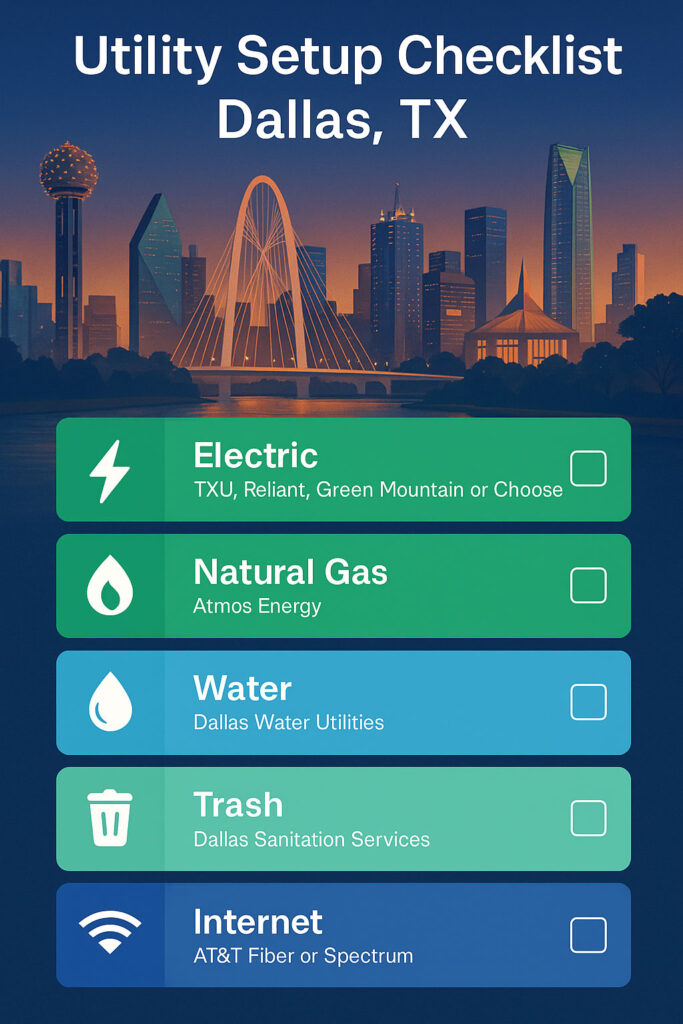
Unlike the fragmented electricity market, water, sewer, and sanitation (trash/recycling) in Dallas are bundled services provided by the City of Dallas. You cannot choose a different provider, but you do need to actively set up your account, ideally 3 to 5 days before your move-in date.
Here is the streamlined guide to navigating Dallas Water Utilities (DWU) and the new DallasGo payment system.
1. How to Start Service
The City of Dallas recently modernized its billing system. You have three ways to initiate service:
- Online (Fastest): Visit the official website. You will likely be directed to the new DallasGo platform to create a profile once your account is active.
- Phone: Call (214) 651-1441 (Monday – Friday, 8:00 a.m. – 5:00 p.m.).
- In-Person: Visit the Customer Service Lobby at 1500 Marilla Street, Room 2D South (Dallas City Hall). This is recommended if you need to present specialized documents (like a probate deed) or pay a deposit in cash.
2. Documents You Will Need
DWU enforces strict identity protection rules under the Texas Utilities Code. Be prepared to provide:
- Government-Issued ID: Driver’s License, State ID, or Passport.
- Proof of Occupancy:
- Renters: A signed copy of your lease agreement.
- Owners: A copy of your settlement statement (HUD-1) or Warranty Deed.
- Social Security Number: Required for the internal soft credit check to determine your deposit eligibility.
3. Costs to Expect (FY 2025 Rates)
When you receive your first bill, it will likely be higher than usual because it includes one-time setup fees. Based on the Fiscal Year 2024-2025 city ordinances, here is what to budget for:
- Account Setup Fee: A one-time administrative fee of $15.00 is added to your first bill.
- Security Deposit:
- Standard Residential (5/8″ meter): $100.00.
- Larger Homes (1″ meter): $125.00.
- Deposit Waivers: You may not have to pay the deposit if you are 65 years of age or older, if you own the property (proof of ownership required), or if you provide a Letter of Credit from another utility showing 12 months of payment history with no late fees.
4. Trash & Recycling
In Dallas, setting up your water account automatically activates your sanitation services.
- Bins: You should find one gray roll cart (garbage) and one blue roll cart (recycling) at the property.
- Missing Bins? If the previous tenant took them or they are damaged, call 3-1-1 or submit a request via the Dallas 311 App to request replacements.
- Collection Schedule: Dallas uses alley collection in older neighborhoods and curbside in newer ones. Pickup is once a week. Check your specific collection day.
Best Internet Providers in Dallas
As a major tech and business hub, Dallas enjoys fierce competition among internet providers. Whether you need multi-gig fiber for working from home or just affordable 5G for streaming, there’s a perfect option. We’ve compared reliability, hidden fees, and customer service so you can skip the frustration and get connected fast.
- Extensive fiber coverage (72% of the city) with speeds up to 5 Gbps.
- Bundle options with home phone and mobile services.
- Cable internet with wide availability (92% of the Dallas area) and no data caps.
- Flexible month-to-month options.
- Bundle options include TV and phone services.
- Wireless 5G-based internet service with simple setup and no annual contract.
- Portable modem ideal for renters.
- Bundle with mobile phone to save.
- High-speed wireless service with competitive introductory rates.
- Equipment included with service.
- Bundle with mobile phone to save.
The “Shadow Utilities”: Permits, Tags & Tolls
Beyond water and power, moving to Dallas requires setting up a layer of “Shadow Utilities” or mandatory city registrations and regional passes. Ignoring these can result in immediate fines or significantly higher costs for daily activities.
Residential Alarm Permits (The “False Alarm” Trap)
If you install a security system (Ring, SimpliSafe, ADT) or move into a home with an existing system, you must obtain a permit.
- The Law: It is illegal to operate an alarm system in Dallas without a permit. The fine for operating an unpermitted system is often issued alongside the fine for a false alarm.
- Cost: $50 per year for residential permits.
- Registration: Apply online.
The Fine Structure (2026): Dallas Police respond to thousands of false alarms yearly. To combat this, they use a tiered fine system for registered users.
- 1st, 2nd, 3rd False Alarm: $0 (Free).
- 4th, 5th, 6th False Alarm: $50 each.
- 7th, 8th False Alarm: $75 each.
- 9th+ False Alarm: $100 each.
CRITICAL WARNING: The “Panic Button” Rule The “3 Free False Alarms” rule applies only to burglar alarms (sensors). It does NOT apply to Panic, Robbery, or Hold-Up alarms (often a button on your keypad or keyfob).
- The Cost: There are NO free false panic alarms. The fine for the first false panic activation is $100.
- Parent Tip: Ensure children do not play with the keypad panic buttons; it is an instant $100 bill.
The NTTA TollTag: Your “Driveway” Tax
Dallas is a toll-heavy city. Major arteries like the Dallas North Tollway (DNT) and President George Bush Turnpike (PGBT) are not free.
- ZipCash vs. TollTag: If you drive on these roads without a tag, a camera photographs your license plate, and you are billed via mail (“ZipCash”).
- The Price Gap: ZipCash rates are 50% higher than TollTag rates. If you commute daily, not having a tag will cost you hundreds of dollars extra per year.
How to Get One:
- Cost: The sticker itself is free. You simply open an account with a prepaid balance (usually $20 or $40). There are no monthly fees.
- Where: Order online or visit a regional customer service center.
- Bonus Utility: Your TollTag works for parking at DFW International Airport and Dallas Love Field. You can enter and exit the airport parking garages using the “TollTag” lanes, and the parking fee is deducted from your balance, no ticket pulling or credit card swiping required.
Pet Registration: The Microchip Mandate
Dallas has modernized its pet laws. You no longer need to buy a metal “City Tag” for your dog’s collar every year.
- The Requirement: All dogs and cats over 4 months old MUST be microchipped.
- The Change: The microchip now serves as the de facto city registration. If your pet is microchipped, you are compliant.
- Compliance: If Animal Services picks up your pet and they are not chipped, you will likely be cited and required to chip them before release.
- Resource: Dallas Animal Services often offers free or low-cost microchipping events for residents. Check their calendar if you need to come into compliance.
Emergency Preparedness
Given North Texas’s history with severe weather (tornadoes and hail), registering with local safety nets is highly recommended.
- DallasAlert: Sign up for the city’s official emergency notification system. You will receive geo-targeted texts and calls regarding civil emergencies, boil water notices, and severe weather events specific to your block. Register online.
- Storm Shelter Registry: If your new home has a safe room or storm shelter, register it with the Dallas Office of Emergency Management. This ensures that if a tornado levels your neighborhood, first responders know exactly where to dig to find you.
Neighborhood-Specific Nuances: The “City Within a City” Trap
Dallas is a patchwork of municipalities. Several independent cities exist entirely inside the borders of Dallas. If you move into one of these “Enclave Cities,” you cannot use Dallas City Services. Calling 3-1-1 will get you nowhere.
The Park Cities (Highland Park & University Park)
While these areas share a zip code with Dallas, they maintain completely separate police, fire, water, and trash departments.
University Park (UP)
- Zip Codes: Primarily 75205 and 75225.
- Water & Trash: Managed by the City of University Park. You must apply in person at 3800 University Blvd or online.
- Deposit: $100 – $200 (depending on meter size).
- Trash: UP offers “Backdoor Pickup” (they walk up to your house to get the bags) twice a week. You do not drag carts to the curb.
- Alarms: You must register your alarm with UP Police, not Dallas PD.
Highland Park (HP)
- Zip Codes: Primarily 75205.
- Water & Trash: Managed by the Town of Highland Park.
- Trash: Pickup is twice weekly. In many sections, this is alley-based.
- 911 Note: Highland Park has its own emergency response. If you call 911 from a cell phone near the border, verify you are speaking to HP dispatch if you need a rapid response within the town limits.
The “CoServ” Exception (Far North Dallas)
If you move to the northern edge of the metroplex (areas near Richardson, Plano, or Frisco borders), you might not be in the deregulated electricity market.
- The Co-op: Large sections of these areas are served by CoServ, an electric cooperative.
- The Difference: You cannot choose your electricity provider here. You must use CoServ.
- The Good News: CoServ rates are generally lower and more stable than the open market, and customer service is rated highly. If you type your zip code into “Power to Choose” and see no options, you are likely in CoServ territory.
Cockrell Hill
- Location: A small independent city in West Dallas (Zip 75211).
- Water: Cockrell Hill contracts with Dallas for water supply, but they handle their own billing and administration. You must set up service at Cockrell Hill City Hall (4125 W. Clarendon Dr), not through Dallas Water Utilities.
Quick-Check Zip Code Matrix
Use this table to determine if you need to double-check your jurisdiction.
| Zip Code | Primary Area | Utility Jurisdiction | Warning |
| 75205 | Park Cities | HP or UP | Do NOT call Dallas Water Utilities. |
| 75225 | University Park / Dallas | Split | Check your specific address. If north of Lovers Ln, likely UP. |
| 75211 | Cockrell Hill / Dallas | Split | Verify if you pay taxes to Dallas or Cockrell Hill. |
| 75201 | Uptown / Downtown | Dallas | Standard Dallas Utilities apply. |
| 75219 | Oak Lawn | Dallas | Standard Dallas Utilities apply. |
The “Alley vs. Curb” Trash Confusion
In Dallas proper, trash pickup location depends on the age of your neighborhood.
- Older Neighborhoods (Pre-1980s): Typically have alleys. Trash is collected from the alley behind the home.
- Newer Neighborhoods: No alleys. Trash is collected at the front curb.
- 2026 Update: The City of Dallas recently paused a controversial plan to force all alley-pickup residents to move their trash to the curb. For now, if your home has an alley, you should continue to use it, but keep an eye on mailers from the Sanitation Department as this pilot program evolves.
Financial Assistance & Billing Help for Utilities in Dallas
Water & Wastewater Aid
- Low‑Income Household Water Assistance Program (LIHWAP): pays current or past bills up to the balance or reconnection fees. Apply via TexasUtilityHelp.com or call 855‑566‑2057. DWU offers a 90‑day hold on shut-off once they know you’ve applied.
(Note: funds may be limited, act promptly.)
Energy Assistance
- Comprehensive Energy Assistance Program (CEAP) via Dallas County and Texas Neighborhood Services: helps low-income families pay electric, gas, and sometimes repairs for heating/cooling systems.
- TXU Energy Aid: operated by the company, offering grants (~$ donor-funded millions) to help TXU customers with electric bills.
- Senior Resources: age 50+ residents can apply for household utility assistance via nonprofits like The Senior Source.
Final Tips for New Dallas Residents
- Compare electricity providers yearly, rates change!
- Lock in a fixed-rate plan to avoid summer price spikes.
- Set up utilities before moving in (some require deposits).
- Check for bundle deals (internet + TV).
About the Author

David has been an integral part of some of the biggest utility sites on the internet, including InMyArea.com, HighSpeedInternet.com, BroadbandNow.com, and U.S. News. He brings over 15 years of experience writing about, compiling and analyzing utility data.
Dallas Internet Connectivity
Fastest Internet Providers in Dallas
| Provider | Connection Type | Download Speed |
|---|---|---|
| Spectrum | Cable & Fiber | 7 Gbps |
| AT&T Fiber | Fiber | 5 Gbps |
| Verizon 5G Home Internet | 5G | 300 Mbps |
| T-Mobile 5G Home Internet | 5G | 498 Mbps |
| AT&T Air | 5G | 300 Mbps |
| Viasat | Satellite | 150 Mbps |
| Starlink | Satellite | 400 Mbps |
| Earthlink | Fiber, Cable, 5G, & Satellite | Varies |
| Frontier | Fiber | 7 Gbps |
| Optimum | Cable & Fiber | 8 Gbps |
| Astound Broadband | Cable | 5 Gbps |
| Brightspeed | Fiber | 2 Gbps |
*Not all speeds available in all areas
Dallas Drinking Water Quality Information
Clean drinking water is essential for maintaining good health and overall well-being. Safe, contaminant-free water helps prevent the spread of diseases, supports proper hydration, and ensures the body's vital functions operate smoothly.
Dallas's Primary Drinking Water Source: Surface Water
Drinking Water Contaminant Levels
Legal limit: 15 ppb
Legal limit: No Limit Set
Legal limit: 100 ppb
Legal limit: No Limit Set
Legal limit: 60 ppb
Legal limit: No Limit Set
Legal limit: No Limit Set
Legal limit: No Limit Set
Legal limit: No Limit Set
Legal limit: No Limit Set
Legal limit: No Limit Set
Legal limit: No Limit Set
Legal limit: No Limit Set
Legal limit: 0.01 ppb
Legal limit: 0.004 ppb
Legal limit: 0.004 ppb
Legal limit: No Limit Set
Legal limit: No Limit Set
Legal limit: No Limit Set
Utilities in Nearby Cities
Frequently Asked Questions
Can I choose my water or gas provider in Dallas?
No. While you can choose your electricity provider (Retail Electric Provider), other utilities are regulated monopolies.
- Water & Trash: Must be serviced by Dallas Water Utilities (City of Dallas).
- Natural Gas: Must be serviced by Atmos Energy (Mid-Tex Division).
- Electricity: You choose your provider (e.g., Reliant, TXU, Green Mountain), but Oncor delivers the power.
How much does it cost to set up water service in Dallas?
As of the October 1, 2024 (FY 2025) fee schedule, you should budget for:
- Account Setup Fee: A non-refundable $15.00 activation fee will appear on your first bill.
- Security Deposit: The standard deposit for a residential 5/8″ meter is $100.00. This deposit may be waived if you are over 65, a homeowner, or can provide a letter of credit from a previous utility.
What is the "Oncor Delivery Charge" on my electric bill?
This is a pass-through charge from Oncor, the company that owns the poles and wires. No matter which electric company you choose, you will pay this fee.
- Monthly Fixed Fee: Approximately $4.23 per month.
- Usage Fee: Approximately 4.5¢ to 5.3¢ per kWh depending on current tariff rates.
- Move-In Fee: Oncor typically charges a one-time Standard Move-In Fee of roughly $3.20 to energize a meter for a new resident.
My first water bill is huge. Why?
First bills often include the $100.00 security deposit and the $15.00 setup fee. Additionally, if you move in during the summer, you haven’t established a “Winter Monthly Average” yet. This means your sewer charge (which is often higher than the water rate) is billed based on your actual consumption (capped at 40,000 gallons) rather than a lower winter average.
What is the "Environmental Cleanup Fee"?
This is a mandatory $3.00 monthly fee added to all City of Dallas utility accounts (Residential and Commercial). It funds the “Clean Sweep!” initiative, which covers litter removal, homeless encampment cleanup, and illegal dumping abatement across the city.
Do I need a "Certificate of Occupancy" to turn on utilities?
Generally, no for single-family home rentals or purchases. The Certificate of Occupancy (CO) requirement usually applies to commercial businesses or multi-tenant apartment complexes (handled by the landlord). However, tenants should ensure their landlord has registered the property with the city’s “Single Family Rental Registration” program to avoid code compliance issues.
How do I get trash and recycling bins?
Trash service is automatically activated when you set up your water account.
- Standard Issue: You should have one gray cart (garbage) and one blue cart (recycling) at the home.
- Missing Carts: If the previous tenant took them, call 3-1-1 or use the Dallas 311 App to request a replacement.
- Cost: Replacement recycling carts are generally free; replacement garbage carts may incur a fee (~$67.90) if they were lost/damaged due to neglect.
How much should I budget for utilities in a standard Dallas home?
While usage varies wildly by home age and insulation, a typical 2,000 sq. ft. home in Dallas budgets the following:
-
Electricity: $150 – $350+. Summer bills (July-Sept) can easily double your winter bills due to air conditioning. The average rate is currently around 14¢-16¢ per kWh.
-
Water/Sewer/Trash: $70 – $120. This is billed monthly by the City of Dallas.
-
Natural Gas (Winter): $50 – $150. Gas heating is common; summer bills may drop to the $25 base charge.
-
Internet: $50 – $90 for standard high-speed fiber or cable.
Who do I call if my power goes out?
Do NOT call the company that sends you your bill (e.g., TXU, Reliant). They cannot help you.
-
Call Oncor Electric Delivery at 888-313-4747.
-
Oncor owns the lines and meters. They are the only ones who can restore power. You should also check the Oncor Storm Center for restoration estimates.
Is Google Fiber available in Dallas?
It is complicated. Google Fiber is not available citywide.
-
Residential Fiber: Available in select pockets of North and Northeast Dallas.
-
Webpass: Google’s “Webpass” (fixed wireless) is widely available in high-rise apartments and condos in Uptown/Downtown.
-
Advice: Never assume a property has fiber. Use the FCC Broadband Map or the provider’s specific address checker before signing a lease.
Do I really need a permit for my home alarm system?
Yes. Operating an alarm without a permit is a violation of City Code 15(c).
-
The Risk: If police respond to a false alarm at your home and you do not have a permit, you can be fined immediately.
-
The Cost: A residential permit is $50/year. You can apply online.