
- Free modem and anti-virus software
- No contracts and unlimited data
- 30 day money-back gurantee
- Speeds up to 2 Gbps**
- Plans starting at $30/month
Top 32 Electric Providers in New York
Con Edison is the primary electric delivery provider for most of NYC, so you must start your service with them before your move-in date to ensure your power is connected. Because New York has a deregulated energy market, you have the option to later choose a third-party Energy Services Company (ESCO) for your electricity supply, though Con Edison will still maintain the power lines and send your monthly bill.
- 17.44¢ /kWh


- 39.999¢ /kWh
- Renewable Energy Option
- 39.999¢ /kWh
- Renewable Energy Option

- 39.999¢ /kWh
- Renewable Energy Option
- 29.6¢ /kWh
- Renewable Energy Option

- 27.1042¢ /kWh
- Renewable Energy Option

- 24.8013¢ /kWh
- Renewable Energy Option

- 24.3023¢ /kWh
- Renewable Energy Option

- 21.99¢ /kWh
- None
- 6-12 Months
- Renewable Energy Option

- 20¢ /kWh
- Renewable Energy Option
- 19.9¢ /kWh
- Renewable Energy Option
- 19.29¢ /kWh
- Renewable Energy Option

- 18.99¢ /kWh
- Renewable Energy Option
- 18.9¢ /kWh
- Renewable Energy Option

- 18.9¢ /kWh
- Renewable Energy Option

- 18.79¢ /kWh
- Renewable Energy Option
- 17.49¢ /kWh
- Renewable Energy Option

- 17.14¢ /kWh
- 16.8¢ /kWh
- Renewable Energy Option
- 16.4¢ /kWh
- Renewable Energy Option

- 16.19¢ /kWh
- Renewable Energy Option
- 15.2¢ /kWh
- Renewable Energy Option

- 15.085¢ /kWh
- Renewable Energy Option

- 15¢ /kWh
- Renewable Energy Option
- 14.7¢ /kWh
- 11.46¢ /kWh
- Renewable Energy Option

- 22.89¢ /kWh

- 19.9¢ /kWh
- 90 days
- 1-36 Months
- Renewable Energy Option
- 16.09¢ /kWh
- None
- 12-20 Months
- Renewable Energy Option

- 15.69¢ /kWh
- None
- 12 Months
- Renewable Energy Option

- 15.39¢ /kWh
- None
- 1-6 Months
- Renewable Energy Option
Top 9 Natural Gas Providers in New York
Con Edison delivers natural gas to Manhattan, the Bronx, and parts of Queens, while National Grid services the remaining boroughs. While you must set up your initial delivery account with these main providers, New York’s deregulated market allows you to eventually switch your gas supply to a third-party ESCO if you want to lock in specific rates or support alternative energy sources.
- $0.7977 therm
- $0.55475 therm
- $0.969 therm
- $0.99 therm
- $01 therm
- $0.7399 therm
- $01.24 therm
- $0.499 therm
- $0.65 therm
Top 10 Internet Providers in New York
The primary internet service providers in the city are Verizon Fios, Spectrum, Optimum, and Astound Broadband, but availability is strictly dependent on your specific building’s wiring. You should check your new address on each provider’s website to compare available plans, and schedule an installation appointment or request a self-install kit a week or two before you move.

- 2.3 Gbps
- Fiber
- Unlimited
- Mobile
- 90.08%
- $49.99/mo
- Fios Home Internet starts as low as $20/mo. Terms apply.
- 2 Gbps**
- Cable
- Unlimited
- TV & Phone
- 61.62%
- $30.00/mo
- Most Affordable Plans

- 415 Mbps
- 5G
- 1.2 TB
- Mobile
- 73.77%
- $20.00/mo
- Wireless Internet Provider

- 300 Mbps
- 5G
- Unlimited
- Mobile
- 65.35%
- $65.00/mo
- Wireless Internet Provider
- 300 Mbps
- 5G
- Unlimited
- Mobile
- 80.46%
- $35.00/mo
- Wireless Internet Provider

- 400 Mbps
- Satellite
- Unlimited
- 100%
- $55.00/mo

- Varies
- Fiber, Cable, 5G, & Satellite
- Varies
- 95%
- $39.95/mo

- 7 Gbps
- Fiber
- Unlimited
- Phone
- Limited%
- $29.99/mo

- 2 Gbps
- Cable & Fiber
- Unlimited
- TV & Phone
- 0.08%
- $45.00/mo

- 8 Gbps
- Cable & Fiber
- Unlimited
- TV & Phone
- 32.44%
- $25.00/mo
Solar Providers in New York


Water & Sewage Providers in New York
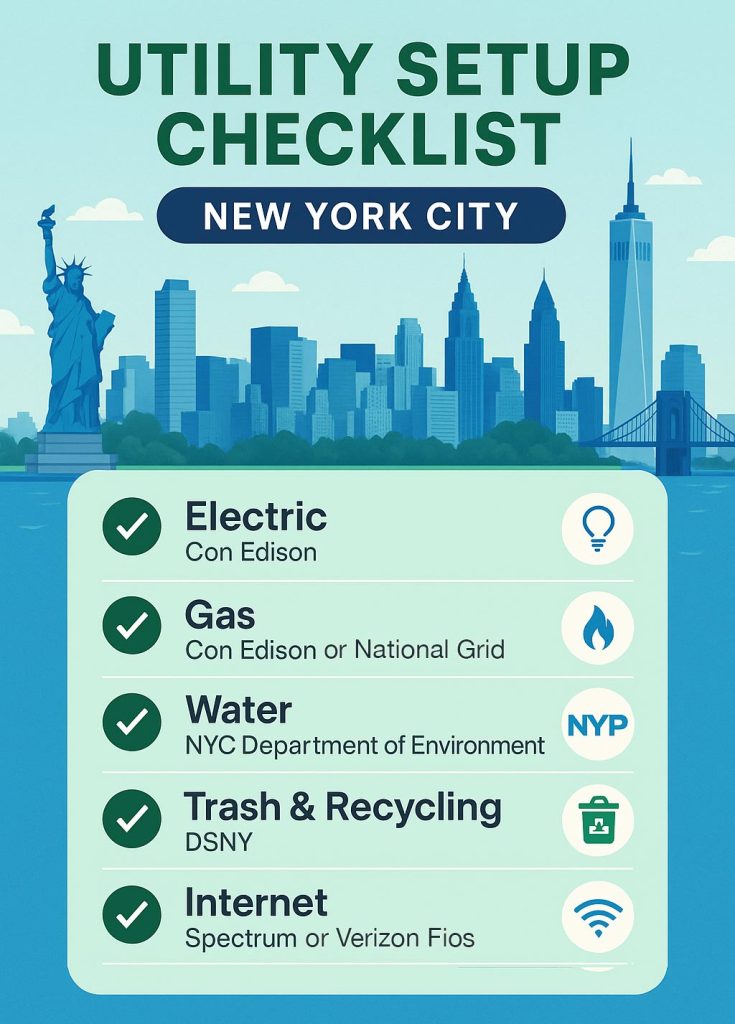
The NYC Department of Environmental Protection (DEP) manages water and sewer services across all five boroughs. Renters typically have water included in their monthly rent, whereas new homeowners will have the service automatically transferred during the home’s closing process and simply need to register for billing on the DEP website.

Top 4 Trash and Recycling Providers in New York
The NYC Department of Sanitation (DSNY) handles residential trash, recycling, and composting as a tax-funded municipal service, meaning no formal account setup or monthly payment is required. You just need to look up your new address on the DSNY website to find your specific collection days and review the city’s strict bin and sorting regulations.
Utilities Summary for New York, NY
| Electric Companies: | 32 |
| Natural Gas Companies: | 9 |
| Water & Sewage Providers: | 1 |
| Garbage, Trash & Recycling Providers: | 4 |
| Municipal Electricity: | No |
Utilities in New York City
NYC is a vibrant, unstoppable energy hub unlike anywhere else. With nearly 8.5 million residents, endless neighborhoods, and a fascinating mix of old-world charm and ultra-modern innovation, it’s both invigorating and sprawling. That means getting your utilities sorted can feel daunting, but don’t worry! This guide breaks it down into friendly, easy-to-follow sections so your transition into your new home goes smoothly and stress-free.
Electricity in NYC
New York City’s electricity is delivered primarily by Consolidated Edison (Con Edison). This long-standing provider handles the power lines, meter, and maintenance. It’s a regulated utility, meaning while they deliver the electricity, you’re free to choose your energy supplier also known as an ESCO or retail electric provider (REP), part of New York’s deregulated market.
How deregulation works
- Since 1997, New Yorkers can shop for electricity suppliers separate from the utility that delivers it .
- Con Edison remains the delivery company no matter who your supplier is .
- In practice, deregulation allows suppliers to compete on rates, renewable energy options, and customer service.
Highly Rated REPs
According to NYEnergyRatings, these providers rank highly in New York:
- XOOM Energy: Top-rated overall (3.5/5)
- Green Mountain Energy: Known for solid green energy options (3.44/5)
- Frontier Utilities: Good ratings (3.42/5)
Choosing a supplier
- Compare rates: Look for offers with fixed or variable rates, lower fixed rates protect you from spikes.
- Seek green options: Some REPs offer 100% renewable energy.
- Watch contract terms: Check early exit fees and contract length.
- Read reviews: Pay attention to service quality and clarity in billing.
Interesting tidbits about Con Edison
- Con Edison has seen steep rate hikes, partly tied to major infrastructure and green energy investments.
- They’re upgrading toward a zero-emissions grid by 2040, aligning with New York’s climate law.
- They also operate the world’s largest district steam-heating system across Manhattan.
Natural Gas
In Manhattan, the Bronx, and small parts of Queens & Westchester, natural gas delivery is via Con Edison, while National Grid covers Brooklyn, Staten Island, and most of Queens.
Deregulation of natural gas
- New York began deregulating gas markets in 1999.
- This lets you pick a retail natural gas supplier (RNGP or ESCO) for just the commodity, while Con Edison or National Grid manage the pipes.
Choosing a gas supplier
- Again, compare rates and contract terms.
- Look into green gas or renewable natural gas (RNG).
- Confirm any switching fees and check for bundled offers (for example gas + electricity + solar).
Water & Steam
Water service in NYC is managed by the NYC Department of Environmental Protection (DEP). It operates an extensive system drawing from the upstate watershed.
Highlights
- DEP delivers high-quality water throughout the five boroughs.
- Con Edison’s steam system provides heating, cooling, and even humidification to buildings across Manhattan, a rare and fascinating feature.
- Steam is produced in plants around the city and piped under streets, it helps reduce building-level emissions by leveraging cogeneration.
Trash & Recycling
The NYC Department of Sanitation (DSNY) handles trash and recycling collection across the city.
- Residential pickup frequencies vary by neighborhood; check DSNY’s online map for your schedule.
- Most trash is sent to out-of-state landfills via transfer stations post-Fresh Kills closure.
- DSNY promotes organics and recycling, we recommend taking advantage of bulk waste days and composting services when available.
Best Internet Providers in NYC
Welcome to the modern world, NYC has excellent internet infrastructure. Here are the top providers:
- Verizon Fios: Offering services to about 90% of NYC. Fiber-to-the-home with fast, symmetrical speeds (up to 2.3 Gbps). Known for reliable service and strong customer satisfaction.
- Spectrum: Widely available, covering 61% of the city, cable internet offering speeds up to 1 Gbps; often includes promotional bundles with TV.
- Optimum: Cable service that’s becoming more common; solid speeds and bundle deals.
- T-Mobile Home Internet: Wireless 5G option with unlimited data, great in zones with strong 5G coverage.
Tips for picking the right plan
- Fiber (Fios) offers best-in-class performance. Cable is solid but less consistent upload speeds.
- Check bundle deals (internet + phone/tv).
- Look at installation fees, equipment costs, and promotional rates that may increase after year one.
Conservation & Green Energy
New Yorkers are increasingly eco-conscious, and there are plenty of options to participate in conservation efforts:
- Green energy REPs: Some suppliers offer 100% wind or solar energy.
- Con Edison’s programs:
- EV charging rewards when you charge off-peak.
- Demand-response programs for gas usage.
- Steam system: Its cogeneration reduces emissions from heating/cooling .
- City-wide initiatives: NYC offers rebates for energy-efficient appliances, insulation upgrades, and heat pumps, especially under mandates like LL97.
Final Move-In Checklist
| Task | Notes |
|---|---|
| Electricity & Gas | Contact Con Edison/National Grid to set up delivery. Compare REPs for best offers. |
| Water & Steam | Ensure DEP account is set up. If your building uses steam, ask management about Con Edison steam charges. |
| Trash/Recycle | Check DSNY schedule and pick up bins. |
| Internet | Compare providers in your area, order install with enough lead time. |
| Green Opportunities | Consider renewable REP plans, apply for conservation incentives, and use smart meters. |
Energy Saving Rebates and Offers in NYC
National Grid offers a variety of money saving options on energy efficiency for it’s customers. Rebates from National Grid are available on products such as heat pumps, heat pump water heaters, furnaces, boilers, smart thermostats, and air quality equipment. Instant rebates are also availably by shopping in the National Grid Marketplace as well as at stores like Home Depot and Lowe’s on energy-saving products like insulation, faucet aerators, and showerheads. Customers can also earn rewards by participating in the Connected Solutions program by connecting a qualifying thermostat to your central heating and cooling system.
The EmPower+ Program from the New York State Energy Research and Development Authority (NYSERDA) offers no-cost solutions for energy efficiency, like insulation, appliances, and water saving showerheads, to New Yorkers who meet certain income requirements. Additionally the Solar for All Program offers monthly credits on electricity bills for subscribing to community solar. New York is the first state to launch an in-store rebate program, the Appliance Upgrade Program, that helps residents save on purchases of ENERGY STAR rated heat pump clothes dryers at participating retailers. New York State also offers assistance and incentives through additional programs like:
Find Help For Paying Your Utility Bills in New York City
Financial assistance for utility bills is available through multiple sources in NYC. The Energy Affordability Program from Con Edison offers discounts on customers’ monthly bills who recieve benefitys from other eligible goverment assistance programs. Depending on which programs you participate in you may be enrolled automatically, but you can still apply online if you are not. In cooperation with HeartShare from the Human Services of New York, the EnergyShare program offers grants up to $200 for qualifying customers.
HeartShare also offers additional energy assitance programs to moderate income families in New York. In cooperation with National Grid, the Hope & Warmth Energy Fund offerst grants that can be recieved once per heating season and the Neighborhood Heating Fund that offers grants in 1-2 family households to help pay for heat for residents of Brooklyn, Queens, and Staten Island.
The Home Energy Assistance Program (HEAP) from the New York State Office of Temporary and Disability Assistance offers help to residents of New York to pay for heating and cooling their homes. Regular HEAP eligibility is based on:
- Household Income
- Household Size
- Primary Heating or Cooling Source
- Age or Disability of household members
- Citizenship Status
- Other aid recieved
Emergency HEAP assistance is also available for qualifying residents. The state also offers energy efficiency assistance through the Clean and Tune Benefit which include the cleaning of heating equipment, minor repairs, and installtion of carbon monoxide detectors or smart thermostats, the Heating Equipment Repair or Replacement (HERR) Benefit which helps qualifying homeowners repair or replace their furnace, boiler, or other heating equipment, and the Cooling Assistance Benefity which assists households with the purchase and installation of an air conditioner or fan. New York State also offers assistance with past due utility bills through the Electric and Gas Bill Relief Program. You do not need to apply for this progran as utility providers are pre-screening customer’s accounts for eligibility.
About the Author

David has been an integral part of some of the biggest utility sites on the internet, including InMyArea.com, HighSpeedInternet.com, BroadbandNow.com, and U.S. News. He brings over 15 years of experience writing about, compiling and analyzing utility data.
New York Internet Connectivity
Fastest Internet Providers in New York
| Provider | Connection Type | Download Speed | |
|---|---|---|---|
| Verizon Home Internet | Fiber | 2.3 Gbps Not all speeds available in all areas |
Check Availability |
| Spectrum | Cable | 2 Gbps Not all speeds available in all areas |
Check Availability |
| T-Mobile 5G Home Internet | 5G | 415 Mbps Not all speeds available in all areas |
Check Availability |
| AT&T Air | 5G | 300 Mbps Not all speeds available in all areas |
Check Availability |
| Verizon 5G Home Internet | 5G | 300 Mbps Not all speeds available in all areas |
Check Availability |
| Starlink | Satellite | 400 Mbps Not all speeds available in all areas |
Check Availability |
| Earthlink | Fiber, Cable, 5G, & Satellite | Varies Not all speeds available in all areas |
Check Availability |
| Frontier | Fiber | 7 Gbps Not all speeds available in all areas |
Check Availability |
| Xfinity | Cable & Fiber | 2 Gbps Not all speeds available in all areas |
Check Availability |
| Optimum | Cable & Fiber | 8 Gbps Not all speeds available in all areas |
Check Availability |
Utilities in Nearby Cities
Frequently Asked Questions
Do I have to choose a third-party energy supplier (ESCO)?
No. While New York is a deregulated energy market giving you the power to choose, you are not required to switch. If you do not choose a third-party Energy Services Company (ESCO), Con Edison or National Grid will automatically serve as both your energy supplier and your delivery company.
Who do I call if my power goes out: my delivery company or my supplier?
You should always call your delivery utility company (such as Con Edison or PSEG Long Island) in the event of a power outage or a gas leak, regardless of which third-party ESCO supplies your energy. They maintain the physical infrastructure and power lines.
Is water and heat included in my rent in New York City?
In most NYC apartments, landlords are legally required to provide heat and hot water, meaning these are typically included in your rent. However, you are usually responsible for your own electricity, cooking gas, and internet. Always check your specific lease agreement to confirm.
How far in advance should I set up my utilities before moving?
It is highly recommended to contact your utility providers at least one to two weeks before your move-in date. This ensures that services like electricity and internet are connected by the time you arrive, avoiding any delays or transfer fees.
How do I dispose of large furniture or bulk trash in NYC?
The NYC Department of Sanitation (DSNY) provides free curbside removal of large items. For non-recyclable bulk items, you can put them out on the curb the evening before your regular trash collection day. For items containing CFCs (like refrigerators or air conditioners), you must schedule a special appointment with DSNY for safe disposal.
Why is my electric bill so high in the summer?
Electricity bills in NYC often spike in the summer due to heavy air conditioning use. Additionally, utility rates can fluctuate based on seasonal demand. If you are using a variable-rate plan through an ESCO, your supply rate may also increase during these peak-demand months.
Are there programs to help pay my utility bills in New York?
Yes! Programs like the Home Energy Assistance Program (HEAP), Con Edison’s Energy Affordability Program, and the EnergyShare program offer financial assistance and grants for qualifying low- and moderate-income residents.