
Frontier Internet Pairs Lightning-Fast Fiber Speeds With Straightforward Pricing, Though Its Legacy DSL Service Leaves Room For Improvement
Key Takeaways
- Frontier’s fiber-optic network offers symmetrical speeds up to 7 Gbps with no data caps or annual contracts.
- The company provides free Wi-Fi routers with all fiber plans, helping you avoid the pesky equipment rental fees common with other providers.
- Legacy DSL service is widely available but typically underperforms when compared to modern fiber connections.
Finding a reliable internet service provider can feel like navigating an endless maze of hidden fees, data caps, and confusing promotional rates, but your connection should simply work without the headache. If you are moving into a new home or simply looking to upgrade your current connection, reading a comprehensive Frontier fiber internet review is a great first step. With a rapidly expanding fiber-optic network and a massive $20 billion pending acquisition by Verizon, the company is making serious waves in the telecom industry as we move through 2026. In this comprehensive review, we cover everything you need to know about Frontier internet plans and pricing, real-world speeds, and its coverage map to help you decide if it is the right environmentally mindful choice for your household’s unique streaming, gaming, and working needs.
About Frontier Communications
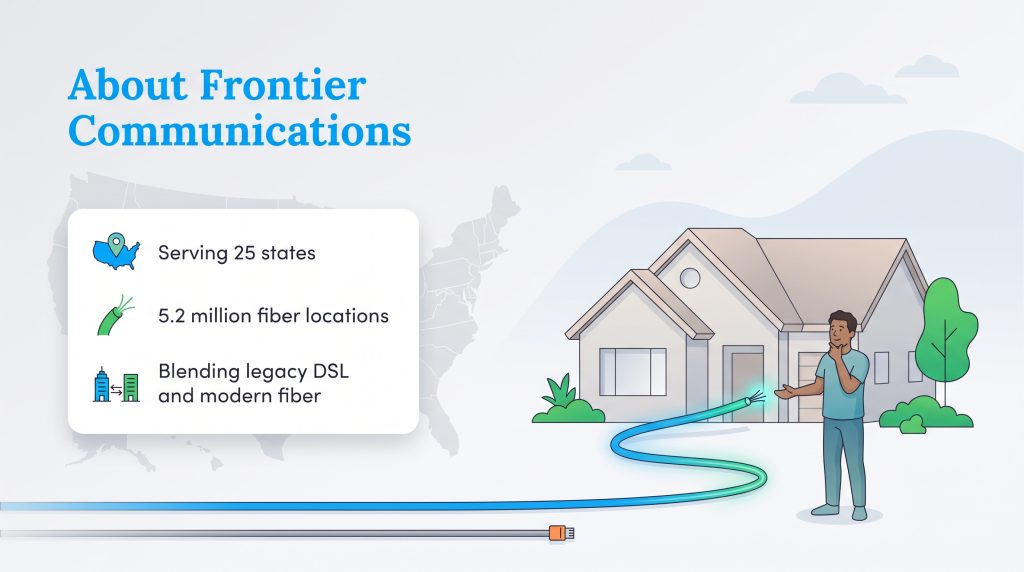
Frontier Communications started way back in 1935 (originally known as Citizens Utilities) and has evolved through decades of mergers, acquisitions, and technological upgrades to become a major U.S. internet player. After emerging from a 2020 restructuring period, the company smartly refocused its efforts and capital on expanding its fiber-optic network, which currently covers well over 5.2 million locations nationwide. In a massive recent shift that will shape the industry for years, Verizon is in the process of acquiring Frontier for $20 billion (approved in May 2025), promising future network integration and vastly improved resources. Today, Frontier blends old-school telecom reliability with modern fiber speed, serving 25 states with a mix of traditional DSL lines and cutting-edge fiber infrastructure.
Frontier Internet Plans And Pricing
Frontier provides both modern fiber connections and copper-based DSL in regions where fiber infrastructure isn’t available yet. The fiber plans easily stand out from the competition by offering symmetrical upload and download speeds ranging from an entry-level 500 Mbps all the way up to an astonishing 7 Gbps. Best of all, every single one of these plans comes with unlimited data, meaning you will never have to worry about frustrating network throttling or costly overage charges at the end of the month.
Frontier Fiber Vs. DSL Packages
When looking at Frontier DSL vs Fiber, the difference is night and day. Fiber packages deliver consistent, symmetrical performance that is virtually immune to neighborhood traffic congestion, making it the superior choice for heavy internet users. On the other hand, Frontier’s legacy DSL packages offer asymmetrical speeds that top out around 115 Mbps and lack the robust price lock guarantees found on the fiber tiers. If your home has access to both, opting for a fiber plan is always the smarter investment.
| Plan Name | Price | Download Speeds | Connection Type | |
|---|---|---|---|---|
| Frontier Internet | $64.99 /month | Up to 12 Mbps | DSL | Check Availability |
| Fiber 200 Mbps | $29.99 /month | Up to 200 Mbps | Fiber | Check Availability |
| Fiber 500 Mbps | $44.99 /month | Up to 500 Mbps | Fiber | Check Availability |
| Fiber 1 Gig | $64.99 /month | Up to 1000 Mbps | Fiber | Check Availability |
| Fiber 2 Gig | $79.99 /month | Up to 2 Gbps | Fiber | Check Availability |
| Fiber 5 Gig | $104.99 /month | Up to 5 Gbps | Fiber | Check Availability |
| Fiber 7 Gig | $124.99 /month | Up to 7 Gbps | Fiber | Check Availability |
While the initial promotional pricing is highly competitive, it is important to plan for eventual rate increases and understand the protection you receive. Frontier now offers generous price lock guarantees on its fiber tiers, shielding you from inflation for up to five years. Below is an estimated breakdown of what you can expect to pay, along with the specific price locks included with each plan.
| Plan Name | Download / Upload Speed | Promotional Price (First 12 Months) | Price Lock Guarantee | Estimated Price After Promo |
|---|---|---|---|---|
| Frontier Fiber 500 | 500 Mbps / 500 Mbps | $29.99/mo. | 1-Year | $39.99/mo. — $44.99/mo. |
| Frontier Fiber 1 Gig | 1,000 Mbps / 1,000 Mbps | $44.99/mo. | 1-Year | $54.99/mo. — $64.99/mo. |
| Frontier Fiber 2 Gig | 2,000 Mbps / 2,000 Mbps | $99.99/mo. | 3-Year | $109.99/mo. — $119.99/mo. |
| Frontier Fiber 5 Gig | 5,000 Mbps / 5,000 Mbps | $129.99/mo. | 5-Year | $139.99/mo. — $149.99/mo. |
| Frontier Internet (DSL) | Up to 115 Mbps | Varies by location | None | Varies by location |
Top Frontier Comparisons
Frontier Service Area And Coverage Map
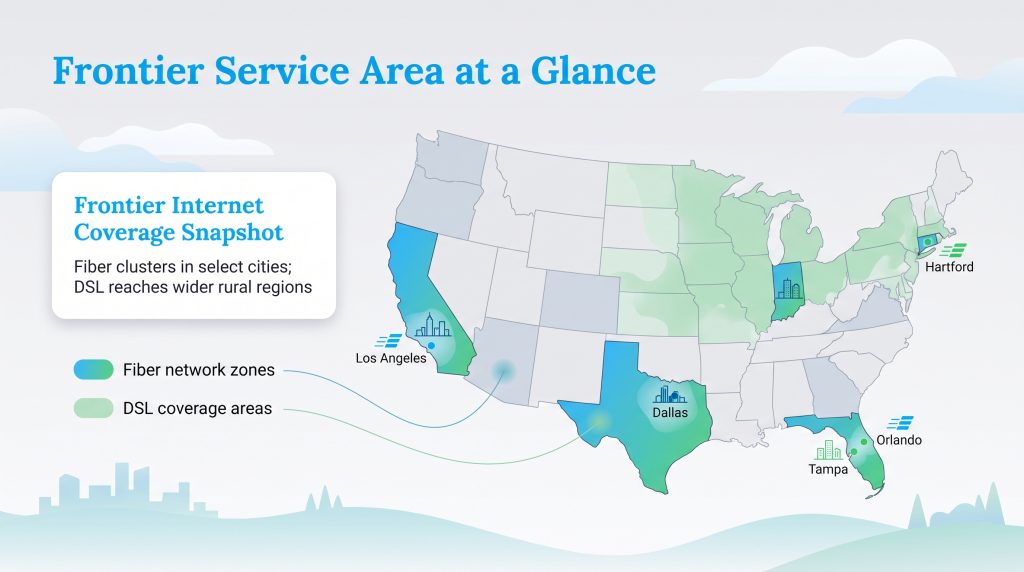
Frontier’s service footprint is split into two very distinct categories: its rapidly expanding 17-state fiber network and its legacy 25-state DSL network. When reviewing the Frontier internet coverage map, you will quickly notice that the best speeds are concentrated in urban and suburban hubs. If you want the best experience possible, you will want to live within the fiber availability zones. The top five states with the highest density of Frontier Fiber coverage include:
- California
- Florida
- Texas
- Connecticut
- Indiana
Major metropolitan hubs like Los Angeles, Orlando, Tampa, Dallas, and Hartford enjoy extensive access to multi-gig fiber speeds. Conversely, Frontier’s DSL service is far broader, acting as a vital lifeline for rural and suburban communities across the Midwest and Northeast that simply lack modern infrastructure upgrades.
Special Deals, Discounts, And Bundles
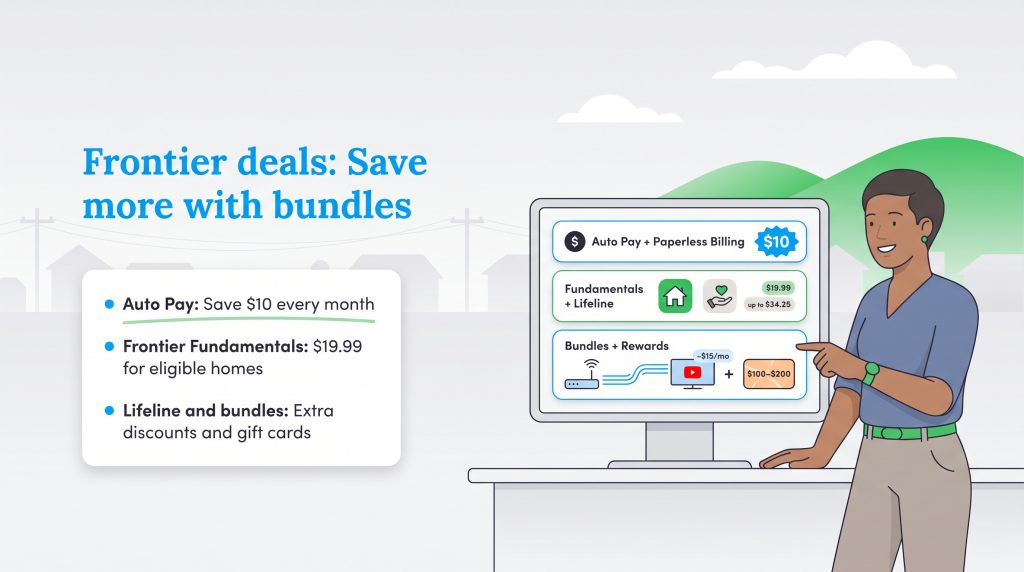
Frontier offers numerous ways to lower your monthly bill, ranging from flexible digital bundles to government-assisted discount programs. If you are looking to maximize your value on day one, enrolling in Auto Pay and paperless billing is an easy way to instantly shave $10 off your monthly statement.
The company also provides targeted discounts for various groups. The “Frontier Fundamentals” plan offers high-speed internet at just $19.99 per month for eligible low-income households. Additionally, Frontier participates in the federal Lifeline program, which can provide necessary utility discounts of up to $9.25 per month (or up to $34.25 on Tribal lands) for qualifying veterans, seniors, and low-income families.
If you are specifically searching for Frontier internet deals for new customers, 2026 brings some excellent bundling opportunities. For those looking to streamline their utility bills, you can easily pair your high-speed internet with a robust YouTube TV bundle. Under current 2026 promotional terms, new Frontier fiber subscribers can score $15 off their YouTube TV subscription each month for an entire year, granting affordable access to over 100 live channels.
Network Information: Speeds And Reliability
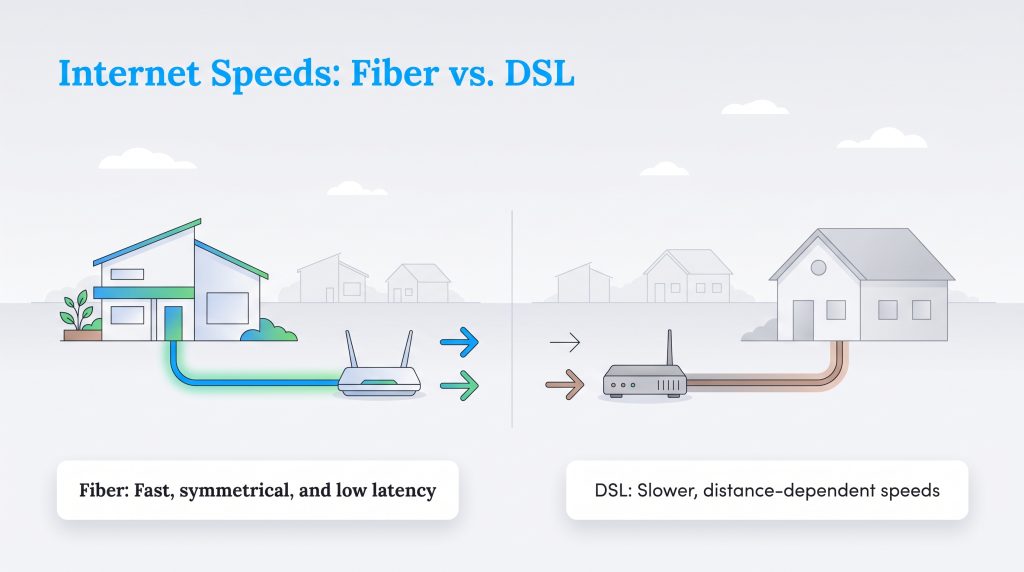
Understanding the actual technology powering your home connectivity is essential when comparing internet providers. Frontier utilizes two completely different network architectures: Fiber-to-the-Home (FTTH) and Digital Subscriber Line (DSL).
Frontier’s FTTH network is the gold standard for modern home internet. Fiber-optic cables transmit data using rapid light pulses rather than electricity, which allows for near-instantaneous data transfer. This results in incredibly low latency — a massive benefit for competitive online gamers and remote workers who rely on lag-free video conferencing. Furthermore, fiber delivers beautifully symmetrical speeds. If you pay for Frontier multi-gig internet speeds like the 2 Gig tier, you get 2,000 Mbps download and 2,000 Mbps upload speeds, making large cloud backups and heavy file transfers a breeze.
On the flip side, Frontier’s legacy DSL network transmits data over traditional copper telephone lines. Because electrical signals degrade over distance, DSL speeds vary wildly depending on how far your home is from the central network hub. Max DSL speeds usually peak around 115 Mbps, with upload speeds sitting much lower (often struggling between 1 Mbps to 10 Mbps). If you have a choice between the two when setting up your new home, fiber is unequivocally the superior option for reliability and performance.
Equipment, Installation, Fees, And Guarantees
Nobody likes surprise charges on their monthly bill. Fortunately, Frontier is fairly transparent about its administrative costs, guarantees, and equipment fees. When reviewing your first statement, you will happily notice there is no Frontier Wi-Fi router fee tacked on; the necessary networking equipment is provided completely free of charge to fiber customers.
Here is a detailed breakdown of the specific perks, guarantees, and installation costs you might encounter:
- Price Lock Guarantees: Frontier provides excellent financial peace of mind. Fiber 500 and 1 Gig plans come with a 1-year price lock, while multi-gig fiber plans feature impressive 3-year (2 Gig) and 5-year (5 Gig/7 Gig) Frontier price lock guarantees, shielding your wallet from sudden rate hikes.
- Free eero Routers ($0/mo.): All fiber plans include a complimentary Wi-Fi 6 or Wi-Fi 7 Amazon eero router, completely eliminating the monthly equipment rental fees that many competitors use to pad their bottom line.
- Professional Installation Fee ($100): A trained technician will mount an Optical Network Terminal (ONT) outside and safely run fiber into your home. This fee is frequently waived if you order online, enable Auto Pay, or select a multi-gig fiber plan.
- Self-Install Kit ($0): If your home is already wired for Frontier service from a previous tenant, the company will ship you the equipment for free so you can plug it in yourself in minutes.
- Early Termination Fee ($100): If you cancel your service within the first 12 months after receiving a promotional perk, you may be hit with a prorated termination fee. However, this fee is widely waived for premium plans like the Fiber 2 Gig tier.
- Unreturned Equipment Fee (Up to $400): When you ultimately cancel your service or move, you must return the provided eero routers and modems. Failing to do so will result in a hefty penalty based on the hardware model.
How Frontier Compares To The Competition
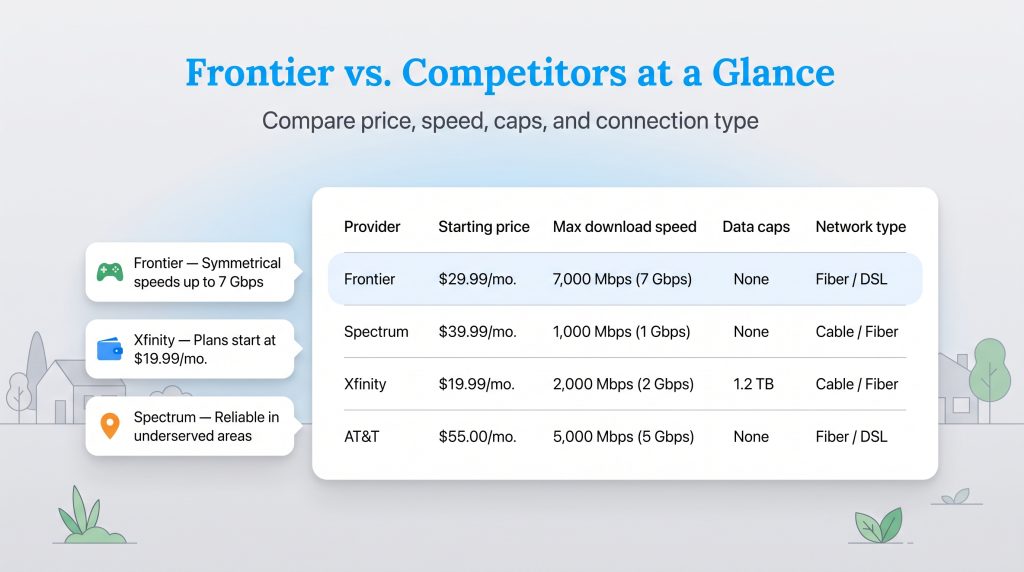
When shopping for the best home network, it is critical to see how major providers stack up against one another in your specific area. If you want a deeper dive, check out our comprehensive Frontier vs. Xfinity analysis or our detailed Frontier vs. Spectrum breakdown. For a quick snapshot, here is a helpful matrix comparing Frontier against some of the biggest names in the residential telecom industry.
| Provider | Starting Price | Max Download Speed | Data Caps | Network Type |
|---|---|---|---|---|
| Frontier | $29.99/mo. | 7,000 Mbps (7 Gbps) | None | Fiber / DSL |
| Spectrum | $39.99/mo. | 1,000 Mbps (1 Gbps) | None | Cable / Fiber |
| Xfinity | $19.99/mo. | 2,000 Mbps (2 Gbps) | 1.2 TB | Cable / Fiber |
| AT&T | $55.00/mo. | 5,000 Mbps (5 Gbps) | None | Fiber / DSL |
- Top provider for gaming: Frontier earns this title thanks to symmetrical speeds that max out at a staggering 7 Gbps, ensuring ultra-low latency.
- Top provider for budget shoppers: Xfinity generally takes the crown for tight budgets, offering entry-level promotional plans starting as low as $19.99 per month.
- Top provider for rural coverage: Spectrum provides an incredibly wide footprint across the country, making it highly reliable for rural and suburban homes that lack fiber infrastructure.
The MyFrontier Mobile App
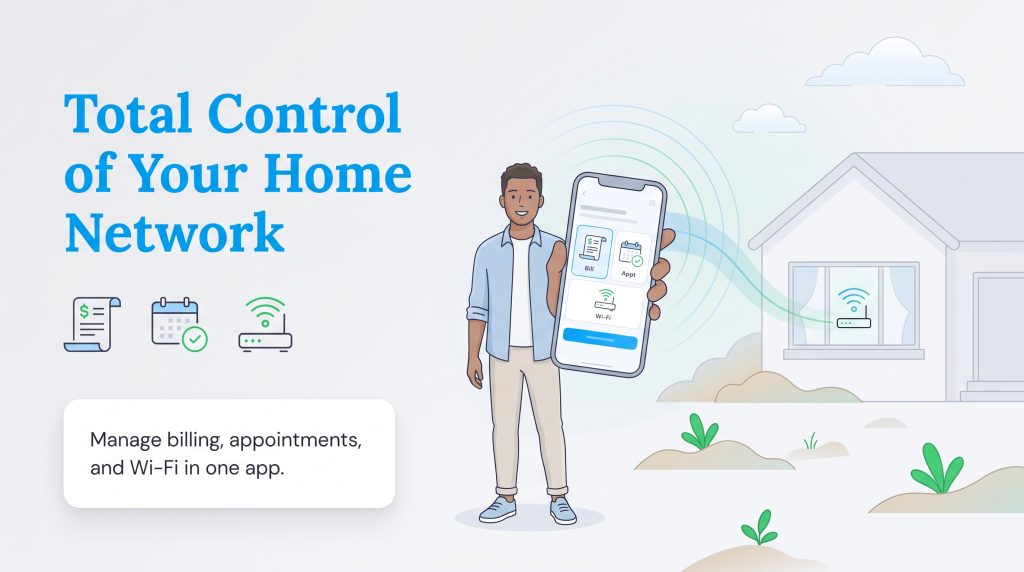
Managing your home network has never been easier thanks to the MyFrontier mobile app. Available for both iOS and Android devices, this intuitive application allows you to handle administrative tasks and troubleshoot minor connection issues directly from your smartphone — entirely bypassing the need to wait on hold for a customer service representative.
Once you download the app and link your account, you can easily view your current statement, set up Auto Pay, and update your billing methods in a few taps. If you are waiting for a technician to arrive for your initial installation or a requested repair, the app provides handy real-time appointment tracking. You can also use the application to reboot your router remotely, run quick speed tests, and safely update your Wi-Fi password in seconds, giving you total control over your digital home.
Sustainability And Green Energy Initiatives
For environmentally conscious homeowners, upgrading to a fiber-optic network is a smart, eco-conscious alternative to traditional broadband infrastructure. According to federal research on energy-efficient infrastructure, fiber networks consume significantly less energy than legacy copper systems, easing the overall burden on our shared electrical grid.
Because fiber relies heavily on passive optical networks (PON) that transmit light rather than electrical currents, the network itself generates less heat and requires less cooling infrastructure at massive regional data centers. Furthermore, fiber-optic cables are vastly more durable than copper wires. They are highly resistant to weather damage, extreme temperature shifts, and natural corrosion.
This increased durability means Frontier has to deploy far fewer repair trucks to neighborhoods after severe storms. Fewer truck rolls translate directly to reduced greenhouse gas emissions and a smaller carbon footprint, making your home’s high-speed connection a genuinely environmentally mindful choice. Ultimately, choosing a utility provider that continuously invests in durable, modern infrastructure is a fantastic energy-saving option for your modern household.
Real Customer Reviews And Ratings
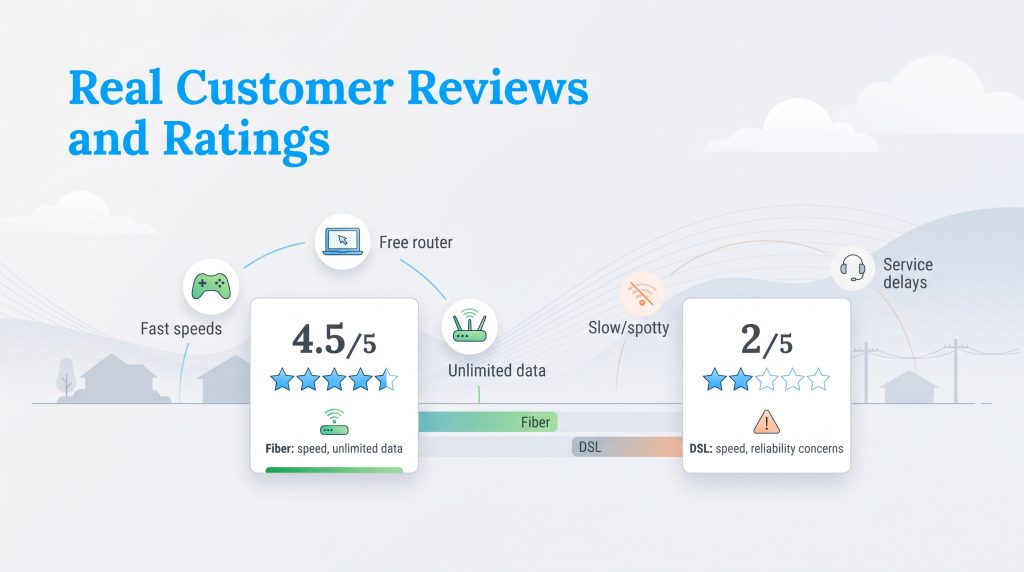
To give you a well-rounded perspective, we aggregated and analyzed Frontier customer service reviews from popular forums like Reddit (specifically r/frontierfios), as well as consumer watchdog sites like the Better Business Bureau and Consumer Affairs. As with most major telecom providers, the feedback is highly polarized depending on whether the customer is subscribed to the new fiber network or stuck on the older DSL network.
What customers praise:
- Symmetrical fiber speeds: Gamers and remote workers consistently rave about the ultra-low latency and blazing-fast upload speeds that fiber naturally provides.
- Free eero routers: Users widely appreciate that Frontier includes high-end Wi-Fi 6 and Wi-Fi 7 mesh routers for free, rather than forcing them to rent cheap, proprietary hardware.
- Unlimited data: The lack of restrictive data caps is a massive selling point for busy households that stream 4K video, download large games, and work from home simultaneously.
What customers complain about:
- Inconsistent DSL performance: Customers living in rural areas who are stuck on legacy copper lines frequently report dropped connections and speeds well below the advertised rates.
- Customer service hurdles: Resolving complex billing issues, securing prorated refunds, or scheduling rapid repairs can sometimes require frustratingly long wait times on the phone.
- Post-promotional price hikes: Some users express frustration when their monthly bill jumps by $10 to $20 after their initial 12-month promotional period officially concludes.
Pros, Cons, And Who Frontier Is Best For
To help you weigh your connection options at a glance, here is a quick breakdown of exactly where Frontier excels and where it falls short. Reviewing both the benefits and the drawbacks can make your final decision much easier.
Pros
- Blazing-fast symmetrical fiber speeds up to 7 Gbps
- No data caps or overage fees on any internet plan
- Free modern eero routers included with fiber plans
- Competitive promotional pricing and low-income discounts
- Wide coverage across 25 states with an expanding fiber footprint
Cons
- DSL service quality can be highly inconsistent
- Prices typically increase after the initial 12-month promotional period
- Ultra-high-speed multi-gig plans can be quite expensive
- Customer service wait times are occasionally frustrating
- Regional deals and discounts are not always available in all markets
Frontier is an absolute powerhouse for high-bandwidth users who live in a designated fiber zone. If you have a busy household full of people streaming Netflix, downloading large files, and playing competitive online games simultaneously, the symmetrical speeds will easily handle the load. However, if you live in a rural area where only Frontier’s DSL is available, you may want to explore fixed wireless or satellite internet alternatives, as the legacy copper infrastructure simply cannot keep up with modern smart home demands.
Making The Switch To Frontier Internet
If you are lucky enough to live within a Frontier fiber coverage area, making the switch to this provider is an incredibly easy recommendation. The company provides fast, highly reliable internet with straightforward terms, zero restrictive data limits, and highly attractive bundles. The inclusion of a free premium eero router and the availability of a truly future-proof 7 Gbps multi-gig option means your home network will be ready for whatever technological demands the next decade brings.
Furthermore, special consumer-friendly programs like the $19.99 Fundamentals plan ensure that high-quality connectivity remains financially accessible for students, veterans, and low-income families. While the legacy DSL service undeniably leaves much to be desired, Frontier’s aggressive ongoing fiber expansion proves a very strong commitment to quality — especially as the vast financial and structural resources of Verizon step into the picture in 2026. Ultimately, if you want dependable, energy-saving internet at competitive rates, Frontier is a top-tier choice for your home.
Frequently Asked Questions About Frontier Internet
How much does Frontier internet cost after 12 months?
Once your initial 12-month promotional period ends, your monthly bill will naturally transition to the standard rate. You can generally expect your bill to increase by $10 to $20 per month, depending heavily on which speed tier you originally selected during sign-up.
What router does Frontier use for fiber internet?
Frontier currently provides high-end Amazon eero routers for free with its fiber internet plans. Depending on your specific speed tier, you will receive either an eero Pro 6E or a cutting-edge Wi-Fi 7 compatible device to ensure optimal, lag-free wireless coverage throughout your home.
Is Frontier fiber internet better than cable?
Yes. Fiber internet is vastly superior to traditional cable internet because it offers fully symmetrical speeds (meaning your upload speed is just as fast as your download speed) and features significantly lower latency, which is ideal for competitive gaming and seamless video calls.
Is Frontier owned by Verizon now?
Verizon is in the process of acquiring Frontier in a massive $20 billion deal that was formally approved in May 2025. However, your daily internet service remains largely unchanged for now, as the two telecom giants slowly and carefully integrate their vast networks.
Does Frontier have data caps?
No. Every single Frontier internet plan, including both the modern fiber packages and legacy DSL connections, comes with truly unlimited data. You will never have to worry about unexpected overage fees or network throttling when streaming movies or downloading massive files.
How long does Frontier installation take?
A professional fiber installation generally takes between two and four hours, as the technician needs to carefully run the optical line to your home and properly set up the terminal. If you are getting DSL installed, it usually only takes about one to two hours since it conveniently utilizes existing telephone wiring.
Can I use my own router with Frontier?
Absolutely. While Frontier provides an excellent eero router entirely for free, you are more than welcome to hook up your own custom networking equipment. Just contact customer support to ensure their provided router is fully disabled from your account to avoid annoying hardware conflicts.
Does Frontier internet require an annual contract?
No, Frontier advertises no annual contracts for any of its internet plans. You operate entirely on a flexible month-to-month basis. However, keep in mind that if you received special promotional items like a Visa Reward Card or a free professional installation, canceling your service within the first year might trigger a prorated early termination fee.
What is the Frontier internet price lock guarantee?
The Frontier price lock guarantee is a billing feature that shields you from sudden price hikes and inflation for a set period. Depending on the fiber speed tier you select, Frontier guarantees your monthly base rate will not change for one to five years, providing excellent financial predictability.
Is Frontier fiber better than AT&T fiber?
Both providers offer exceptional service, but they excel in slightly different areas. Frontier Fiber offers a higher maximum speed tier (up to 7 Gbps compared to AT&T’s 5 Gbps) and frequently includes better promotional gift cards. However, AT&T routinely scores slightly higher in national customer satisfaction surveys. If you have access to both, comparing the specific promotional deals available in your zip code is the best way to choose.
About the Author

LaLeesha has a Masters degree in English and enjoys writing whenever she has the chance. She is passionate about gardening, reducing her carbon footprint, and protecting the environment. She also recently served as President of the Board for City Sprouts (a community garden).