Verizon Home Internet Review: Is It Right for Your Home?

Explore Fios Fiber, 5G Wireless Plans, And Exclusive Bundles To Find The Perfect Internet Connection For Your Household

Key Takeaways
- Verizon Fios offers symmetrical fiber speeds up to 2 Gig for heavy internet users and gamers looking for ultra-low latency.
- The 5G Home Internet service provides flexible, plug-and-play Wi-Fi, now including prepaid Visible options and Lite data caps.
- New myHome bundles unlock massive savings on top streaming services like Netflix, Max, and Disney+.
Finding a reliable utility provider often feels like navigating a maze of hidden fees and spotty connections, but Verizon provides a refreshingly straightforward alternative by offering two distinct service types: lightning-fast Fios fiber-optic connections that use glass cables for maximum bandwidth, and flexible 5G fixed wireless broadband that beams high-speed internet directly to a plug-and-play gateway in your home. Whether you are seeking the unshakeable stability of fiber for remote work or a simple, cord-free setup for a new apartment, both primary services share a highly consumer-friendly approach. When you switch to this powerhouse provider, you can look forward to no data caps, no equipment charges, and absolutely no annual contracts. In this comprehensive Verizon Home Internet review, we break down everything you need to know about speeds, pricing, real-world reliability, and the latest promotional deals to help you make an environmentally mindful choice for your new household.
Verizon Availability and Coverage Map
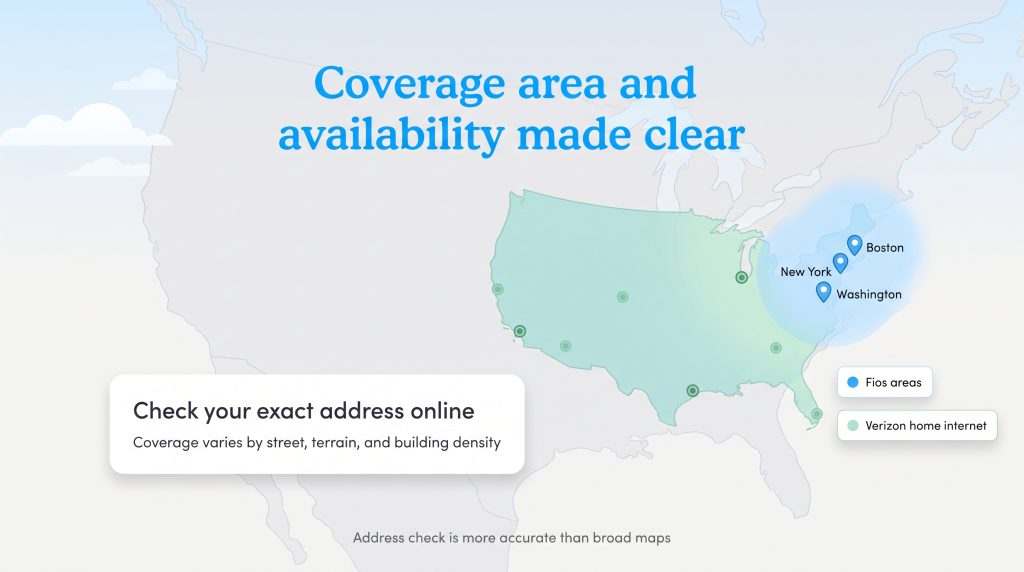
Choosing between these services usually comes down to your exact street address. Fios is geographically limited to roughly 10 states, largely concentrated in the densely populated Northeast. On the flip side, the Verizon home internet availability footprint covers over 65% of households nationwide thanks to their sprawling cellular network.
It is important to remember that 5G Ultra Wideband is primarily an urban and suburban solution, while LTE fills in the rural gaps. A broad visual map can sometimes be misleading because environmental factors like thick trees, large hills, or concrete buildings can block high-frequency 5G signals. To verify the exact services offered at your location, we strongly recommend visiting the official Verizon availability checker tool online.
Verizon Fios Coverage Map
Fios Major Cities
5G Home Major Cities
Types Of Verizon Home Internet: 5G, LTE, And Fios
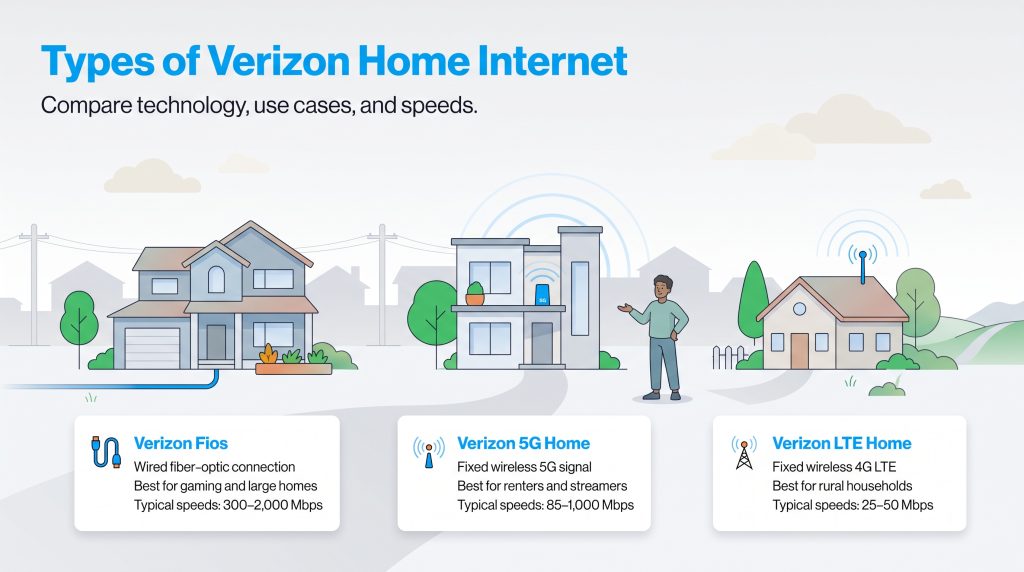
Before diving into plans and pricing, it is essential to understand the underlying technology that powers your connection. Verizon is a heavyweight in U.S. telecommunications, offering a blend of wired and wireless home internet solutions designed to fit drastically different living situations. Knowing the difference between Verizon 5G Home Internet, traditional LTE, and Fios ensures you pay for the correct infrastructure.
Verizon Fios is a 100% fiber-optic network that delivers data via glass fiber cables buried underground or strung along utility poles. Because fiber is mostly immune to the weather and congestion issues that plague older coaxial lines, it is the gold standard for heavy streaming and gaming. To bridge the coverage gap in areas where laying fiber is too expensive, the company rapidly expanded its fixed wireless access (FWA) options. 5G Home Internet uses Verizon’s robust cellular network to beam broadband directly into your house via a receiver, while Verizon LTE home internet serves rural gaps using widespread 4G cellular signals.
| Service Type | Connection Technology | Best For | Typical Speeds |
|---|---|---|---|
| Verizon Fios | Wired Fiber-Optic Cable | Competitive gamers, smart homes, and large families | 300 Mbps – 2,000 Mbps |
| Verizon 5G Home | Fixed Wireless (5G Ultra Wideband) | Renters, cord-cutters, and everyday streaming | 85 Mbps – 1,000 Mbps |
| Verizon LTE Home | Fixed Wireless (4G Cellular) | Rural households lacking broadband infrastructure | 25 Mbps – 50 Mbps |
Verizon Internet Plans And Pricing Breakdown
| Plan Name | Price | Download Speeds | Connection Type | |
|---|---|---|---|---|
| High Speed Internet | $40 /month | Up to 15 Mbps | DSL | Check Availability |
| Verizon Home Internet Lite | $35 /month | Up to 25 Mbps | 5G | Check Availability |
| Verizon Home Internet Lite Extra | $55 /month | Up to 25 Mbps | 5G | Check Availability |
| 5G Home | $50 /month | Up to 100 Mbps | 5G | Check Availability |
| 5G Home Plus | $60 /month | Up to 150 Mbps | 5G | Check Availability |
| Fios 300 Mbps | $30 /month | Up to 300 Mbps | Fiber | Check Availability |
| 5G Home Ultimate | $75 /month | Up to 300 Mbps | 5G | Check Availability |
| Fios 500 Mbps | $65 /month | Up to 500 Mbps | Fiber | Check Availability |
| Fios 1 Gig | $80 /month | Up to 1000 Mbps | Fiber | Check Availability |
| Fios 2 Gig | $90 /month | Up to 2.3 Gbps | Fiber | Check Availability |
| Fios 5 Gig | $104.99 /month | Up to 5 Gbps | Fiber | Check Availability |
*Pricing and speeds may vary by location. Discounted pricing is available with Auto Pay and any qualifying Verizon mobile phone plan.
Verizon offers several distinct internet connection types tailored to different household needs and data demands. The standout feature of Verizon internet plans is the transparent flat-rate pricing. Whether you opt for fiber or wireless, the core tiers come with extended price-lock guarantees that shield you from surprise rate hikes for up to four years.
Fios Fiber Plans
Fios remains Verizon’s premium service. Every tier comes with symmetrical speeds, meaning your upload rate is exactly as fast as your download rate. This is absolutely essential for quickly backing up large files to the cloud or hosting lag-free video conference calls.
- Fios 300 Mbps: A highly affordable baseline that is perfect for small households with standard streaming and browsing habits.
- Fios 500 Mbps: The sweet spot for medium-sized families or work-from-home professionals who frequently download large updates.
- Fios 1 Gig: Designed for households with intense bandwidth needs, 4K streaming on multiple TVs, and robust smart home setups.
- Fios 2 Gig: The top-tier powerhouse, offering blazing-fast internet for tech enthusiasts, content creators, or small businesses with massive data demands.
5G Home And LTE Home Plans
For homes outside the fiber footprint, Verizon breaks its fixed wireless service into two primary tiers: 5G Home and 5G Home Plus. The standard tier handles routine web browsing and HD streaming effortlessly, while the Plus tier taps into mmWave technology for premium speeds in select urban areas. However, Verizon recently introduced a “Home Internet Lite” tier for addresses sitting just on the fringe of their coverage maps. If you are placed on the Lite tier, your data is capped at 150GB per month. Once you hit that ceiling, your speeds will drop to a painfully slow 10 Mbps for the remainder of the billing cycle.
If you live in a highly remote area, the LTE Home plan connects your household to Verizon’s reliable 4G network. It serves as a highly capable, energy-saving option compared to bulky satellite dishes that consume more power and suffer from worse weather interference.
Mobile Bundle Pricing Advantage
The most compelling reason to consider a Verizon internet price quote is the steep discount available to existing mobile customers. If you have a qualifying postpaid Verizon 5G mobile plan, your home internet base price is slashed dramatically.
| Plan Name | Standard Monthly Price (With Auto Pay) | Discounted Price (With Qualifying Mobile Plan) |
|---|---|---|
| 5G Home | $60.00 | $35.00 |
| 5G Home Plus | $80.00 | $45.00 |
| Fios 300 Mbps | $49.99 | $24.99 |
| Fios 500 Mbps | $69.99 | $44.99 |
| Fios 1 Gig | $89.99 | $64.99 |
Learn more about How Much Speed Your Home Needs.
Verizon Internet Speeds And Network Reliability
When shopping for utilities, there is often a vast gap between marketing claims and everyday reality. Verizon heavily advertises peak wireless speeds of up to 1,000 Mbps on the 5G Home Plus tier. However, if you look closely at the required FCC broadband labels, the average real-world Verizon internet speed generally lands between 85 Mbps and 300 Mbps depending on local network congestion and your home’s unique layout. This is plenty of bandwidth for scrolling social media, checking email, or streaming your favorite shows in 4K, but you should temper expectations if you plan on routinely downloading massive files over the air.
When it comes to competitive online gaming or rapid-fire remote server work, we need to issue a specific warning about the wireless connection. Assessing network reliability reveals a major divide. Fios fiber is virtually flawless, boasting ping rates that often drop below 10 milliseconds. Wireless 5G and LTE, on the other hand, frequently suffer from packet loss and noticeably higher ping rates. Because cellular bandwidth is shared with mobile phone users in your immediate area, your home internet speeds can momentarily throttle if the local tower gets overwhelmed during peak evening hours (typically 6:00 p.m. to 10:00 p.m.). This high latency means remote workers might experience brief stuttering on video conference calls, and gamers could face frustrating lag spikes during crucial matches. If milliseconds matter to you, always prioritize a hardwired Fios connection over a wireless gateway.
Equipment, Installation, And Setup Process
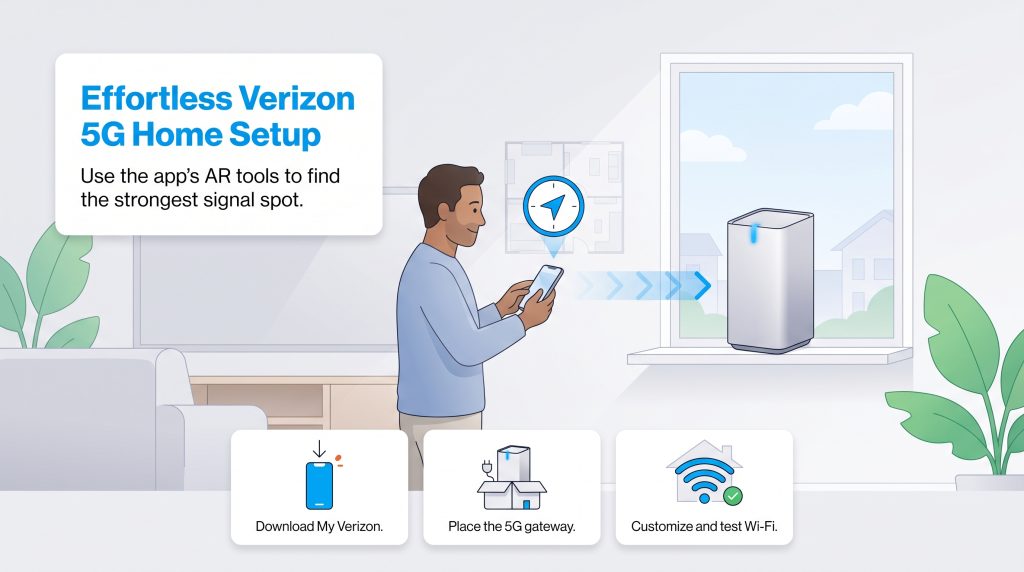
Verizon keeps hardware management remarkably simple. Both the Fios and wireless setups avoid the hidden rental fees that so many legacy cable providers sneak into your monthly bill. Fios customers generally receive an advanced Wi-Fi 6E router, and many higher-tier plans even include free mesh extenders for complete whole-home coverage. Fios installation often requires a professional technician to run a physical line to your home, but the wireless option skips this entirely.
If you choose the fixed wireless route, mastering the plug-and-play setup process is crucial to maximizing your signal. You are strictly required to download and use the My Verizon mobile app to activate the device. The app utilizes helpful augmented reality (AR) tools to guide you to the exact spot where the cellular signal enters your home strongest.
Step-By-Step 5G Gateway Setup
- Download the app: Install the My Verizon app on your smartphone and log into your newly created account.
- Unbox the gateway: Remove the Verizon 5G Gateway and power cord from the shipping box. Do not plug it in yet.
- Use the AR compass: Open the setup guide in the mobile app. The augmented reality tool will use your phone’s camera and GPS to pinpoint the nearest 5G cellular tower.
- Find the right window: Walk around your home holding your phone until the app indicates a strong line of sight. Place the gateway in a window facing that exact direction, keeping it elevated off the floor and away from thick concrete or large metal appliances.
- Power up and connect: Plug the gateway into a nearby electrical outlet. Follow the final in-app prompts to customize your Wi-Fi network name and password.
Run a speed test in three different rooms before firmly deciding on the gateway’s permanent home. Sometimes shifting the box just a few feet or moving it away from modern low-E (energy efficient) coated windows can drastically improve your download rate.
Current Deals, Discounts, And Bundling
Verizon continues to offer compelling monthly discounts for military members, veterans, first responders, teachers, and students. Qualifying customers can routinely save between $5 and $15 per month. However, the biggest shift in promotions revolves around their newly introduced myHome ecosystem.
Maximize your savings by setting up Auto Pay to instantly shave $10 off your monthly bill. As mentioned earlier, if you already have a qualifying Verizon mobile plan, you are eligible for up to a 50% discount on your Verizon Home Internet service — bringing your base cost down to a staggeringly low rate.
Instead of forcing you into bulky legacy TV packages, the myHome system allows you to build customized digital bundles. Once your internet is active, you can add heavily discounted premium streaming services directly to your Verizon account. For example, customers can bundle a Netflix and Max combination tier or grab the Disney+ trio for roughly $10 per month, saving you significantly over retail pricing.
To sweeten the deal for new users, the company frequently rolls out massive promotional hardware giveaways. Depending on the season and the tier you select, you might score a free gaming console, a premium soundbar, a generous Amazon gift card, or high-end smart home devices just for signing up online.
Verizon Home Internet Versus T-Mobile And Competitors
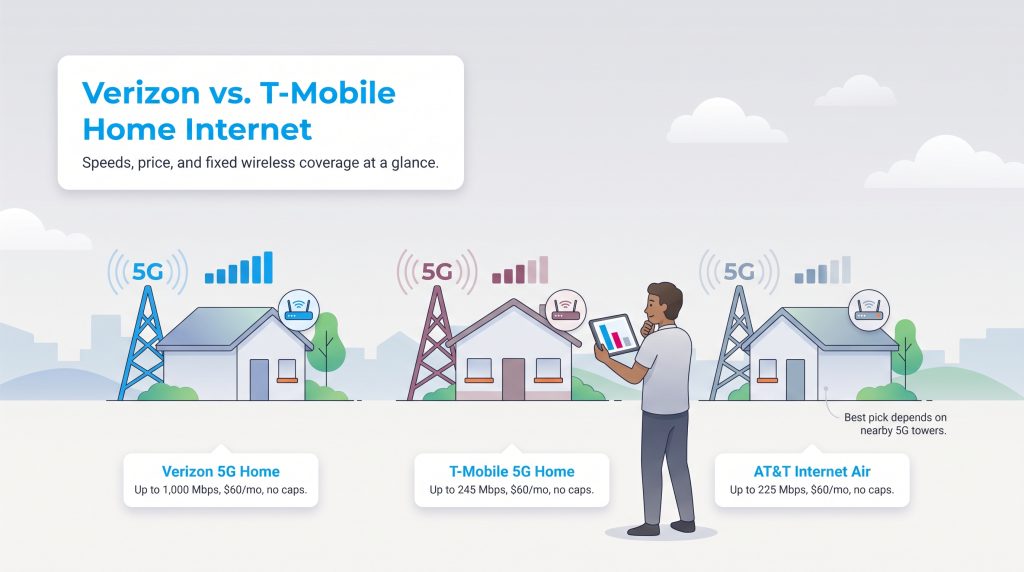
As fixed wireless technology rapidly expands across the United States, homeowners have more cord-cutting options than ever before. When comparing Verizon home internet vs T-Mobile or AT&T, the decision largely depends on which provider’s 5G cell towers are geographically closest to your specific address. Here is how the big three mobile carriers stack up when beaming internet into your living room.
| Provider | Starting Price (With Auto Pay) | Max Advertised Speed | Data Caps or Hidden Fees? |
|---|---|---|---|
| Verizon 5G Home Internet | $60.00 / month | Up to 1,000 Mbps (Plus Tier) | No |
| T-Mobile 5G Home Internet | $60.00 / month | Up to 245 Mbps | No |
| AT&T Internet Air | $60.00 / month | Up to 225 Mbps | No |
While standard pricing is nearly identical across all three competitors, Verizon maintains an edge for high-end users thanks to its mmWave Ultra Wideband technology, which allows for significantly faster peak download speeds in major metro areas. If you are comparing traditional wired connections instead, be sure to explore our deep dives into the legacy cable giants below.
Top Verizon Comparisons
Customer Service And Real User Reviews
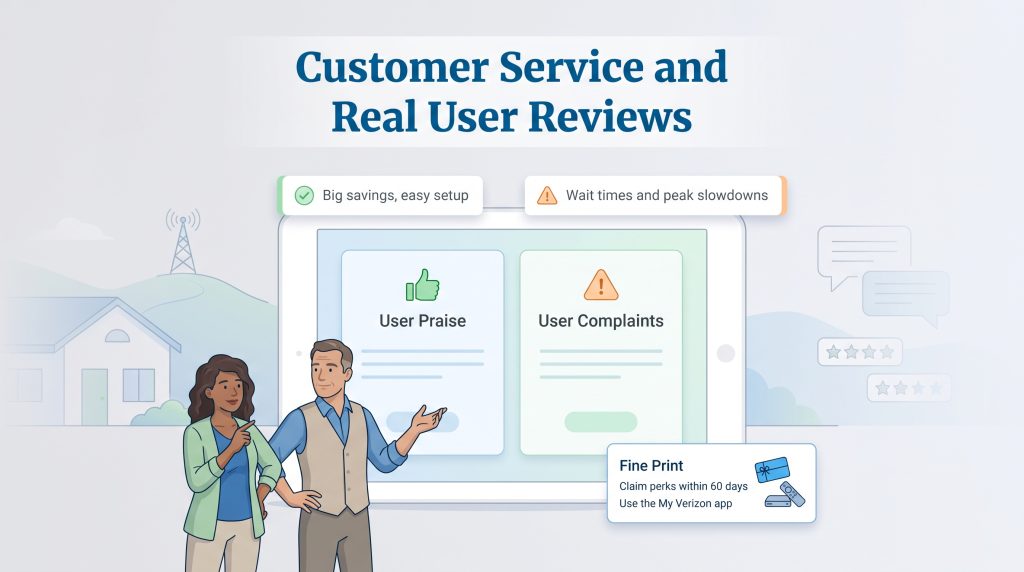
To provide an objective perspective, we analyzed thousands of consumer comments across local community forums, Better Business Bureau (BBB) complaints, and active Reddit threads like r/verizon. The overarching sentiment points to massive cost savings and immense relief from the strict, binding contracts of the past.
- Common Praise: Customers consistently highlight the ease of the plug-and-play setup for 5G gateways. The flat-rate billing system and zero hidden equipment fees earn high marks, giving users much-needed predictability in their monthly budgets.
- Common Complaints: When evaluating Verizon internet customer service, users occasionally cite long telephone wait times during billing disputes. Technical frustrations usually center on inconsistent latency for gamers and momentary speed drops during evening hours when local cellular towers experience peak traffic. Fios users, conversely, rarely report these stability issues.
Always read the fine print on promotional sign-up perks. Many Verizon home internet reviews note that you must actively claim your gift card or streaming device via the My Verizon app within 60 days of installation, or the lucrative offer expires completely.
Deciding If Verizon Home Internet Is Right For You
If you want top-tier speeds, unmatched reliability, and the flexibility to leave without facing early termination penalties, Verizon checks nearly every box. The symmetrical fiber options provide the ultimate backbone for large, bandwidth-heavy households, while the rapidly expanding 5G network brings real competition to neighborhoods historically trapped by a single cable monopoly.
Choosing this provider also serves as a strong environmentally mindful choice. Verizon actively funds massive solar and wind farms to cleanly power their cell towers, and they maintain an overarching pledge to achieve net-zero emissions across their operations by 2035. With their long-term price locks, excellent mobile bundle discounts, and commitment to a greener grid, it is easy to see why millions of households confidently make the switch.
Pros
- Symmetrical fiber speeds up to 2 Gbps in select areas.
- No annual contracts, data caps on base plans, or equipment rental fees.
- Price locks guarantee steady rates for three to four years.
- Massive bundled savings available for existing mobile customers.
Cons
- Fios fiber availability is severely limited geographically.
- 5G and LTE performance fluctuates heavily based on exact tower proximity.
- Higher latency on wireless plans can cause lag for competitive online gaming.
- Fios setup may require a time-consuming technician appointment.
Frequently Asked Questions About Verizon Home Internet
How do I check Verizon home internet availability in my area?
You can easily check availability by navigating to Verizon’s official home internet portal and typing your exact street address into their interactive coverage tool. Because 5G signals can be blocked by local geography and fiber lines stop at specific streets, an address-level check is the only guaranteed way to confirm service.
What is the difference between Verizon Fios and 5G Home Internet?
Fios is a hardwired, 100% fiber-optic service providing ultra-fast, symmetrical speeds that are highly stable. It is best for heavy internet users and smart homes. 5G Home Internet is a wireless fixed broadband connection using Verizon’s cellular network. It requires an easy plug-and-play setup without any cables, but performance fluctuates depending on your distance from the nearest cell tower.
Is Verizon 5G Home Internet good for gaming?
While 5G Home Internet offers strong download speeds capable of handling massive game updates, it generally suffers from higher latency and occasional packet loss. For casual gaming, it performs reasonably well. However, for competitive online matches where split-second reactions matter, you should opt for a hardwired Fios connection to avoid frustrating lag spikes.
Does Verizon Home Internet have data caps or hidden fees?
No, the core Fios and standard 5G Home plans feature unlimited data with zero caps and no hidden equipment rental fees. The only exception is if your address falls strictly onto the fringe “Home Internet Lite” plan, which imposes a strict 150GB monthly data limit before severely slowing your speeds.
Are there contracts or mid-year price hikes?
Verizon does not require annual contracts, meaning you can cancel anytime without early termination penalties. Furthermore, most of their core plans come with extended price-lock guarantees ranging from three to four years, ensuring your monthly rate stays steady before matching future market standards.
Can I get Verizon 5G Home Internet through Visible or prepaid?
Yes. Verizon recently launched a Visible 5G Home Broadband plan. This utilizes the exact same 5G network towers but allows you to pay on an easy month-to-month prepaid basis without undergoing a formal credit check.
About the Author

David has been an integral part of some of the biggest utility sites on the internet, including InMyArea.com, HighSpeedInternet.com, BroadbandNow.com, and U.S. News. He brings over 15 years of experience writing about, compiling and analyzing utility data.