

Comparing Connection Types, Pricing, and Smart Home Capabilities to Find Your Perfect Internet Match

- 7 Gbps
- Cable & Fiber
- Unlimited
- $30.00/mo

- 5 Gbps
- Fiber
- Unlimited
- $30.00/mo
*Not all internet providers and speeds available in all areas.
Key Takeaways
- Verizon Fios offers pure fiber connections with symmetrical upload and download speeds that are ideal for heavy remote work and gaming.
- Spectrum provides wider availability through its hybrid cable network and includes straightforward plans that currently advertise no data caps.
- Choosing an energy-efficient router and optimizing your smart home connection can help lower your overall household electricity footprint.
Moving into a new residence is stressful enough without having to worry about dead zones, buffering streams, or smart home devices dropping offline during your first week. When you evaluate Spectrum vs. Verizon Home Internet, you first need to understand that Verizon offers two entirely distinct services — Verizon Fios (pure fiber-optic) and Verizon 5G Home Internet (fixed wireless) — while Spectrum operates on a traditional hybrid fiber-coaxial cable network. We put together this definitive 2026 guide to help you compare Spectrum vs Verizon connection types, untangle long-term pricing, and identify the most environmentally mindful setup for your space. By matching your household’s unique digital demands with the right underlying network technology, you can establish a seamless, reliable connection without facing any unexpected budget surprises on move-in day.
Head-to-Head Provider Overview
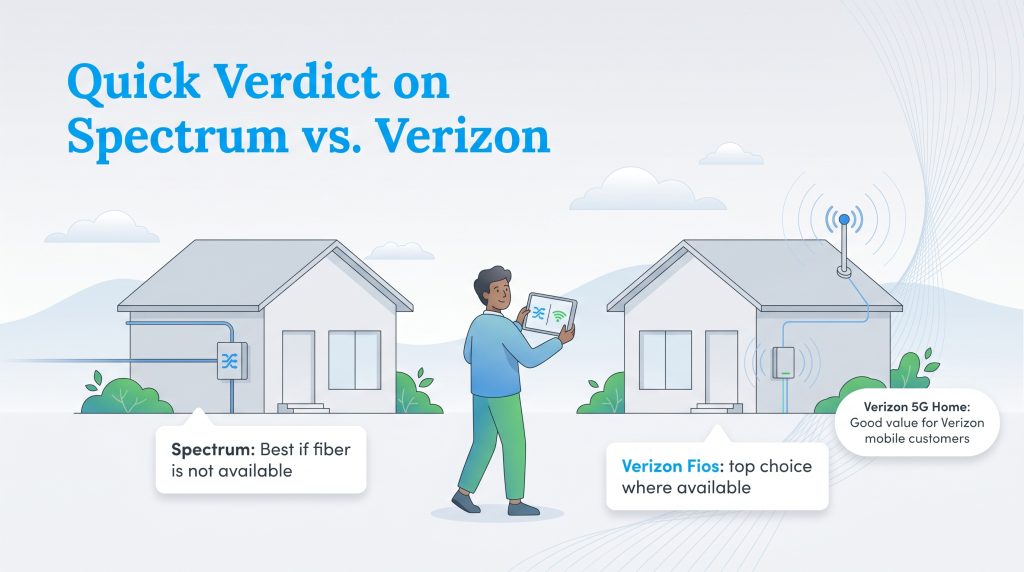
To make an informed decision, you need to see exactly how these services stack up on paper before diving into the fine print. Reviewing Verizon 5G home internet vs Spectrum or traditional Fios reveals massive differences in how data is delivered, how much you will pay, and what hardware is required. Use the comparison table below to get a high-level view of what to expect when setting up your new utility services.
| Feature | Spectrum (Cable) | Verizon Fios (Fiber) | Verizon 5G (Wireless) |
| Connection Type | Hybrid Fiber-Coaxial | 100% Fiber-Optic | Fixed Wireless |
| Download Speed Range | 300 Mbps – 2 Gbps | 300 Mbps – 5 Gbps | 85 Mbps – 300 Mbps |
| Upload Speed Range | 10 Mbps – 35 Mbps | 300 Mbps – 5 Gbps | 10 Mbps – 50 Mbps |
| Starting Advertised Price | $30.00/mo (varies) | $49.99/mo (varies) | $35.00/mo (with mobile) |
| Data Caps | None | None | None |
| Equipment Fees | Router fee typically applies | Router often included | Gateway usually included |
Keep in mind that Verizon home internet availability is highly dependent on your physical street address. Fios is generally restricted to specific metro regions in the Northeast and Mid-Atlantic, while Verizon 5G relies on proximity to upgraded cellular towers. Spectrum, on the other hand, boasts an enormous national footprint across 41 states.
Network Types Explained: Cable Vs. Fiber Vs. 5G
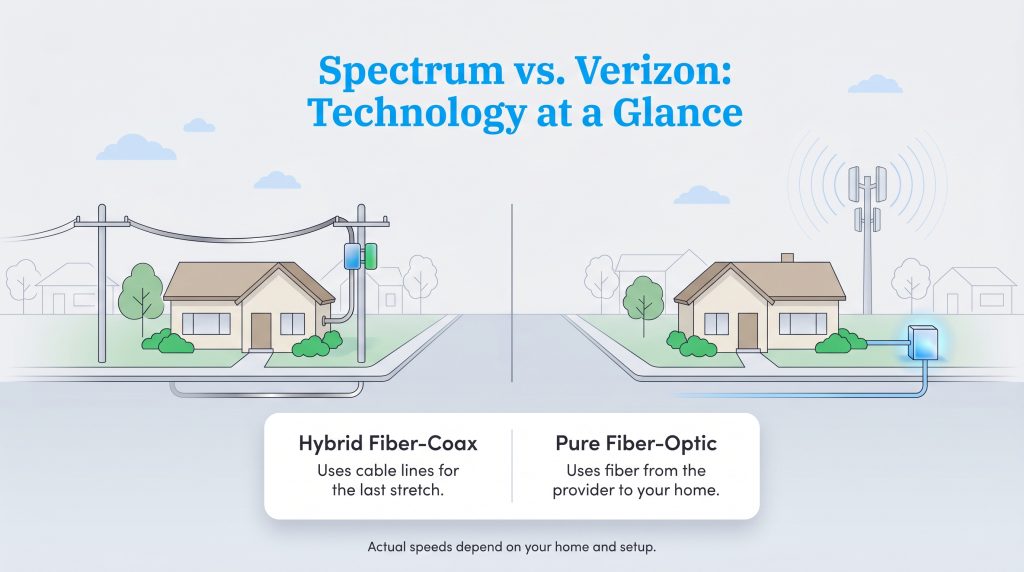
Understanding the actual hardware carrying your signal is vital for establishing a stable, energy-conscious home network. Spectrum operates a Hybrid Fiber-Coaxial (HFC) system. This means fiber-optic lines run to a central node in your neighborhood, but the final stretch to your house relies on older copper coaxial cables. While this legacy infrastructure makes Spectrum incredibly widely available, the shared nature of copper lines means you might experience slight slowdowns during peak evening hours when all your neighbors are streaming at once.
When looking at Spectrum vs Verizon Fios, you are comparing that hybrid system to a 100% pure fiber-optic network. Fios runs dedicated strands of glass directly to an Optical Network Terminal (ONT) installed on or inside your house. Because fiber transmits data using pulses of light rather than electricity, it boasts massive bandwidth capacity, is practically immune to weather interference, and delivers a much more stable, dedicated connection to your household.
Verizon 5G Home Internet operates on a Fixed Wireless Access (FWA) model, which bypasses buried street cables entirely. Instead, a small gateway device plugs into a standard wall outlet in your home, captures a 5G cellular signal from a nearby Verizon tower, and converts it into a local WiFi network. It is incredibly easy to set up — perfect for renters or fast move-ins — but real-world performance will fluctuate depending on your home’s layout, window placement, and the distance to the nearest cell tower.
Speed and Reliability Comparison
Speed is typically the first metric people check, but you need to look at both directions — download and upload — to truly evaluate performance. For 2026, Spectrum continues to offer robust download speeds up to 1 Gbps, but the technology has a distinct bottleneck. Spectrum primarily offers asymmetrical speeds, meaning your download speeds are significantly faster than your upload speeds (which often cap out around 35 Mbps). This is usually perfectly fine for basic streaming and web browsing, but it can cause headaches if you frequently upload large files.
In stark contrast, Verizon Fios delivers symmetrical speeds, meaning your upload rate is just as fast as your download rate. With Fios plans reaching up to 2.3 Gbps in both directions, it is the undisputed champion for bandwidth-heavy households. Whether you are hosting video conferences, syncing massive cloud backups, or running a complex smart home network, that upstream capacity makes a world of difference. When determining if you need Spectrum or Verizon for work from home, that symmetrical fiber performance gives Verizon Fios a massive edge.
Verizon 5G Home Internet is a bit of a wildcard in the speed department. In areas with premium Ultra Wideband (UWB) coverage, you can see download speeds approach 1 Gbps. However, in standard 5G coverage zones, speeds usually hover between 85 Mbps and 300 Mbps. Its reliability is generally solid, but fixed wireless latency (the tiny delay in data transmission) is naturally higher than a hardwired fiber or cable connection, making it less ideal for hyper-competitive online gaming.
Pricing, Contracts, and Hidden Fees
Comparing Spectrum vs Verizon internet prices requires looking past the flashy year-one promotional banners. Both providers frequently run deep discounts to get you to sign up, but your monthly bill can jump significantly once those initial 12 to 24 months expire. Spectrum offers a straightforward pricing structure with no long-term contracts, but you must factor in their standard rate increases and router rental fees.
Verizon Fios has moved toward transparent pricing with their “Mix & Match” plans, which generally eliminate sudden second-year price hikes and often include the router rental in the base cost. Meanwhile, Verizon 5G Home Internet represents one of the best budget hacks in the industry — if you already have a qualifying Verizon cellular plan, you can bundle your services to drastically lower your monthly home internet bill.
Spectrum Plans & Pricing
| Plan Name | Price | Download Speeds | Connection Type |
|---|
Verizon Home Internet Plans & Pricing
| Plan Name | Price | Download Speeds | Connection Type | |
|---|---|---|---|---|
| High Speed Internet | $40 /month | Up to 15 Mbps | DSL | Check Availability |
| Verizon Home Internet Lite | $35 /month | Up to 25 Mbps | 5G | Check Availability |
| Verizon Home Internet Lite Extra | $55 /month | Up to 25 Mbps | 5G | Check Availability |
| 5G Home | $50 /month | Up to 100 Mbps | 5G | Check Availability |
| 5G Home Plus | $60 /month | Up to 150 Mbps | 5G | Check Availability |
| Fios 300 Mbps | $30 /month | Up to 300 Mbps | Fiber | Check Availability |
| 5G Home Ultimate | $75 /month | Up to 300 Mbps | 5G | Check Availability |
| Fios 500 Mbps | $65 /month | Up to 500 Mbps | Fiber | Check Availability |
| Fios 1 Gig | $80 /month | Up to 1000 Mbps | Fiber | Check Availability |
| Fios 2 Gig | $90 /month | Up to 2.3 Gbps | Fiber | Check Availability |
| Fios 5 Gig | $104.99 /month | Up to 5 Gbps | Fiber | Check Availability |
Equipment, Installation, and Smart Home Compatibility
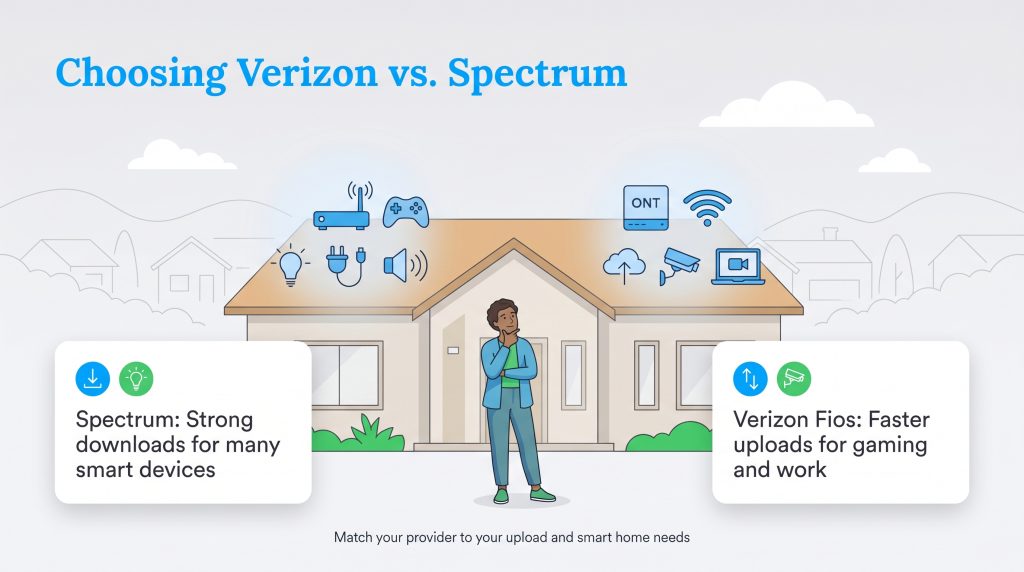
When assessing Verizon internet equipment fees vs Spectrum, the hardware logistics play a huge role in your overall experience. Spectrum typically provides a modem for free but charges a monthly rental fee if you want to use their WiFi router. To save money over the long haul, we highly recommend purchasing your own certified, energy-efficient router. Spectrum installations are usually simple, often allowing for DIY self-installation if your new home is already wired for cable.
Verizon Fios requires an ONT (which acts like a fiber modem) to be installed at your residence. If the previous owners didn’t have Fios, you will need a professional technician to drill and run the fiber line into the house. Once installed, Verizon often includes their high-end router in the monthly cost of premium plans, making it incredibly friendly for smart homes that require strong whole-house WiFi coverage.
For modern connected living, managing the constant background traffic of smart thermostats, security cameras, and voice assistants requires a robust local network. Spectrum offers plenty of download bandwidth to keep dozens of internet of things (IoT) devices online without breaking a sweat. However, if your home relies heavily on uploading HD video feeds from multiple outdoor security cameras, a fiber connection typically handles that constant upstream data better.
The Eco-Conscious Choice: Which Network Is Greener?
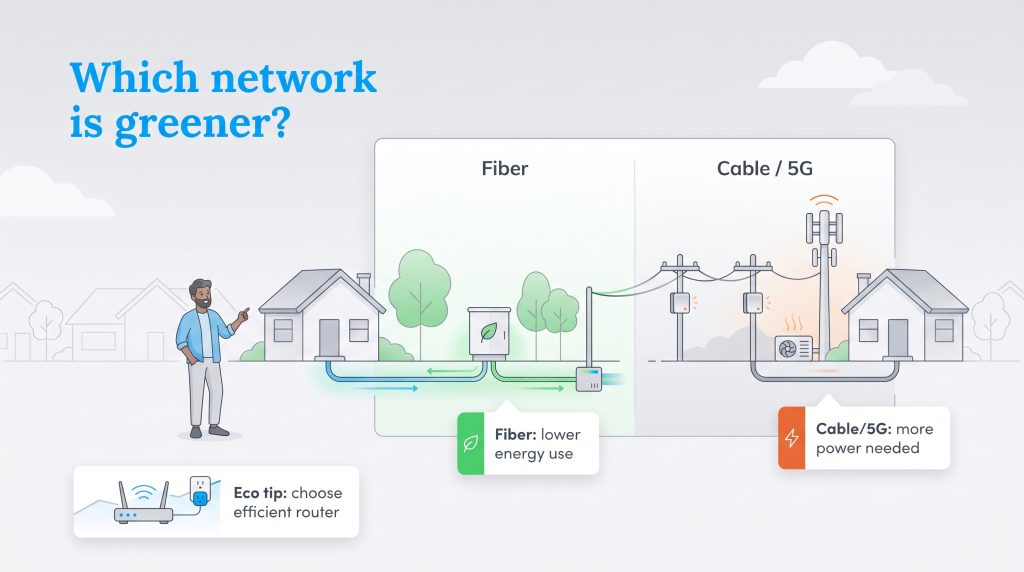
If you are actively lowering your monthly electricity costs and aiming for a sustainable lifestyle, the underlying technology of your internet service actually matters. Fiber-optic networks like Verizon Fios are inherently the most environmentally mindful choice. Because fiber cables transmit data via pulses of light, the network naturally requires less electrical power to push signals over long distances compared to a legacy coaxial cable system. Furthermore, fiber networks require fewer powered neighborhood amplifiers and cooling systems, drastically reducing the overall carbon footprint of the network infrastructure.
Spectrum’s hybrid cable system still relies heavily on electrical signals pushed through copper wire, which generates more heat and requires constant power boosts along the street. Verizon 5G Home Internet is a mixed bag for sustainability; while it reduces the need to trench physical cables through neighborhoods, the 5G cellular towers themselves require significant energy to operate.
Choosing the Best Connection for Your New Address
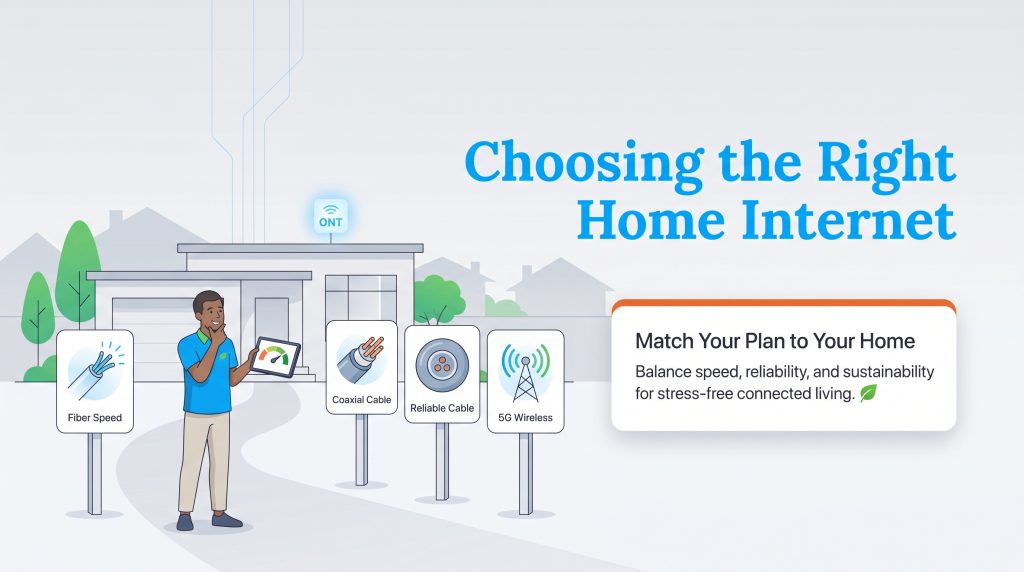
Deciding between these broadband giants ultimately comes down to what is physically wired to your street and how your household consumes data. If Verizon Fios is available at your address, it is the undisputed winner for performance, eco-efficiency, and demanding smart homes thanks to its symmetrical speeds and pure fiber infrastructure. If Fios isn’t an option, Spectrum remains a highly reliable, capable cable alternative with a massive footprint, ensuring you will rarely be left without a fast connection.
If you are looking to cut costs, Verizon 5G Home Internet provides an incredible value for existing Verizon mobile customers who want a completely wireless, plug-and-play setup. Choosing the right internet provider is a critical step in establishing a comfortable, modern, and energy-conscious home. By taking the time to match your household’s digital habits with the appropriate connection type, you are setting yourself up for years of stress-free streaming, gaming, and connected living.
Frequently Asked Questions About Spectrum Vs. Verizon Home Internet
These quick answers cover the most common questions people have when comparing Spectrum, Verizon Fios, and Verizon 5G Home Internet. Use them as a final check before you choose a provider for your new home.
Is Verizon home internet better than Spectrum for gaming?
Do Spectrum or Verizon have data caps?
Can I bundle my cell phone plan with Spectrum or Verizon to save money?
Does Verizon 5G Home Internet use more energy than Spectrum cable?
Which provider is more reliable during power outages?
Can I use my own eco-friendly router with both Spectrum and Verizon?
Are there early termination fees if I switch from Spectrum to Verizon internet?
About the Author

David has been an integral part of some of the biggest utility sites on the internet, including InMyArea.com, HighSpeedInternet.com, BroadbandNow.com, and U.S. News. He brings over 15 years of experience writing about, compiling and analyzing utility data.

LaLeesha has a Masters degree in English and enjoys writing whenever she has the chance. She is passionate about gardening, reducing her carbon footprint, and protecting the environment. She also recently served as President of the Board for City Sprouts (a community garden).