

Frontier Fiber offers fast, symmetrical speeds that are especially useful for remote work, gaming, cloud backups, and busy connected homes, while Spectrum provides widespread availability and reliable cable internet for most households.

- 7 Gbps
- Cable & Fiber
- Unlimited
- $30.00/mo

- 7 Gbps
- Fiber
- Unlimited
- $29.99/mo
*Not all internet providers and speeds available in all areas.
Key Takeaways
- Frontier Fiber delivers symmetrical upload speeds up to 7 Gbps and zero router fees, making it our top pick for remote workers, gamers, and heavy streamers.
- Spectrum is widely available across 41 states, offering reliable cable internet and traditional TV bundles that easily outpace Frontier DSL.
- Promotional rates and hidden fees vary significantly, and Frontier’s 2026 acquisition by Verizon brings brand-new mobile bundling perks to the table.
If you’re comparing Spectrum vs. Frontier for a new home, focus first on the exact connection type wired to your address. Sorting through internet providers can feel like deciphering a foreign language, yet choosing the right service directly dictates how smoothly your smart home runs and whether your video calls drop midway through an important meeting. Frontier Fiber is almost always the better choice if you can get it, thanks to its symmetrical upload speeds, included Wi-Fi equipment, and new Verizon mobile bundle perks. However, Spectrum cable is the safer, faster pick when the only Frontier option on your street is aging DSL. We’re here to help you decode 2026 connection speeds, compare hidden fees, and pick the best ISP for your specific address so your next binge-watching session or remote workday goes off without a hitch.
Bottom Line: Is Frontier Better Than Spectrum?
You might be wondering right out of the gate: Is Frontier better than Spectrum? The short answer relies entirely on the type of connection wired to your specific neighborhood. If you have access to Frontier Fiber, it is the stronger choice for most homes because it delivers symmetrical speeds, stellar upload performance, free router equipment, and no data caps. Because fiber-optic technology offers matching download and upload speeds, it creates a noticeably smoother experience for households juggling multiple 4K screens, cloud backups, and video calls simultaneously.
However, the story flips completely if Frontier only offers its legacy DSL service on your street. In that scenario, Spectrum’s reliable hybrid fiber-coaxial cable network is much faster and far more practical than Frontier DSL for streaming, gaming, and multi-device households. Spectrum also shines if you want an all-in-one bundle combining traditional live cable television with low-cost mobile phone lines under a single billing umbrella.
📌 Quick Fact: Fiber-optic internet transmits data using light signals through glass strands, offering fast symmetrical speeds, whereas cable and DSL rely on older copper wires that often struggle with uploading large files.
Spectrum vs. Frontier at a Glance
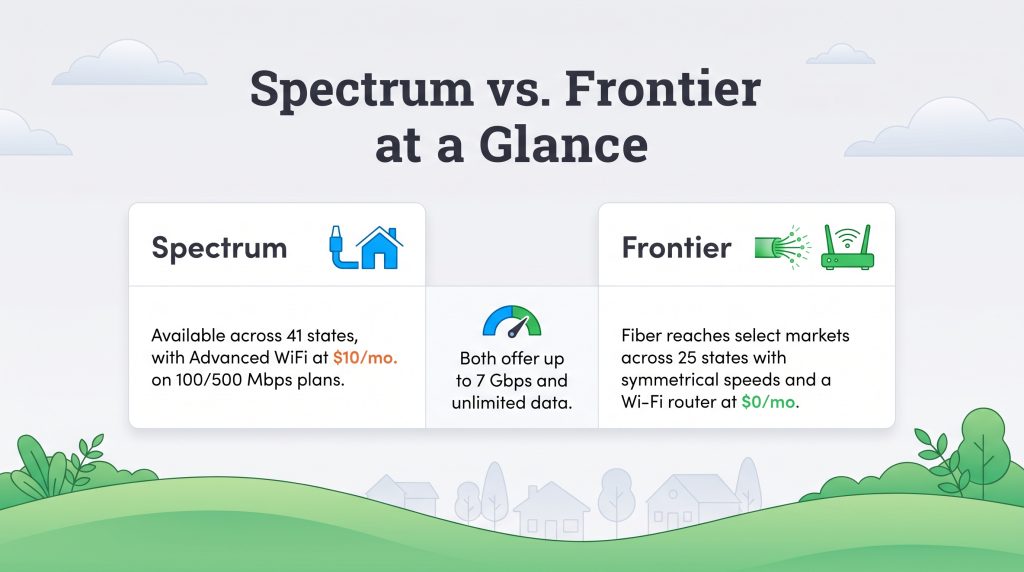
When evaluating these two providers side by side, it helps to weigh their core strengths and network limitations against each other. Both companies offer multi-gigabit top tiers and unlimited data, but the day-to-day experience — and what you pay for equipment — differs quite a bit. Here is a quick look at the pros, cons, and head-to-head specifications of both services.
- Frontier Pros: Symmetrical upload and download speeds on fiber plans, no data caps, a high-performance Wi-Fi router included at $0 per month, and new Verizon Wireless bundle discounts.
- Frontier Cons: Fiber availability is limited to select markets across 25 states, its legacy DSL alternative is sluggish, and promotional pricing requires AutoPay and paperless billing.
- Spectrum Pros: Widely available across 41 states, reliable cable download speeds, no annual contracts, and strong in-house bundling with Spectrum TV and Spectrum Mobile.
- Spectrum Cons: Upload speeds on standard cable plans top out at 20 to 35 Mbps, and renting an Advanced WiFi router costs an extra $10 per month on entry-level and mid-tier plans.
| Category | Spectrum Internet | Frontier Internet |
|---|---|---|
| Starting Price | $30.00/mo. | $29.99/mo. |
| Max Download Speed | Up to 7 Gbps | Up to 7 Gbps |
| Max Upload Speed | 35 Mbps on most cable plans (up to 7 Gbps on limited fiber) | Up to 7 Gbps symmetrical on Frontier Fiber (1 to 15 Mbps on DSL) |
| Connection Types | Coax/Hybrid Fiber-Coax & limited Fiber | Fiber & DSL |
| Data Caps | None | None |
| Equipment Fees | $10/mo. for Advanced WiFi on 100/500 Mbps plans (free on 1 Gig+) | $0/mo. (Wi-Fi router included) |
| Contract Requirements | None (12- to 24-month promotional rate locks available) | None (promotional gift cards or free install deals may carry a prorated ETF) |
Spectrum vs. Frontier Plans and Pricing
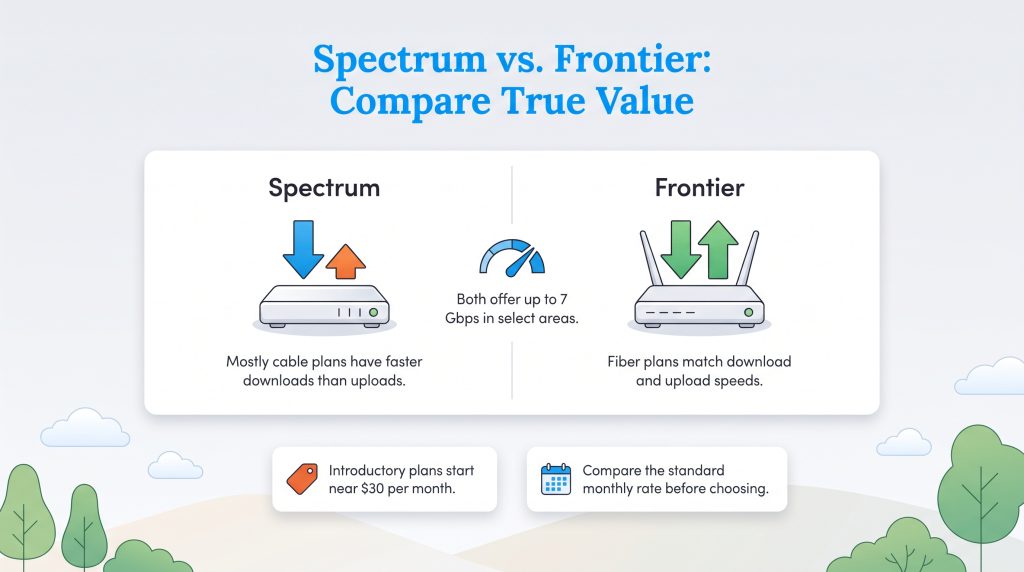
Navigating Spectrum vs. Frontier internet pricing requires looking past the flashy promotional banners to see what your household actually gets for the money. Both providers attract new movers with introductory first-year rates starting right around $30 per month. However, the value per megabit tilts heavily toward Frontier if you live in a fiber-equipped neighborhood, largely because Frontier matches your download speed with an identical upload speed at every single fiber tier.
As of 2026, both Spectrum and Frontier have expanded their lineups to include multi-gigabit speeds reaching up to 7 Gbps in select areas. Keep in mind that promotional rates increase after your introductory period expires, so always compare the standard monthly rate before committing to a plan. Below is how each provider structures its current residential internet tiers.
Spectrum Internet Plans & Pricing
Spectrum keeps its cable internet lineup straightforward, scaling from an entry-level 100 Mbps plan for light users up to multi-gigabit tiers for demanding smart homes. While Spectrum is gradually rolling out fiber-to-the-home technology for its 7 Gig tier and upgrading select markets to symmetrical speeds, the vast majority of its footprint runs on a Hybrid Fiber-Coax (Cable) network with asymmetrical upload speeds.
| Plan Name | Price | Download Speeds | Connection Type | |
|---|---|---|---|---|
| Spectrum Internet 100 | $30 /month | Up to 100 Mbps | Cable | Check Availability |
| Spectrum Internet 500 | $40 /month | Up to 500 Mbps | Cable | Check Availability |
| Spectrum Internet 1 Gig | $60 /month | Up to 1000 Mbps | Cable | Check Availability |
| Spectrum Internet 2 Gig | $80 /month | Up to 2 Gbps | Cable | Check Availability |
| Spectrum Internet 7 Gig fiber internet | $140 /month | Up to 7 Gbps | Fiber | Check Availability |
| Plan Name | Promotional Price | Download Speeds | Upload Speeds | Connection Type |
|---|---|---|---|---|
| Spectrum Internet Advantage (100) | $30.00/mo. for 12 mos. | 100 Mbps | 20 Mbps | Hybrid Fiber-Coax (Cable) |
| Spectrum Internet Premier (500) | $50.00/mo. for 12 mos. | 500 Mbps | 20 Mbps | Hybrid Fiber-Coax (Cable) |
| Spectrum Internet Gig (1 Gig) | $70.00/mo. for 12 mos. | 1,000 Mbps | 35 Mbps | Hybrid Fiber-Coax (Cable) |
| Spectrum Internet 2 Gig | $90.00/mo. for 12 mos. | 2,000 Mbps | 1,000 Mbps | Hybrid Fiber-Coax (Cable) |
| Spectrum Internet 7 Gig | $150.00/mo. for 12 mos. | 7,000 Mbps | 7,000 Mbps | Fiber |
Frontier Internet Plans & Pricing
Frontier’s fiber lineup is built for speed symmetry, offering six distinct fiber tiers ranging from 200 Mbps all the way up to a massive 7,000 Mbps connection. If you live in a rural area where fiber hasn’t arrived yet, Frontier still offers its legacy DSL plan, which delivers basic connectivity over copper phone lines.
| Plan Name | Price | Download Speeds | Connection Type | |
|---|---|---|---|---|
| Frontier Internet | $64.99 /month | Up to 12 Mbps | DSL | Check Availability |
| Fiber 200 Mbps | $29.99 /month | Up to 200 Mbps | Fiber | Check Availability |
| Fiber 500 Mbps | $44.99 /month | Up to 500 Mbps | Fiber | Check Availability |
| Fiber 1 Gig | $64.99 /month | Up to 1000 Mbps | Fiber | Check Availability |
| Fiber 2 Gig | $79.99 /month | Up to 2 Gbps | Fiber | Check Availability |
| Fiber 5 Gig | $104.99 /month | Up to 5 Gbps | Fiber | Check Availability |
| Fiber 7 Gig | $124.99 /month | Up to 7 Gbps | Fiber | Check Availability |
| Plan Name | Promotional Price | Download Speeds | Upload Speeds | Connection Type |
|---|---|---|---|---|
| Frontier Fiber 200 | $29.99/mo. for 12 mos. | 200 Mbps | 200 Mbps | Fiber |
| Frontier Fiber 500 | $44.99/mo. for 12 mos. | 500 Mbps | 500 Mbps | Fiber |
| Frontier Fiber 1 Gig | $64.99/mo. for 12 mos. | 1,000 Mbps | 1,000 Mbps | Fiber |
| Frontier Fiber 2 Gig | $99.99/mo. for 12 mos. | 2,000 Mbps | 2,000 Mbps | Fiber |
| Frontier Fiber 5 Gig | $129.99/mo. for 12 mos. | 5,000 Mbps | 5,000 Mbps | Fiber |
| Frontier Fiber 7 Gig | $199.99/mo. for 12 mos. | 7,000 Mbps | 7,000 Mbps | Fiber |
| Frontier Internet (DSL) | $54.99/mo. | Up to 115 Mbps | 1 to 15 Mbps | DSL |
Note: Frontier promotional prices require enrollment in AutoPay and paperless billing.
Extra Fees, Equipment, and Contracts
A major differentiator between these two providers lies in the subtle extra costs that creep onto your monthly statement, particularly when comparing the Frontier equipment fee vs. Spectrum router fee. Frontier includes an Amazon eero or high-capacity Wi-Fi router at $0 per month across all of its fiber plans, simplifying your bill and removing unexpected hardware charges. Spectrum includes a basic modem at no cost with all residential plans, but adding its Advanced WiFi router costs an extra $10 per month on the 100 Mbps and 500 Mbps tiers (it is included free on the 1 Gig plan and higher). If you have a large home with dead zones, Spectrum also charges $5 per month per WiFi extender pod. Over two or three years, those router rental charges add up to hundreds of dollars.
Installation and billing policies also create very different out-of-pocket costs when moving into a new home. Spectrum charges a $30 activation fee for self-installation kits and $65 if you require a professional technician to wire your residence. Frontier waives professional installation fees entirely ($0) for its fiber plans, though setting up a legacy DSL line can cost up to $100. However, Frontier is strict with billing fees: if you opt out of AutoPay, your bill jumps by $10 per month, and requesting a physical paper statement adds a $2.99 monthly paper bill fee. Frontier also assesses a $50 equipment restocking fee when you disconnect service and return hardware, and if you accept a promotional gift card or special installation agreement at signup, canceling early can trigger up to a $100 prorated early termination fee.
To dodge second-year rate hikes and extra fees, you have two smart strategies. You can call the customer retention department right before your 12-month promotion ends to politely negotiate a renewal discount, or you can supply your own personal Wi-Fi router from day one.
| Fee / Term Category | Frontier Internet | Spectrum Internet |
|---|---|---|
| Starting Price | $29.99/mo. (with AutoPay & paperless billing) | $30.00/mo. (for 12 mos.) |
| Router / Equipment Fees | $0/mo. for included router/gateway; $50 equipment restocking fee upon cancellation | Modem included ($0/mo.); $10/mo. for Advanced WiFi on 100/500 Mbps plans (free on 1 Gig+); $5/mo. per WiFi extender |
| Installation & Activation Fees | $0 for Fiber installation; up to $100 for DSL installation | $30 for self-installation activation; $65 for professional installation |
| Billing & Payment Fees | $10/mo. fee if you opt out of AutoPay; $2.99/mo. paper bill fee | $5/mo. fee without AutoPay on select plans |
| Data Caps | None (Unlimited data) | None (Unlimited data) |
| Contract & Cancellation Terms | No annual contract; up to a $100 prorated early termination fee if you accept promotional gift cards or free installation agreements | No annual contract; $0 early termination fee |
Check Before You Sign Up
When setting up utilities at a new address, verifying a few details ahead of time can save you from unexpected bill shock. Before finalizing your internet order with either company, make sure to check:
- The standard monthly price after your 12-month promotional period ends.
- Required equipment fees and whether using your own router waives the $10 monthly rental charge.
- Upfront installation, activation, or future equipment restocking charges.
- Whether the advertised rate requires linking a bank account or debit card for AutoPay and paperless billing.
- Both the download and upload speeds listed on the broadband consumer label for your specific address.
- Whether the service utilizes 100% fiber-to-the-home, hybrid cable, or legacy DSL technology.
- If the service can be activated or professionally installed before your official move-in day.
💸 Money-Saver: Purchasing your own energy-efficient network equipment eliminates monthly rental fees and helps reduce phantom power draw, making it a financially savvy and eco-conscious alternative for your home.
Frontier Fiber vs. Spectrum Cable Speeds
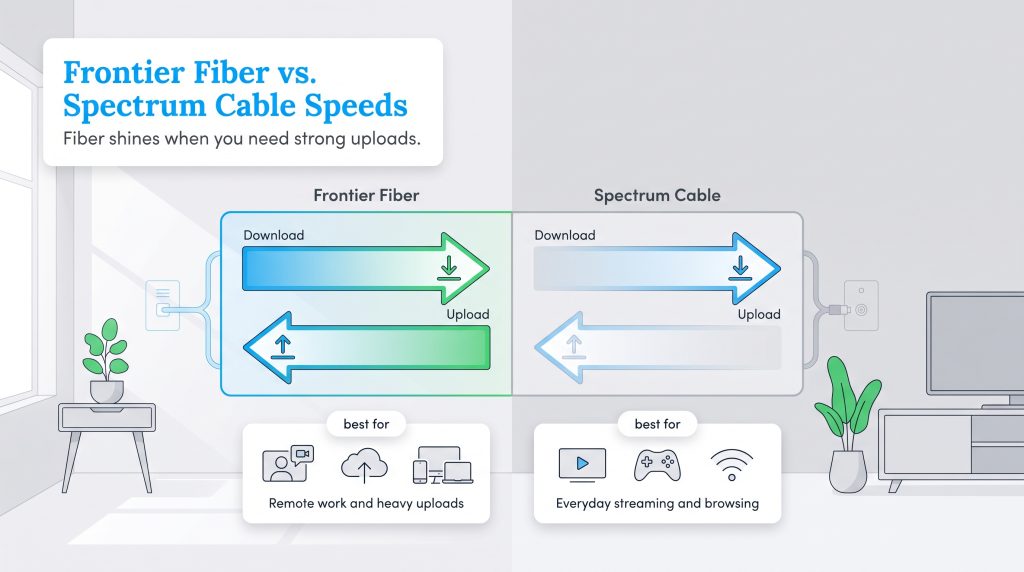
Understanding the physical wiring behind your wall outlet is crucial when comparing home internet options and weighing cable vs. fiber internet, as network architecture directly shapes your daily routine. When matching up Frontier fiber vs. Spectrum cable, the core difference comes down to how data travels the “last mile” into your living room. Spectrum primarily operates a Hybrid Fiber-Coaxial (HFC) network. That means Spectrum runs fiber-optic lines to a central neighborhood node, but relies on traditional copper coaxial television cables to carry the signal from the street into your home. Copper coaxial lines are great at pulling data down, but they have limited bandwidth capacity for sending data back upstream. In contrast, Frontier Fiber uses a 100% Fiber-to-the-Home (FTTH) architecture, running glass fiber-optic strands directly into your home’s optical network terminal (ONT).
This architectural difference explains the massive gap in Frontier vs. Spectrum upload speeds and network responsiveness (latency). Because light signals travel through glass with minimal resistance, Frontier Fiber averages an impressive 12.2 ms latency on its fiber lines (and 19.9 ms overall across all of its networks), compared to Spectrum’s 27.7 ms average latency. That lower ping makes a huge difference when you’re playing fast-paced online games or collaborating on live video calls. Even more striking is the upload comparison when evaluating Frontier 1 Gig vs. Spectrum 1 Gig plans: while both plans download a massive video game at 1,000 Mbps, Frontier’s 1 Gig fiber plan provides a matching 1,000 Mbps upload speed, whereas Spectrum’s 1 Gig cable plan caps your uploads at just 35 Mbps.
Symmetrical upload speeds and low latency matter most if your household regularly engages in two-way digital activities. You’ll notice the biggest upgrade with Frontier Fiber if:
- You upload large video projects to YouTube, TikTok, cloud drives, or company servers.
- You rely on Zoom, Microsoft Teams, or Google Meet daily without wanting frozen screens.
- You have multiple 2K or 4K cloud-connected security cameras continuously uploading footage around your property.
- You regularly back up large photo libraries or system drives to iCloud, Google Drive, or Dropbox.
- Multiple family members play competitive online games or video chat at the exact same time.
| Category | Frontier Fiber (FTTH) | Frontier DSL | Spectrum Cable (HFC) |
|---|---|---|---|
| Download Speed | 200 Mbps to 7,000 Mbps | Up to 115 Mbps (often 10 to 50 Mbps) | 100 Mbps to 2,000 Mbps (up to 7 Gbps on fiber) |
| Upload Speed | 200 Mbps to 7,000 Mbps (Symmetrical) | 1 to 15 Mbps | 20 to 35 Mbps (1,000 Mbps on 2 Gig tier) |
| Average Latency | 12.2 ms (19.9 ms overall network average) | Higher (typically 35+ ms) | 27.7 ms |
| Best For | Remote work, competitive gaming, large uploads, smart homes | Light email and basic web browsing only | 4K streaming, browsing, casual gaming, general household use |
| Main Drawback | Limited geographic availability | Outdated copper speeds and high latency | Asymmetrical uploads on standard plans |
Frontier DSL vs. Spectrum Cable
Pitting Frontier DSL vs. Spectrum cable reveals an entirely different reality. In rural areas where Frontier hasn’t upgraded its infrastructure, its DSL internet service runs over aging copper telephone lines that struggle to deliver modern broadband performance. With download speeds often hovering well below 115 Mbps and upload speeds crawling between 1 and 15 Mbps, Frontier DSL quickly buckles in homes where more than one person is streaming, gaming, video calling, or running smart cameras at the same time. Even though Spectrum’s HFC network shares neighborhood bandwidth and offers modest 20 to 35 Mbps uploads on standard tiers, its 100 Mbps to 1,000 Mbps download speeds are vastly faster, more stable, and far more practical than Frontier DSL for any modern household.
TV and Mobile Bundles: Spectrum vs. Frontier
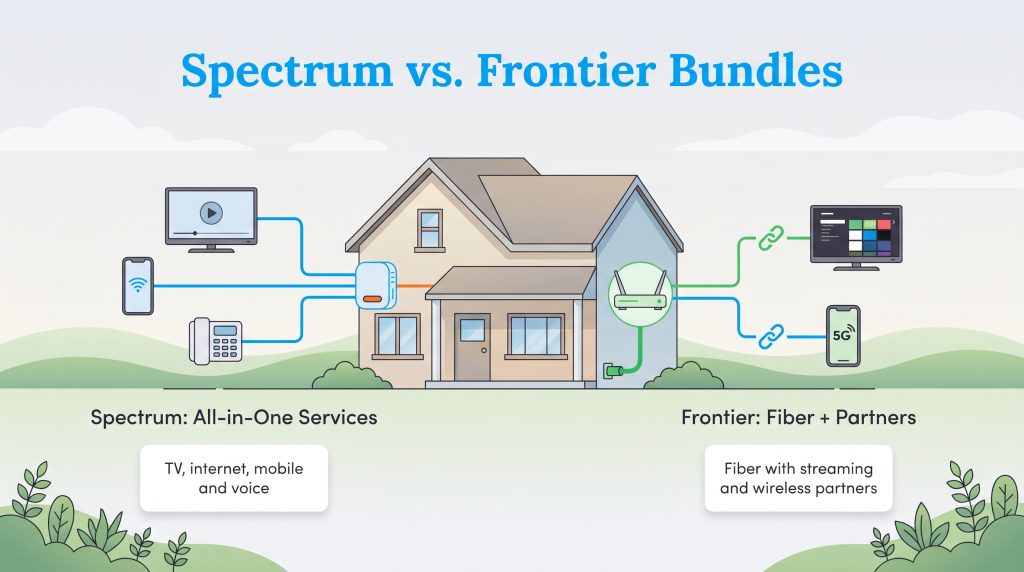
When you’re moving into a new home, consolidating your internet, live television, and cell phone bills can save both time and money. However, when comparing Spectrum vs. Frontier bundles, the two providers take vastly different approaches: Spectrum operates as a traditional, all-in-one utility powerhouse, while Frontier relies on modern streaming and wireless partnerships.
Spectrum still embraces the classic triple-play bundle, allowing you to pair home internet with Spectrum TV Select (starting at $75+ per month), Spectrum Mobile ($30 per month for Unlimited lines), and Spectrum Voice home phone service ($15 per month). A huge perk added to Spectrum TV Select in recent years is the inclusion of free ad-supported streaming apps — including Disney+, Peacock, Paramount+, Max, and more — directly inside your TV package at no extra charge. Furthermore, new Spectrum Internet customers can often claim one Unlimited mobile line free for 12 months, and if you’re locked into a contract with a competing provider, Spectrum’s Contract Buyout Program covers up to $500 in early termination fees when you bundle qualifying TV and internet services.
Frontier, on the other hand, discontinued its legacy cable television service to focus purely on fiber broadband and strategic partnerships. Instead of maintaining bulky cable boxes, Frontier partners with YouTube TV, giving Frontier internet subscribers a $10 per month discount for their first 12 months of live streaming TV (bringing the base YouTube TV plan down from $82.99 to $72.99 per month) alongside a unified billing option. On the mobile front, following Verizon’s 2026 acquisition of Frontier, new and existing Frontier Fiber subscribers can now bundle their home internet with qualifying Verizon Mobile plans to unlock a $15 per month discount, bridging the gap between fiber broadband and nationwide 5G wireless service.
| Bundle Combination | Internet Speeds | Included Perks & Features | Promotional Price |
|---|---|---|---|
| Spectrum Internet Premier + Spectrum Mobile | 500 Mbps down / 20 Mbps up | 1 Unlimited Mobile line free for 12 mos.; free modem ($10/mo. WiFi router optional) | $50.00/mo. (for 12 mos.) |
| Spectrum Internet Gig + TV Select + Mobile | 1,000 Mbps down / 35 Mbps up | 150+ live channels; free ad-supported Disney+, Peacock & Paramount+; free Advanced WiFi; up to $500 Contract Buyout | $145.00+/mo. (for 12 mos.) |
| Frontier Fiber 500 + Verizon Mobile Bundle | 500 Mbps symmetrical | $15/mo. discount when linking Frontier Fiber with qualifying Verizon Wireless Unlimited plans; free Wi-Fi router | $29.99/mo. for internet (after $15/mo. bundle credit) |
| Frontier Fiber 1 Gig + YouTube TV | 1,000 Mbps symmetrical | $10/mo. off YouTube TV for 12 mos. (100+ live channels & unlimited cloud DVR); free Wi-Fi router | $137.98/mo. combined (for 12 mos.) |
Availability and Customer Satisfaction
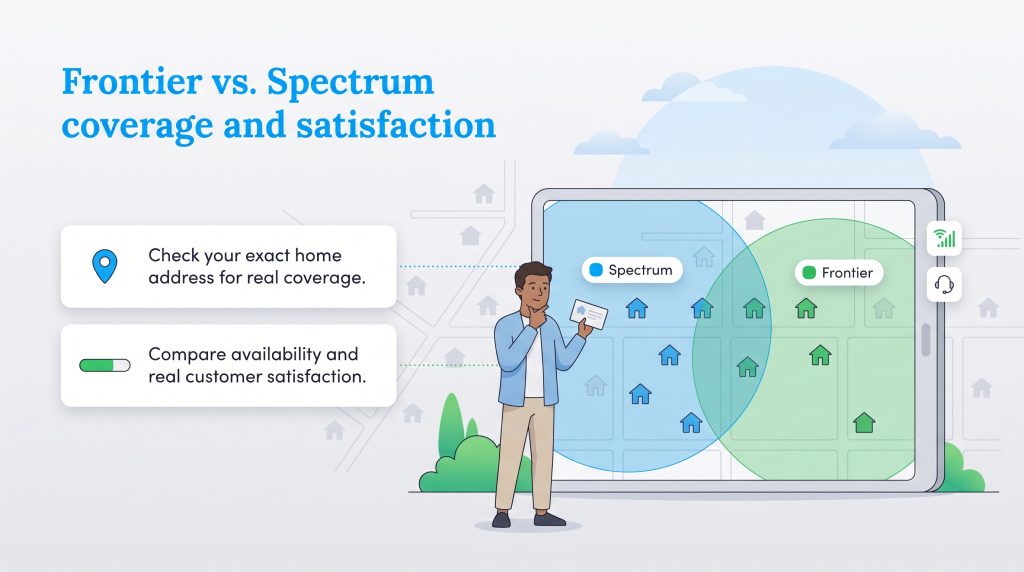
The biggest hurdle you’ll encounter when weighing Spectrum vs. Frontier availability is sheer geographic reach. Spectrum operates a massive footprint across 41 states, with heavy concentrations in major metro and suburban markets across New York, Ohio, North Carolina, South Carolina, Texas, and California. Frontier operates on a smaller regional scale across 25 states. Within Frontier’s territory, its coveted Fiber network is heavily concentrated in California, Texas, Florida, and Indiana — making up roughly two-thirds of its total footprint — while its older DSL network covers the remaining rural third. Because both providers overlap significantly in states like California, Texas, and Florida, always check your local broadband coverage to see which exact cables reach your street.
🚩 Heads Up: Just because a provider serves your local zip code doesn’t guarantee their premium tiers are wired directly to your street, so always check your exact home address before making any final decisions.
When it comes to industry reputation, there are telling differences in Spectrum vs. Frontier customer service depending on the underlying network technology. According to the 2026 American Customer Satisfaction Index (ACSI), Frontier Fiber edges out Spectrum with a score of 72 out of 100, while Spectrum follows closely behind at 71 out of 100. However, Frontier’s non-fiber DSL service lags significantly with a score of just 63 out of 100. Unbiased consumer sentiment echoes these exact numbers; users weighing the Spectrum vs. Frontier debate on neighborhood forums frequently note that Frontier Fiber subscribers love their rock-solid connection quality and price stability, while Spectrum earns praise for fast self-installation and accessible local retail stores, even if post-promotional bill increases cause frustration.
| Provider / Network Type | 2026 ACSI Score (Out of 100) | Key Customer Takeaway |
|---|---|---|
| Frontier Fiber | 72 / 100 | High marks for symmetrical speed reliability, low latency, and included Wi-Fi equipment |
| Spectrum Internet | 71 / 100 | Strong satisfaction for widespread coverage, easy self-install, and mobile/TV bundle value |
| Frontier DSL | 63 / 100 | Lower ratings driven by aging copper line speeds and rural repair wait times |
What Verizon’s Acquisition of Frontier Means for You
If you’ve noticed Verizon branding alongside Frontier lately, there is a major industry reason why: Frontier is now officially a Verizon company following their landmark $20 billion acquisition agreement. Ironically, several of Frontier’s prime fiber markets in California, Texas, and Florida were originally purchased from Verizon Fios years ago, meaning this deal brings those fiber-optic networks right back under the Verizon umbrella to create a unified coast-to-coast fiber and wireless giant.
For consumers moving into a new home in 2026, the Verizon Frontier acquisition delivers immediate, tangible benefits. Both new and existing Frontier Fiber customers can now bundle their home broadband with Verizon Wireless mobile plans to save $15 per month on their combined connectivity costs. Looking further ahead, Verizon’s deep capital investments are accelerating fiber buildouts into underserved DSL neighborhoods while integrating Frontier accounts into Verizon’s streamlined customer support, retail store network, and billing infrastructure.
How to Switch From Spectrum to Frontier
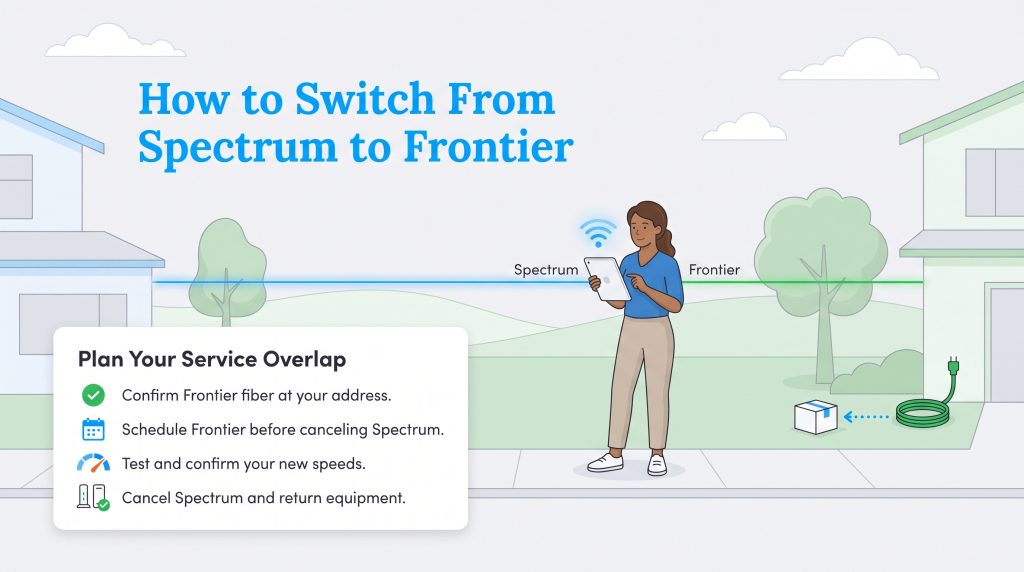
Switching from Spectrum to Frontier doesn’t have to be a headache-inducing ordeal that leaves your household offline for days. Whether you are moving into a new residence and setting up utilities, or you simply want to upgrade your current home’s cable connection to newly installed fiber, a little proactive scheduling guarantees a smooth transition. The smartest strategy is to overlap your service dates by a day or two, ensuring you never miss an important work email or live broadcast while swapping hardware.
Follow these five steps to manage the switch without a hiccup:
- Verify exactly what Frontier offers: Enter your full street address to confirm that 100% Fiber-to-the-Home is genuinely available at your residence, rather than the slower DSL alternative.
- Schedule your Frontier installation: Book your professional fiber installation appointment for a date two or three days before your Spectrum billing cycle renews or before you plan to cancel.
- Test the new connection: Once the Frontier technician installs the optical network terminal (ONT) and router, connect your primary devices and run a quick speed test to verify symmetrical performance.
- Cancel your Spectrum service: Call Spectrum to close your account only after you know your new fiber network is completely stable and active.
- Return your old equipment: Drop off your Spectrum modem and router at a local Spectrum store or UPS shipping center — and keep the paper receipt — to avoid unreturned equipment fees.
Choosing the Right Internet for Your Household
Selecting the ideal internet provider ultimately boils down to matching the physical wiring on your street to your household’s daily digital diet. When weighing Spectrum vs. Frontier, we recommend using three simple rules of thumb to make your final decision:
- Choose Frontier Fiber if symmetrical upload speeds, low 12.2 ms latency, free Wi-Fi router equipment, and Verizon Mobile bundle discounts matter most to your home.
- Choose Spectrum if Frontier Fiber isn’t wired to your street, or if you want reliable cable download speeds paired with traditional live cable TV and free streaming apps.
- Avoid Frontier DSL if your household streams in 4K, plays online games, works remotely, or relies on cloud-connected smart home devices.
If your home falls inside Frontier’s expanding fiber footprint, the combination of symmetrical bandwidth, zero monthly router fees, and newly integrated Verizon Wireless perks makes Frontier Fiber our top overall winner for remote workers, gamers, and busy families. On the other hand, if Frontier only offers legacy DSL in your neighborhood, Spectrum easily takes the crown. Spectrum’s widespread cable network delivers the fast download speeds, quick self-installation, and flexible TV and mobile bundles needed to keep modern life humming along smoothly.
As you finalize your internet setup, consider taking a few small steps to make your home network more sustainable. Placing your router in a central, elevated, and unobstructed spot often prevents the need to buy extra mesh extenders that draw continuous electricity. In addition, fiber-optic networks naturally require less energy to transmit data over long distances than traditional copper lines, making fiber an environmentally mindful choice when available. Whenever you upgrade your home hardware, always return rental units to your ISP or recycle older personal routers through a certified electronics recycling program rather than tossing them in the trash.
🌱 Eco Edge: Don’t pay for more speed than your household actually uses. Choosing the right-sized plan can save money, and using efficient networking equipment can trim small but steady electricity use over time.
Frequently Asked Questions About Spectrum vs. Frontier
Is Verizon Fios the same as Frontier?
Does Spectrum offer fiber internet to the home?
Can you bundle TV and mobile phone service with Frontier and Spectrum?
Can I use my own router with Spectrum and Frontier?
Why is Frontier DSL so much slower than Spectrum?
Do Spectrum or Frontier require annual contracts?
Which provider is better for gaming and working from home?
About the Author

David has been an integral part of some of the biggest utility sites on the internet, including InMyArea.com, HighSpeedInternet.com, BroadbandNow.com, and U.S. News. He brings over 15 years of experience writing about, compiling and analyzing utility data.

LaLeesha has a Masters degree in English and enjoys writing whenever she has the chance. She is passionate about gardening, reducing her carbon footprint, and protecting the environment. She also recently served as President of the Board for City Sprouts (a community garden).