

Hybrid fiber-coaxial networks combine traditional copper cables with modern fiber optics to power your home internet, offering a reliable bridge to high-speed connectivity.
Key Takeaways
- Hybrid Fiber-Coaxial (HFC) networks use a blend of infrastructure to deliver broadband without requiring costly new fiber lines dug straight to your door.
- A direct fiber vs. cable internet comparison is crucial for smart homes, as full fiber often provides the stronger upload speeds that busy households and remote workers appreciate.
- Choosing full fiber over legacy connections can be an environmentally mindful choice, as active HFC networks generally consume more neighborhood power.
Setting up a new residence involves juggling dozens of moving parts, but deciphering which internet service provider to hire shouldn’t cause a headache. If you are seeing advertisements for “fiber-powered” internet plans, there is a strong chance you are actually looking at a Hybrid Fiber-Coaxial (HFC) network. These widely available systems combine the cutting-edge speed of modern fiber optics with the older, existing copper wiring already buried in your yard. Demystifying how these blended networks function will help you bypass telecom marketing fluff and choose the exact level of bandwidth your family requires. Our goal is to give you the practical knowledge to navigate this technology, compare it against pure fiber options, and confidently select a broadband plan that keeps your household connected without overpaying for unnecessary capacity.
How HFC Network Architecture Works
If you’re wondering what an HFC network is, it’s essentially a tag-team effort between light and electricity. Having HFC network architecture explained simply comes down to understanding the journey your data takes from the wider internet directly into your living room. The process begins at your internet service provider’s central data hub. From there, blazing-fast data travels as pulses of light through advanced fiber-optic cables over long distances to reach a localized street cabinet in your neighborhood, known as an optical node.
Once the light pulses reach this neighborhood node, the equipment converts the optical signals into radio frequency electrical signals. From that node, traditional copper coaxial cables carry the data signal the remaining distance to your home’s modem. This blended approach allows telecom companies to deliver incredibly fast download speeds to residential areas without the massive expense and disruption of trenching new fiber lines straight to every single property.
📌 Quick Fact: When you purchase standard “cable internet” from a major provider, you are almost certainly running on an HFC architecture rather than an entirely outdated pure copper system.
HFC vs. FTTH (Fiber to the Home): Key Differences
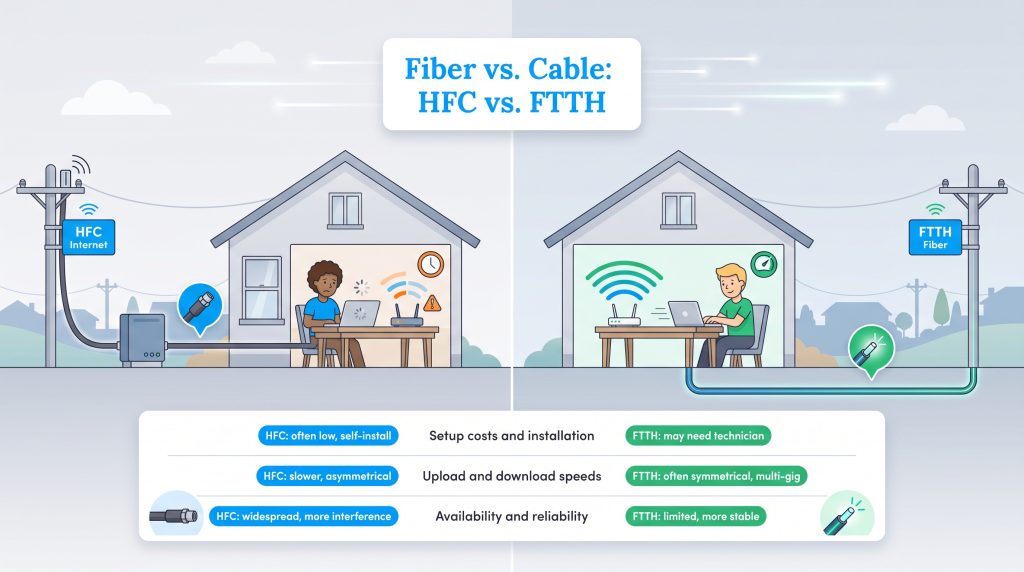
Conducting a fiber vs. cable internet comparison is an essential step if you live in an area serviced by multiple modern telecom providers. Fiber to the Home (FTTH) means the provider skips the neighborhood copper node entirely and buries a direct glass fiber line straight into your house.
When looking at HFC vs. FTTH internet, the most critical difference involves how they handle uploading and downloading data. FTTH provides symmetrical speeds, meaning your upload speed is exactly as fast as your download speed. HFC provides asymmetrical speeds, prioritizing lightning-fast downloads while offering much slower uploads. Furthermore, comparing fiber-optic vs. coaxial cable reveals that pure fiber is significantly more reliable. Coaxial cable can be vulnerable to signal degradation, corrosion, and electromagnetic interference, whereas fiber-optic signals rely on light and are completely immune to electrical disruptions.
| Feature | HFC Internet | FTTH (Pure Fiber) |
|---|---|---|
| Speed Configuration | Asymmetrical (faster downloads, slower uploads) | Symmetrical (equal upload and download speeds) |
| Latency & Ping | Moderate (typically 20–40 ms) | Extremely low (often under 10 ms) |
| Reliability | Susceptible to peak-hour neighborhood congestion and interference | Highly reliable, resistant to electromagnetic interference |
| Setup Costs | Often low; DIY self-install kits frequently available | Varies; typically requires professional technician installation |
Pure fiber networks are incredibly future-proof, easily scaling to multi-gigabit speeds as household bandwidth demands continue to explode. However, you will often find that FTTH availability is much scarcer than traditional HFC, which heavily piggybacks on decades-old television infrastructure. To verify exactly which technology reaches your specific address, we highly recommend typing your new street details into the FCC National Broadband Map.
Understanding DOCSIS and HFC Internet Speeds
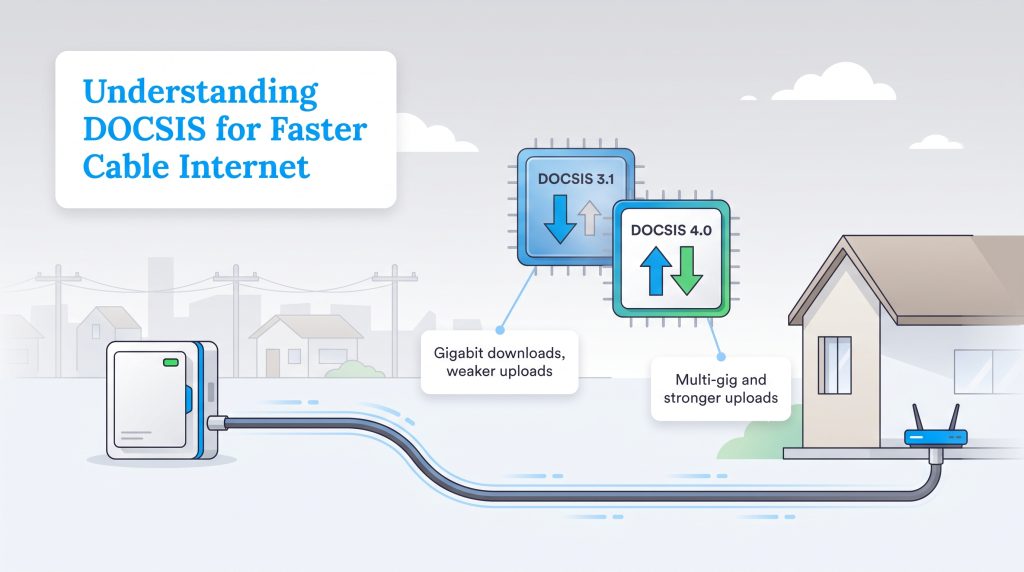
To fully grasp HFC internet speeds and reliability, you need to know how data is packaged over those copper wires. The telecom industry uses a standard called DOCSIS (Data Over Cable Service Interface Specification) to dictate how internet data translates across older television cables. Upgrading DOCSIS versions is exactly how cable companies continuously squeeze faster speeds out of aging copper infrastructure.
Understanding DOCSIS 3.1 vs. DOCSIS 4.0 HFC capabilities is crucial when evaluating modern speeds. Currently, DOCSIS 3.1 is the widely used standard in most cable internet plans. It is incredibly capable, easily allowing your legacy coaxial cables to handle gigabit download speeds for heavy 4K streaming. However, it still struggles with upload speeds. According to industry specifications, the emerging DOCSIS 4.0 technology will drastically improve this. As providers roll out DOCSIS 4.0 upgrades to neighborhood nodes, users will eventually see multi-gigabit speeds and heavily improved upload capacities that start to rival pure fiber networks.
Pros and Cons of Hybrid Fiber-Coaxial Internet
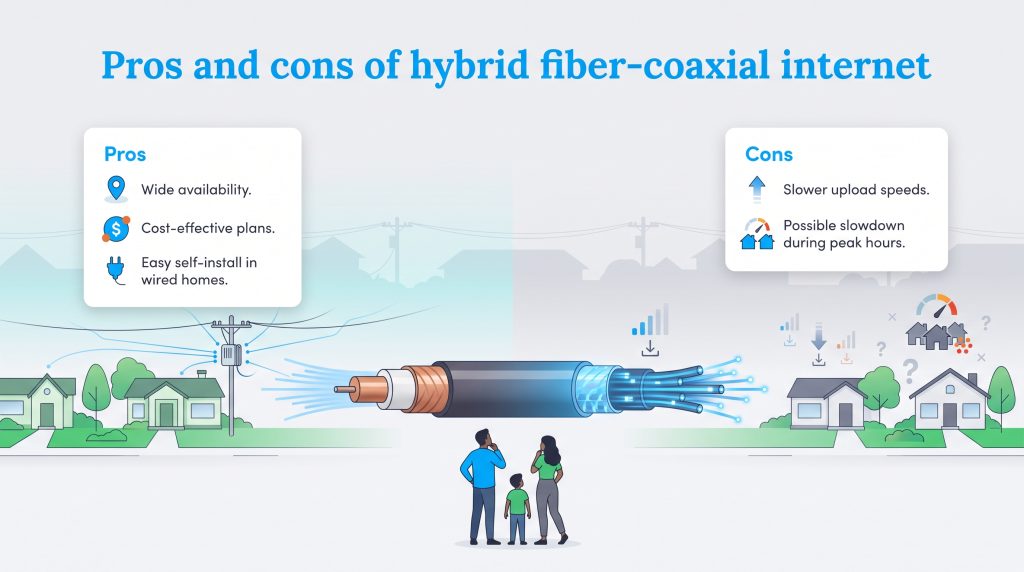
When you are comparing your local internet service options, weighing hybrid fiber-coaxial pros and cons provides a quick snapshot of what to expect from your connection. While fiber is considered the gold standard, HFC holds its own as a highly capable choice for the vast majority of consumers.
The Pros:
- Wide Availability: Because it utilizes existing cable TV lines, HFC is accessible in nearly every urban and suburban neighborhood.
- Cost-Effectiveness: Plans are typically budget-friendly, offering massive download speeds for a fraction of what early fiber setups cost.
- Easy Setup: If your new home already has coaxial wall outlets, you can often save money by choosing a self-install kit over a technician visit.
The Cons:
- Slower Upload Speeds: The asymmetrical nature of HFC means uploading large files or managing multiple security cameras can create bottlenecks.
- Neighborhood Network Congestion: Since coaxial nodes share bandwidth across multiple homes on a street, you may experience slower speeds during peak evening hours when everyone is streaming.
Top Hybrid Fiber-Coaxial Internet Providers
If you are actively shopping for a connection in the United States, you will likely encounter one of these major hybrid fiber-coaxial internet providers. Each utilizes a robust HFC network to cover millions of households.
- Xfinity (Comcast): As one of the largest internet providers in the country, Xfinity leverages an extensive HFC network to offer widely available gigabit download speeds, with DOCSIS-powered multi-gig upgrades actively rolling out across major cities.
- Spectrum: Spectrum utilizes its massive hybrid infrastructure to deliver reliable, no-data-cap internet plans, making 1 Gbps download speeds incredibly accessible without the need for localized fiber trenching.
- Cox Communications: Covering vast regions across the U.S., Cox provides a flexible mix of HFC internet tiers that comfortably cater to everything from basic web browsing to heavy home streaming and smart device integration.
The Eco-Conscious Choice: Broadband Energy Efficiency
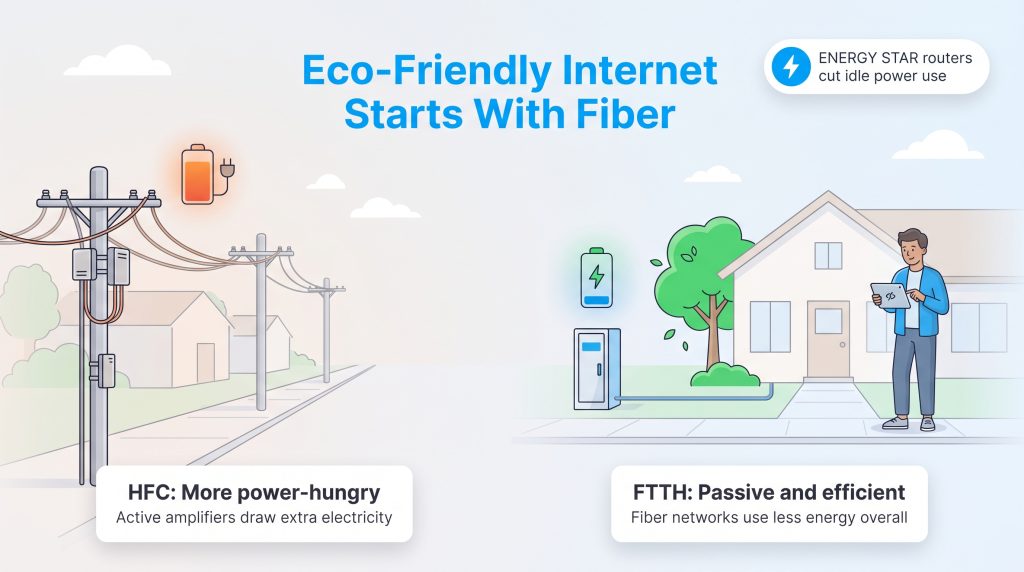
Beyond speed and reliability, the physical infrastructure of your internet connection directly impacts neighborhood power consumption. HFC networks require active, electrically powered amplifiers spaced out along utility poles to push the data signal over older copper wires. In contrast, modern FTTH setups utilize passive optical networks that rely on unpowered light splitters, which generally draw significantly less electricity from the local grid. If you are focused on reducing your monthly home energy footprint, examining how your data is delivered is an excellent next step.
🌱 Eco Edge: Choosing a passive fiber network is an environmentally mindful choice that actively contributes to lowering your community’s overall baseline power demands.
You can also boost your household’s efficiency by selecting ENERGY STAR certified networking equipment. These devices automatically scale down power usage during periods of network inactivity to conserve electricity.
Hardware and Upgrades: Future-Proofing Your Setup
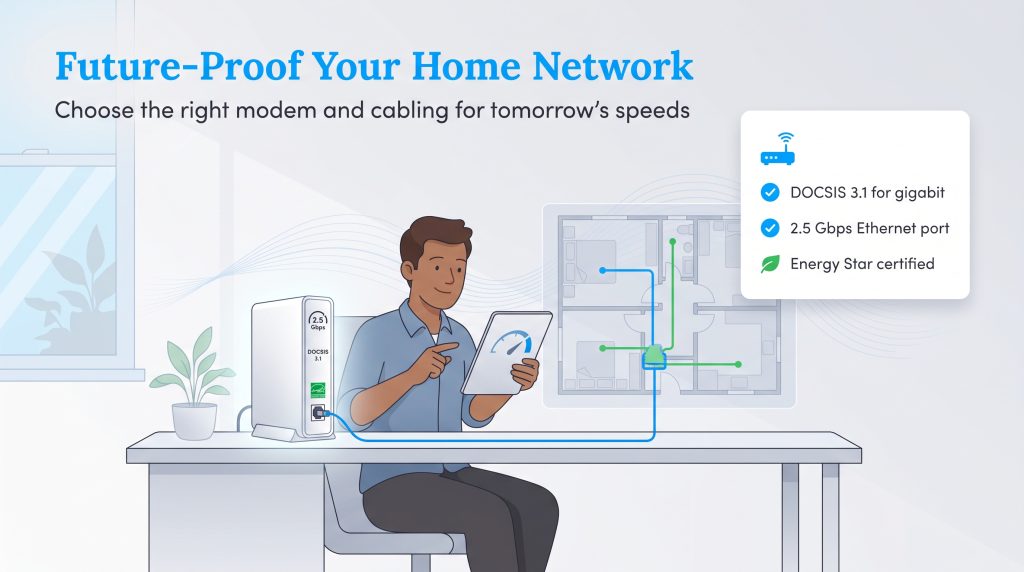
If your neighborhood exclusively offers cable internet, purchasing the best modem for HFC internet will ensure you maximize whatever speeds are currently available from your provider’s local node. Many readers ask us how to upgrade HFC to fiber, but this isn’t a DIY hardware swap. Moving to FTTH requires a local internet provider to physically trench new optical lines down your street. What you can control, however, is the equipment living on your desk.
If you are organizing your new home move and planning an extensive remodel, consider asking your contractor to run Cat6 Ethernet cables through the walls so your internal network can handle high-capacity DOCSIS improvements as they arrive. When buying a new modem for your current cable setup, check the box for these specific hardware specifications:
- DOCSIS 3.1 certification to ensure absolute compatibility with modern gigabit download plans.
- A multi-gigabit (2.5 Gbps) Ethernet port to prevent artificial bottlenecks between the modem and your main router.
- ENERGY STAR certification for much lower power use when the device is idle or lightly used.
Questions to Ask Before You Choose an HFC or Fiber Plan
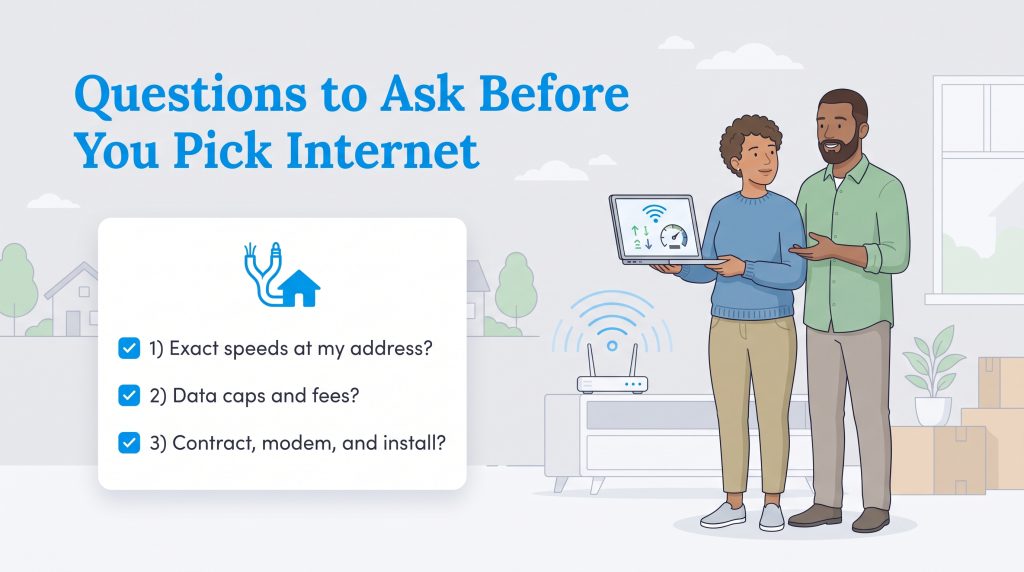
Moving into a new home provides a perfect opportunity to reevaluate your broadband needs from scratch. Before committing to a new contract or rolling over your previous service, use this quick checklist when speaking with local providers to ensure you get the right structural connection for your family.
- What specific upload speed is included with this plan?
- Is the advertised speed available at my exact address, or just in the general zip code?
- Is there a monthly data cap, and what are the overage fees?
- Is the modem included, rented for a monthly fee, or purchased separately?
- Does the plan require signing a multi-year contract?
- Is self-install available to save on activation fees?
- Is pure fiber available now, planned for later this year, or entirely unavailable in this neighborhood?
Choosing the Optimal Broadband Path for Your New Home
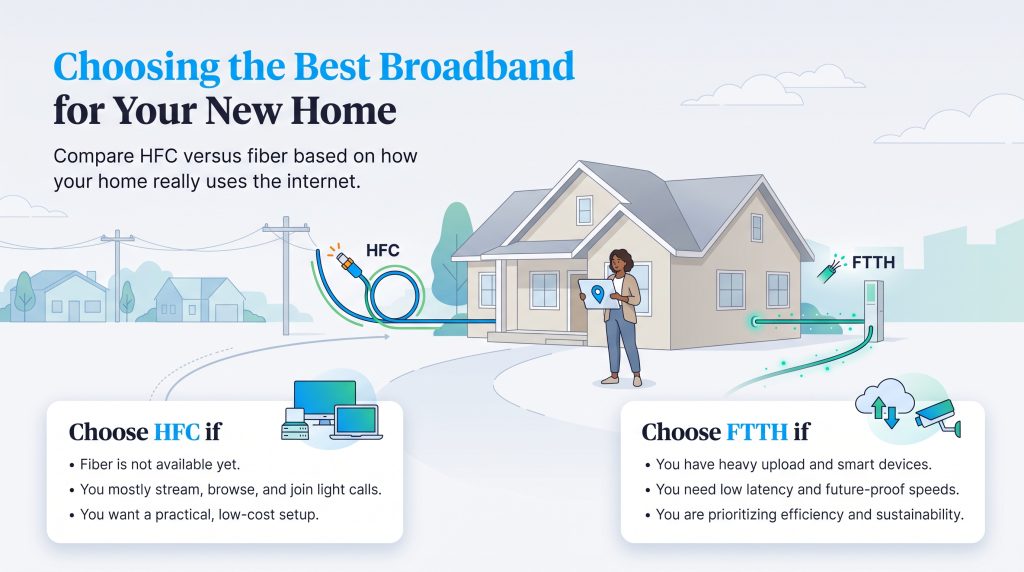
Securing a reliable internet connection doesn’t have to be a guessing game when you truly understand the physical infrastructure running beneath your street. Hybrid fiber-coaxial networks are highly capable, robust systems that easily support standard 4K streaming, heavy browsing, and regular remote work for the vast majority of modern households. If your home primarily downloads entertainment and joins occasional video calls, a well-priced HFC plan is often the most practical and accessible choice.
However, eco-conscious buyers and tech enthusiasts with heavy smart-home upload requirements should definitely prioritize a pure FTTH connection if one is actually available in their local market. Take a few minutes to verify your exact address on the FCC map, honestly assess your family’s daily upload habits, and confidently lock in a service that keeps your new home efficiently connected.
Choose HFC if:
- Pure fiber isn’t available at your address yet.
- Your household mainly streams shows, browses the web, and works remotely with one or two video calls at a time.
- You want to utilize a cost-effective plan and potentially self-install the equipment using existing cable outlets.
Choose FTTH if:
- You run multiple smart security cameras, host constant video calls, or sync massive cloud backups simultaneously.
- You want incredibly low latency, symmetrical upload performance, and the best future-proofing available.
- You’re prioritizing an energy-saving option and have multiple service plans available to choose from.
Frequently Asked Questions About Hybrid Fiber-Coaxial (HFC) Networks
Still sorting through the technical details? These quick answers cover the most common questions homeowners ask when comparing HFC, cable, and fiber internet service.
Is an HFC network the same as fiber internet?
How fast is a hybrid fiber-coaxial network?
Is HFC internet good for gaming?
What is the difference between DOCSIS 3.1 vs. DOCSIS 4.0 HFC?
How do I find the best modem for HFC internet?
How can I upgrade my HFC to fiber connection?
Is an HFC network considered an eco-conscious alternative to fiber?
About the Author

David has been an integral part of some of the biggest utility sites on the internet, including InMyArea.com, HighSpeedInternet.com, BroadbandNow.com, and U.S. News. He brings over 15 years of experience writing about, compiling and analyzing utility data.

LaLeesha has a Masters degree in English and enjoys writing whenever she has the chance. She is passionate about gardening, reducing her carbon footprint, and protecting the environment. She also recently served as President of the Board for City Sprouts (a community garden).