

Understand Your Options for Electricity and Natural Gas in Deregulated Energy Markets to Lower Your Monthly Bills
Key Takeaways
- Residential energy suppliers sell electricity and natural gas directly to consumers, while your local utility company remains responsible for delivering power and maintaining physical grid infrastructure.
- Comparing options lets you secure competitive home energy rates, allowing you to choose between fixed or variable rates and explore renewable energy options based on your household needs.
- Switching energy providers is an easy and completely seamless process that causes zero service interruptions to your daily routine, as your local utility handles the transition securely on the backend.
Energy deregulation has revolutionized how homeowners and renters manage their monthly utility costs by empowering them to choose their own residential energy suppliers. Rather than being permanently tied to a single traditional utility monopoly, residents in deregulated energy markets can actively shop around for both electricity and natural gas suppliers that better align with their household budgets and lifestyle goals. Whether you want to compare home energy rates to lock in a stable, long-term price against inflation, or you aim to transition your household to 100% renewable energy to reduce your carbon footprint, the power of choice rests firmly in your hands. By understanding how these competitive markets operate, you can easily secure customized plans that lower your utility bills and provide lasting peace of mind.
What Is a Residential Energy Supplier?
Residential energy suppliers are independent companies that sell electricity and natural gas directly to everyday consumers. Think of them as the customer-facing middlemen between the massive wholesale energy generation markets and your home. While traditional utility companies still own the physical power lines, underground gas pipes, and neighborhood distribution infrastructure, residential electricity providers and natural gas suppliers give you the absolute freedom to choose who actually supplies the energy flowing through those physical systems.
Different states use completely different terminology to describe these companies, which can sometimes cause confusion for new residents. In Texas, the Public Utility Commission officially calls them Retail Electric Providers (REPs). If you live in Pennsylvania or New Jersey, you will likely hear them called Electric Generation Suppliers. New York uses the term Energy Services Company (ESCO), while New England states like Connecticut and Massachusetts often refer to them as Competitive Suppliers. Regardless of the regional naming conventions you see across a state energy deregulation map, these companies all serve the exact same core purpose — offering you a competitive alternative to your expensive default utility rate.
💡 Pro Tip: Not all states have deregulated energy markets. Always check your local public utility commission website to see if you have the power to choose your natural gas and electric suppliers before you begin shopping for new rates.
Utility Company vs. Energy Supplier: What’s the Difference?
Understanding the fundamental difference between your local utility and an independent energy supplier is critical when navigating state energy choice programs. Traditional electric and gas utilities are the legacy organizations that physically deliver power to your home. In a fully regulated market, they handle everything from generation to transmission. However, in deregulated energy markets, these responsibilities are legally split to encourage healthy, cost-saving competition.
| Responsibility | Traditional Utility Company | Residential Energy Supplier |
|---|---|---|
| Physical Delivery | Owns and maintains the power lines, utility poles, transformers, and underground gas pipelines. | Does not own, operate, or manage any physical grid infrastructure. |
| Emergency Response | Responds directly to all neighborhood power outages, severe storm damage, and dangerous gas leaks. | Cannot assist with neighborhood emergencies or dispatch physical repair crews. |
| Billing & Fees | Charges a standard, unavoidable “delivery fee” on your monthly bill to cover infrastructure upkeep. | Strictly dictates the specific “energy supply charges” based on your chosen contract rate. |
| Rate Setting | Provides a default supply rate that is heavily regulated and fluctuates based on state mandates. | Purchases bulk energy on the wholesale market to offer competitive, highly customized pricing. |
Types of Energy Plans Offered by Suppliers
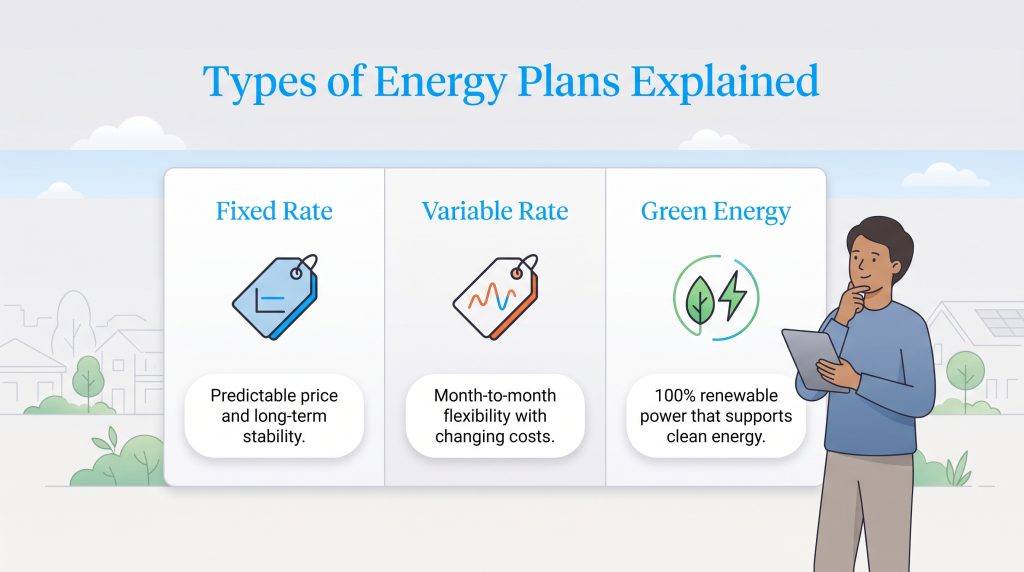
Once you decide to switch residential energy providers, the next major hurdle is selecting the exact type of plan that best suits your home. Energy suppliers structure their pricing in a few distinct ways, and understanding the financial nuances of each category is vital for your long-term budget stability. Whether you want rock-solid predictability or supreme flexibility, there is a structure designed for you.
Fixed-Rate Energy Plans
A fixed-rate plan successfully locks in your exact price per kilowatt-hour (kWh) or therm for the entire duration of your legal contract, which usually ranges from 12 to 36 months. This remains the safest and most popular consumer option because it completely shields your household budget from volatile energy market spikes caused by extreme weather or global supply chain disruptions.
- Pros for Fixed-Rate Energy Plans: Delivers predictable monthly bills, protects against sudden seasonal rate hikes, and simplifies long-term household budgeting.
- Cons for Fixed-Rate Energy Plans: Typically includes early cancellation penalties if you break the contract, and you will not benefit if overall wholesale market prices naturally drop.
Variable-Rate Electricity Plans
With a variable-rate plan, your energy price actively fluctuates from month to month based entirely on current wholesale market conditions. While you might enjoy significantly lower rates during mild spring and fall months when demand is low, your monthly bill can skyrocket dramatically during peak summer heat waves or severe winter storms.
- Pros for Variable-Rate Electricity Plans: Offers supreme flexibility with zero long-term commitments and no early termination fees, making it perfect for short-term renters.
- Cons for Variable-Rate Electricity Plans: Carries a high risk of sudden, uncapped rate hikes that can drastically inflate your monthly utility bill without warning.
Renewable Energy Options
Many suppliers now offer specialized plans backed entirely by official renewable energy certificates (RECs). This transparent verification process ensures that an amount of green energy — such as wind, solar, or hydroelectric power — equal to your home’s total consumption is actively added back into the regional power grid.
- Pros for Renewable Energy Options: Actively reduces your household’s carbon footprint and strongly supports the clean energy transition without requiring expensive physical solar panels on your roof.
- Cons for Renewable Energy Options: Can occasionally carry a slightly higher premium price per kWh compared to traditional fossil fuel plans.
🌱 Eco Edge: Opting for renewable energy suppliers is one of the fastest and most impactful ways a renter or homeowner can support clean energy infrastructure without making any structural modifications to their property.
How to Choose the Best Residential Energy Supplier
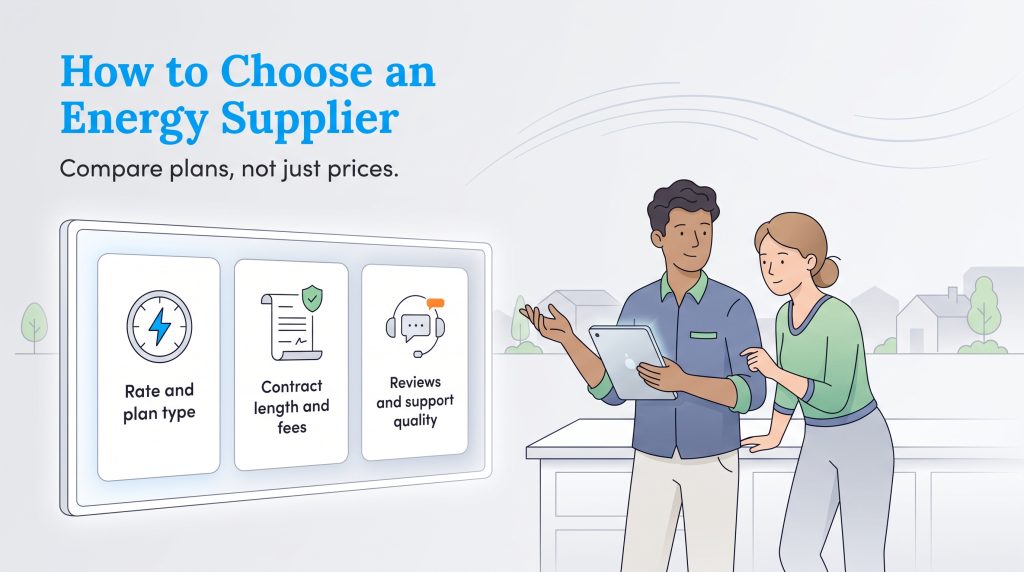
Having the freedom to choose your own energy provider brings several distinct advantages to your household. Instead of being locked into a single, state-mandated utility rate that fluctuates without your control, you can shop the open market for a customized plan. Because suppliers actively compete for your business, they frequently offer aggressive promotional discounts, cost-saving lifestyle perks, and superior terms compared to your default utility standard offer. To make an informed decision, carefully review this checklist when evaluating your local options:
- Rate Structures: Determine whether the security of a fixed-rate plan or the flexibility of a variable-rate plan makes the most sense for your immediate financial goals.
- Contract Length: Decide exactly how long you want to lock in your energy supply charges. Plans typically span anywhere from a brief three months up to a highly secure 36-month term.
- Early Termination Fees: Always check the fine print for early termination fees (ETFs). While a modest ETF is standard for fixed contracts, ensure the penalty isn’t overly punitive if you need to move or change providers unexpectedly.
- Customer Reviews and Support: Investigate the supplier’s reputation. The most trustworthy organizations offer highly responsive customer service, easy-to-read billing, and excellent digital account management tools.
Top Residential Energy Suppliers in the United States
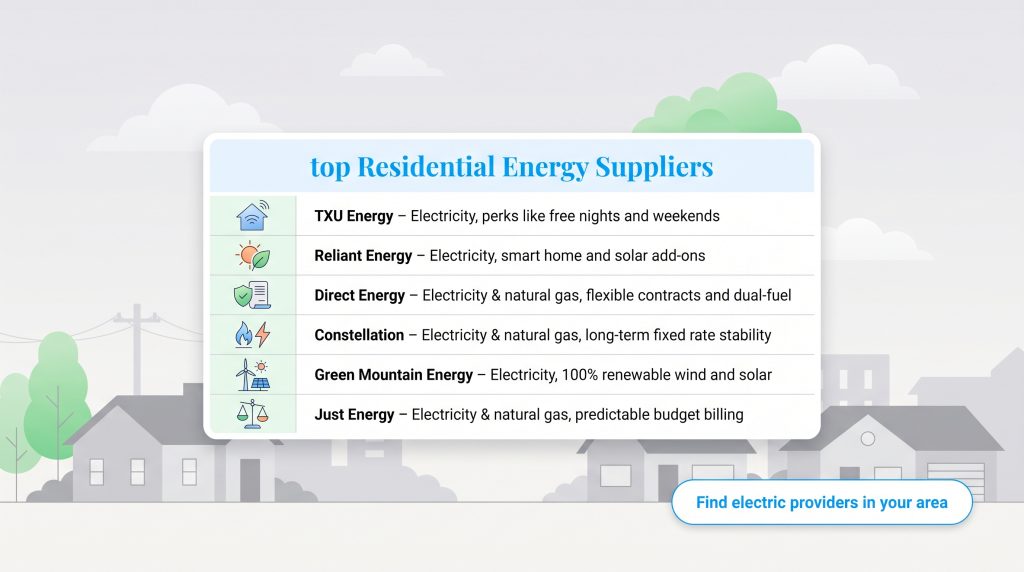
When searching for the best residential gas suppliers and electric providers, a few national companies consistently stand out as reliable industry leaders. These established organizations have built their solid reputations by serving millions of customers across multiple deregulated states. Below is a quick comparison of some of the largest players operating in the competitive energy market today.
| Provider Name | Services Offered | Best For |
|---|---|---|
| TXU Energy | Electricity | Creative lifestyle perks like free nights and weekends, plus robust customer loyalty rewards programs. |
| Reliant Energy | Electricity | Smart home technology integration, home security bundles, and specialized solar buyback plans. |
| Direct Energy | Electricity & Natural Gas | Comprehensive coverage across North America with flexible contract terms and dual-fuel options. |
| Constellation | Electricity & Natural Gas | Reliable, long-term fixed rates and heavily bundled residential home service plans. |
| Green Mountain Energy | Electricity | Eco-conscious consumers looking for 100% wind and solar renewable energy suppliers. |
| Just Energy | Electricity & Natural Gas | Predictable budget billing programs designed to help users manage severe seasonal energy cost fluctuations. |
Find Electric Providers In Your Area
Step-by-Step Guide to Switching Providers
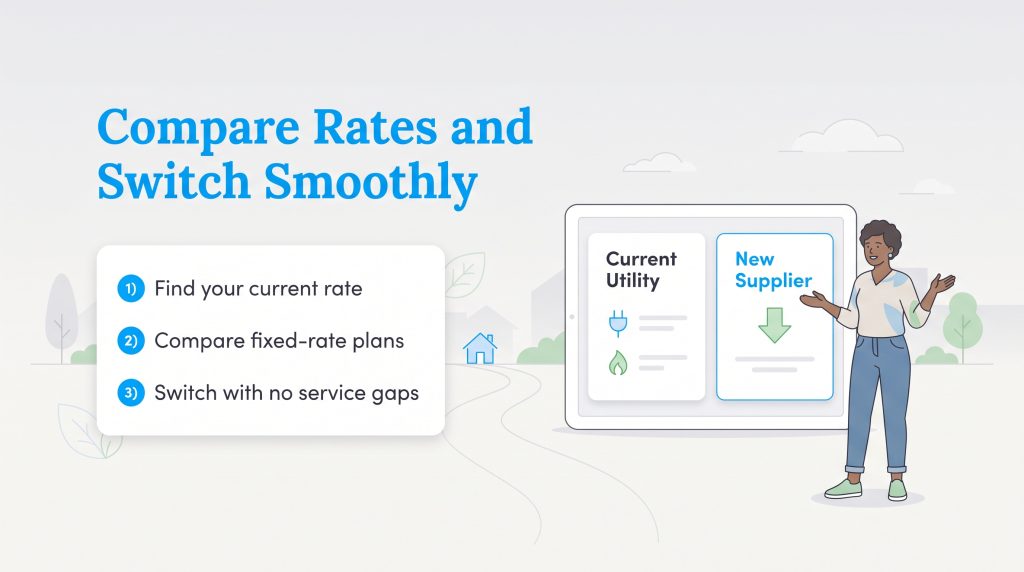
Learning how to switch energy providers might seem intimidating at first glance, but deregulated energy markets are legally designed to make the transition as incredibly smooth as possible. By following a highly structured approach, you can easily secure a much better rate without experiencing any physical interruption to your daily service.
- Review Your Current Bill: Grab your most recent home energy bill and locate the “Price to Compare” or current “Standard Offer Service” rate. This is the baseline price per kWh (for electricity) or per therm (for natural gas) that you currently pay. Use this exact number as your benchmark to measure potential savings.
- Compare Home Energy Rates: Utilize your state’s official public utility commission shopping website or an independent energy comparison tool to view active offers in your zip code. Look specifically for highly reputable residential energy suppliers offering fixed-rate energy plans that successfully undercut your current utility’s default rate.
- Enroll in Your New Plan: Once you find the absolute perfect plan, simply sign up through the new supplier’s website or over the phone. You will only need your current utility account number to complete the enrollment process.
That is truly all it takes. Your new supplier will happily coordinate the rest of the backend transition directly with your local utility company. This ensures that switching causes zero service interruptions — meaning your lights stay on, your home stays warm, and you never have to schedule a tedious home visit from a technician.
Deregulated Energy Markets by State
Energy deregulation varies widely across the United States. While some states boast completely open markets for both electricity and natural gas, others remain entirely regulated or only offer limited commercial choices. If you want to take advantage of competitive energy supply charges, check this list of states that currently feature active residential deregulated energy markets:
- Deregulated Electricity Markets: Connecticut, Delaware, Illinois, Maine, Maryland, Massachusetts, Michigan, New Hampshire, New Jersey, New York, Ohio, Pennsylvania, Rhode Island, Texas, and Washington D.C.
- Deregulated Natural Gas Markets: California, Colorado, Connecticut, Florida, Georgia, Illinois, Indiana, Kentucky, Maryland, Massachusetts, Michigan, Montana, New Jersey, New York, Ohio, Pennsylvania, Rhode Island, Texas, Virginia, Washington D.C., and Wyoming.
📌 Quick Fact: Even within a deregulated state, energy choice programs can be highly localized. Certain municipal grids or electric cooperatives may still operate as traditional monopolies, so always confirm availability using your specific zip code.
Preparing for Your Next Energy Contract
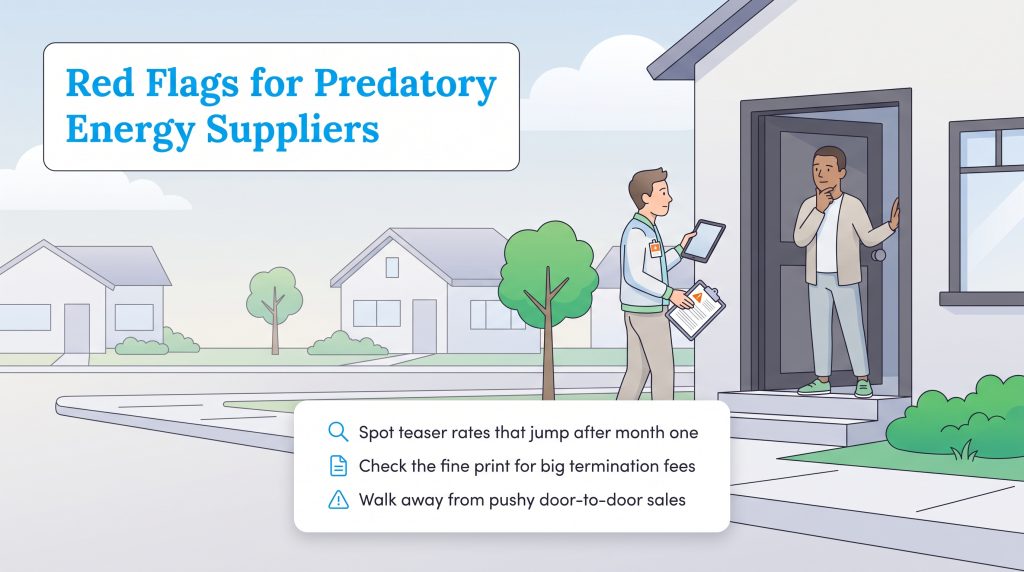
While the vast majority of residential energy suppliers operate with strict integrity, energy choice programs can occasionally attract bad actors looking to make a quick buck. As you prepare to sign a new contract, it is crucial to remain incredibly vigilant and consciously protect yourself from deceptive sales practices or overly aggressive marketing tactics. If an energy deal sounds entirely too good to be true, it is always worth investigating further.
Be extremely cautious of suppliers offering a promotional introductory rate that is drastically lower than the current market average. These “teaser rates” often expire rapidly after the first month, seamlessly rolling your account into an exorbitant, uncapped variable rate. Additionally, legitimate energy suppliers rarely use aggressive door-to-door sales tactics or demand to see your physical utility bill on the spot. Never hand over your sensitive account information to an unverified salesperson, as this oversight can easily lead to switching your energy provider without your explicit consent.
Ultimately, navigating historically deregulated energy markets does not have to be a confusing household chore. By taking the time to fully understand the nuanced differences between your local legacy utility and an independent supplier, you empower yourself to make informed, money-saving decisions on a daily basis. Armed with the right foundational knowledge, you can comfortably switch to a customized plan that offers both reliable physical comfort and lasting financial peace of mind year-round.
Frequently Asked Questions About Energy Suppliers
What is a residential energy supplier?
Do I have to switch my residential energy supplier?
Are there fees for canceling my current energy contract early?
Why should I choose an alternative residential energy supplier?
Which states allow me to choose my residential energy supplier?
Will my power go out if I switch energy providers?
Do residential energy suppliers handle power outages?
About the Author

David has been an integral part of some of the biggest utility sites on the internet, including InMyArea.com, HighSpeedInternet.com, BroadbandNow.com, and U.S. News. He brings over 15 years of experience writing about, compiling and analyzing utility data.

Claudio is a sustainability-focused writer with a background in Anthropology and Psychology from NC State University. He has spent over 15 years working in writing, interpretation, and translation, driven by a deep interest in how human culture shapes the environment. Today, he shares his curiosity with readers by writing about sustainable living solutions and the connection between everyday choices and environmental impact.