Take control of your utility costs before moving day by understanding the Ameren price to compare and exploring renewable energy choices.
Key Takeaways
- Determine your service area to know if you live in regulated Missouri or deregulated Illinois.
- Locate your Price to Compare or Time-of-Use plan to effectively shop for competitive energy plans, adjust your peak usage, and explore renewable options.
- Set up your online account early to manage billing, track usage, and monitor outage maps on moving day.
Moving can easily become an overwhelming puzzle of cardboard boxes and forwarding addresses, but figuring out your utilities shouldn’t add to the headache. Securing reliable and affordable electricity and natural gas typically ranks right at the top of your moving checklist, and we know that setting up an account doesn’t simply mean accepting a default rate without asking how your energy is billed. Our objective is to guide you through starting your service, decoding the confusing jargon on your utility bills, comparing Illinois supply rates and Missouri Time-of-Use plans, and exploring sustainable energy options so you can keep your new home comfortable and efficient from day one.
Where Does Ameren Provide Service?

📌 Quick Fact: Ameren splits its vast Midwest operations into two distinct state entities, currently serving 2.5 million electric customers and over 900,000 natural gas customers across 64,000 square miles in Illinois and Missouri.
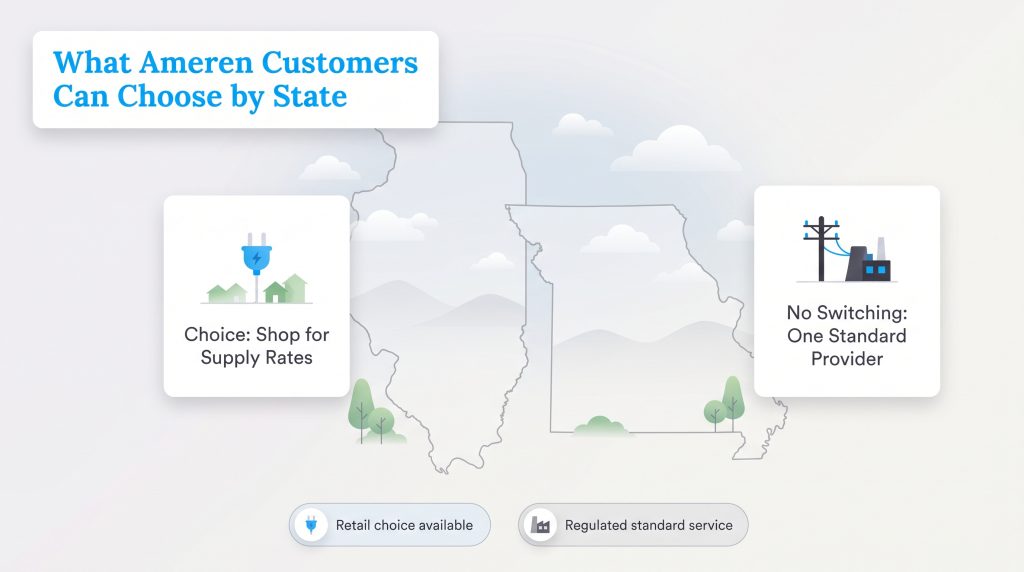
Ameren operates an expansive energy grid across the Midwest, serving 2.5 million electric customers and over 900,000 natural gas customers across 64,000 square miles. The company splits its core operations into two major regional subsidiaries based on state lines: Ameren Illinois (serving roughly 1.2 million electric and 800,000 gas customers) and Ameren Missouri (serving approximately 1.3 million electric and 100,000 gas customers). Because state energy laws differ dramatically across the Mississippi River, your rate options and supplier choices depend entirely on your address.
| State | Can You Choose an Electric Supplier? | What Ameren Handles |
|---|---|---|
| Illinois | Yes, for eligible customers | Delivery, outage response, billing, and default supply |
| Missouri | No, regulated utility service (can choose Time-of-Use plans) | Generation, delivery, billing, and outage response |
If you are relocating to the region, it helps to know if your new address falls within their territory. Ameren provides electric and natural gas service to hundreds of communities, spanning major metropolitan hubs and smaller rural farming towns.
Ameren Service Area & Coverage Map
Some of the most notable cities within their coverage map include:
- Ameren Illinois: Peoria, Springfield, Decatur, Champaign, and Belleville
- Ameren Missouri: St. Louis, Jefferson City, Cape Girardeau, Columbia, St. Charles, Wentzville, and surrounding communities
How to Start Ameren Service in a New Home

Initiate an Ameren start service request for your new property early so you can avoid long phone wait times and prevent moving day delays. You can seamlessly transfer an existing account or open a brand-new one by visiting the “Start, Stop, or Move Service” portal directly at ameren.com. If you prefer speaking with a representative, call their main support lines Monday through Friday from 7:00 a.m. to 7:00 p.m. at 800-755-5000 (Illinois) or 800-552-7583 (Missouri). You will need your new service address, your exact move-in date, and your Social Security number or primary identification to verify your identity.
- Check your address and move-in date: Confirm that your new home actually falls within the Ameren coverage area and finalize the exact date you take possession of the property.
- Register online: Visit the official Ameren website, select your state, and navigate to the online service portal to input your personal details and set up your profile.
- Choose your rate or supply option: If you live in Illinois, decide whether to stick with the default utility supply rate or select an alternative supplier; if you live in Missouri, select the residential rate plan that matches your household schedule.
🚩 Heads Up: Always initiate your service transfer at least three to five business days before your move-in date. This gives the utility ample time to process the request and ensures your power and gas are successfully connected before the moving truck arrives.
Your Ameren Move-In Checklist

Moving day is chaotic enough without worrying about whether your lights or furnace will turn on. Follow these specific steps to ensure a seamless utility transition, giving yourself plenty of time to review your options before you unpack. Setting up your account properly from the beginning prevents billing surprises down the road.
- Confirm whether your address is in Ameren Illinois or Ameren Missouri territory.
- Start or transfer Ameren service at least three to five business days before move-in.
- If you live in Illinois, check the current Ameren price to compare; if you live in Missouri, verify which residential Time-of-Use rate plan is assigned to your account.
- Compare supplier rates, contract terms, and renewable content if shopping for electricity in Illinois.
- Set up online billing, outage alerts, and usage notifications.
- Review your first full bill after move-in to verify all charges.
Plans and Pricing: Ameren Electric Rates by State
Evaluating Ameren electric rates requires knowing which side of the state line you call home. Illinois operates a deregulated electricity market where your benchmark supply rate adjusts seasonally, whereas Missouri operates a regulated market where smart meter households choose between Time-of-Use rate structures.
Ameren Illinois Price to Compare (Summer vs. Non-Summer)
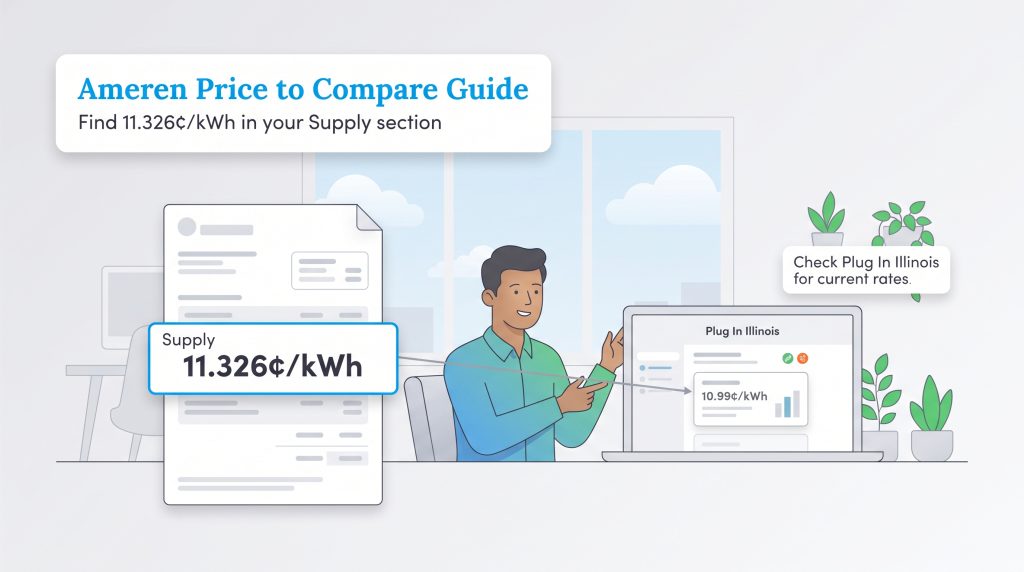
When evaluating Ameren Illinois electric rates, your foundational benchmark is the default rate Ameren charges per kilowatt-hour (kWh) for the supply portion of your bill if you do not choose an alternative provider. This figure is calculated using a straightforward formula: Electric Supply Charge + Transmission Service Charge = Price to Compare.
The current Non-Summer (October through May) residential Ameren price to compare is 10.441 cents per kWh for the first 800 kWh of monthly usage, dropping to 8.262 cents per kWh for usage over 800 kWh. During the historical Summer period (June through September), the benchmark sits at 11.326 cents per kWh. You can easily locate your current figure by checking the “Supply” section of your most recent bill or logging into your online dashboard.
| Rate Benchmark | Current Figure | Applies To | Source |
|---|---|---|---|
| Ameren Illinois Non-Summer Price to Compare (Oct. – May) | 10.441 cents per kWh (0–800 kWh) 8.262 cents per kWh (over 800 kWh) | Residential supply | Plug In Illinois |
| Ameren Illinois Summer Price to Compare (June – Sept.) | 11.326 cents per kWh (all kWh) | Residential supply | Plug In Illinois |
Once you identify your baseline rate, you can evaluate third-party offers to see if switching makes financial sense. You should periodically review the official State of Illinois Plug In Illinois portal to view current rates safely and securely. Because the price to compare shifts every June 1 and Oct. 1, always check the official Plug In Illinois page before signing any supplier agreement.
Ameren Missouri Residential Rate Options (Time-of-Use Plans)
While Ameren Missouri customers cannot shop for a third-party electricity supplier, households equipped with a smart meter can choose between five distinct Ameren rate options. You are allowed to switch your residential rate plan once every 12 months. Picking the right plan depends on whether your home sits empty during the workday or if you run heavy appliances and air conditioning during the afternoon.
| Plan Name | How It Works | Best For |
|---|---|---|
| Anytime Users | Flat rate all day (approx. 15.60¢/kWh in summer; 10.62¢/kWh for the first 750 kWh and 7.14¢/kWh over 750 kWh in winter). | Occupied homes, remote workers, and families running A/C during the afternoon. |
| Evening/Morning Savers | Default plan for smart meters; slightly lower rates overnight (9:00 p.m. to 9:00 a.m.) and slightly higher rates during the day. | Households that want mild overnight savings without strict daytime peak penalties. |
| Overnight Savers | Deep discounts late at night in exchange for higher daytime rates. | Overnight Electric Vehicle (EV) charging and shifting laundry or dishwashers to late hours. |
| Smart Savers | Three-tiered pricing (Off-Peak, Mid-Peak, On-Peak) where summer peak rates (3:00 p.m. to 7:00 p.m. Mon.–Fri.) jump sharply (up to ~40.6¢/kWh) while off-peak hours drop significantly. | Disciplined savers who can turn off A/C and major appliances during weekday late afternoons. |
| Ultimate Savers | Combines very low off-peak kWh rates with a monthly peak demand charge based on your highest single hour of usage. | Advanced smart-home users who stagger appliance runtimes so high-draw devices never run simultaneously. |
🚩 Heads Up: Log into your Ameren Missouri online account immediately after setup to verify whether your home is enrolled in “Anytime Users” or “Evening/Morning Savers.” Many new smart meter accounts default to Evening/Morning Savers, which can raise your bill if you work from home during the day.
Understanding Delivery vs. Supply Charges and Shopping in Illinois

Most people glance at the final total on their monthly electricity bill and pay it without a second thought. However, taking a few minutes to read the itemized breakdown reveals how utility billing actually works. In Illinois, your monthly invoice separates costs into two primary categories: delivery and supply.
- Delivery Charge: Pays for grid maintenance, repairing downed poles and wires, customer service, and local infrastructure. These regulated fees stay with Ameren regardless of who supplies your electricity.
- Supply Charge: Pays for the actual kilowatt-hours (kWh) of electricity generated at power plants and transmitted across high-voltage lines.
- Taxes and Fees: State and local municipal taxes applied to your monthly consumption.
If you stick with Ameren Illinois for your electricity supply, you are enrolled in Basic Generation Service (BGS). Under state law, Ameren purchases power through wholesale auctions administered by the Illinois Power Agency and passes those supply charges through to you dollar-for-dollar with zero markup. Ameren makes all of its profit from regulated delivery infrastructure, meaning the utility doesn’t lose money if you switch to an Alternative Retail Electric Supplier (ARES).
Many Illinois residents also encounter Municipal Aggregation. Under this program, local city councils or county boards negotiate bulk electricity supply rates on behalf of their residents. If your town passes an aggregation referendum, eligible households are automatically enrolled into the community rate unless they actively opt out by returning an opt-out notice. Always compare your town’s aggregation rate against the current Price to Compare, as you can opt out and return to Ameren’s Basic Generation Service at any time without penalty.
Evaluating Fixed vs. Variable Supply Plans

If you shop independently for an alternative supplier in Illinois, you will encounter two primary types of contracts: fixed-rate plans and variable-rate plans. A fixed-rate plan locks in your price per kilowatt-hour for a set term, providing predictable bills during scorching summer heatwaves. Variable-rate plans fluctuate monthly based on wholesale market conditions, which can lead to steep price spikes when energy demand surges.
Shopping for alternative suppliers also opens the door to greener living. Many retail suppliers offer plans backed by 100% renewable energy using Renewable Energy Certificates (RECs). A 100% renewable supply plan means the supplier buys enough RECs to match your electricity usage, supporting wind or solar generation on the broader grid without requiring you to install rooftop panels. If you want to dive deeper into the mechanics of RECs, spending a few minutes understanding how green power works helps clarify why these plans matter for the environment.
How to Compare Alternative Suppliers Without Getting Burned
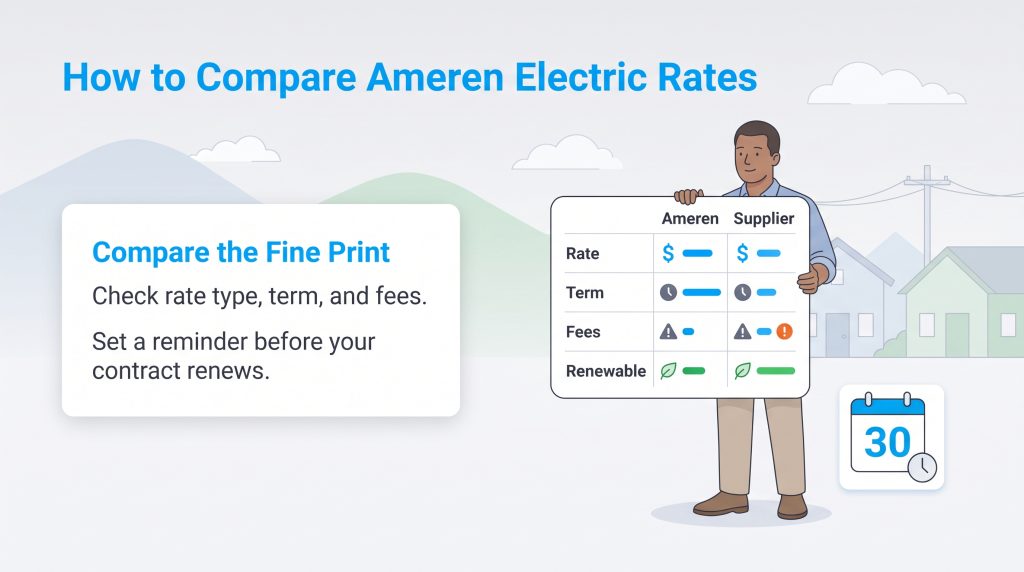
If you live in Illinois and explore alternative suppliers, read the fine print carefully and never give your Ameren account number to unsolicited door-to-door salespeople or telemarketers. An advertised teaser rate that looks fantastic today might cost much more once the introductory window closes. Follow this checklist to evaluate offers safely:
- Compare against the baseline: Measure the supplier rate directly against the current Ameren Illinois Price to Compare (10.441¢/kWh non-summer or 11.326¢/kWh summer).
- Verify the rate structure: Confirm whether the rate is fixed for the entire term or variable month-to-month.
- Check contract length and fees: Review how many months the contract lasts and look for early termination fees or flat monthly membership fees.
- Confirm renewable percentages: Check the Uniform Disclosure Statement to see the exact percentage of RECs backing the plan.
- Track your expiration date: Set a calendar reminder 30 days before the contract ends to prevent automatic renewals at higher variable rates.
🌱 Eco Edge: Choosing an alternative energy supplier that uses wind- or solar-backed plans is an eco-conscious alternative that supports renewable generation without having to physically install expensive roof panels.
Why to Choose (Or Skip) an Alternative Supplier in Illinois

Deciding whether to switch away from Ameren’s default Basic Generation Service comes down to your personal priorities regarding budget predictability and environmental impact. The right choice depends on how long you plan to stay in your home, how comfortable you are managing contract renewal dates, and whether 100% renewable energy is worth a potential premium. Below is a comparative look at the main factors an Illinois customer should weigh before signing a third-party contract.
| Pros of Switching Suppliers | Cons of Switching Suppliers |
|---|---|
| Ability to lock in a multi-season fixed rate | Potential for early termination or monthly fees |
| Access to 100% green energy and RECs | Variable rates that can spike unexpectedly |
| Access to municipal aggregation bulk pricing | Contracts automatically renewing at higher rates |
| Choose Default Ameren Supply If… | Consider an Alternative Supplier If… |
|---|---|
| You want zero-markup wholesale rates with no contracts to manage | You found a fixed rate below the Price to Compare |
| You may move again within the next 12 months | You want a 100% renewable-backed electricity plan |
| You do not want early termination or renewal risk | You actively track contract expiration dates |
Ameren Natural Gas Service and Safety
Beyond electricity, Ameren plays a huge role in heating Midwest homes and fueling kitchen appliances. Ameren Illinois is the third-largest natural gas distributor in Illinois, delivering gas to more than 800,000 customers across central and southern regions of the state. Meanwhile, Ameren Missouri provides natural gas service to over 100,000 customers in select regional pockets, including Columbia, Jefferson City, Cape Girardeau, and Rolla.
When you review the natural gas portion of your Ameren natural gas invoice, you will notice your consumption is measured in therms (one therm equals 100,000 BTUs of heat energy). Just like electricity, your gas bill is split into two main components: Delivery Charges (the fixed monthly customer charge and per-therm distribution fee to maintain pipelines) and the Purchased Gas Adjustment (PGA). The PGA represents the wholesale cost of the natural gas itself, which Ameren passes directly to customers dollar-for-dollar without any profit markup.
Natural Gas Leak Safety Warning: Because raw natural gas is colorless and odorless, Ameren adds a chemical odorant called mercaptan to give it a distinct rotten egg or sulfur smell. If you ever smell rotten eggs, hear a hissing sound near a gas line or appliance, or suspect a gas leak, leave your home immediately. Do not flip any light switches, do not unplug appliances, do not use your phone or garage door opener inside the house, and do not light matches, as even a tiny static spark can ignite leaking gas. Once you and your family are safely away from the building, call 911 and contact Ameren’s 24/7 emergency gas leak response line at 800-755-5000 (Illinois) or 800-552-7583 (Missouri).
Ameren Customer Service and Bill Pay Options
Fulfilling your monthly utility obligations is straightforward when you know the exact Ameren customer service number and the right payment portals to use. Whether you need to process a quick one-time payment, set up Auto Pay, or manage paperless billing, you have several convenient options. We recommend setting up an online profile right away so you can manage your account from anywhere.
Below is a breakdown of the primary ways to pay your bill, including the specific Ameren phone number for automated phone payments and the mailing addresses for both state subsidiaries.
| Payment Method | Illinois Details | Missouri Details |
|---|---|---|
| Ameren login pay bill (Online) | ameren.com/illinois | ameren.com/missouri |
| Guest Pay | ameren.com (10-digit account number required) | ameren.com (10-digit account number required) |
| Ameren phone number (Speedpay) | 888-777-3108 | 866-268-3729 |
| Standard Customer Service (M–F, 7:00 a.m. – 7:00 p.m.) | 800-755-5000 | 800-552-7583 |
| Mailing Address | P.O. Box 88034, Chicago, IL 60680-1034 | P.O. Box 88068, Chicago, IL 60680-1068 |
Deals, Discounts, and Energy Assistance Programs
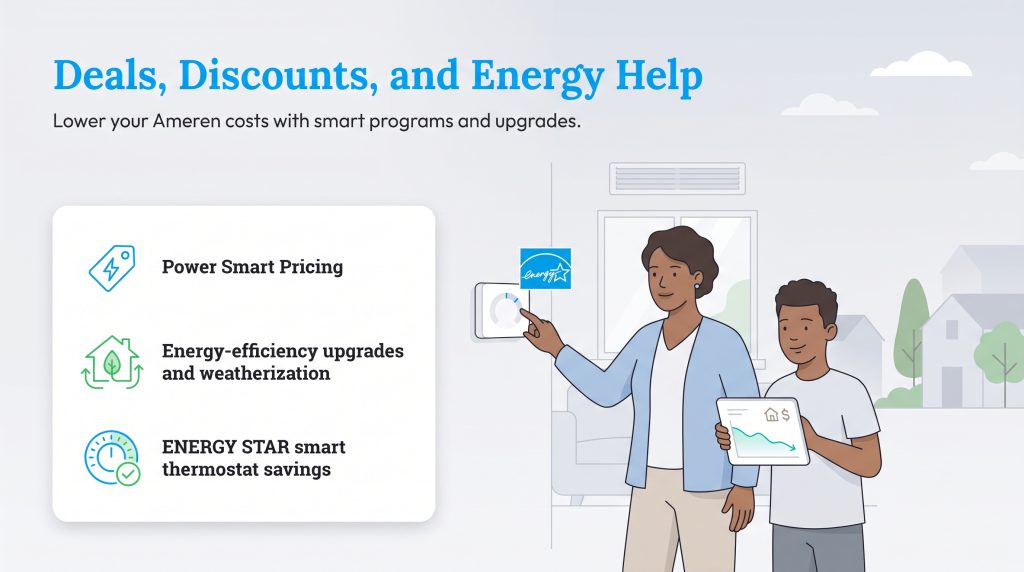
Ameren provides several avenues for households to reduce their monthly burden through energy-efficiency rebates, flexible billing tools, and structured financial assistance programs. If you want to smooth out seasonal spikes caused by freezing Midwest winters and humid summers, you can enroll in Budget Billing, which averages your annual energy usage into predictable monthly payments. You can also use the Pick A Due Date tool in your online account to shift your monthly billing cycle to align with your payday.
For families facing financial hardship, state and utility programs offer vital relief through Ameren.com/Assistance:
- Electric Service Discount (ESD) Program (Illinois): Provides automatic monthly bill discounts ranging from 5% to 75% (depending on household income tiers) for Ameren Illinois customers who qualify for the Low Income Home Energy Assistance Program (LIHEAP).
- Warm Neighbors Cool Friends (Illinois): An energy assistance foundation helping low-to-moderate-income Illinois residents who often fall just above the strict federal poverty cutoffs for LIHEAP.
- Dollar More (Missouri): A community-funded assistance program providing financial grants to qualifying low-income Missouri households struggling to keep up with utility bills.
- Low-Income Weatherization Assistance Program: Available in both states to provide free energy-efficiency upgrades — such as enhanced attic insulation, weatherstripping, and HVAC repairs — to qualifying households.
Ameren Illinois customers can also explore Power Smart Pricing, a real-time pricing program where electricity supply prices adjust by the hour based on wholesale market demand. It rewards flexible households that shift heavy energy use away from peak hours, though savings are never guaranteed. Additionally, upgrading your new home by installing an ENERGY STAR certified smart thermostat is an energy-saving option that qualifies for instant utility rebates in both Illinois and Missouri while automating your daily HVAC savings.
💸 Money-Saver: Check the Ameren online marketplace before buying a smart thermostat or LED bulbs at the hardware store. Both Ameren Illinois and Ameren Missouri offer instant point-of-sale rebates of $50 to $100 on qualifying smart thermostats.
Sustainability, Renewable Energy, and Community Solar

Even if you prefer sticking with your standard utility setup, you can still participate in the broader transition toward clean energy. Ameren is actively retiring aging coal plants and investing billions into utility-scale solar arrays, wind generation, and battery storage as part of its goal to achieve net-zero carbon emissions by 2045.
For renters and homeowners who cannot install rooftop solar panels due to shade, roof age, or HOA rules, community solar is an environmentally mindful choice. In Illinois, customers can subscribe to local solar farms through the state-backed Illinois Shines program. You earn solar supply credits directly on your monthly Ameren Illinois bill for your share of the farm’s electricity production, typically saving 10% to 15% on those supply credits. In Missouri, residents can join the Ameren Missouri Community Solar program to replace a portion of their standard usage with local solar generation, or enroll in the Pure Power program to purchase blocks of Renewable Energy Certificates supporting regional wind and solar facilities.
How to Report and Search for Ameren Power Outages
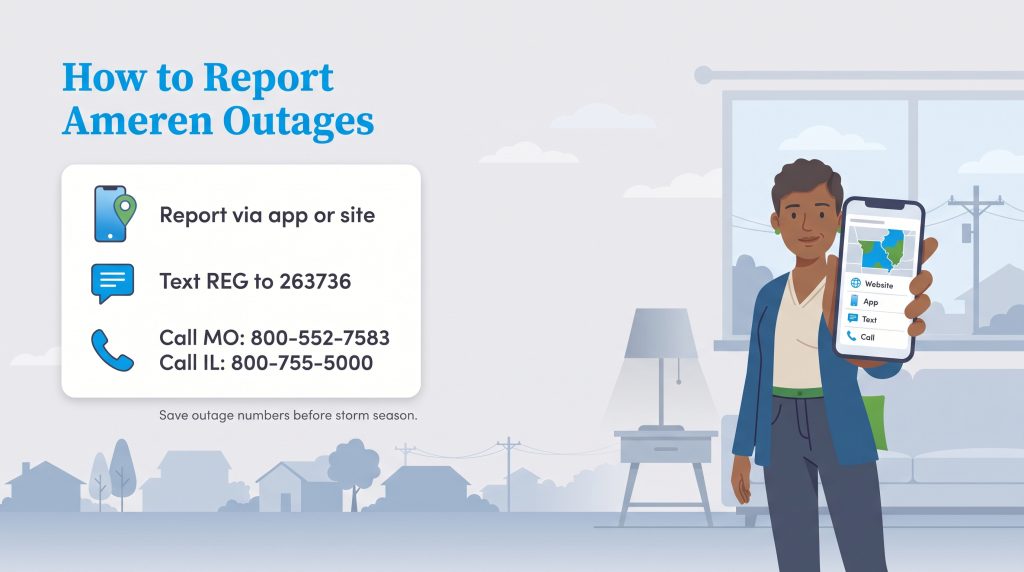
Severe Midwest thunderstorms, derechos, and winter ice storms bring unpredictable weather and occasional power interruptions. When the lights go out, knowing where to look minimizes the stress. Ameren provides an interactive online Ameren outage map within its Outage Center that tracks active incidents by zip code, displays estimated restoration times, and shows how many customers are impacted in your neighborhood.
When you need to report an outage, use the online Outage Center, open the mobile app, or call their 24/7 emergency outage lines directly. For an Ameren Missouri power outage, dial 800-552-7583, while Illinois residents should call 800-755-5000. For the fastest updates, register for two-way text alerts before storm season hits by texting REG to AMEREN (263736). Once registered, you can simply text OUT to report a blackout or STAT to receive an instant restoration update.
💡 Pro Tip: Save Ameren’s outage reporting number and the 263736 text shortcode in your phone contacts right now. Having them ready ensures you aren’t scrambling in the dark trying to load a webpage when your Wi-Fi router loses power.
Managing Your Account With the Ameren Mobile App
About the Author

David has been an integral part of some of the biggest utility sites on the internet, including InMyArea.com, HighSpeedInternet.com, BroadbandNow.com, and U.S. News. He brings over 15 years of experience writing about, compiling and analyzing utility data.