Discover 2026 rates, plans, and customer reviews to see if ComEd is the right electricity provider for your Illinois home
Key Takeaways
- ComEd delivers electricity to over 4 million customers across northern Illinois, while allowing residents to choose their own retail energy supplier.
- The early 2026 ComEd default supply Price to Compare averages 9.66 cents per kWh, while the total all-in rate averages around 19.2 cents per kWh once delivery, taxes, and fees are included.
- Customers can instantly report power outages and manage their billing by using the ComEd mobile app or calling 1-800-EDISON-1.
Moving to a new home in northern Illinois or simply looking to lower your monthly utility bill? Navigating your electricity options starts with understanding Commonwealth Edison, better known as ComEd. Operating within a deregulated energy market, this utility gives you the freedom to choose your energy supply while continuing to handle the physical delivery of your power. Whether you’re considering the standard fixed rate, exploring Time-of-Day or dynamic hourly pricing, or comparing third-party suppliers, we’ve broken down everything you need to know about ComEd electricity rates, bill line items, rebate programs, and customer reviews to help you make a smart, money-saving choice for your household.
What Is ComEd and How Does It Work in Illinois?
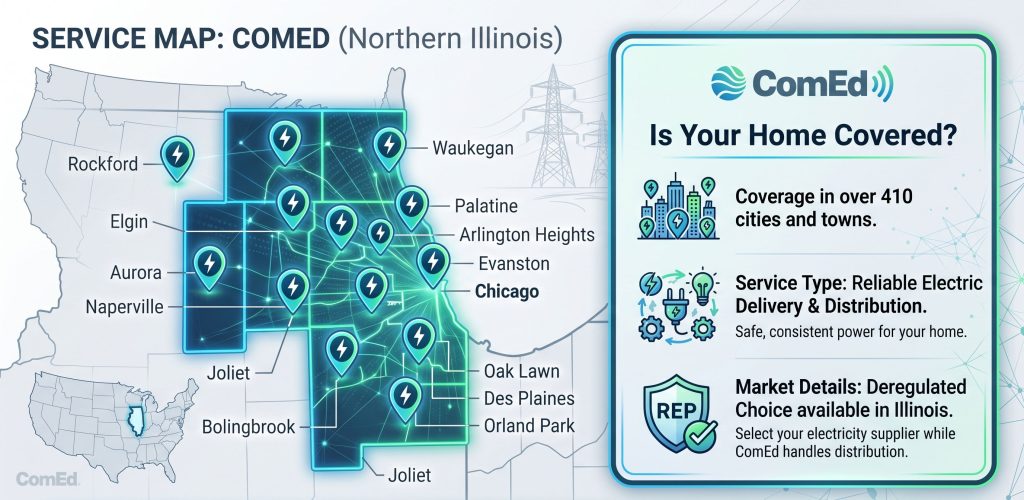
Commonwealth Edison (ComEd) is the primary electricity delivery company for northern Illinois and a major subsidiary of the Exelon Corporation. Because Illinois operates a deregulated energy market, ComEd’s role is split into two distinct parts: delivery and supply. Knowing the difference between your utility company and your energy supplier is the easiest way to avoid overpaying on your monthly electric bill.
ComEd is legally mandated to act as your local utility company. They maintain the sprawling network of power lines, poles, and transformers that bring electricity to your home, and they respond to all power outages regardless of who generates your power. When it comes to your energy supplier, however, you have a choice. You can buy your electricity supply directly from ComEd at their regulated default rate, or you can shop the open market for an Alternative Retail Electric Supplier (ARES). This separation prevents utility monopolies and gives you the flexibility to match your energy plan to your budget and sustainability goals.

- Calculate Your Moving Costs
- Compare Moving Companies
- Get Multiple Quotes
- Move with Confidence
ComEd Coverage Area and Major Cities Served
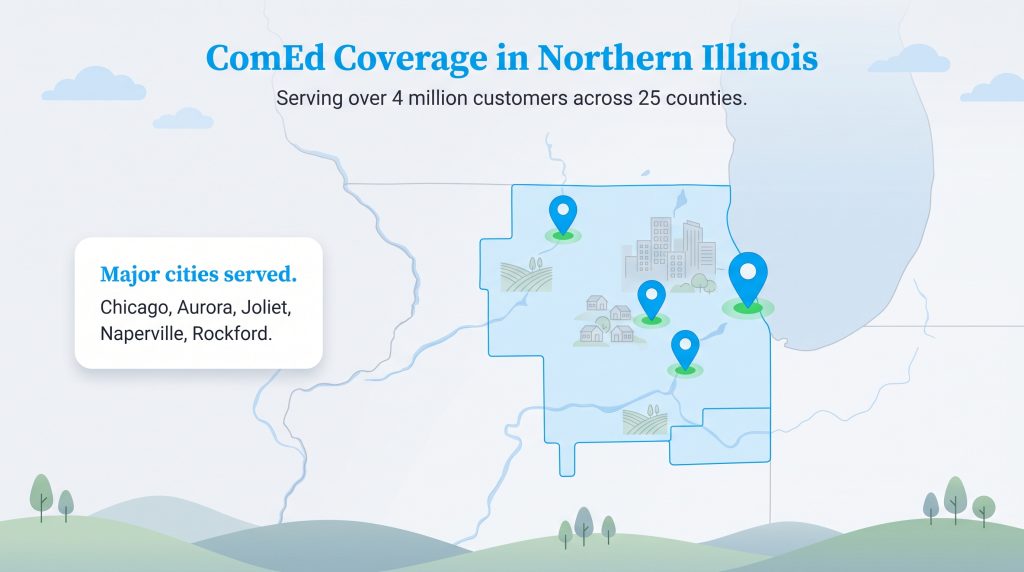
The ComEd coverage area spans roughly 70% of the state’s population, blanketing 11,400 square miles from the Wisconsin border down to Pontiac, and stretching from the Indiana border west to the Mississippi River. If you move to the northern third of Illinois, ComEd is almost certainly your designated utility for energy delivery, with rare exceptions for a handful of municipal utilities like Naperville and St. Charles that manage their own local grids.
The provider powers a customer base of over 4 million residential and commercial accounts across 25 counties, primarily serving heavily populated hubs in Cook, DuPage, Lake, Will, Kane, McHenry, and Winnebago counties. Some of the most notable cities in the ComEd service territory include:
- Chicago
- Aurora
- Joliet
- Naperville
- Rockford
- Elgin
- Waukegan
- Cicero
- Schaumburg
- Evanston
- DeKalb
Current ComEd Plans, Pricing, and the Price to Compare
When you set up electricity service, you need to know how your rate structure impacts your wallet. If you don’t actively choose a special pricing program or a third-party supplier, ComEd automatically enrolls you in its Basic Electric Service (BES). This default rate serves as the standard baseline for the entire region.
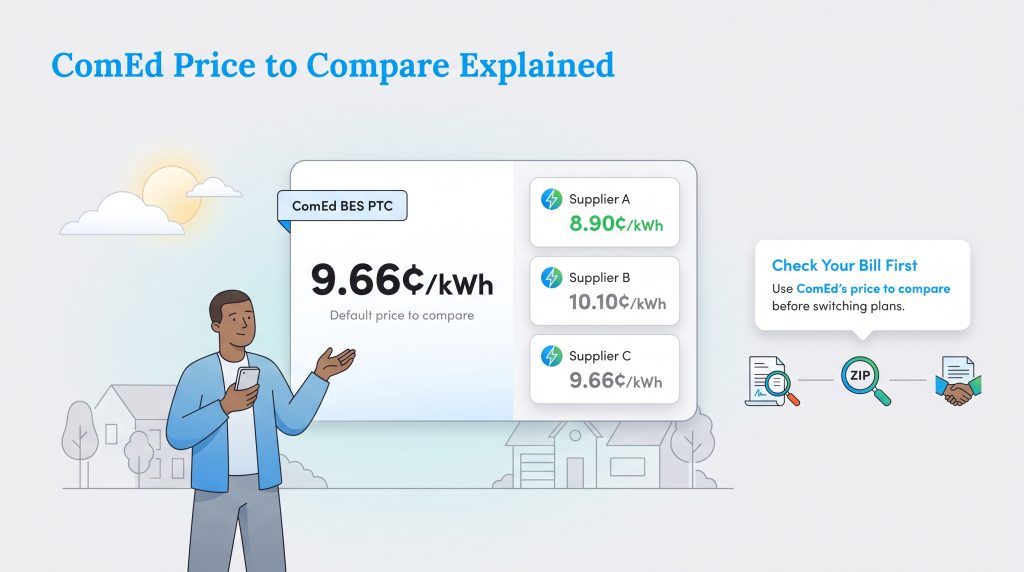
As you explore ComEd electricity rates, you’ll frequently see the term “Price to Compare” (PTC). The ComEd price to compare is the exact combined rate per kilowatt-hour (kWh) that the utility charges for the generation and transmission of your electricity. It acts as your primary benchmark when shopping among competitive retail electric providers (REPs). Always reference your most recent statement to verify the exact PTC for your household before comparing outside offers.
| Service Type | Current Plan Structure | 2026 Average Rate (per kWh) | Best For |
|---|---|---|---|
| Basic Electric Service (BES) | Default fixed-rate supply (adjusts June & October) | ~9.66¢/kWh supply (~19.2¢/kWh total with delivery/taxes) | Households wanting predictable, hands-off billing. |
| Time-of-Day Pricing | 4 fixed daily pricing windows (365 days/year) | ~11.0¢/kWh Overnight to ~32.1¢/kWh Mid-Day Peak (total rate) | EV owners and households that can avoid 1 p.m.–7 p.m. usage. |
| Hourly Pricing (Rate BESH) | Real-time wholesale PJM market rate | Fluctuates hourly based on real-time grid demand | Smart-home users able to automate heavy appliances overnight. |
| Alternative Retail Supplier (ARES) | Fixed or variable multi-month contracts | Varies by provider | Shoppers looking for 100% green plans or promotional fixed rates. |
Default Basic Electric Service (BES) vs. All-In Rate
One of the biggest misconceptions for new Illinois movers is assuming the 9.66 cents per kWh Price to Compare is the total price you pay for electricity. In reality, that figure only covers the raw energy supply and high-voltage transmission. ComEd passes this supply cost directly to you without marking it up for profit.
Once you factor in local distribution charges, meter fees, environmental surcharges, and municipal taxes, the total all-in average rate for a standard residential customer lands closer to 19.2 cents per kWh. Sticking with fixed-rate plans like BES gives you solid budgeting stability, as the base supply rate only adjusts twice a year in June and October. However, keeping an eye on your all-in cost per kWh helps you accurately project what a typical 750 kWh monthly bill will actually cost your family.
ComEd Time-of-Day Pricing vs. Hourly Pricing
If you don’t mind adjusting when you run your major appliances, ComEd offers two dynamic rate structures that reward off-peak consumption: ComEd Time-of-Day Pricing and ComEd Hourly Pricing (Rate BESH). While both plans aim to reduce strain on the regional grid, they calculate your costs in very different ways.
Unlike Hourly Pricing, which changes every 60 minutes based on live PJM wholesale market auctions, Time-of-Day Pricing divides the clock into four fixed daily windows that remain identical 365 days a year:
- Overnight (9 p.m. to 6 a.m.): The lowest rate window, ideal for charging electric vehicles and running dishwashers.
- Morning (6 a.m. to 1 p.m.): Moderate pricing designed for standard morning routines and remote work.
- Mid-Day Peak (1 p.m. to 7 p.m.): The highest pricing tier, when regional commercial and residential demand hits its peak.
- Evening (7 p.m. to 9 p.m.): A transitional shoulder rate as grid demand cools down for the night.
Under the Time-of-Day structure, the Mid-Day Peak rate is roughly three to six times higher than the Overnight rate. It’s also important to note that Time-of-Day Pricing applies time-based rates to both your supply and delivery charges, and it cannot be combined with an alternative supplier. Meanwhile, Hourly Pricing only varies your supply rate based on real-time grid demand. While Hourly Pricing carries the risk of sudden price surges during extreme summer heatwaves, smart-home enthusiasts who automate their air conditioning and laundry overnight often unlock substantial annual savings.
Understanding Alternative Retail Electric Suppliers (ARES)
In Illinois, you have the right to buy your electricity supply from an Alternative Retail Electric Supplier (ARES). These competitive companies buy energy on the wholesale market and offer independent pricing structures directly to consumers. When you evaluate third-party options — such as Constellation, Direct Energy, or Ambit Energy — you must weigh their offered rate against ComEd’s default PTC, and you can also verify historical supplier performance on the official Plug In Illinois portal.
If a competitor offers a fixed rate lower than 9.66 cents per kWh without tacking on hidden monthly administrative fees, you’ll save money on the supply portion of your bill. Switching away from the ComEd default rate is a straightforward process that takes only a few minutes:
- Locate your 10-digit ComEd account number on your most recent paper or digital bill.
- Search your ZIP code on our platform to find and compare competitive local rates in your exact area.
- Select a plan and sign up through the new supplier’s website. They will notify ComEd of the change on your behalf, and your service will never be interrupted during the billing transition.
How to Start, Stop, or Transfer ComEd Service
Whether you’re buying a house in the suburbs or moving into a Chicago apartment, setting up your electricity well before moving day saves you from unpacking in the dark. Because nearly all northern Illinois residences are already equipped with smart meters, ComEd can usually activate or transfer your account remotely without sending a technician to your property.
Follow this step-by-step checklist to start, stop, or transfer your residential service smoothly:
- Submit Your Request Early: Access the online ComEd “Move” portal or call ComEd customer service at 1-800-EDISON-1 (1-800-334-7661) at least three to five business days before your target move-in or move-out date.
- Gather Required Documentation: Have your new service address (including the specific apartment or unit number), your scheduled move-in date, and your Social Security Number or government-issued ID ready for a soft credit verification. If you’re renting, keep your landlord or property manager’s contact information handy in case the meter reading needs verification.
- Choose Your Move Option: Existing customers moving within northern Illinois can select “Transfer Service” to seamlessly overlap or transition their stop and start dates on a single profile. New Illinois residents will select “Start Service” to generate a brand-new account.
- Verify Deposit Requirements: During enrollment, ComEd runs a soft credit check that won’t impact your credit score. If your credit history triggers a security deposit requirement, ComEd splits the deposit into smaller installments across your first few bills. You can often waive or reduce deposit requirements by providing a letter of credit showing 12 months of on-time payments with a previous utility, or by enrolling in AutoPay to build an on-time payment history.
Fees, Guarantees, and Understanding Your ComEd Bill
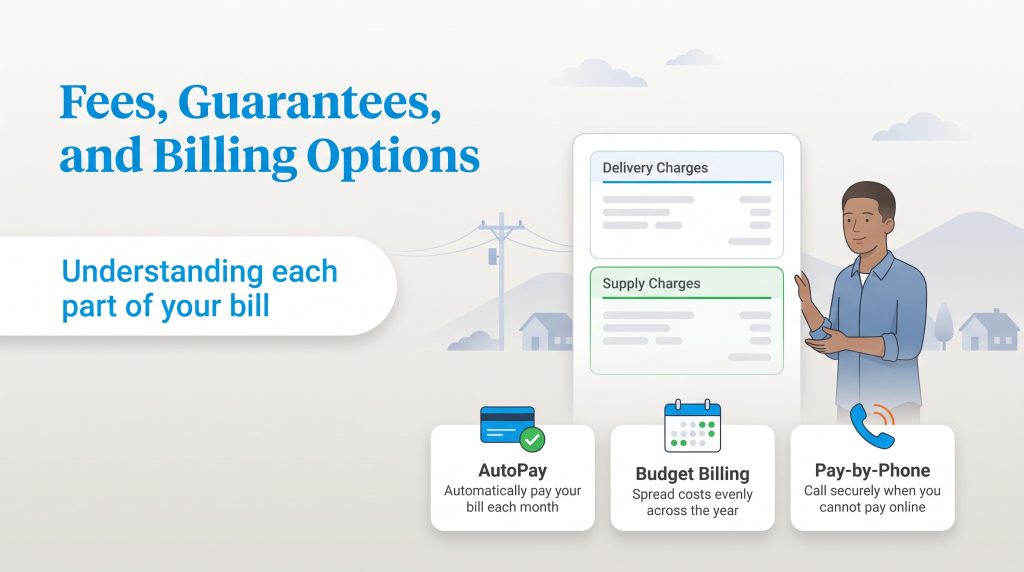
Decoding your monthly statement is the first step to lowering your household overhead. Every residential statement follows a simple core formula: Supply + Delivery + Taxes & Fees = Total Amount Due.
While Supply Charges represent the shoppable cost of the actual electricity you consume, Delivery Charges are non-shoppable fees regulated by the Illinois Commerce Commission (ICC). You must pay ComEd these delivery fees to maintain the local grid regardless of who supplies your power.
Delivery, Supply, and Line-Item Charges Explained
When you review a ComEd bill breakdown, you’ll notice several individual surcharges grouped under the supply, delivery, and tax sections. Here is what those specific line items actually fund:
- Customer Charge: A fixed monthly service fee (typically around $12 to $15 for standard residential accounts) that covers billing, meter maintenance, and account administration, regardless of how much power you use.
- Distribution Facilities Charge: A per-kWh delivery fee that pays for the physical upkeep of neighborhood poles, wires, and transformers.
- Illinois Electricity Distribution Charge: A state-regulated per-kWh charge that offsets the utility’s operational taxes and regulatory expenses for distributing electricity.
- Transmission Services Charge: Included within the supply section, this per-kWh rate covers the cost of moving high-voltage electricity from regional power plants across the PJM grid to ComEd’s local substations.
- Purchased Electricity Adjustment (PEA): A fluctuating monthly supply adjustment (which can be a credit or a surcharge) that reconciles the difference between what ComEd projected wholesale power would cost and what it actually paid.
- Environmental Cost Recovery Adjustment: A small per-kWh surcharge under the taxes and fees section that funds the cleanup of historic manufactured gas plant sites and environmental compliance across Illinois.
As you inspect your statement, take a close look at the 13-month usage graph to verify whether your cycle was billed as an “Actual” or “Estimated” meter reading. An Actual reading comes directly from your smart meter’s cellular transmitter. If wireless communication is temporarily blocked, ComEd issues an Estimated bill based on historical weather and usage patterns, which is later corrected with a true-up adjustment once an actual reading goes through.
Flexible Billing Options and Payment Guarantees
ComEd provides a 21-day payment grace period from the date your bill is issued before applying a 1.5% monthly late payment fee on any past-due balance. To help you avoid late fees and smooth out seasonal expenses, you can enroll in several flexible billing tools:
- AutoPay: Automatically deducts your monthly balance from a linked checking account or credit card on your due date so you never miss a payment.
- Budget Billing: Spreads your projected annual energy costs evenly across 12 months, preventing sudden bill spikes during peak summer cooling and winter heating seasons.
- Pay-by-Phone: Allows you to submit a one-time payment securely through the automated 1-800-EDISON-1 hotline if you don’t have internet access.
How to Report and Track ComEd Power Outages
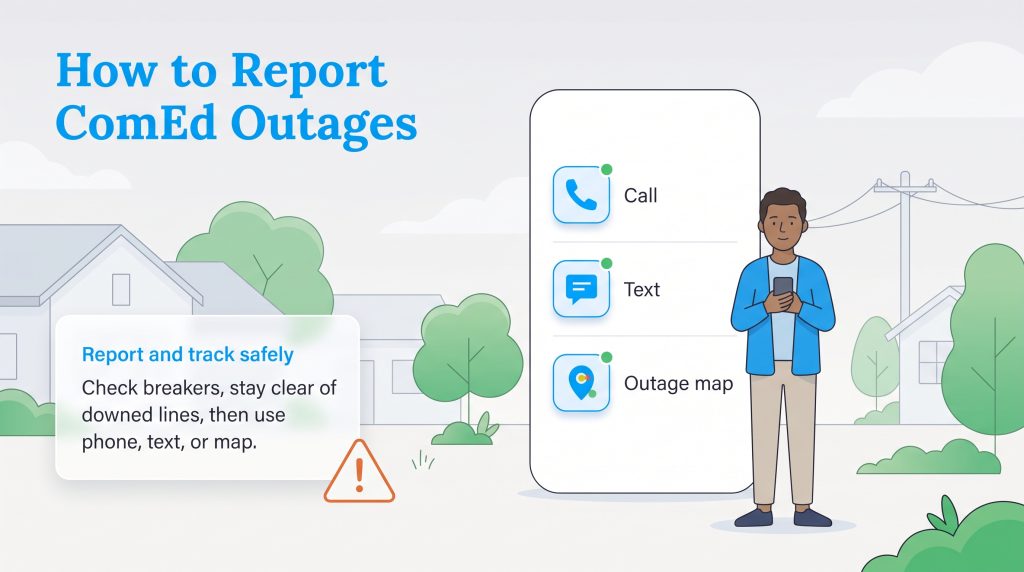
Severe weather in the Midwest can trigger unexpected grid disruptions, but tracking a power outage is simple. If your lights go out, don’t assume your neighbors have already reported it. Promptly notifying the utility helps dispatch crews faster and improves localized grid response times. Before reaching for your phone, always check your home’s circuit breakers to make sure the issue isn’t isolated to your own electrical panel.
🚩 Heads Up: If you see a downed power line, do not approach it. Immediately call the official ComEd customer service number at 1-800-EDISON-1 (1-800-334-7661) to report the hazard and initiate an emergency service request.
Here are the quickest ways to handle an electrical outage:
- Call Customer Service: Dial the official support line at 1-800-EDISON-1 to report an outage securely through their automated phone system.
- Use the Text Alert System: Text the word OUT to 26633 to instantly report a service drop. You can also text STAT to check the estimated crew restoration time for your specific address.
- View the Outage Map: Visit the interactive ComEd power outage map on their website to see the scope of affected neighborhoods, active crew statuses, and localized restoration timelines based on color-coded incident icons.
ComEd Mobile App and Digital Account Management
For busy households, managing your utility account from a smartphone is a major time-saver. The official ComEd mobile app is free to download on both iOS and Google Play, putting your smart meter data and billing controls in one place.
The app offers several core capabilities that simplify everyday account management:
- Mobile Bill Pay: Securely view itemized PDF statements, schedule one-time payments, or adjust your AutoPay and Budget Billing settings without logging into a desktop computer.
- One-Tap Outage Reporting: Bypass phone queues during heavy storms by reporting a localized power outage and viewing the live ComEd power outage map directly inside the app.
- Hourly Energy Usage Tracking: Monitor your granular electricity consumption data and set high-bill alerts to catch energy-hogging habits early — an indispensable feature for Time-of-Day and Hourly Pricing enrollees.
Sustainability: ComEd’s Green and Renewable Initiatives
ComEd places a strong emphasis on grid modernization and reducing the carbon footprint of northern Illinois under the state’s Climate and Equitable Jobs Act (CEJA). The utility continuously invests in smart grid technology to integrate clean energy across its territory.
For eco-conscious consumers looking for an energy-saving option at home, ComEd offers several residential sustainability programs and ComEd energy efficiency rebates:
- Home Energy Assessments: Homeowners and renters can schedule a free in-home or virtual assessment where professionals identify air leaks and provide free efficiency upgrades like LED bulbs, programmable thermostats, and smart power strips.
- Heat Pump Rebates: Generous financial incentives (often ranging up to $2,000 depending on system efficiency) are available for upgrading outdated heating and cooling equipment to ENERGY STAR-certified electric heat pumps.
- EV Charger and Installation Rebates: To accelerate clean transportation across northern Illinois, ComEd provides substantial residential rebates to help cover the purchase and licensed electrical installation of qualifying Level 2 smart EV chargers at home, with higher rebate tiers reserved for income-eligible and equity-eligible communities.
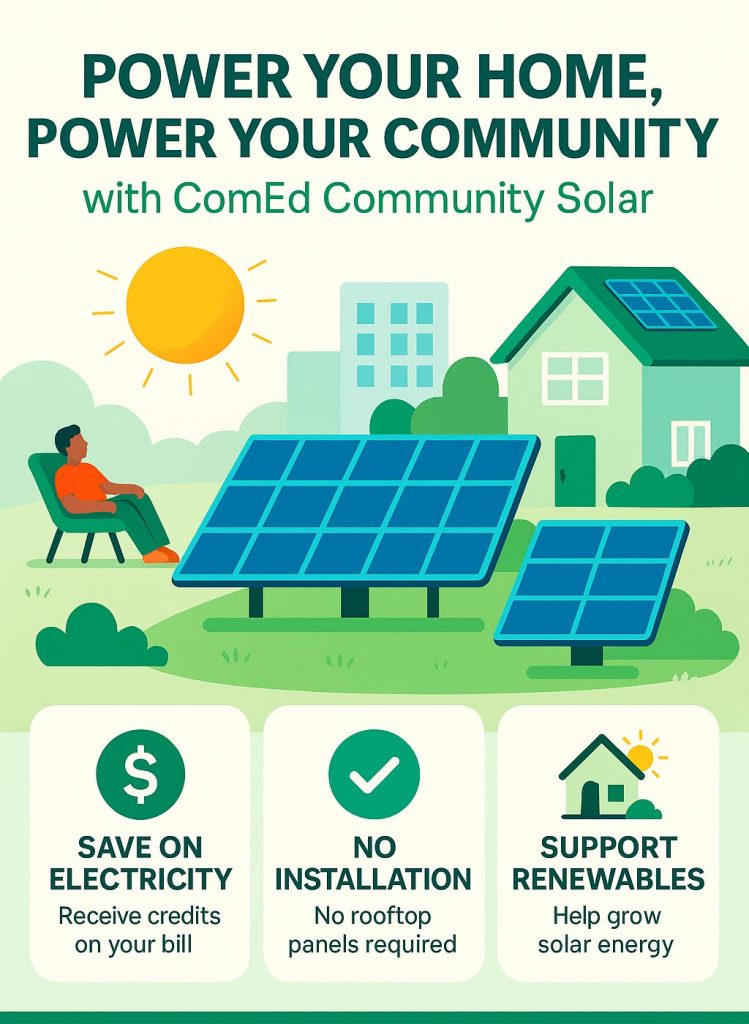
- Community Solar Integration: This setup serves as an eco-conscious alternative for renters and homeowners who want to support renewable generation without installing rooftop panels. By subscribing to a local solar farm, your share of generated power is fed into the grid in exchange for supply bill credits. However, you should inspect your monthly statements carefully for delayed solar net-metering or community solar credits, which have occasionally occurred following ComEd’s recent billing platform migration. If your solar credits are missing, contact ComEd’s dedicated Green Power Connection team directly at 1-800-825-5436.
If you want to ensure your home’s electricity usage is completely backed by clean generation right away, you can also shop around for 100% renewable plans from competitive retail suppliers.
Financial Assistance, Deals, and Ways to Save
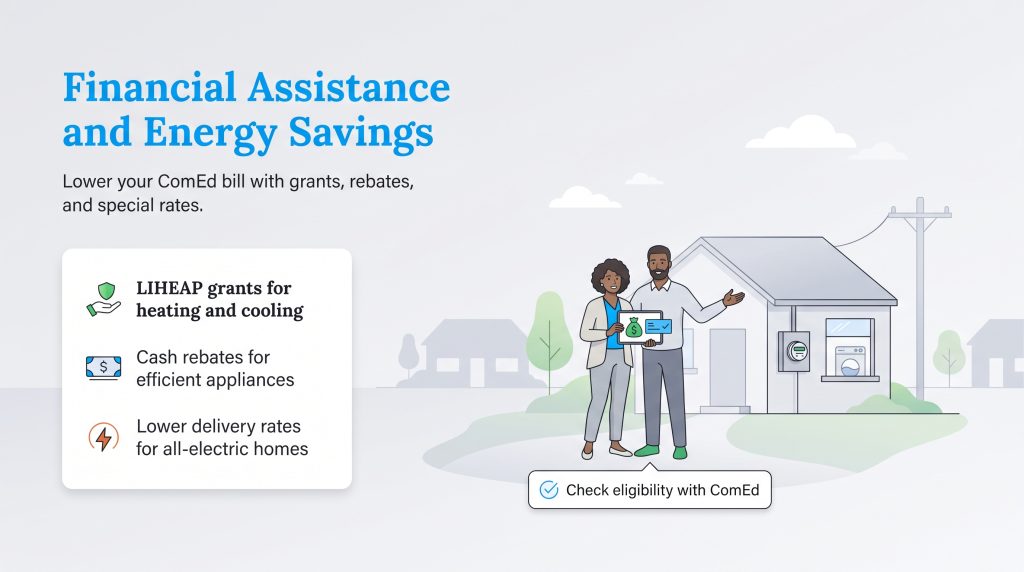
Managing utility costs shouldn’t put a strain on your household budget, and ComEd provides a solid lineup of assistance programs and ComEd energy efficiency rebates to help lower your monthly bills. Beyond retail discounts on smart thermostats, weatherization, and old refrigerator recycling, eligible residents can tap into four major bill-relief programs:
- LIHEAP (Low Income Home Energy Assistance Program): A vital federal and state resource for income-eligible households (typically those earning up to 200% of the federal poverty level). You can apply through your local Community Action Agency for one-time grants that pay down winter heating and summer cooling balances.
- PIPP (Percentage of Income Payment Plan): Available to LIHEAP-eligible customers, PIPP caps your monthly utility bill at a manageable percentage of your gross household income. When you make your reduced monthly PIPP payments on time, you also earn credits toward forgiving pre-existing past-due balances.
- ComEd CARE (Customer Assistance & Residential Energy): A collection of hardship grants designed for income-qualified seniors, military veterans, deployed service members, and families experiencing sudden financial emergencies like medical crises or job loss.
- Peak Time Savings: A voluntary, risk-free reward program open to any customer with a smart meter. By voluntarily reducing your electricity usage during designated high-demand summer hours (usually a few afternoons between June and September), you earn direct bill credits for every kWh you save compared to your typical baseline usage, with zero penalties if you choose not to participate on a given day.
💡 Pro Tip: If your home relies entirely on all-electric heating, you may qualify for a significantly reduced delivery rate. Contact ComEd customer service to verify your eligibility and potentially slash your winter distribution charges in half.
Customer Reviews: What Are People Saying About ComEd?
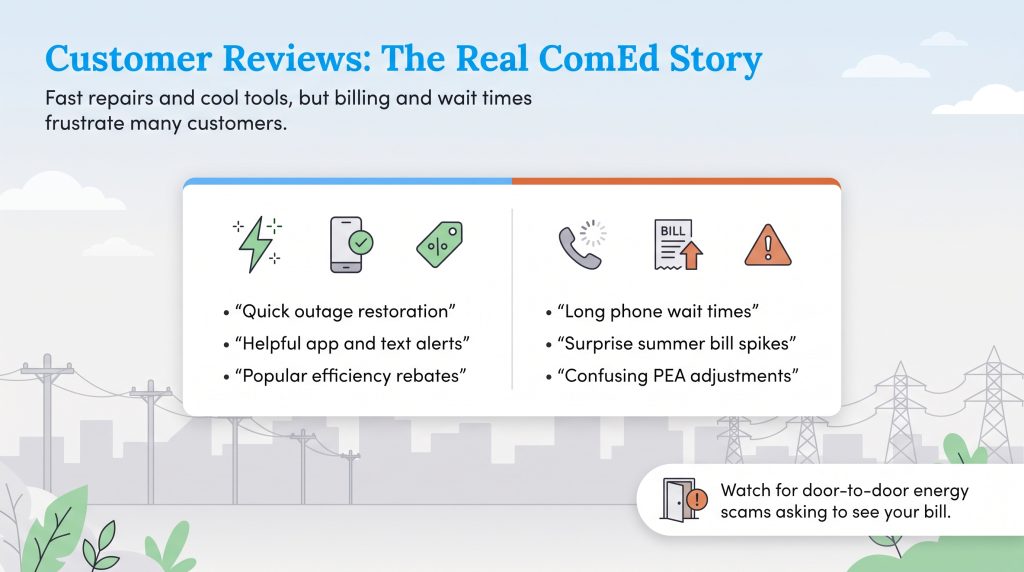
When researching utility providers, checking third-party sentiment reveals how a company handles day-to-day billing and grid emergencies. Because ComEd serves over 4 million accounts, customer feedback naturally highlights a mix of dependable infrastructure and occasional bureaucratic headaches.
Better Business Bureau (BBB), ConsumerAffairs, and ICC Complaints
Across formal review platforms like the Better Business Bureau (BBB) and ConsumerAffairs, customer feedback reflects the typical frustrations associated with large regional utilities. Reviewers frequently point to long hold times when trying to reach a live ComEd customer service representative during severe summer storms or after a major billing system update. Another common pain point involves unexpected billing spikes when the variable Purchased Electricity Adjustment (PEA) shifts from a credit to a charge during high-usage summer months.
If you run into a complex billing error, meter dispute, or delayed solar credit that standard customer support fails to resolve, you aren’t out of options. Illinois residents can escalate unresolved utility disputes directly to the Illinois Commerce Commission (ICC) Consumer Services Division or reach out to the Citizens Utility Board (CUB), a nonprofit watchdog organization that helps Illinois ratepayers fight unfair billing practices.
Local Forums and Reddit Sentiment
On community discussion boards like Reddit’s r/chicago and r/illinois, customer sentiment is much more balanced. Residents consistently praise ComEd for its rapid outage restoration times, impressive overall grid reliability, and user-friendly mobile app. Likewise, homeowners regularly vouch for the ComEd Energy Efficiency Program, noting that rebates on smart thermostats and weatherization arrive quickly with minimal paperwork.
On the flip side, forum discussions frequently vent frustration over non-shoppable delivery charges, which often account for roughly 40% to 50% of a household’s total monthly bill — especially for low-usage apartment dwellers paying fixed monthly customer charges. Redditors also occasionally complain about receiving multiple “Estimated” meter reads in a row, followed by an unexpectedly high “Actual” catch-up bill once the meter reconnects to the network.
🚩 Heads Up: Local forums frequently warn readers about aggressive door-to-door energy scams. Remember that official ComEd representatives will never come to your door demanding to see your utility bill to “lock in a lower rate.”
Why Choose (or Skip) ComEd: Who This Provider Is Best For
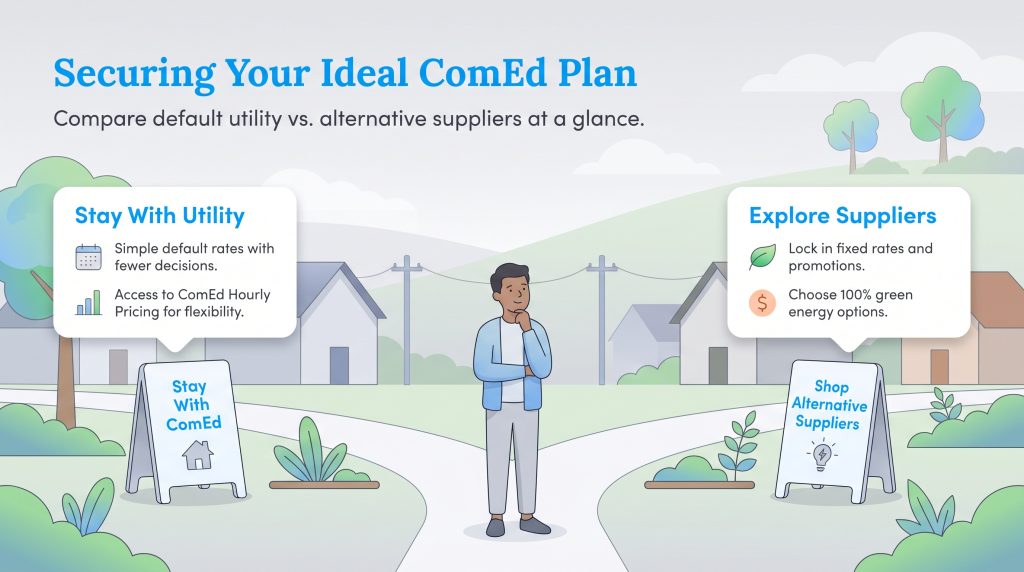
Because you have the power to choose your energy supply and pricing structure in northern Illinois, you should weigh the convenience of ComEd’s default rates against its time-based plans and the broader deregulated market. Here is a quick breakdown of how ComEd’s in-house supply stacks up.
Pros of Sticking with ComEd:
- Default Convenience: You skip the hassle of shopping around, tracking contract expiration dates, and managing a secondary supplier agreement.
- Flexible Dynamic Plans: You gain direct access to ComEd Time-of-Day Pricing and Hourly Pricing if you want to lower your bill by shifting your daily energy habits.
- Regulatory Stability: ComEd’s Basic Electric Service is strictly regulated by the Illinois Commerce Commission and passed through at wholesale cost, protecting you from predatory rate markups.
Cons of Sticking with ComEd:
- Missed Promotional Savings: Third-party suppliers occasionally offer cheaper multi-year fixed rates or sign-up bill credits that the default utility doesn’t match.
- Lack of 100% Green Default Supply: The standard supply mix relies heavily on nuclear and fossil fuel generation, meaning you must subscribe to community solar or switch to an alternative supplier to back your usage with 100% wind or solar.
To help you finalize your setup, match your household habits to one of these three customer profiles:
- Best for ComEd Default BES: Busy families, retirees, and remote workers who run their air conditioning and appliances between 1 p.m. and 7 p.m. and want predictable, regulated pricing without worrying about contract renewals.
- Best for ComEd Time-of-Day / Hourly Pricing: Electric vehicle owners, smart-home enthusiasts, and night owls who can program heavy appliances and EV chargers to run between 9 p.m. and 6 a.m. for deep off-peak discounts.
- Best for a Third-Party Green Supplier (ARES): Eco-minded households seeking a 100% renewable energy plan to offset their carbon footprint, or savvy comparison shoppers who find a fixed rate below ComEd’s 9.66¢/kWh Price to Compare with zero early termination fees.
Whether you stick with the simplicity of ComEd’s default supply, optimize your schedule with Time-of-Day pricing, or lock in a clean energy contract on the open market, taking a few minutes to review your rate structure ensures your new Illinois home runs efficiently from day one.
Frequently Asked Questions About ComEd
What is the difference between ComEd Time-of-Day Pricing and Hourly Pricing?
ComEd Time-of-Day Pricing divides the day into four fixed rate windows — Overnight (9 p.m. to 6 a.m.), Morning (6 a.m. to 1 p.m.), Mid-Day Peak (1 p.m. to 7 p.m.), and Evening (7 p.m. to 9 p.m.) — that stay on the same schedule 365 days a year and apply to both supply and delivery. In contrast, ComEd Hourly Pricing (Rate BESH) only changes your electricity supply rate every 60 minutes based on real-time wholesale prices on the PJM power grid.
How much is the total ComEd cost per kWh including delivery fees?
While ComEd’s early 2026 default supply Price to Compare averages 9.66 cents per kilowatt-hour (kWh), your total all-in cost averages around 19.2 cents per kWh. This all-in rate includes the base supply price plus non-shoppable delivery charges, the fixed monthly customer charge, environmental adjustments, and state and local utility taxes.
How far in advance should I set up ComEd before moving into a new home?
You should submit your start or transfer request at least three to five business days before your scheduled move-in date using the online ComEd Move portal or by calling 1-800-EDISON-1. Have your new service address, move-in date, Social Security Number (or government ID), and landlord contact info ready to complete the setup.
Why does my ComEd bill say “Estimated” instead of “Actual” usage?
Your bill shows “Estimated” usage when ComEd’s billing system temporarily fails to receive a wireless signal from your smart meter at the end of a billing cycle. When this happens, ComEd estimates your bill based on your historical energy usage and local weather patterns, then automatically issues a credit or charge adjustment on your next “Actual” meter reading.
Do I have to use ComEd for my electricity supply?
No, you do not have to use ComEd for your electricity supply. While ComEd is legally mandated to deliver your power and maintain the grid, Illinois operates a deregulated energy market. This means you can pick an Alternative Retail Electric Supplier (ARES) for your electricity supply, or simply stick with ComEd’s default rate.
How do I report a power outage to ComEd?
You can report a power outage by calling their customer service line at 1-800-EDISON-1, utilizing the one-tap reporting feature on the official ComEd mobile app, checking the interactive outage map online, or by texting the word OUT to 26633 from a registered mobile device.
Does ComEd offer financial assistance or discount programs?
Yes, ComEd connects income-eligible customers with LIHEAP grants, the Percentage of Income Payment Plan (PIPP), and ComEd CARE hardship grants for seniors, veterans, and families in crisis. They also offer Peak Time Savings bill credits and the ComEd Energy Efficiency Program, which provides cash rebates on smart thermostats, heat pumps, and EV chargers.
About the Author

David has been an integral part of some of the biggest utility sites on the internet, including InMyArea.com, HighSpeedInternet.com, BroadbandNow.com, and U.S. News. He brings over 15 years of experience writing about, compiling and analyzing utility data.