

Understanding your ComEd delivery charges empowers you to decode your monthly bill, lower your energy usage, and make smarter eco-conscious decisions for your home.
Key Takeaways
- ComEd delivery charges cover the cost of infrastructure like poles, wires, and grid maintenance, ensuring reliable electricity reaches your home.
- Fixed delivery fees create a mandatory monthly billing floor of around $19.37 for standard single-family homes before you use a single kilowatt-hour of electricity.
- While you cannot change your delivery provider, you can now lower your per-kWh delivery rate by enrolling in ComEd’s Delivery Time-of-Day (DTOD) pricing program and reducing your overall energy consumption.
If you just moved to northern Illinois or bought a new home in the Chicago area, you might feel a wave of frustration after glancing at your first few monthly utility statements. Seeing a delivery fee that occasionally costs more than the actual electricity you used can feel overwhelming, especially when you are already juggling moving expenses. However, decoding your ComEd bill is the first step toward regaining control over your household budget. We are here to break down the exact 2026 ComEd delivery charges line by line, explain why these rates have climbed, and show you practical ways — including a brand-new time-of-day pricing option — to trim down those surprisingly high numbers.
What Are ComEd Delivery Charges?
Seeing the ComEd distribution charge explained in plain English helps you grasp what you are paying for every month. Think of your electricity bill like ordering a product online: the supply charge covers the cost of the actual item you purchased, while the delivery charge is the shipping and handling fee required to get that package safely to your front door.
ComEd is strictly a delivery utility rather than a power generator. If you take default supply service, ComEd bills you for electricity procured at cost through Illinois’ regulated procurement process, while focusing its daily operations on the logistics of transporting that electricity to your neighborhood. Your delivery fee pays for the physical network of utility poles, substations, high-voltage wires, and transformers scattered across northern Illinois. It also covers essential grid maintenance, severe storm repairs, and 24/7 customer service support to ensure your lights stay on year-round.
2026 ComEd Delivery Charge Breakdown: Line-by-Line Costs
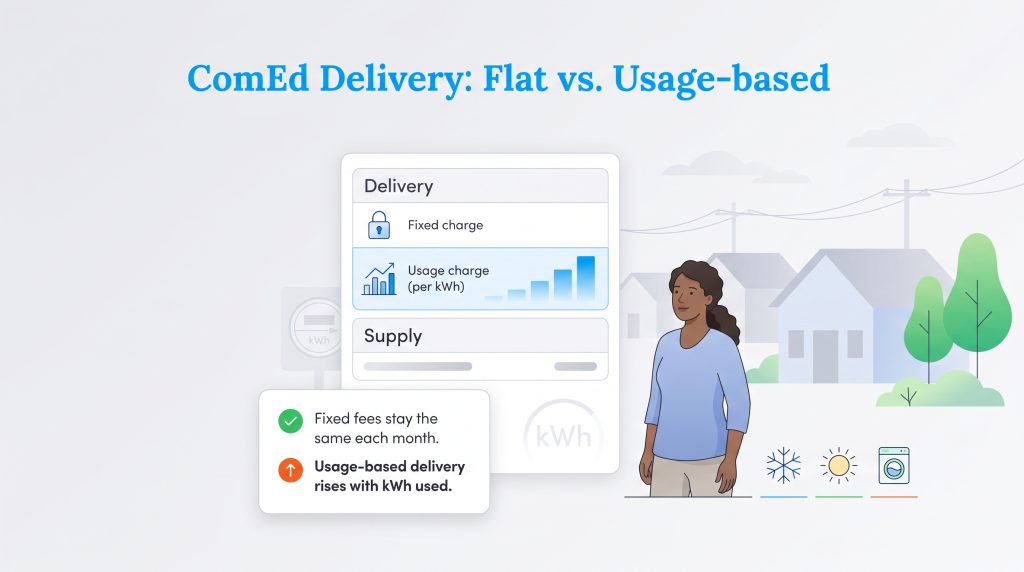
You may be wondering if ComEd delivery charges are a flat rate. The short answer is no — they are a hybrid of flat monthly service fees and volumetric charges. While administrative and metering items are fixed every billing cycle, the vast majority of your delivery cost is calculated per kilowatt-hour (kWh) of electricity you consume.
The more power you pull from the grid, the higher your delivery total will climb. If you are in the process of setting up utilities in the area, you should budget for higher delivery costs during the peak summer air-conditioning and winter heating months. Because the volumetric delivery fee scales directly with your consumption, running energy-heavy appliances inflates both the supply and delivery sections of your bill simultaneously. Here is a line-by-line look at the four primary delivery charges on a standard 2026 residential bill:
| Delivery Line Item | 2026 Charge (Single-Family Non-Electric Heat) | How It Is Billed |
|---|---|---|
| Customer Charge | $15.50 | Flat monthly |
| Standard Metering Service Charge | $3.87 | Flat monthly |
| Distribution Facilities Charge | ~6.333¢ to 6.5¢/kWh | Per kWh |
| IL Electricity Distribution Tax Charge | 0.128¢/kWh | Per kWh |
Fixed Monthly Fees: Customer and Standard Metering Charges
When you glance closely at the delivery section of your statement, you will notice two unchanging monthly fees before any kilowatt-hour math even begins. The ComEd customer charge and the ComEd standard metering service charge are fixed monthly fees that keep your home connected to the local grid and ensure your usage is accurately tracked, regardless of whether you turn on a single lightbulb.
- Customer Charge ($15.50/month): For standard single-family homes in 2026, this fixed monthly fee covers the baseline administrative costs of maintaining your account, running customer service centers, and issuing your monthly statements.
- Standard Metering Service Charge ($3.87/month): This fixed cost pays for the physical smart meter attached to your home, along with the wireless technology required to read your hourly usage data and transmit it back to the utility.
Combined, these two ComEd fixed monthly fees create a mandatory billing floor of $19.37 per month for a typical single-family residence. Even if you leave town for a month and turn off your main breaker, you will still owe $19.37 simply to maintain an active utility account.
Usage-Based Fees: Distribution Facilities and Distribution Tax Charges
Once you start running appliances, the volumetric portion of your delivery bill kicks in. This is where most of your delivery money goes during high-usage months, and it is divided into two specific per-kWh line items:
- Distribution Facilities Charge (~6.333¢ to 6.5¢/kWh): The ComEd distribution facilities charge is the primary usage-based fee that pays for physical grid hardware — including substations, poles, underground cables, and repair crews. Rather than a single static number, ComEd calculates the printed rate on your bill by combining a base delivery charge with quarterly and annual regulatory adjustment factors (such as Rider RCA, the Retail Customer Assessments). Because these riders fluctuate slightly throughout the year, you may see the rate hover between 6.333 cents and 6.5 cents per kWh on your 2026 statements.
- IL Electricity Distribution Tax Charge (0.128¢/kWh): The Illinois electricity distribution tax charge (often abbreviated as IEDT) is a state-mandated charge collected by ComEd on every kilowatt-hour delivered across its lines to help fund state regulatory oversight and public energy initiatives.
To put these numbers in perspective, if a single-family household uses 800 kWh of electricity in a summer month, the Distribution Facilities Charge and IEDT will add roughly $51.70 to the bill. When you tack on the $19.37 in fixed monthly fees, the total delivery section lands right around $71.07 — before adding electricity supply or local taxes.
How Delivery Rates Vary by Home Type and Electric Heat
Not every Illinois resident pays the exact same delivery rate. ComEd groups residential accounts into four primary delivery rate classes based on whether you live in a detached house or an apartment building, and whether your primary winter heating system runs on electricity or natural gas.
| Residential Rate Class | 2026 Customer Charge (Fixed) | 2026 Distribution Facilities Charge (Per kWh) |
|---|---|---|
| Single-Family (Non-Electric Heat) | $15.50/month | ~6.33¢/kWh |
| Multi-Family (Non-Electric Heat) | $11.69/month | ~4.87¢/kWh |
| Single-Family with Electric Space Heat | $18.45/month | ~3.22¢/kWh |
Multi-family apartments and condos enjoy lower fixed and volumetric rates because delivering power to dozens of units in a single building requires far less wire and transformer equipment per household than serving spread-out suburban homes. Meanwhile, the ComEd electric heat delivery rate offers a massive discount on the per-kWh Distribution Facilities Charge — cutting it nearly in half to around 3.22¢/kWh (with multi-family electric heat buildings dropping even lower). If your home relies on an electric heat pump, electric baseboard heaters, or an electric furnace as its primary heat source, call ComEd customer service right away to verify that your account is assigned to the correct electric space heat rate class.
Where to Find Delivery Charges on Your ComEd Bill
Reviewing the “Delivery Services” section on the back of your statement helps you map out where every dollar goes. Your monthly ComEd bill is divided into three distinct cost categories, and understanding your electric bill takes the guesswork out of your utility budget.
| Bill Section | What It Means | Can You Change It? |
|---|---|---|
| Supply | The cost of the electricity itself | Sometimes, by choosing an alternative supplier or hourly pricing |
| Delivery | ComEd’s cost to deliver electricity to your home | Not the provider, but usage and DTOD enrollment affect the cost |
| Taxes and Fees | Government fees, state clean-energy riders, and municipal charges | Usually no, though usage reductions lower per-kWh riders |
ComEd Delivery vs. Supply Charges: What Is the Difference?
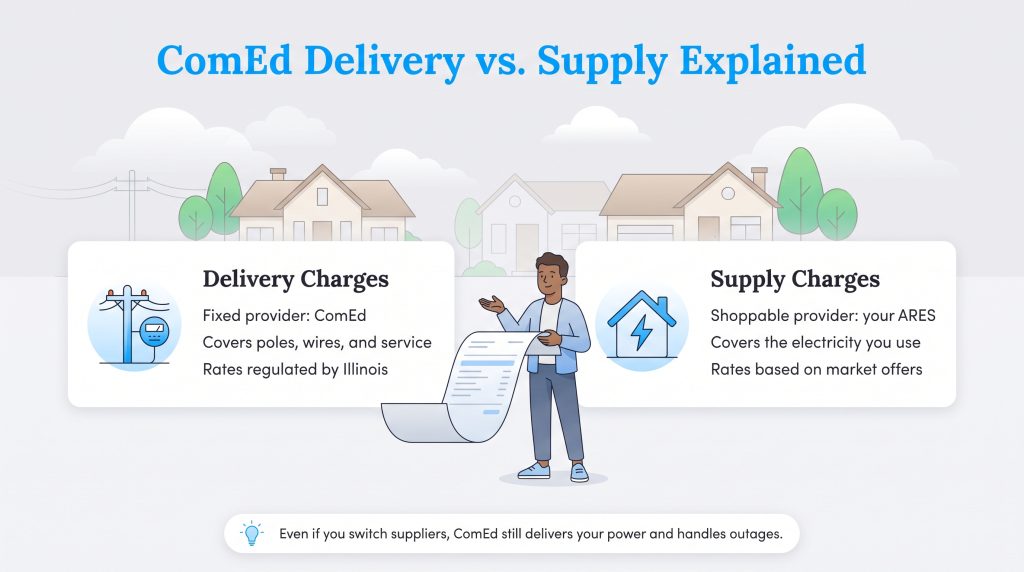
Grasping the difference between ComEd delivery vs. supply charges is essential for managing your home energy costs effectively. While ComEd maintains a regulated monopoly on the physical delivery of power to your house, you have the freedom to choose who generates that electricity. Illinois operates a deregulated energy market, giving consumers the power to shop for competitive supply plans or join dynamic pricing programs rather than sticking with the utility’s default flat supply rate.
By choosing an Alternative Retail Electric Supplier (ARES), you can potentially lock in a different rate or source renewable energy for your home. To explore your options safely, visit the official Illinois Commerce Commission choice portal and compare active offers against ComEd’s Price to Compare. If you want to see exactly where these items sit on your paper statement, the Plug In Illinois bill breakdown page and the state’s residential bill breakdown guide provide a detailed overview. No matter who supplies your power, ComEd remains your delivery company and maintains the neighborhood grid.
| Delivery Charges | Supply Charges |
|---|---|
| Fixed provider (ComEd is mandatory) | Shoppable provider (Default ComEd rate or an ARES) |
| Covers infrastructure, maintenance, and metering service | Covers the actual electricity generated and capacity costs |
| Rates are regulated by the Illinois Commerce Commission | Rates fluctuate based on market offers and the Price to Compare |
💡 Pro Tip: Even if you switch to a third-party supplier to manage your supply rate, ComEd is still your main point of contact for the physical grid. The utility will continue to send your single monthly bill and is the company you call to report power outages or downed lines.
Why Are ComEd Delivery Charges So High in 2026?
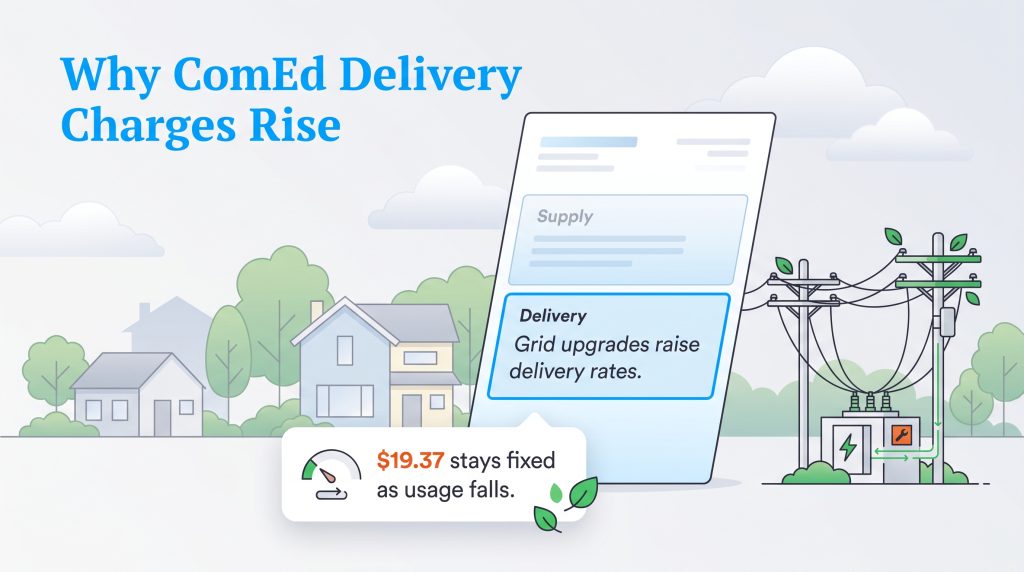
If you find yourself asking, “Why are my ComEd delivery charges so high?” after opening a recent statement, you certainly are not alone. Delivery rates have climbed over the past couple of years as state regulators approve multi-year investments in grid hardening, substation modernization, clean-energy integration, and customer assistance programs. In fact, in April 2026, the Illinois Commerce Commission (ICC) approved annual tariff adjustment factor resets alongside multi-year grid plan updates, nudging per-kWh delivery rates and monthly customer charges upward. Illinois energy policy, including the Climate and Equitable Jobs Act (CEJA), also shapes long-term grid investments. Watchdog groups like the Citizens Utility Board (CUB) regularly review and provide helpful consumer context on these approved rate changes.
It also helps to separate delivery increases from the broader electricity price headlines dominating 2026. Much of the recent sticker shock on northern Illinois electric bills stems from massive spikes in regional PJM Interconnection capacity auctions — driven by surging data center energy usage and the retirement of older fossil-fuel power plants. However, those PJM capacity spikes inflate the supply side of your ComEd bill. On the delivery side, your rising costs are driven entirely by state-approved multi-year grid investments, storm-resiliency upgrades, and regulatory adjustment riders.
Another common culprit behind disproportionate delivery charges comes down to seasonal shifts in your home energy habits. During mild spring and autumn months — when neither the air conditioner nor the furnace is working overtime — your actual electricity consumption drops significantly. Because the delivery side of your bill includes $19.37 in flat monthly fees, those fixed costs suddenly eat up a much larger percentage of your overall statement, making it look like the delivery fee is unusually expensive compared to the electricity you used.
🚩 Heads Up: Delivery charges can make up more than half of your ComEd bill during mild spring and fall months when your $19.37 in fixed monthly fees is spread across far fewer kilowatt-hours.
What You Can and Can’t Control on Your ComEd Bill
Understanding the exact levers you can pull to reduce your monthly expenses helps you focus your energy on practical solutions. While certain grid-maintenance fees are set in stone, you have more control over your delivery rate in 2026 than ever before.
| What You Can Control | What You Cannot Control |
|---|---|
| The total amount of kilowatt-hours you use each month | Choosing a different delivery company in ComEd territory |
| Switching from the standard flat delivery rate to ComEd’s Delivery Time-of-Day (DTOD) rate | Avoiding fixed customer and metering charges while connected to the grid |
| Verifying you are in the correct residential delivery rate class (e.g., electric space heat) | State-mandated distribution taxes and administrative utility riders |
| Comparing supply offers from third-party ARES providers or joining Hourly Pricing | The baseline standard rate ComEd charges for delivery per kWh |
| Improving your home’s overall energy efficiency | Regional PJM capacity costs baked into electricity supply rates |
New for 2026: ComEd Delivery Time-of-Day (DTOD) Pricing
For decades, Illinois homeowners were stuck with a single, flat per-kWh rate for the Distribution Facilities Charge. In 2026, ComEd changed the game by launching its optional ComEd delivery time-of-day pricing program — officially known as Delivery Time-of-Day (DTOD or DTOU). Instead of paying roughly 6.33¢ to 6.5¢ per kWh no matter when you flip a switch, DTOD replaces the flat Distribution Facilities Charge with four daily time windows that apply 365 days a year.
Best of all, enrolling in DTOD only modifies the delivery portion of your statement. It leaves your electricity supply plan — whether you are on ComEd’s default fixed-price supply, ComEd Hourly Pricing, or a third-party ARES contract — completely untouched. Here is how the 2026 DTOD rates compare to the standard flat delivery rate for single-family homes:
| Pricing Period (Hours) | Standard Delivery Rate | DTOD Rate (Single-Family) |
|---|---|---|
| Morning (6 a.m. – 1 p.m.) | ~6.33¢ – 6.5¢/kWh | ~4.6¢/kWh |
| Mid-Day Peak (1 p.m. – 7 p.m.) | ~6.33¢ – 6.5¢/kWh | ~12.0¢/kWh |
| Evening (7 p.m. – 9 p.m.) | ~6.33¢ – 6.5¢/kWh | ~4.3¢/kWh |
| Overnight (9 p.m. – 6 a.m.) | ~6.33¢ – 6.5¢/kWh | ~3.5¢/kWh |
Notice how for 18 hours of the day, the DTOD rate is significantly cheaper than the standard rate — dropping to nearly half price (~3.5¢/kWh) overnight. The catch is the six-hour Mid-Day Peak window from 1 p.m. to 7 p.m., when the delivery charge jumps to roughly 12.0¢/kWh because stress on neighborhood transformers and wires is at its highest.
If your household can shift heavy chores away from that 1 p.m. to 7 p.m. afternoon window, DTOD is a fantastic money-saver and an environmentally mindful choice that relieves strain on local grid infrastructure. According to ComEd program estimates, residential customers who enroll in DTOD and shift some usage off-peak lower their delivery bills by roughly 5% on average. Plus, if you drive an electric vehicle (EV) and register it when enrolling in DTOD, ComEd rewards you with an extra $2/month bill credit per EV (for up to two EVs, or $4/month total) for up to 24 months.
💸 Money-Saver: Have an electric vehicle in the garage? Plugging your EV in after 9 p.m. on ComEd’s DTOD rate slashes your delivery fee to ~3.5¢/kWh and nets you a $2 monthly EV bill credit for two full years.
How to Lower the Usage-Based Part of ComEd Delivery Charges
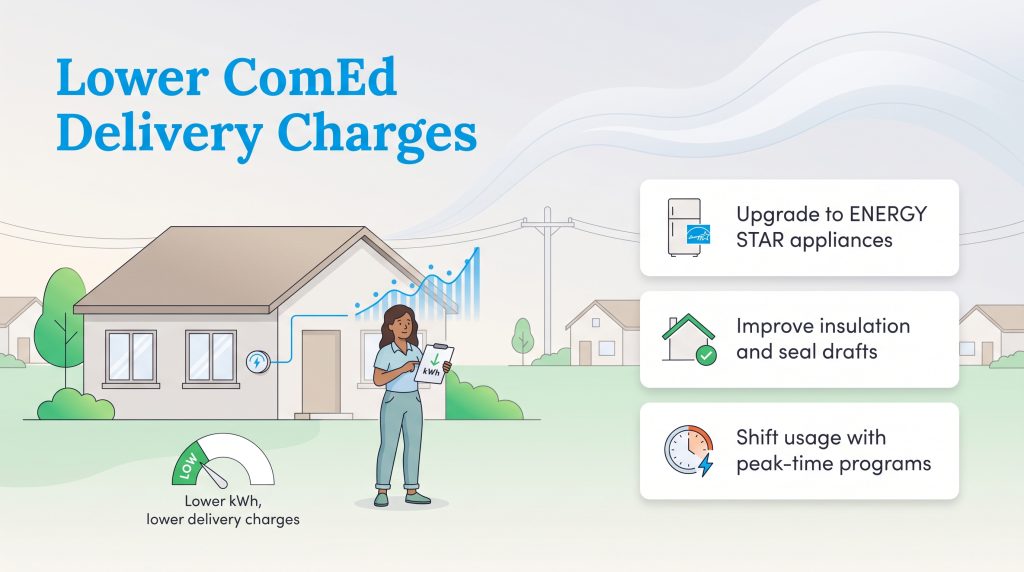
Learning how to lower ComEd delivery charges comes down to two things: using fewer total kilowatt-hours and timing your energy use wisely. Because the Distribution Facilities Charge and state distribution tax scale with every kWh you pull from the grid, cutting your home’s energy footprint automatically shrinks the delivery portion of your bill. Combining smart rate programs with a few proven strategies to save on your electric bill can make a noticeable dent in your 2026 expenses.
Use these five actionable strategies to stop overpaying for electricity delivery:
- Shift heavy appliance usage outside the 1 p.m. to 7 p.m. window on DTOD: If you enroll in ComEd’s Delivery Time-of-Day program, schedule your dishwasher, clothes dryer, and EV charger to run after 7 p.m. or before 1 p.m. Avoiding the 12.0¢/kWh mid-day peak window allows you to take advantage of ~3.5¢ to 4.6¢/kWh off-peak delivery rates.
- Apply for ComEd’s 2026 Low-Income Discount Program: Launched in early 2026, this program provides automatic monthly percentage discounts on electric bills for income-qualified households based on Federal Poverty Level or Area Median Income tiers. You can check your eligibility and apply online through ComEd’s Smart Assistance Manager (ComEd.com/SAM).
- Invest in ENERGY STAR appliances: Older refrigerators, window AC units, and electric water heaters pull a massive amount of power. Swapping them out for certified energy-saving options reduces the strain on your electrical system and cuts your monthly kWh consumption.
- Improve your home insulation and weatherization: Sealing drafts around windows, adding attic insulation, and installing a smart thermostat prevent your heating and cooling systems from working overtime, meaningfully cutting your volumetric delivery charges in both summer and winter.
- Enroll in Peak Time Savings: When you enroll in ComEd Peak Time Savings, voluntarily reducing your electricity usage during designated summer peak events earns you direct bill credits that help offset your delivery fees.
🌱 Eco Edge: Using less electricity during high-demand afternoon periods supports a more resilient local grid and reduces the need for dirtier backup peaker plants, shrinking your home’s carbon footprint while lowering your bill.
Taking Control of Your Next Energy Bill
While delivery fees are an unavoidable part of maintaining a reliable, modern electrical grid in northern Illinois, they do not have to be a mystery. Taking a few minutes to audit your statement — checking that you are in the right residential rate class, weighing whether the new 2026 Delivery Time-of-Day program fits your daily routine, and trimming wasted kilowatt-hours — puts you back in the driver’s seat. By focusing on the usage-based costs and rate options you can control, you can keep your monthly utility budget in check and build a more sustainable, energy-efficient home.
Frequently Asked Questions About ComEd Delivery Charges
Still sorting through the fine print on your ComEd statement? These quick answers cover the most common questions about 2026 delivery charges, rate classes, time-of-day pricing, and solar billing.
What is the Distribution Facilities Charge on my ComEd bill?
How does ComEd Delivery Time-of-Day (DTOD) pricing work?
Does ComEd offer a lower delivery rate for homes with electric heat?
What is the average ComEd bill in Chicago?
Where can I find the ComEd Price to Compare?
Can I opt out of paying ComEd delivery charges?
Why is my delivery charge higher than my supply charge?
Does switching to solar energy eliminate delivery charges?
About the Author

LaLeesha has a Masters degree in English and enjoys writing whenever she has the chance. She is passionate about gardening, reducing her carbon footprint, and protecting the environment. She also recently served as President of the Board for City Sprouts (a community garden).

David has been an integral part of some of the biggest utility sites on the internet, including InMyArea.com, HighSpeedInternet.com, BroadbandNow.com, and U.S. News. He brings over 15 years of experience writing about, compiling and analyzing utility data.