

Understanding This Benchmark Rate Is the Key to Unlocking Potential Savings on Your Monthly Energy Costs
Key Takeaways
- The price to compare (PTC) is the generation and supply rate your local utility company charges for electricity if you do not actively choose a competitive supplier.
- You can easily find this specific rate on your monthly statement, often located under secondary pages labeled “Supply Detail” or “Message Center.”
- Comparing a fixed-rate plan against your utility’s fluctuating PTC is the best way to calculate potential savings and lock in long-term budget stability.
Understanding exactly what is price to compare (electricity) and how it dictates your monthly costs is the fundamental first step to taking absolute control of your household energy budget. The price to compare (PTC) is the default supply rate set by your local electric distribution company to cover the raw cost of generating your power when you do not actively select an independent energy provider. If you live in a deregulated energy market, this single baseline metric serves as the ultimate benchmark to help you evaluate competitive market offers and calculate your potential electricity savings. Knowing this exact figure allows you to confidently compare electricity suppliers, lock in predictable long-term pricing, and seamlessly transition to environmentally mindful choices without worrying about overpaying on your monthly utility bill.
What Does the “Price to Compare” (PTC) Mean?
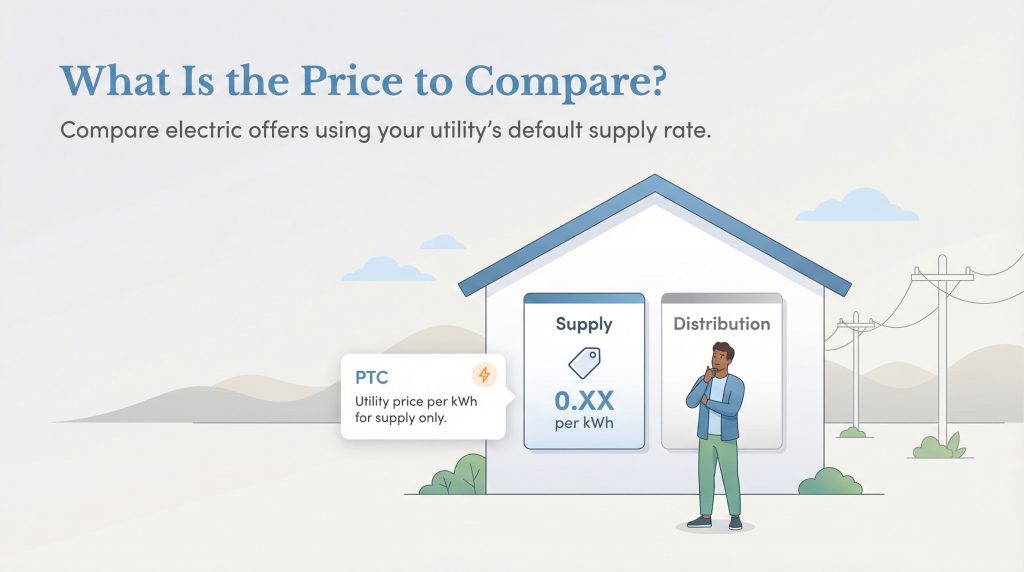
The price to compare (PTC) is the default supply rate per kilowatt-hour (kWh) your local distribution utility charges for the electricity your household consumes. Think of it as the default factory setting for your home’s power plan. If you recently moved into a new residence, set up an account with your local utility, and have never actively shopped around for a third-party retail electric provider, you are automatically enrolled in this baseline utility rate.
Historically, before energy deregulation took effect across various states, consumers had no choice but to purchase their electricity directly from their local utility monopoly at a fixed, regulated price. Today, in deregulated states like Pennsylvania, Ohio, and New Jersey, energy choice laws separate the ownership of the physical power lines from the actual electricity flowing through them. While the utility still delivers the power to your home safely, they no longer hold a monopoly on generating or supplying it.
When you remain on the default utility rate, your local provider secures electricity on the open wholesale market on your behalf and passes that exact generation expense directly to you. Many consumers mistakenly believe they have no control over their electric bills, assuming the total amount due is entirely fixed. However, isolating this specific generation rate — your PTC — from the rest of your monthly statement provides you with a powerful, transparent metric for comparison shopping in the competitive retail energy market.
💡 Money-Saver: Even if you never signed a formal contract for your home’s power, you still have an active electric rate. This baseline cost is your utility’s default price to compare, and it fluctuates multiple times a year based on volatile market conditions.
Supply vs. Delivery: What Does the PTC Actually Cover?
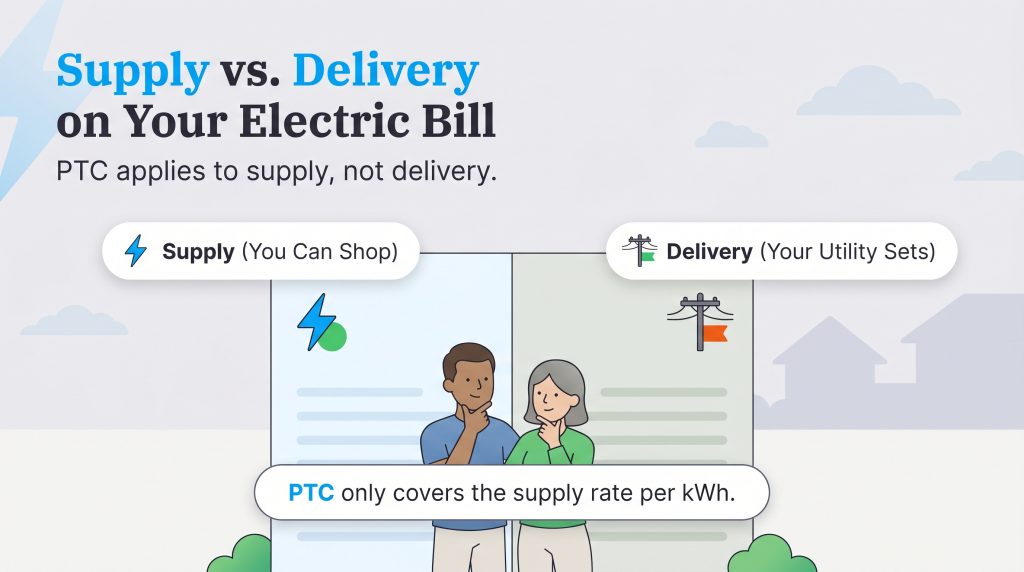
To truly grasp how the PTC impacts your wallet and understand exactly where your money goes each month, you must understand the two primary components of your monthly energy bill: supply charges and delivery charges. Your utility statement bundles these costs together to give you a single total amount due, but they pay for entirely different services and grid infrastructure.
| Generation Supply Costs (PTC) | Utility Delivery Charges |
|---|---|
| Negotiable and actively shoppable in deregulated markets | Fixed and strictly non-negotiable for all residents |
| Covers the raw electricity your home actively consumes | Covers the physical poles, wires, substations, and meters |
| Provided by a retail supplier or defaulted to the utility | Always managed and collected by your local utility company |
The PTC only applies to the supply portion of your bill. This represents the actual raw electricity — the electrons — that your household consumes when you turn on the lights, run the air conditioning, or charge your electric vehicle. Because you live in a deregulated market, this is the only part of your electric service that you can actively shop around for. By comparing the utility’s default supply rate against competitive market offers, you can significantly lower this half of your monthly bill.
Delivery charges, on the other hand, are strictly non-negotiable. These are the fixed fees collected by your local utility company to maintain the physical power grid, including the distribution poles, wires, substations, and smart meters in your specific neighborhood. Even if you switch your generation supply to a new independent energy provider, you will always continue to pay these required delivery fees directly to your local utility, and they will still be the ones to restore your power during an outage.
Kilowatt-Hours (kWh) and Therms: Understanding Your Energy Metrics
Before you start crunching numbers, it helps to understand exactly how energy is measured and billed. Your monthly statement breaks your energy usage down into standardized units, and your PTC is tied directly to these measurements.
- Kilowatt-Hour (kWh): This is the standard unit of measurement for electricity. One kWh equals the amount of energy required to run a 1,000-watt appliance for one hour. When you look at the price to compare for electricity, it is almost always expressed in cents per kWh (e.g., 11.76¢ per kWh).
- Therm: If you are also shopping for natural gas in a deregulated market, your usage is measured in Therms or hundred cubic feet (CCF). The natural gas equivalent of a price to compare is typically expressed in dollars per Therm.
Your total supply cost is simply your PTC rate multiplied by the total number of kWh or Therms your household used during the billing cycle.
Regional Terminology: SSO, BGS, and DSR Explained
Depending on exactly where you live in the United States, your local distribution company might not use the exact phrase “price to compare” on your monthly statement. Different state public utility commissions enforce their own naming conventions for this baseline generation rate. When checking your bill or browsing your state’s official energy marketplace, it is vital to keep an eye out for these localized terms to ensure you are comparing the correct numbers:
- Standard Service Offer (SSO): Commonly used by major utilities in Ohio, representing the default rate set through competitive bidding.
- Basic Generation Service (BGS): The standard terminology used in New Jersey for the default electricity supply provided to customers who do not shop for third-party providers.
- Default Service Rate (DSR): A general umbrella term used in various states across New England and the Mid-Atlantic to describe the benchmark supply cost.
- Provider of Last Resort (POLR): Used frequently in Texas, where the market is fully deregulated, and consumers are heavily encouraged to select a retail provider rather than fall back on these notoriously expensive safety-net rates.
How Is the Utility Price to Compare Calculated?
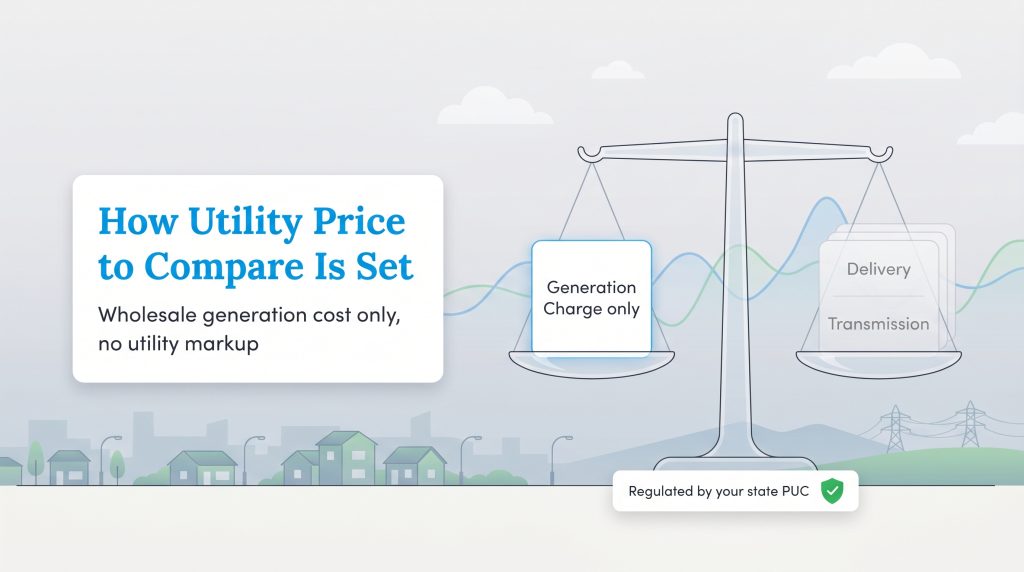
You might wonder how utility companies arrive at their default numbers in the first place. Setting the price to compare is a highly regulated, transparent process designed to keep your essential energy services stable. Here is the step-by-step breakdown of how that calculation works:
- Wholesale Energy Procurement: Local utilities do not generate their own power in deregulated states. Instead, they purchase massive quantities of raw electricity on the wholesale market through periodic auctions.
- Averaging the Costs: The utility takes the varying prices it paid for this bulk electricity over several months and averages them out into a single, predictable rate.
- Direct Pass-Through to Consumers: By law, the utility simply passes this exact generation cost directly to you. They are not allowed to mark up the cost of the electricity or add hidden profit margins to the supply portion of your bill.
The Role of the State Public Utility Commission (PUC)
If utilities cannot profit from the generation of electricity, who ensures they play by the rules? That critical job falls to your state’s public utility commission (PUC) or Board of Public Utilities (BPU). These government regulatory bodies exist specifically to protect everyday consumers from price gouging and unfair monopoly practices.
Every time a utility company wants to adjust its default supply rate — which typically happens two to four times a year — it must submit the proposed changes to the PUC for rigorous review. The commission verifies that the utility is passing along the true wholesale cost without arbitrary markups. Because utility monopolies cannot legally profit from the generation portion of your bill, their primary revenue stream comes exclusively from the delivery and distribution fees.
Where to Find the PTC on Your Electric Bill
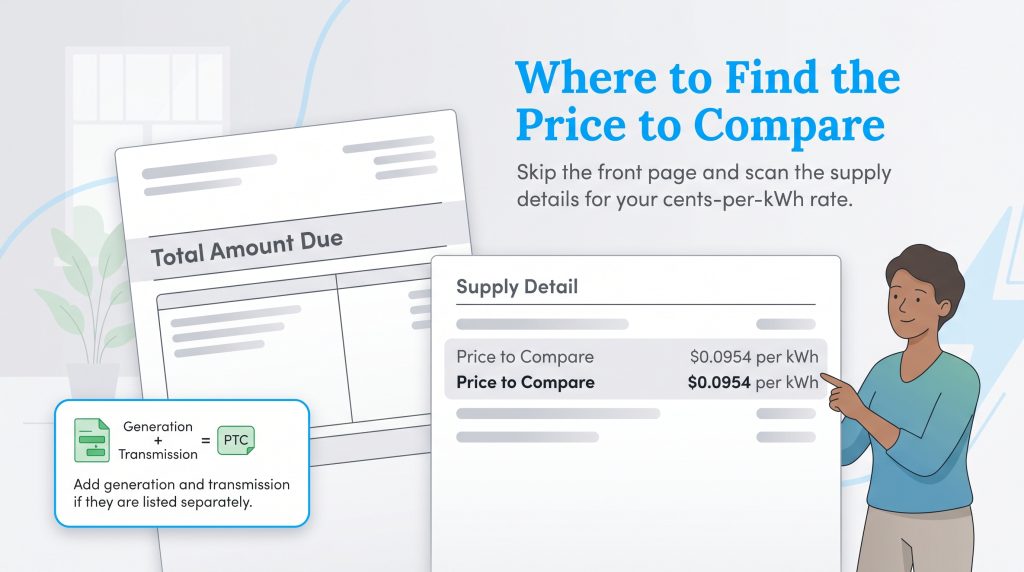
Ready to see what you are currently paying? Locating your specific PTC is quick, but it does require looking past the prominent total amount due on the first page of your statement. Follow these simple steps to find your exact baseline rate:
- Locate a recent statement: Grab your latest paper bill or log into your online utility account and download the full PDF statement.
- Skip the summary page: Move past the first page, which usually only outlines your total balance due and overall usage history.
- Find the “Supply Details” section: Look for secondary pages labeled “Supply Details,” “Generation Charges,” or the “Message Center.”
- Identify the rate: Look for the bolded phrase “Price to Compare” or your regional equivalent (like Basic Generation Service). It will be explicitly listed in cents per kWh, such as “Your Price to Compare is $0.1176 per kWh.”
How to Calculate Your Electricity Savings Using the PTC
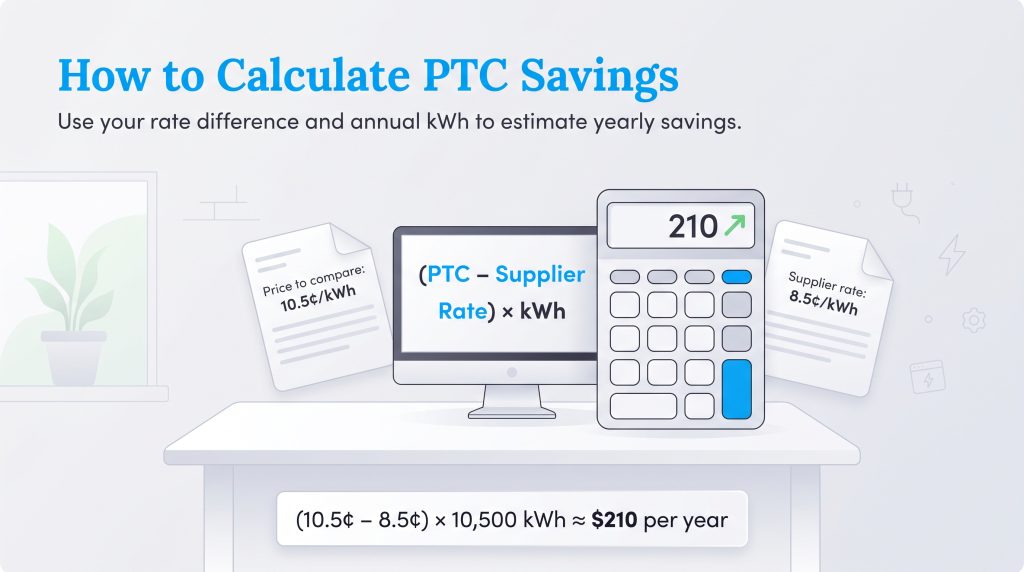
Once you have located your benchmark rate, determining whether an alternative energy service company (ESCO) will actually save you money is entirely straightforward. You just need a simple mathematical formula:
(Utility PTC – Competitor Rate) x Annual kWh Usage = Yearly Savings
Let’s walk through a concrete numerical example. Imagine your utility’s current price to compare is 13.08¢ per kWh (or $0.1308), and you find a reputable competitive supplier offering a fixed rate of 9.50¢ per kWh ($0.0950). If your household consumes an average of 1,000 kWh per month, your total annual usage would be 12,000 kWh.
- Step 1: Subtract the competitor rate from the utility rate ($0.1308 – $0.0950 = $0.0358 saved per kWh).
- Step 2: Multiply that difference by your yearly usage ($0.0358 x 12,000 kWh).
- Total Savings: In this scenario, switching would save you $429.60 per year just by changing the name of the company that supplies your power.
Fixed Rates vs. Variable Rates vs. PTC
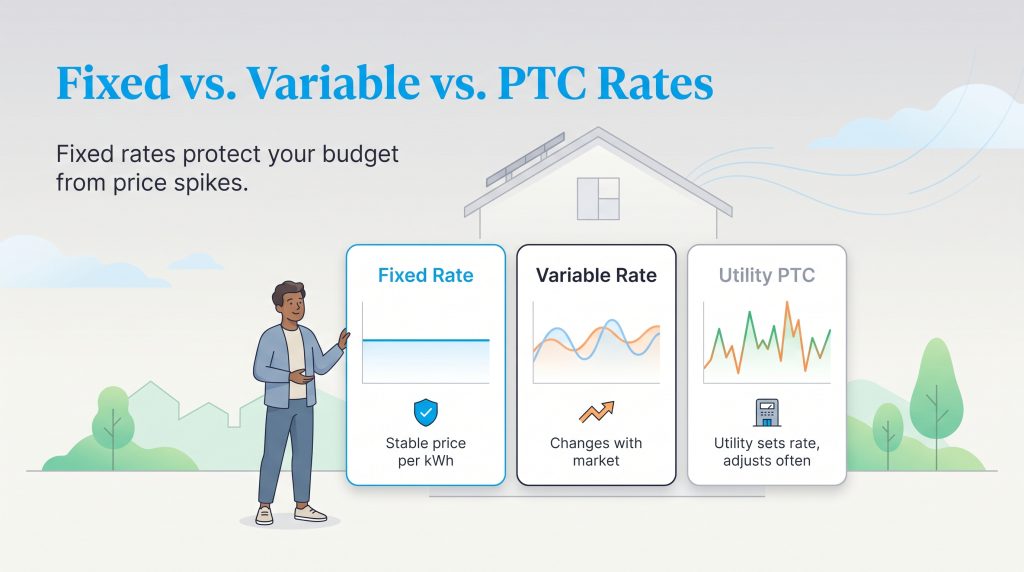
When you enter the competitive energy market to shop around, you will encounter two main types of pricing models offered by third-party suppliers: fixed rates and variable rates. Understanding how these differ from your utility’s PTC is crucial to making an informed decision.
Your utility’s price to compare is essentially a fluctuating default rate. While it remains stable for a few months at a time, it is legally required to adjust periodically to reflect current wholesale market costs. This means your bills can spike drastically during high-demand summer or winter seasons.
To establish true budget stability, we highly recommend choosing a fixed-rate plan. A fixed-rate contract locks in your exact cents-per-kWh price for the entire duration of your agreement, which typically lasts anywhere from 12 to 36 months. Regardless of how high the wholesale market spikes, your energy supply cost remains completely shielded.
Conversely, variable-rate plans change on a month-to-month basis depending on market conditions. While they might occasionally dip lower than the utility’s PTC, they carry significant financial risk. A sudden heatwave or extreme winter storm can cause variable rates to skyrocket overnight, leaving you with an astronomical utility bill. For the everyday household consumer, fixed-rate plans provide far superior peace of mind.
Current PTC Averages in Deregulated States
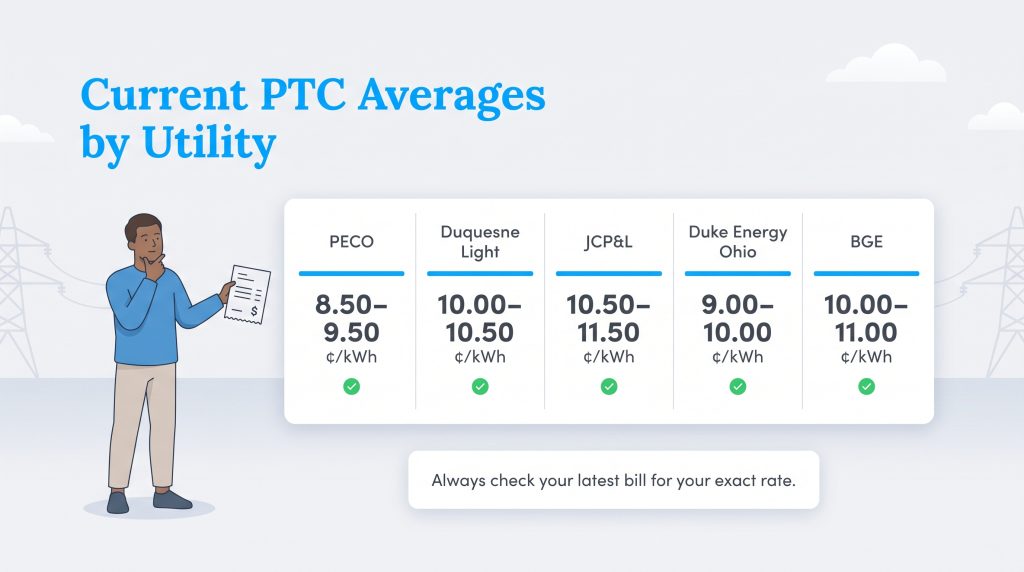
To give you a general sense of what default generation costs look like across the country, we have compiled a snapshot of recent default rates from major utilities in prominent deregulated states. Keep in mind that these rates fluctuate based on seasonal updates and local public utility commission rulings.
| State | Primary Utility Example | Local Terminology | Recent Default Rate Benchmark |
|---|---|---|---|
| Pennsylvania | PECO Energy | Price to Compare (PTC) | ~ 11.76¢ per kWh |
| Pennsylvania | PPL Electric Utilities | Price to Compare (PTC) | ~ 13.08¢ per kWh |
| Ohio | AEP Ohio | Standard Service Offer (SSO) | ~ 10.16¢ per kWh |
| New Jersey | PSE&G | Basic Generation Service (BGS) | Varies strictly by annual BGS auction |
Using the Price to Compare to Support Green Energy
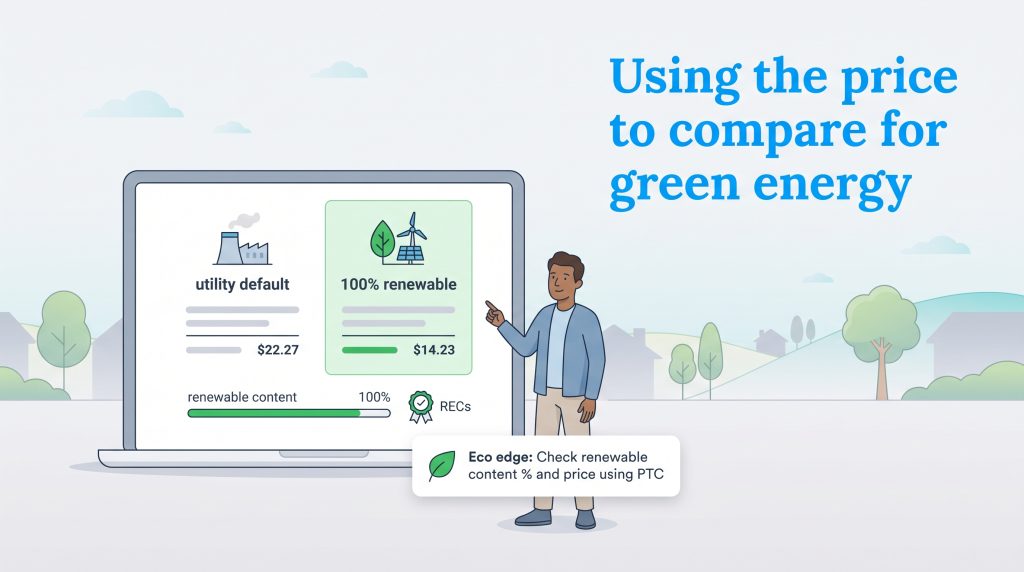
If you are an eco-conscious consumer, your price to compare is also the golden ticket to finding an environmentally mindful choice that fits your budget. Often, third-party suppliers offer 100% renewable energy plans — backed by wind or solar generation — at fixed rates that are surprisingly lower than your utility’s fossil-heavy default service rate.
Preparing to Switch Your Electricity Supplier
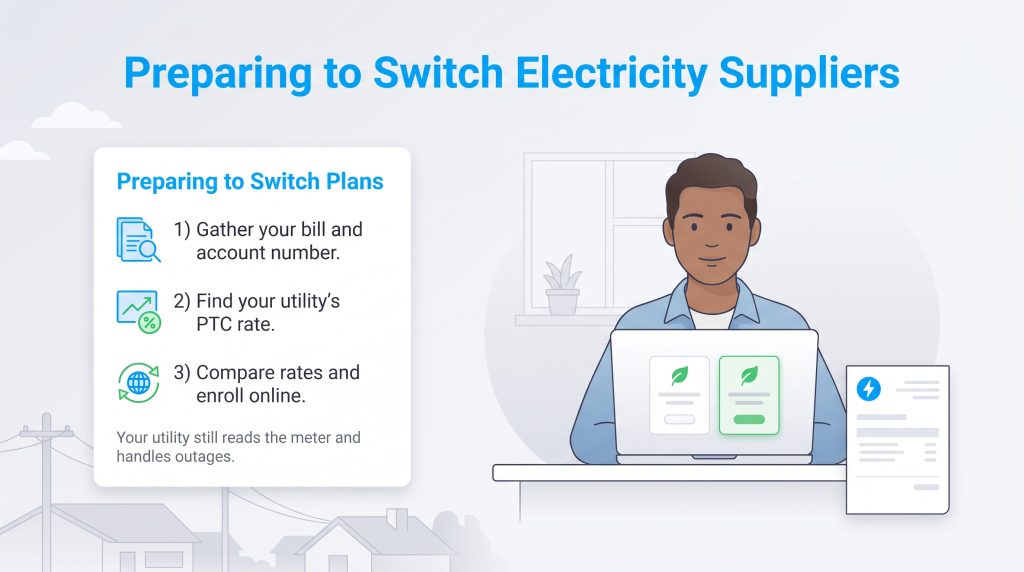
Once you locate your utility’s PTC, switching to a new supplier is a seamless online process. To start, visit your state’s official energy shopping website (such as PA Power Switch or Energy Choice Ohio) or use a reputable private comparison engine. Enter your ZIP code and sort the available plans by price.
Filter the results exclusively for fixed-rate contracts that are lower than your current default rate. Carefully read the terms of service, paying special attention to early termination fees and monthly base charges. Once you hit enroll, your new supplier will coordinate the switch directly with your local utility company. There will be zero interruption to your daily service, no new equipment to install, and nobody will need to visit your home.
Managing Your Energy Contract Renewals
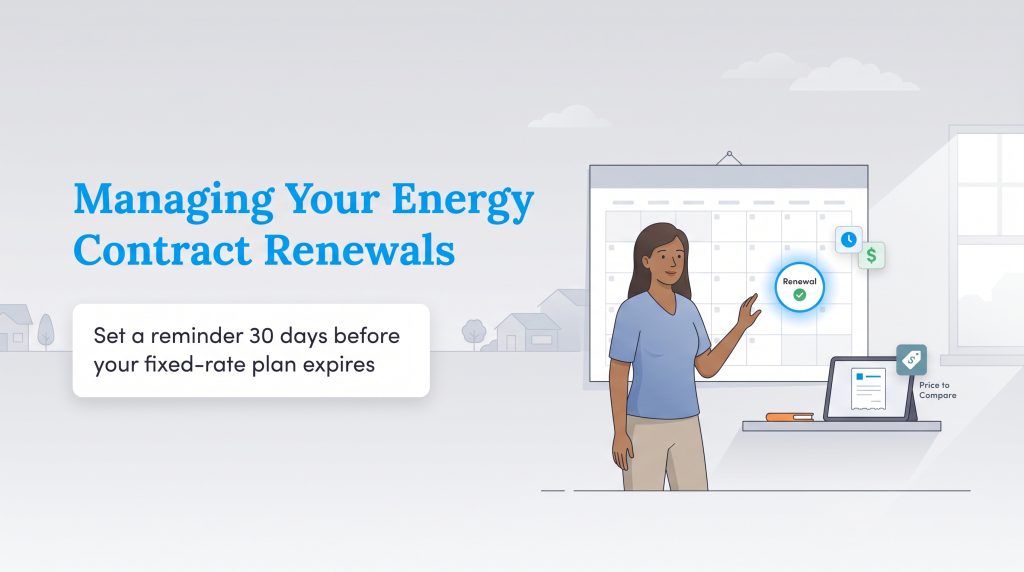
Managing your energy contract renewals effectively ensures you never fall back onto an expensive variable rate. Keeping track of your fixed-term expiration date is just as important as securing a competitive introductory rate.
📌 Quick Fact: Most energy contracts do not require you to call your utility company to break ties. Your newly chosen supplier acts on your behalf and processes the paperwork seamlessly behind the scenes.
Taking Control of Your Household Energy Budget
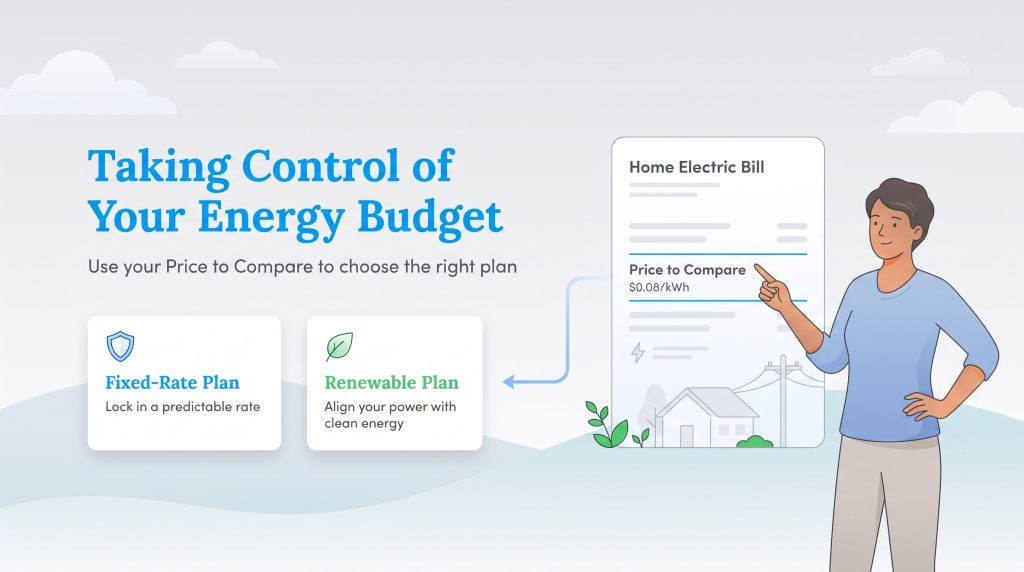
Navigating the deregulated energy market might seem intimidating at first glance, but it ultimately boils down to a single, essential number. By locating the price to compare on your monthly statement, you immediately cut through the confusing jargon and give yourself a clear benchmark for success. Taking five minutes to review your supply details empowers you to abandon unpredictable utility rates and actively shop for stability.
Armed with this foundational knowledge, you can securely lock in a fixed-rate plan, protect your wallet against harsh seasonal price spikes, and even actively support clean energy initiatives. You no longer have to settle for whatever baseline rate your utility hands you — the power to choose is entirely yours.
Frequently Asked Questions About the Price to Compare
How long does it take to switch from my utility’s price to compare to a new supplier?
How often does the utility price to compare change?
Are there cancellation fees if I switch away from the default utility price to compare?
Does the price to compare apply to both electricity and natural gas?
Is my power at risk of being shut off if I switch from the utility PTC to an energy service company (ESCO)?
About the Author

David has been an integral part of some of the biggest utility sites on the internet, including InMyArea.com, HighSpeedInternet.com, BroadbandNow.com, and U.S. News. He brings over 15 years of experience writing about, compiling and analyzing utility data.

Claudio is a sustainability-focused writer with a background in Anthropology and Psychology from NC State University. He has spent over 15 years working in writing, interpretation, and translation, driven by a deep interest in how human culture shapes the environment. Today, he shares his curiosity with readers by writing about sustainable living solutions and the connection between everyday choices and environmental impact.