

Finding the Right Energy Plan Requires Understanding Your Monthly Usage and Knowing Exactly Which Hidden Fees to Avoid
Key Takeaways
- Check your average kWh usage per month before comparing energy suppliers to ensure you get an accurate rate estimate based on your actual habits.
- Fixed-rate plans offer long-term price stability, while variable-rate plans can fluctuate unpredictably with the energy market.
- Watch out for hidden costs like early termination fees and minimum usage charges before you officially switch electricity providers.
Skyrocketing utility costs are straining household budgets across the country, making it more critical than ever to learn how to choose an electricity provider that genuinely works for your lifestyle and budget. In this comprehensive guide, you will discover how to calculate your exact monthly usage, confidently compare electricity rates, and sidestep predatory fees buried deep within your contract fine print. Navigating a competitive energy market does not have to feel overwhelming when you know exactly what to look for. By evaluating your historical usage patterns and analyzing modern plan types, you can protect your wallet from unexpected market spikes caused by extreme weather. Whether you want to lock in a reliable fixed rate or figure out exactly how to switch electricity providers without a frustrating service gap, this step-by-step breakdown gives you the actionable tools needed to take back control of your monthly electric bill.
Understand Your Deregulated Energy Market
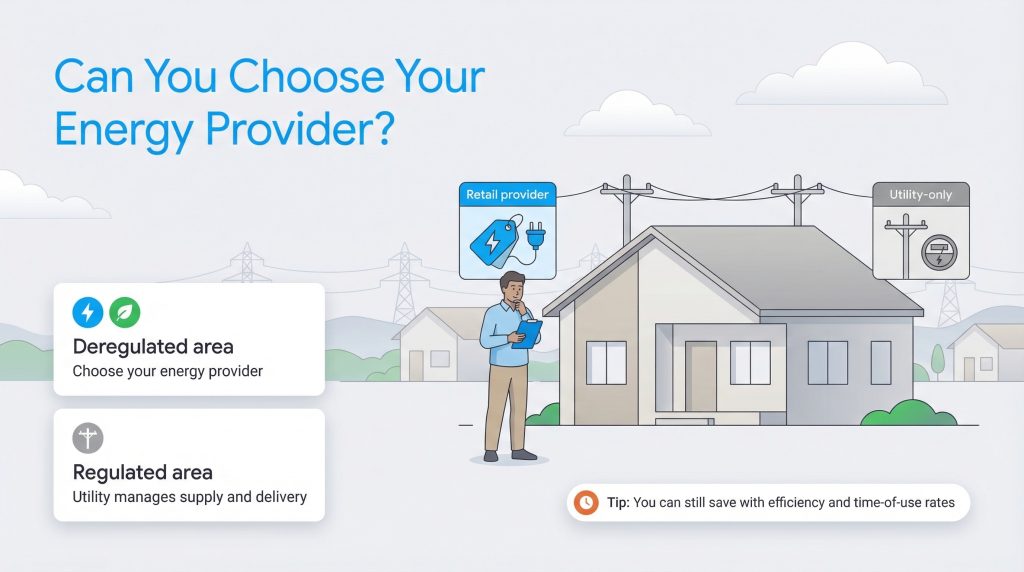
Before diving into rate comparisons and complex billing structures, you need to confirm if you actually reside in one of the deregulated energy market states where choice is available. In heavily regulated territories, a single local utility company holds a complete monopoly over both the generation and the delivery of your power. Because you cannot shop around for better rates in these areas, your only option for managing high costs involves reducing your energy consumption directly through home improvements.
However, if you live in a deregulated region — such as Texas, Pennsylvania, or Ohio — you possess the power to choose electric plans that fit your exact household needs. A common roadblock for homeowners navigating this deregulated energy market is distinguishing between the different organizations that handle their power. Your local utility company is permanently bound to your geographic location and focuses entirely on the grid’s physical infrastructure, like utility poles and wires.
Meanwhile, a retail electric provider (REP) — such as Reliant Energy, TXU Energy, or Direct Energy — operates in a highly competitive marketplace. They purchase wholesale energy on the open market and sell it directly to residential customers. By keeping these two roles straight, you will know exactly who to call when the neighborhood lights go out and who to contact when you want to dispute a confusing billing charge.
| Responsibility | Local Utility Company | Retail Electric Provider (REP) |
|---|---|---|
| Infrastructure Maintenance | Maintains physical power lines, poles, and grid equipment. | Has no role in maintaining physical infrastructure. |
| Outage Restoration | Dispatches crews to restore power during a blackout or severe weather. | Cannot restore power; will direct you to contact the utility. |
| Energy Supply | Simply delivers the energy to your home. | Purchases wholesale power on the open market and supplies it to you. |
| Rate Setting | Charges regulated delivery and transmission fees. | Sets the actual cost per kilowatt-hour (kWh) for your supply. |
Calculate Your Monthly Electricity Usage
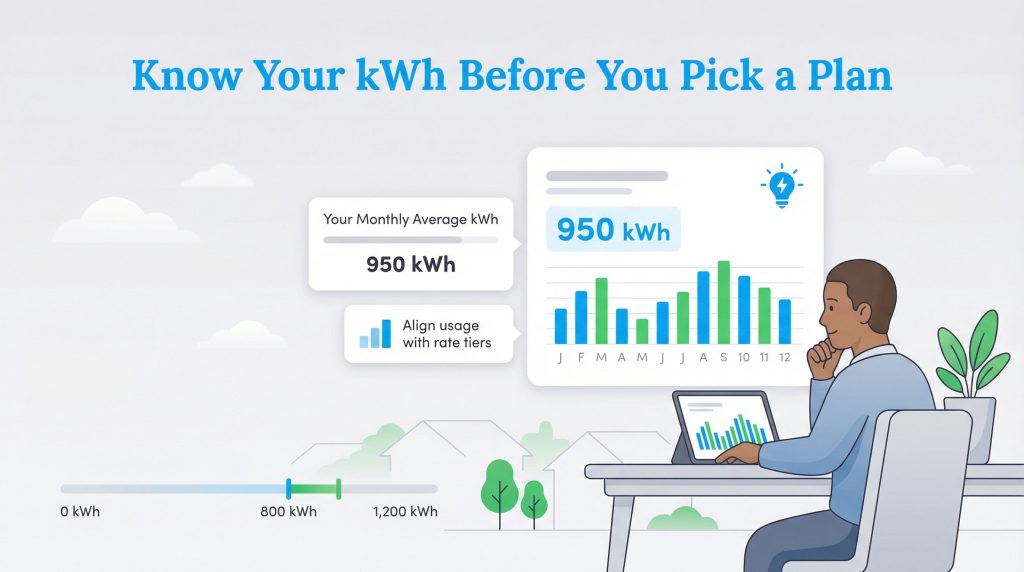
Unlocking the cheapest electricity supplier heavily depends on knowing exactly how much power your household consumes in a given month. Simply picking the lowest advertised price often leads to unexpected bill spikes if that specific promotional rate does not align with your daily habits. Getting comfortable and understanding your electric bill serves as the necessary foundation for any smart shopping decision.
Your overall power consumption is measured in kilowatt-hours (kWh). To put this into a realistic perspective, the U.S. Energy Information Administration reports that the average U.S. residential customer uses about 800 to 900 kWh per month. To establish a highly accurate baseline for your own home, pull up your last 12 months of utility statements to review your exact usage trends across both the mild shoulder seasons and extreme summer months.
Why Tiered Usage Matters
Many retail suppliers lure new customers in with aggressive teaser rates that look incredibly cheap at first glance. However, these heavily promoted prices usually apply only if you hit a very specific usage tier — such as exactly 1,000 kWh — during your billing cycle. Falling just short or exceeding that strict benchmark by a few kilowatt-hours can completely invalidate your discounted pricing structure, causing your average rate to skyrocket.
💡 Pro Tip: If you are moving into a brand-new home and don’t have past bills, ask your real estate agent or landlord for the previous occupant’s average usage to help you estimate your future energy needs.
Compare Electricity Plan Types
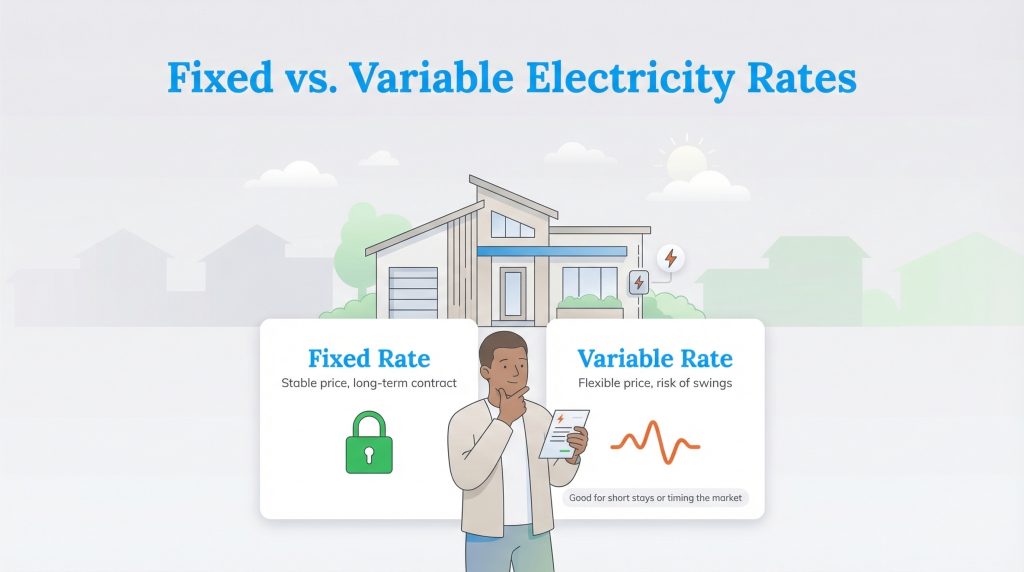
Deciding between competing contract structures trips up countless shoppers, making it one of the most critical steps to get right in a deregulated market. To protect your wallet, you must thoroughly evaluate fixed vs. variable electricity rates alongside alternative billing structures. We highly recommend exploring all options to find the one that effortlessly aligns with how your family uses power.
Fixed-Rate Plans
A fixed-rate plan secures a specific price per kWh for the entire duration of your contract, ensuring reliable and steady monthly forecasting. We highly recommend fixed-rate plans for long-term budget stability. Locking into this plan type permanently shields your monthly budget from severe wholesale market swings during intense summer heatwaves or freezing winter storms. While your total bill will naturally fluctuate depending on how much energy you consume, the actual price you pay for every unit of energy remains entirely protected from market volatility.
Variable-Rate Plans
Conversely, a variable-rate plan fluctuates month-to-month based heavily on global energy market conditions. These structures provide total flexibility with absolutely no long-term commitments or early cancellation fees. However, this freedom comes with a significant catch. Variable rates leave you highly vulnerable to massive and sudden price surges. If a regional pipeline issue occurs or a heat dome settles over your state, your electricity bill could easily double without any advanced warning from your provider.
Time-of-Use (TOU) Plans
With the widespread deployment of smart home meters, time of use electricity plans have become a dominant offering in competitive energy markets. Under a TOU structure, the price you pay per kilowatt-hour changes dramatically depending on the specific time of day you consume the power. Providers charge premium, expensive rates during “peak” hours when regional grid demand is highest — typically late afternoons and early evenings when people return from work. In exchange, they offer heavily discounted rates during “off-peak” hours, such as the middle of the night.
These plans are exceptionally beneficial for consumers who can easily shift their heavy power consumption. If you own an electric vehicle, work overnight shifts, or utilize a flexible remote work schedule that allows you to run major appliances like your dishwasher and HVAC at noon, a TOU plan can yield massive savings. However, if your household is busiest during standard dinner hours, this setup will likely increase your overall monthly costs.
Prepaid Electricity Plans
Prepaid electricity plans require no upfront security deposit or formal credit check to initiate service, making them highly accessible. You load funds into an account balance in advance, and your retail provider deducts money daily based on your actual, real-time consumption. While this is an excellent solution for consumers needing immediate power, prepaid accounts typically feature noticeably higher overall rates per kWh than standard fixed-rate contracts.
Watch Out for Free Nights and Weekends Plans
Retail energy providers frequently lure eager shoppers in with flashy advertising campaigns promising complimentary power during specific hours. At first glance, signing up for a plan that offers completely free electricity all weekend sounds like an unbeatable, money-saving deal. Unfortunately, these aggressive marketing tactics often hide a severe mathematical trap designed to boost the supplier’s bottom line at your expense.
To heavily offset the cost of giving away power during those promotional periods, providers dramatically inflate the standard daytime rates. You might easily end up paying double or triple the standard market rate during regular weekday hours. Unless your house is completely empty from Monday through Friday — and you rigorously schedule all laundry, dishwashing, and intense air conditioning usage exclusively for the weekend — you will almost certainly overpay in the long run. Before agreeing to one of these gimmicky pricing structures, aggressively calculate your daytime usage to verify if the math genuinely works in your favor.
Analyze the Electricity Facts Label
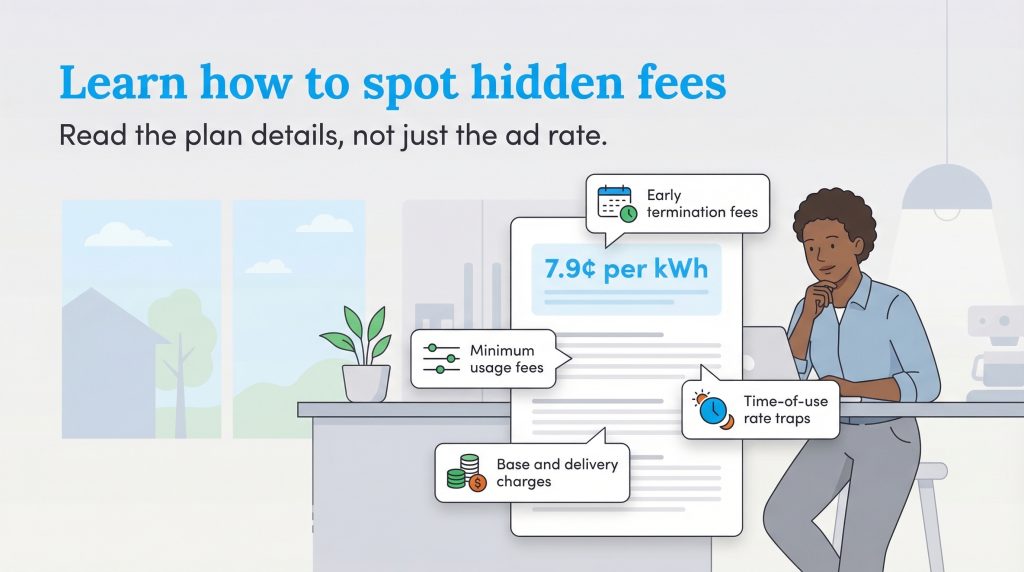
Searching for a competitive rate often brings up dozens of compelling advertisements, but you should never rely on flashy marketing claims alone to make your decision. Before agreeing to any new service, you must carefully read the plan’s official disclosure document. In states like Texas, this is commonly known as the Electricity Facts Label (EFL). Getting the electricity facts label explained is the ultimate key to consumer protection. We strongly instruct you to never sign a contract without reading this critical document from top to bottom first.
This mandatory, government-regulated summary strips away the sales pitch to reveal the true cost breakdown of your new energy plan. Skipping this step is a surefire way to get blindsided by predatory billing tactics. A standard EFL provides a comprehensive breakdown of the following key elements:
- Base charges: A flat, recurring monthly fee charged by your provider regardless of how much electricity you actually use.
- Energy charges: The specific cost you pay per kilowatt-hour (kWh) for the electricity your household consumes.
- Delivery fees: Regulated charges assessed by your local utility company for safely transmitting the power across their lines to your home.
- Rate tiers: Specific price points that apply based on your exact usage volume, typically benchmarked tightly at 500, 1000, and 2000 kWh.
To visually demonstrate exactly how this math works on a standard EFL, here is a table breaking down a highly realistic example of these standard charges:
| Charge Component | Realistic Example Cost | How It Impacts Your Bill |
|---|---|---|
| Base Charge | $9.95 per month | A flat fee applied every billing cycle regardless of usage. |
| Energy Charge | 11.2¢ per kWh | The actual cost for the power you consume at home. |
| Delivery Fee | 4.5¢ per kWh + $4.39 | Regulated charges passed straight from the utility. |
Evaluate Green Energy Plans and Perks
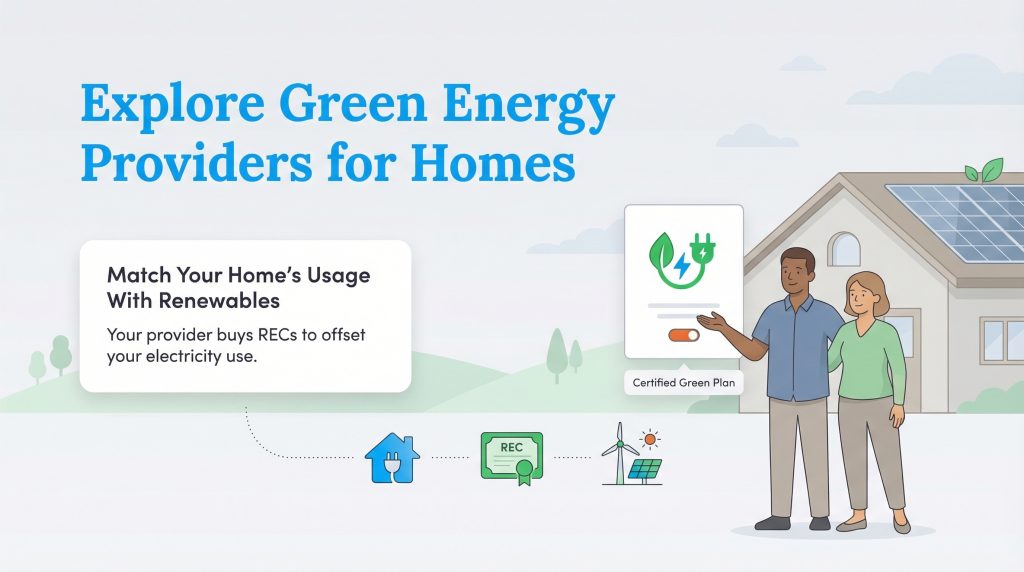
Sustainability is no longer a niche market in the competitive utility sector. Opting for green energy plans is a highly impactful, seamless way to reduce your household’s carbon footprint without needing to finance or install bulky equipment on your roof. By filtering your search for modern plans that promise 100% wind or solar energy — such as those offered by Green Mountain Energy — you can actively support clean power generation simply by paying your monthly bill.
When you sign up for these eco-conscious alternatives, the physical electricity flowing to your outlets still travels through the standard, shared power grid. However, your retail supplier officially purchases Renewable Energy Certificates (RECs) on your behalf to match your household consumption. This essential accounting mechanism ensures that an equivalent amount of clean power is generated by wind farms or solar arrays and fed safely back into the regional grid.
Treating your utility selection as an environmentally mindful choice accelerates the broader national transition toward sustainable infrastructure. While exploring residential solar panel systems serves as a fantastic long-term alternative, picking a certified green supplier takes mere minutes to complete and requires no upfront construction costs.
🌱 Eco Edge: Look for providers that source their wind or solar energy locally. If you want to verify a company’s green claims, check if their plans are certified by the EPA’s Green Power Partnership.
Identify Early Termination Fees and Hidden Costs
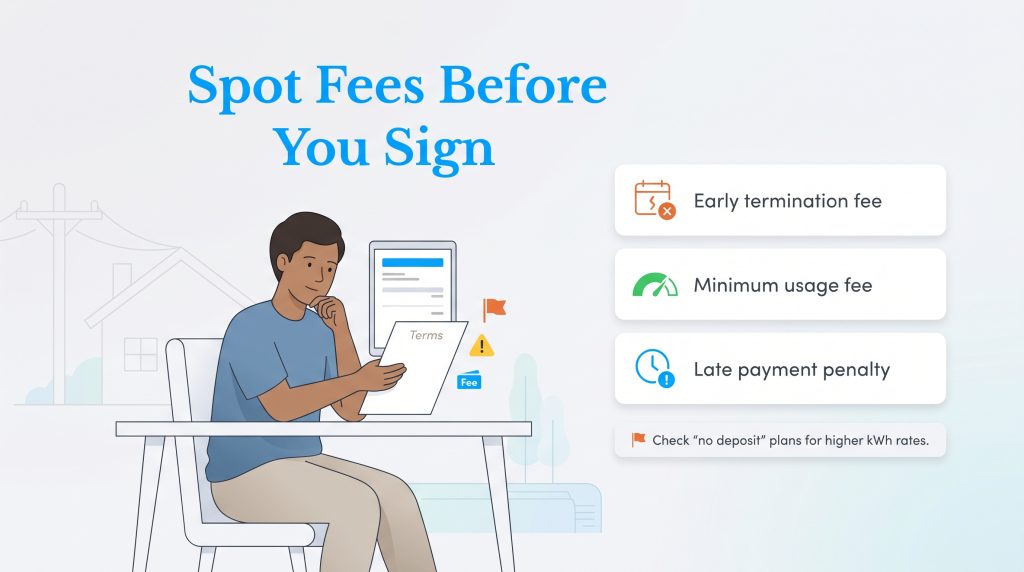
Even if you secure an impressively affordable energy charge, hidden costs can drastically inflate your final monthly bill. Some deceptive providers purposefully mask their actual profitability by burying punitive clauses deep within their massive terms of service documents. To successfully avoid these common pricing traps, you need to actively identify and calculate any potential fees before finalizing your enrollment.
Always review the fine print meticulously for these significant financial red flags:
- Early termination fees: These are steep, unavoidable monetary penalties charged if you break or cancel your long-term contract before the agreed-upon expiration date.
- Minimum usage fees: This is a sneaky financial penalty applied directly to your statement if your household fails to consume a required threshold of electricity during a specific billing cycle.
- Late payment penalties: These are strict extra charges tacked onto your account balance if you fail to pay your monthly utility bill by the official, documented due date.
🚩 Heads Up: Always check if a “no deposit electricity plan” requires you to pay higher overall cents per kWh. Sometimes skipping the upfront deposit ends up costing you substantially more in the long run.
Five Essential Questions to Ask Your New Provider
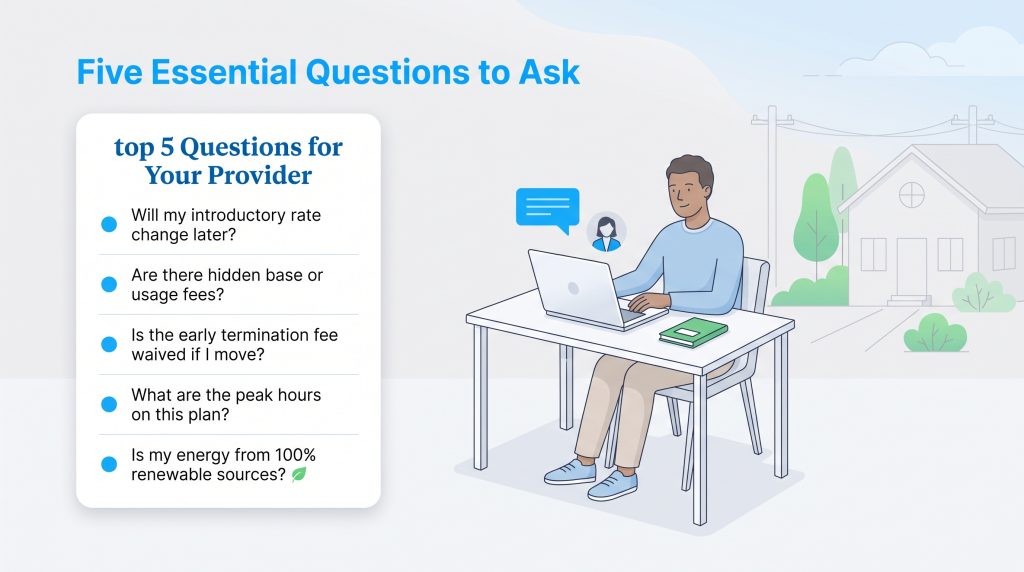
Creating a quick checklist of questions to ask energy provider representatives gives you a massive advantage in a crowded market. Whether you speak to an agent on the phone or use a live chat portal, demanding transparent answers puts you firmly in control. Before you finalize your enrollment, run through this definitive list of five questions to ensure the new contract perfectly fits your budget:
- Will my introductory rate expire and automatically switch to a variable rate? Determine exactly when the promotional teaser rate ends and what default variable rate your account will transition into afterward.
- Are there any hidden base fees or minimum usage charges on this plan? Verify if you will face arbitrary penalties for using too little electricity during mild spring and fall months.
- Do you waive the early termination fee (ETF) if I move to a new address? Ask about their official waiver policies if you relocate outside of their designated service territory before your term ends.
- What are the specific peak hours for this Time-of-Use plan? If you are heavily considering a TOU plan, you need to know exactly when the expensive, premium electricity rates kick in so you can adjust your schedule.
- Does this plan source energy from 100% renewable generation? If going green is a priority for your family, confirm whether they purchase renewable energy certificates to offset your entire annual usage.
Step-by-Step Guide to Switching Electricity Providers
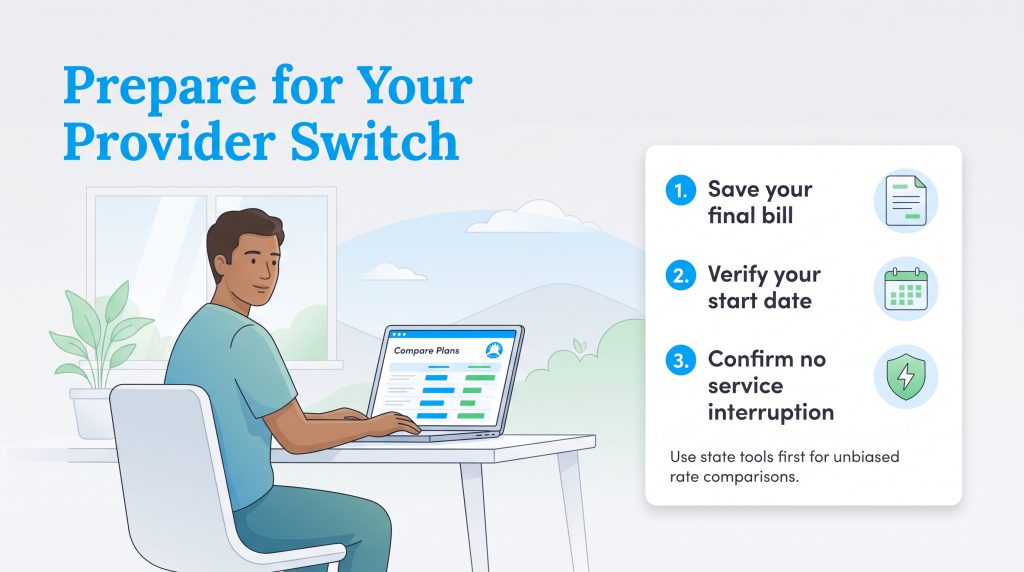
Once you accurately verify your consumption habits, ask the right questions, and understand which hidden pitfalls to avoid, taking action becomes a wonderfully streamlined and stress-free process. To compare electric rates effectively, prioritize state-run comparison websites — such as Power to Choose in Texas — as an unbiased shopping baseline. To successfully finalize your new contract and learn how to switch electricity providers without missing a beat, simply follow these detailed sequential steps.
Step 1: Save your final bill and gather your information. Start the switching process by downloading your most recent statement from your current supplier. This document contains critical identifying information, including your historical account number, exact service address, and your specialized meter identifier. Having this raw data on hand ensures a smooth, rapid verification process when you sign up with a new retail company.
Step 2: Verify the new start date with your provider. Once you select a highly competitive rate, communicate directly with your new retail electric provider to confirm the exact activation date. Knowing precisely when your new rate officially takes effect prevents frustrating overlapping billing cycles and guarantees you get the promotional price you signed up for.
Step 3: Confirm no service interruption will occur. You never have to worry about the lights unexpectedly going out during a switch. Rest assured knowing your physical power supply will not be shut off for even a single second. Your local utility company seamlessly handles the background transition, completely rerouting the administrative billing responsibilities without ever physically touching your meter connection.
Finalizing Your Energy Plan Choice
Taking a proactive stance with your utility choices completely transforms how you manage your long-term monthly household expenses. By meticulously verifying your historical usage data, hunting down hidden base fees, and securing a dependable fixed-rate contract, you successfully shield your budget from unpredictable energy market volatility.
If you are currently moving into a new home, knocking out these final essential steps provides major peace of mind during a chaotic transition. Once your new rate is officially active, you can begin confidently exploring other ways to lower your electric bill through smart home upgrades and straightforward behavioral changes. Mastering your local energy market empowers you to stop overpaying for necessities, prioritize smart eco-conscious options, and keep significantly more of your hard-earned money right where it belongs.
Frequently Asked Questions About Choosing an Electric Provider
How do I compare electric rates effectively?
Will I lose power when I switch to a new retail electric provider?
Do I have to pay an early termination fee if I move?
Where can I find the cheapest electricity rates available right now?
How long does it take to switch electricity providers?
Are no-deposit electricity plans a good idea?
When is the best time of year to switch energy plans?
Do I need to notify my current electric provider when I switch?
What happens if my new electric provider goes out of business?
Can renters choose their own electric provider?
About the Author

David has been an integral part of some of the biggest utility sites on the internet, including InMyArea.com, HighSpeedInternet.com, BroadbandNow.com, and U.S. News. He brings over 15 years of experience writing about, compiling and analyzing utility data.

LaLeesha has a Masters degree in English and enjoys writing whenever she has the chance. She is passionate about gardening, reducing her carbon footprint, and protecting the environment. She also recently served as President of the Board for City Sprouts (a community garden).