

Understanding Your Power to Choose Can Lead to Lower Rates and Greener Energy Options
Key Takeaways
- Energy deregulation separates the supply of electricity from the delivery, allowing you to shop for competitive rates while your local utility still maintains the wires.
- You can lower your monthly bills or choose green energy by switching to a Retail Energy Provider (REP) instead of staying with the default utility rate.
- Your power reliability does not change when you switch providers; the local utility company is still responsible for fixing outages and maintaining infrastructure.
If you are setting up utilities for the first time or moving to a new state, you might be asking yourself: what is energy deregulation? Decades ago, massive monopolies controlled all power in the United States, but today, an open energy choice program lets you evaluate competitive rates and secure a better deal for your home. Just as you effortlessly compare prices for internet service or car insurance, you can confidently shop around to find a plan that perfectly aligns with your household budget. This power to choose empowers you to potentially save hundreds of dollars annually and easily access environmentally mindful green energy options without ever sacrificing your home’s power reliability.
What Is Deregulation in the Energy Sector?
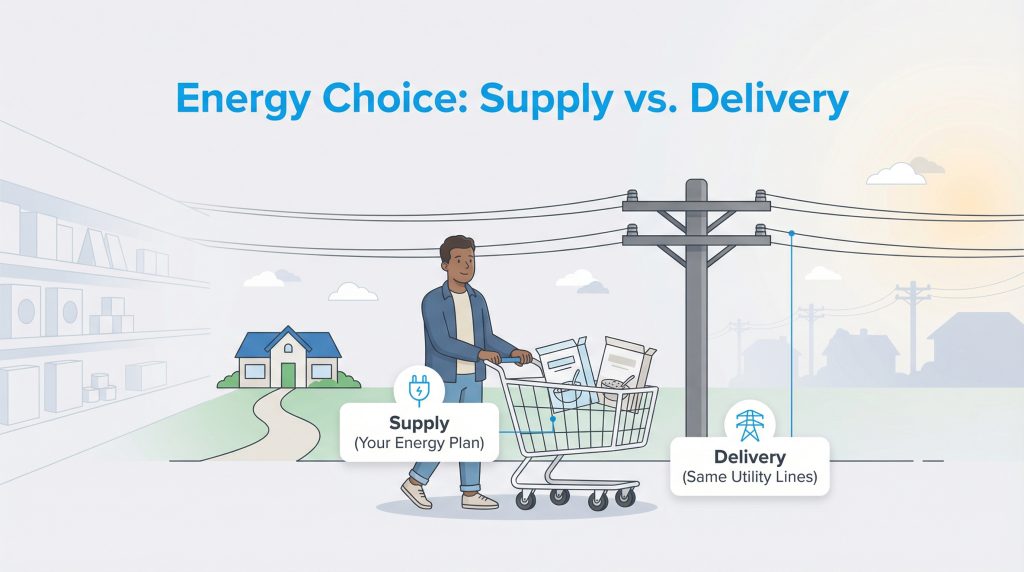
What is deregulation? In the energy sector, deregulation is the legal unbundling of electricity supply from its physical delivery. This system breaks up traditional utility monopolies, giving you the power to choose your retail energy provider while your local utility company continues to safely maintain the grid and restore outages.
In the simplest terms, energy deregulation completely dismantles the traditional grip that massive utility companies once held over the entire power grid. To understand the impact of deregulated electricity states, it helps to look at the three distinct phases of power distribution: generation (where massive power plants create the electricity), transmission (where high-voltage lines efficiently move that power across regions), and retail (where the electricity is finally sold to your home). Historically, a single corporate entity controlled all three phases without any external competition. In a modern deregulated energy market, these roles are legally split up to prioritize consumer choice and drive fair pricing.
How Does Energy Deregulation Work?
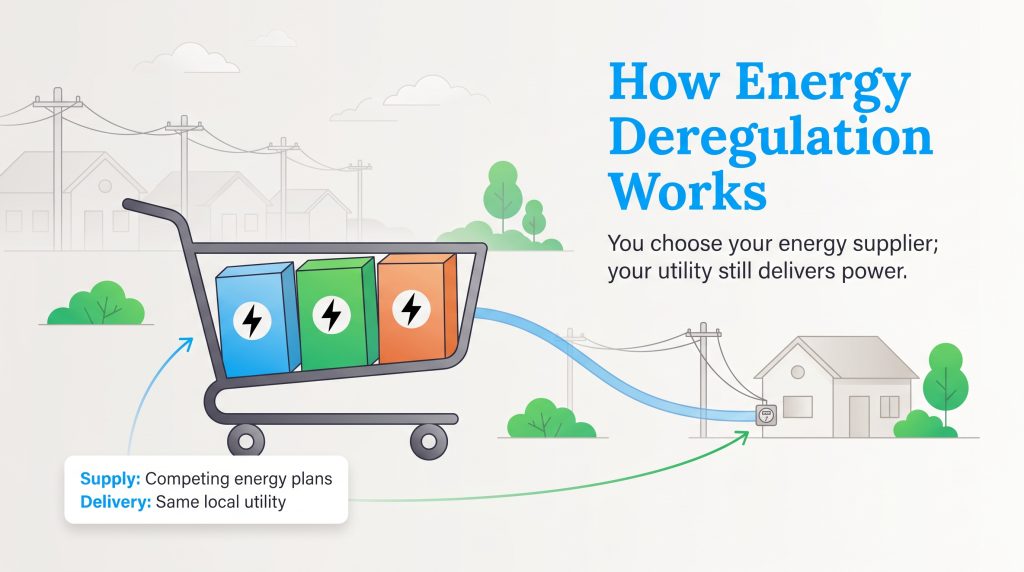
When you ask how does energy deregulation work, think of it much like shopping for your family’s groceries. You can thoughtfully choose to buy a box of cereal from General Mills, Kellogg’s, or a generic store brand — that perfectly illustrates the “supply” portion of your electricity. However, you use the exact same shopping cart, store aisles, and checkout lane to get your groceries to your car regardless of which brand you ultimately choose. That universal infrastructure represents the “delivery” portion handled exclusively by the traditional utility lines in your neighborhood.
While the local utility company still owns and maintains the physical wires, poles, and meters outside your house, the actual electricity flowing into your home is sold by competing suppliers. In a competitive market, retail energy providers (REPs) actively compete for your business every single day. This open marketplace can systematically drive down prices, spark creative plan innovation, and offer transparent pricing structures that fit your specific financial goals. The modern mandate for fair, open access to transmission lines ultimately ensures affordability and accessibility for every household.
Regulated vs Deregulated Energy Markets
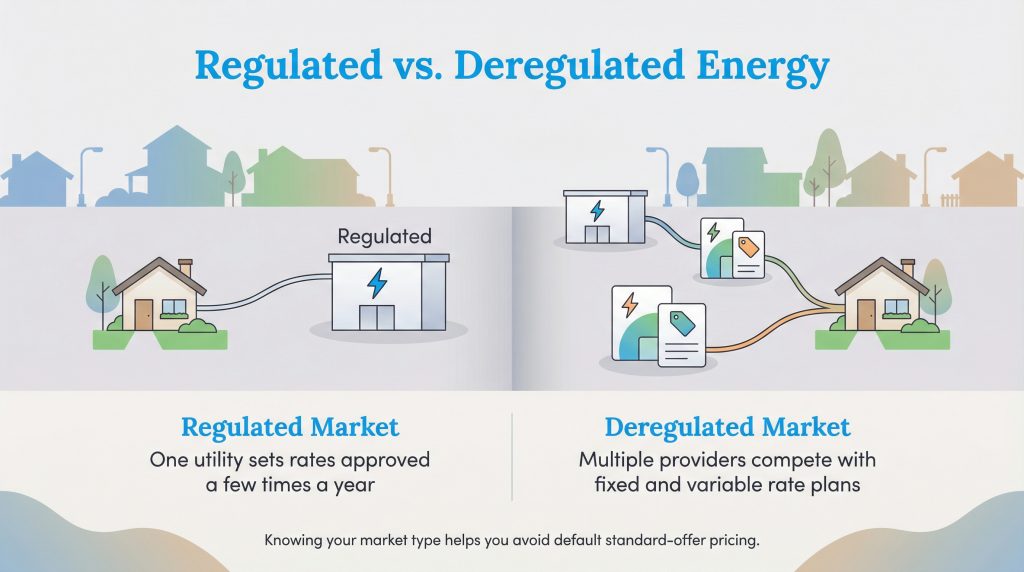
Understanding the fundamental differences between regulated vs deregulated energy markets is the absolute key to taking control of your monthly utility costs. In a fully regulated system, you have absolutely no choice in the matter. A single utility company handles everything from generating the power to mailing your monthly statement, and the state government firmly sets the fixed rates. Conversely, in a deregulated market, you hold the power to choose who generates and sells your electricity, while the traditional utility continues to safely deliver it to your home.
Before reviewing the chart below, here are the main distinctions to keep in mind:
- Competition: Regulated markets feature monopolies; deregulated markets invite multiple retail energy providers to compete for your business.
- Rate Flexibility: State commissions dictate rigid pricing in regulated zones, while free-market forces determine dynamic rates in deregulated territories.
- Consumer Power: Only a deregulated electricity state allows you to proactively shop around for green energy plans or better contract terms.
| Feature | Regulated Energy Market | Deregulated Energy Market |
|---|---|---|
| Price Control | Fixed rates are strictly set by state regulators and the utility company. | Dynamic rates are directly driven by marketplace competition among suppliers. |
| Provider Choice | None. A single localized monopoly handles your entire service. | Total freedom to shop around and choose from multiple Retail Electric Providers. |
| Infrastructure Ownership | The utility company owns the delivery wires, generates the power, and sells it directly to you. | The utility company only maintains the delivery wires, while competitive suppliers generate and sell the power. |
Energy Suppliers vs Utility Companies
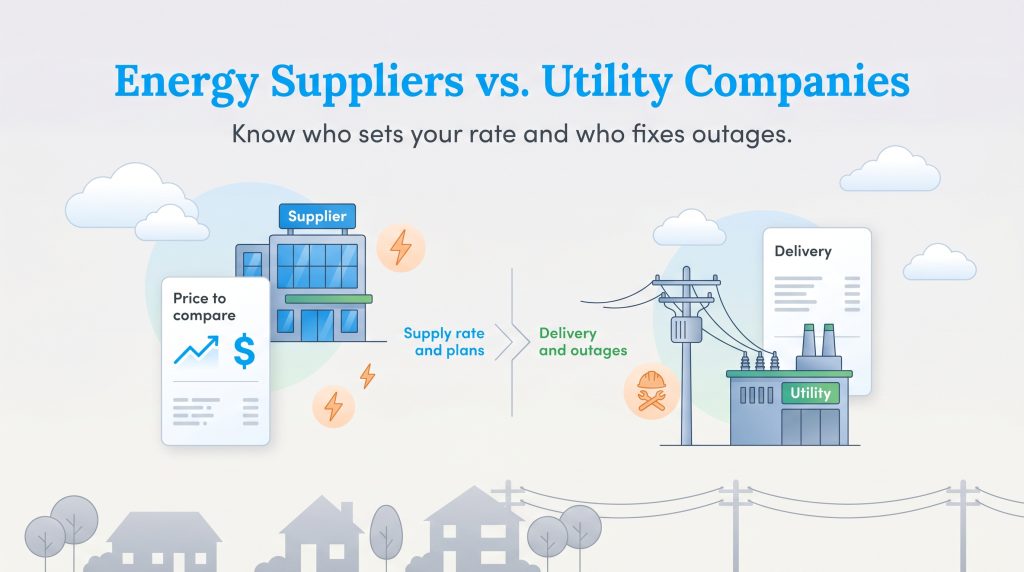
When navigating an open market, you must cleanly distinguish energy suppliers vs utility companies. Retail electric providers (REPs), often referred to simply as energy suppliers, are the independent companies that buy bulk electricity on the wholesale market and sell it directly to you. Because these companies fiercely compete for your business, they are exclusively responsible for determining your actual energy rate, plan length, and special perks.
On the other hand, local utility companies — also known as transmission and distribution utilities (TDUs) — are the traditional entities that own and maintain the physical grid infrastructure. Regardless of which competitive supplier you choose, the local utility continues to reliably deliver that electricity to your home. Their Transmission and Delivery Utility charge is highly regulated and remains on your bill no matter who supplies your power.
Call Your Utility Company For:
- Sudden power outages or emergencies
- Downed lines, poles, or severe storm damage
- Physical meter readings and hardware maintenance
Call Your Energy Supplier For:
- Monthly billing questions and payments
- Current supply rates and competitive promotions
- Upgrading plan types, green energy, and renewals
Look for a line on your bill labeled “Price to Compare” or “Supply Rate.” This is the specific rate your utility charges for supply, and you can easily use this benchmark number to see if a competitive supplier is offering a better deal.
Pros and Cons of Energy Deregulation
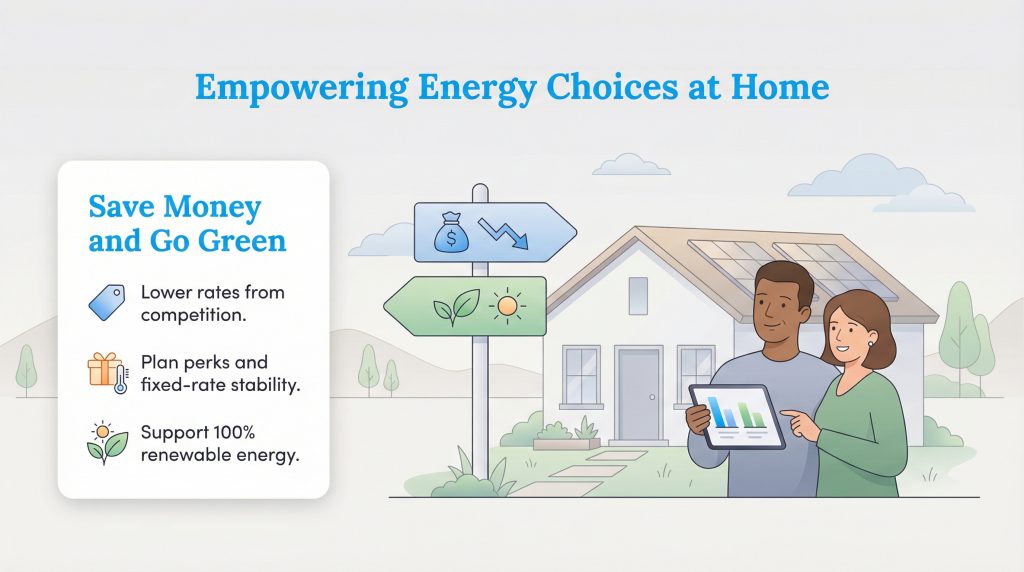
While having the power to choose is generally a massive advantage for homeowners, it is highly important to weigh both sides of the coin. Evaluating the pros and cons of energy deregulation ensures you enter the marketplace fully informed and ready to maximize your long-term savings.
The Pros:
- Lower Rates: Increased market competition frequently drives down prices, allowing you to easily secure a cheaper rate than the default utility standard.
- Green Energy Options: You can quickly opt into 100% renewable energy plans backed by Renewable Energy Certificates (RECs) rather than relying solely on nuclear or coal plants, shrinking your footprint without installing solar hardware.
- Competitive Perks: Suppliers often try to win your business by proactively offering smart home devices, loyalty rewards, or free nights and weekends.
The Cons:
- Confusing Contracts: The sheer number of options and complex promotional terms can easily overwhelm consumers who do not carefully read the fine print.
- Early Termination Fees: If you consciously decide to break a fixed-rate contract before it officially expires, you may face a hefty cancellation penalty.
- Variable Rate Spikes: If you unintentionally enroll in a variable plan, your monthly rate could quickly skyrocket during extreme summer heat or winter cold fronts.
List of Deregulated Energy States
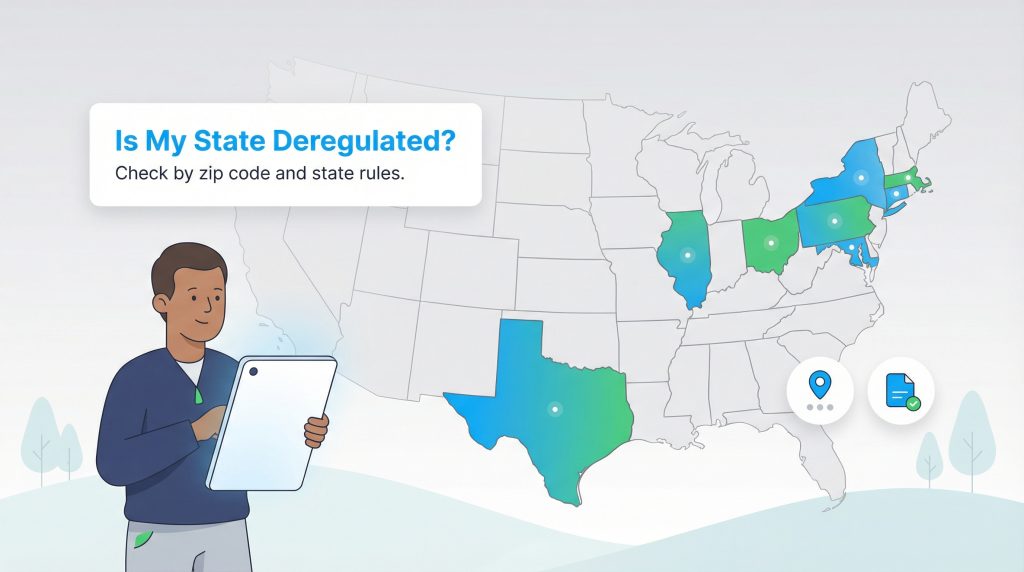
Living in a deregulated state means your right to choose a competitive supplier is fully protected by local laws, but this flexible framework depends entirely on your specific zip code. If you view an energy deregulation map of the United States, you will notice that this is decided strictly at the state level. Some regions feature expansive deregulated natural gas markets but firmly maintain monopolies on electricity, while others have done the exact opposite.
Here is a comprehensive deregulated states list highlighting exactly where you can actively participate in an energy choice program:
- Electricity Only: Connecticut, Delaware, Maine, Massachusetts, New Hampshire, and Texas.
- Natural Gas Only: Colorado, Florida, Georgia, Indiana, Kentucky, Montana, New Mexico, South Dakota, Virginia, and Wyoming.
- Both Electricity and Natural Gas: Illinois, Maryland, Michigan, New Jersey, New York, Ohio, Pennsylvania, Rhode Island, and Washington D.C.
It is highly important to note that the shopping rules vary dramatically by location. For example, Texas operates a uniquely deregulated grid where most residents in eligible areas must choose a competitive provider, whereas in states like Pennsylvania or Ohio, shopping for an alternative supplier is entirely optional. For the most authoritative and up-to-date information on available energy markets, you can confidently visit the U.S. Energy Information Administration (EIA).
Ready to find out your status? You can instantly enter your ZIP code into a reputable energy comparison marketplace to safely check local availability and discover the lowest rates in your area.
How to Check If Your State Is Deregulated
If your state was not explicitly listed above or you simply want to verify your exact local market conditions, figuring out your status is incredibly straightforward. You do not need to be an industry expert to check if my state is deregulated; you simply need to follow this three-step guide:
- Locate your most recent utility bill: Grab a recent paper statement or log into your digital utility account to clearly review the monthly breakdown of your charges.
- Look for separated supply and delivery charges: Carefully scan the line items. If your state is deregulated, your bill will cleanly divide the total into a “Supply” (or generation) charge and a “Delivery” (or distribution) charge. If it only lists a single bundled rate, you are almost certainly in a regulated market.
- Search for your local utility provider online: Visit your state’s Public Utility Commission website or search for your local utility company’s name alongside the phrase “energy choice program.” Regulated areas will openly state that they manage both the supply and delivery of your household power.
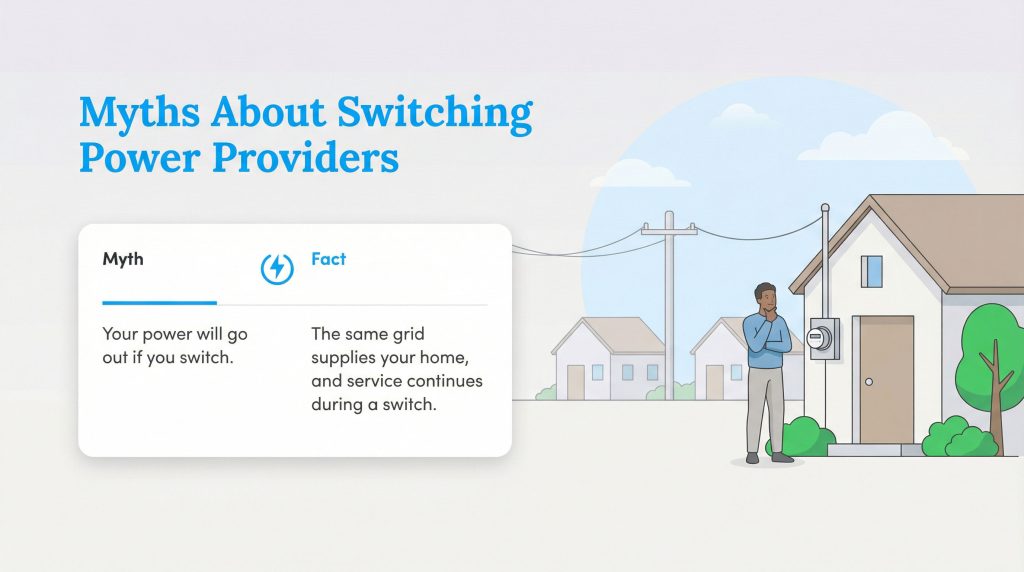
Once you verify that you successfully reside in a deregulated territory, you can confidently start browsing the market without fear of service interruptions. Before finalizing any switch, always review an Electricity Facts Label (EFL) or a similarly standardized disclosure document so you thoroughly understand the rate structure and terms of service. For more practical tips on safely navigating these documents, check out our comprehensive guide on how to save on your electric bill.
Types of Energy Plans: Fixed, Variable, and Green
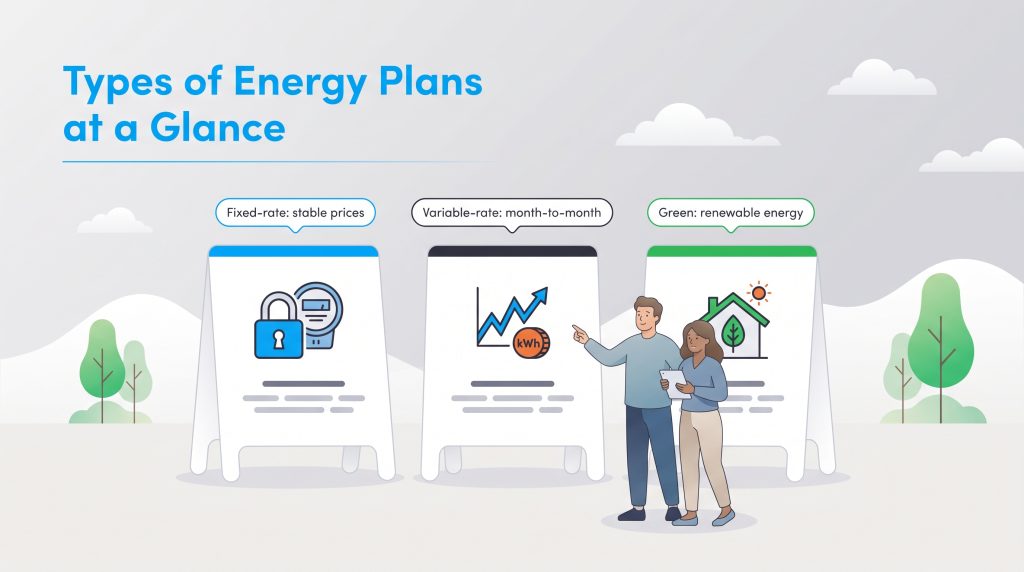
Navigating an open marketplace means you will quickly encounter several distinct contract structures. Understanding fixed vs variable energy plans is absolutely critical for keeping your household budget predictable and affordable. When thoughtfully shopping for a new retail energy provider, you will generally choose from these three popular categories:
Fixed-Rate Energy Plans
A fixed-rate plan safely locks in your precise price per kilowatt-hour (kWh) for the entire duration of your contract, which usually ranges from six to 36 months. This transparent structure thoroughly shields you from seasonal market spikes and unexpected global fuel shortages. Always choose a fixed-rate energy plan if you want true long-term budget stability and total peace of mind for your home.
Variable-Rate Energy Plans
With a variable-rate plan, your price per kWh constantly fluctuates from month to month based on the current wholesale energy market. While these specific plans typically offer freedom because they rarely require a long-term commitment, your monthly rates can dangerously soar during high-demand summer or winter months. They are incredibly risky for the average household and should strictly be used as a short-term stopgap.
Green Energy Plans
Green energy plans are an environmentally mindful choice that offset your exact electricity usage with 100% renewable sources, such as wind or solar power. By consciously enrolling in one of these eco-conscious alternatives, your supplier purchases Renewable Energy Certificates on your behalf, effectively shrinking your carbon footprint every time you turn on the lights.
How to Switch Energy Providers
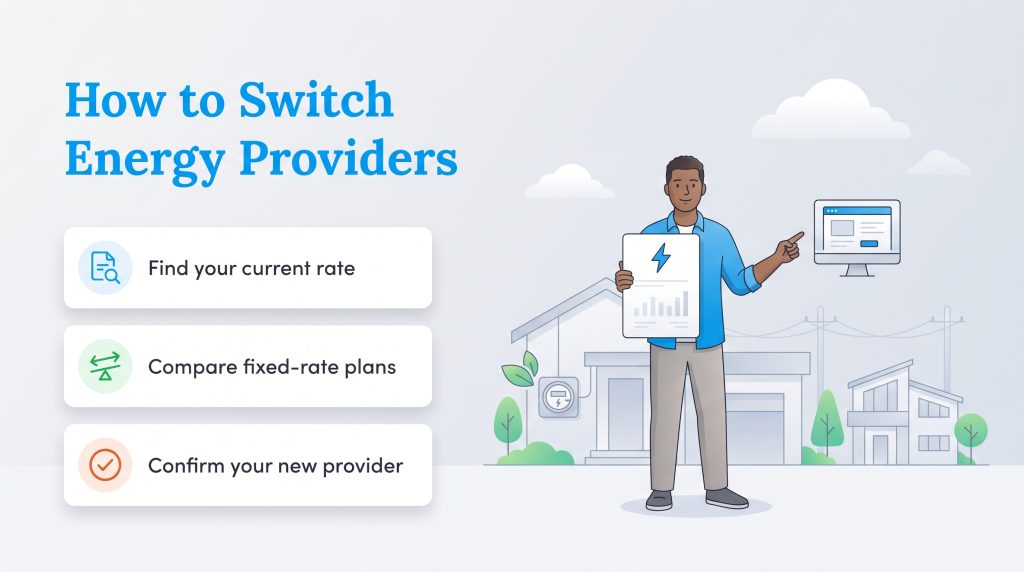
Energy deregulation rightfully puts the power directly back into your hands, effectively transforming you from a passive ratepayer into an active, empowered consumer. If you are thoroughly prepared to switch energy providers, follow this simple three-step actionable checklist to take immediate charge of your monthly utility expenses today:
- Find your current rate: Grab your most recent electric statement, identify your current “Price to Compare” or supply rate, and note your average monthly kWh usage. This establishes a clear baseline to ensure you are genuinely saving money with a brand new plan.
- Compare new plans: Use your specific zip code to seamlessly shop for reputable suppliers in your local area. Filter your digital search results to prioritize straightforward fixed-rate plans to secure long-term budget stability without surprise spikes.
- Confirm your switch: Confidently sign up through your new provider’s secure website or speak to them directly over the phone. They will automatically communicate with your local utility company to seamlessly complete the entire transition without any physical changes to your home or drops in power.
Preparing for Your Next Energy Bill
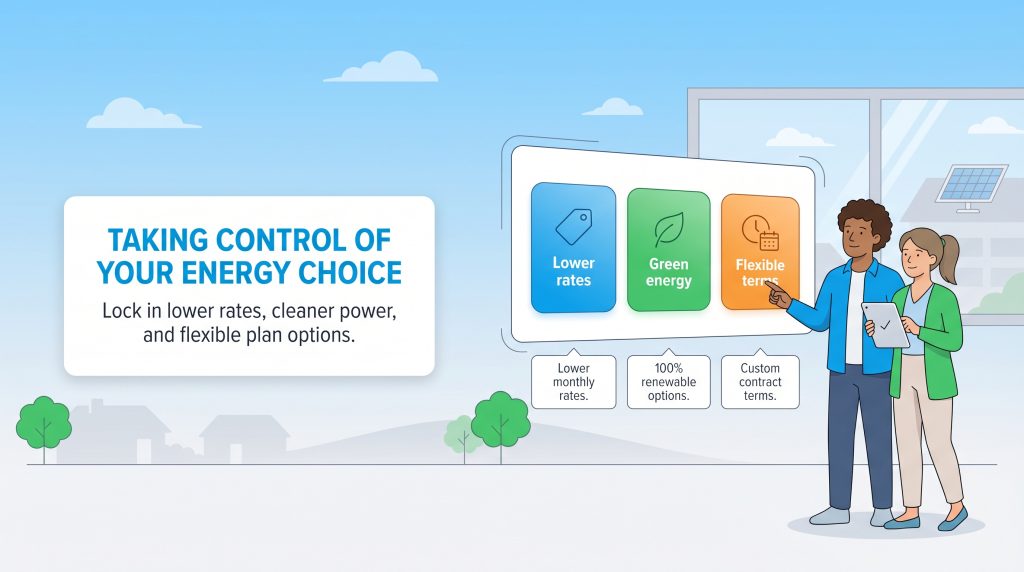
Understanding exactly how the open marketplace works allows you to easily find a customized energy plan that offers long-term price stability and cleaner energy options without ever sacrificing the physical reliability you depend on. When you actively participate in an energy choice program, you immediately unlock several core benefits for your household.
- Immediate Financial Relief: Fierce competition firmly forces suppliers to offer highly aggressive pricing and unique sign-up incentives that frequently beat your utility’s default standard offer.
- A Sustainable Future: Renters and homeowners can effectively shrink their environmental impact by consciously selecting plans powered by 100% renewable wind or solar energy.
- Total Lifestyle Control: You can select tailored plans offering free nights or weekends, and safely lock in a secure fixed rate from six months up to three years to completely avoid volatile seasonal price spikes.
A simple, well-informed switch could effortlessly keep more of your hard-earned money in your pocket every single month while simultaneously supporting environmentally mindful energy generation across the country. By fully understanding your local competitive marketplace, you guarantee your home runs efficiently and cost-effectively all year round.
Frequently Asked Questions About Energy Deregulation
Which states have energy deregulation?
Do I have to switch energy providers in a deregulated state?
Who do I contact during a power outage in a deregulated market?
Can I really save money by switching suppliers?
What is a retail energy provider (REP)?
What are the pros and cons of energy deregulation?
Does energy deregulation apply to both natural gas and electricity?
Will I lose power when switching energy providers?
How long does it take to switch energy providers?
Are there hidden fees when switching energy suppliers?
Do I need a smart meter to participate in an energy choice program?
About the Author

David has been an integral part of some of the biggest utility sites on the internet, including InMyArea.com, HighSpeedInternet.com, BroadbandNow.com, and U.S. News. He brings over 15 years of experience writing about, compiling and analyzing utility data.

Claudio is a sustainability-focused writer with a background in Anthropology and Psychology from NC State University. He has spent over 15 years working in writing, interpretation, and translation, driven by a deep interest in how human culture shapes the environment. Today, he shares his curiosity with readers by writing about sustainable living solutions and the connection between everyday choices and environmental impact.