

Take control of your home’s energy costs with these proven, money-saving strategies.
Key Takeaways
- Calculate your home’s average energy usage before locking into a long-term contract to ensure you get the most cost-effective tier.
- Compare fixed vs. variable rate plans to find the right balance of price stability and market flexibility for your household budget.
- Always read the fine print to spot early termination fees, base charges, and renewable energy percentages before you sign.
Moving to a new home or actively looking to lower your monthly bills in a deregulated market can feel overwhelming, but finding the right provider doesn’t have to be a headache. If you’re searching for the best tips for choosing an electricity plan, we have you covered with proven strategies that cut right through the confusing industry jargon. You hold the power to dictate your monthly energy expenses by selecting a supplier that works for your unique household needs. By breaking down the fine print and focusing on the details that actually matter, we’ll help you navigate how to choose an electricity plan and teach you how to compare electricity rates by zip code like a seasoned expert.
1. Confirm You Live in a Deregulated Energy State
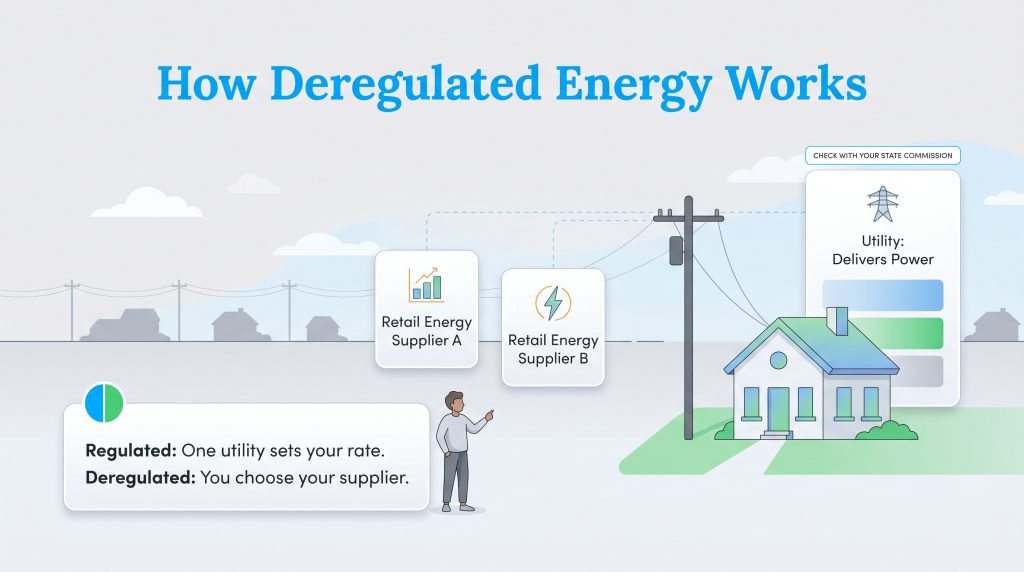
Navigating your home energy options starts with understanding how power actually reaches your house. In a fully regulated state, one local utility company monopolizes both the supply of electricity and the delivery network. This means you simply pay whatever standard rate they dictate without any alternative options.
However, if you reside in one of the active deregulated energy states, those responsibilities are split up to benefit the consumer. Your local utility company still owns the physical power lines and handles all deliveries and outages, but you possess the freedom to shop around for the actual retail energy supplier. This separation of powers forces competitive providers to bid for your business, resulting in innovative plans, better customer perks, and potentially lower rates.
Some of the most prominent deregulated energy states with active consumer choice include:
- Texas
- Pennsylvania
- Ohio
- New York
- Illinois
To confirm your eligibility, explicitly use your state-sponsored energy choice portal (like Power to Choose in Texas or PA Power Switch in Pennsylvania) or enter your zip code into a reputable marketplace to verify if you can select a new provider.
2. Calculate Your Historical Monthly kWh Usage
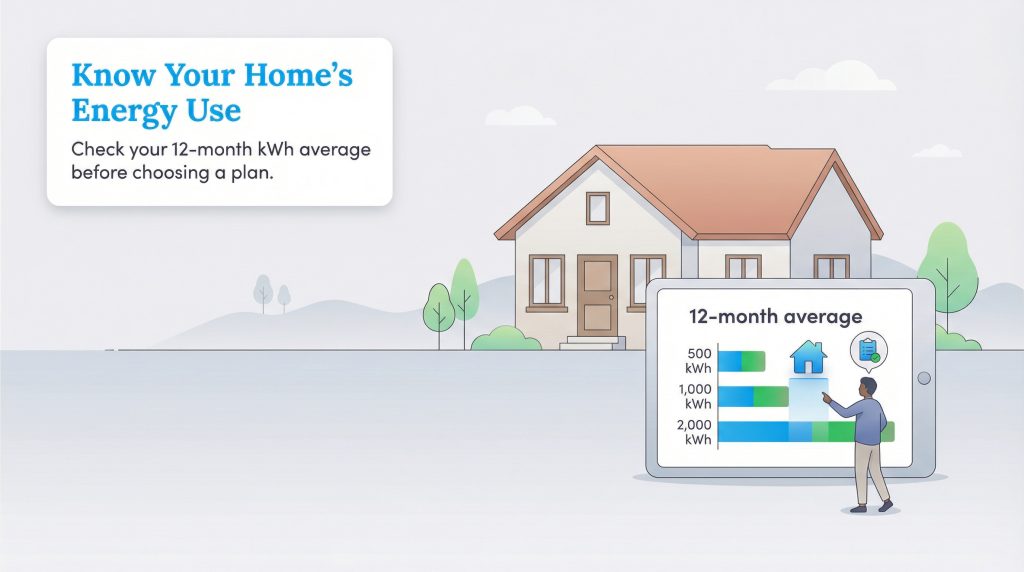
Preparation is the vital first step to finding a cost-effective energy deal. Before you dive into the market to compare electricity rates by zip code, you absolutely must understand your average electricity usage per month. Retail electric providers base their pricing structures around three standardized usage tiers: 500 kilowatt-hours (kWh) for apartments and small condos, 1,000 kWh for medium-sized homes, and 2,000 kWh for larger properties.
To accurately find your baseline and avoid falling into an expensive pricing tier, use this simple formula:
Add your past 12 months of total kWh usage together, then divide by 12 to calculate your true monthly average.
If you’re moving into a brand new home, you can call the local utility company to request the property’s historical consumption data. Should your historical usage reveal a heavier footprint, you can take practical steps to reduce your overall energy consumption before entering a long-term commitment.
| Home Size | Estimated Monthly Usage | Best Plan Type Focus |
|---|---|---|
| 1-Bedroom Apartment | 500 kWh | Low base charges and competitive 500 kWh rates. |
| Medium House (2-3 Beds) | 1,000 kWh | Standard fixed-rate plans optimized for 1,000 kWh. |
| Large House (4+ Beds) | 2,000+ kWh | High-usage plans, potentially with bulk energy discounts. |
📌 Quick Fact: According to the U.S. Energy Information Administration’s Residential Energy Consumption Survey, the average household uses around 877 kWh per month, but your actual consumption will depend heavily on your local climate and heating type.
3. Compare Fixed vs. Variable Electricity Plans
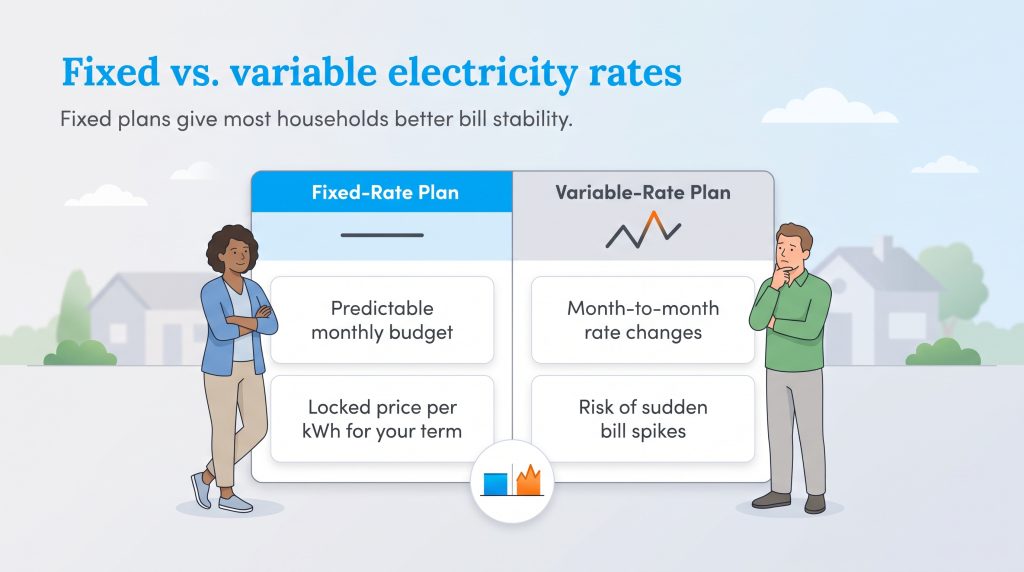
Deciding on a fixed vs variable rate electricity structure dictates how market volatility will directly impact your wallet. Understanding the difference between fixed vs variable electricity plans is crucial for long-term budget stability.
We actively instruct consumers to select fixed-rate plans for reliable price stability. A fixed-rate plan locks in a specific price per kWh for the entire duration of your contract, shielding you from wild seasonal price spikes during summer heat waves or winter freezes. Conversely, a variable-rate plan shifts from month to month depending on wholesale energy costs, offering zero price protection but total freedom to leave the plan at any time without a penalty.
You may also encounter indexed plans, which tie your rate directly to a specific public commodity index, such as the real-time price of natural gas. These indexed structures are incredibly complex and can backfire dramatically during severe weather events, making them a dangerous choice for the average household budget.
| Plan Type | When to Choose This Plan | Associated Risk Factors |
|---|---|---|
| Fixed-Rate | When you want predictable monthly budgeting, long-term price stability, and protection from market inflation. | You will face early termination fees (ETFs) if you break the contract before the term expires. |
| Variable-Rate | When you’re in a short-term housing situation, between leases, or waiting a few weeks for fixed rates to drop. | Severe market volatility leaves you entirely vulnerable to unexpected and sudden bill surges. |
4. Choose the Right Electricity Contract Length
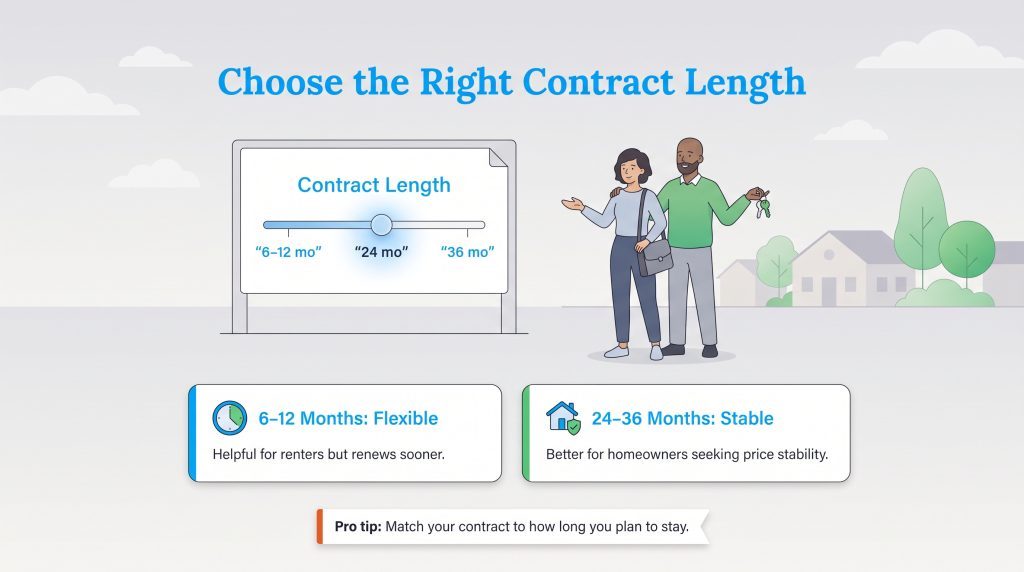
Once you decide on a fixed rate, you must determine the optimal timeline for your agreement. Analyzing different electricity contract lengths is a strategic move that aligns your energy costs directly with your living situation. Providers typically offer standard contract terms spanning 6, 12, 24, or 36 months, and each duration offers distinct advantages depending on your needs.
Short-term contracts (6 to 12 months) are excellent for renters who need a plan that matches their lease term. However, they leave you vulnerable to market rate changes sooner when it’s time to renew. Long-term contracts (24 to 36 months) are ideal for homeowners seeking multi-year budget consistency and protection against inflation, though they require a much stronger commitment to a single provider.
| Contract Term | Pros | Cons |
|---|---|---|
| 6 – 12 Months | Great for renters on short leases; allows you to test out a new provider without a massive commitment. | Exposes you to market rate changes sooner; requires frequent shopping and renewals. |
| 24 – 36 Months | Provides reliable long-term budget stability; protects your home against multi-year market inflation. | Steep early termination fees apply if you move out of the utility area or break the contract early. |
💡 Pro Tip: Never sign a 36-month electricity contract if you only plan to live in your current residence for a year. Mismatching your contract length with your housing timeline is the easiest way to incur massive cancellation penalties.
5. Master the Electricity Facts Label (EFL)
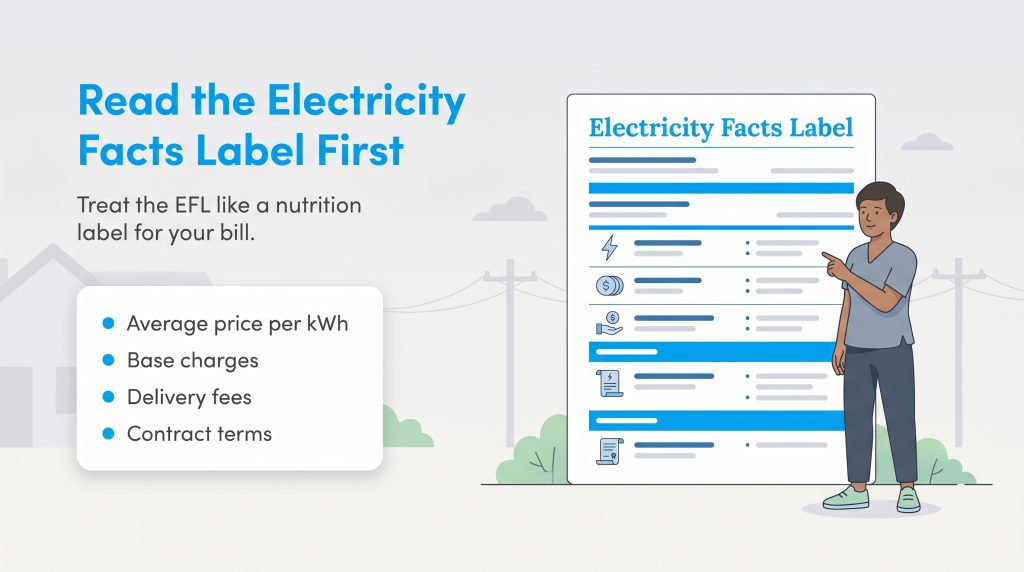
If you’re wondering what an Electricity Facts Label (EFL) is, think of it as a standardized nutrition label for your energy contract. It cuts through flashy marketing promises to reveal the exact mathematical formulas governing your monthly bill. Learning how to read an electricity facts label empowers you to spot gimmicks and verify your precise rate before signing a binding contract.
When reviewing your EFL, you should strictly scrutinize these three core components:
- Base Charges: Fixed monthly fees applied by the retail provider just for keeping the account active, regardless of how much power you consume.
- Energy Charges: The actual retail cost per kWh for the electricity supply you use during the billing cycle.
- Utility Delivery Fees (TDU/TDSP): Mandatory distribution charges passed down by your local utility company to maintain local poles and wires.
Most importantly, always verify the average price per kWh listed on the EFL for the specific tier that matches your home’s historical usage:
- 500 kWh: The standard rate benchmark for small apartments.
- 1,000 kWh: The standard rate benchmark for medium-sized homes.
- 2,000 kWh: The standard rate benchmark for large houses or homes with pools.
Paying close attention to these usage tiers prevents you from falling into restrictive pricing traps. Retail energy providers often advertise incredibly low rates that only apply if your monthly consumption hits an exact mathematical sweet spot. If your home uses 999 kWh on a plan requiring a strict 1,000 kWh minimum to activate a bill credit, that credit won’t apply. This exposes you to expensive hidden fees simply because you used one fewer kilowatt-hour.
6. Evaluate Time-of-Use (TOU) and Free Nights/Weekends
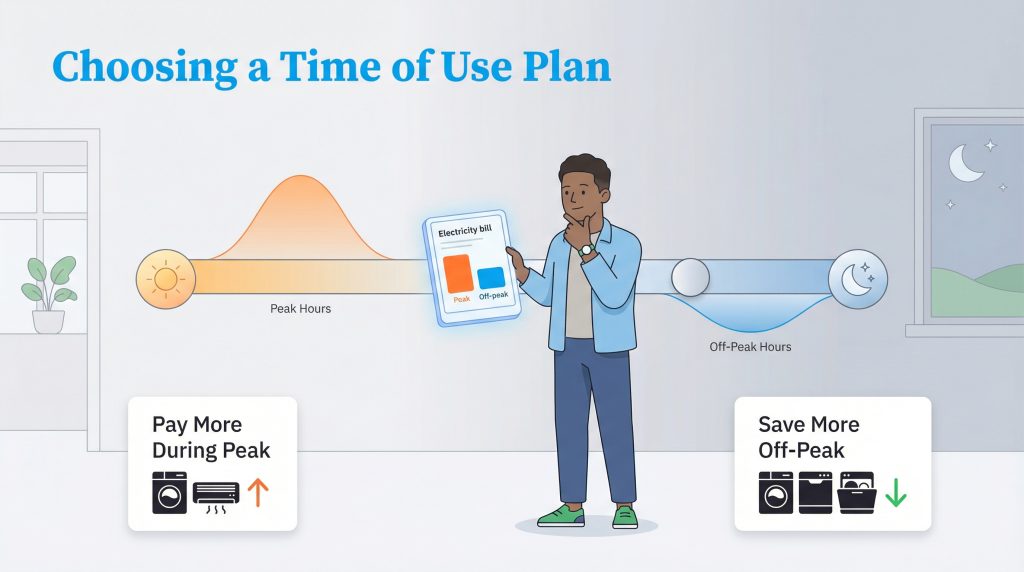
When searching for time of use electricity plans, you’ll undoubtedly encounter flashy marketing for Free Nights and Weekends. These specialized plans operate by charging a high premium during “peak” daytime hours — when the electrical grid is heavily strained — and offsetting it with free or heavily discounted energy during “off-peak” hours in the middle of the night.
The mathematical reality of these plans requires strict lifestyle adjustments to be cost-effective. You should only consider a TOU plan if you can check off the following lifestyle requirements:
- Pass/Fail: You own an electric vehicle (EV) and charge it exclusively overnight.
- Pass/Fail: You use a programmable smart thermostat to pre-cool the house during off-peak windows.
- Pass/Fail: You’re willing to run heavy appliances, like your dryer and dishwasher, strictly late at night or on weekends.
Because daytime rates on these plans are often significantly higher than a standard fixed plan, you must physically shift roughly 70% of your total energy consumption to the designated off-peak hours to see any real financial benefit. If you fail to meet these criteria — especially if you work from home and run your air conditioner while the sun is up — a Time of Use plan will quickly inflate your monthly budget.
7. Separate Energy Supply from Utility Delivery Charges
One of the most common points of confusion for new homeowners is deciphering energy supply versus delivery charges on their monthly invoice. When you live in a deregulated area, your bill is fundamentally split into two distinct halves.
The energy supply charge comes directly from your chosen Retail Electric Provider (REP). This is the cost of generating the actual electricity you consumed. The delivery charge comes from your local utility company (often referred to as the TDU or TDSP). This local utility owns the physical infrastructure required to transport that electricity safely to your home.
It’s crucial to understand that delivery charges are entirely unavoidable and regulated by the state. No matter which retail provider you choose for your energy supply, the utility delivery fees remain exactly the same. When comparing rates online, we explicitly command readers to verify whether the advertised rate represents the “bundled” price (which includes both supply and delivery costs) or just the unbundled supply rate.
Opting for a Clean Energy Supply
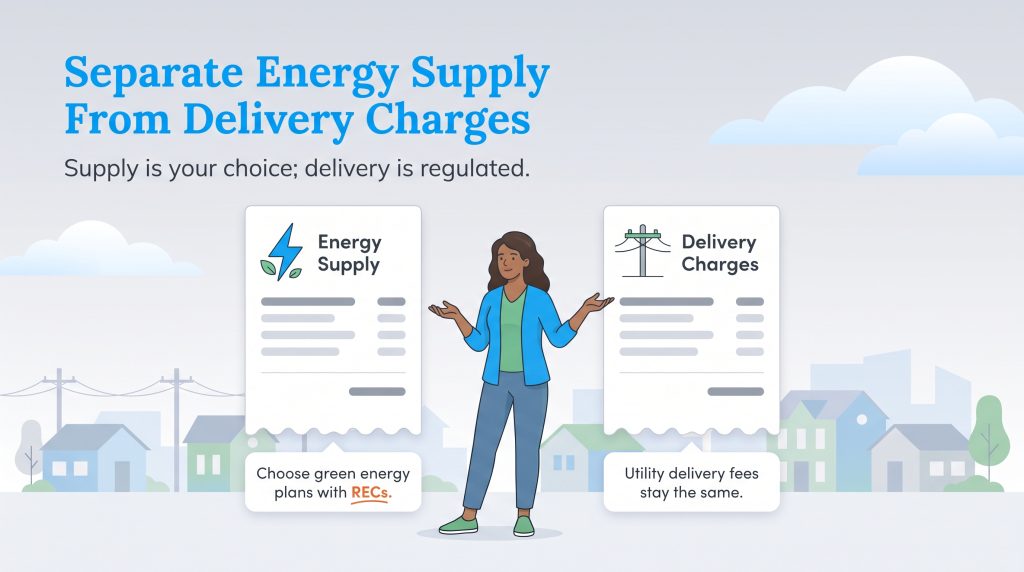
Because you control the supply side of your energy bill, you can easily support sustainable generation. Most retail providers offer plans that purchase Renewable Energy Certificates (RECs) on your behalf. These RECs guarantee that an equivalent amount of clean energy enters the broader grid to offset your exact household usage. You can even cross-reference your supplier with verified renewable energy programs to ensure they meet strict environmental standards. This environmentally mindful choice is a fantastic stepping stone before eventually transitioning to residential solar power.
8. Watch Out for Hidden Early Termination Fees (ETFs)
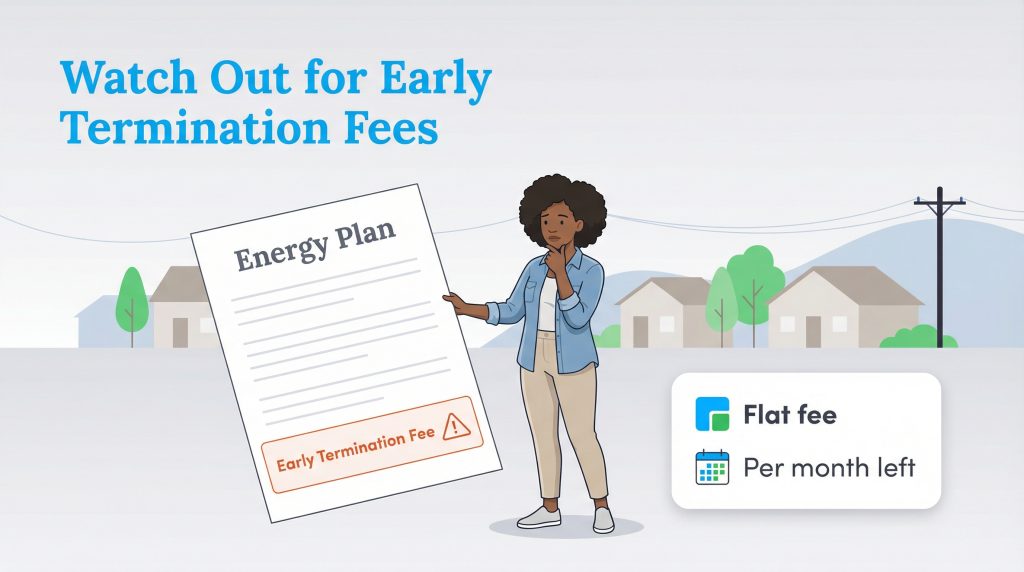
Understanding the early termination fees for electricity is non-negotiable when signing a new fixed-rate contract. An Early Termination Fee (ETF) is a financial penalty enforced if you cancel your agreement before the term officially expires.
Providers generally structure these penalties in two standard ways. You might face a flat fee, which typically ranges from $150 to $250, regardless of how much time remains on your contract. Alternatively, some suppliers charge a recurring penalty — roughly $15 to $20 for every single month left on your agreement. To protect your wallet, you must actively align your housing lease length directly with your contract term to avoid these ETFs entirely when it’s time to move out.
9. Consider the Best Time of Year to Shop for Electricity

Just like booking an airline ticket or a hotel room, energy pricing fluctuates heavily based on seasonal demand. Determining the best time of year to shop for electricity can drastically impact the fixed rate you secure for the life of your contract.
Industry experts strongly advise shopping during the “shoulder months” — typically spring (March to May) and fall (late September to November). During these moderate seasons, household demand for heating and cooling plummets, causing wholesale energy prices to drop. We highly warn against signing long-term contracts during peak summer heat waves or mid-winter freezes, as providers aggressively mark up their rates to hedge against grid strain and high consumption.
💸 Money-Saver: If your current contract expires in the middle of July, consider signing a short-term, 3-month variable plan to bridge the gap until the cheaper fall shoulder months arrive.
10. Review Verified Provider Ratings and PUC Complaints
Before committing to a new provider, taking a moment to evaluate their customer service track record is a smart move. However, relying solely on standard search engine reviews can be incredibly misleading. Consumers rarely leave glowing reviews when their lights turn on exactly as expected, but they frequently leave furious one-star ratings during storm-related power outages — events that the retail energy provider doesn’t even control.
Instead of trusting generic online reviews, mandate checking your state’s Public Utility Commission (PUC) complaint scorecard. These official government portals track legitimate grievances related to billing errors, deceptive marketing practices, and customer service failures. Choosing a provider with a high PUC rating ensures you’ll have a reliable, communicative partner if a billing dispute ever arises.
Checklist for Switching Your Electricity Provider
Taking charge of your monthly utility expenses is a deeply empowering aspect of managing your household. If you’re still wondering how to choose an electricity plan that makes practical and financial sense, following a strict operational process ensures you secure the best possible deal.
Use this actionable, 5-step checklist to confidently find the cheapest energy provider in your area:
- Check your current contract expiration date to ensure you won’t incur any early termination fees for switching too soon.
- Calculate your precise average monthly usage by reviewing your past 12 months of utility statements.
- Compare available rates in your zip code, filtering your search specifically for stable, fixed-rate plans.
- Read the Electricity Facts Label (EFL) meticulously to confirm the bundled rate and spot any tier-based traps.
- Enroll with the new provider online, allowing them to coordinate the seamless switch with your local utility company.
Armed with these essential strategies, you’re entirely prepared to navigate the deregulated market with the confidence of an industry insider. Keep a close eye on your average consumption, embrace the long-term predictability of a fixed rate, and watch those monthly savings stack up.
Frequently Asked Questions About Choosing an Electricity Plan
How do I know if I live in a deregulated electricity market?
What is a good electricity rate per kWh?
How many days before my contract expires should I shop for a new plan?
Will I lose power when switching electricity providers?
Do I need to notify my current provider when I switch?
What is the difference between a fixed and variable electricity plan?
What is an Electricity Facts Label (EFL) and why does it matter?
What happens if I cancel my electricity contract early?
About the Author

David has been an integral part of some of the biggest utility sites on the internet, including InMyArea.com, HighSpeedInternet.com, BroadbandNow.com, and U.S. News. He brings over 15 years of experience writing about, compiling and analyzing utility data.

LaLeesha has a Masters degree in English and enjoys writing whenever she has the chance. She is passionate about gardening, reducing her carbon footprint, and protecting the environment. She also recently served as President of the Board for City Sprouts (a community garden).