

Key Takeaways
- Time of Use plans charge different electricity rates depending on the exact time of day, offering deep discounts during periods of low grid demand.
- You can safely lower your monthly utility costs by adopting time-based habits, such as running your dishwasher or doing laundry late at night to capitalize on cheaper off-peak rates.
- By leveraging a modern smart meter to monitor and shift energy usage away from critical peak hours, you gain ultimate control over your household expenses.
If you want to lower your shockingly high monthly utility bill, understanding exactly what a time of use (TOU) plan is should be your first step. A time of use plan is a specialized electricity contract where your rate fluctuates based on the time of day, charging you significantly less during periods of low grid demand. While learning about variable vs fixed rate electricity is helpful, mastering TOU schedules provides the ultimate flexibility for eco-conscious households aiming to proactively reduce their utility costs.
How Time Of Use Billing Works
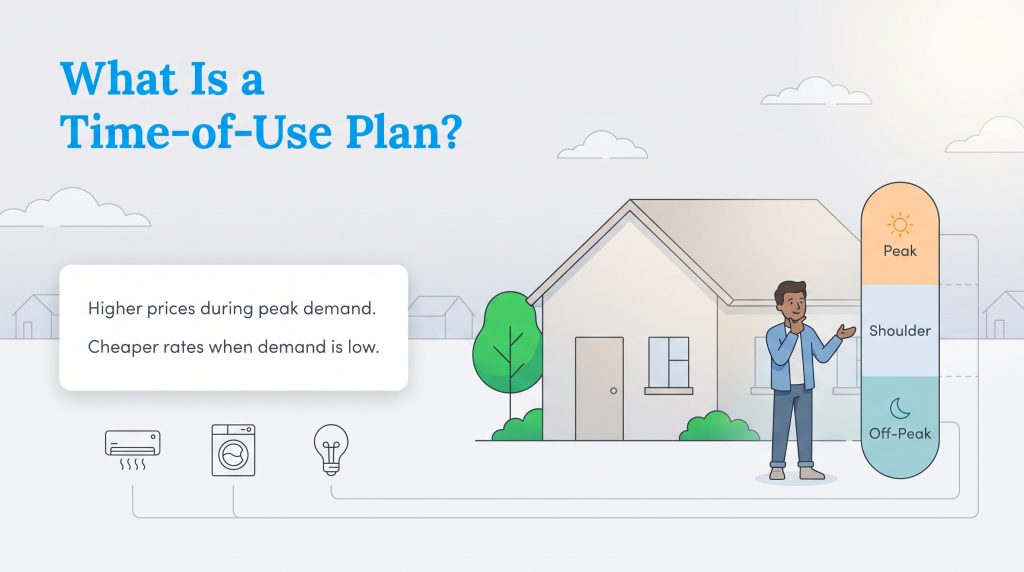
A time of use electricity plan aligns the price you pay for power directly with regional grid demand. Instead of paying one flat fee for every kilowatt-hour (kWh) you use, your energy provider divides the day into designated pricing blocks. This means your savings potential heavily relies on exactly when you flip the switch. For example, standard peak hours typically run from 4:00 p.m. to 9:00 p.m., while discounted off-peak hours often stretch from 10:00 p.m. to 6:00 a.m.
It is important to distinguish this structure from demand charges, which aggressively bill you based on a single, massive spike in power over a 15-minute period. Time of use plans simply calculate the total volume of electricity you consume during those specific daily schedules, providing everyday homeowners with a predictable way to save money by delaying heavy chores.
Peak Vs Off-Peak Hours Explained
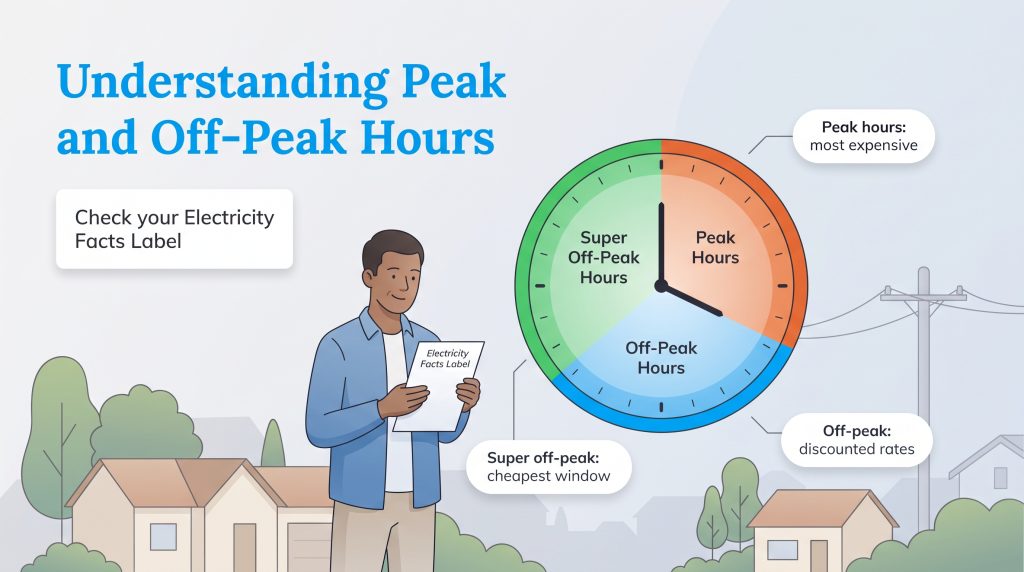
To successfully navigate these time-varying alternatives and capitalize on peak vs off-peak hours, you must understand exactly how your utility company divides the day. The most essential tool for finding these exact timeframes is knowing how to read an electricity facts label (EFL). This mandated regulatory document provides a completely transparent breakdown of exactly when your rates change.
While exact operational windows vary slightly among retail electric providers like TXU Energy or Reliant Energy, most companies universally structure their days into three distinct pricing tiers. Below is a visual timetable detailing how a typical weekday is divided on a TOU plan:
| Pricing Tier | Typical Time Window | Rate Impact | What You Should Do |
|---|---|---|---|
| Peak Hours | 4:00 p.m. – 9:00 p.m. | Highest Cost | Minimize usage, turn up the thermostat, avoid large appliances. |
| Off-Peak Hours | 6:00 a.m. – 4:00 p.m. | Discounted Cost | Resume normal activities, pre-cool your home before 4 p.m. |
| Super Off-Peak | 9:00 p.m. – 6:00 a.m. | Lowest Cost | Charge EVs, run the dishwasher, wash laundry. |
Super Off-Peak Hours
By heavily utilizing super off-peak hours, you are tapping into electricity when it is incredibly cheap and abundant to produce. Furthermore, many utility providers implement occasional demand response programs during extreme weather events. These programs actively text or email you to temporarily raise prices even higher during critical peak emergencies, rewarding you for powering down entirely until the grid stabilizes.
Time Of Use Vs Fixed-Rate Vs Variable-Rate Plans
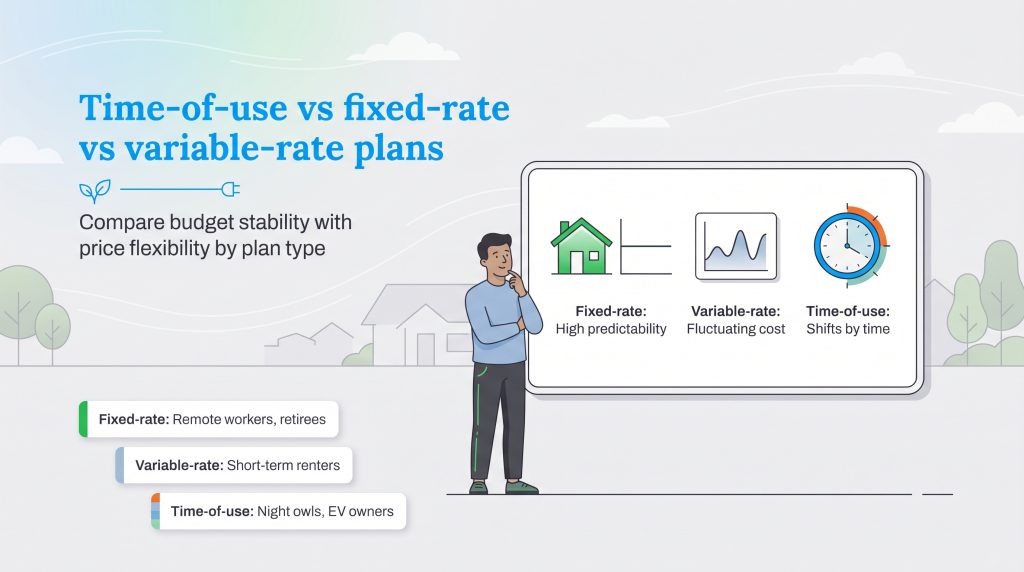
One of the most common dilemmas for homeowners is deciding between time of use, fixed-rate, and variable-rate plans. A standard fixed-rate pricing model guarantees that the cost per kWh remains identical 24 hours a day, providing incredible budget predictability. Conversely, a variable-rate plan fluctuates from month to month based on wholesale market conditions, offering zero price protection during extreme seasons.
A TOU rate plan offers conditional rewards that financially penalize you if you consume too much power during busy afternoons. Running a heavy appliance like a clothes dryer at 5:00 p.m. on a TOU plan might cost a massive premium, but waiting until 11:00 p.m. could drop the price significantly. Review the comparison table below to understand which option best aligns with your daily lifestyle:
| Plan Type | Cost Predictability | Ideal Customer Lifestyle |
|---|---|---|
| Fixed-Rate Plans | High (Consistent rate all day) | Stay-at-home parents, remote workers, retirees |
| Variable-Rate Plans | Low (Changes monthly) | Short-term renters needing no-contract flexibility |
| Time of Use (TOU) Plans | Medium (Dependent on the clock) | Night owls, EV owners, eco-conscious flexible families |
Why Energy Companies Offer TOU Rates
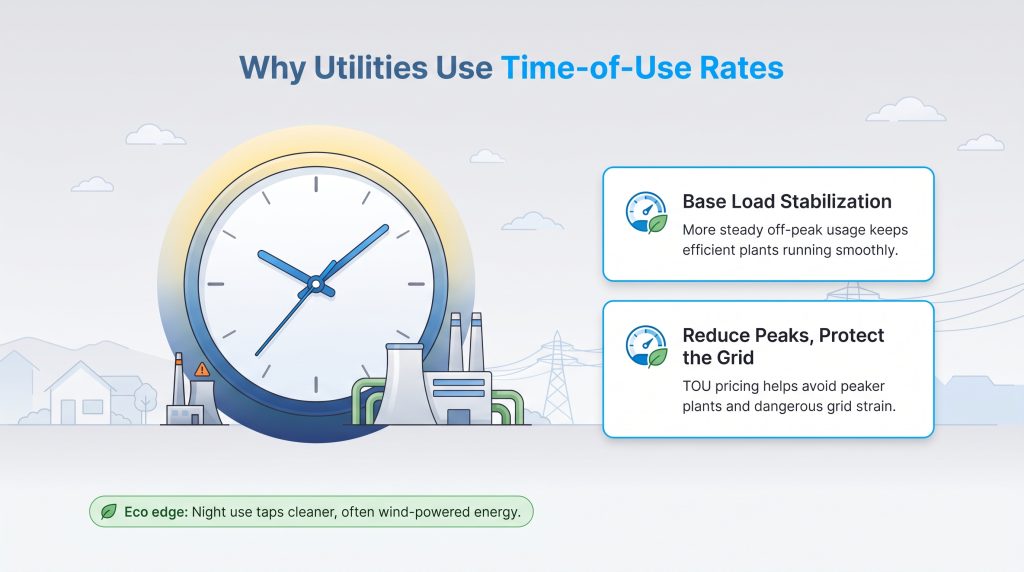
Utility companies across the country use time-varying rates as a critical strategy to prevent severe grid strain. Because electricity cannot be easily stored on a massive scale, grid operators must instantly generate the exact amount of power communities consume at any given second. By incentivizing customers to shift energy demand to off-peak hours, utilities actively reduce the need to activate expensive and inefficient peaker plants.
When peak demand surges — such as during extreme summer heatwaves — local transformers experience dangerous stress. TOU pricing structures naturally encourage eco-conscious consumers to reduce their usage, actively preventing rolling blackouts and keeping base load power plants running smoothly through the night.
Are Time Of Use Plans Worth It?
Deciding if these dynamic rate structures are beneficial depends entirely on your daily routine. Here is a quick look at the pros and cons to help you evaluate if shifting your habits is a smart financial move for your household.
Pros of TOU Plans:
- Free nights and weekends electricity: Many deregulated energy markets offer specific TOU variants where off-peak power costs exactly zero cents.
- Significant savings potential: Flexible households can dramatically lower their bills simply by avoiding peak pricing blocks.
- Maximizes green tech ROI: Solar panels and home batteries become incredibly valuable when you can store and deploy your own power during peak hours.
- Reduces your carbon footprint: Utilizing off-peak green energy is an environmentally mindful choice that deeply supports long-term grid stability.
Cons of TOU Plans:
- High financial penalties: Running heavy appliances on weekday afternoons will cause your utility bill to skyrocket.
- Requires specific hardware: You must have a compatible smart meter installed to accurately track your hourly consumption.
- Demands active management: You must be willing to continuously monitor the clock and make firm lifestyle adjustments.
How To Save Money On A Time Of Use Plan
Utility companies frequently issue demand response challenges that grant lucrative bill credits when you hit specific energy reduction targets. To maximize these rewards and conquer your time-varying rates, you must actively shift your habits. If you are wondering how to save on time of use rates, the answer lies in utilizing modern automation and making thoughtful, environmentally mindful choices.
Optimize EV Charging And Solar Battery Storage
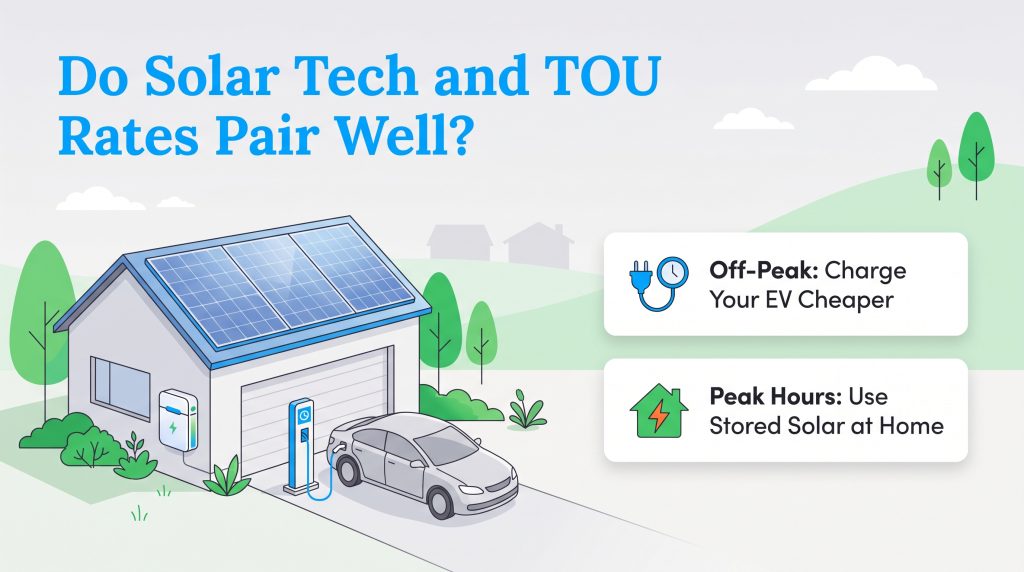
For environmentally conscious homeowners, adopting a TOU rate plan is an incredibly powerful way to leverage green technology. When paired with the right hardware, dynamic pricing structures rapidly accelerate the return on investment for your sustainable home upgrades. If you have solar panels installed, combining them with a home battery backup system allows you to store self-generated power during the morning. You can then deploy this solar battery power during peak afternoon hours to run your home for free, avoiding the utility provider’s premium rates entirely.
Electric vehicle owners also see direct financial benefits from these plans. Attempting to charge a large EV battery during peak hours sends your utility bill skyrocketing, eliminating many of the cost benefits of driving electric. However, by pulling power using the cheapest super off-peak rates overnight, you can fully recharge your EV for a mere fraction of traditional fuel costs. Simply plug your car in when you get home from work, but program the charger’s internal scheduling software to remain dormant until midnight.
Shift High-Energy Appliance Usage
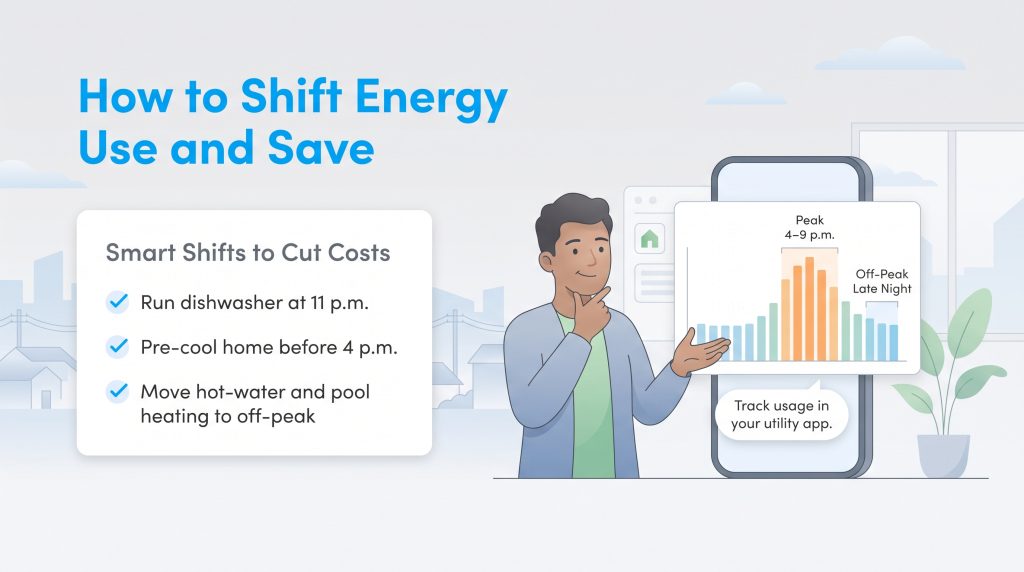
If you want to maximize your savings, you must adjust when you run the most demanding systems in your home. Follow these actionable, step-by-step tips to conquer your peak hours:
- Pre-cool your living spaces: Your HVAC system is the single largest energy drain in your home. Aggressively cool your house during the mid-morning off-peak hours. When peak hours begin at 4:00 p.m., bump your thermostat up a few degrees so your system rests.
- Run heavy cleaning appliances late: Load your dishwasher and washing machine after dinner, but instruct them to run exclusively during off-peak electricity times. Use delayed start buttons to bypass expensive evening windows effortlessly.
- Adjust electric water heaters: Lower your water heater’s baseline temperature slightly, or install a mechanical timer so it stops needlessly reheating a full tank of water right when peak evening rates begin.
Leverage Smart Home Technology
Modern automation takes the guesswork out of time of use billing, allowing you to seamlessly protect your wallet. Use programmable smart thermostats to automatically adjust your indoor climate before peak hours hit, ensuring your home stays comfortable without drawing premium power. For entertainment centers or space heaters, explore different smart plug uses for energy saving. These clever devices let you use your smartphone to cut phantom power draws entirely during the most expensive parts of the day, securing your savings even when you are away from home.
Deciding If A TOU Plan Is Right For Your Home
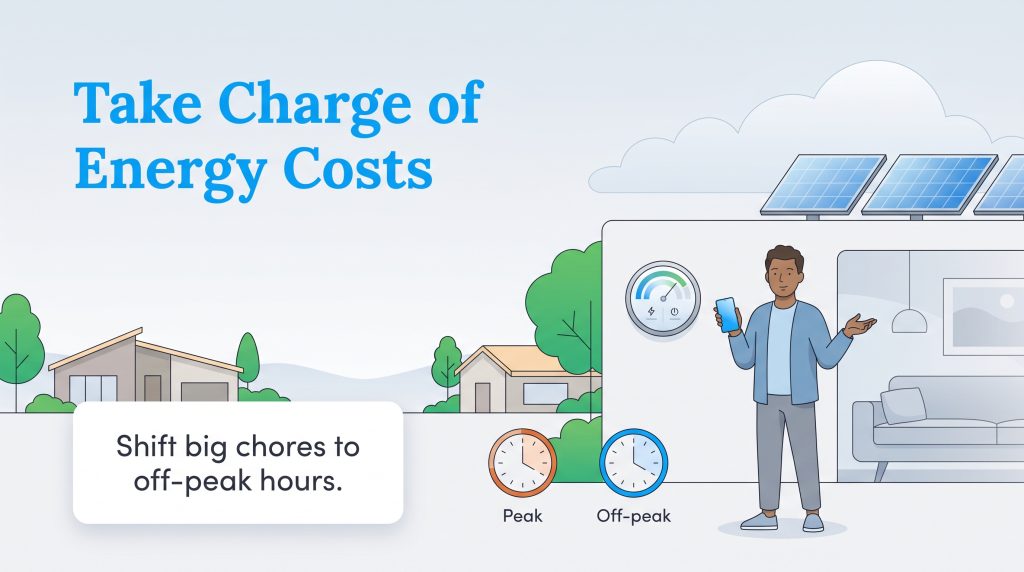
Jumping into a time-based pricing structure without proper preparation can lead to incredibly unexpected bills. While an energy-saving option like a TOU plan financially rewards flexibility, it harshly penalizes rigid afternoon habits. To figure out if this structure is a smart fit for your lifestyle, run through this quick self-assessment checklist:
- Are you frequently away from home during weekday afternoons?
- Can you comfortably run heavy appliances (like your dishwasher and laundry machines) late at night?
- Do you own an electric vehicle that requires regular overnight charging?
- Do you have a smart meter installed to track your hourly usage?
- Are you willing to actively shift your energy demand to maximize eco-conscious savings?
If you answered yes to most of these questions, adjusting your relationship with the local power grid empowers you to outsmart traditional pricing models. By aligning your heavy usage with periods of low grid demand, you are making a financially brilliant and environmentally mindful choice for the future of your home.
Frequently Asked Questions About Time Of Use Plans
Does a time of use plan actually save money?
Yes, you can confidently save substantial money with a TOU plan, but only if you are willing and able to shift a significant portion of your electricity usage to off-peak hours. Proactive activities like running major kitchen appliances late at night, charging electric vehicles overnight, and pre-cooling your home early in the morning lead to much lower bills. If your usage remains primarily during peak afternoon hours, this plan will unfortunately cause your bill to increase.
What are standard peak and off-peak hours?
For most utility companies across the country, standard peak hours occur on weekdays between 4:00 p.m. and 9:00 p.m. Off-peak hours typically stretch from 10:00 p.m. to 6:00 a.m., with the remaining daytime hours acting as transitional or shoulder periods with moderate rates.
What is the most expensive time of day to use electricity?
The most expensive time of day to use electricity is during your provider’s designated peak hours. For most utility companies across the country, this high-cost window occurs on weekdays between 4:00 p.m. and 9:00 p.m., as families return home, adjust thermostats, and run heavy household appliances simultaneously.
What time of day is electricity the cheapest?
Electricity is almost always cheapest during super off-peak hours, which typically occur late at night and early in the morning (e.g., 10:00 p.m. to 6:00 a.m.) when most households are asleep and overall grid demand plummets.
What are the cheapest hours to do laundry on a TOU plan?
The absolute cheapest time to run your washer and electric dryer is during your plan’s super off-peak window. For most households, this window begins after 10:00 p.m. and stretches until 6:00 a.m. Using delayed start functions on modern appliances makes tackling overnight laundry effortless.
How do weekends and holidays affect time of use rates?
For many TOU plans, weekends and major federal holidays are considered entirely off-peak, meaning you pay the heavily discounted rate all day long regardless of the hour. However, it is vital that you check your specific Electricity Facts Label, as some aggressive plans still enforce peak pricing on Saturday and Sunday afternoons.
Are free nights and weekends plans considered time of use?
Yes, free nights and weekends plans are incredibly popular variations of Time of Use contracts. Instead of just lowering the rate during off-peak hours, the utility provider drops the energy charge to exactly zero cents during specific nightly or weekend windows, while usually charging a significantly higher premium rate during weekday daytime hours.
How can I track my daily electricity usage?
If your home is equipped with a modern smart meter, you can easily track your daily and hourly usage by logging directly into your utility provider’s online dashboard or downloading their mobile app. Detailed interval reports allow you to see exactly when your appliances draw the most power.
Does a smart meter automatically put me on a time of use plan?
No. While you need a smart meter to participate in a TOU plan, having one installed does not automatically change your billing structure. You must intentionally enroll in a time-varying rate plan with your current energy provider to begin accessing dynamic rates.
Can I opt out of a time of use rate plan?
Depending on where you live, you can typically opt out by calling your utility company and requesting a switch back to a standard flat-rate plan. In fully deregulated energy markets, you have the ultimate freedom to shop around for a completely different provider if you find that a time-varying structure doesn’t suit your lifestyle.
Do I need special equipment to be on a TOU plan?
Yes, almost all modern utility companies require a digital smart meter to be installed at your home to utilize dynamic pricing. A smart meter expertly records your electricity usage in real-time and neatly differentiates between your total consumption and peak demand periods. If you do not already have one, your utility company will typically install it for free when you sign up.
How do I know if I have a TOU rate plan?
The easiest way to find out is to carefully review your most recent electric bill or check your plan’s Electricity Facts Label (EFL). If you see varying line-item charges based on the time of day, or if you are enrolled in prepaid electricity plans that feature “free nights,” you are on a TOU structure. In deregulated markets, you can use your state’s official comparison portal to shop for independent providers like Gexa Energy to explore more dynamic plan options.
About the Author

David has been an integral part of some of the biggest utility sites on the internet, including InMyArea.com, HighSpeedInternet.com, BroadbandNow.com, and U.S. News. He brings over 15 years of experience writing about, compiling and analyzing utility data.

LaLeesha has a Masters degree in English and enjoys writing whenever she has the chance. She is passionate about gardening, reducing her carbon footprint, and protecting the environment. She also recently served as President of the Board for City Sprouts (a community garden).