

Understanding If a Flat Rate Unlimited Style Electricity Plan Fits Your Budget and Lifestyle
Key Takeaways
- Flat rate plans offer a consistent monthly bill regardless of usage, similar to a subscription service, but they often come with usage caps or thresholds.
- There is a major difference between “flat rate” and “fixed rate” plans; flat rate locks your total bill amount, while fixed rate locks your price per kilowatt-hour (kWh).
- High-usage households often benefit most from these plans, while energy-conscious users or frequent travelers may end up overpaying for electricity they don’t use.
Opening an unexpectedly high utility bill during extreme weather can quickly ruin your household budget, which is exactly why many companies heavily push flat rate plans as the ultimate stress-free solution. A flat-rate electricity plan is a specialized billing structure where you pay a single, consistent monthly charge regardless of minor usage fluctuations, much like you do for a standard internet or streaming subscription. However, the shiny marketing hype often obscures strict contractual limits and expensive hidden fees that can completely derail your finances. We want to help you unpack the fine print, compare the best flat bill energy plans against all other market alternatives, and determine if this specific billing structure truly provides predictable energy bills or simply traps you into consistently overpaying for power you never actually use.
What Is a Flat-Rate Electricity Plan
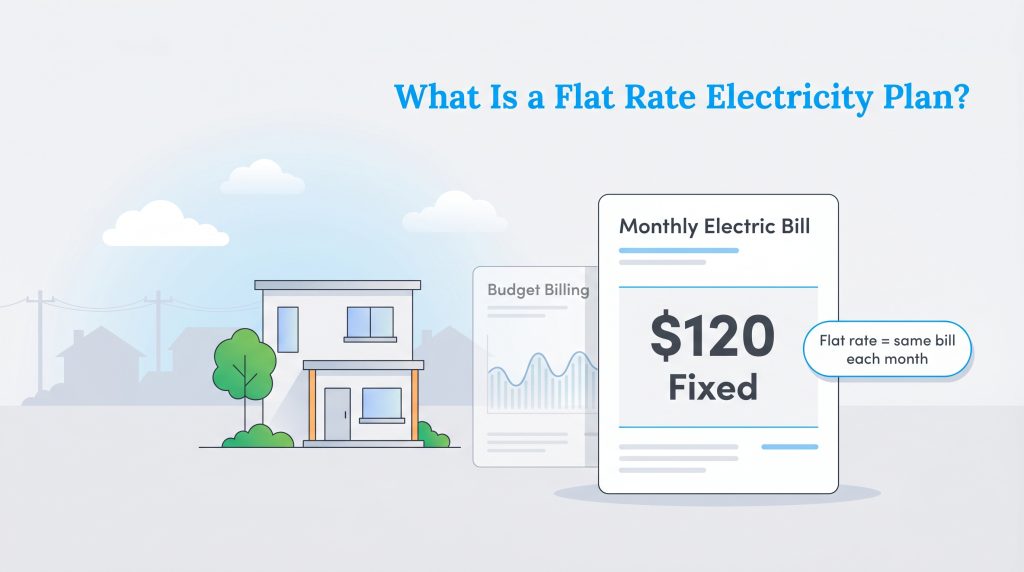
When you sit down to sign up for new service, exploring what is a flat rate electricity plan usually sounds incredibly appealing. You pay the exact same monthly fee whether you run your air conditioning continuously all weekend or spend the entire week out of town on vacation. However, these structured agreements are not just randomly generated numbers. Retail Electricity Providers (REPs) calculate your flat monthly fee based directly on historical usage data for your specific property size and region.
How Flat-Rate Billing Actually Works
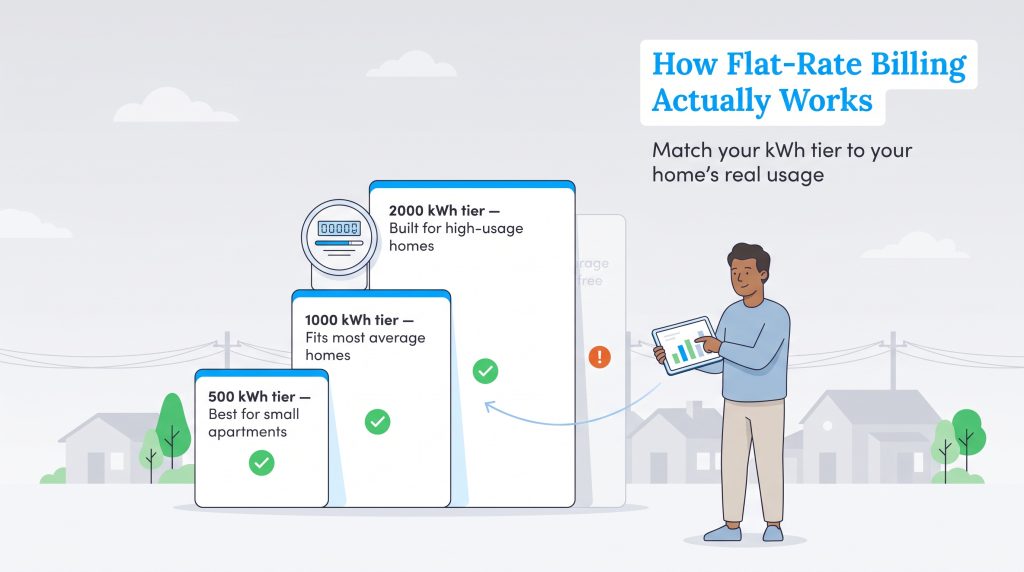
To establish a fixed monthly electricity cost, providers offer different usage tiers intricately tailored to your home’s past consumption. Understanding these standard thresholds is the key to locking in a fair contract without leaving money on the table:
- The 500 kWh Tier: This entry-level flat rate is typically best suited for single occupants or renters living in smaller apartments with highly predictable, minimal cooling needs.
- The 1000 kWh Flat Rate: Moving up the scale, a 1000 kWh tier targets average, mid-sized homes where families require enough flexibility to run standard household appliances and seasonal HVAC systems without constant worry.
- The 2000 kWh Tier: This expansive tier exists specifically to accommodate much larger properties, giving high-usage households the peace of mind to run multiple air conditioning units during extreme heat waves.
While a traditional utility billing system charges you precisely for every single kilowatt-hour (kWh) you use, flat-rate billing focuses entirely on convenience and budget stability. But to truly understand if you are getting a good deal, you must recognize how companies formulate these predictable prices.
How Providers Calculate Your Flat Rate
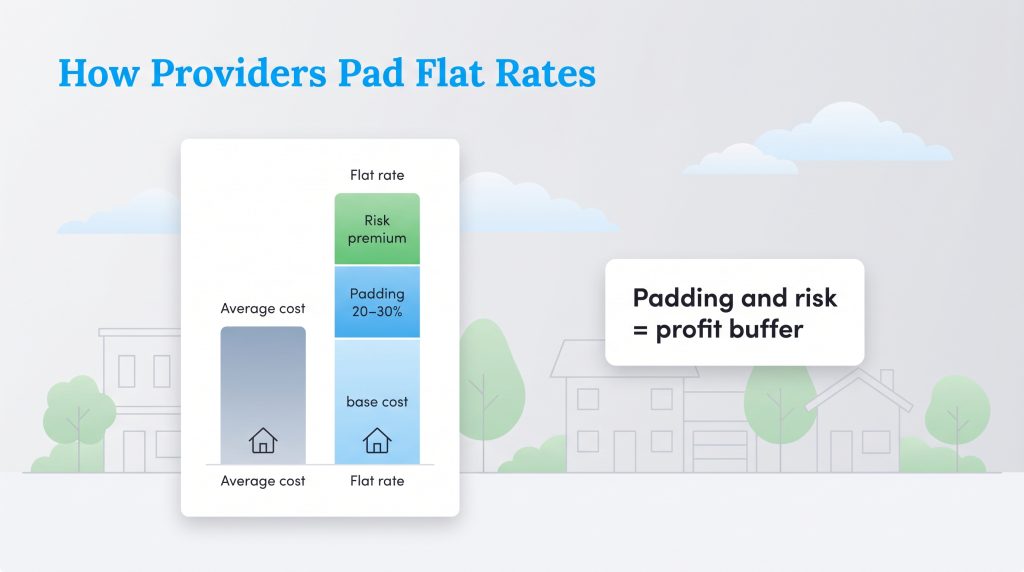
Providers look deeply at decades of weather data, extreme temperature probabilities, and average household consumption habits. If their data shows that a typical three-bedroom home uses an average of $120 worth of electricity per month on a standard plan, they will not offer a flat rate at $120. Instead, they actively protect their bottom line by integrating specific buffers directly into the contract. Providers routinely apply a lucrative 20% to 30% markup over the historical usage average for your specific property size. This padding ensures they profit even during mild weather months and serves as a financial safety net. You are effectively paying a notable premium for the luxury of financial predictability.
💡 Pro Tip: Don’t confuse flat rate electricity plans with “Budget Billing” offered by traditional utility companies. Flat rate plans are a separate product with a hard set monthly bill, whereas budget billing simply averages your fluctuating costs over a 12-month period.
Flat-Rate vs Fixed-Rate Electricity Plans
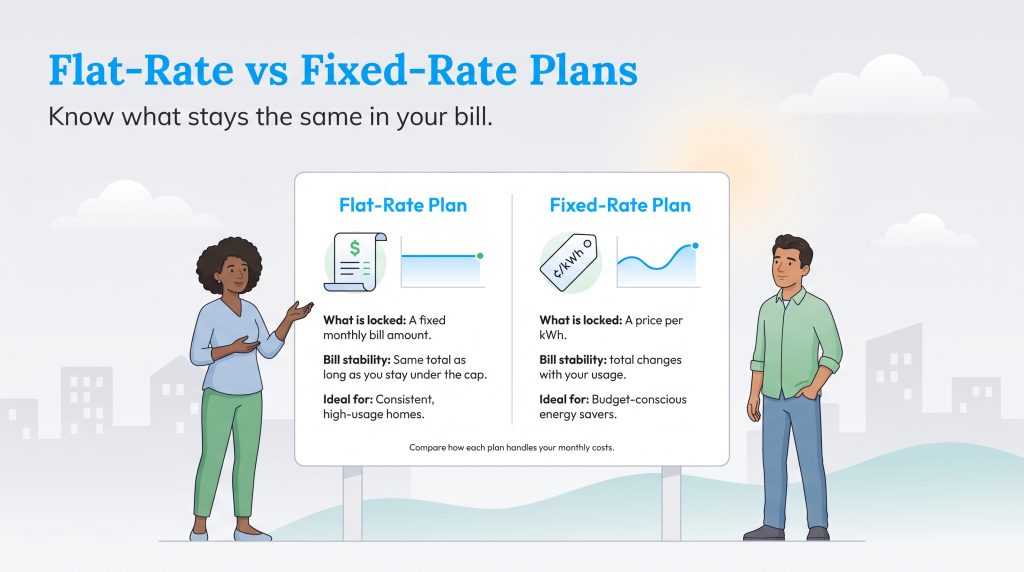
One of the absolute most common sources of confusion for consumers navigating a competitive energy market is understanding flat rate vs fixed rate electricity options. While they sound incredibly similar, they function completely differently when it comes time to calculate your monthly invoice.
A fixed rate plan rigidly locks in the price you pay for each individual unit of electricity (measured in cents per kWh) for the duration of your contract. Your rate per unit stays perfectly static, but your total bill naturally fluctuates up or down depending on how much electricity you actually draw from the grid that month. In stark contrast, a flat-rate plan firmly locks in your total bottom-line bill amount, establishing a fixed monthly dollar amount (e.g., $150 per month). Whether you use 800 kWh or 950 kWh in a given billing cycle, you pay the exact same total amount, assuming you stay safely under the plan’s threshold.
The market also offers specialized alternatives like tiered electricity plans, which change the price per kWh based on usage buckets, and Time-of-Use (TOU) options. Use this direct side-by-side comparison to clarify the differences between the two most popular billing structures.
| Feature | Flat-Rate Plan | Fixed-Rate Plan |
|---|---|---|
| What is locked? | A fixed monthly dollar amount (e.g., $150/month). | A locked price per kWh (e.g., 12 cents/kWh). |
| Bill Stability | 100% predictable as long as you stay under the usage cap. | Fluctuates naturally up or down with your actual usage. |
| Risk Level | High financial penalty if you cross the usage limit. | Medium risk tied directly to extreme seasonal weather. |
| Ideal User | Consistent, high-usage homes aiming for total budget certainty. | Budget-conscious energy conservers seeking control over savings. |
Pros and Cons of a Flat Energy Bill
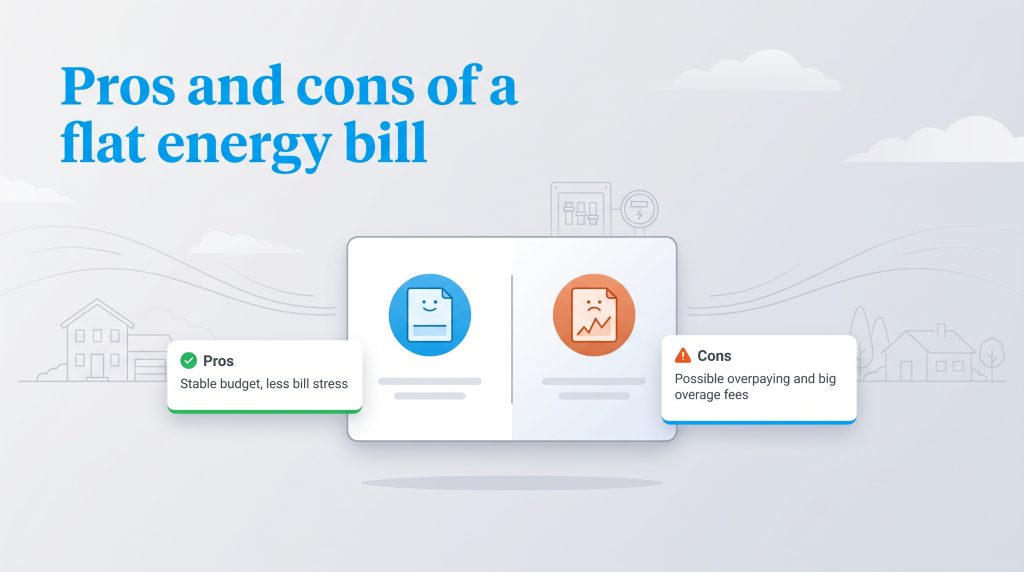
Deciding if no tier electricity rates or a strict flat bill energy plan is genuinely worth your signature requires carefully weighing the psychological benefit against the potential financial drawbacks. For some busy households, avoiding bill shock is entirely worth paying a premium. For others, the complete lack of control over potential savings is an absolute dealbreaker.
Pros of Flat Rate Plans
- Predictable energy bills: You gain total budget predictability, knowing exactly what you owe every single month without guessing.
- Great for roommates: You can easily split a perfectly stable, unchanging utility bill without arguing over constant monthly math.
- Extreme weather peace of mind: Run your air conditioner during intense summer heatwaves without stressing over devastating meter spikes.
Cons of Flat Rate Plans
- Paying for provider padding: Energy efficiency habits do not result in lower bills, and you pay a built-in premium for unused electricity.
- Heavy financial penalties: Crossing your strict contractual limits triggers massive, budget-breaking overage fees.
- Zero flexibility: Extended vacations or significant time spent away from home result in entirely wasted money.
How to Read the Electricity Facts Label
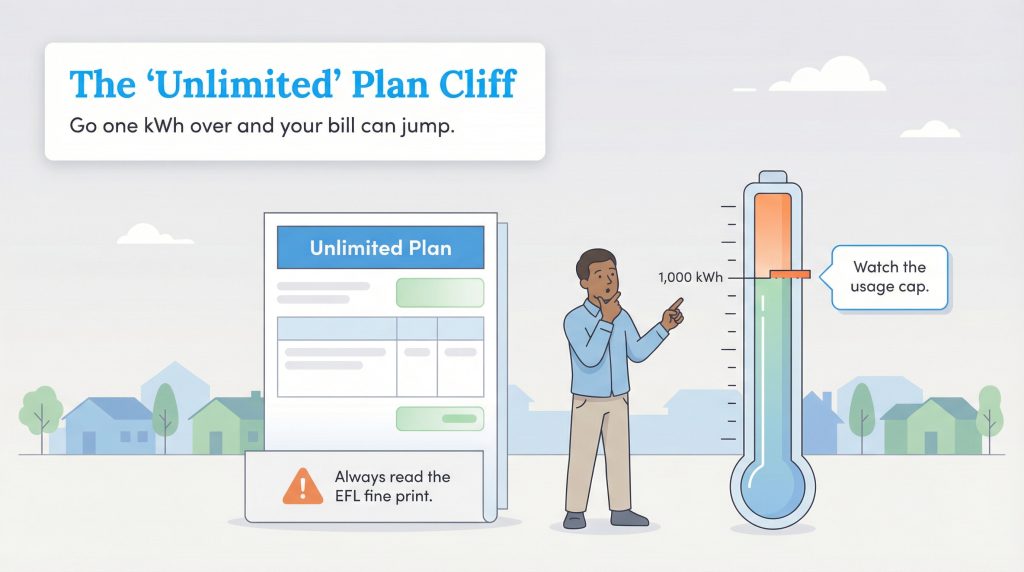
While energetic marketing materials frequently highlight unlimited electricity plans, the legally binding fine print found on the Electricity Facts Label (EFL) usually tells a significantly different story. Almost all flat-rate plans feature a hidden boundary line, sometimes referred to in the industry as a “cliff.” If your usage exceeds the agreed-upon cap by even a single kilowatt-hour, the financial consequences can be devastating to your monthly budget.
Understanding volatile wholesale electricity prices is essential here. Energy providers build their EFL limits around these unpredictable market costs to shield their profits. If you blow past your cap during a severe summer grid surge, the provider has to buy extra power at premium wholesale rates — and they will immediately pass that massive expense directly to you. Follow these specific steps to decode your EFL and spot hidden traps before you sign:
- Locate the usage limits: Scan the pricing chart for specific usage tiers or maximum kilowatt-hour allowances. Verify exactly where your flat rate boundary ends.
- Check for penalty clauses: Meticulously find the section detailing overage fees. Look for aggressive language stating that crossing your threshold applies an instant $50 or $100 penalty to your invoice.
- Review the base charge: Ensure the provider isn’t padding the contract with excessive monthly administrative fees piled on top of the advertised flat rate.
- Identify variable reversions: Check if exceeding the limit revokes your flat-rate benefit completely, forcing your entire month’s usage into a severely inflated variable rate.
🚩 Heads Up: Look closely at your EFL for the specific sections outlining the Usage Credit and Base Charge. The usage cliff is often buried right here, explicitly stating that exceeding your specific allowance revokes your hard-earned credit and instantly applies a massive overage fee directly to your bill.
Calculating Your Flat-Rate ROI
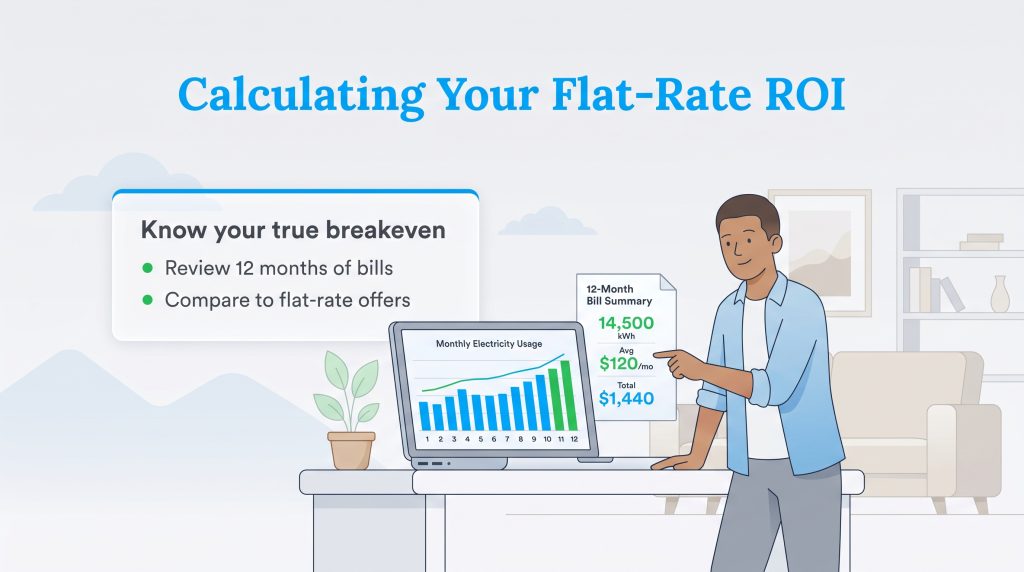
Securing the perfect energy deal in a wildly competitive deregulated market demands a strategic, systematic approach. Flat-rate plans can provide tremendous value, but they are far from a universally perfect solution for every type of consumer. To mathematically determine if you should pursue one of these predictable contracts, you must thoroughly audit your past 12 months of electricity bills to establish a reliable baseline.
Who Is the Ideal Candidate for a Flat-Rate Plan
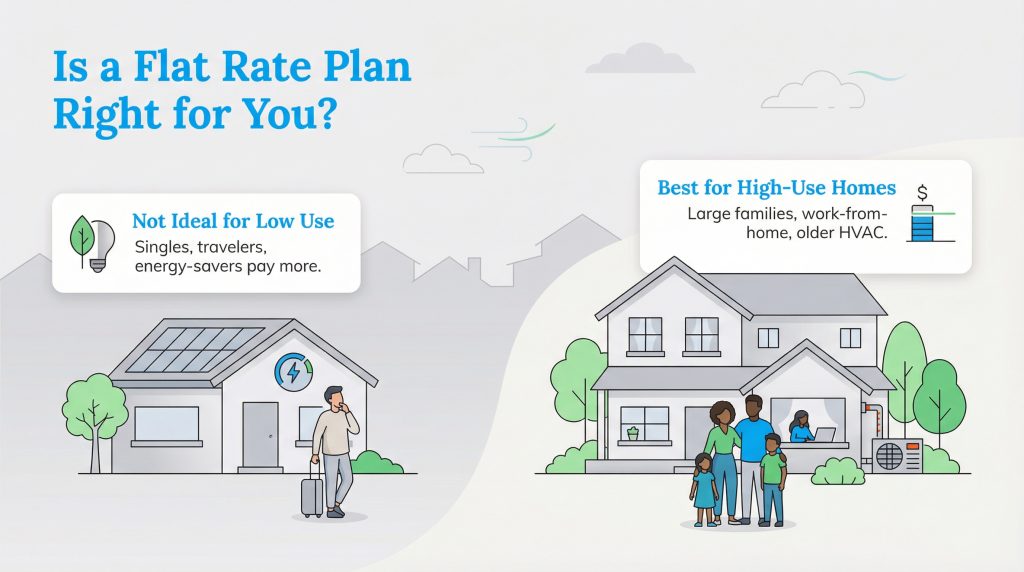
Before putting your signature on any new service agreement, consider this comprehensive checklist of ideal candidates for a flat bill structure. Evaluating these points ensures you do not lock yourself into an incompatible contract. You are likely a great fit for a flat-rate plan if you meet the following criteria:
- A strict budgeter: You prioritize perfectly predictable energy bills and value absolute financial stability over securing the lowest possible price per kWh.
- A consistent energy consumer: Your household maintains steady, historically proven usage without dramatic seasonal spikes that risk triggering the usage cliff.
- Living in a high-usage home: You reside in a larger, multi-generational household that constantly runs HVAC systems and heavy appliances year-round.
- Splitting costs with roommates: You need an uncomplicated, guaranteed monthly total to divide fairly among multiple occupants without arguing over the thermostat.
Why You Should Check Your Usage History First
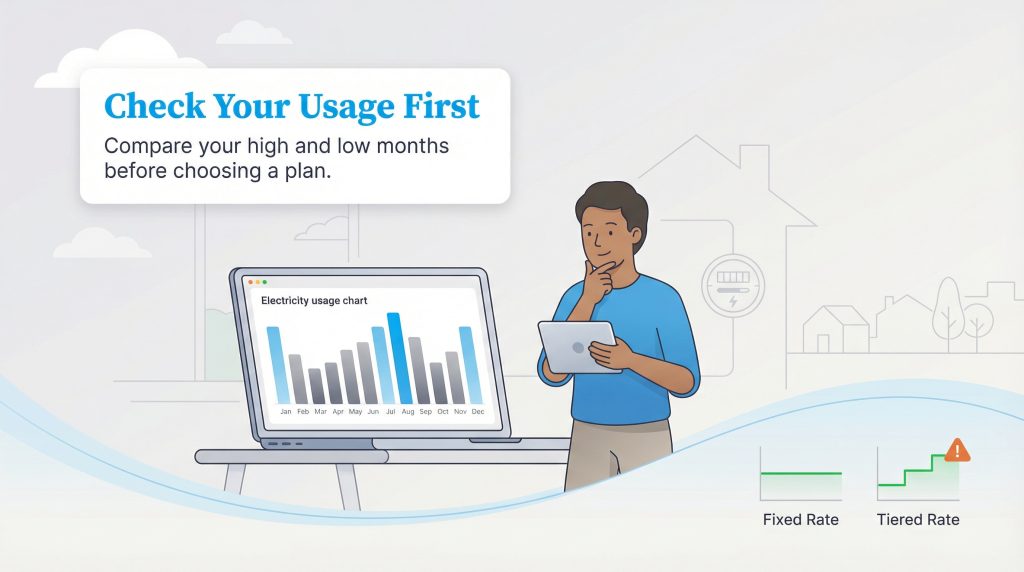
If your historical usage fluctuates wildly — for example, pulling a mere 500 kWh in the gentle spring but drastically spiking to 2,500 kWh in the grueling summer heat — signing up for a flat rate plan is a highly dangerous financial gamble. You need a dynamic plan that accommodates your peak usage periods without forcing you to egregiously overpay during your low-usage months.
Action Plan for Securing Your Next Energy Contract
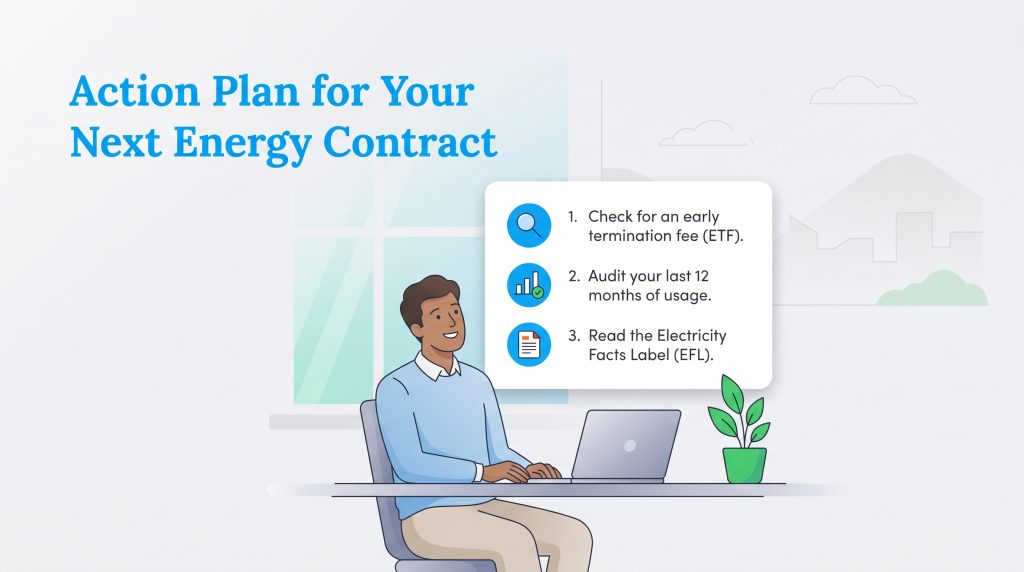
Log in to your current electricity provider’s web portal and carefully download your usage history for the last calendar year. Look critically at your highest usage month and your absolute lowest usage month to find your swing. If you genuinely cannot find a flat tier that accommodates your annual range comfortably, you are almost universally better off securing a traditional fixed-rate plan. If you are deeply determined to lower your overall consumption to safely fit into a cheaper tier, be sure to check out our comprehensive guide on how to save on your electric bill by vastly improving your home’s thermal envelope and operational efficiency.
🌱 Eco Edge: Flat rate plans can accidentally discourage energy conservation because your bill doesn’t logically drop when you save power. However, choosing an energy-saving option like upgrading to LED bulbs still reduces overall strain on the grid and cuts local carbon emissions, regardless of your specific pricing plan.
Making the Best Choice for Your Home
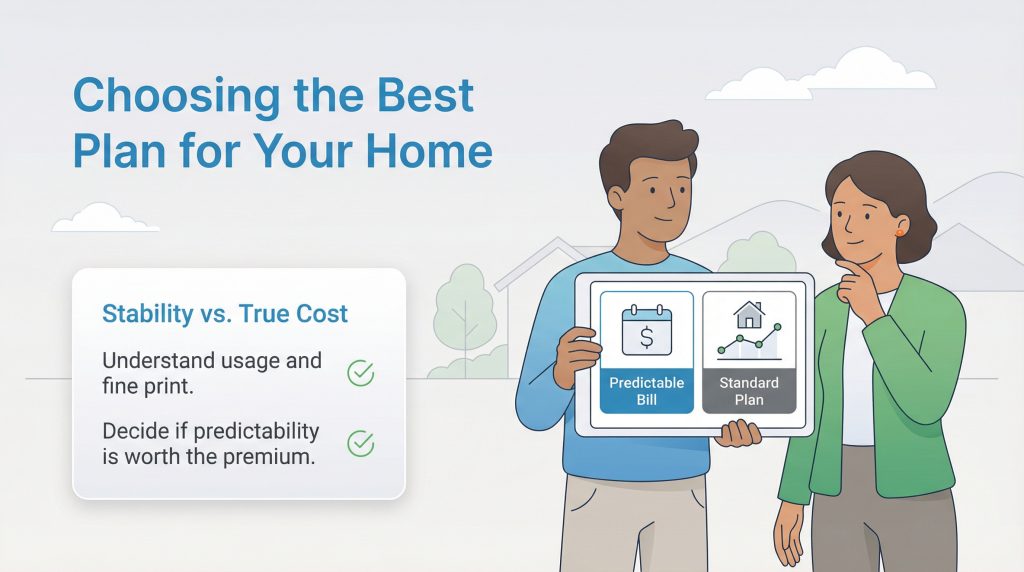
The single most important step you can take today is to actively read the binding fine print. Do not let an overly simplistic marketing flyer dictate a massive financial commitment for your home without verifying the facts. By thoroughly understanding your own seasonal usage habits and accurately cross-referencing them against the strict terms of the EFL, you can confidently take total control of your utility budget. Armed safely with this knowledge, you can seamlessly choose a plan that genuinely serves your daily needs, rather than one that eventually traps you in endless penalty fees.
Frequently Asked Questions About Flat Rate Plans
What happens if I go over my usage limit on a flat-rate plan?
Exceeding your specific contractual threshold by even a single kilowatt-hour typically triggers a severe financial penalty. Providers may instantly apply a hefty overage fee directly to your invoice or aggressively bump you into a significantly more expensive pricing tier for the remainder of the billing cycle.
Are unlimited electricity plans the same as flat-rate plans?
Usually, yes, but the term “unlimited” is primarily a marketing tactic. Most consumer plans aggressively marketed as unlimited possess a fair usage policy or a hard contractual cap detailed exclusively in the Electricity Facts Label (EFL). If you accidentally exceed this hidden cap, you are penalized just like any standard flat-rate structure.
Do flat-rate energy plans actually save you money?
Often, no. Flat-rate plans are intelligently designed by providers for budget predictability, not necessarily for the lowest bottom-line price. They typically save money for high-usage households that would otherwise pay exorbitant rates during peak summer or winter months, but low-usage homes almost always overpay for the built-in padding.
What happens if I use less electricity than the flat rate tier?
You still unfortunately pay the absolute full flat price for that specific month. This frustratingly means your effective rate per kWh goes up significantly because you are actively paying the company for valuable energy you never actually pulled from the grid.
Are flat rate plans available in every state?
No, flat rate plans are primarily available exclusively in states with deregulated energy markets, such as Texas flat rate electricity options, or markets in Ohio and Pennsylvania. In regulated states, you will typically find standard utility rates, though some providers generously offer budget billing to help smooth out your payments.
What should I look for in the electricity facts label (EFL)?
You should specifically hunt for the “Usage Credit,” “Base Charge,” and any surprisingly aggressive clauses regarding overage penalties. Pay close attention to the precise usage thresholds that trigger a sudden price change, as crossing these boundaries by even a marginal amount can drastically increase your bill.
Is a flat bill energy program the exact same as budget billing?
No, a flat bill energy program is a specialized contract that strictly locks in a static monthly price, successfully absorbing the cost of minor usage fluctuations up to a rigid set limit. In direct contrast, budget billing is a helpful utility feature that simply averages your variable annual costs into predictable, equal monthly payments. Budget billing ultimately reconciles at the end of the year, meaning you eventually pay for the exact amount of electricity you actively consumed.
About the Author

LaLeesha has a Masters degree in English and enjoys writing whenever she has the chance. She is passionate about gardening, reducing her carbon footprint, and protecting the environment. She also recently served as President of the Board for City Sprouts (a community garden).

Claudio is a sustainability-focused writer with a background in Anthropology and Psychology from NC State University. He has spent over 15 years working in writing, interpretation, and translation, driven by a deep interest in how human culture shapes the environment. Today, he shares his curiosity with readers by writing about sustainable living solutions and the connection between everyday choices and environmental impact.