

Budget billing smooths out your utility payments to avoid seasonal spikes, but it doesn’t lower your total energy costs.
Key Takeaways
- Budget billing averages your annual energy usage into predictable monthly payments.
- Depending on your provider, your account settles through annual true-up balances or rolling monthly recalculations if your actual energy usage differs from estimates.
- Measuring your electric usage is a smart way to ensure the plan works for your financial goals.
Opening your utility bill during a scorching heatwave or a bitter cold snap can feel like a financial gamble, with costs often jumping hundreds of dollars higher than expected. At UtilitiesForMyHome.com, we know that if you live on a fixed income or simply prefer knowing the exact dollar amount leaving your bank account each month, a level payment plan offers a reliable solution to that seasonal roller coaster. While it will not lower the total amount you pay for energy over the course of the year, understanding how budget billing works allows you to transform volatile utility bills into a steady monthly payment that makes household budgeting virtually stress-free.
What Is Budget Billing?
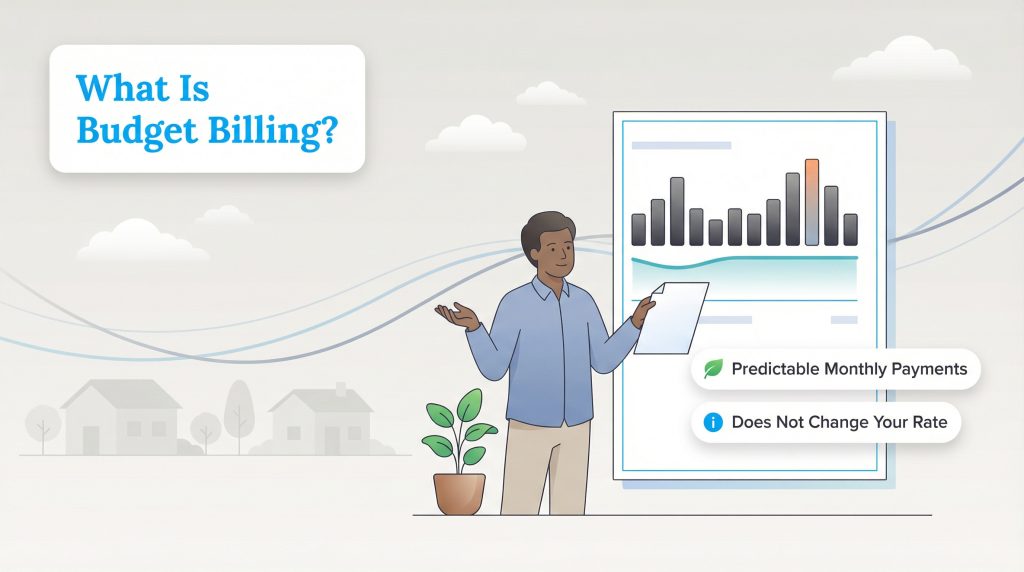
What is budget billing? It is an average payment plan that smooths out seasonal spikes by calculating your annual electricity or natural gas consumption and dividing it into 12 equal monthly installments. This structure ensures your utility payments stay consistent every month, helping you avoid financial shocks during extreme winter or summer weather, since heating and cooling dominate consumption.
Budget billing is a popular billing arrangement offered by most retail electric providers and regulated utility companies across the country. Instead of paying for the exact kilowatt-hours (kWh) or therms you consume on a month-to-month basis — which inevitably results in steep bills in the summer and winter and low bills in the spring and fall — you pay a predictable rate. However, this is strictly a cash-flow strategy designed for consumer convenience. It is not a discount program, and it does not reduce the base rate you pay for your electric supply or natural gas delivery.
Depending on your specific utility provider, such as TXU Energy or Reliant Energy, you might see this option listed under names like “Level Payment Plan,” “Average Monthly Billing,” or “Balanced Billing.” While utilities use these names to market predictable billing programs, they are not always identical under the hood. The underlying math differs significantly depending on whether your provider uses a fixed annual average that locks in your payment for a year or a rolling monthly average that recalculates every billing cycle. Just remember that securing predictable payments doesn’t replace the need to monitor your home consumption if you want to keep your carbon footprint and long-term costs in check.
How Does Budget Billing Work Step-by-Step?
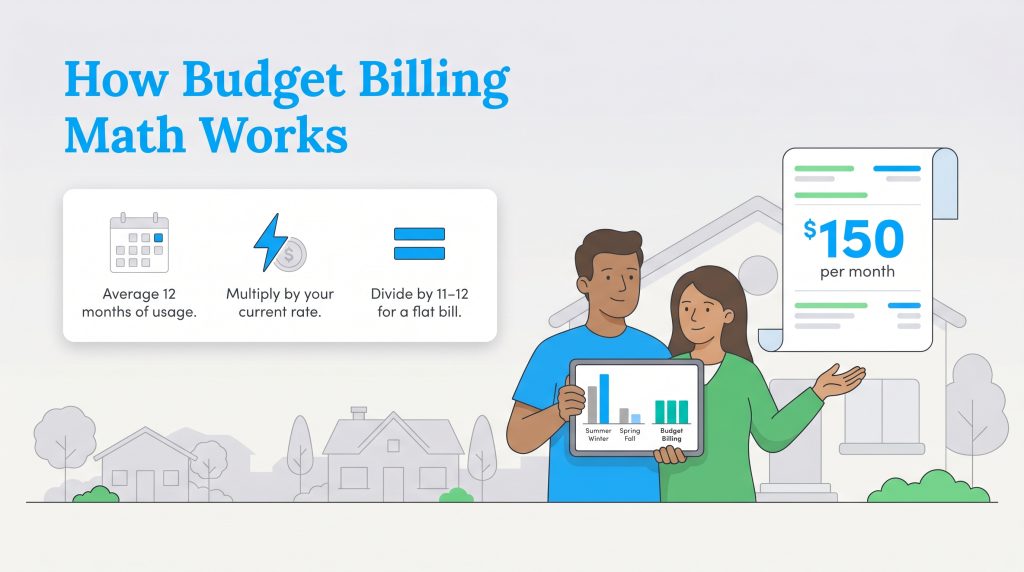
Utility companies use a straightforward mathematical formula to determine your monthly installment. Their goal is to ensure that by the end of your 12-month cycle, your total payments match the actual value of the energy you consumed. Here is how utility companies calculate your rate in four steps:
- Analyze your historical usage: The utility provider reviews the total energy consumption history for your specific service address over the previous 12 months.
- Apply the current market rate: They multiply your historical energy usage by the current market rate for electricity or natural gas, along with standard delivery and base customer charges.
- Factor in projected adjustments: Providers often adjust this baseline estimate to account for expected fuel price fluctuations, approved regulatory rate hikes, or seasonal weather forecasts from the National Oceanic and Atmospheric Administration (NOAA).
- Divide into equal installments: Finally, they take that total estimated annual cost and divide it by 11 or 12 months to create your monthly payment. (The division depends on whether your provider uses the 12th month strictly as a settlement period to clear out any remaining balance).
When comparing standard billing to an averaged plan, the total annual cost remains identical while your monthly cash flow changes dramatically:
📌 Quick Fact: If your household uses 12,000 kWh per year at an average rate of $0.15 per kWh, your total annual electricity cost is $1,800. Instead of paying a massive $300 bill in July and a tiny $75 bill in April, budget billing divides that $1,800 total by 12 months — locking in a predictable payment of $150 per month all year long. Remember, budget billing is a financial pacing strategy, so you remain responsible for every kilowatt-hour or therm you use.
Fixed Budget Billing vs Rolling Levelized Billing
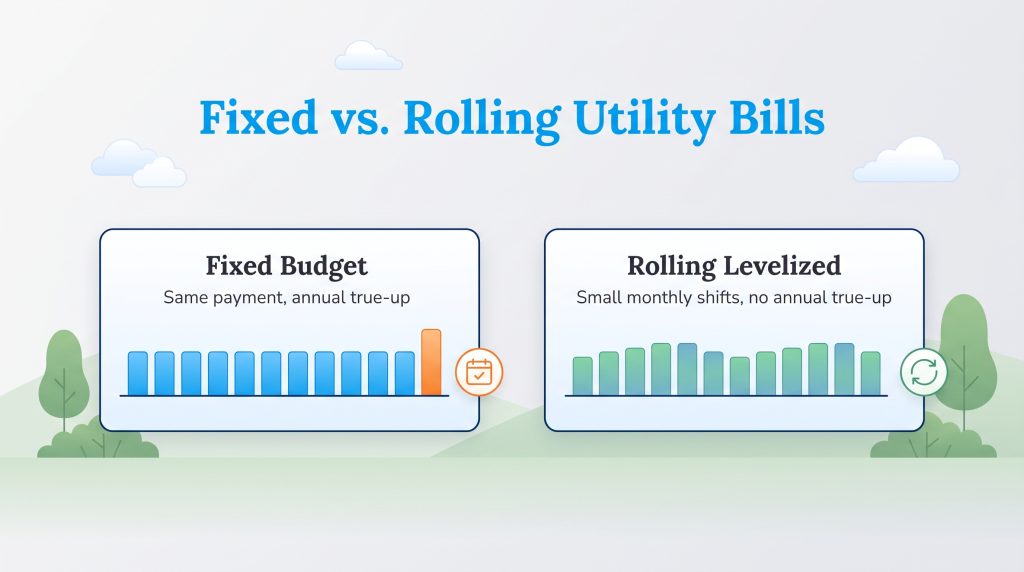
One of the biggest misconceptions about utility payment programs is assuming that all averaged plans work the same way. When comparing levelized billing vs budget billing, or looking at average monthly billing vs budget billing, the specific structure your utility company uses will dictate whether your bill stays completely flat or shifts by a few dollars each cycle. Utilities rely on two distinct models to manage these programs:
- Traditional (Fixed) Budget Billing: This model locks in a flat monthly fee for a set 6-month or 12-month period. Your bill is the exact same down to the penny every month. However, because your payments are static while your real-world usage fluctuates, the difference accumulates in the background. The cycle ends with a mandatory annual “true-up” or settlement month where you must pay off any underpaid balance or receive a credit for overpayments.
- Rolling Levelized (Average) Billing: Instead of locking in a single number for a full year, levelized billing uses a rolling 12-month average that recalculates every single month. Each cycle, the provider drops your oldest month of usage from a year ago and adds in your current month’s usage, dividing the new 12-month total by 12. Because your bill adjusts gradually by $5 to $15 each month to absorb weather swings and rate changes in real time, a rolling plan eliminates the year-end true-up time bomb.
Understanding the structural differences between standard utility billing and these two averaging methods will help you choose the best fit for your household budget.
| Feature | Standard Billing | Fixed Budget Billing | Rolling Levelized Billing |
|---|---|---|---|
| Monthly Payment Stability | Volatile; fluctuates heavily based on seasonal weather and real-time usage. | 100% static; you pay the exact same dollar amount for 6 to 12 months. | Semi-stable; fluctuates slightly by a few dollars each month without extreme spikes. |
| How It Is Calculated | Actual energy consumed during the current 30-day cycle multiplied by current rates. | Estimated annual cost divided by 12 equal installments, reviewed once or twice a year. | Rolling average of your current month’s bill plus the previous 11 months, divided by 12. |
| Year-End True-Up Required? | No; you settle your exact balance every 30 days. | Yes; requires a mandatory annual settlement month to reconcile your deferred balance. | No; ongoing monthly recalculations absorb usage spikes gradually, preventing a year-end lump sum. |
| Immediate Conservation Rewards | High; lowering your energy use immediately cuts your very next bill. | None until your 6- or 12-month recalculation period or annual settlement arrives. | Gradual; energy-saving habits lowered in the current month slightly reduce your next rolling average. |
| Cancellation Consequences | You only owe for the current month’s usage when closing or switching accounts. | Any accumulated negative deferred balance becomes immediately due in a single lump sum. | Any remaining deferred difference between your rolling payments and actual usage is due on your final bill. |
Who Qualifies for Budget Billing? (Eligibility & New Movers)
While leveled utility plans are widely available, enrollment isn’t guaranteed for every household. Because the utility company is essentially extending short-term credit during high-usage months when your fixed payment doesn’t cover your actual consumption, providers enforce strict utility budget billing eligibility rules. Before you can enroll, your account typically must meet three core prerequisites:
- Good Account Standing: You must have a $0 past-due balance at the time of enrollment. Most utility companies also require a clean payment history with zero late payments, disconnection notices, or dishonored checks over the prior 6 to 12 months. If you currently carry utility debt, you will need to pay it off or complete a formal deferred payment arrangement before qualifying.
- Residency & Usage History (The New Mover Trap): Because accurate calculations rely on historical data, utilities frequently require 9 to 12 months of continuous usage history at your specific service address. Some providers allow new movers to enroll immediately by estimating your bill based on the previous occupant’s consumption. However, beware of the “New Mover Trap”: if a family of four moves into a home that was previously vacant or occupied by a single retiree who barely ran the air conditioning, your initial budget billing rate will be set artificially low. If you don’t catch the discrepancy, you will build up a massive deficit and get hit with a devastating year-end true-up bill.
- Eligible Charges Only: Budget billing strictly covers regulated electricity or natural gas supply, delivery charges, and standard taxes. It excludes unregulated add-on services. If you pay for HVAC equipment protection plans, water heater rentals, surge protection programs, or outdoor security lighting through your utility bill, those fees will be tacked on top of your fixed monthly budget amount.
🚩 Heads Up: If you just moved into a new home and your utility provider lets you enroll in budget billing right away, ask the customer service representative how they calculated your baseline. If the estimate is based on a vacant property or a low-usage prior tenant, wait 6 to 12 months to establish your own usage history before enrolling.
How to Read Your Budget Billing Statement
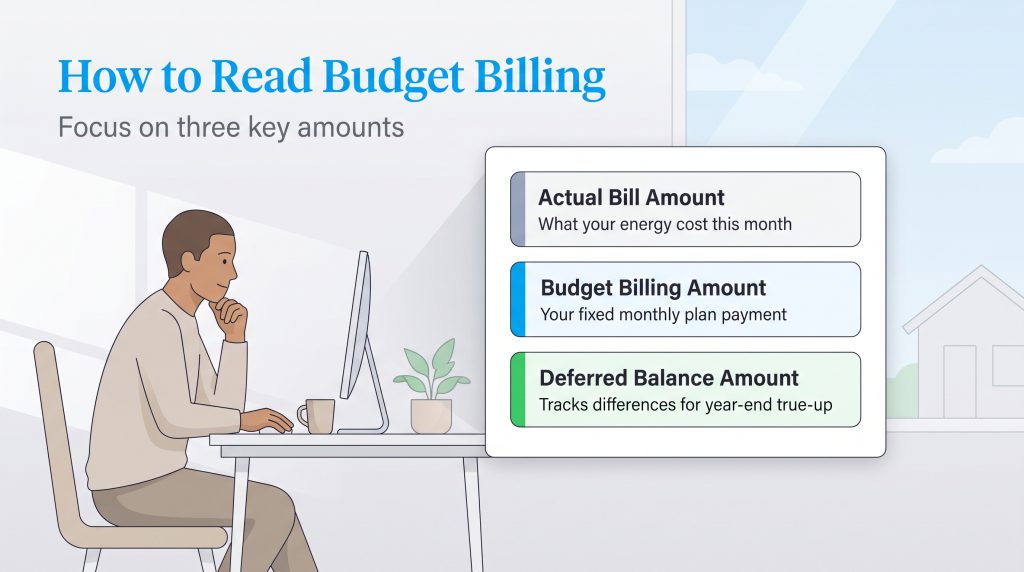
When you transition to a level payment plan, your monthly utility statement will include a few extra data points. Instead of just glancing at the total amount due, you need to monitor the breakdown that tracks your progress toward your annual reconciliation. Keeping an eye on these three line items is the best way to prevent surprises at the end of your billing year:
- Actual Bill Amount: This is the real-world cost of the energy your household consumed during the current 30-day billing cycle. If you were on standard billing, this is the exact amount you would pay that month.
- Budget Billing Amount: This is the predetermined installment you are required to pay for the current cycle. Regardless of how much energy you actually used over the last 30 days, this is the dollar amount due on your bill.
- Deferred Balance Amount: Sometimes labeled as “Accumulated Variance” or “Settlement Balance,” this is the running tally of the difference between your Actual Bill Amount and your Budget Billing Amount. When you use more energy than you pay for during a scorching August, this balance grows as a debit you owe the utility. When you use less energy during a mild October, your overpayment chips away at that debit or shifts the balance into a positive credit.
Understanding the True-Up Bill and Deferred Balances
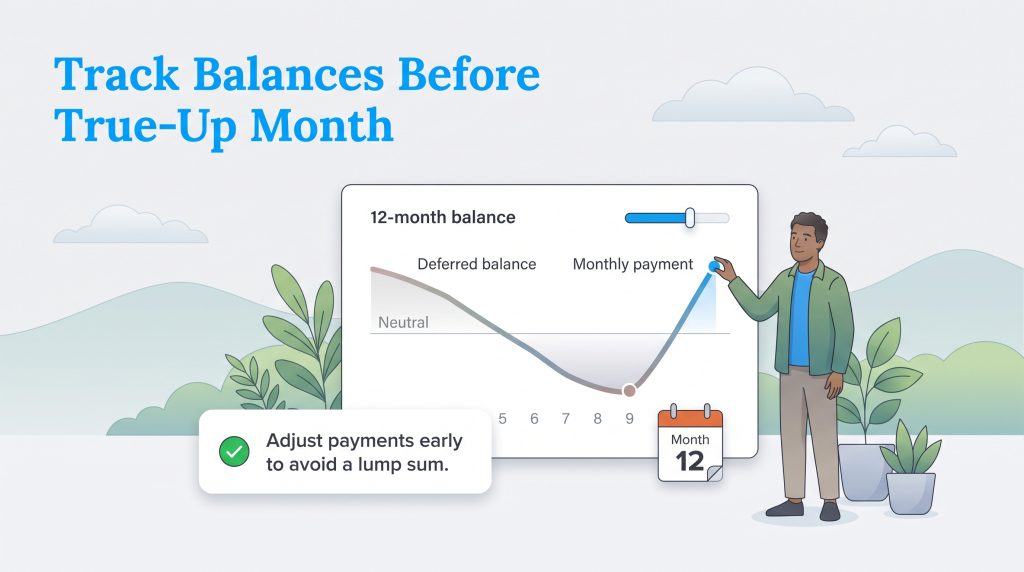
The most confusing aspect of fixed budget billing is the annual reconciliation period. Because your monthly payments are based on historical estimates and weather projections, they rarely match your actual energy costs down to the penny. Eventually, the utility company has to balance the books during your anniversary or settlement month.
Throughout the year, your provider tracks your budget billing deferred balance. Your deferred balance is the running tally of the difference between the fixed amount you have paid so far and the actual cost of the energy you have consumed. During the 12th month of your billing cycle, the provider compares your total payments against your total actual charges, resulting in one of three outcomes:
- If you underpaid (Owe a True-Up Bill): If you used more energy than the company estimated — or if energy rates spiked mid-year — your deferred balance will be negative. You will owe a true-up bill, meaning the entire negative balance becomes due as a single lump sum alongside your regular monthly payment. A severe budget billing true-up bill often catches households off guard after an unusually harsh winter or record-breaking summer.
- If you overpaid (Receive a Credit): If you used less energy than predicted, you built up a positive deferred balance. The utility company will apply that overpayment as a credit toward your upcoming bills or issue a direct refund check.
- If your provider rolls the balance forward: Not every utility demands an immediate lump-sum cash payment at the end of the year. Some providers allow you to roll a negative deferred balance into the next 12-month billing cycle. Instead of paying a $240 true-up bill all at once, the utility divides that $240 deficit by 12 and tacks an extra $20 onto your new monthly budget amount for the upcoming year.
To avoid a painful true-up bill, make a habit of understanding your electric bill by checking your digital or paper statement every month. If you spot a growing negative deferred balance by mid-year, call your provider and ask to increase your monthly payment by $15 or $25 to close the gap early. You can also review our guide on how to save on your electric bill to adopt energy-saving habits that bring your actual usage down before your settlement month arrives.
Pros and Cons of Budget Billing
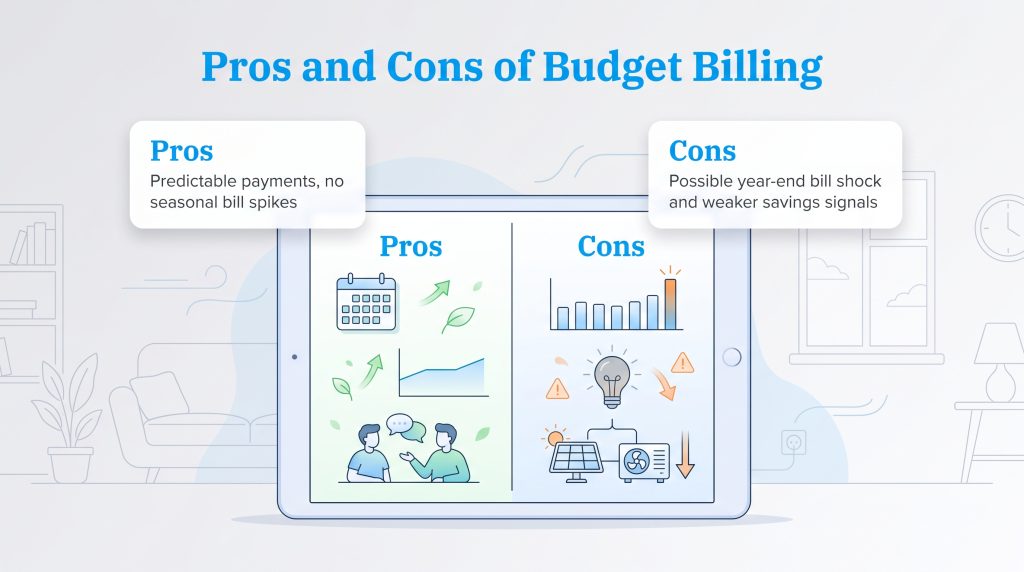
Deciding whether to enroll in an averaged payment plan comes down to how you prefer to manage your household cash flow. It eliminates month-to-month anxiety for many families, yet frustrates customers who dislike deferred balances or hidden fees. Weighing the budget billing pros and cons side by side will help you decide if this strategy fits your financial style.
| Pros of Budget Billing | Cons of Budget Billing |
|---|---|
| Predictable Budgeting: Fixed or stabilized monthly payments make household cash-flow planning effortless. | True-Up Bill Shock: You risk facing a steep lump-sum settlement balance at year-end if your energy usage was underestimated. |
| Avoid Seasonal Spikes: Protects your checking account from massive utility bills during extreme summer and winter weather. | Overpaying in Mild Months: You pay much more than your actual usage during spring and fall, tying up your cash liquidity interest-free with the utility company. |
| Autopay Compatibility: Because the bill amount is consistent, you can safely set up automatic bank drafts without worrying that a summer spike will overdraw your checking account. | Administrative & Program Fees: While most utilities offer the program for free, some providers charge a monthly maintenance or administrative fee ($1 to $5 per month) to participate. |
| Protection Against Late Fees: Eliminates the risk of getting blindsided by a $350 summer cooling bill that you can’t afford to pay on time. | Lack of Conservation Incentive: Because your payment doesn’t drop immediately when you use less power, you lose the psychological nudge to conserve energy. |
| Easier for Shared Housing: Splitting a flat, predictable utility bill every month is much simpler for roommates sharing living expenses. | Delayed Return on Investment: If you install solar panels or upgrade to an ENERGY STAR HVAC system, it takes months for your averaged payment to reflect those savings. |
Does Budget Billing Actually Save You Money?
If you are wondering, “does budget billing save money?” the short answer is no. Budget billing does not reduce the total cost of your utilities; it simply smooths out your cash flow so you aren’t hit with seasonal spikes. In fact, because your monthly bill feels disconnected from your daily thermostat habits, some households accidentally spend more money on budget billing because they don’t notice their air conditioner or furnace working overtime until the settlement bill arrives.
If your primary goal is lowering your utility expenses, your best move is to pair your payment plan with eco-conscious upgrades that cut your physical energy consumption. Installing an ENERGY STAR certified smart thermostat, sealing air leaks around doors and windows, and switching to LED bulbs because they use 90% less energy than incandescent lights will actively shrink your actual monthly charges. When you lower your real-world usage, your deferred balance shifts in your favor, resulting in a year-end credit and a lower monthly installment the following year.
Alternatives to Utility Budget Billing
If you love the idea of predictable utility bills but hate the risk of year-end true-up debt or letting the power company hold onto your overpayments during mild weather, you don’t have to rely on your provider’s program. Consider these three smart alternatives to budget billing that keep you in complete control of your energy costs.
Create a DIY Energy Sinking Fund
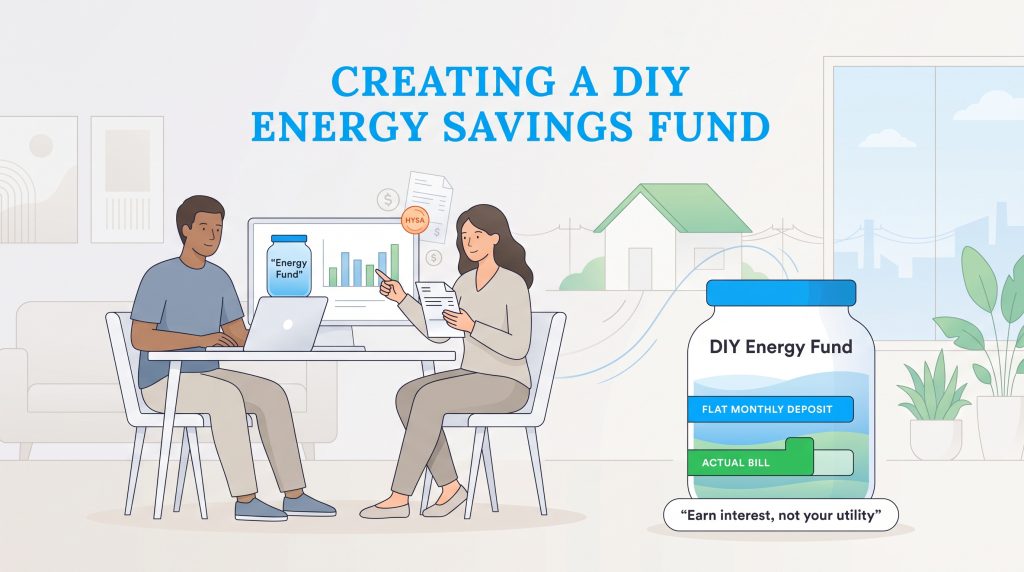
Instead of letting the utility company hold your excess payments interest-free during the spring and fall, act as your own billing manager by creating a DIY energy sinking fund. Review your last 12 months of utility bills to find your monthly average, or research how to estimate appliance energy use if you are in a new home. Set up an automatic monthly transfer for that exact average amount from your checking account into a dedicated High-Yield Savings Account (HYSA).
During low-usage mild months, your utility bill will be small, allowing the extra cash in your HYSA to build a cushion and earn 4% to 5% APY interest. When high-usage summer and winter bills arrive, you pull the extra funds directly from that savings bucket to cover the spike without disrupting your regular monthly checking budget. Better yet, if your utility company does not charge credit card processing fees, pay your monthly bill using a cash-back rewards credit card (some cards offer up to 5% cash back on home utilities) and immediately pay off the card balance from your HYSA. You get the exact same monthly budget stability while pocketing both savings interest and credit card rewards.
💸 Money-Saver: Building a DIY Energy Sinking Fund in a high-yield savings account lets your mild-month overpayments earn compound interest for you instead of giving an interest-free loan to your utility provider.
Enroll in Time-of-Use (TOU) Rate Plans
While budget billing masks high seasonal bills by spreading them out, a Time-of-Use (TOU) rate plan helps you actively lower the price you pay per kilowatt-hour. Under a TOU plan, your electric provider charges higher rates during peak demand hours (typically late afternoon and early evening when everyone runs their air conditioning and cooks dinner) and heavily discounted rates during off-peak hours (late at night, early morning, and weekends).
If your household can shift heavy appliance usage — such
About the Author

LaLeesha has a Masters degree in English and enjoys writing whenever she has the chance. She is passionate about gardening, reducing her carbon footprint, and protecting the environment. She also recently served as President of the Board for City Sprouts (a community garden).

David has been an integral part of some of the biggest utility sites on the internet, including InMyArea.com, HighSpeedInternet.com, BroadbandNow.com, and U.S. News. He brings over 15 years of experience writing about, compiling and analyzing utility data.