

Knowing What to Expect From Your Utility Bills Helps You Budget Effectively and Avoid Surprises When Moving Into a New Home
Key Takeaways
- Plan for startup costs like deposits and connection fees, which are common for first-time renters and homeowners alike.
- Compare average utility costs by housing type to benchmark your spending and identify areas where you can reduce usage.
- Adopt eco-conscious habits immediately to lower your monthly bills and reduce your household’s carbon footprint.
A utility bill is a monthly invoice for the essential household services that keep your home running safely, including electricity, natural gas, water, trash, and internet. In the U.S., the average monthly utility cost ranges from $550 to $600 when combining all standard energy, municipal, and digital services. While transferring services during a move can feel overwhelming, this guide to Utility Bills 101 breaks down everything you need to know about 2026 national cost averages, reading your statements, setting up essential services, and adopting energy-saving options that keep money in your pocket.
What Is Considered a Utility Bill?
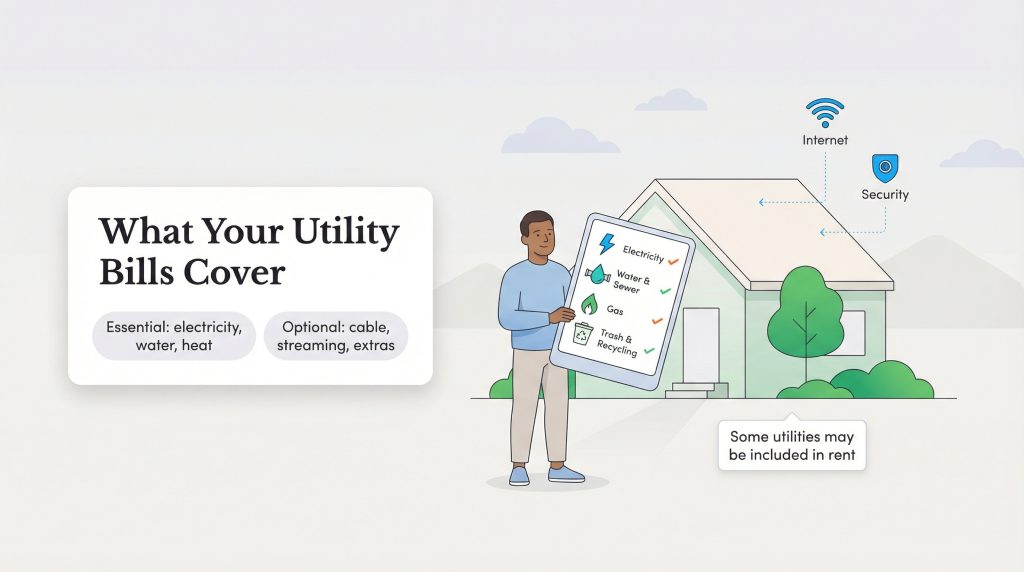
Before signing a lease or closing on a house, you need to know exactly what is included in utilities so you can build an accurate household budget. If you are renting, your landlord might include certain services in your monthly rent payment, leaving you responsible for setting up and paying the remaining accounts. To organize your monthly expenses, it helps to separate your statements into foundational utilities required for basic habitation and modern household services that keep you connected.
📌 Quick Fact: Government agencies frequently require a recent proof of residence utility bill when you update your driver’s license, apply for a passport, or register to vote. Because these vital services are strictly tied to a physical address rather than a generic P.O. Box, they serve as the gold standard for verifying your official location.
Essential Home Utilities (Electric, Gas, Water, Sewer, Trash)
These core services are legally required for a residence to be considered habitable and safe. Depending on your city, they are managed by either regulated municipal departments or private energy companies.
- Electricity: The cornerstone of the modern home, electricity powers your lights, major appliances, and HVAC systems. It typically accounts for the largest portion of your monthly utility budget.
- Natural Gas: Depending on your home’s infrastructure, natural gas fuels furnaces, water heaters, clothes dryers, and cooking stoves. Homes without gas lines rely entirely on electricity or delivered fuels like propane and heating oil.
- Water and Sewer: This combined municipal service supplies fresh, potable water to your taps for drinking, cooking, and bathing. It also covers the safe treatment and disposal of wastewater leaving your drains and toilets.
- Trash and Recycling: Local municipal departments or private waste haulers provide curbside pickup to ensure sanitary garbage disposal and recycling processing. In many single-family neighborhoods, this fee is billed quarterly or bundled directly into your water statement.
Modern Household Services (Internet, Cable, Phone, Security)
While you don’t legally need telecom or security accounts to obtain a certificate of occupancy, most households treat them as mandatory monthly bills. Unlike water or electric grids, you usually have several competing providers to choose from at your address.
- Internet and Cable: High-speed broadband via fiber, cable, or 5G connects your home to remote workspaces, smart home devices, and television broadcasts. Because reliable Wi-Fi is vital for daily life, it belongs right alongside power and water in your budget.
- Phone: This category covers traditional landline setups or bundled household mobile plans. Most modern movers skip the copper landline altogether and fold their cellular family plans into this budget line.
- Streaming Services: Monthly subscriptions for on-demand digital entertainment and live TV platforms have largely replaced traditional cable boxes. Tracking these recurring charges alongside your utilities prevents subscription creep from draining your bank account.
- Home Security Systems: Monitored alarms, smart locks, and video doorbells provide peace of mind for an additional monthly fee. Many insurance companies offer homeowner or renter policy discounts if you maintain an active professional monitoring plan.
Average Monthly Utility Costs in 2026
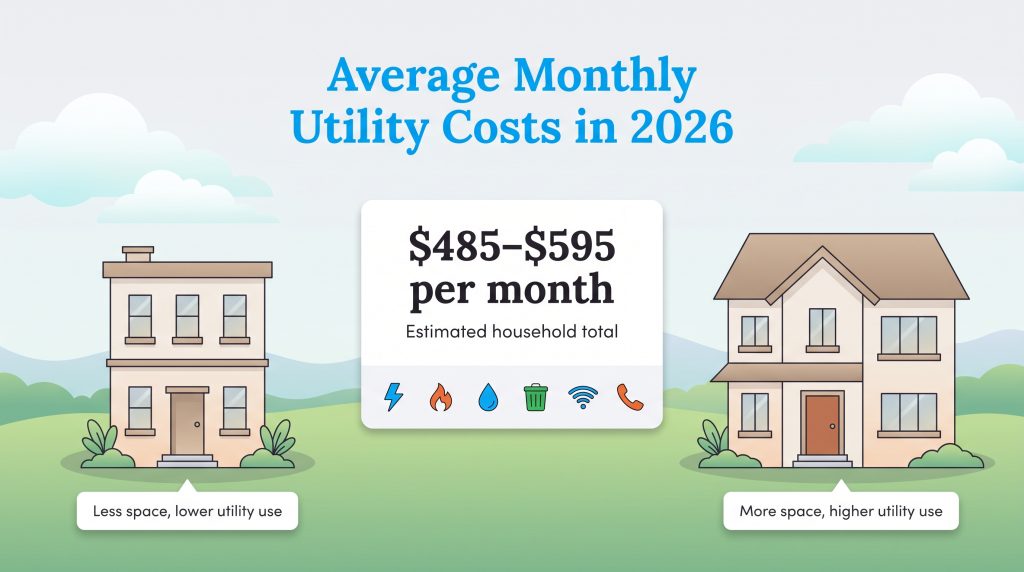
Predicting your exact monthly expenses can feel like a moving target, but establishing a baseline helps you budget before signing a lease or mortgage. While historical data from the U.S. Energy Information Administration (EIA) showed that electricity previously cost the average American household around $137 per month, rising grid maintenance fees and fuel costs have pushed 2026 rates higher. Today, most households spend between $485 and $595 per month across all essential and digital utilities.
National Cost Breakdown by Utility Type
To give you a realistic look at what you will pay this year, we compiled the 2026 national average monthly utility costs across all six major household categories. Use this breakdown to benchmark your current spending or estimate expenses for an upcoming move.
2026 National Average Monthly Utility Costs
| Utility Service | Average Monthly Cost | Primary Cost Driver |
|---|---|---|
| Electricity | $145–$150 | HVAC heating and cooling loads (accounts for over 50% of usage) |
| Natural Gas | $70–$75 | Seasonal winter furnace usage and gas water heaters |
| Water & Sewer | $80–$85 | Bathroom fixtures, laundry loads, and outdoor lawn irrigation |
| Trash & Recycling | $60–$70 | Municipal processing fees, bin sizes, and pickup frequency |
| Internet | $80–$120 | Connection type (fiber vs. cable), bandwidth speed tiers, and equipment rental |
| Phone/Streaming | $50–$95 | Number of active mobile lines and ad-free entertainment subscriptions |
| Total Estimated Average | $485–$595 | Combined household size, local climate, and regional infrastructure rates |
Key Factors That Influence Your Monthly Bill
Why does the average utility cost by state fluctuate so wildly? Your actual bills depend heavily on three variables: local climate, home square footage, and household size. Climate dictates how hard your heating and cooling systems work. A homeowner in Phoenix running central air conditioning through July will see massive electric spikes, whereas a Boston resident faces steep natural gas bills to heat their home in January.
Your property’s physical footprint matters just as much. A compact one-bedroom apartment shares insulated walls with neighbors and requires far less energy to climate-control than a sprawling 2,500-square-foot detached house with high ceilings. Finally, the number of people living under your roof directly drives consumption. Every additional family member or roommate means more hot showers, extra laundry loads, dishwashers running daily, and more electronics drawing power around the clock, making it essential to know how to split utility bills with roommates fairly if you share a home.
Following the popular 50/30/20 budgeting rule, your core living costs — housing, groceries, and utility bills — should stay under 50% of your take-home pay. You can estimate your new home’s specific baseline using this quick three-step formula:
- Calculate Energy by Square Footage: Combined residential electricity and gas usually cost around $0.10 to $0.15 per square foot monthly. Multiply this rate by your home’s total square footage. (Example: 1,500 sq. ft. x $0.14 = $210)
- Add Flat-Rate and Municipal Services: Add your fixed regional costs for home internet ($90), trash collection ($65), and baseline water delivery ($80). (Example: $210 + $235 = $445)
- Include the “Weather Buffer”: For extreme summer or winter months, add an extra 20% to your subtotal to account for heavy HVAC usage when outdoor temperatures spike or plummet. (Example: $445 x 1.20 = $534 estimated peak bill)
How to Read a Utility Bill: Line-by-Line Anatomy
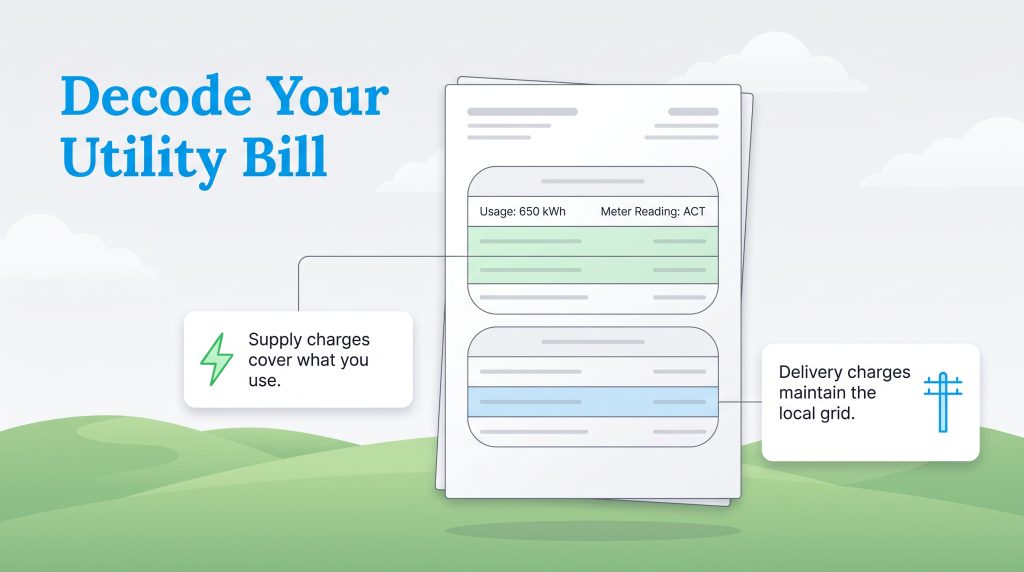
Once your accounts are active, you will receive monthly statements detailing your consumption. Learning how to read a utility bill line by line helps you understand where your money goes and empowers you to spot billing mistakes before you pay them. While every provider formats their invoice slightly differently, almost every statement breaks down into supply vs. delivery charges, unit measurements, and meter reading codes.
Supply Charges vs. Delivery Charges
The biggest source of confusion on an energy or water statement is the split between supply and delivery. Supply charges (sometimes labeled as generation or commodity charges) represent the cost of the actual electricity, natural gas, or water you consumed during the billing cycle. If you live in a state with a deregulated energy market, you can shop around and switch providers to lower this specific rate.
Delivery charges (also called distribution or transmission fees) cover the physical infrastructure required to move that commodity to your home. This pays for maintaining local power lines, transformers, gas pipelines, water mains, and utility poles. Delivery charges typically combine a flat monthly customer charge (just for keeping your meter connected) with a variable fee based on usage. Because one local utility company maintains the physical grid in your neighborhood, delivery fees are regulated by the state and cannot be shopped away.
Understanding Units of Measurement (kWh, Therms, CCF, Gallons)
To verify that you are being billed accurately, you need to know how utilities measure what flows through your meters. Here is a quick glossary of the unit abbreviations printed on your monthly statements:
- Kilowatt-Hours (kWh): The standard unit for electricity kWh usage. One kilowatt-hour equals 1,000 watts of power used continuously for one hour — roughly the energy needed to run a typical central air conditioner for 20 minutes or a modern LED lightbulb for 100 hours.
- Therms: A unit of heat energy used to bill natural gas. One therm equals 100,000 British thermal units (BTUs), which is roughly the amount of gas needed to heat water for four or five average showers.
- CCF (Centum Cubic Feet): Volume measurement representing 100 cubic feet of gas or water. Natural gas meters measure physical volume in CCF, which your utility company then multiplies by a heat-content factor to convert into billable therms.
- Gallons: Municipal water departments bill either in thousands of gallons or in CCF. If your water bill uses CCF, remember that one CCF equals 748 gallons of water.
Actual vs. Estimated Meter Readings
Always check the meter summary box on your statement to see if your bill is marked “Actual” (ACT) or “Estimated” (EST). An Actual reading means a smart meter transmitted your exact consumption data — or a technician physically read your meter — so you are paying for the exact amount of energy or water you used.
An Estimated reading happens when the utility company cannot access your meter due to severe weather, a locked gate, or a wireless transmission glitch. When this happens, they bill you based on historical usage at your address from previous years. If the previous tenant ran three space heaters all winter and you keep the thermostat at a modest 65 degrees, an estimated bill will severely overcharge you. Conversely, if they underestimate your usage for three months straight, you will get hit with a massive catch-up “shock bill” once they finally record an actual reading.
💡 Pro Tip: If you spot “EST” printed next to your meter reading, walk outside, snap a clear photo of the dials or digital display on your utility meter, and submit the numbers through your provider’s online customer portal. The billing department will cancel the estimated invoice and issue a corrected statement based on your true usage.
Common Utility Billing Structures Explained
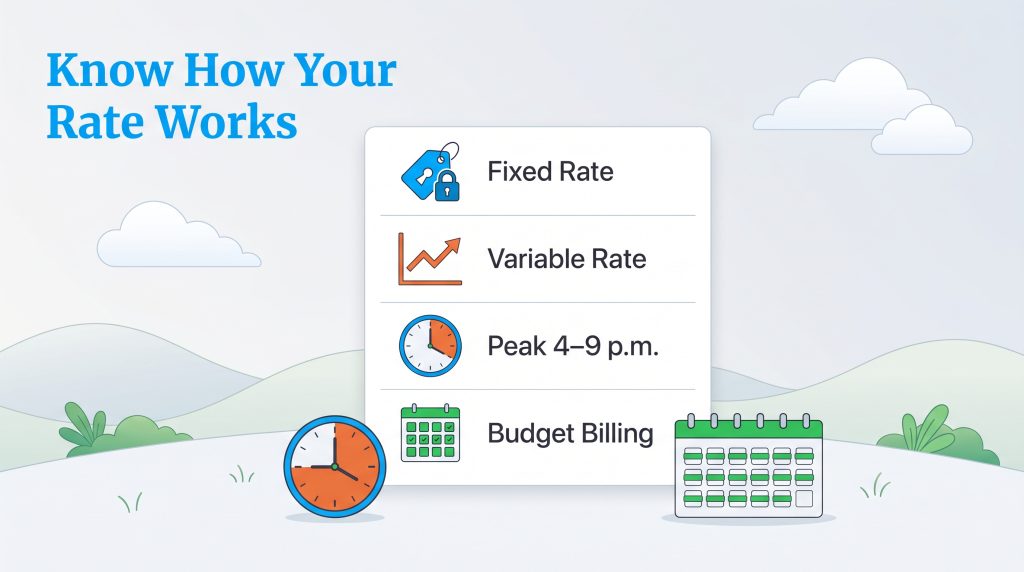
Beyond basic meter readings, the way your utility company structures your rate plan has a massive impact on what you owe each month. Understanding the rules of your billing structure allows you to adjust when and how you use energy to avoid preventable price spikes.
Fixed-Rate vs. Variable-Rate Plans
If you live in a deregulated energy state like Texas, Ohio, or Pennsylvania, you can choose between fixed-rate and variable-rate supply plans. A fixed-rate plan locks in your price per kWh or therm for a set contract term — usually 12 to 24 months. Even if a summer heatwave or winter freeze sends wholesale energy prices soaring, your rate per unit never changes, making it much easier to predict your bills.
A variable-rate plan has no contract commitment, but your rate fluctuates monthly based on wholesale market demand and fuel supply. While variable rates can save you money during mild spring and autumn weather, they leave you completely exposed to sudden price surges during extreme weather events. For most household budgets, locking in a reasonable fixed rate is the safest choice.
Time-of-Use (TOU) and Peak Pricing
Many electric utilities across the country now enroll customers in time of use rates (TOU). Instead of charging a single flat rate per kWh all day, TOU plans price electricity based on the time of day and season to reduce strain on the power grid. During peak hours — typically between 4 p.m. and 9 p.m. when everyone returns home from work, cooks dinner, and cranks up the air conditioning — electricity costs two to three times more than usual.
During off-peak hours (late at night, early in the morning, and on weekends), power demand drops and rates plummet. If you are on a TOU plan, simply waiting until after 9 p.m. to run your dishwasher, clothes dryer, or electric vehicle charger can shave 15% to 25% off your monthly statement without reducing how much electricity you actually use.
Budget Billing and Equal Payment Plans
When comparing budget billing vs. flat rate programs, it is important to read the fine print. True flat-rate billing (where you pay one fixed dollar amount for unlimited energy) is extremely rare and usually inflated in the utility’s favor. Budget billing — also called levelized or equal payment billing — is much more common. Under budget billing, the utility provider totals your home’s usage over the past 12 months and divides it into 12 predictable monthly installments. You don’t get free energy; you simply spread winter heating or summer cooling spikes across the entire calendar year.
- Pros of Budget Billing:
- Predictable monthly budgeting: You pay the exact same dollar amount every month, which is ideal if you live on a fixed income.
- No seasonal sticker shock: You won’t get blindsided by a $350 air conditioning bill in August or a massive heating bill in January.
- Free to enroll: Most regulated utility companies offer levelized billing at no extra administrative cost.
- Cons of Budget Billing:
- Annual true-up bills: At the end of the 12-month cycle, the utility reconciles your actual usage against what you paid. If you used more energy than projected, you owe the balance immediately or see it rolled into higher monthly payments next year.
- Hides bad energy habits: Paying a flat installment makes it easy to ignore how much power you are actually wasting during peak seasons.
- Higher bills during mild weather: You will pay more in April and October than your actual usage warrants to subsidize your heavy summer and winter consumption.
Setting Up Utilities When Moving Into a New Home
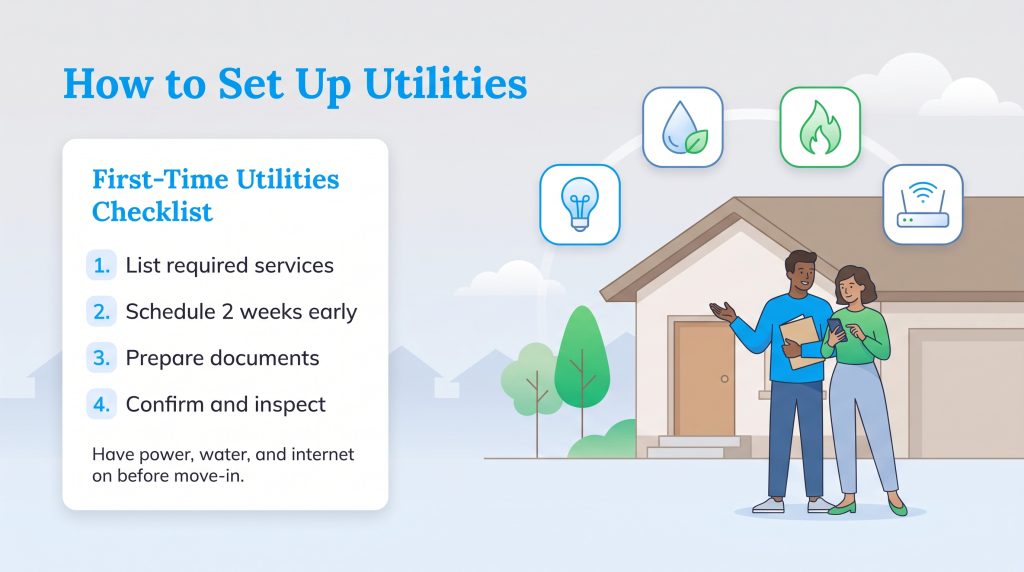
Coordinating your accounts ahead of time ensures you have functioning lights, hot water, and Wi-Fi the moment you unlock the door to your new home. Whether you are setting up utilities for first time renters or buying a house across the state, following a strict timeline prevents stressful connection delays.
Utility Setup Timeline for Movers
Don’t wait until the moving truck is parked in the driveway to call your providers. Pair our moving utilities checklist with this chronological timeline when setting up utilities when moving:
- 3–4 Weeks Before Moving: Confirm which utilities your new home requires (e.g., all-electric vs. natural gas) and check your lease or HOA rules to see which services are already included. If you are moving to a deregulated area, research and select an electricity or gas supplier.
- 2 Weeks Before Moving: Contact your electric, gas, water, and internet providers to schedule disconnection at your current address and activation at your new home. Book technician appointments for fiber or cable internet installation now, as time slots fill up fast during peak summer moving seasons.
- 1 Week Before Moving: Gather required account documentation — including your driver’s license, Social Security number, signed lease or closing disclosure, and bank details — to finalize any pending applications. Pay any required security deposits and confirm that your new utilities are scheduled to turn on the day before you arrive.
- Move-In Day: Walk through the property to verify that the electricity, hot water, and gas appliances are working safely. Locate your main water shutoff valve and electrical breaker box, and snap a timestamped photo of all utility meters so you aren’t billed for the previous resident’s usage.
Deposits, Credit Checks, and Connection Fees
When opening new accounts, budget for upfront administrative charges. Almost all utility companies run a soft credit check during enrollment to assess payment risk. If you have a thin credit history or a lower credit score, providers will require an upfront security deposit ranging from $50 to $300 before flipping the switch. You can often waive this deposit by providing a “letter of credit” from your previous utility company showing 12 consecutive months of on-time payments, or by adding a guarantor to the account.
If you do have to pay a deposit, most providers refund it automatically as a statement credit after 12 months of timely payments. Beyond deposits, expect a one-time connection or activation fee of $20 to $75 per account on your very first bill.
🚩 Heads Up: Double-check your lease agreement to verify exactly what “utilities included in rent” truly covers. It is a very common point of confusion to assume everything is paid for, only to find out that water and trash are covered while electricity and internet are entirely your responsibility.
Sustainable Ways to Lower Your Monthly Utility Bills

Learning how to lower utility bills doesn’t mean sitting in the dark or sweating through the summer. By shifting focus from basic habits to high-impact, eco-conscious home upgrades, you can permanently slash your household’s energy waste and shrink your carbon footprint. Here are the most effective energy-saving options for 2026:
- Install Smart Thermostats: Heating and cooling dominate your energy spend. Upgrading to an ENERGY STAR-certified smart thermostat allows your HVAC system to learn your daily routines and scale back automatically when the house is empty. Adjusting your temperature by seven to 10 degrees for eight hours a day can save you up to 10% annually on heating and cooling.
- Seal HVAC Ductwork and Drafts: Leaky air ducts in attics or crawlspaces can waste 20% to 30% of the conditioned air your furnace or AC works so hard to produce. Sealing accessible ductwork joints with mastic sealant (or foil tape) and applying fresh weatherstripping around doors and windows keeps conditioned air inside where it belongs.
- Conduct a Home Energy Audit: Many electric and gas utilities offer free or heavily subsidized professional energy audits. A certified technician will use infrared cameras and blower door tests to pinpoint hidden insulation gaps, air leaks, and inefficient equipment, handing you a customized roadmap of upgrades that often qualify for utility rebates.
- Switch to ENERGY STAR Appliances: When replacing aging refrigerators, clothes washers, or heat pump water heaters, look for the blue ENERGY STAR label. These models use 10% to 50% less energy and water than standard models, paying you back month after month on your supply charges.
- Eliminate Phantom Energy Loads: Modern electronics, gaming consoles, and kitchen gadgets draw standby power continuously even when turned off. This “phantom load” can quietly add up to 10% to your electric bill. Plug entertainment centers and home offices into smart power strips that cut current completely when devices enter sleep mode.
- Upgrade to WaterSense Fixtures for Water Conservation: Swapping standard bathroom aerators and showerheads for EPA WaterSense-labeled fixtures reduces water flow without sacrificing pressure. This simple 15-minute upgrade can save the average family up to 2,700 gallons of water per year, cutting both your municipal water bill and the gas or electricity required to heat that water.
- Go Solar or Join a Community Solar Program: Installing rooftop solar panels — or subscribing to a local community solar farm if you rent — offsets expensive grid electricity with clean, renewable power. You can also check if your utility offers an EPA Green Power partnership option to source your electricity from wind and solar projects.
For even more actionable ways to trim your monthly expenses, explore our in-depth guide on how to save on your electric bill.
Taking Control of Your Home Utility Budget
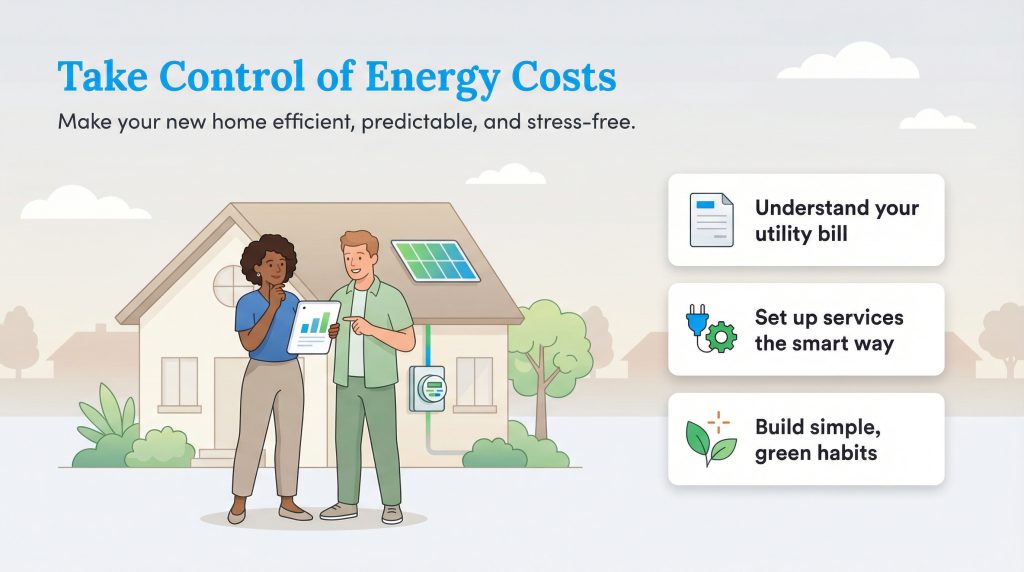
Once you survive your first full month in your new home, set aside 15 minutes to audit your initial utility statements. Record your total kWh, therms, and gallons consumed to establish a baseline usage metric for your household, and double-check that your meter readings are marked “Actual” rather than “Estimated.” Next, log into each provider’s online portal to enroll in paperless billing and autopay, which protects you from accidental late fees and often unlocks a $5 to $10 monthly discount. Ready to optimize your setup even further? Explore UtilitiesForMyHome’s regional setup guides and energy efficiency calculators to compare local rates and build a smarter, greener home today.
Frequently Asked Questions About Utility Bills
What utilities are typically included in rent vs. paid by the tenant?
Why is my utility delivery charge higher than my actual usage charge?
How much should I budget for utilities in a new home?
Does paying utility bills on time build credit?
What happens if I forget to pay a utility bill?
How can I check previous utility bills for a home I want to buy or rent?
Can I choose my own utility provider?
About the Author

LaLeesha has a Masters degree in English and enjoys writing whenever she has the chance. She is passionate about gardening, reducing her carbon footprint, and protecting the environment. She also recently served as President of the Board for City Sprouts (a community garden).

David has been an integral part of some of the biggest utility sites on the internet, including InMyArea.com, HighSpeedInternet.com, BroadbandNow.com, and U.S. News. He brings over 15 years of experience writing about, compiling and analyzing utility data.