

Analyzing The Two Biggest Texas Electricity Providers To See Which One Actually Saves You Money
Key Takeaways
- Direct Energy is often better for flat-rate simplicity, while TXU Energy shines with high-usage households that can maximize their monthly bill credits.
- Both providers charge strict Early Termination Fees (ETFs), so renters should look specifically for shorter contract terms or month-to-month options.
- Pay close attention to TDU delivery charges, which are added to the advertised rate for both providers and can significantly increase your final utility bill.

- 11¢ /kWh
- 3-100%
- 60 days
- 1-36 Months
- Highest Trustpilot Rating 4.7/5 ★

- 14.6¢ /kWh
- 24%
- None
- 12-36 Months
- Best for Apartments
*rates may vary by location and household usage
Choosing an electricity plan in the deregulated Texas market is stressful enough without having to decipher confusing marketing jargon. When you look closely at a TXU Energy vs. Direct Energy comparison, the primary difference is that TXU rewards high-usage homes with bill credits while Direct Energy focuses on simple, fixed-rate plans for standard usage. To help you cut through the noise, this comprehensive guide provides a direct, data-backed look at the real costs, hidden fees, and verified customer experiences of TXU Energy and Direct Energy so you can confidently sign up for the best option for your home.
At A Glance: TXU Vs Direct Energy
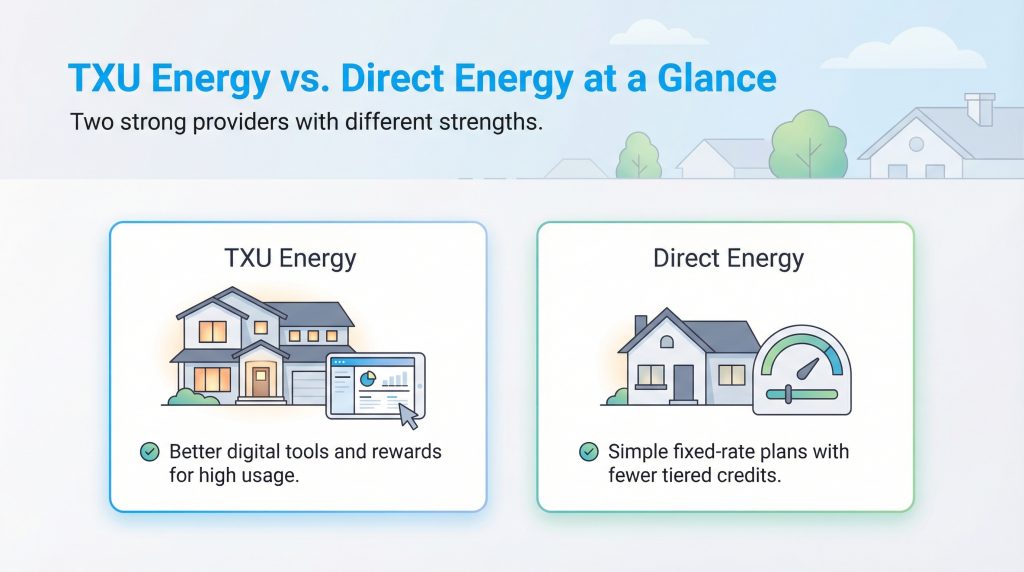
Before diving into the technical fine print, here is a quick visual summary of how these two heavyweights stack up across several critical categories. Both are massive, premium providers, but they structure their plans to appeal to slightly different types of Texas households.
| Feature | TXU Energy | Direct Energy |
|---|---|---|
| Best For | Large homes & heavy energy users | Apartments & flat-rate simplicity |
| App Rating | Consistently high (top-tier digital tools) | Solid, but fewer granular tracking features |
| Base Charge | Frequently $9.95/month on top plans | Varies (often $0 to $4.95/month) |
| Cancellation Fee Range | $150 to $295 (flat fee) | $135 to $295 (flat fee) |
| Green Energy Options | Robust solar buy-back & 100% renewables | Strong renewable plans & smart home bundles |
While both companies offer long-term stability and comparable contract terms, they aggressively target slightly different household needs. TXU Energy generally provides a superior digital experience, a highly valuable 60-day satisfaction guarantee, and plans that reward heavy energy consumption. Direct Energy appeals to customers looking for straightforward billing without complex tiered credits or those who require flexible prepaid options to skip credit checks.
Comparing Texas Electricity Rates By Home Size
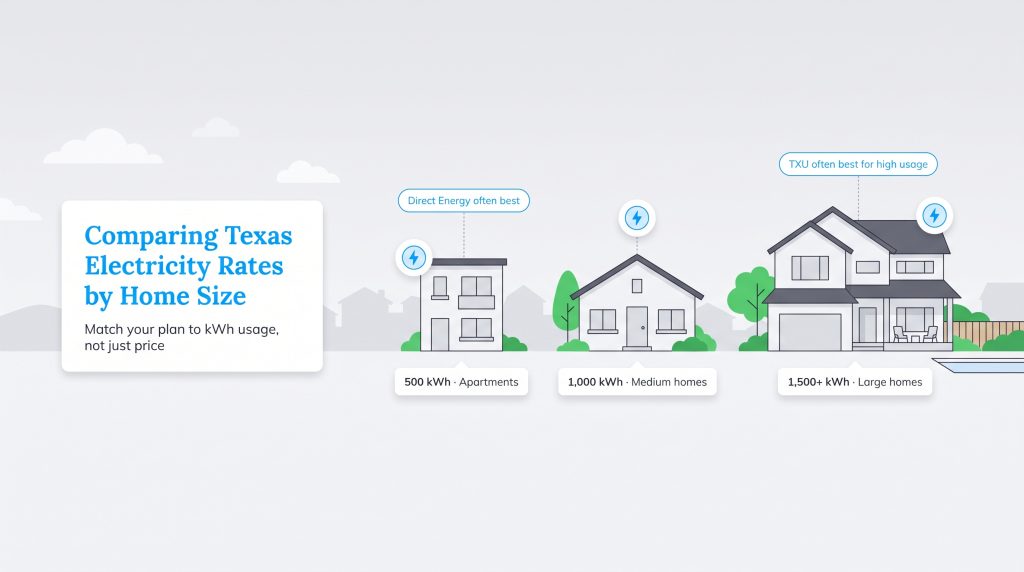
When evaluating TXU vs Direct Energy rates, it is crucial to recognize that the number you see advertised heavily depends on exactly how much electricity you consume. Texas energy providers structure their pricing around three standard usage tiers: 500 kWh, 1,000 kWh, and 2,000 kWh. Choosing the wrong plan for your home size can trigger minimum usage fees or cause you to completely miss out on massive bill credits.
- 500 kWh (Apartments & Small Condos): Direct Energy is often the best electric company for Texas apartments. They typically offer straightforward fixed-rate plans where you pay a set energy charge for every kWh you use. TXU Energy plans at this tier can sometimes be more expensive because smaller homes rarely use enough power to unlock TXU’s lucrative bill credits.
- 1,000 kWh (Medium-Sized Homes): At this usage level, comparing the two brands becomes a toss-up. Both offer competitive fixed rates for mid-sized homes. You will need to check the fine print to see if TXU is offering a $30 bill credit exactly when you hit 1,000 kWh, which brings the effective rate down significantly.
- 1,500+ kWh (Large Family Homes): TXU Energy frequently utilizes a tiered credit structure for its most popular plans, making them phenomenal for high-usage households. If you run your air conditioning constantly or have a pool pump, hitting TXU’s upper-tier requirements is easy, ensuring your average price per kWh drops dramatically compared to a standard flat-rate plan.
Evaluating Flagship Tiered And Fixed Plans
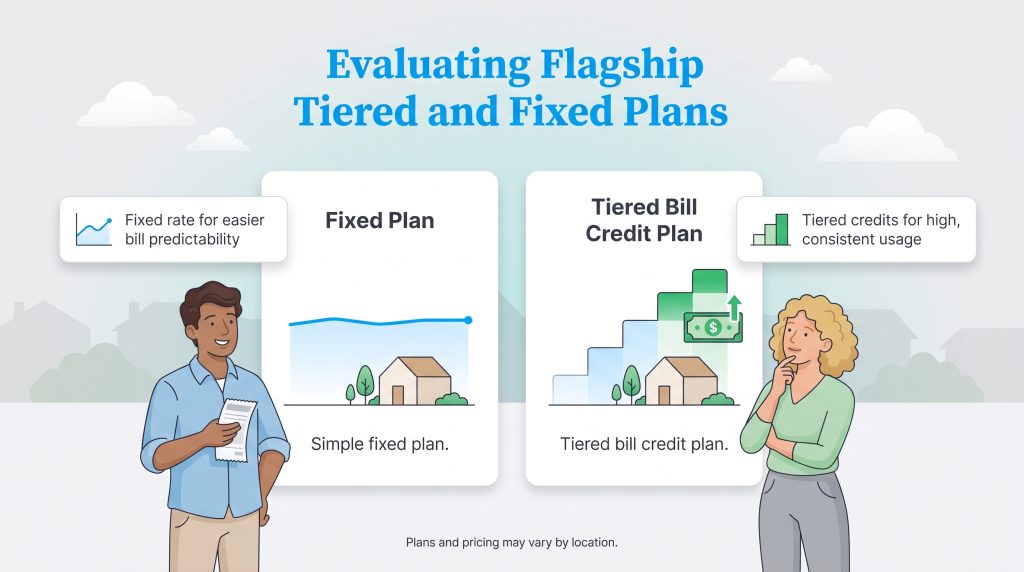
Pitting the flagship plans of the two brands directly against each other reveals these fundamentally different pricing strategies in action. Direct Energy plans minimize gimmicks, making it much easier to predict your monthly bill if your energy habits vary. TXU requires a bit more strategic planning, but heavily rewards consumers who consistently meet their tier targets.
| Plan Name | Rate /kWH | Plan Term | Cancellation Fee | |
|---|---|---|---|---|
| Smart 1000 Saver 12 | 10.9¢ | Month to Month | N/A | Check Availability |
| Smart Edge 12 | 13.5¢ | 12 Months | $150.00 | Check Availability |
| Smart Edge 24 | 13.9¢ | 24 Months | $295.00 | Check Availability |
| Clear Deal 12 | 14.6¢ | Month to Month | N/A | Check Availability |
| Solar Value 12 | 15.4¢ | Month to Month | N/A | Check Availability |
| Smart 500 Start 12 | 16.1¢ | Month to Month | N/A | Check Availability |
| Simple Rate 12 | 16.6¢ | Month to Month | N/A | Check Availability |
| On Your Terms | 16.9¢ | Month to Month | N/A | Check Availability |
| Free Nights & Cool Summer 12 | 17.9¢ | Month to Month | $Fixed | Check Availability |
| Flex Forward | 19.1¢ | Month to Month | N/A | Check Availability |
| Solar Club 12 | 19.1¢ | 12 Months | $150.00 | Check Availability |
| Texas Choice 12 | 19.2¢ | 12 Months | $150.00 | Check Availability |
| Texas Choice 24 | 19.2¢ | 24 Months | $295.00 | Check Availability |
| Ultimate Season Pass 12 | 19.2¢ | Month to Month | N/A | Check Availability |
| Flex Rewards | 19.3¢ | Month to Month | $0.00 | Check Availability |
| Smart Deal 12 | 19.6¢ | 12 Months | $150.00 | Check Availability |
| Smart Deal 24 | 20.4¢ | 24 Months | $295.00 | Check Availability |
| Smart Deal 36 | 20.4¢ | 36 Months | $395.00 | Check Availability |
| Solar Saver 12 | 21.3¢ | Month to Month | N/A | Check Availability |
| Saver's Discount 12 | 22¢ | Month to Month | N/A | Check Availability |
*Plans and pricing may vary by location.
| Plan Name | Rate /kWH | Plan Term | Cancellation Fee | |
|---|---|---|---|---|
| Autopay Texas 12 | 13.3¢ | 12 Months | $150.00 | Check Availability |
| Autopay Texas 24 | 13.6¢ | 24 Months | $295.00 | Check Availability |
| Autopay Texas 36 | 14.1¢ | 36 Months | $395.00 | Check Availability |
*Plans and pricing may vary by location.
Free Nights Vs Free Weekends: Which Saves More?
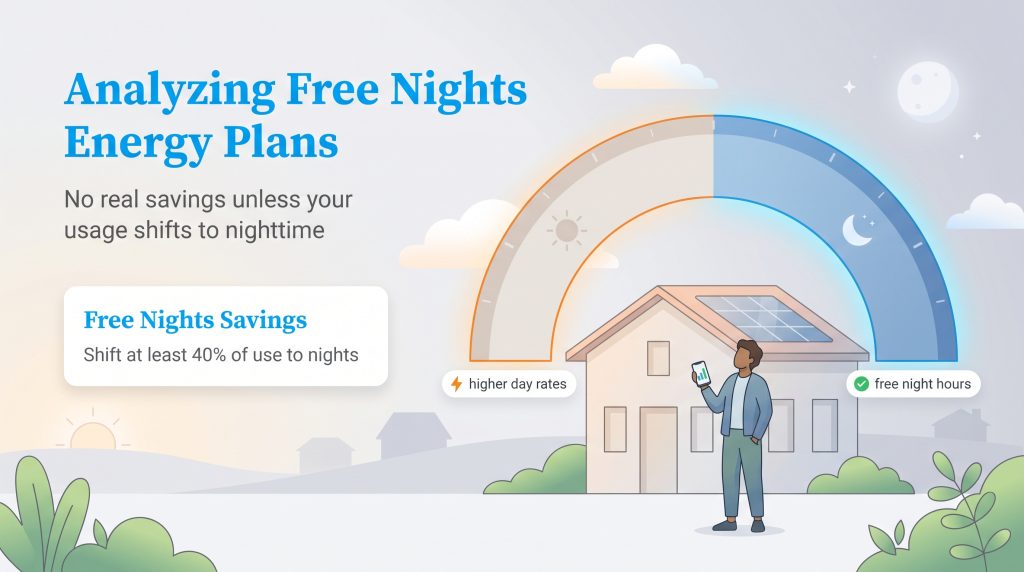
The concept of getting something for free is incredibly appealing, which is why a TXU Free Nights vs Direct Energy Free Days search comes up so often. Both companies offer highly advertised time-of-use plans, but they structure their free periods differently.
TXU’s Free Nights plans typically offer a generous nighttime relief window — often spanning from 8:00 p.m. to 5:00 a.m. every single day of the week. This is an excellent option for night owls or families who can confidently program their smart thermostats to pre-cool the house overnight. In contrast, Direct Energy frequently heavily promotes its “Twelve Hour Power” or “Free Weekends” plans. A free weekends plan might completely wipe out your energy charges from Friday evening through Sunday night, which is brilliant if you work in an office all week and run all your household chores on Saturday.
However, there is a massive catch. Both providers charge significantly higher base rates during the daytime to offset these free hours. For a time-of-use plan to actually lower your bill, you must calculate if you can actively shift at least 40% of your usage to those off-peak windows. If you cannot realistically delay running your dishwasher, doing laundry, or blasting the AC until the free period begins, these plans will likely end up costing you more than a standard fixed rate.
💸 Money-Saver: Before signing up for a free nights or weekends plan, log into your current provider’s portal or Smart Meter Texas to view your hourly usage history. If you naturally use most of your electricity during the day, stick to a flat-rate plan to save money.
Decoding The Electricity Facts Label And Hidden Fees
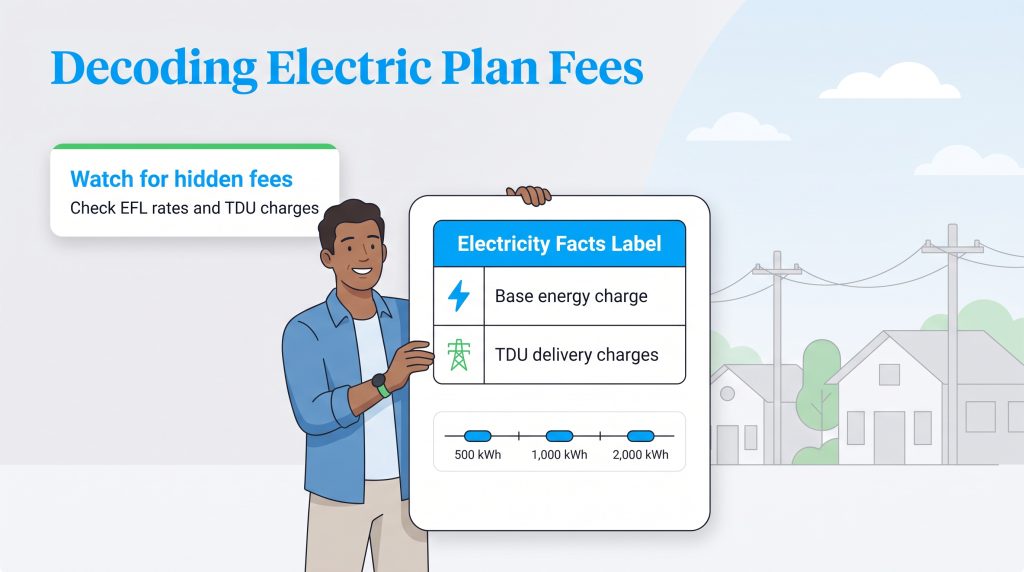
Learning how to read Electricity Facts Labels is the only way to uncover the true cost of your power. A thorough Texas electricity facts label comparison reveals that the large rate displayed on a website is almost never the exact amount you pay. When calculating your final bill, you absolutely must account for TDU delivery charges.
These are separate, state-regulated fees passed through from the local utility company that maintains the wires and poles in your neighborhood. Both TXU and Direct Energy pass these exact charges on to you without markup. For example, current TDU delivery charges for major Texas service areas heavily impact your baseline costs. In the Oncor service area, you can generally expect a flat base charge of around $4.23 per month plus roughly 4.54¢ per kWh. In the CenterPoint area, this sits closer to $4.39 per month plus approximately 5.46¢ per kWh.
Here is a step-by-step breakdown of how these fees impact your final rate:
- Find the Base Energy Charge: This is the price TXU or Direct Energy actually charges for the electricity itself.
- Add the TDU Delivery Charge: Add the flat monthly utility fee plus the per-kWh utility charge for your specific zip code.
- Factor in Usage Credits or Minimum Fees: Look for fine print that penalizes you for using too little power (common in apartment plans) or rewards you for hitting a specific tier.
Always check the “Average Price per kWh” at the 500, 1,000, and 2,000 kWh usage levels listed on the EFL. This chart is legally required and demonstrates exactly what happens to your rate if you miss a bill credit threshold or trigger a base charge penalty.
💡 Pro Tip: If your electricity usage drops below a certain threshold, many plans trigger a minimum usage fee or monthly base charge. Check your EFL closely to avoid a surprise price spike during mild weather months like April or October.
Early Termination Fees And Deposit Requirements
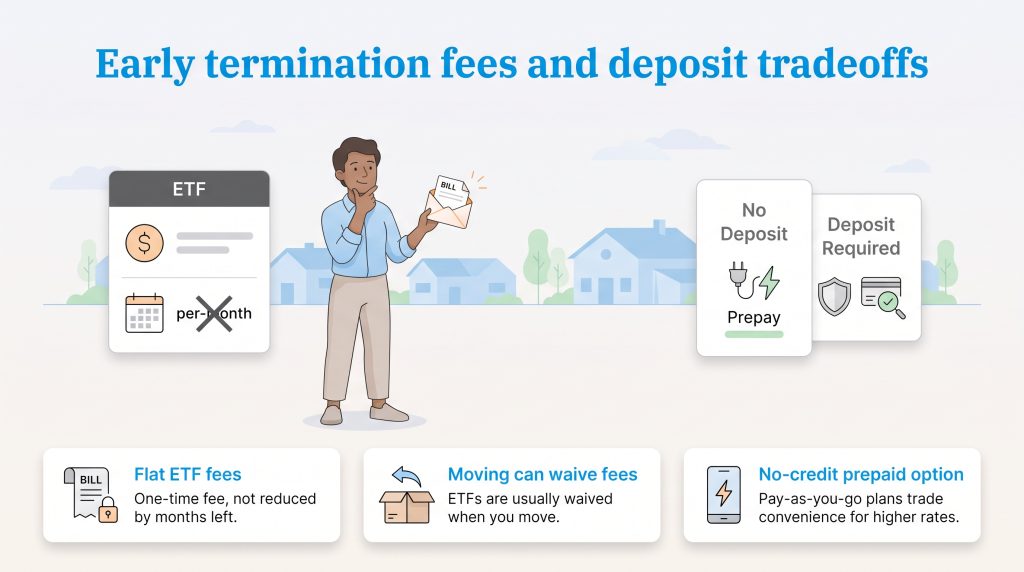
Life happens, and sometimes you need to break a contract early. However, a TXU Energy cancellation fee is quite strict, and Direct Energy operates with a nearly identical penalty structure. Both providers use Early Termination Fees (ETFs) to heavily discourage you from switching providers before your term ends.
Direct Energy typically charges flat ETFs ranging from $135 to $295 based on the length of the contract. TXU Energy follows suit with flat fees generally ranging from $150 to $295. Crucially, neither provider uses a “per month remaining” prorated formula. This means you will pay the full $295 penalty even if you only have one month left on your agreement unless you are physically moving to a new address, which legally waves the fee.
Before you even secure a plan, you also have to navigate credit checks. Direct Energy deposit requirements offer far more flexibility for renters or individuals building their credit. They provide the highly accessible Direct Energy Power-To-Go prepaid plan, which functions entirely on a flexible pay-as-you-go model. Because you purchase your electricity before consuming it, Direct Energy completely waives the credit check and requires no massive upfront deposit.
Conversely, TXU Energy does not currently offer a prepaid electricity plan. Every single one of their offerings requires a standard credit assessment. You can only secure a deposit waiver with TXU if you meet specific Public Utility Commission of Texas (PUCT) requirements — such as being 65 or older with no recent late payments, a verified victim of family violence, or submitting a letter of guarantee from an existing customer.
🚩 Heads Up: Prepaid plans like Direct Energy’s Power-To-Go often carry slightly higher per-kWh rates than standard fixed plans. You are essentially trading a lower overall rate for the immediate convenience of skipping the credit check and deposit.
Customer Service And PUCT Trust Ratings

Customer service and digital management tools can easily be the deciding factor when comparing two massive utility providers. When deeply evaluating TXU Energy vs Direct Energy reviews, a sharp contrast in trust signals begins to emerge. TXU Energy is owned by Vistra Corp, while Direct Energy is owned by NRG Energy. Both parent companies represent incredible financial stability, meaning neither brand is going out of business anytime soon.
According to recent Public Utility Commission of Texas (PUCT) scorecard data, both companies maintain exceptionally strong trust ratings compared to smaller, high-risk providers. However, TXU often holds a slight edge with a pristine complaint history rating. This is largely backed by their superior customer support infrastructure. TXU Energy offers access to a 24/7 customer service network, ensuring you can reach a live agent during late-night power emergencies. Direct Energy operates on more standard daytime operating hours for live support, which can be frustrating if you need immediate assistance over a holiday weekend.
Furthermore, TXU Energy consistently ranks near the top of J.D. Power’s annual retail electric provider satisfaction studies for Texas. They heavily promote a 60-day satisfaction guarantee — if you are unhappy within your first 60 days on an eligible plan, TXU waives the early termination fee entirely. Their mobile app is widely considered the gold standard in the Texas market for hour-by-hour usage tracking. Direct Energy provides a highly functional app and reliable billing, but for premium app features and proven complaint resolution, TXU clearly takes the lead.
Green Energy Options And Smart Home Perks
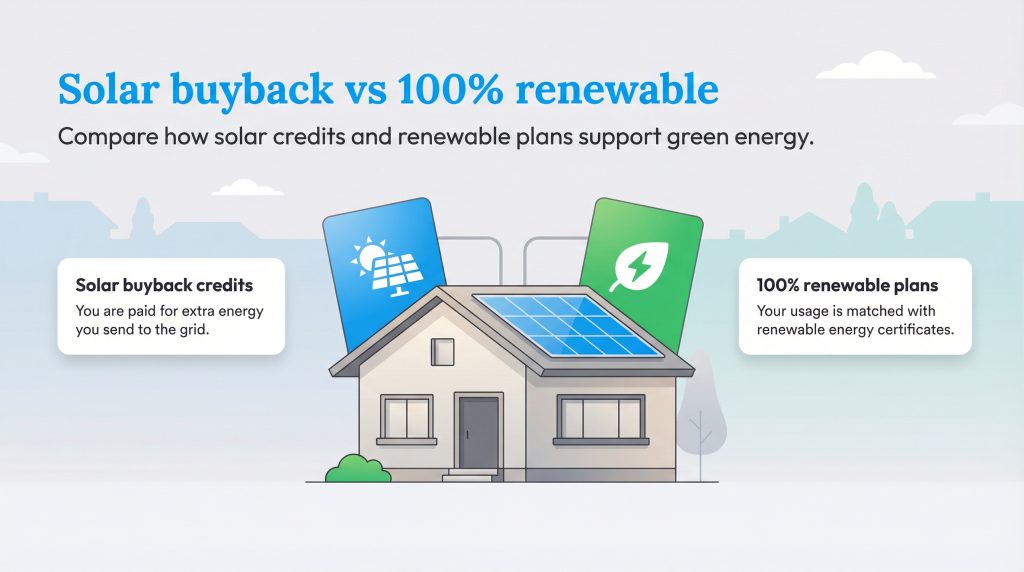
For environmentally mindful homeowners looking to lower their grid dependency, comparing TXU solar plans to Direct Energy’s sustainable offerings is a fantastic place to start. TXU Energy operates a dedicated, heavily marketed solar buy-back program where they generously credit you for the excess energy your rooftop panels send back to the Texas grid. While these plans rarely offer a true 1:1 wholesale buy-back rate, they provide a reliable way for solar owners to dramatically offset their monthly utility costs.
Direct Energy also offers viable solar options, but they truly excel when it comes to integrating smart home technology. Many Direct Energy plans are bundled with top-tier smart thermostats, like the Google Nest or ecobee, allowing you to seamlessly track your energy consumption and automate your home’s climate control directly from your smartphone.
If you do not own your home or cannot install solar panels, both providers offer excellent plans backed by 100% renewable energy certificates (RECs). Choosing a renewable plan is an eco-conscious alternative that allows you to confidently support wind and solar generation across Texas. You can rest assured knowing renewable energy certificates are the legally accepted instruments to substantiate renewable electricity use claims in the United States.
🌱 Eco Edge: Even if you select a standard fossil-fuel plan, simply upgrading to a smart thermostat provided by either brand can reduce your annual heating and cooling costs by up to 10%, making your household far more sustainable.
Choosing Your Texas Energy Provider
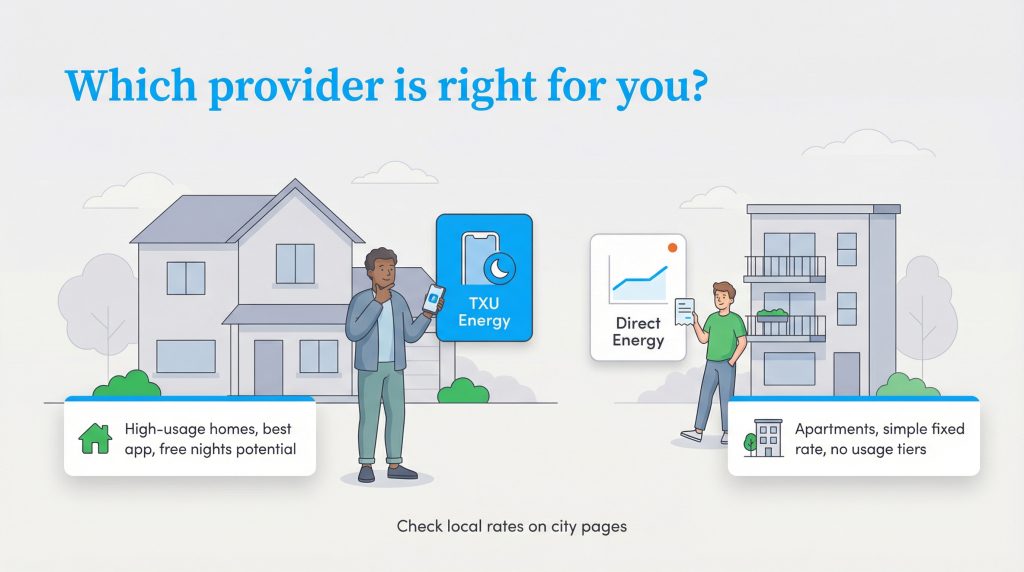
Both TXU and Direct Energy are exceptionally reliable, stable choices that will not disappear overnight during a grid crisis. When deciding between Direct Energy or TXU Energy which is better entirely depends on your household’s unique footprint. Neither company aims to be the absolute cheapest electricity provider in Texas — instead, they offer premium stability, excellent tools, and unique structural benefits.
- Choose TXU Energy if you own a large home with consistently high energy usage, want the best mobile app experience on the market, value a 60-day satisfaction guarantee, or can strictly manage your daily habits to maximize their lucrative tiered bill credits.
- Choose Direct Energy if you prefer a simpler monthly bill without complex usage tiers, live in a smaller condo or apartment, need immediate access to a guaranteed-approval prepaid option like Power-To-Go, or want the stability of a straightforward fixed rate.
Whichever provider you choose, remember to carefully review your Electricity Facts Label for TDU delivery charges and hidden usage penalties to avoid unexpected costs. Once you know exactly how many kilowatt-hours your home consumes, you can confidently lock in the right plan to keep your household powered smoothly all year long.
Frequently Asked Questions About TXU Energy Vs Direct Energy
Which is cheaper, TXU Energy or Direct Energy?
There is no single answer because it depends entirely on your household usage. Direct Energy is often cheaper for apartments or homes with low to moderate usage because their fixed plans rarely have high minimum usage penalties. TXU Energy is generally much cheaper for large, energy-hungry homes that use enough power to consistently unlock their massive tiered bill credits.
Does Direct Energy or TXU have a cancellation fee?
Yes, both providers charge a strict Early Termination Fee (ETF) if you break your contract before the term expires. TXU Energy generally charges a flat fee ranging from $150 to $295, while Direct Energy charges a flat fee ranging from $135 to $295. These fees are not prorated, though they can legally be waived if you provide proof that you are moving to a new address.
Can I get a Texas electricity plan with no deposit from TXU or Direct Energy?
Yes, you can secure a no-deposit plan through Direct Energy by signing up for their prepaid Power-To-Go option, which skips the credit check entirely. TXU Energy does not offer prepaid plans, meaning they always run a credit check and require a deposit unless you qualify for a state-mandated waiver (such as being 65 or older or a victim of family violence).
Are TXU and Direct Energy the same company?
No, they are entirely separate competing entities. TXU Energy is owned by Vistra Corp, while Direct Energy is owned by NRG Energy. Both are massive, financially stable corporations, but they operate independently with wildly different plan structures, apps, and customer service teams.
Do TXU or Direct Energy offer smart thermostats with their plans?
Yes, both providers frequently run promotions that bundle a smart thermostat, such as a Google Nest or ecobee, with specific long-term contracts. These plans often come with a slightly higher energy rate to offset the cost of the device, so always calculate the total cost over the length of the contract before committing.
Can I switch from Direct Energy to TXU Energy without a penalty?
You can only switch without penalty if your current contract has expired (or is within 14 days of expiring) or if you are moving to a new address. If you are in the middle of a contract term and simply want to switch for a better rate, you will be required to pay the flat-rate Early Termination Fee outlined in your existing contract.
Where can I compare official rates for these providers?
You can access the state-managed website to compare unbiased, official rates for all licensed providers in Texas. This utility site allows you to filter plans strictly by usage tiers and renewable content to ensure you are seeing the true, regulated cost of each plan.
About the Author

David has been an integral part of some of the biggest utility sites on the internet, including InMyArea.com, HighSpeedInternet.com, BroadbandNow.com, and U.S. News. He brings over 15 years of experience writing about, compiling and analyzing utility data.

Claudio is a sustainability-focused writer with a background in Anthropology and Psychology from NC State University. He has spent over 15 years working in writing, interpretation, and translation, driven by a deep interest in how human culture shapes the environment. Today, he shares his curiosity with readers by writing about sustainable living solutions and the connection between everyday choices and environmental impact.