

Understanding How Usage Credits Affect Your Monthly Electricity Bill Can Help You Decide if These Plans Will Save You Money or Cost You More
Key Takeaways
- Bill credit plans offer a specific dollar discount on your energy bill when you use a targeted amount of electricity each month.
- Hitting the exact usage tier is critical, as falling into the “donut hole” of missing the required kilowatt-hours (kWh) results in a massive price spike.
- Evaluating your energy consumption history is the best way to uncover the true math behind advertised teaser rates and decide if the plan fits your home’s energy habits.
A bill credit plan is an electricity contract that applies a fixed monetary discount to your monthly statement once your household reaches a specific energy consumption target. While scoring a $100 discount sounds like an easy way to save money in a deregulated energy market, falling just one kilowatt-hour short plunges you into a costly “donut hole.” Missing your tier wipes out the savings entirely and leaves you paying an inflated base rate. By diving into the fine print of these contracts and evaluating your consumption history, you can avoid predatory teaser rates and determine if these tiered electricity plans actually make financial sense for your home.
Bill Credit Usage Calculator
What Is a Bill Credit Electricity Plan?
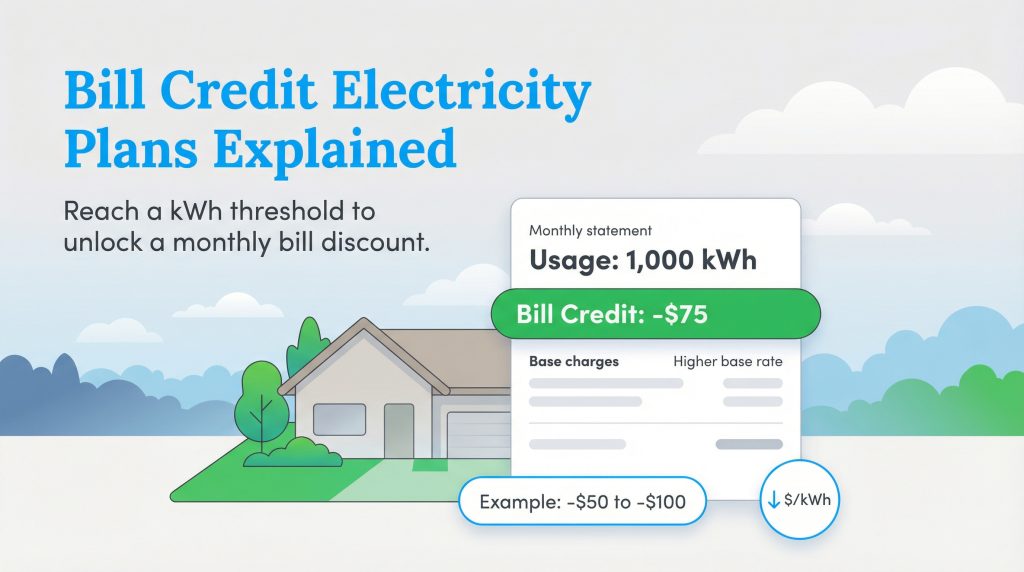
When comparing your electric plan options, you will inevitably spot offers promising a hefty financial discount if you reach a specific volume of electricity. Retail providers typically structure this tiered rate plan around standard energy usage tiers like 500, 1,000, and 2,000 kWh. You only unlock this generous reward by crossing that exact kilowatt-hour limit during a standard 30-day billing cycle.
Understanding how these structures operate in daily practice requires looking past the bold numbers on a marketing brochure. Think of a bill credit electricity plan as a high-stakes incentive program. The underlying base charge for the electricity itself is typically much higher than standard market prices. However, the moment your home consumes enough energy to cross that specific threshold, the provider automatically applies the credit to your account. This sudden discount offsets the higher base cost of the power, artificially dropping your effective rate per kWh for that particular month.
The Math: Hitting vs Missing Your Energy Usage Tiers
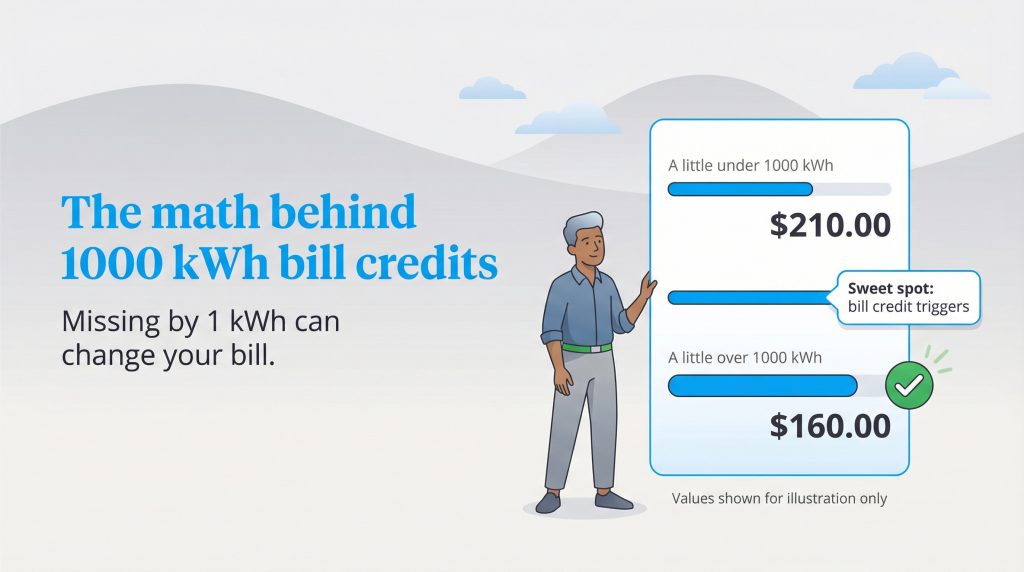
Providers heavily market the 1,000 kWh tier because it looks incredibly cheap on shopping portals. However, that advertised price only exists if you perfectly hit your target. The financial penalty for missing your energy usage tiers is staggering. If your underlying base charge sits at 16 cents per kWh and you miss the mark, you pay a steep premium.
To demonstrate the severe financial danger of missing a usage threshold, let’s look at a concrete mathematical breakdown for a plan offering a $100 credit at 1,000 kWh:
Scenario A: Hitting the Tier
You consume exactly 1,000 kWh. The base cost of your electricity is $160 (1,000 x $0.16). Because you hit the threshold, the $100 credit is applied to your account. Your resulting bill is $60, making your effective rate an impressive 6 cents per kWh.
Scenario B: Missing the Tier
You consume 999 kWh. The base cost of your electricity is $159.84 (999 x $0.16). Because you missed the threshold by a single kilowatt-hour, you receive $0 in credits. Your resulting bill is $159.84, leaving you with an effective rate of 16 cents per kWh.
Final Price Difference: $99.84. Using slightly less electricity actually costs you nearly $100 more, completely wiping out your intended savings.
Pros and Cons of a Tiered Electricity Plan
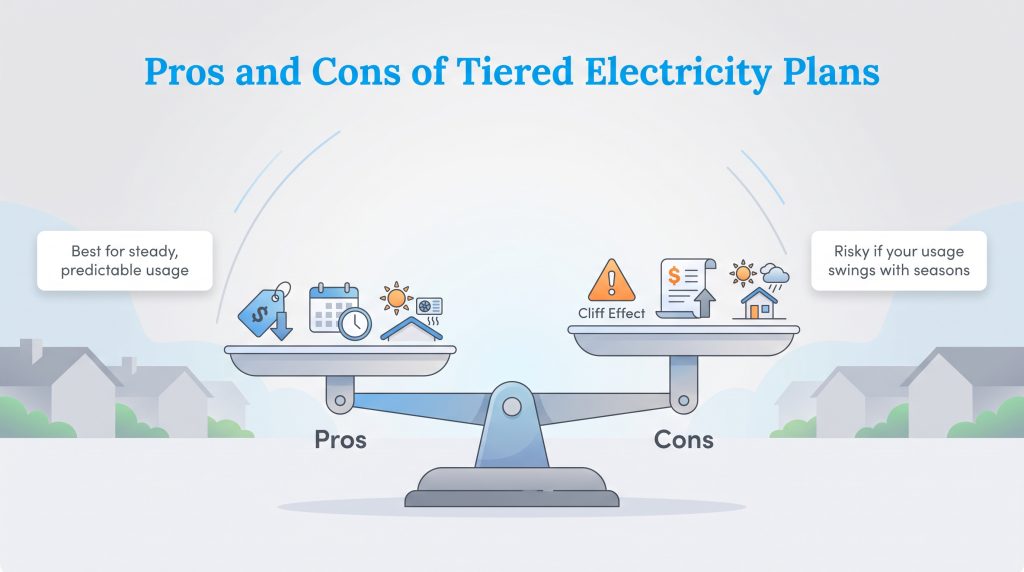
Every energy contract involves trade-offs. Before locking into a tiered electricity plan, you should carefully weigh the maximum benefits against the rigid rules to see if it fits your home’s fluctuating seasonal consumption.
Pros
- Maximum savings potential: You can achieve some of the lowest effective rates on the market if your home perfectly hits the required usage window.
- Rewards predictable habits: Excellent for households that closely monitor historical usage and maintain highly steady energy habits year-round.
- Offsets heavy summer usage: A well-placed credit softens the blow during the hottest months when your air conditioning spikes.
Cons
- The cliff effect: Missing your target by a tiny margin triggers a massive price spike because the discount vanishes instantly.
- Rigid financial penalties: You face the full weight of an inflated base charge and a minimum usage fee if you fail to hit the required tier.
- Seasonal fluctuation risk: Mild weather months naturally cause your consumption to drop, risking the complete loss of your monthly discount.
Bill Credit Plans vs Fixed-Rate Electricity Plans
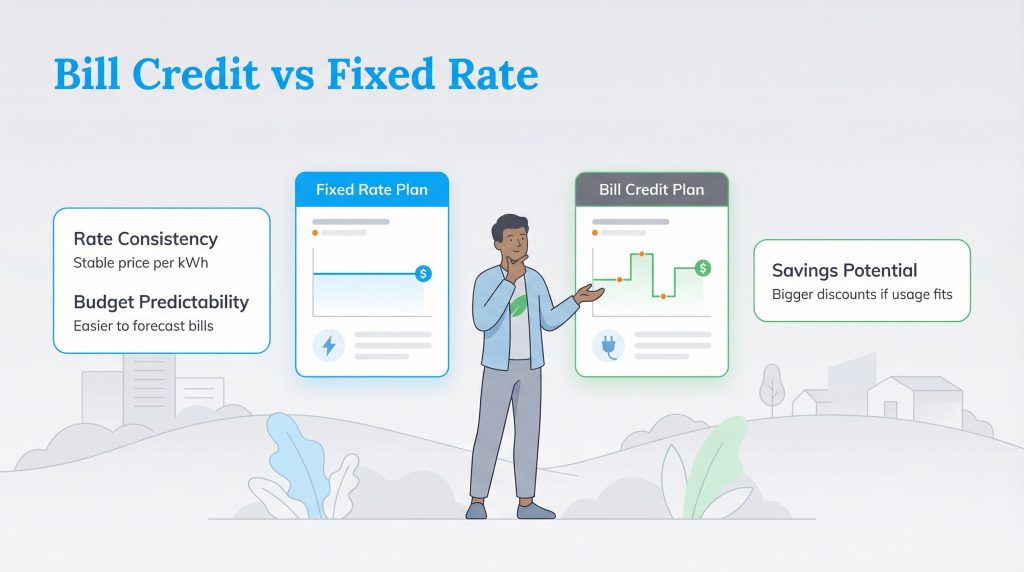
When evaluating your contract choices, the biggest difference ultimately comes down to your personal risk tolerance. A true fixed-rate plan charges the exact same price per kilowatt-hour regardless of how much energy your household consumes. Conversely, credit-based options offer potentially steeper discounts but carry significant volume risk.
To help you make an immediate decision, here is a fast comparison of how a tiered plan stacks up against a standard fixed-rate electricity plan:
| Feature | Bill Credit Plan | Fixed-Rate Electricity Plan |
|---|---|---|
| Rate Predictability | Highly volatile based on exact monthly usage | Stable and predictable every single month |
| Best Household Size | Large homes with high, steady energy demands | Apartments and small to mid-sized homes |
| Financial Risk Level | High (missing a tier causes a massive price spike) | Low (you pay a consistent price per kWh) |
Providers like Gexa Energy frequently offer these credit-based structures to attract shoppers looking for the absolute lowest advertised price on platforms like the Texas official Power to Choose marketplace. To ensure you lock in the best rate for your specific needs, follow these hard-and-fast rules:
- Choose a fixed-rate plan if you live in an apartment. Small living spaces rarely use enough energy to clear a 1,000 kWh tier, making standard fixed rates the cheapest and safest option.
- Choose a fixed-rate plan if your usage fluctuates. If you travel frequently or have variable seasonal usage, securing a stable price protects you from sudden bill spikes.
- Choose a bill credit plan if you have a large home with consistent usage. If you run a pool pump year-round or possess a massive HVAC system, you will easily hit the threshold and secure huge discounts.
Spotting a Texas Teaser Rate on the Electricity Facts Label
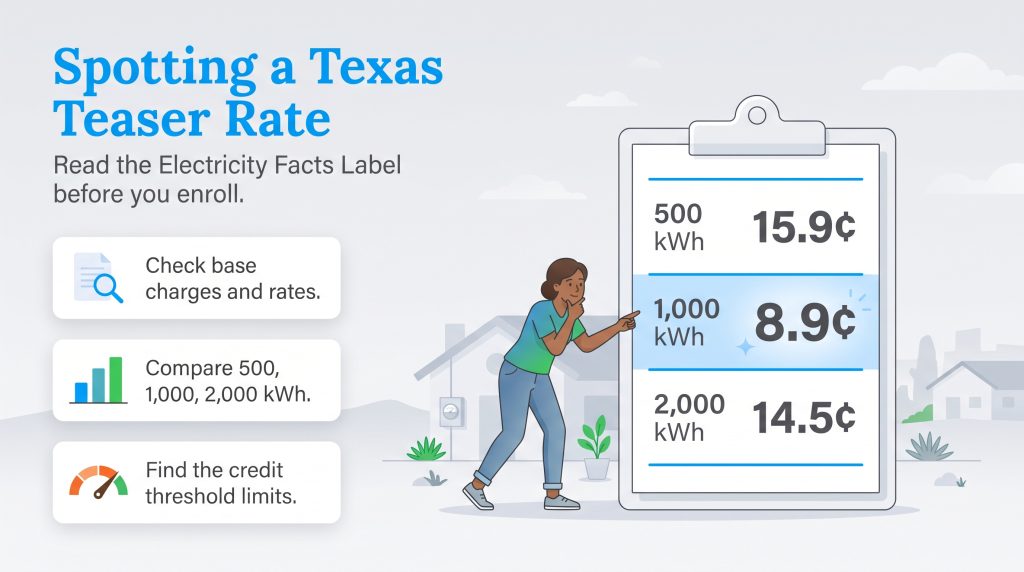
The Electricity Facts Label (EFL) acts as the ultimate nutrition label for energy plans. It strips away flashy marketing jargon and exposes the true cost of your power. To keep costs stable in a deregulated energy market, retail providers often use Texas teaser rates — artificially low advertised prices that assume you will perfectly hit a specific usage tier — to lure in shoppers.
Before you agree to any new contract, review this legally required document and verify the math. Use this simple three-step checklist to navigate complex contracts and find exactly where the true costs hide:
- Check the base charges and energy rates: Look past the top average price chart to find the distinct “Energy Charge” line item. This tells you exactly what you pay per kWh if you miss the discount window.
- Look for massive price discrepancies: Compare the average price points listed for 500 kWh, 1,000 kWh, and 2,000 kWh. If the rate jumps drastically between these benchmarks, you are looking at a teaser rate designed to penalize variable usage.
- Identify the exact credit threshold limits: Pinpoint the minimum and maximum kilowatt-hour limits required to trigger the discount. Check if standard TDU delivery charges apply regardless of your credit status.
Who Actually Benefits From a Usage Credit Plan?
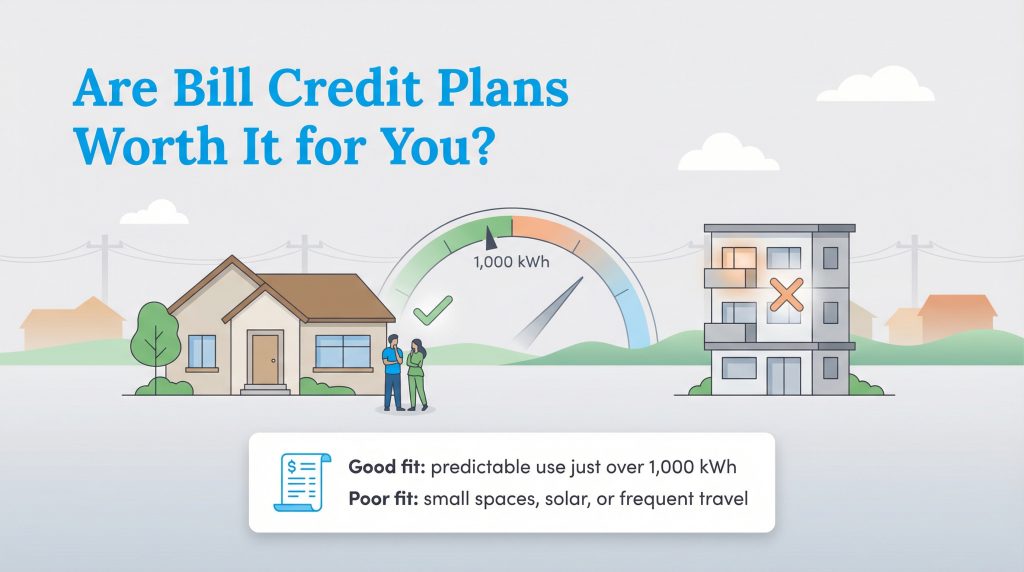
Purposefully leaving lights on or running empty appliances just to hit a 1,000 kWh threshold defeats the entire purpose of conservation. Wasting power is never an environmentally mindful choice. Instead, you should rely on proven strategies to save on your electric bill and only select a usage credit plan if your existing lifestyle naturally fits the contract’s requirements.
Whether you live in the South or you are comparing options on PA Power Switch, these aggressive pricing structures are a fantastic financial tool for the right household. You are the ideal candidate for a usage credit plan if you meet the following criteria:
- You live in a large home: Consistently clearing a 1,000 or 2,000 kWh benchmark without wasting energy requires significant square footage or heavy appliances like pool pumps and electric vehicle chargers.
- Your consumption is highly predictable: You have reviewed your usage data and confirmed that your absolute lowest volume month still confidently clears the required energy usage tiers.
- You utilize average billing: Leveraging average billing programs helps stabilize your seasonal peaks, making the rigorous demands of a tiered rate plan significantly easier to manage financially.
Making Your Final Electricity Plan Choice
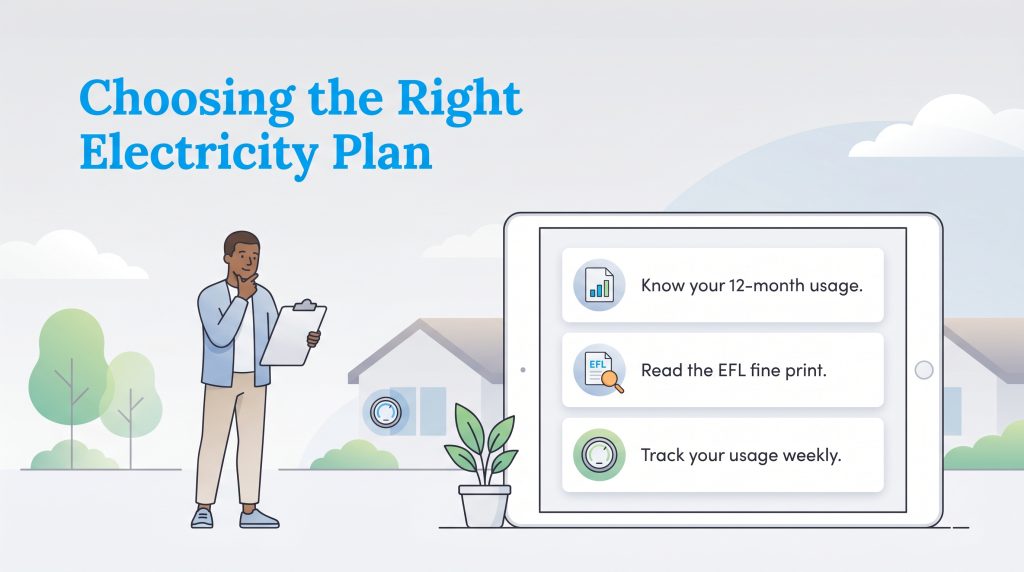
Harnessing a targeted discount can serve as a powerful tool to lower your expenses, provided you understand your historical data perfectly. These tiered programs deeply reward consistency, but they demand your active participation. By taking control of your data, reading the fine print on the EFL, and monitoring your monthly meter readings, you can ensure a high base charge doesn’t catch you off guard during a mild month.
Ultimately, selecting the right energy contract is about matching the product to your lifestyle. If you own a large property with high, steady energy demands, chasing those massive bill credits can substantially lower your average monthly electric bill. However, if you live in a smaller space or travel frequently, prioritizing the unshakeable stability of a standard fixed-rate electricity plan provides far better long-term peace of mind. Review your numbers carefully, bypass the deceptive marketing tactics, and choose an energy plan that truly supports your household’s daily rhythms.
Frequently Asked Questions About Bill Credit Electricity Plans
Are bill credit plans considered fixed-rate plans?
What is a Texas teaser rate?
Which energy providers offer the best bill credit electricity plans?
Do bill credit plans roll over to the next month?
What happens if I use less electricity than my bill credit tier requires?
Are bill credit electricity plans a scam?
What happens if I use 999 kWh on a 1,000 kWh bill credit plan?
Do bill credit plans include TDU delivery charges in the advertised rate?
Are bill credit plans only available in Texas?
Why do electric companies offer usage credits?
Can I get a bill credit plan with renewable energy?
How do I find out my exact average monthly electricity usage?
About the Author

LaLeesha has a Masters degree in English and enjoys writing whenever she has the chance. She is passionate about gardening, reducing her carbon footprint, and protecting the environment. She also recently served as President of the Board for City Sprouts (a community garden).

David has been an integral part of some of the biggest utility sites on the internet, including InMyArea.com, HighSpeedInternet.com, BroadbandNow.com, and U.S. News. He brings over 15 years of experience writing about, compiling and analyzing utility data.