

Discount Power Offers Lower Advertised Rates For High Usage, While TXU Energy Provides Superior Stability And Customer Service For Renters And Smaller Homes
Key Takeaways
- Discount Power is generally cheaper for high usage, averaging around 11.9¢ per kWh, if you consistently use over 1,000 kWh per month due to their bill credit structures.
- TXU Energy is the safer choice for lower usage, offering steady rates around 14.5¢ per kWh that rarely punish apartment dwellers with extreme hikes for missing targets.
- Both providers are backed by massive parent companies, with TXU Energy owned by Vistra Corp and Discount Power operating as a subsidiary of NRG Energy.

- 10.9¢ /kWh
- 3-100%
- 60 days
- 1-36 Months
- Highest Trustpilot Rating 4.7/5 ★

- 7.3¢ /kWh
- 24%
- 90 days
- 12-36 Months
- Get Rewarded for Higher Usage
*rates may vary by location and household usage
Shopping for electricity in Texas often feels like choosing between a bargain bin and a luxury boutique, only to realize both sell the exact same electrons. When looking at a TXU Energy vs. Discount Power comparison, the core difference comes down to how they price their power. TXU Energy is ideal for steady, predictable rates and robust green energy options, while Discount Power focuses heavily on lucrative bill credits for high-usage households. Backed by corporate energy titans — TXU Energy by Vistra Corp and Discount Power by NRG Energy — both providers are highly reliable. However, the smartest choice entirely depends on the size of your home and your monthly energy consumption.
TXU Energy Vs Discount Power: 2026 Comparison Guide
Comparing Texas electricity providers can quickly become overwhelming, especially when promotional rates hide the true cost of your monthly bill. In this comprehensive guide, we unpack the critical differences between TXU Energy and Discount Power. Whether you want to leverage smart home technology to save money or simply want a hands-off plan that won’t punish you during mild weather, knowing how these two giants structure their contracts is the first step to securing the cheapest electricity plans in Texas for your exact needs.
At A Glance: TXU Energy Vs Discount Power
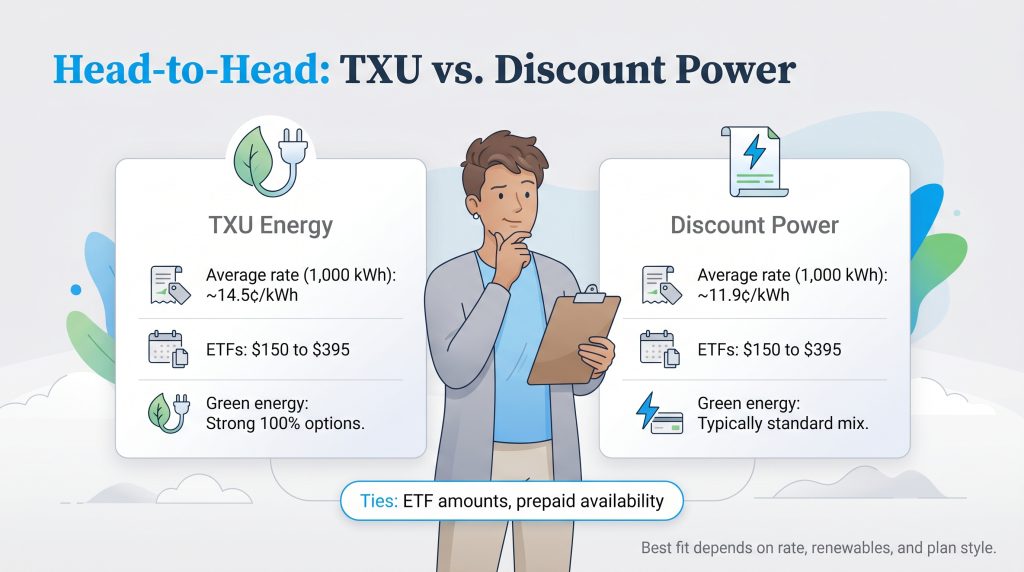
To help you cut through the marketing noise, we have compiled a direct head-to-head breakdown. Here is how both companies perform across the most essential categories.
| Comparison Metric | TXU Energy | Discount Power |
|---|---|---|
| Parent Company | Vistra Corp | NRG Energy |
| Average Rate (1,000 kWh) | ~14.5¢ / kWh | ~11.9¢ / kWh |
| Early Termination Fees (ETFs) | $150 to $395 | $150 to $395 |
| Green Plan Availability | Robust 100% renewable plans | Standard grid mix; no 100% green plans |
| Best For | Eco-conscious users & apartments | High-usage large homes |
Parent Companies And Brand Reputation
Understanding the corporate hierarchy behind retail brands helps establish trust when signing a long-term electricity contract. In the deregulated Texas market, both of these providers are backed by massive, publicly traded energy conglomerates. TXU Energy operates under Vistra Corp, a highly respected power generation and retail company. Meanwhile, Discount Power acts as a subsidiary of NRG Energy.
What does this mean for you? Both companies operate on the exact same Texas grid and deliver the same reliable electricity to your home. However, they differ significantly in overhead, customer service investments, and target audiences. Vistra Corp vs NRG Energy brands often compete by offering distinct tiers of service. TXU Energy functions as Vistra’s premium brand with robust tools, reliable customer support, and a highly rated mobile app. Conversely, Discount Power serves as NRG’s budget-conscious tier designed to keep administrative costs low. When comparing TXU Energy vs Discount Power reviews, you will typically find TXU praised for its reliability, while Discount Power appeals strictly to proactive bargain hunters.
Pricing Structures: Flat Rates Vs Bill Credit Incentives
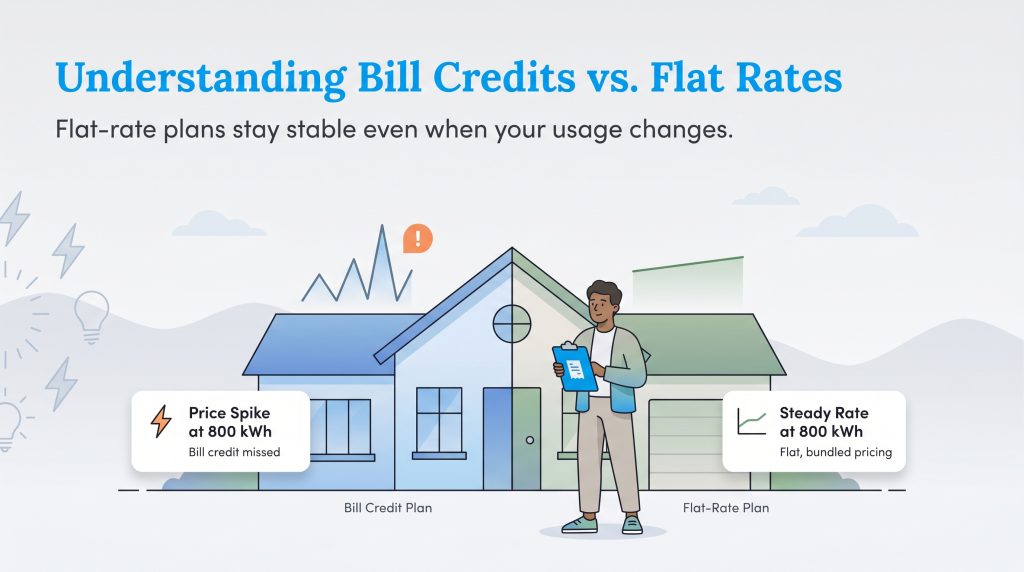
When you look at comparison websites, you will frequently notice Discount Power advertising a significantly lower rate than TXU Energy. However, that flashy number is usually tied to Discount Power bill credit plans, like their popular “Bill Credit Bundle.” These structures require you to consume a precise amount of power to receive a lump-sum discount on your statement. We call this the usage trap.
- Discount Power Bill Credit Incentives: These plans reward high-usage customers. You must hit exact kilowatt-hour (kWh) thresholds — often 1,000 kWh or 2,000 kWh — to trigger the bill credit. If you hit the target, your effective rate drops significantly. If you miss it, you are penalized with a much higher base rate.
- TXU Energy Flat Rates: TXU markets plans like “Smart Edge” as their dependable, flat-rate option. These feature a bundled “Simple Rate” that includes your energy charges and delivery fees. There are no surprise bill spikes if your usage drops while you are on vacation or during a mild spring month.
Here is a hypothetical illustration of how missing that credit affects your wallet:
| Scenario | Discount Power (Est.) | TXU Energy (Est.) |
|---|---|---|
| Advertised Rate (at 1,000 kWh) | 11.9¢ per kWh | 14.5¢ per kWh |
| Actual Usage | 800 kWh (Missed Credit) | 800 kWh |
| Effective Price You Pay | ~19¢ per kWh | ~14.9¢ per kWh |
| Result | Price Spike | Steady Rate |
For renters or energy-conscious homeowners, this difference is critical. You can learn more about monitoring your usage to avoid these traps in our guide on how to save on your electric bill.
| Plan Name | Rate /kWH | Plan Term | Cancellation Fee | |
|---|---|---|---|---|
| Smart 1000 Saver 12 | 11.5¢ | Month to Month | N/A | Check Availability |
| Smart 1000 Select 12 | 11.5¢ | Fixed Months | $3 | Check Availability |
| Smart Edge 12 | 13.5¢ | 12 Months | $150.00 | Check Availability |
| Smart Edge 24 | 13.9¢ | 24 Months | $295.00 | Check Availability |
| Clear Deal 12 | 14.5¢ | Month to Month | N/A | Check Availability |
| Solar Value 12 | 15.9¢ | Month to Month | N/A | Check Availability |
| Simple Rate 12 | 16.4¢ | Month to Month | N/A | Check Availability |
| On Your Terms | 16.9¢ | Month to Month | N/A | Check Availability |
| Smart 500 Start 12 | 17.1¢ | Month to Month | N/A | Check Availability |
| Simple Value 12 | 18¢ | 12 Months | $150.00 | Check Availability |
| Ultimate Season Pass 12 | 18.7¢ | Month to Month | N/A | Check Availability |
| Flex Forward | 19.1¢ | Month to Month | N/A | Check Availability |
| Solar Club 12 | 19.1¢ | 12 Months | $150.00 | Check Availability |
| Texas Choice 12 | 19.2¢ | 12 Months | $150.00 | Check Availability |
| Texas Choice 24 | 19.2¢ | 24 Months | $295.00 | Check Availability |
| Flex Rewards | 19.3¢ | Month to Month | $0.00 | Check Availability |
| Smart Deal 12 | 19.6¢ | 12 Months | $150.00 | Check Availability |
| Smart Deal 24 | 20.4¢ | 24 Months | $295.00 | Check Availability |
| Smart Deal 36 | 20.4¢ | 36 Months | $395.00 | Check Availability |
| Solar Saver 12 | 21.3¢ | Month to Month | N/A | Check Availability |
| Saver's Discount 12 | 21.9¢ | Month to Month | N/A | Check Availability |
| Plan Name | Rate /kWH | Plan Term | Cancellation Fee | |
|---|---|---|---|---|
| Bill Credit Bundle 24 | 7.3¢ | 24 Months | $150.00 | Check Availability |
| Bill Credit Bundle 12 | 7.6¢ | 12 Months | $150.00 | Check Availability |
| Wise Buy Basic 24 Online | 14.9¢ | Month to Month | N/A | Check Availability |
| Wise Buy 12 | 16.9¢ | 12 Months | $150.00 | Check Availability |
| Bill Credit Bundle Essential 12 | 17.5¢ | Month to Month | N/A | Check Availability |
Green Energy And Eco-Conscious Plan Options
If powering your home with green energy is a priority, TXU Energy completely dominates this category. As an environmentally mindful choice, TXU offers several robust renewable add-ons and dedicated green plans. Programs like TXU GreenUp, the Solar Club, and TXU Free Nights & Solar Days allow eco-conscious shoppers to offset their carbon footprint using 100% renewable energy sourced from Texas wind and solar farms. They also have established solar buyback programs for homeowners with panels.
In stark contrast, Discount Power currently lacks dedicated 100% renewable plan options. They focus primarily on standard supply plans to keep their base costs as low as possible. While a fraction of their power mix includes the state-mandated minimum for renewables, they do not cater to the green energy market. If you are an eco-conscious consumer looking to support sustainability, TXU Energy is our definitive recommendation.
Contract Terms, Fees, And Early Termination
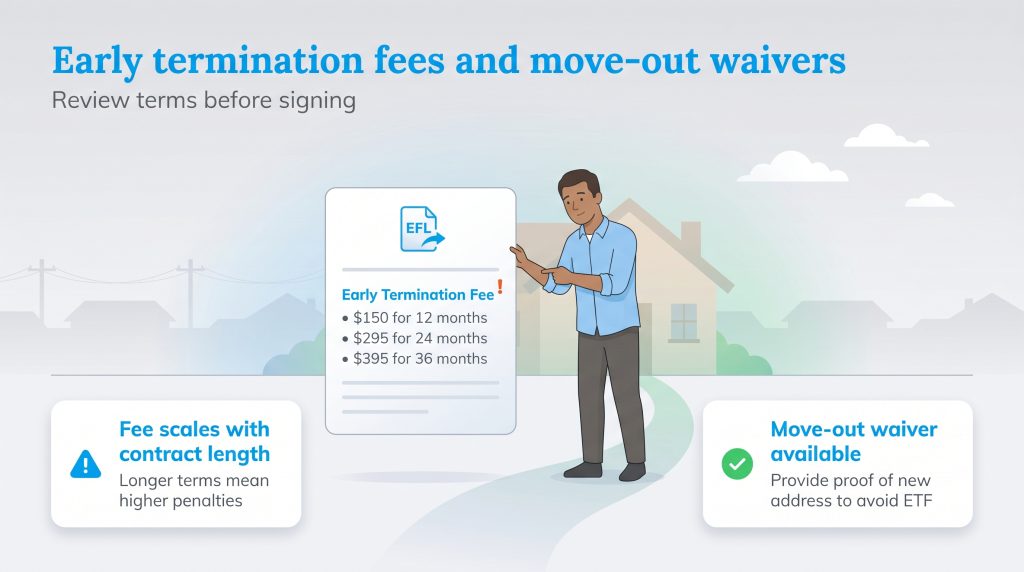
Life is unpredictable, and locking into a long-term electricity contract means you need to understand the exit penalties. The fine print in the Electricity Facts Label (EFL) outlines exact cancellation costs. Both providers pass through standard TDU delivery charges from utilities like Oncor or CenterPoint, but their cancellation protocols require careful attention.
The TXU Energy early termination fee (ETF) structure mirrors Discount Power’s almost exactly. For both providers, the exact penalty scales based on your contract term length. If you cancel a 12-month contract early, expect to pay a $150 penalty. Breaking a 24-month contract incurs a $295 fee, and abandoning a 36-month plan will cost you a steep $395. These fees significantly impact your decision if you think you might switch providers before your contract ends.
Fortunately, there is a standard waiver policy for both companies. If you are moving to a new address, you can typically waive the early termination fee entirely by providing proof of your change of address. This protection ensures you are not financially punished simply for relocating.
Which Provider Is Best For Your Home Size?
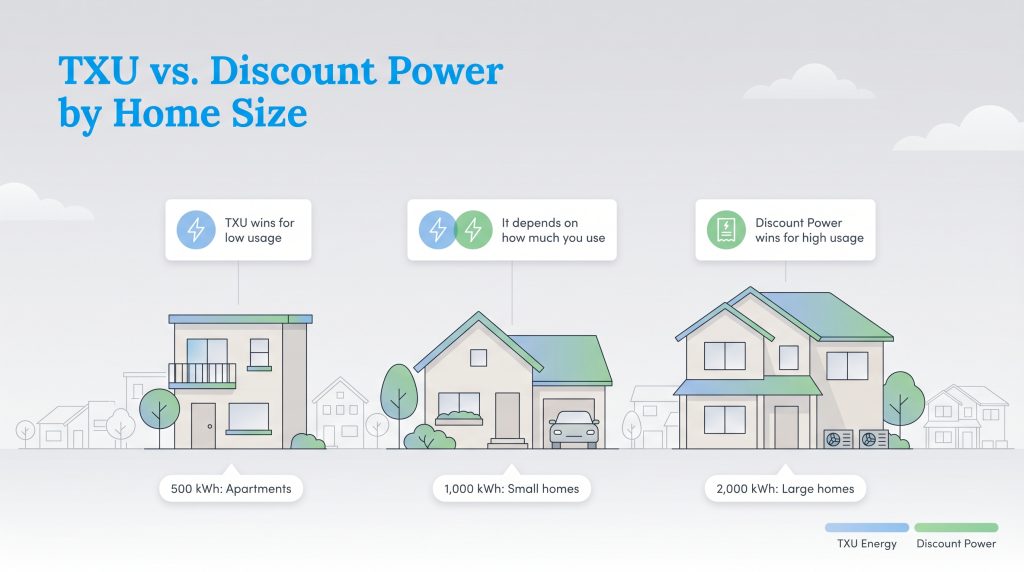
Your property size is the ultimate deciding factor when choosing between TXU Energy and Discount Power. The Texas electricity market operates on predefined usage blocks, meaning the price you pay heavily depends on whether you hit specific monthly thresholds. Here is how both providers stack up depending on your home size.
For Apartments And Small Homes
If you live in a one-bedroom apartment or an energy-efficient townhome, your usage will frequently hover around 500 kWh. At this tier, TXU Energy is the clear winner and widely considered the best electric company for apartments in Texas. They offer straightforward pricing without the steep penalties that come from missing a bill credit. Discount Power’s plans often charge a premium base rate that only drops if you consume 1,000 kWh or more, making them a surprisingly costly choice for small spaces.
For Large Homes
Larger homes with multiple air conditioning units easily consume 2,000 kWh or more during the brutal Texas summer. Discount Power consistently secures the win here. Once you unlock their 1,000 kWh or 2,000 kWh usage credits, the savings scale efficiently to give you some of the cheapest electricity plans in Texas. However, TXU Energy remains a strong contender for high-usage households that prefer premium customer service over raw bargain-bin pricing.
Plan Types: Free Nights And Weekends Vs Fixed Rates
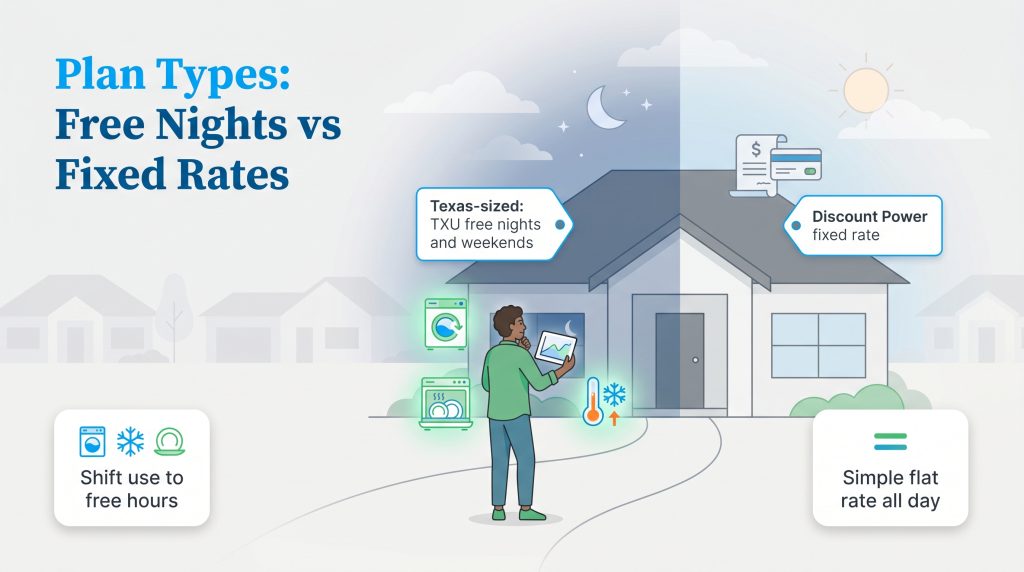
Beyond standard pricing, the types of plans available can radically shift your monthly expenses. When comparing TXU Free Nights vs Discount Power, you will find that time-of-use plans are immensely popular for households that can adapt their daily routines. TXU Energy free nights and weekends plans charge a higher premium during the day but drop your energy cost to zero during specific nighttime hours.
To make these plans more economical than standard fixed rates, you must actively shift heavy appliance usage — like running the dishwasher, doing laundry, or aggressively cooling the house — to the free overnight hours. If you work from home and blast the A/C at noon, these plans will cost you significantly more.
Discount Power tends to avoid complex time-of-use structures, focusing instead on standard fixed-rate contracts and usage bundles. Discount Power customer reviews often highlight the simplicity of these fixed plans, provided the customer thoroughly understands their personal usage habits. If you live in a major metro area, you can see how these providers stack up locally on our Houston utilities page.
Choosing Your Next Energy Provider
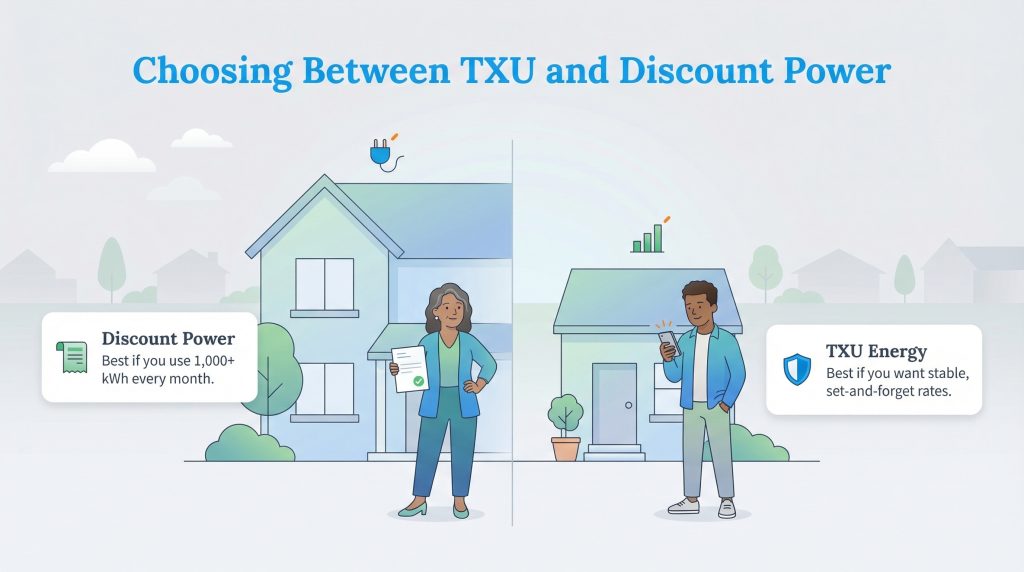
Choosing between these two energy heavyweights comes down to knowing your home’s consumption patterns and your personal tolerance for billing fluctuations. If you manage a large household and reliably pull more than 1,000 kWh every single month, Discount Power provides aggressive rates that can yield significant annual savings. Their bill credit energy plans in Texas are highly effective if you track your usage meticulously.
Conversely, if you prefer a set-it-and-forget-it approach, TXU Energy is worth the slight price premium. Their predictable rates, superior mobile app, eco-conscious plan options, and transparent billing make them an excellent choice for renters and energy-conscious homeowners who want to avoid surprise rate spikes during milder weather. For more comparisons and deep dives into regional providers, check out our main electricity hub.
Frequently Asked Questions About TXU Energy And Discount Power
Which is cheaper: TXU Energy or Discount Power?
Discount Power is generally cheaper for large homes using over 1,000 kWh per month due to aggressive bill credits. However, TXU Energy is the more affordable and stable choice for apartments or homes using less than 800 kWh, as they do not penalize you with extreme rate hikes for missing a usage target.
Is Discount Power the same as Reliant?
Both companies are owned by NRG Energy, but they operate as separate brands. Discount Power is positioned as the budget-friendly option with fewer perks, while Reliant is the premium brand with better tools and support, similar to TXU Energy.
Does Discount Power offer renewable energy plans?
No, Discount Power does not currently offer dedicated 100% renewable energy plans. They focus primarily on keeping base rates low through standard grid power. If you are an eco-conscious shopper wanting green energy, TXU Energy is the much better choice.
Does TXU Energy charge cancellation fees?
Yes, TXU typically charges an Early Termination Fee scaling between $150 and $395 depending on the length of your contract. However, they typically waive these fees if you supply proof that you are moving to a new residential address.
Can I transfer my Discount Power plan if I move?
In Texas, if you move to a new address, you can usually transfer your service without penalty. If the provider does not service your new area, or if you provide proof of your move, you can typically cancel your contract fee-free.
Who has better reviews, TXU or Discount Power?
TXU Energy generally holds higher customer satisfaction ratings, particularly regarding their mobile app usability and reliable customer support. Discount Power reviews often feature complaints from customers who missed a bill credit threshold and were surprised by a higher-than-expected bill.
Do TXU Energy or Discount Power require a security deposit?
Yes, both providers typically require a security deposit before starting service. However, they will often waive this fee if you meet specific credit score requirements, are 65 years of age or older, or can provide a recent letter of credit from your previous utility provider.
What happens to my rate if I use less than 1,000 kWh with Discount Power?
If you are enrolled in a Discount Power bill credit plan and fail to reach the minimum 1,000 kWh threshold, you forfeit the financial credit for that billing cycle. This means your effective price per kWh will spike significantly, resulting in a much higher bill despite using less electricity.
About the Author

David has been an integral part of some of the biggest utility sites on the internet, including InMyArea.com, HighSpeedInternet.com, BroadbandNow.com, and U.S. News. He brings over 15 years of experience writing about, compiling and analyzing utility data.

LaLeesha has a Masters degree in English and enjoys writing whenever she has the chance. She is passionate about gardening, reducing her carbon footprint, and protecting the environment. She also recently served as President of the Board for City Sprouts (a community garden).