

Understanding the Difference Between Buyback Plans and Net Metering to Maximize Your Solar Savings
Key Takeaways
- Solar buyback programs vs. net metering differences dictate whether you get paid at a variable market rate or credited at the full retail rate for exported energy.
- These programs are most common in deregulated energy markets (like Texas, Ohio, and Pennsylvania), requiring you to shop for specific plans to get the best value for your surplus power.
- Pairing your solar panels with a home battery system can significantly increase your earnings by allowing you to sell excess solar energy back to the grid when rates are highest.
There are few things more confusing than installing a brand-new solar panel system and still receiving an electric bill the following month. This frustrating “bill shock” happens to many new owners who assume their solar panels will completely zero out their living costs immediately, only to realize that selling power back to the grid is a highly nuanced process rather than a simple 1:1 swap. Whether you live in a state with traditional net metering policies or a deregulated market that relies on provider-specific plans, the rules dictating your savings depend entirely on your geographic location and utility provider. We are here to help you navigate the fine print, understand exactly how your utility credits you for the power you generate, and figure out the best strategies to make your residential solar investment pay off in the long run.
What Is a Solar Buyback Program?
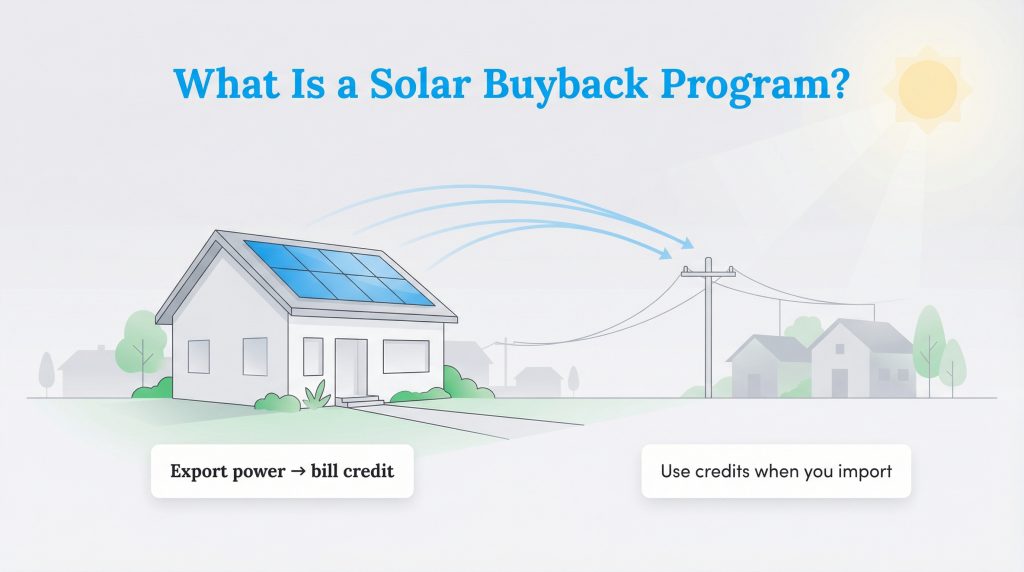
A solar buyback program is a formal, contractual agreement between you and your electric provider where you receive financial compensation for the excess solar energy your panels generate. During a bright, sunny afternoon, your rooftop panels will often produce significantly more power than your home can currently consume. This surplus energy does not just disappear into thin air; it flows outward from your home and onto the local public power grid to be utilized by your nearby neighbors. When this outward flow happens, your utility company compensates you by issuing solar billing credits directly to your account. In the energy industry, sending your extra power out to the grid is called “exporting,” while buying energy from the grid when the sun goes down or during severe weather is called “importing.”
To establish realistic baseline expectations for your payouts, you absolutely must understand the fundamental difference between retail and wholesale rates. The retail rate is the premium, full price you pay your utility company for electricity, which bakes in the cost of generation, grid transmission, and physical delivery. Conversely, wholesale energy rates reflect the lower base market price utilities pay to acquire raw power before delivering it to consumers. Most standard buyback programs compensate you at or near these lower wholesale energy rates, which effectively means the power you export is frequently valued lower than the power you import.
Understanding the exact life cycle of these credits makes managing your solar system much easier. At the end of your billing cycle, your retail provider calculates the total surplus you pushed to the grid and applies the resulting financial value to your invoice. It is crucial to remember that these programs are primarily designed to reduce your monthly utility bills, not to serve as an independent income stream. Direct cash payouts are exceptionally rare. Instead, generous providers offer month-to-month credit rollover, allowing you to bank excess summer credits to offset heavier energy usage during the dark winter months.
Net Metering Versus Solar Buyback Programs
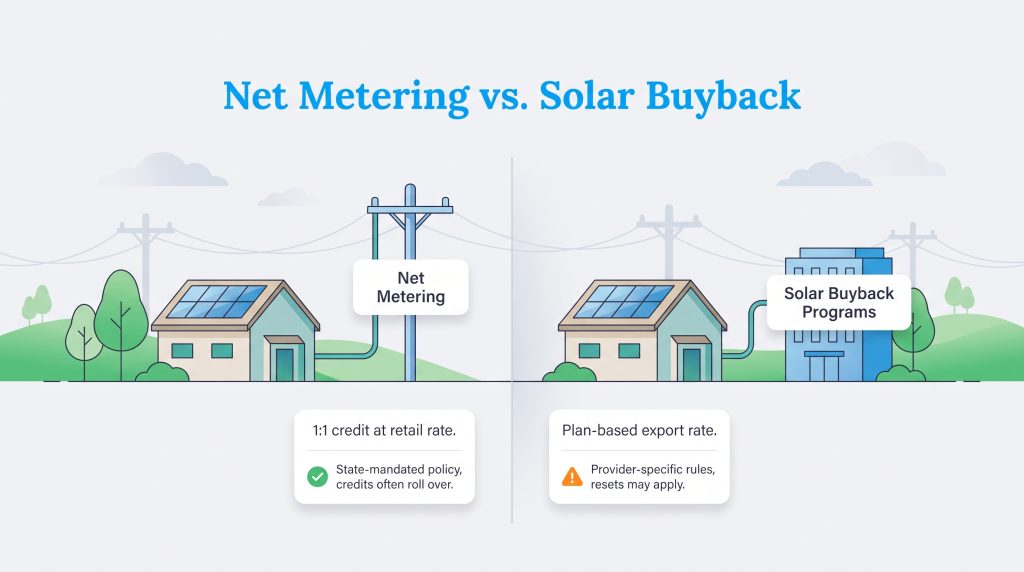
One of the biggest hurdles for new property owners is navigating the complex difference between “net metering” and “solar buyback programs.” While neighbors or salespeople often use these terms interchangeably in casual conversation, they operate under very different legal frameworks depending on your regional laws. Net metering is a mandated policy implemented by state governments operating within heavily regulated energy markets. Under traditional, regulated net metering (common in states like California, New York, or Florida), the local utility monopoly is legally required to credit you at a 1:1 ratio. This means if you give the grid 1 kWh of electricity, you receive a full retail credit for 1 kWh to use later, effectively treating the massive public grid as your own free personal battery system.
In sharp contrast, solar buyback programs are the standard in deregulated energy markets. In deregulated zones like Texas, Ohio, and Pennsylvania, the state government does not strictly mandate the exact price of energy exports. Instead, Retail Electric Providers (REPs) are free to create their own competing buyback rates to win your business. In these open markets, the final value of your export depends entirely on the specific plan you sign up for and the fluctuating current market conditions. For detailed information on incentives, local policies, and structural market rules in your specific state, the Database of State Incentives for Renewables & Efficiency (DSIRE) is an excellent verified resource to consult.
| Feature | Net Metering | Solar Buyback Programs |
|---|---|---|
| Market Type | Regulated energy monopolies | Deregulated energy markets |
| Compensation Rule | State-mandated policies | Utility-specific and highly variable |
| Credit Value | Usually Full Retail Rate (1:1 match) | Wholesale or Market Rate (often lower than retail) |
| Availability | Common in states like CA, NY, FL | Common in deregulated areas like TX, OH, PA |
| Rollover Rules | Credits often roll over indefinitely | Credits may reset monthly or annually |
Types of Solar Buyback Rates
If you live in a deregulated market, you will need to actively shop for a solar buyback plan that outlines precisely how you get paid for your exported power. Evaluating these plans requires a solid understanding of how utilities structure their compensation limits. Choosing the right framework depends heavily on the physical size of your solar array, your daily lifestyle, and your overall financial risk tolerance.
Uncapped Solar Buyback Plans
When you invest in a robust, high-capacity solar array, you want to ensure every single kilowatt-hour you produce works to your financial advantage. An uncapped solar buyback plan allows homeowners to earn unlimited export credits with limitless rollover potential. Under this specific structure, your utility provider does not place an artificial ceiling on how much energy you can sell back to the grid. If your panels generate 1,200 kWh of surplus power in a month but your home only imports 300 kWh, you receive full compensation for the entire 1,200 kWh you provided to the community.
These plans are undeniably the premier choice for households with oversized solar installations or comprehensive home battery setups. The primary benefit of an uncapped structure is the ability to strategically stockpile a massive reserve of solar billing credits during long, sunny summer months. You can then comfortably apply that banked surplus to offset your heavier heating and grid-import costs during the winter.
Capped Credit Plans
Conversely, capped credit plans strictly restrict your credit earning potential to match your household’s monthly import usage. For example, if you consume 600 kWh from the grid at night, the absolute maximum amount of exported energy you will be credited for is 600 kWh — even if your panels forcefully pushed 900 kWh back into the local infrastructure. Any surplus generation beyond your import cap essentially becomes free, uncompensated energy for the utility company.
While this sounds entirely disadvantageous on the surface, capped plans often offset this restriction by providing much stronger baseline retail rates and lower monthly account fees. Consider these key differences before dismissing them entirely:
- Pros: Usually feature a highly predictable 1:1 retail credit match up to your consumption limit, making monthly budget forecasting straightforward and stress-free.
- Pros: Frequently come with significantly lower fixed monthly subscription fees, keeping your baseline overhead costs down.
- Cons: You completely forfeit the financial value of any excess solar energy generated beyond your monthly import volume.
- Cons: They actively discourage investing in larger, highly efficient solar arrays since you cannot monetize the surplus power.
Real-Time Wholesale Metering Plans
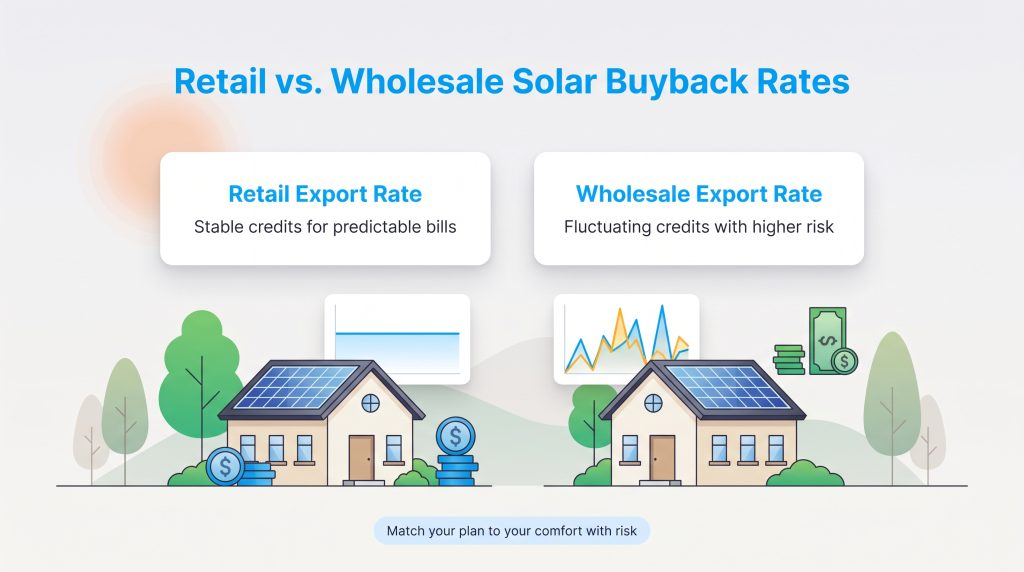
Real-time wholesale export rates compensate you based on the continuously fluctuating market price of electricity on the public grid. This means the monetary value of your power rises and falls dramatically based on regional supply and demand. Real-time wholesale metering plans offer uncapped earning potential during extreme weather events — like intense summer heatwaves or severe winter freezes — when grid demand is critically high and wholesale prices skyrocket.
However, this structure carries serious financial risk. The payouts can drop to near zero (or even enter negative pricing territory) during mild spring and fall months when overall grid demand is exceptionally low and solar production is universally high. To put this into perspective, if you are on a fixed retail plan paying 15 cents per kWh, 500 kWh of export earns you a stable $75 credit. On a wholesale plan averaging just 3 cents per kWh during typical daytime hours, your credit drops dramatically to just $15.
Real-time wholesale plans are fantastic for energy nerds who use smart home batteries to practice energy arbitrage, but if you want to ‘set it and forget it,’ a fixed retail-rate buyback plan is usually the safer bet for predictable bills.
Key Features of the Best Solar Buyback Plans
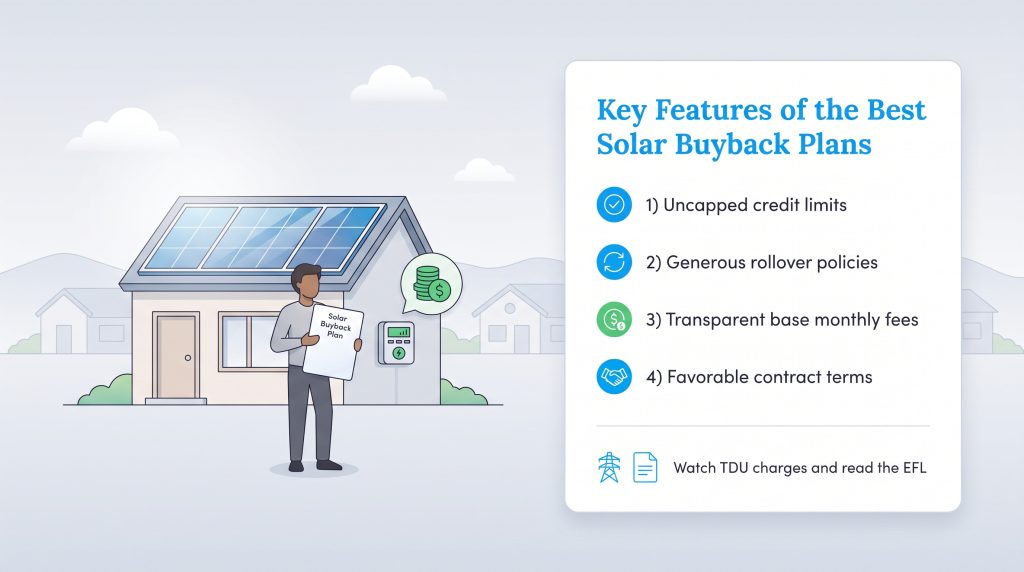
Finding the absolute best solar buyback plan takes a little bit of upfront homework. Many providers cleverly structure their plans with embedded fees or complex terms that can rapidly eat into your solar savings. When evaluating competing utility buyback rates in your local market, use this checklist to ensure you are getting a transparent and fair deal:
- Uncapped Credit Limits: Ensure the provider allows you to earn credits for all the excess power you produce, rather than artificially cutting you off once you match your household’s monthly import usage.
- Generous Rollover Policies: Look for plans that let your solar buyback credits roll over month-to-month continuously, allowing you to build a substantial buffer for seasonal usage changes.
- No Punitive Annual Credit Sweeps: Many energy providers include a clause stating that any accumulated bill credits will expire or be “swept” away at the end of an annual cycle. Avoid these whenever possible.
- Transparent Base Monthly Fees: Watch out for sneaky subscription fees charged simply for the privilege of being on a solar plan. A hidden $20 monthly base fee can completely wipe out your hard-earned export credits.
- Favorable Contract Length Requirements: Evaluate early termination fees carefully. A shorter contract (like 12 months) grants you the flexibility to easily switch providers if solar buyback rates improve in your area next year.
- Exemptions on TDU Delivery Charges: In many service areas, you pay Transmission and Distribution Utility (TDU) delivery charges on every single kilowatt-hour you import. Check if your provider generously credits you for delivery fees on the power you export.
Always read the fine print in the Electricity Facts Label (EFL) to spot these hidden hurdles. Taking an extra 10 minutes to scrutinize the EFL ensures your eco-conscious choice remains a financially sound one. To learn more about how to navigate and minimize these sneaky costs, read our actionable tips on how to save on your electric bill.
Hardware Requirements to Participate
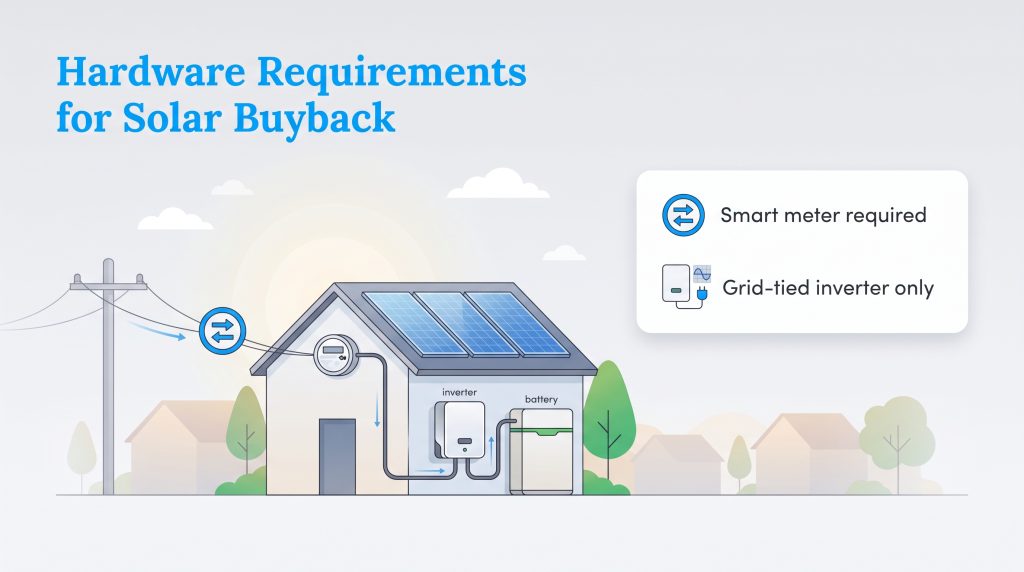
You cannot simply bolt solar panels to your roof, flip a switch, and immediately start collecting bill credits from the electric company. Exporting power to the public grid requires specific technical hardware and verified legal documentation to ensure the utter safety of utility line workers and the overall stability of the local infrastructure.
First and foremost, you absolutely must have a bi-directional smart meter installed by your local utility. Standard utility meters only measure the electricity flowing into your home on a single channel. A bi-directional smart meter acts as a highly accurate two-way street, measuring both the electricity you consume from the grid and the excess solar generation you feed back into it. Without this specific piece of communicative hardware, your provider cannot legally verify or calculate your exported generation.
Furthermore, grid-tied inverters are mandatory for safe participation. Your inverter must be capable of syncing perfectly with the public grid’s frequency to seamlessly transfer alternating current (AC) power outward. Because of this structural necessity, completely off-grid solar systems are entirely ineligible for buyback programs, as they physically lack the grid-tied hardware connection required to send energy outward to the neighborhood. If you are interested in learning more about how modern storage integrates seamlessly with your grid-tied system, check out our comprehensive guide to solar energy solutions.
Maximizing Your Solar Savings
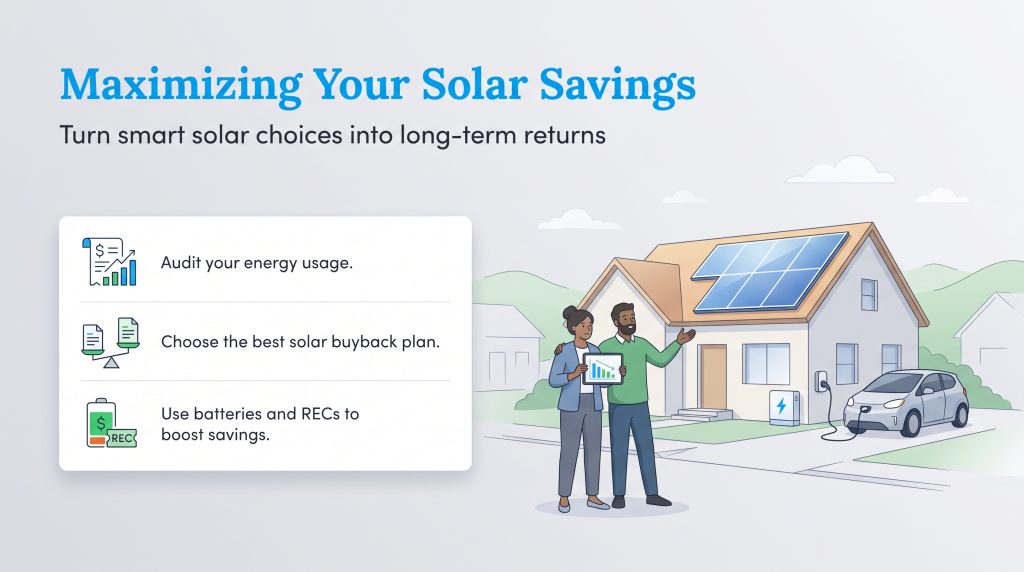
Successfully navigating solar buyback programs does not have to feel like solving complex algebraic equations, but taking immediate, organized action after your installation is crucial to locking in your savings. Once your local utility company formally grants your system Permission to Operate (PTO), use this step-by-step guide to audit your setup and maximize your return on investment:
- Audit Your Energy Usage: Review your past 12 months of utility bills to understand your exact monthly import habits. Knowing your baseline energy usage is the key to deciding whether a capped or uncapped plan suits your lifestyle best.
- Size Your System Appropriately: If you plan on purchasing an electric vehicle (EV) or switching to electric heat pumps soon, your future consumption will rise. Ensure your panels generate enough surplus power to cover these future upgrades before locking into a restrictive long-term plan.
- Compare Provider Electricity Facts Labels (EFLs): Carefully shop your local deregulated market using the criteria we outlined above. Ensure you sign a contract with a reputable retail provider — such as Green Mountain Energy or TXU Energy — offering a buyback plan tailored to your specific generation habits. Residents in Texas can securely use the official Power to Choose website to compare current market offers easily.
- Incorporate Battery Storage and Arbitrage: If you invested in home battery storage, program your system’s software to prioritize energy arbitrage. By discharging your stored power back to the grid precisely during expensive evening peak hours, you can capitalize on the highest possible export rates while drawing from the grid only when rates are low.
Earning renewable energy credits (RECs) represents another powerful avenue to maximize your system’s financial return. A Renewable Energy Credit acts as a certified, tradable certificate proving that 1 megawatt-hour (MWh) of electricity was generated from an eligible renewable energy resource. Depending on your state’s specific legislation, utilities are mandated to source a certain percentage of their power from renewables to meet state-enforced Renewable Portfolio Standards. To meet these targets, utility companies often purchase these certificates directly from residential solar owners. Selling your Solar Renewable Energy Certificates (SRECs) provides an additional financial incentive completely separate from your standard monthly solar energy buyback credits. By matching the right provider contract with intelligent battery management and REC sales, you turn your home into an environmentally mindful choice that works tirelessly to lower your monthly expenses. If you need help understanding the basics of switching providers safely, visit our electric service hub.
Choosing the Right Solar Buyback Plan
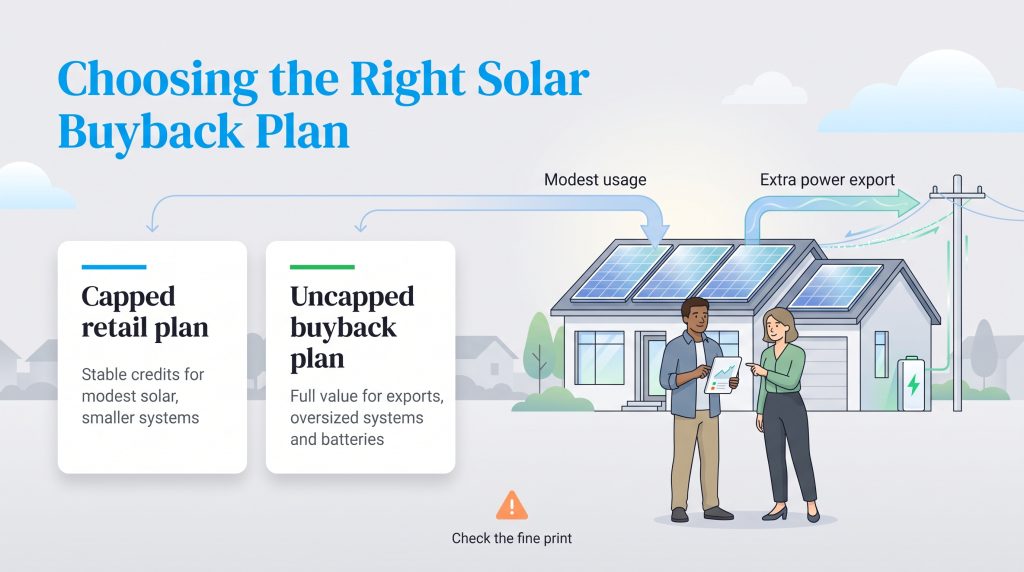
Investing in solar technology is one of the smartest decisions you can make to lower your carbon footprint and take control of your long-term energy costs. However, simply installing panels is only half the battle. If you live in a deregulated market, your choice of solar buyback plan fundamentally dictates the financial success of your entire system. For homeowners with modest, efficiency-focused solar arrays designed simply to offset their baseline consumption, a reliable capped retail plan often provides the predictability and low base fees required for peace of mind. On the other hand, if you invested in an oversized array or substantial battery storage, securing an uncapped solar buyback plan is absolutely essential to ensure you are fully compensated for every drop of clean energy you provide to the grid.
Take the time to read the fine print, dodge punitive credit sweeps, and compare multiple Electricity Facts Labels before signing a contract. By remaining vigilant and actively managing your export strategy, you transform your home into an efficient, eco-conscious powerhouse that actively pays you back.
Frequently Asked Questions About Solar Buyback Programs
What is the difference between net metering and solar buyback programs?
Net metering is typically a state-mandated policy found in regulated utility markets that legally credits you at a 1:1 retail rate for your excess power. Solar buyback programs, on the other hand, are competitive, market-based plans found in deregulated areas where the credit rate and earning limits are determined by specific electricity providers and can vary widely based on the contract you select.
What are the best solar buyback rates in deregulated energy markets?
The “best” rate highly depends on your system’s size and your daily usage habits. Generally, an uncapped retail rate that closely matches your import price offers the most robust financial return for large systems. However, if your system is small, a capped plan with exceptionally low monthly base fees might actually save you more money over the course of a year. Always utilize comparison tools like your state’s Power to Choose portal to evaluate current market offerings.
How do solar energy buyback credits appear on my bill?
Buyback credits typically appear as a distinct, separate line item on your monthly utility invoice. The statement will normally show your total imported grid usage (what you owe), followed by a deduction line labeled “Solar Generation Credit,” “Distributed Generation,” or “Export Credit.” The credited amount is automatically subtracted from your total balance due for that specific billing cycle.
Can I get cash for my excess solar energy?
Direct cash payouts are extremely rare. The vast majority of solar buyback programs strictly offer bill credits that offset your future utility costs rather than cutting you a check. While a few highly specific utility providers may issue a cash reimbursement if your credit balance drastically exceeds a certain dollar amount at the end of an annual true-up period, this is absolutely the exception rather than the rule.
Do solar buyback credits roll over every month?
It depends entirely on the terms outlined in the specific plan you choose. Some lucrative contracts allow credits to roll over month-to-month indefinitely, letting you strategically build up a massive balance in the summer to cover heavy heating usage in the winter. Others may aggressively reset your balance to zero every single month or perform an annual “credit sweep” where your banked value is completely erased. Always verify the rollover rules before committing.
What happens to my accumulated solar credits if I switch electricity providers?
If you decide to cancel your current contract or switch to a new retail electricity provider before your term is up, you will almost always forfeit your remaining banked credits immediately. Utility companies do not transfer these credits to competitors. In addition to losing your banked value, you may also be subject to a steep early termination fee, so always check your contract terms before switching services.
Can I participate in a solar buyback plan if I lease my solar panels?
In most scenarios, yes, you can still participate in a buyback plan if you lease your system through a Power Purchase Agreement (PPA) or standard solar lease. As long as the utility account is in your name and you are responsible for paying the household electric bill, you are typically the one who receives the solar billing credits for the excess energy exported. However, you should carefully review your leasing agreement, as some specific third-party owners may claim the rights to any Renewable Energy Credits (RECs) your system generates.
Do I need special equipment to participate in a solar buyback program?
Yes, you absolutely must have a bi-directional smart meter installed by your local utility company, along with a grid-tied inverter. This specialized communicative hardware accurately measures both the electricity you import from the grid and the excess solar energy you export back to it, making it legally mandatory for calculating your monthly bill credits.
Is a solar buyback plan worth it?
In almost all cases, participating is incredibly worthwhile. Without a formalized buyback plan, any excess energy your panels generate flows into the public grid for free, offering you absolutely no financial return. Even if the contracted wholesale buyback rate is significantly lower than what you pay for retail electricity, receiving some financial credit is always better than receiving zero credit, provided you carefully avoid plans with unusually high monthly base subscription fees.
About the Author

LaLeesha has a Masters degree in English and enjoys writing whenever she has the chance. She is passionate about gardening, reducing her carbon footprint, and protecting the environment. She also recently served as President of the Board for City Sprouts (a community garden).

David has been an integral part of some of the biggest utility sites on the internet, including InMyArea.com, HighSpeedInternet.com, BroadbandNow.com, and U.S. News. He brings over 15 years of experience writing about, compiling and analyzing utility data.