

Understanding How Your Utility Company Credits You For Excess Solar Energy And Why That Might Be Changing
Key Takeaways
- Net metering allows homeowners to send excess solar energy back to the grid in exchange for bill credits they can use later.
- Many states are switching to “net billing” or NEM 3.0, which often reduces the monetary value of exported electricity compared to retail rates.
- Virtual net metering offers a way for renters or those with shaded roofs to benefit from solar credits without installing panels on their own property.
Net metering is a utility billing mechanism that credits homeowners for the excess electricity their solar panels add to the municipal grid. When your system generates more power than your home uses, that surplus energy flows outward, and the utility compensates you with solar energy credits. Opening your first utility bill after installing solar can feel overwhelming, but understanding how this accounting system works is the key to unlocking long-term savings. The electrical grid essentially acts as a massive battery, storing monetary value when the sun shines brightly and releasing it when you turn the lights on at night. We will break down exactly how this process operates, explore recent shifts in billing policies like NEM 3.0, and help you determine if installing a residential solar system is a smart financial move for your household.
How Does Solar Net Metering Work?
Most residential solar setups generate significantly more electricity than a home consumes during peak daylight hours. Without physical battery storage, that energy has to go somewhere. Instead of letting that valuable power go to waste, it flows automatically into the electrical grid for your neighbors to use. Net energy metering (NEM) ensures you receive fair financial compensation for this clean energy contribution.
The Role Of The Bidirectional Electric Meter
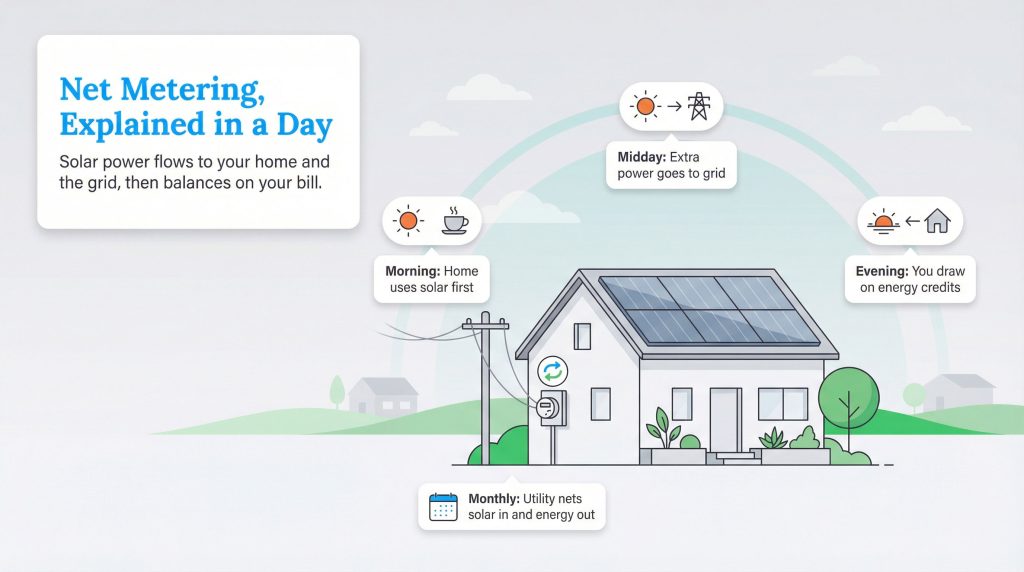
To track this constant exchange of power, utility companies must install a specialized device called a bidirectional electric meter. Unlike standard utility meters that only spin forward to record the electricity you pull from the grid, a bidirectional electric meter physically tracks energy moving in both directions. It actively measures the power you consume when your panels are dormant at night and the surplus solar electricity you export during the day. This vital hardware upgrade acts as the mechanical heart of any grid-tied solar system, ensuring every single kilowatt-hour (kWh) is accurately logged on your energy account.
Earning And Using Excess Solar Energy Credits
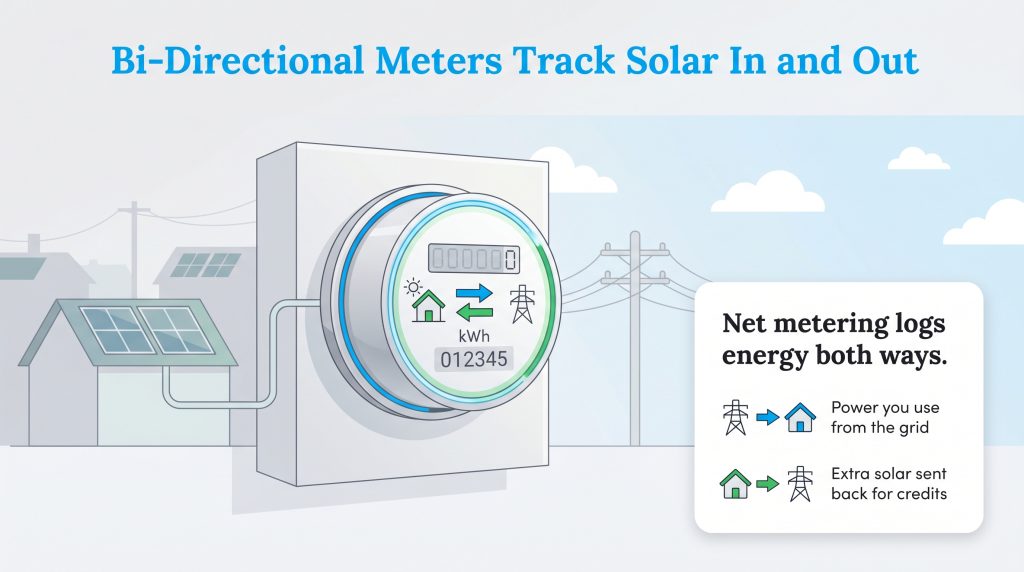
Think of this system like the rollover minutes on an old cell phone plan. If you produce a surplus of solar energy today, the utility company logs an excess solar energy credit on your personal account. You can spend those accrued credits later in the evening, or bank them for several months to help offset higher winter energy usage. The complete daily cycle involves three exact steps:
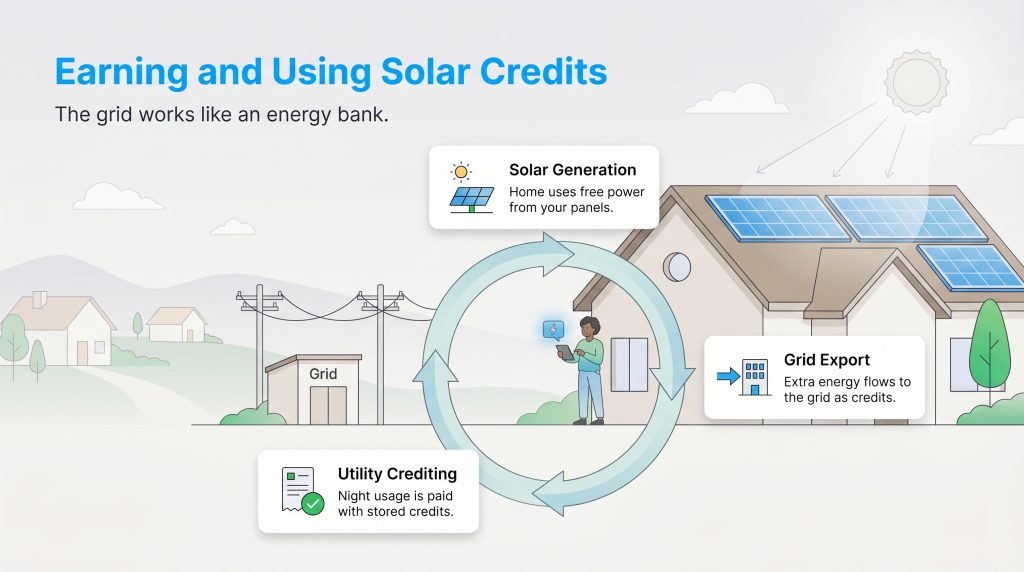
- Panels produce energy: As the sun rises, your rooftop solar panels capture sunlight and convert it into usable electricity. If your home currently needs power to run an air conditioning unit or coffee maker, your house automatically consumes this free solar energy first.
- Excess energy flows to the grid: Around midday, your solar system likely produces far more energy than your home realistically uses. This surplus electricity flows backward through your bidirectional meter directly onto the municipal grid, providing clean power to your neighbors.
- The utility credits your account: Your utility meter records this outflow and banks proportional credits onto your energy account. When the sun sets and your home switches back to pulling electricity from the local grid, you pay for that nighttime usage using the exact credits you banked earlier in the day. At the end of your billing cycle, the utility calculates the net difference.
💡 Pro Tip: The grid functions much like a community bank. When your panels overproduce, you deposit energy. When your house needs more power than you make, you withdraw energy. Net metering is simply the accounting ledger that tracks these daily transactions.
The Financial And Environmental Benefits Of Net Metering
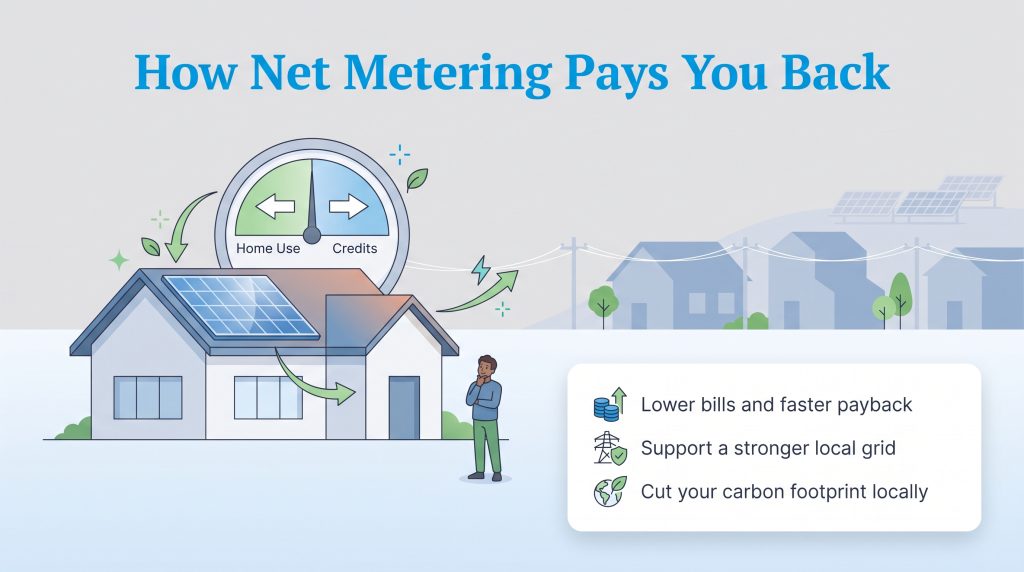
Choosing to install solar panels goes beyond simply producing clean energy; it fundamentally changes your relationship with the utility company. When paired with a robust net energy metering agreement, transitioning to renewable energy offers several compelling advantages for the everyday homeowner.
- Lower utility bills: By offsetting the energy you pull from the grid with the excess electricity you produce, you can dramatically shrink your monthly utility costs — sometimes down to a few basic connection fees.
- Faster ROI on solar panels: Traditional 1-to-1 retail net metering offers the highest possible compensation for your exported power, significantly shortening the payback period on your initial hardware investment.
- Grid resilience: Decentralizing power generation takes immense pressure off aging local infrastructure. By feeding clean energy back into the system during hot summer days, you help your community avoid rolling blackouts.
- Reduced carbon footprint: An environmentally mindful choice, exporting solar power means your neighbors use your locally generated, emission-free electricity instead of energy sourced from distant fossil-fuel plants.
Net Metering Vs Net Billing: Understanding The Difference
For more than a decade, traditional 1-to-1 net metering was the gold standard for renewable incentives. However, as residential solar becomes exponentially more popular, utility companies argue that paying the full retail rate forces non-solar customers to subsidize grid maintenance. As a result, states and utility commissions across the country are rapidly shifting toward a new framework. Understanding net billing vs net metering is essential because it fundamentally restructures your system’s financial return.
The core difference relies on retail versus wholesale valuations. Under a net billing paradigm, you continue to buy electricity at the high retail rate but are forced to sell your excess solar back to the grid at the much lower wholesale rate. The retail rate includes the baseline cost of generating power, maintaining vast transmission lines, and delivery fees. Conversely, the wholesale rate — frequently called the avoided cost rate — reflects only the raw cost of the energy itself. These varying solar buyback programs can drastically alter your long-term savings.
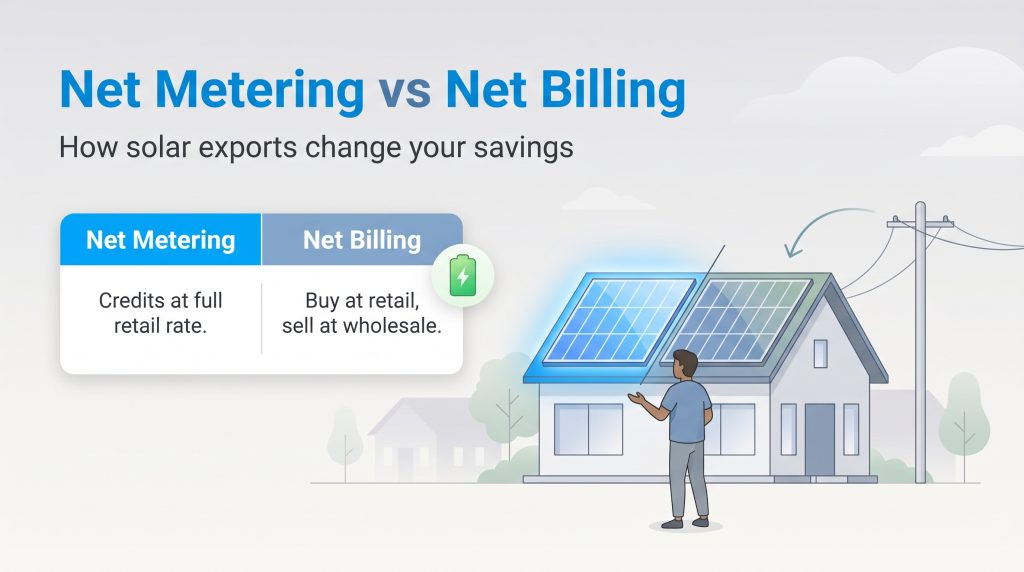
Here is a detailed breakdown of how these two dominant structures compare:
| Feature | Net Metering | Net Billing |
|---|---|---|
| Compensation Rate | 1-to-1 Retail Rate (High value) | Wholesale / Avoided Cost Rate (Low value) |
| How Credits are Applied | Credits offset energy kilowatt for kilowatt and roll over easily | Credits are assigned a monetary value that fluctuates, often settling at fractions of a cent |
| Long-term Savings Potential | Shorter payback period; oversizing panels yields maximum credits | Longer payback period; highly requires battery storage to capture true value |
If you are actively researching specific solar policies for your state, the NC Clean Energy Technology Center maintains the Database of State Incentives for Renewables & Efficiency (DSIRE). Checking this free database of state incentives is a vital first step to confirm exactly which compensation structure your local utility provider uses.
How Time-Of-Use Rates And True-Up Bills Affect Your Savings
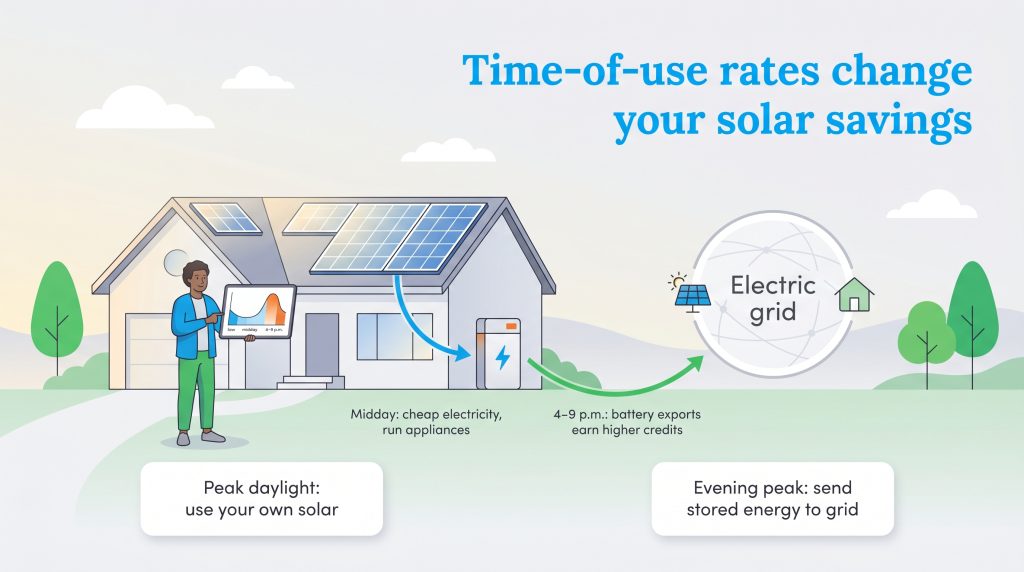
A central component of modern utility policies is the mandatory integration of time-of-use TOU rates. Under a TOU pricing plan, the cost of electricity is not fixed; instead, it fluctuates based on the specific time of day and the overall stress on the regional grid. Power is incredibly cheap during the middle of the day when massive solar farms are churning out abundant energy. However, prices skyrocket during peak evening hours — usually between 4:00 p.m. and 9:00 p.m. — when people return home from work, crank up their air conditioners, and the sun inevitably sets.
This dynamic means that energy exported at noon may be worth substantially less than energy imported at 7:00 p.m. To navigate this, homeowners need to optimize their solar usage. By running heavy appliances like your dishwasher, pool pump, and electric dryer during peak daylight hours, you consume your own off-peak solar power directly. If you invest in solar battery storage, you can physically capture that midday energy and discharge it to the grid in the evening to secure the highest possible credit valuation.
All of these daily credits and charges eventually culminate in an annual true-up bill. Instead of paying a fluctuating electric bill every month, solar owners usually just pay a nominal grid connection fee throughout the year. At the end of your 12-month billing cycle, the utility issues a true-up bill to reconcile your total energy consumed versus your total energy exported. If you consumed more than you produced, you owe a lump sum. If you produced more, your account resets and you might receive a small wholesale payout depending on your local regulations.
Understanding Virtual Net Metering For Renters And Shared Solar
If you rent an apartment, live under a strict homeowners association (HOA), or happen to have a roof completely shaded by historic oak trees, you might assume you cannot participate in the clean energy economy. Fortunately, you can still reap the financial benefits of solar through an innovative policy called virtual net metering.
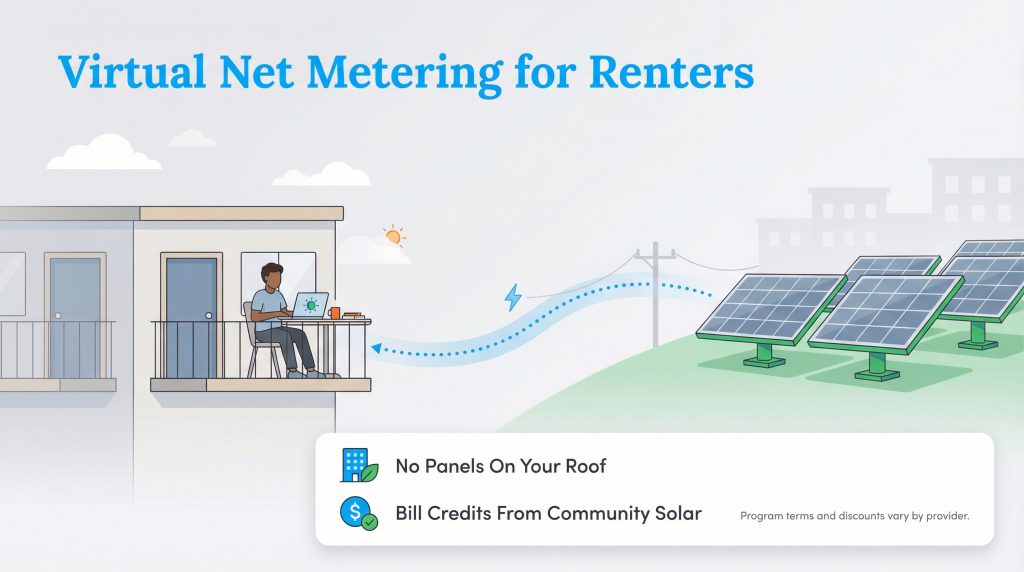
Virtual net metering allows households to receive utility bill credits for renewable energy generated by an off-site solar array. Instead of a 1-to-1 connection on your roof, the electricity produced by your designated share of a remote solar farm feeds directly into the broader grid. The utility company tracks this generation and applies the corresponding financial credits directly to your personal residential electric bill. Because subscribers avoid the high costs of solar panels and loans associated with traditional rooftop systems, it makes sustainable power highly accessible.
This flexible billing structure typically applies to three main scenarios:
- Community solar gardens: Large, off-site arrays where hundreds of local residents subscribe to a portion of the total energy output.
- Multi-family housing: Apartment complexes or condominiums where a single large rooftop solar array distributes equitable credits to individual tenant meters.
- Commercial properties: Business parks or agricultural co-ops that share solar generation across several distinct buildings and electric meters.
🌱 Eco Edge: Virtual net metering makes sustainable living possible for dense urban populations. By supporting community solar programs, you actively help decarbonize your local grid without altering your own living space.
Navigating State Policies And NEM 3.0 Changes
When discussing the aggressive transition away from 1-to-1 retail crediting, the most dramatic and widely discussed example is California’s NEM 3.0 changes. Implemented by the California Public Utilities Commission, Net Energy Metering 3.0 is a regulatory framework that drastically reduced the financial value of exported solar energy by roughly 75% compared to the state’s previous iteration. Instead of earning an equal trade for their power, homeowners are compensated based on an intricate avoided cost calculator that effectively forces new solar buyers to install home batteries to see a viable return.
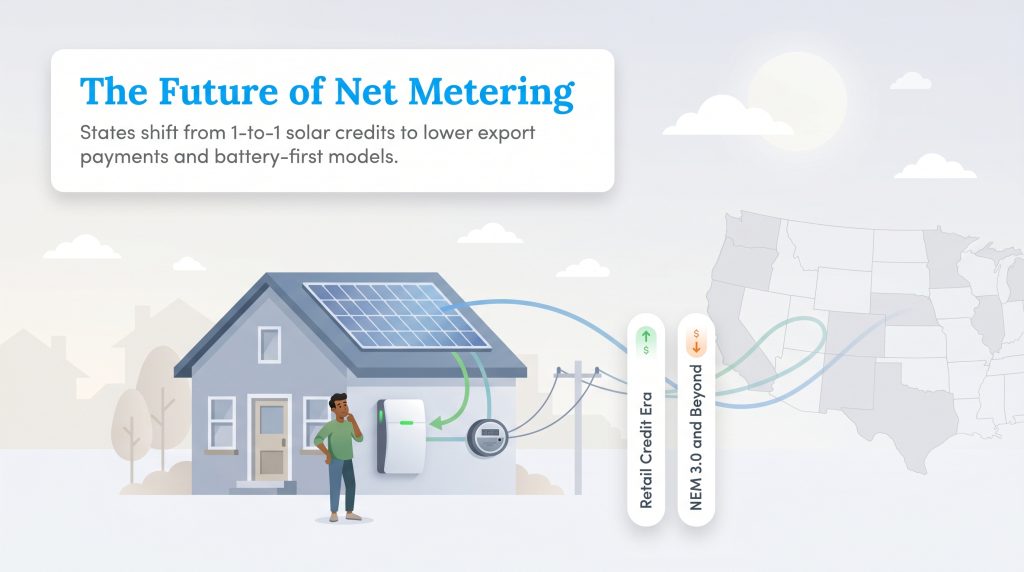
While this was initially a localized ruling, industry experts view it as a massive bellwether for the rest of the United States. Utility providers nationwide are closely monitoring this exact shift and actively proposing similar rate restructurings to their local governments. If you live in a state actively moving toward these modern net billing models — such as Hawaii, Arizona, or North Carolina — you must strongly prioritize installing home battery storage alongside your solar panels. By storing your excess energy on-site rather than exporting it for pennies, you bypass the unfavorable utility rates entirely and ensure a reliable return on your investment.
Preparing Your Home For A Solar Buyback Program
While the highly lucrative era of widespread 1-to-1 net metering is gradually fading in some regions, generating your own localized power remains one of the most effective ways to achieve true energy independence. The economics of solar ownership have simply shifted from basic export schemes to intelligent self-consumption strategies. By prioritizing smart energy management, securing renewable energy certificates (RECs) if your local market offers them, and exploring solar energy solutions tailored to your lifestyle, you can continue to see strong financial returns regardless of changing utility policies.
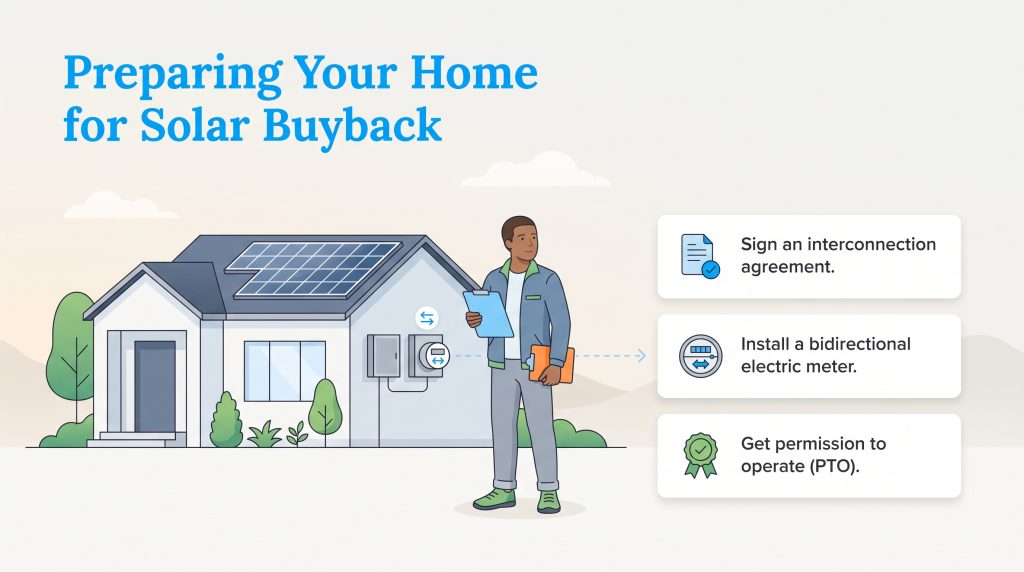
To make the smartest choice for your home, you must actively verify the policies and equipment required by your utility provider. Before you can actually flip the switch and start banking credits to save on your electric bill, you must formalize your system. Complete this strict administrative checklist before activating grid-tied solar systems:
- Sign an Interconnection Agreement: This legal contract between you and the utility provider outlines the safety standards, grid fees, and exact billing structure for your exported power.
- Install a Bidirectional Electric Meter: The utility company must physically swap out your old spinning meter for a modern bidirectional unit capable of actively tracking your outgoing solar exports.
- Obtain Permission to Operate (PTO): After a final safety inspection by local city officials, the utility will issue a formal PTO letter. You cannot legally turn on your solar array until you have this essential document in hand.
Maximizing Your Home Solar Energy Investment
Understanding the intricacies of net metering ensures you get the absolute most out of your home’s solar array. While the landscape of renewable energy compensation is shifting quickly from retail credits to wholesale net billing, adopting smart consumption habits and exploring home battery storage will keep you ahead of the curve. By taking the time to research your local utility’s specific solar buyback program, you can comfortably transition into a cleaner, more resilient, and highly cost-effective energy future.
Frequently Asked Questions About Net Metering
Is net metering going away?
Do I lose my net metering credits at the end of the year?
Do I need a solar battery if I have net metering?
Why did my electric bill go up if I have solar panels and net metering?
What happens to my solar credits if I move?
Can I go off-grid with net metering?
About the Author

LaLeesha has a Masters degree in English and enjoys writing whenever she has the chance. She is passionate about gardening, reducing her carbon footprint, and protecting the environment. She also recently served as President of the Board for City Sprouts (a community garden).

David has been an integral part of some of the biggest utility sites on the internet, including InMyArea.com, HighSpeedInternet.com, BroadbandNow.com, and U.S. News. He brings over 15 years of experience writing about, compiling and analyzing utility data.