


Solar Energy Prices Have Stabilized, Making 2026 an Excellent Time to Invest in a System That Can Pay for Itself in Under a Decade
Key Takeaways
- The average cost of a solar panel system typically sits between $13,000 and $33,600 for standard 5 kW to 10 kW arrays, based on 2026 national average pricing of $2.60 to $3.36 per watt.
- The homeowner-claimed 30% federal solar tax credit expired at the end of 2025 for cash and loan buyers, meaning the $20,300 average gross cost for a 7 kW system is now your baseline price before state rebates or third-party lease discounts.
- Return on investment often falls in the eight to 12 year range depending on local electricity rates and state incentives, after which the power generated by your panels is essentially free for the remainder of their 25-to-30-year lifespan.
Are you wondering how much do solar panels cost in 2026 after the major changes to federal energy policy? If you’re exploring renewable energy for your household, knowing the bottom line is your top priority, so we’ll cut straight to the numbers: the national average cost of a standard 7-kilowatt (kW) system in 2026 is $20,300 before state incentives. Because Congress allowed the homeowner-claimed 30% federal solar tax credit to expire at the end of 2025 for direct cash and loan purchases, that $20,300 gross figure is now your true baseline price unless you live in a state with local rebates or utilize a third-party lease pass-through. Seeing a price tag akin to a home remodel can cause immediate sticker shock, but fixating solely on that upfront expense misses the massive long-term financial benefits. Between achieving energy independence, shielding your monthly budget from aggressive utility rate hikes, and locking in decades of nearly free electricity, the solar panel return on investment remains remarkably strong. We’re breaking down everything you need to know about navigating the post-credit market, including the average cost of solar panels by state, individual panel pricing, hardware versus soft costs, and the hidden installation fees that sales reps often downplay, so you can confidently make an environmentally mindful choice for your home.
Average Cost of Solar Panels in 2026
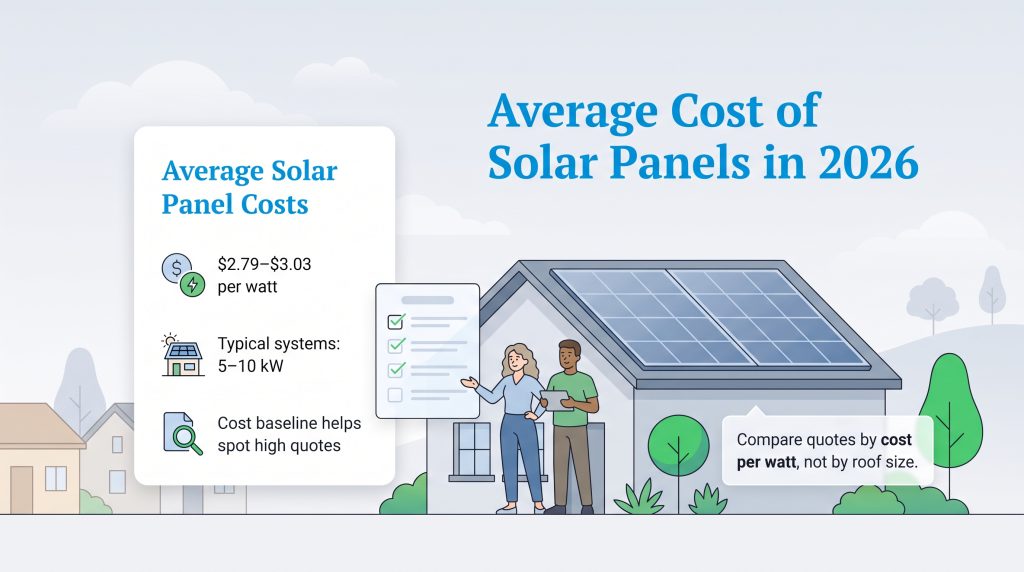
If you want to know exactly what you’ll pay, the national average solar panel installation cost in 2026 sits between $2.60 and $3.36 per watt. For a standard residential setup, which usually ranges from 5 kW to 10 kW depending on your household’s daily power habits, you can expect to pay anywhere from $13,000 to $33,600 before any state rebates or utility incentives are applied. After a period of industry restructuring following the shift in federal tax policy at the end of 2025, equipment pricing has stabilized as domestic manufacturing scaled up and installers trimmed their overhead margins to keep solar competitive for the everyday consumer.
Understanding these baseline averages is your best defense before sitting down with a solar sales representative. When you know current market rates, you can easily spot an inflated quote right out of the gate. Keep in mind that your specific final price tag will ultimately depend on the tier of equipment you select, the structural pitch of your roof, and prevailing electrician wages in your area.
Solar Panel Cost per Watt Explained
A common misconception among homeowners starting their research is that solar arrays are priced like flooring, decking, or roofing shingles. Solar installation companies don’t price systems by the square foot. Instead, they price them strictly by wattage and total generating capacity.
Why does the industry work this way? Solar panels vary wildly in their efficiency ratings and cellular technology. When weighing budget solar panels against premium options, a top-tier panel might generate 440 watts in the exact same physical footprint that an older budget panel uses to generate 350 watts. Because you’re essentially buying a miniature power plant for your roof, the physical space it occupies matters much less than the amount of electricity it produces over 25 years. Evaluating multiple contractor bids using the solar panel cost per watt metric is the only reliable way to ensure an apples-to-apples comparison. Just divide the total quoted contract price by the system’s total wattage (for example, a 7 kW system is 7,000 watts). If a contractor quotes you $20,300 for a 7,000-watt system, your cost is $2.90 per watt — right in the sweet spot of the 2026 national average.
How Much Does One Solar Panel Cost?
Whether you’re pricing out a small off-grid DIY project for a detached workshop or budgeting to replace storm-damaged equipment on your roof, you might be wondering: how much does one solar panel cost on its own? In 2026, buying an individual residential-grade solar panel costs between $200 and $350 at retail. That price variance comes down to the panel’s wattage rating (which typically ranges from 400W to 450W for modern residential modules) and its underlying silicon architecture. Standard monocrystalline PERC panels sit at the lower end of that price bracket around $200 to $260 per module, whereas next-generation N-Type TOPCon (Tunnel Oxide Passivated Contact) or heterojunction (HJT) panels command $280 to $350 because they handle extreme summer heat better and degrade much slower over time.
It’s crucial to understand that single-panel retail prices only cover the raw photovoltaic glass and aluminum frame. They exclude microinverters, racking rails, weatherproof roof flashing, copper conduit wiring, and professional electrical labor. Furthermore, if a falling tree limb cracks a single panel on your existing rooftop array, you won’t just pay $250 for the replacement glass. Replacing one damaged panel on an active residential system typically costs between $400 and $700 in total. That higher bill accounts for shipping a single oversized freight item, truck-roll service fees, and paying a licensed two-person crew to safely climb your roof, unbolt the racking, de-energize the circuit, and commission the replacement unit.
Solar Panel Cost by System Size
Understanding “kilowatts” can feel overwhelming if you’re just trying to figure out what fits on your roof. In reality, the exact size of the array you need depends far more on your family’s monthly electricity consumption habits — like running central air conditioning all summer, heating a pool, or charging an electric vehicle — than the physical square footage of your house. Because systems are priced directly by their total energy capacity, right-sizing your array is vital to controlling your total solar panel installation cost.
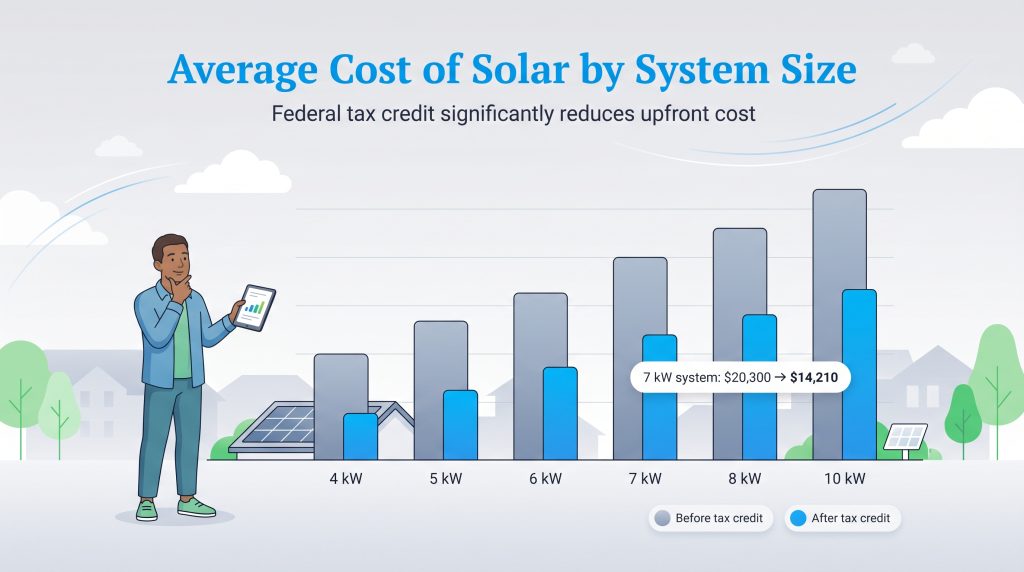
If you’re calculating the cost of solar panels for a 2000 sq ft home, the typical annual energy demand hovers around 10,000 to 11,500 kilowatt-hours (kWh) per year. To comfortably offset this standard level of consumption, installers generally recommend a system size of around 7 kW (which requires about 17 to 18 individual 400-watt panels). Based on the 2026 national average of $2.90 per watt, a 7 kW system carries an out-of-pocket cost of $20,300. In previous years, homeowners buying with cash or a loan could rely on a $6,090 federal tax deduction to drop that price down to $14,210. With that direct homeowner credit now expired for 2026, $20,300 stands as your true net baseline cost unless you qualify for state-specific rebates or utilize a third-party lease structure.
To help you visualize how different capacities impact your wallet and long-term utility budget, the table below outlines the average cost of solar panels across common system sizes, along with panel counts and projected 25-year electricity savings.
| System Size (kW) | Average Total Cost (2026 Baseline) | Estimated Number of Panels (400W) | Estimated 25-Year Utility Savings | Estimated Home Square Footage |
|---|---|---|---|---|
| 4 kW | $11,600 | 10 panels | $28,500 | 1,000 – 1,200 sq ft |
| 5 kW | $14,500 | 13 panels | $35,600 | 1,200 – 1,500 sq ft |
| 6 kW | $17,400 | 15 panels | $42,700 | 1,500 – 1,800 sq ft |
| 7 kW | $20,300 | 18 panels | $49,800 | 1,800 – 2,200 sq ft |
| 8 kW | $23,200 | 20 panels | $57,000 | 2,200 – 2,500 sq ft |
| 10 kW | $29,000 | 25 panels | $71,200 | 2,500 – 3,500 sq ft |
These figures provide a reliable benchmark based on broad market data consistent with reports from the National Renewable Energy Laboratory (NREL) and 2026 national electricity pricing. Notice that because panels come in whole units, a 5 kW system using 400W panels rounds up to 13 panels (5.2 kW actual capacity), while a 7 kW system rounds to 18 panels (7.2 kW). If you’re still unsure what capacity fits your household, you can learn more about how these systems scale in our comprehensive solar energy guide.
Average Cost of Solar Panels by State
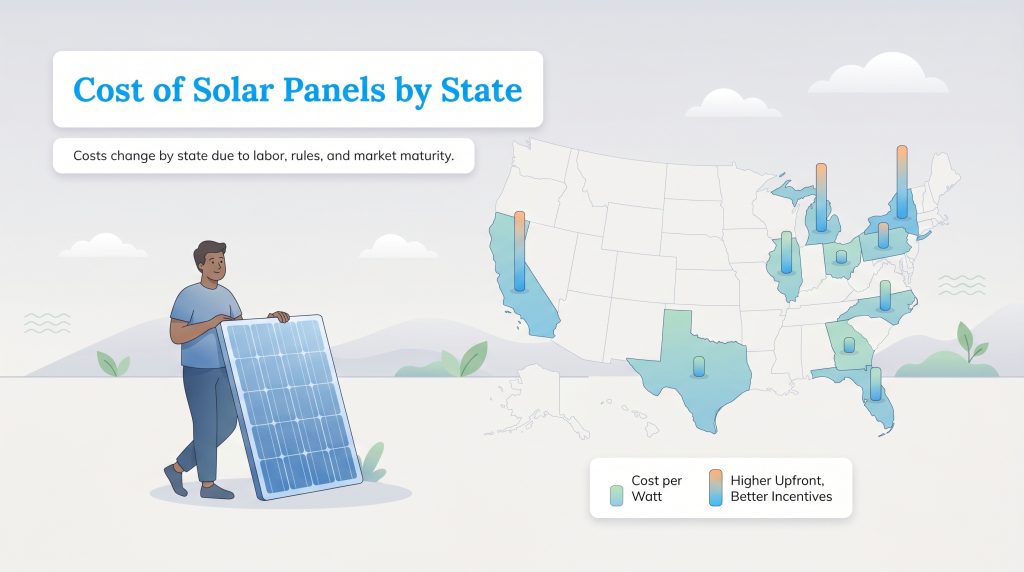
Geography plays a massive role in both your final installation invoice and how quickly your panels pay for themselves. Local electrician wages, state-specific building codes, wind-load engineering rules (such as hurricane ratings in coastal zones), and local installer competition all heavily influence regional pricing. States with mature solar markets often use automated municipal permitting platforms like SolarApp+, which cuts administrative red tape and lowers soft costs for contractors.
Just as important as the upfront equipment cost is what your local utility charges for grid power and how generously your state rewards renewable adoption. To give you a complete picture of regional variances, the table below breaks down the 2026 average cost of solar panels by state for a 7 kW system across the 10 most populated U.S. states, alongside average monthly electric bills from the U.S. Energy Information Administration (EIA) and current state incentive availability.
| State | Average Cost Per Watt | Average 7 kW System Cost | Average Monthly Electric Bill (EIA) | State Incentive Grade / Availability |
|---|---|---|---|---|
| California | $3.15 | $22,050 | $215 | B (Strong battery rebates via SGIP; NEM 3.0 lowers export rates) |
| Texas | $2.60 | $18,200 | $175 | B- (No state tax credit, but lucrative utility rebates & retail buyback plans) |
| Florida | $2.65 | $18,550 | $180 | B (100% sales & property tax exemptions; full retail net metering) |
| New York | $3.20 | $22,400 | $168 | A (25% state tax credit up to $5,000 + NY-Sun megawatt block rebates) |
| Pennsylvania | $2.95 | $20,650 | $152 | B+ (Active SREC market & full retail net metering) |
| Illinois | $3.00 | $21,000 | $138 | A+ (Illinois Shines SREC program covers 25%–35% of system cost upfront) |
| Ohio | $2.85 | $19,950 | $145 | C+ (SREC market access & local property tax exemptions in select cities) |
| Georgia | $2.70 | $18,900 | $165 | D (Limited net metering caps; no statewide solar tax credit) |
| North Carolina | $2.75 | $19,250 | $155 | B- (Duke Energy PowerPair battery & solar rebates up to $9,000; revised net metering) |
| Michigan | $3.10 | $21,700 | $142 | C+ (Property tax exemptions & distributed generation inflow/outflow credits) |
While states like New York, Illinois, and California show higher upfront installation prices due to steeper labor markets and stringent building codes, they frequently offset that initial sting. In New York and Illinois, state tax credits and upfront clean energy rebates can shave $5,000 to $7,500 straight off your net investment. Meanwhile, in sun-belt states like Texas and Florida, rock-bottom per-watt installation prices ($2.60 to $2.65 per watt) combined with high year-round air conditioning bills create a fast natural payback without needing heavy state subsidies.
What Changed in 2026 For Federal Tax Credits & Local Incentives
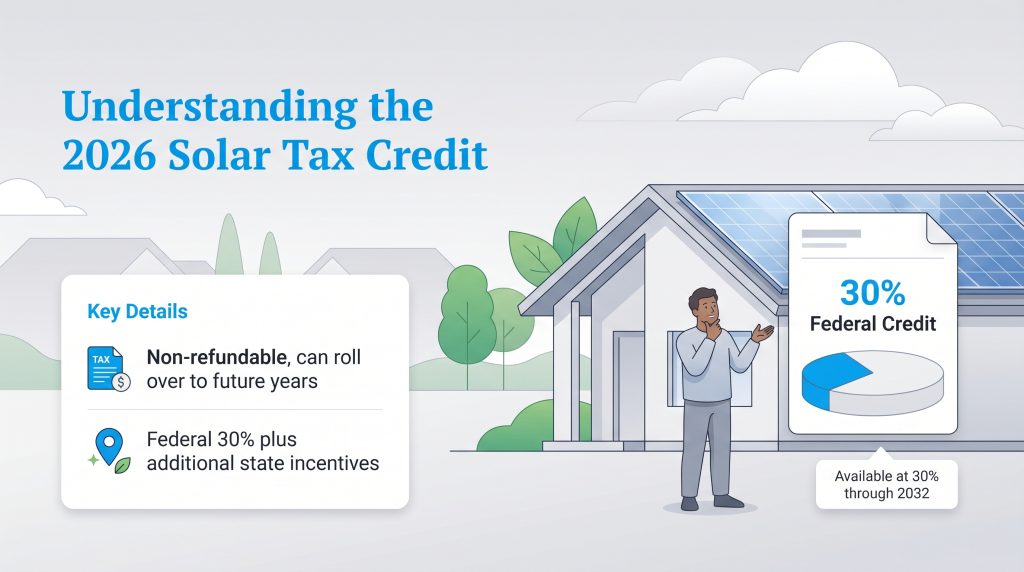
If you’ve been researching solar for a while, you probably read countless articles claiming the 30% Residential Clean Energy Credit (Internal Revenue Code Section 25D) was locked in until 2032 under the Inflation Reduction Act. However, a major legislative overhaul passed by Congress in 2025 repealed the individual residential solar tax credit effective Dec. 31, 2025. As a result, the federal solar tax credit 2026 landscape looks completely different for everyday homeowners.
Here is the exact rule for 2026: if you purchase a rooftop solar system directly using cash or a traditional solar loan, you can no longer claim a 30% deduction on your personal federal income taxes via IRS Form 5695. The only homeowners claiming that personal credit on their tax returns this year are those whose systems were fully installed and placed in service prior to the end of 2025, or those carrying forward unused credit balances from a prior tax year.
While losing the direct 30% homeowner write-off was a tough blow for cash buyers, federal incentives haven’t vanished entirely from the residential rooftop sector. Instead, the financial advantage shifted toward commercial tax provisions and aggressive state-level programs.
The Section 48 Lease and PPA Workaround
When Congress terminated the Section 25D personal tax credit for individual homeowners at the end of 2025, it preserved the commercial clean energy investment tax credit (Section 48 / Section 48E) for businesses that own and operate energy-generating assets. That single legislative distinction created the most important financial workaround in the 2026 solar market.
When you sign a solar lease or a Power Purchase Agreement (PPA), you don’t legally own the panels on your roof — the solar financing company does. Because that financing provider is a commercial entity putting a power-generating asset into service, they can still legally claim the 30% federal commercial tax credit (and sometimes an extra 10% domestic content bonus credit) on the system installed on your home.
To win your business in 2026, reputable solar installers and third-party financiers pass a massive chunk of that federal tax credit directly down to you. Homeowners are leveraging this loophole in two distinct ways:
- Prepaid Solar Leases: If you wanted to buy solar with cash, a prepaid lease is now the smartest alternative. You make a single upfront payment to the leasing company, and they apply the commercial tax credit immediately to reduce your upfront price by 15% to 25%. On a $20,300 system, a prepaid lease can drop your one-time cost down to roughly $15,200 to $17,250, with contracts structured to transfer system ownership to you after year five or six once the federal tax recapture period ends.
- Monthly Leases and PPAs with Lower Escalators: For zero-down monthly plans, third-party owners use their federal tax savings to subsidize the monthly kilowatt-hour rate they charge you, resulting in immediate day-one savings of 15% to 30% below your local utility’s retail electricity rate.
State Rebates, SRECs, and Net Metering
Whether you buy your panels outright or use a lease workaround, local incentives play a massive role in trimming your net price. Across the country, states, municipalities, and electric utilities offer three main types of financial perks:
- State Tax Credits and Cash Rebates: Several states offer their own income tax deductions or direct cash-back grants that remain fully active in 2026. For example, New York lets residents deduct 25% of their solar equipment cost (up to $5,000) from their state taxes, while Massachusetts offers a $1,000 state tax credit alongside its SMART energy production program.
- Solar Renewable Energy Certificates (SRECs): In states with Renewable Portfolio Standards — including Illinois, Pennsylvania, New Jersey, Ohio, Maryland, Virginia, and Washington, D.C. — you earn one tradable SREC for every megawatt-hour (1,000 kWh) of electricity your panels produce. A standard 7 kW system generates roughly eight to 10 SRECs per year. Depending on your state’s market value, selling these certificates yields anywhere from $300 to over $1,500 in cash annually, or an upfront lump sum of $4,000 to $7,000 in markets like Illinois.
- Net Metering Programs: Net metering is the billing mechanism that credits your utility account whenever your panels send surplus daytime electricity back to the public grid. In states with 1-to-1 retail net metering, every kilowatt-hour you export erases a full kilowatt-hour you pull from the grid at night.
Before signing any installation contract, we strongly recommend searching your zip code on DSIRE (Database of State Incentives for Renewables & Efficiency) or checking Energy.gov to verify the exact state tax exemptions, property tax waivers, and utility rebates currently funded in your community.
Solar Installation Cost Breakdown of Hardware vs Soft Costs
When you see that an individual solar panel only costs around $250, it’s natural to do some quick mental math: 18 panels multiplied by $250 equals $4,500. Why, then, does a professional installer hand you a quote for $20,000? The reality of modern residential solar is that physical hardware makes up only about a third of your total invoice, while “soft costs” — labor, engineering, permitting, and business overhead — make up the majority.
To give you complete transparency into where your money actually goes during a turnkey installation, here is the itemized cost breakdown for a standard $20,000 residential solar project in 2026:
| Cost Category | Percentage of Total Cost | Estimated Dollar Amount ($20,000 System) | What This Covers |
|---|---|---|---|
| Solar Panels | 12% – 15% | $2,400 – $3,000 | 16 to 18 tier-one monocrystalline or N-Type TOPCon photovoltaic modules |
| Inverter & Balance of System / Racking | 15% – 20% | $3,000 – $4,000 | Microinverters or string inverter, aluminum roof rails, lag bolts, flashing, disconnect switches, and copper conduit |
| Installation Labor | 15% | $3,000 | On-site wages for licensed master electricians, roofers, and certified solar mounting technicians |
| Permitting, Inspection & Interconnection Fees | 5% – 10% | $1,000 – $2,000 | Structural PE engineering stamps, municipal building permits, city inspections, and utility grid PTO fees |
| Installer Overhead, Marketing & Supply Chain | 40% – 50% | $8,000 – $10,000 | Customer acquisition/sales commissions, warehousing, fleet vehicles, general liability insurance, and 25-year workmanship warranty reserves |
Seeing 40% to 50% of your budget go toward installer overhead and supply chain expenses can feel frustrating, especially when sales commissions alone can eat up 10% to 15% of a quote from aggressive door-to-door companies. However, you can actively shrink that soft-cost category. By bypassing national door-to-door sales brokers and requesting bids directly from established, local solar electrical contractors who rely on word-of-mouth rather than massive marketing budgets, you can often shave $2,000 to $3,500 off that overhead slice without sacrificing equipment quality.
5 Key Factors That Impact Your Solar Installation Cost
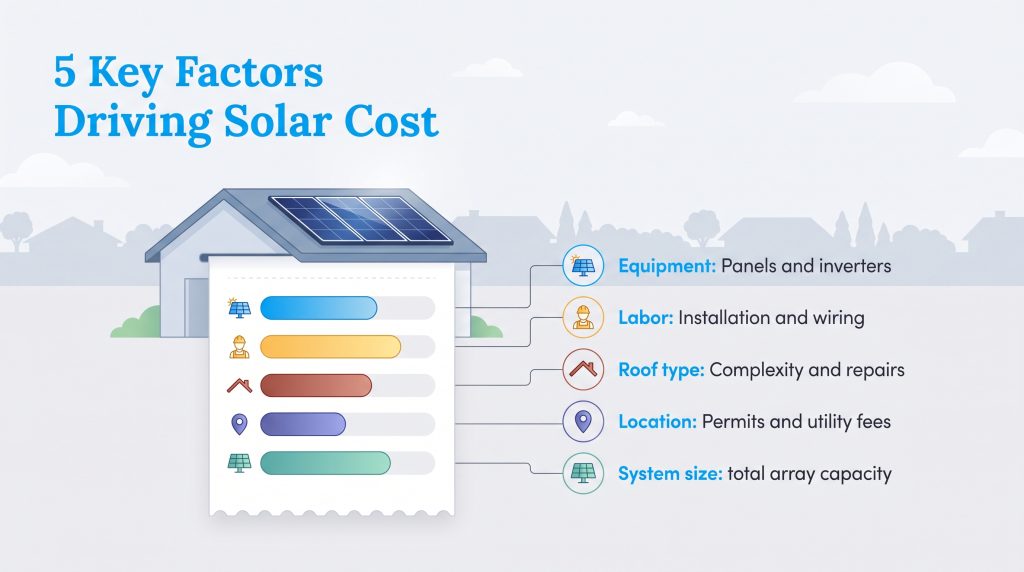
While the breakdown above reflects national norms, no two rooftops are identical. Two neighbors with the exact same square footage can easily receive quotes that differ by $4,000 or more. Understanding the five core variables that sway your project pricing helps you spot where a contractor is adding legitimate engineering costs versus unnecessary markups:
- Equipment Tier and Inverter Architecture: When evaluating different types of solar panels, choosing high-efficiency N-Type panels from top-tier manufacturers will raise your cost per watt by $0.15 to $0.25 over standard budget modules, but they deliver better low-light output and slower annual degradation. Similarly, equipping each panel with its own microinverter (like Enphase) or DC power optimizer costs roughly $1,500 to $2,500 more than a single wall-mounted string inverter, though microinverters prevent a single shaded panel from dragging down your entire array’s production.
- Local Labor Rates: Making up roughly 54% of your on-site soft costs, prevailing electrical and roofing wages vary substantially by zip code. Hiring certified NABCEP (North American Board of Certified Energy Practitioners) installers and licensed master electricians costs more in major metro areas, but guarantees safe wiring that won’t void your homeowner’s insurance.
- Roof Pitch, Complexity, and Material: A simple, south-facing asphalt shingle roof with a gentle slope is the cheapest surface to outfit. If your roof has multiple steep hip angles, dormers, or skylights, crews must split the array into smaller sub-sections using extra conduit runs, adding $500 to $1,500 in labor. Fragile roofing materials like Spanish clay tile, slate, or wood shake require specialized tile-hook brackets and painstaking hand-removal work, adding $1,500 to $3,000 to the bill. Conversely, standing-seam metal roofs can actually lower your hardware costs because installers can clamp rails directly onto the metal seams without drilling a single hole.
- Location and Permitting Rules: Your municipality dictates everything from structural snow-load and wind-uplift engineering requirements to mandatory fire-setback pathways on your roof. Cities with slow, in-person permitting departments and utilities with complex grid-interconnection reviews pass those administrative hours directly onto your quote.
- System Size and Economies of Scale: Larger arrays require more physical panels, extra racking rails, and heavier gauge wire. However, fixed costs like building permits, engineering stamps, and crew mobilization remain the same whether you install 10 panels or 25. As a result, a 10 kW system almost always carries a lower price per watt ($2.70/W) than a tiny 4 kW system ($3.10/W).
Hidden Costs of Installing Solar Panels
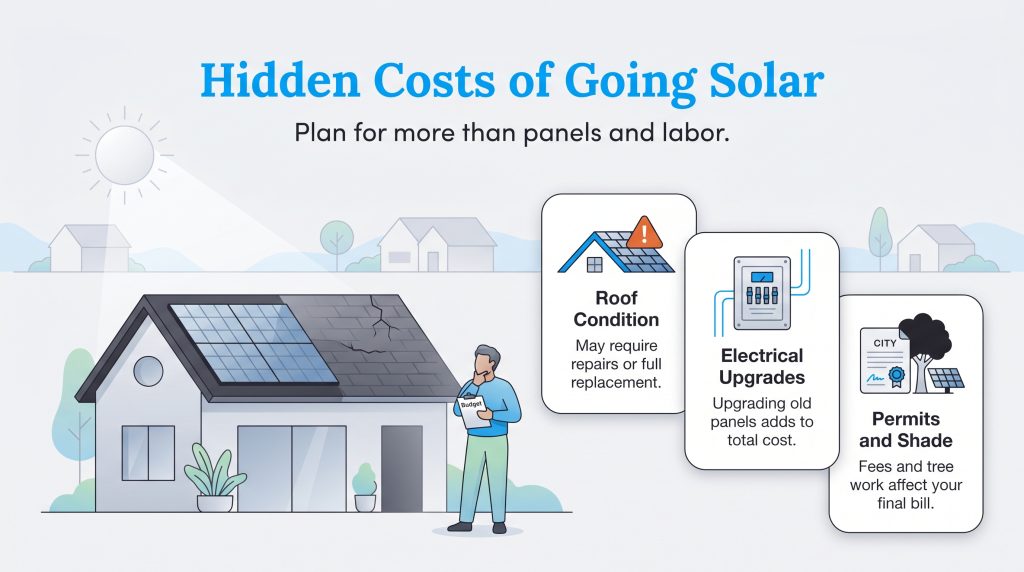
Initial solar proposals are notorious for showcasing a sleek, all-inclusive price tag — right up until the site engineer visits your home and uncovers structural or electrical hurdles. Budgeting for the hidden costs of installing solar panels ahead of time ensures your payback math doesn’t get derailed halfway through the project.
Beyond standard equipment and labor, watch out for these five commonly overlooked expenses:
- Main Electrical Panel Upgrades ($1,500 – $3,500): Older homes still running on 100-amp electrical service frequently lack the busbar capacity to safely accept backfed solar current under the National Electrical Code’s “120% rule.” Upgrading to a modern 200-amp main breaker panel — or installing a smart load-management collar — is a common surprise add-on.
- Roof Replacement or R&R Fees ($2,500 – $15,000+): Solar panels last 25 to 30 years, whereas standard asphalt shingle roofs last 20 to 25 years. If your roof is already 15 years old, putting solar on top of it is a costly mistake. When your shingles eventually fail five years later, paying a solar crew to detach and reset (“Remove & Reinstall” or R&R) your array so roofers can work underneath will cost you $2,500 to $6,000 out of pocket. Always replace an aging roof (or at least the section under the array) before mounting panels.
- Homeowners Insurance Premium Increases ($100 – $350/year): Because a rooftop solar system adds $20,000+ in replacement value to your dwelling structure, most insurance carriers will raise your coverage limit to match. In storm-prone states like Florida or Texas, be sure to call your insurance agent first to confirm your policy covers rooftop arrays without adding massive windstorm deductibles.
- Critter Guards and Ongoing Maintenance ($500 – $1,200): Squirrels and pigeons love nesting in the warm, sheltered gap beneath solar panels, where they frequently chew through exposed DC wiring. Having your installer wrap the perimeter of the array in heavy-gauge wire mesh (critter guards) on day one costs $500 to $900, saving you thousands in emergency re-wiring bills later. You should also budget $150 to $300 every year or two for professional panel washing if you live in a dusty, low-rainfall region.
- Mid-Life Inverter Replacement ($1,500 – $3,000): While solar panels and microinverters generally carry 25-year warranties, central string inverters only last 10 to 15 years. If you choose a string inverter setup to save money upfront, you’ll need to budget for one hardware replacement halfway through your system’s life.
💡 Quick Fact: Shade is the absolute enemy of solar production. You may need to pay $500 to $2,000 for professional tree trimming or removal initially and budget for ongoing landscaping maintenance to keep your panels in direct sunlight year-round.
Adding a Battery and Solar Panel Cost With Battery Storage
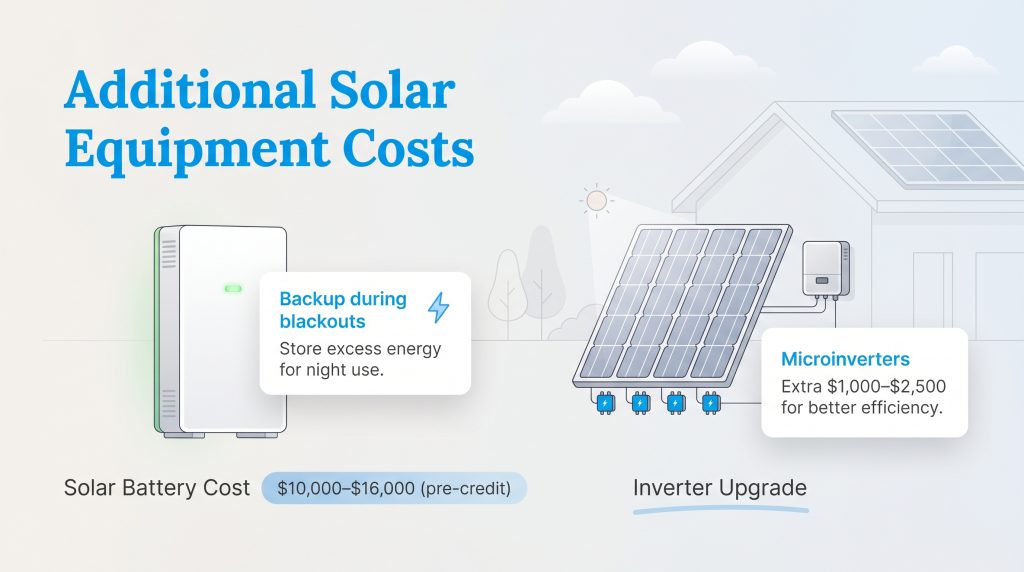
Standard installation quotes cover the hardware needed to push power directly into your home and out to the utility grid. However, a growing percentage of homeowners now pair their panels with home energy storage, making the solar panel cost with battery storage one of the most important pricing figures in 2026.
Why doesn’t a standard solar system work during a power outage? When you understand how solar panels work with the public utility grid, the safety restriction makes sense: by law, grid-tied solar inverters must automatically shut down the second a neighborhood blackout occurs so they don’t accidentally send lethal voltage into power lines that utility crews are trying to repair. Adding a solar battery (along with an automatic transfer switch or backup gateway) allows your home to “island” itself from the dead grid, keeping your appliances running at night and seamlessly recharging when the sun comes up the next morning.
In 2026, integrating a high-capacity lithium iron phosphate (LFP) solar battery — such as a Tesla Powerwall 3, Enphase IQ Battery 5P, or FranklinWH system — adds between $10,000 and $16,000 to your project cost for a standard 10 kWh to 13.5 kWh unit. That brings the total solar panel cost with battery storage for a 7 kW system to roughly $30,300 to $36,300 before state or utility storage rebates. (Note: Bundling a battery during your initial solar installation saves you $2,000 to $3,500 in overlapping permitting and electrical labor compared to retrofitting a battery onto an existing system years later.)
While batteries represent a hefty financial commitment, there are three specific scenarios where installing one is a smart move:
- Lack of 1-to-1 Net Metering (Solar Billing Plans): In states where utilities have slashed export credit rates by 75% or more — such as California under NEM 3.0, as well as parts of North Carolina, Arizona, and Texas — sending excess midday power back to the grid earns you pennies on the dollar. Storing your own cheap daytime solar electricity in a battery and discharging it to run your home at night is the only way to achieve a fast payback in these markets.
- Steep Time-of-Use (TOU) Rate Structures: If your electric company charges aggressive peak rates between 4:00 p.m. and 9:00 p.m. (often $0.35 to $0.60+ per kWh), deploying stored battery power during those evening hours shields you from buying peak-priced grid electricity when your family gets home from work and school.
- Frequent Grid Outages and Virtual Power Plants (VPPs): If you live in an area plagued by severe storms, wildfire shutoffs, or grid instability, a battery keeps your refrigerator, well pump, medical devices, and Wi-Fi running without the noise or carbon monoxide hazards of a gas generator. Plus, utilities in states like California, Massachusetts, Connecticut, and Texas now pay battery owners $500 to $1,500 per year to join Virtual Power Plant programs that let the utility tap into excess battery reserves during summer heatwaves.
How to Pay for Solar With Cash, Loans, Leases, and PPAs
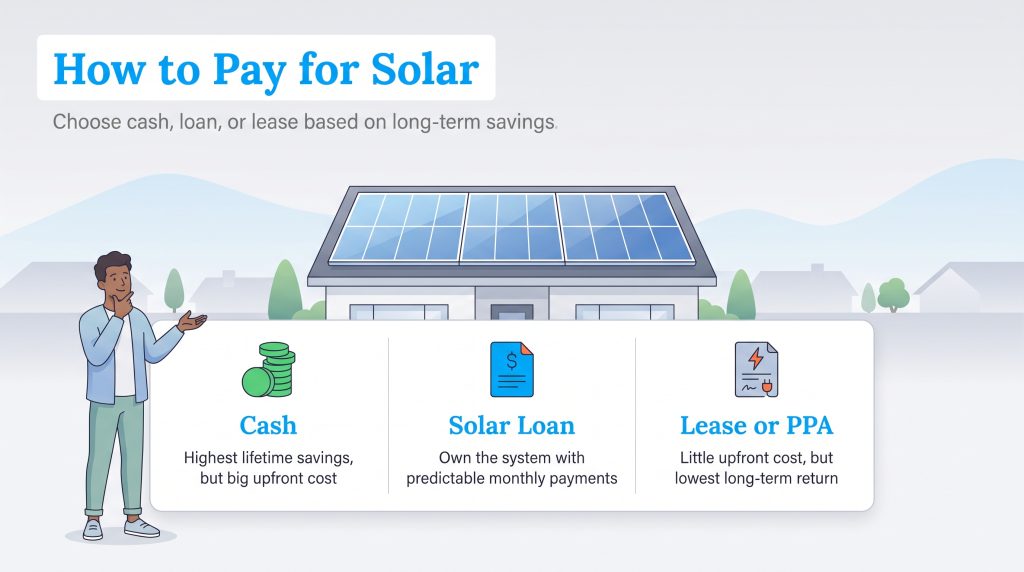
How you choose to pay for your installation affects your lifetime savings just as much as the equipment you put on your roof. Furthermore, the 2026 rules around solar financing vs leasing have flipped conventional wisdom on its head. For over a decade, financial advisors universally warned homeowners to avoid solar leases because leasing meant forfeiting the 30% federal tax credit. Now that individual homeowners can no longer claim that 30% credit on cash or loan purchases anyway, third-party leases and Power Purchase Agreements (PPAs) have surged back into the spotlight as a highly competitive way to capture federal tax savings indirectly.
To help you weigh your options, the table below compares the four primary ways to fund a residential solar system in 2026:
| Payment Method | Upfront Cost | Eligible for Federal Credit Pass-Through? | Impact on Home Value |
|---|---|---|---|
| Cash Purchase | 100% of system cost ($18,000 – $25,000+) | No (Section 25D residential credit expired end of 2025) | High Positive (+4% avg.): System is a fully owned, debt-free asset that transfers seamlessly to homebuyers |
| Solar Loan (or HELOC) | $0 to minimal down payment | No (Homeowner owns system, so no commercial credit applies) | Moderate Positive: Adds equity once paid off, though outstanding solar loan liens must be settled at closing |
| Prepaid Solar Lease / PPA | 75% – 85% of cash price ($14,500 – $17,500) | Yes: Commercial owner claims 30% Section 48 credit and discounts your upfront lump sum by 15%–25% | Positive: No monthly payments left for homebuyers to assume; ownership typically transfers after year 5 or 6 |
| Monthly Solar Lease or PPA | $0 down | Yes: Commercial owner uses Section 48 credit to subsidize lower monthly kWh rates | Neutral to Complicated: Does not build home equity; homebuyers must qualify to assume the monthly contract or seller must buy it out |
Let’s take a closer look at the pros and cons of each route in today’s market:
- Paying with Cash: Buying your system outright gives you 100% ownership from day one with zero interest charges, zero monthly solar bills, and full control over local SRECs and state tax credits. While you no longer get a federal tax write-off, cash buyers avoid all financing fees and capture every single penny of utility savings over 25 years.
- Using a Solar Loan or HELOC: If you want to own your equipment without draining your savings account, financing is the standard route. However, watch out for “low-APR” dealer loans offered by solar salespeople. A loan advertised at 3.99% APR almost always hides a massive 20% to 30% “dealer origination fee” baked into your principal balance, instantly inflating a $20,000 system to $26,000. In 2026, you’re almost always better off securing a transparent, zero-dealer-fee loan through a local credit union or taking out a Home Equity Line of Credit (HELOC), where the interest may even be tax-deductible.
- Signing a Solar Lease or PPA: Under a lease (fixed monthly rent for the hardware) or a PPA (paying a fixed per-kWh rate for the power the panels generate), a third-party company owns, insures, monitors, and maintains the array on your roof for 20 to 25 years. Because that company claims the 30% commercial Section 48 federal tax credit in 2026, they can offer monthly payments that are significantly lower than a unsubsidized solar loan. Just make sure you read the fine print: never sign a lease with an annual “escalator clause” higher than 1.9% to 2.9% per year, and ask for a clear buyout schedule in case you sell your house early.
🚩 Heads Up: If you have the cash on hand to buy solar in 2026, ask your installer if they offer a Prepaid Lease with an Early Buyout Option. This hybrid arrangement lets a commercial financing partner claim the 30% federal tax credit, pass a 15% to 25% upfront discount to you, and transfer full legal ownership of the panels to you after year five or six for a nominal fee.
Are Solar Panels Worth It Without the Federal Tax Credit?
With the direct 30% homeowner tax credit off the table in 2026, it’s fair to ask: are solar panels still worth the money? For homeowners living in areas where retail electricity rates are near or above the national average, committing to an energy-saving option like solar remains a winning investment. Why? Because utility companies haven’t stopped raising their rates. Driven by grid modernization costs and surging electricity demand from AI data centers and electric vehicles, national average residential electricity prices have climbed to roughly 18.8 cents per kWh in 2026 (and well over 30 to 40 cents per kWh in the Northeast and California).
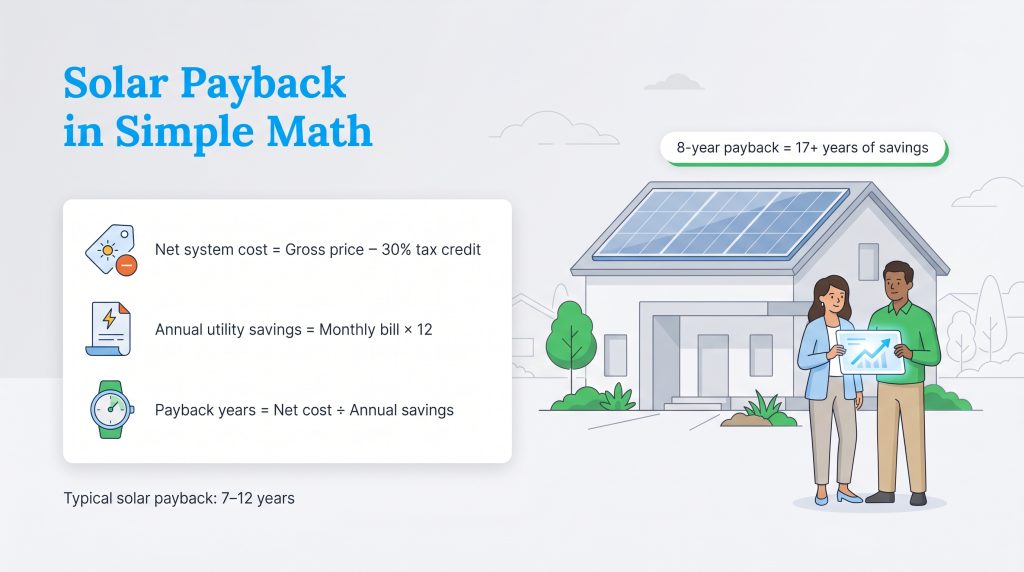
A standard solar panel return on investment calculation centers on your “payback period” — the exact number of years it takes for your cumulative electric bill savings to equal your initial out-of-pocket cost.
You can calculate your realistic 2026 payback timeline in three simple steps:
- Determine Your Net System Cost: Start with your gross installation quote and subtract any state tax credits, utility rebates, SREC upfront payments, or prepaid lease discounts. For example, take a standard $20,000 gross system cost and subtract a realistic $2,000 state or utility rebate, which leaves a $18,000 net cost.
- Calculate Your Annual Utility Savings: A 7 kW solar system generates roughly 10,000 kWh of electricity per year in a moderately sunny climate. Multiply that annual production by the 2026 national average electricity rate of 18.8 cents ($0.188) per kWh (10,000 kWh × $0.188 = $1,880 saved in year one, or about $157 per month).
- Divide Net Cost by Annual Savings: Divide your net cost ($18,000) by your annual electricity savings ($1,880) to find your baseline payback period. In this scenario, $18,000 ÷ $1,880 = 9.57 years.
In fact, that 9.5-year estimate is actually conservative because it assumes your electric company will never raise its rates again. If utility rates continue climbing by a modest 3.5% per year, your annual savings grow larger every single summer, pulling your true payback period closer to 8.4 years. Because modern solar panels carry 25-year warranties and have an operational lifespan of 30+ years, hitting payback in year eight or nine leaves you with over two decades of debt-free, profit-generating power.
💸 Money-Saver: Ready to see your exact numbers? Using an online solar panel cost calculator that factors in your zip code and average monthly electric bill will provide a much more accurate quote tailored to your local utility rates and sun exposure.
Preparing Your Roof and Wallet for Solar Energy
Transitioning to home solar power takes a bit of homework, especially now that navigating state rebates and financing structures matters more than ever. Even without the direct federal tax write-off, solar remains one of the very few home improvements that actively pays for itself over time. The combination of immediate monthly utility relief, insulation against volatile grid rate hikes, and stronger property resale value makes rooftop solar a resilient, sustainable choice for your household’s financial future.
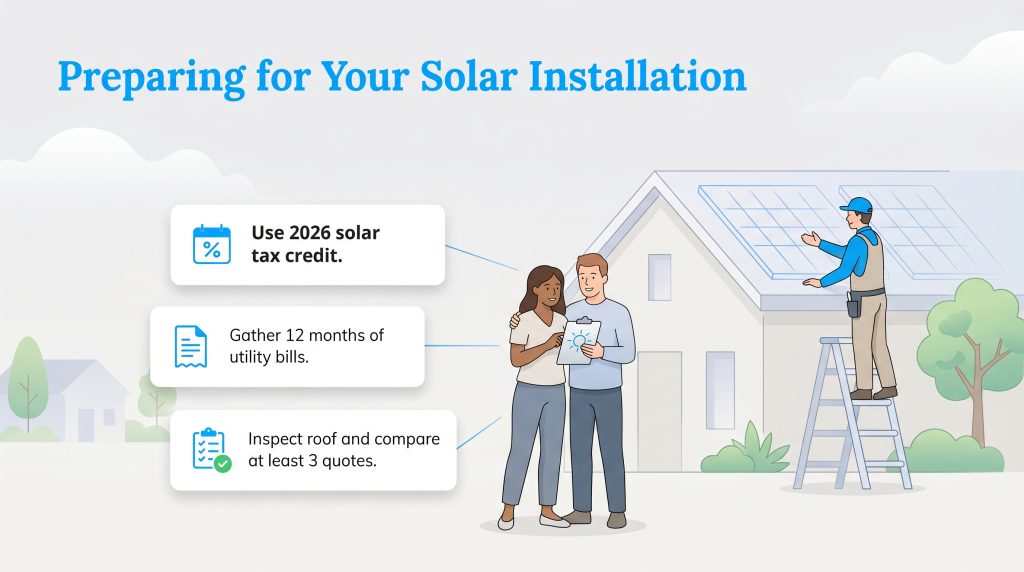
To take the first step toward energy independence, pull your last 12 months of electric bills to see both your total annual kilowatt-hour usage and the exact price per kWh your utility charges. Next, have a trusted roofer inspect your shingles to verify your roof has at least 15 to 20 years of life left before bolting down racking rails. Finally, request at least three itemized quotes from certified local solar contractors — and ask each one to show you side-by-side numbers for an outright cash purchase versus a Section 48 prepaid lease. Comparing multiple bids guarantees you get fair per-watt pricing, honest payback math, and the right equipment for your budget. If installing rooftop panels feels out of reach right now, exploring community solar programs or checking out our guide on how to save on your electric bill are great alternatives to lower your monthly energy costs without mounting hardware on your roof.
Frequently Asked Questions About Solar Panel Costs
Why did the 30% federal solar tax credit end for homeowners in 2026?
How much does a single solar panel cost to buy or replace?
How many solar panels do I need for a 2,000 square foot house?
How much do solar panels cost for a 2,000 square foot home?
How long do solar panels take to pay for themselves?
Is it better to lease or buy solar panels?
Do solar panels increase home value?
About the Author

LaLeesha has a Masters degree in English and enjoys writing whenever she has the chance. She is passionate about gardening, reducing her carbon footprint, and protecting the environment. She also recently served as President of the Board for City Sprouts (a community garden).

Jared Evans is a licensed electrician and the owner of Full Circuit Electric in Omaha, Nebraska. As an expert reviewer for UtilitiesForMyHome.com, Jared uses his 10+ years of hands-on experience to ensure our electrical advice is safe, accurate, and easy to follow. Whether he's troubleshooting a complex wiring issue or sharing tips on green energy upgrades, Jared is dedicated to helping you power your home efficiently — and safely.

David has been an integral part of some of the biggest utility sites on the internet, including InMyArea.com, HighSpeedInternet.com, BroadbandNow.com, and U.S. News. He brings over 15 years of experience writing about, compiling and analyzing utility data.