

Understanding How Solar Financing Works Can Save You Money and Headaches When Buying or Selling a Home
Key Takeaways
- A Power Purchase Agreement (PPA) is a financial arrangement where a developer installs solar panels on your roof, and you purchase the power they generate at a set rate.
- Unlike owning panels, you do not own the equipment in a PPA, which means you avoid upfront costs but miss out on federal tax incentives like the Solar Investment Tax Credit (ITC).
- If you are moving, transferring a PPA to a new homeowner requires specific credit checks and contract reviews, making it a critical step in the real estate closing process.
When searching for ways to cut utility costs without draining your savings, Power Purchase Agreements often emerge as an attractive solution for eco-conscious households. This popular arrangement allows homeowners to see immediate reductions in their monthly electricity bills, but it comes with a major tradeoff: you never actually own the solar system. By choosing a residential power purchase agreement, you completely bypass the heavy upfront costs of buying panels, but you also forfeit the lucrative financial incentives tied to ownership. Navigating the choice between zero-down solutions and traditional home improvements requires a careful look at the fine print. In this guide, we break down exactly how these agreements impact your household economics, compare the most popular financing models, and uncover the hidden clauses that heavily influence your long-term utility budget.
What Is a Solar Power Purchase Agreement (PPA)?
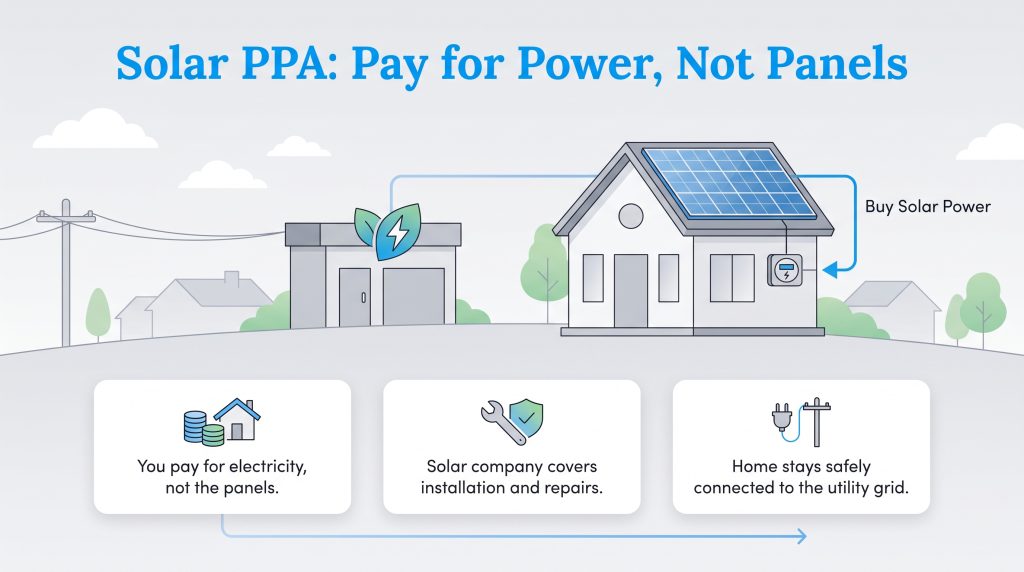
A Power Purchase Agreement (PPA) is a popular third-party solar ownership model designed to remove the massive financial hurdles of switching to renewable energy. To put it simply, you buy the electricity the panels produce, not the physical solar panels themselves. Because a professional solar developer installs and maintains the equipment on your property for free, it acts as a form of zero down solar financing that requires no upfront capital from your bank account.
Under this arrangement, you sign a contract agreeing to purchase the generated power at a set, discounted rate for decades. Because the developer assumes legal and financial ownership of the system, they handle the initial installation, daily performance monitoring, and all ongoing maintenance. Meanwhile, your home stays safely connected to the local utility grid to ensure you always have power when the sun goes down or during heavy rainstorms.
💡 Pro Tip: Since you don’t own the system, the solar company is fully responsible for maintenance and repairs. If a panel breaks or the inverter stops producing power, it is on them — not you — to fix it at zero additional cost.
How Does a Residential Solar PPA Work?
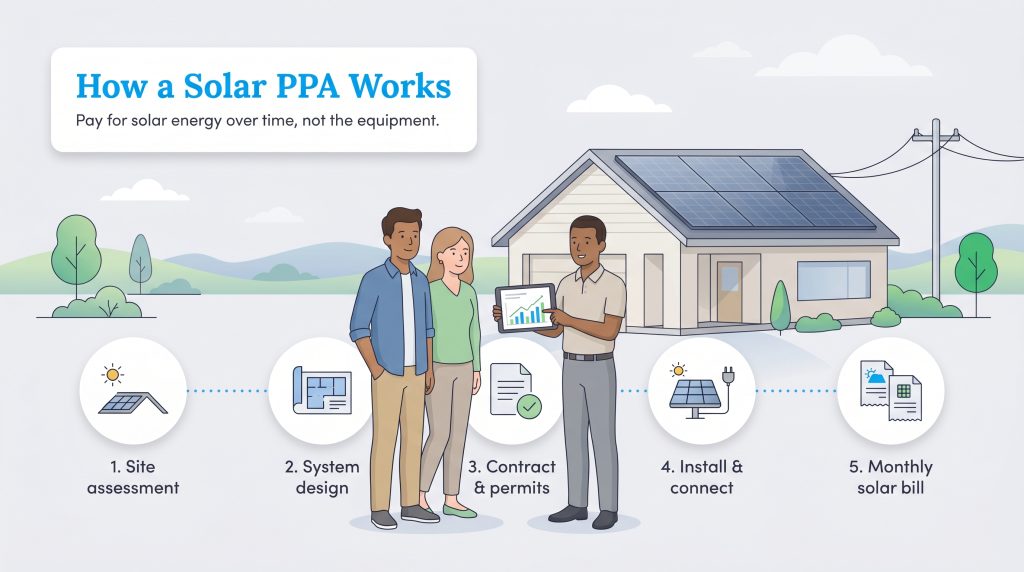
Choosing a residential solar PPA seamlessly shifts the operational burden of a home energy system from your shoulders to the developer. When you enter into this third-party ownership agreement, the entire lifecycle of your roof’s energy production follows a streamlined, step-by-step process:
- Design and Permitting: The solar developer inspects your roof, creates a customized solar array design, secures Homeowner Association (HOA) approvals, and pulls all mandatory local building permits. You pay nothing for this preparatory work.
- Installation and Interconnection: A specialized crew installs the physical mounting hardware, panels, and inverters. They also establish the essential interconnection to your municipal grid so your solar energy system can safely transmit excess power.
- Monthly Billing: Once the system activates, you will begin receiving two separate monthly statements. One bill comes from the developer for the roof-generated power you used, billed at a specific rate per kilowatt-hour (kWh). The second is a much smaller bill from your utility company covering standard grid connection fees and any supplemental energy used at night. Utilizing net metering can help you strategically offset those remaining utility charges.
- Long-Term Maintenance: The developer continuously monitors the system’s output over the 20- to 25-year contract term. If generation drops or equipment fails, they dispatch technicians to resolve the issue for free.
PPA Pricing Models: Fixed Price Vs Fixed Escalator Plans
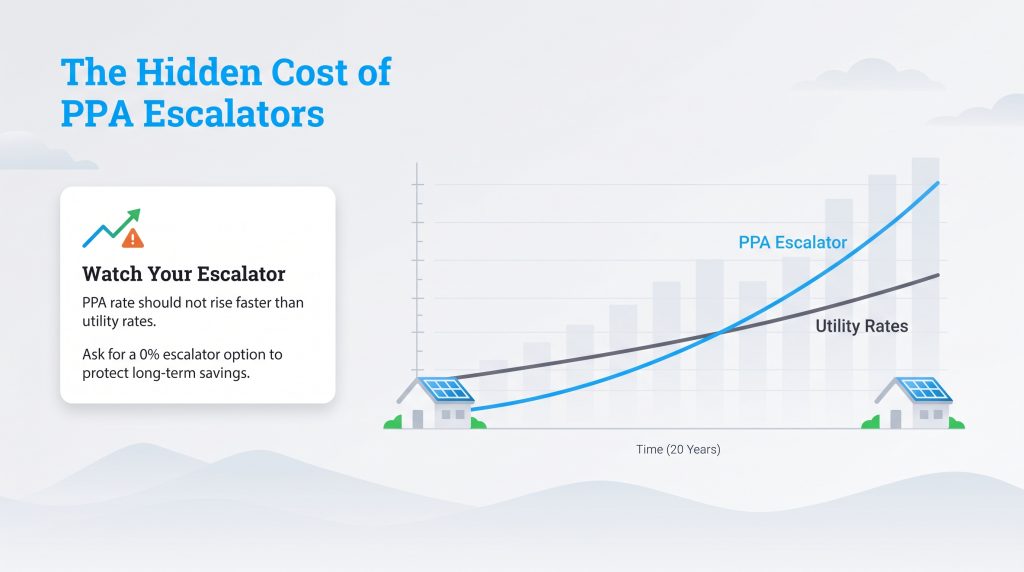
The biggest appeal of signing a residential power purchase agreement is locking in a cheaper electricity rate on day one. However, the fine print heavily dictates your long-term success. Homeowners must understand the crucial differences between a fixed price plan and a fixed escalator plan solar contract, as choosing the wrong structure can slowly drain your savings.
- Fixed Price Plan: This contract guarantees that your rate per kWh will never increase for the entire 20- to 25-year duration of the agreement. While the starting rate might be slightly higher, this model completely shields you from future utility inflation.
- Fixed Escalator Plan: This contract includes a specific provision that automatically increases the price of your electricity at a predetermined rate, typically ranging from 2% to 5% annually. The industry pitch is that municipal utility rates historically rise, so your solar rate can slowly increase alongside them while remaining relatively cheaper.
Unfortunately, compounding math can severely erode your energy savings. If your starting rate is $0.15 per kWh with a 3.5% escalator, your rate climbs drastically over two decades. By year 15, you might find yourself overpaying for your own roof-generated power during the hot summer months compared to standard local grid prices.
💸 Money-Saver: Always request a PPA proposal with a 0% escalator option. While your starting kWh rate will be slightly higher initially, a flat-rate contract guarantees your price never increases, maximizing your savings against inflation.
Solar PPA Pros and Cons
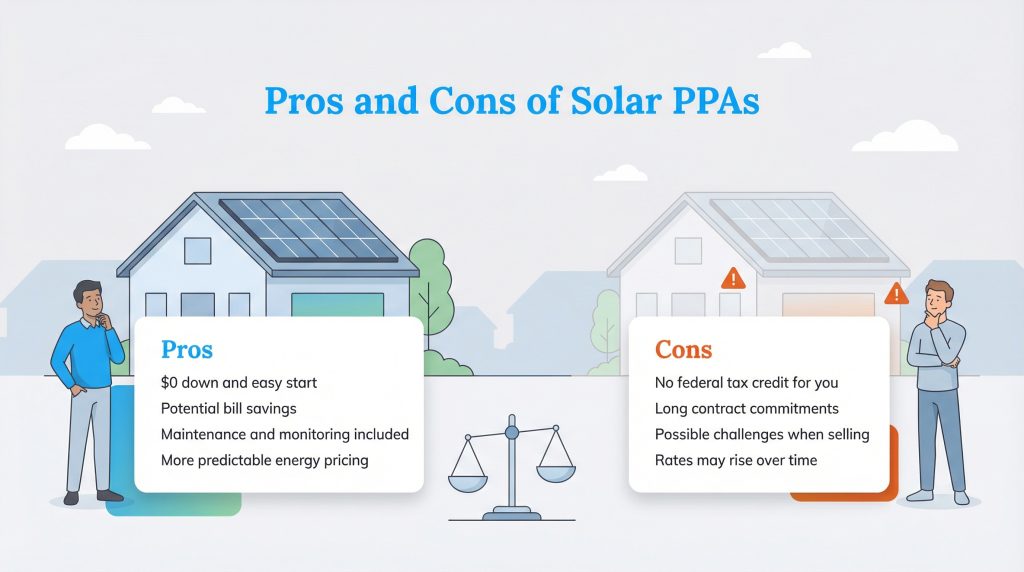
Deciding if a residential power purchase agreement is the right choice depends heavily on your current household budget and long-term financial flexibility. To evaluate whether this financing path suits your property, take a look at these scannable solar PPA pros and cons.
Pros of a Solar PPA
- Zero Upfront Costs: You can quickly transition to renewable energy without draining your savings to buy expensive panels.
- Predictable Energy Bills: By locking in a set rate per kWh, you gain immediate relief from volatile municipal grid price spikes.
- Zero Maintenance Responsibility: The developer is entirely on the hook for monitoring, routine repairs, and part replacements.
Cons of a Solar PPA
- Inability to Claim Tax Credits: Since you don’t own the system, you cannot claim valuable federal or state solar tax incentives.
- Lower Long-Term ROI: Over 25 years, buying a system outright will yield significantly higher savings than renting the power.
- Complications When Selling: Transferring a long-term contract to a new buyer can create hurdles during the escrow process.
Solar PPA Vs Solar Lease Vs Buying Panels
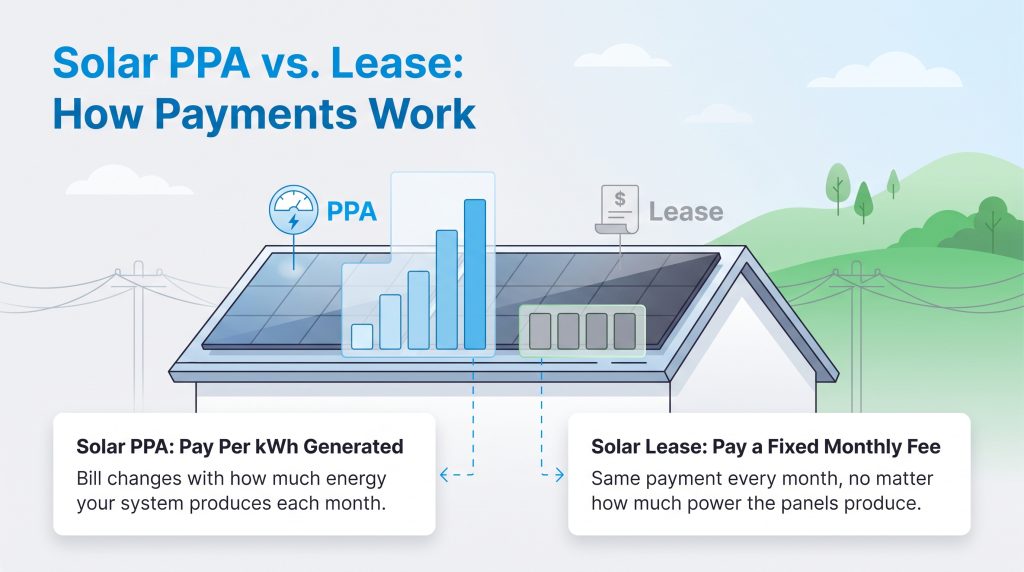
A frequent point of confusion for homeowners exploring zero-down solar financing is distinguishing a solar PPA vs solar lease versus buying the panels outright. All three paths put active solar equipment on your roof, but they carry fundamentally different structural and financial commitments. Choosing the wrong setup can lead to unexpected budget surprises.
While a PPA charges you a variable rate based on the exact energy generated each month, a solar lease requires a flat monthly fee to rent the equipment — regardless of whether the panels overproduce or severely underperform. Conversely, buying the panels outright requires a substantial upfront cash investment or a personal loan, but it grants you complete control and maximum financial return. Use this comparison table to confidently evaluate the most common pathways.
| Comparison Factor | Solar PPA | Solar Lease | Cash/Solar Loan |
|---|---|---|---|
| Upfront Cost | $0 upfront | $0 upfront | High (Requires cash or direct loan) |
| Maintenance Responsibility | Developer handles all hardware maintenance | Developer handles all hardware maintenance | Homeowner handles all maintenance |
| Tax Credit Ownership | Developer claims ITC | Developer claims ITC | Homeowner claims ITC |
| Long-Term ROI | Low to Moderate | Low to Moderate | Highest |
Who Claims the Federal Solar Tax Credit?
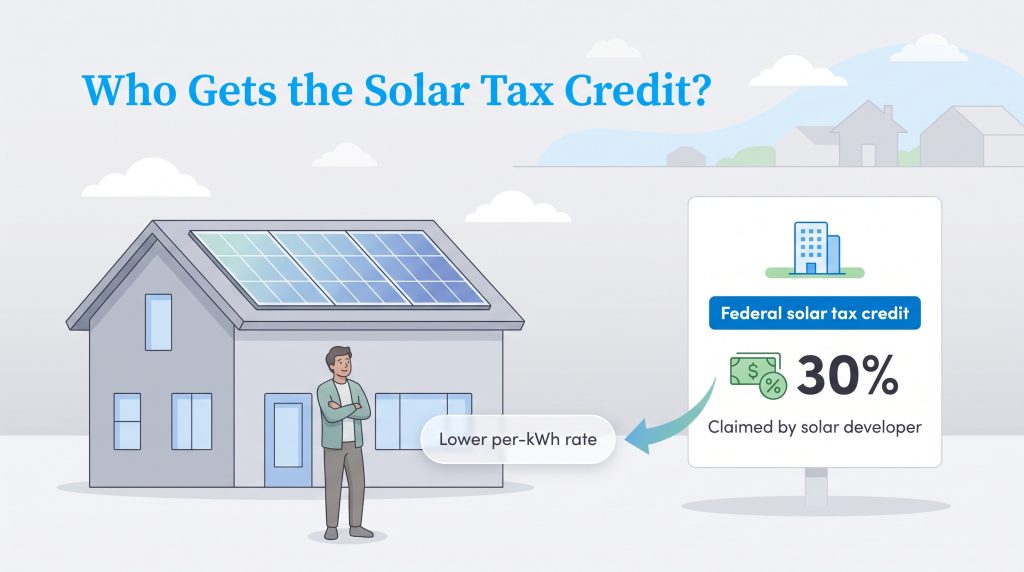
When transitioning to renewable energy, the government offers lucrative incentives to directly offset the heavy costs of installation. However, when homeowners ask who claims the solar tax credit with a PPA, the answer often catches them by surprise. Because the solar developer legally owns the equipment on your roof, they are the sole entity permitted to claim the 30% Federal Solar Investment Tax Credit (ITC).
In addition to the federal tax credit, the developer also legally pockets any local state rebates or Solar Renewable Energy Certificates (SRECs) generated by your specific system. While missing out on this massive deduction can feel frustrating, this precise mechanism is exactly what enables the developer to offer the installation at no upfront cost. The developer absorbs these tax benefits into their business model to heavily subsidize the hardware and labor. As a savvy consumer, you must ensure the developer explicitly factors this tax credit into giving you a significantly lower per-kWh electricity rate.
What Happens to Your PPA When You Sell Your Home?
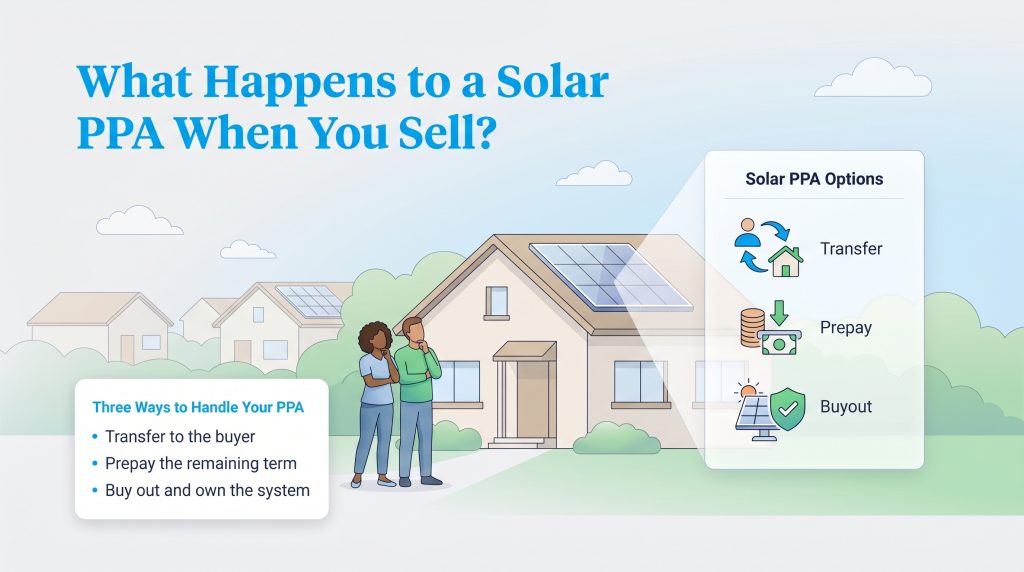
Perhaps the most anxiety-inducing aspect of third-party solar agreements is how they impact real estate transactions. When selling a house with a solar PPA, the contract is tied to the physical property, but the financial obligation remains strictly yours until formally resolved. If you are preparing to move and currently outlining your moving and utilities timeline, you generally have three distinct outcomes for handling the contract.
Transferring the Agreement
This is the most seamless and common route. The new homeowner takes over the monthly payments and enjoys the generated clean energy. However, transferring a PPA relies entirely on the buyer agreeing to your specific contract terms and successfully passing the solar developer’s mandatory credit check. If their credit score is too low, the developer will block the transfer.
Buying Out the Contract
If the buyer balks at taking over a monthly payment, you can pay the developer to buy out the contract entirely before closing. Once you own the system free and clear, you eliminate the ongoing monthly bill. You can then confidently roll that added equity into the total asking price of your home, transforming the panels into an attractive, fully-paid asset for buyers.
The Buyer Refusing the PPA
Occasionally, a buyer absolutely refuses to take on the agreement or pay a premium for a buyout. In this worst-case scenario, you can often pay the solar developer a substantial fee to carefully remove the equipment from your roof and reinstall it at your new residence, allowing you to honor the remainder of the contract at a different property.
Contract End and PPA Buyout Options
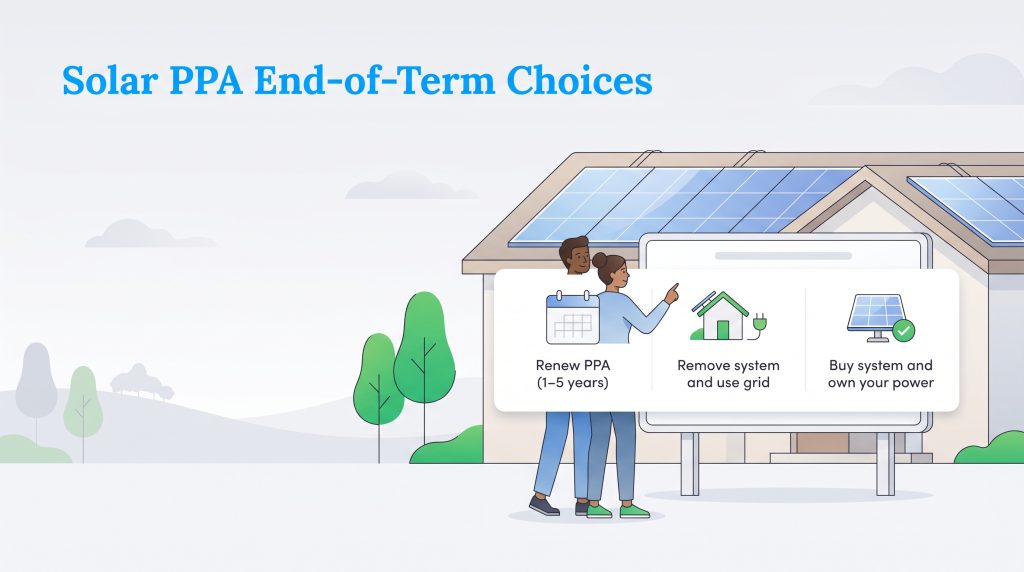
Because residential power purchase agreements almost always span 20 to 25 years, homeowners naturally wonder what happens when the term finally expires. Preparing for the end of your contract involves clearly understanding your PPA buyout options and determining the next best step for your home’s energy infrastructure.
Once the agreement successfully concludes, developers typically offer three standard lifecycle choices. First, you can choose to renew the contract for an extended term, usually in one- to five-year increments. Second, you can request that the developer remove the aging system from your roof entirely for free, which completely returns you to standard utility grid reliance. Finally, you can utilize a buyout option to purchase the system outright at its current fair market value. Buying the hardware at the end of the term allows you to enjoy free electricity for the remaining functional lifespan of the panels without making any ongoing monthly payments to the provider.
Deciding on Your Best Solar Financing Path
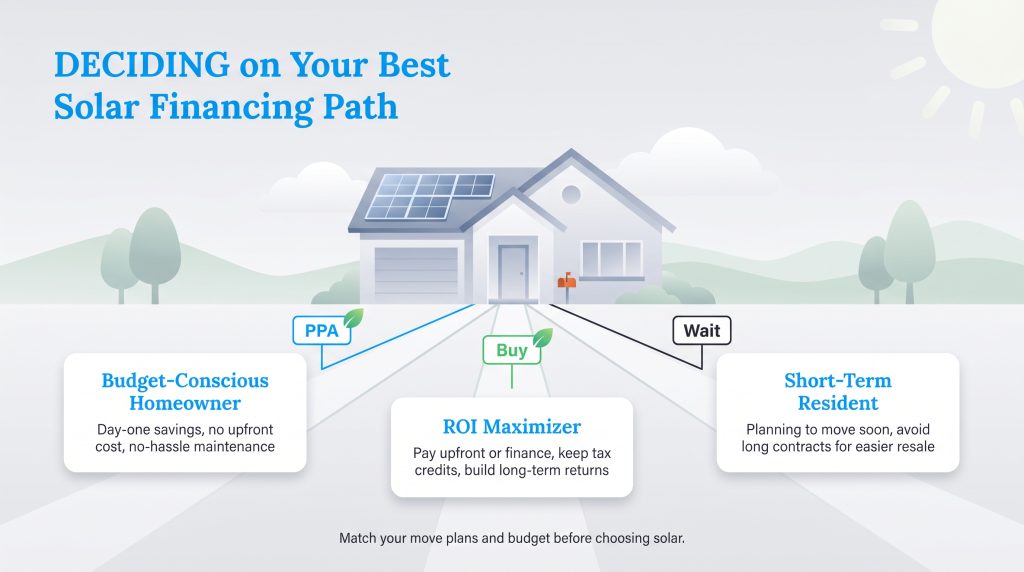
A residential power purchase agreement serves as a highly capable tool for homeowners who desperately want to support environmentally mindful choices without taking on the stressful burden of ownership. However, matching your household goals to the correct financing vehicle is critical. Evaluate these three distinct homeowner profiles to find your ideal solar setup, and consult our main solar installation guide for deeper insights into the process, or review consumer reports from the National Renewable Energy Laboratory (NREL) to guide your ongoing strategy.
The Budget-Conscious Homeowner
If you prioritize immediate day-one utility savings, lack the capital for high upfront costs, and desire maintenance-free living, a zero-down PPA is an excellent fit. It provides an immediate bridge to clean energy without stretching your current finances.
The ROI Maximizer
If you can easily afford the cash cost or qualify for a low-interest solar loan, buying the system outright practically always offers a much stronger long-term return on investment. You keep the 30% federal tax credit and enjoy decades of free electricity once the loan is paid off.
The Short-Term Resident
If you anticipate moving within the next five years, tying your property to a 25-year corporate energy contract introduces unnecessary risks. For short-term residents, we recommend holding off on solar installations entirely to avoid complicated contract transfers and escrow disputes when it comes time to sell.
Frequently Asked Questions About Power Purchase Agreements
What is the average length of a solar PPA contract?
The standard length for a residential contract is between 10 and 25 years. This extended timeframe allows the solar developer to slowly recoup their installation costs while providing you with a predictable, lowered energy rate over the life of the agreement.
Can I cancel a solar power purchase agreement?
Yes, but canceling early usually incurs exorbitant termination fees. Most contracts force you to pay the projected remaining balance of the entire 25-year term in one lump sum, making outright cancellation financially unrealistic for most homeowners.
Who is responsible for solar energy system maintenance in a PPA?
The solar developer owns the equipment, meaning they are completely responsible for all maintenance, repairs, and eventual removal. If an inverter fails or a panel breaks, they must fix it at zero additional cost to you.
Does a solar PPA increase my home’s property value?
Unlike a cash-purchased system, a PPA generally does not increase your home’s appraised property value. Because you do not legally own the equipment, it is viewed as a third-party service contract rather than a permanent real estate asset.
Is a solar PPA better than a solar lease?
It heavily depends on your preference. A PPA charges you strictly for the exact power actively produced, which is a variable monthly cost. A lease charges a flat monthly rental fee for the equipment, acting as a fixed cost regardless of energy output.
Can I claim the solar tax credit with a PPA?
No. Under this arrangement, the third-party developer legally owns the system. Because they hold ownership, they are the only entity legally entitled to claim the 30% Federal Solar Investment Tax Credit and any associated local incentives.
Do I still pay my utility company if I have a PPA?
Yes, you will. You will still receive a smaller, secondary bill from your local utility company for any supplemental electricity you use when your panels aren’t actively producing — like at night — and for the standard mandatory grid connection fees.
What happens to my PPA if my solar panels break?
Because you do not own the equipment, you are entirely shielded from repair costs. If a panel breaks, the inverter fails, or a storm damages the mounting hardware, the solar developer is contractually obligated to fix or replace the components quickly at no additional cost to you.
Is a prepaid solar PPA worth it?
A prepaid solar PPA allows you to pay for all the estimated electricity generation upfront for the entire 20- or 25-year term. While this requires a massive initial cash payment, it fully eliminates your ongoing monthly bill to the developer and secures an incredibly low per-kWh rate. It is generally worth it if you have the cash on hand but still want to avoid the personal liability of system maintenance.
Can I buy out my solar PPA early?
Yes. Most developers include a specific clause that allows you to buy out the remainder of your contract early, typically after year five or year ten. You will pay the fair market value for the system at that time, giving you full ownership and effectively ending your monthly payments.
Do I have to pay for solar panel maintenance with a PPA?
No, you do not. Under a third-party ownership model, the developer handles all standard maintenance, software monitoring, and physical repairs without billing you for the service or replacement parts.
Is a solar PPA considered a lien on my house?
A standard residential PPA is not a financial lien on your home, but the solar company will file a Uniform Commercial Code (UCC-1) fixture filing. This filing simply provides public notice that the developer owns the solar equipment attached to your roof, preventing you from illegally selling the hardware along with the house.
About the Author

David has been an integral part of some of the biggest utility sites on the internet, including InMyArea.com, HighSpeedInternet.com, BroadbandNow.com, and U.S. News. He brings over 15 years of experience writing about, compiling and analyzing utility data.

LaLeesha has a Masters degree in English and enjoys writing whenever she has the chance. She is passionate about gardening, reducing her carbon footprint, and protecting the environment. She also recently served as President of the Board for City Sprouts (a community garden).