

Understanding how MUDs fund infrastructure and impact your monthly costs is essential for homebuyers in developing areas.
Key Takeaways
- Municipal Utility Districts (MUDs) are special political subdivisions that finance water, sewage, and other infrastructure in areas where city services aren’t yet available.
- MUD taxes are an additional line item on your property tax bill used to pay off the bonds that funded the community’s development, though these rates often decrease over time.
- While often confused with HOAs, MUDs are government entities with the power to levy taxes and foreclose for nonpayment, whereas HOAs are private organizations that enforce deed restrictions and collect fees.
If you are house hunting in a developing suburb, you might wonder about the municipal utility district meaning when scanning a property listing. A Municipal Utility District (MUD) is a state-regulated, localized government entity that finances and manages essential infrastructure — like water and sewage — in areas where standard city utility bills and services are not yet available. Understanding this unique setup can demystify your housing costs and help you budget effectively before you buy your next home.
What Is the Meaning of a Municipal Utility District?
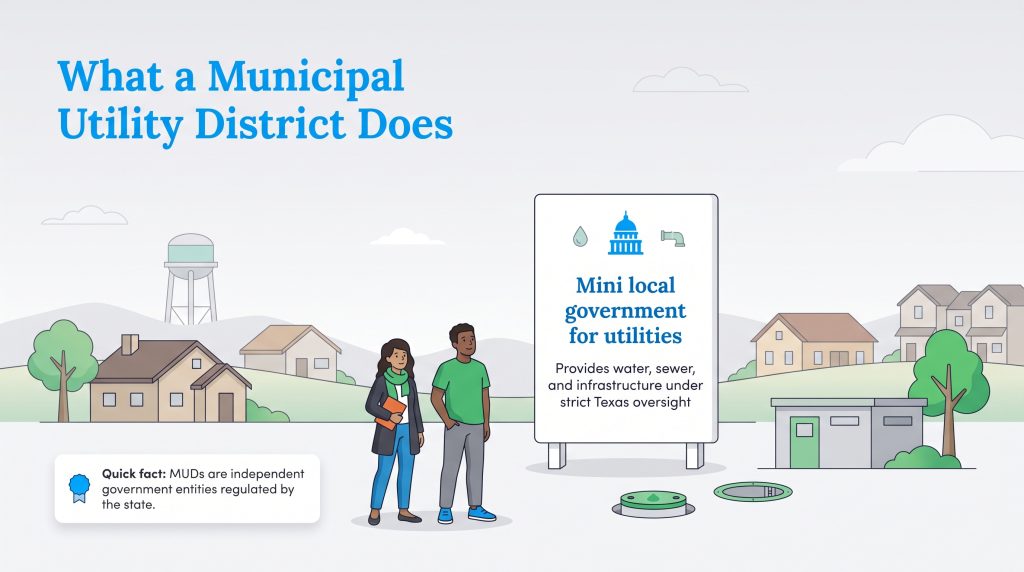
A Municipal Utility District acts as a specialized political subdivision, authorized to provide crucial public services to communities located outside standard municipal reaches. While these special-purpose districts exist nationwide to bridge the gap between rural land and new developments, they are particularly common in the Lone Star State to support rapidly expanding master-planned communities. In fact, any municipal utility district Texas authorizes operates under intense state scrutiny.
In Texas, these localized governments operate under strict statutory authority with the following heavy oversight:
- Texas Water Code: Chapters 49 and 54 legally define a MUD’s powers, strictly dictating how they can issue bonds and levy property taxes.
- TCEQ Oversight: The Texas Commission on Environmental Quality (TCEQ) heavily regulates these districts to ensure financial transparency and safe utility operations.
📌 Quick Fact: Because MUDs function as independent government entities, their operations are highly regulated by the state, ensuring that the infrastructure built meets or exceeds standard municipal building codes.
How MUDs Work: Core Services and Infrastructure
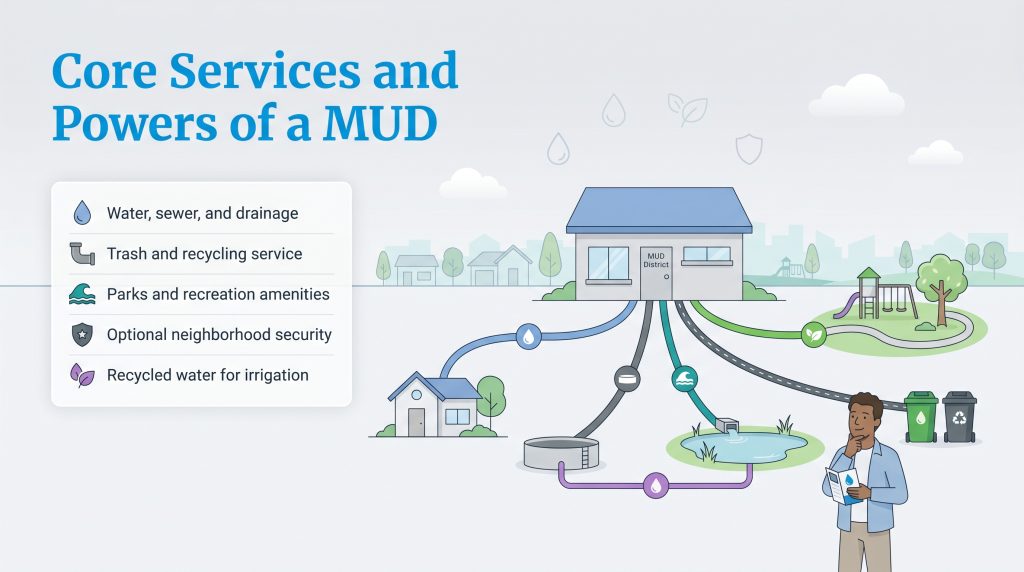
While the name implies a narrow focus on basic utilities, a district’s actual authority extends much further. Depending on community needs, a MUD provides a remarkably wide array of vital public services to keep your neighborhood functioning smoothly.
These core services typically include:
- Water Supply: Sourcing, treating, and delivering safe drinking water to every household. They also establish fair MUD water rates for the community.
- Wastewater Treatment: Managing sewage collection through underground pipes. The district safely operates localized treatment plants positioned away from residential zones.
- Stormwater Control: Engineering, building, and maintaining retention ponds and drainage canals to prevent regional flooding during heavy rain events.
- Solid Waste Collection: Contracting out neighborhood trash and recycling pickup for reliable weekly service.
- Park Development: Financing public recreational facilities, community pools, and playgrounds. They also maintain paved jogging trails to enhance the neighborhood’s appeal.
Beyond maintaining basic infrastructure, these districts frequently lead local sustainability efforts. Many modern districts utilize innovative “purple pipe” systems as an eco-conscious alternative that safely recycles heavily treated wastewater specifically for irrigation in parks, drastically reducing the strain on fresh drinking water.
The Governance: Who Runs the MUD Board of Directors?
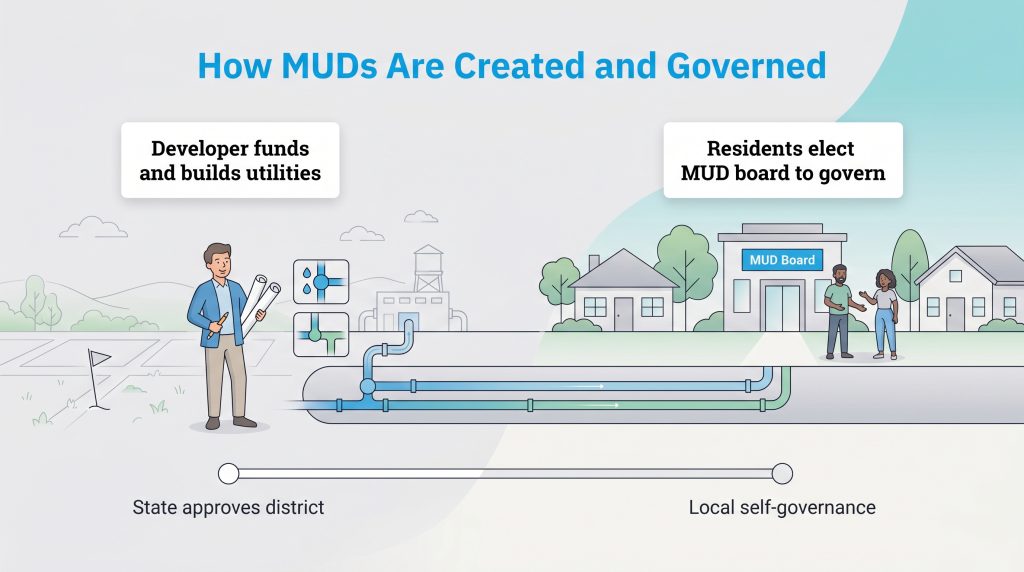
When a developer first builds a master-planned community, they front the initial millions required to lay foundational pipes and construct localized water treatment facilities. As residents move in, however, the developer steps back and the district transitions to local, democratic governance.
A MUD is governed by a five-member elected MUD board of directors who must either own property or be registered voters residing within the district’s boundaries. This gives local residents direct voting power over their neighborhood’s financial future. Because a MUD is a public entity, the board operates strictly under the Texas Open Meetings Act, ensuring complete transparency when they adopt annual operating budgets, manage ongoing maintenance contracts, and set the yearly tax rate.
Understanding the MUD Tax Rate and How to Pay It
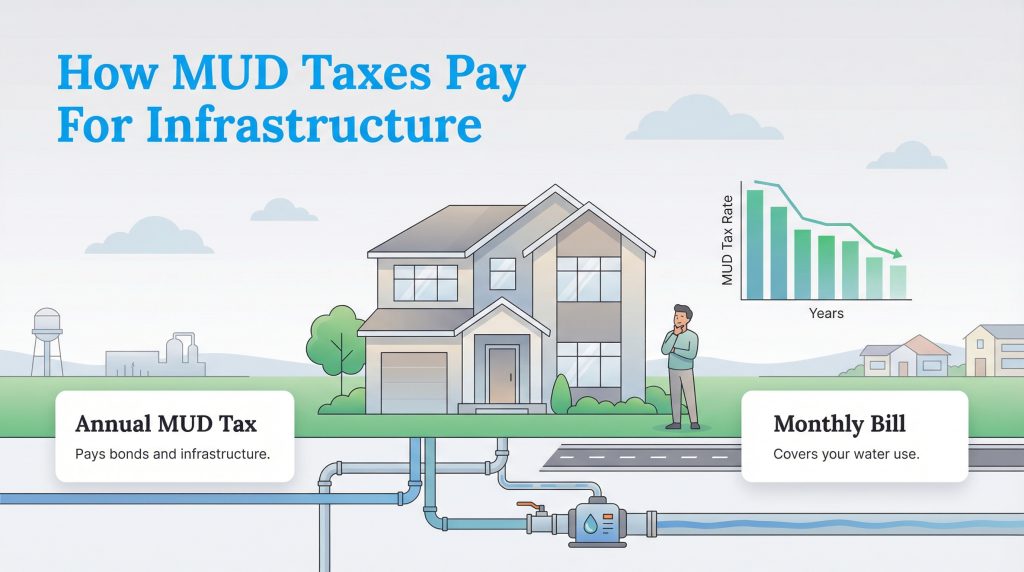
Understanding the financial structure of a MUD means looking at how underground construction is ultimately reimbursed. When a developer fronts the capital for water lines and roads, the newly formed district agrees to pay them back by issuing tax-exempt municipal bonds.
Here is a simplified look at the financing cycle:
- The Developer Fronts the Cash: The private builder pays for the initial design and installation of underground systems.
- The MUD Issues Bonds: Once approved by state regulators, the district sells municipal bonds to public investors.
- Residents Pay Off the Debt: Homeowners pay an annual MUD property tax, which is exclusively used to pay back those bond investors over several decades.
You will still receive a monthly utility bill for the actual gallons of water you consume. The annual tax simply covers the infrastructure debt, while the monthly bill covers your household usage.
Paying MUD Taxes: You pay your annual MUD tax exactly like your standard property taxes — typically bundled into your mortgage escrow account and paid at the end of the year by your lender, or paid directly to your county tax assessor if you do not use an escrow account.
🧮 Calculating Your Total MUD Tax Burden: Wondering how this impacts your escrow? MUD taxes are calculated based on your home’s assessed value per $100. For example, if your home is assessed at $400,000 and the MUD tax rate is $0.85 per $100 of value, your formula is ($400,000 / 100) x $0.85. Your annual MUD tax is $3,400. Divide this by 12 to see your monthly escrow impact, which in this case adds roughly $283 to your monthly housing payment.
MUD Vs City Utilities: What Is the Difference?
If you are used to living in a dense urban center, transitioning to a special utility district can feel foreign. While both provide identical essential services, the financial structures behind them vary significantly. Here is the primary difference between MUD and city utilities:
- Billing Structure and Usage Fees: City utilities typically bundle water, sewer, and trash into one centralized municipal bill, occasionally subsidizing broader infrastructure costs through slightly higher usage rates. A MUD strictly separates your monthly usage bill from the overarching infrastructure costs.
- Debt Servicing via Property Taxes: Cities often fund new pipes or repairs through general municipal funds. Conversely, a MUD services its massive infrastructure debt directly through a dedicated annual property tax line item assessed on your home’s value.
- Regulatory Oversight Differences: Standard city utilities answer to the local city council and mayor. A MUD answers directly to its neighborhood-elected board of directors and is heavily audited by overarching state environmental agencies to ensure absolute compliance with federal and state safety standards.
MUD Vs PID Vs HOA: Knowing Your Neighborhood Fees
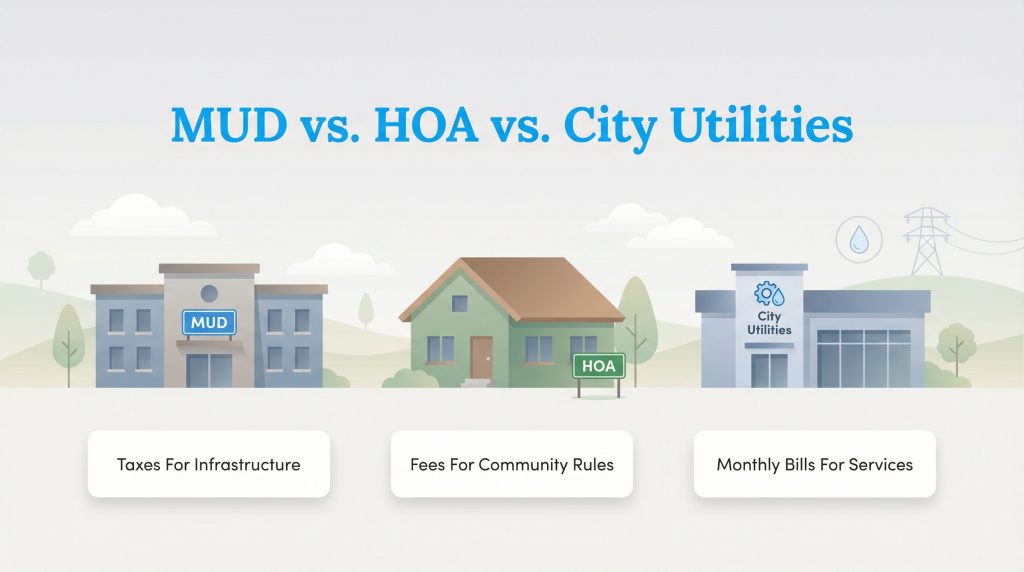
When purchasing a home in a developing suburb, you will likely encounter a confusing alphabet soup of community acronyms. It is incredibly easy to conflate a MUD with a Homeowners Association (HOA) or a Public Improvement District (PID). However, the distinctions are legally and financially significant.
A MUD is a public, government entity that funds underground infrastructure through property taxes, holding the constitutional authority to foreclose for unpaid taxes. An HOA is a private, non-profit corporation governed by civil contracts that collects dues to maintain visible common areas and enforce aesthetic deed restrictions.
Meanwhile, a Public Improvement District (PID) operates slightly differently. Created by a city or county, a PID funds specific neighborhood improvements — like decorative street lighting or upgraded sidewalks. Instead of a fluctuating tax rate, a PID levies a fixed special assessment against each property, which homeowners can often pay off upfront in a lump sum.
| Feature | Municipal Utility District (MUD) | Public Improvement District (PID) | Homeowners Association (HOA) |
|---|---|---|---|
| Primary Purpose | Foundational infrastructure (water, sewer, heavy drainage) | Specific community upgrades (landscaping, lighting, roads) | Community aesthetics, rule enforcement, private amenities |
| Funding Source | Ad valorem property taxes & monthly utility charges | Fixed special property assessments | Private membership dues/fees |
| Governance | Elected Board of Directors (Government entity) | City Council or County Commissioners | Elected Board of Directors (Private non-profit) |
| Rule Enforcement & Security | Can employ peace officers and enforce real property restrictions | Administered by the local municipality overseeing the PID | Enforces private deed restrictions and architectural guidelines |
| Tax Deductible? | Generally yes (as property taxes) (Consult a tax professional.) | Usually no (viewed as a specific assessment, not a general tax) | Generally no |
The Pros and Cons of Living in a MUD
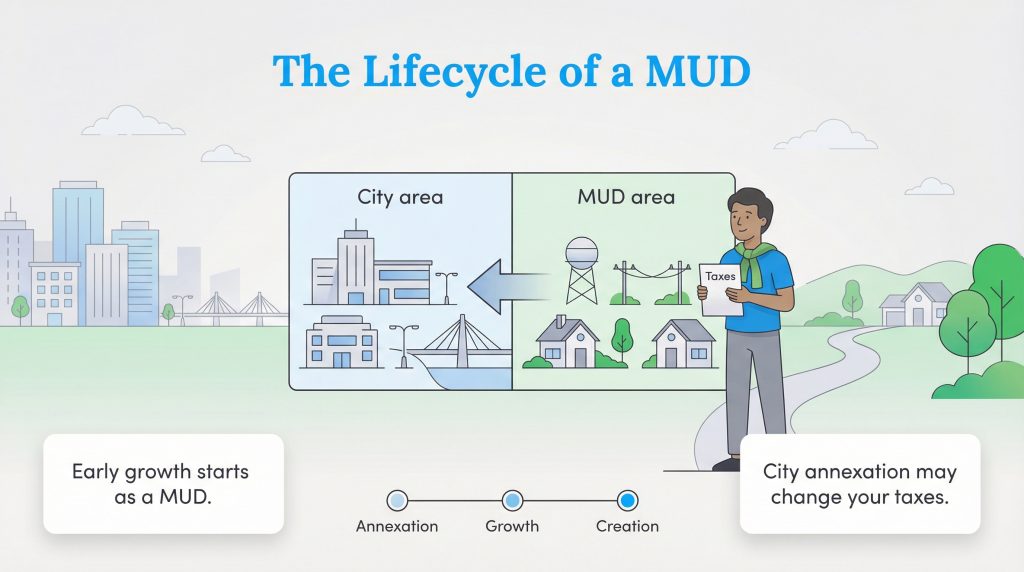
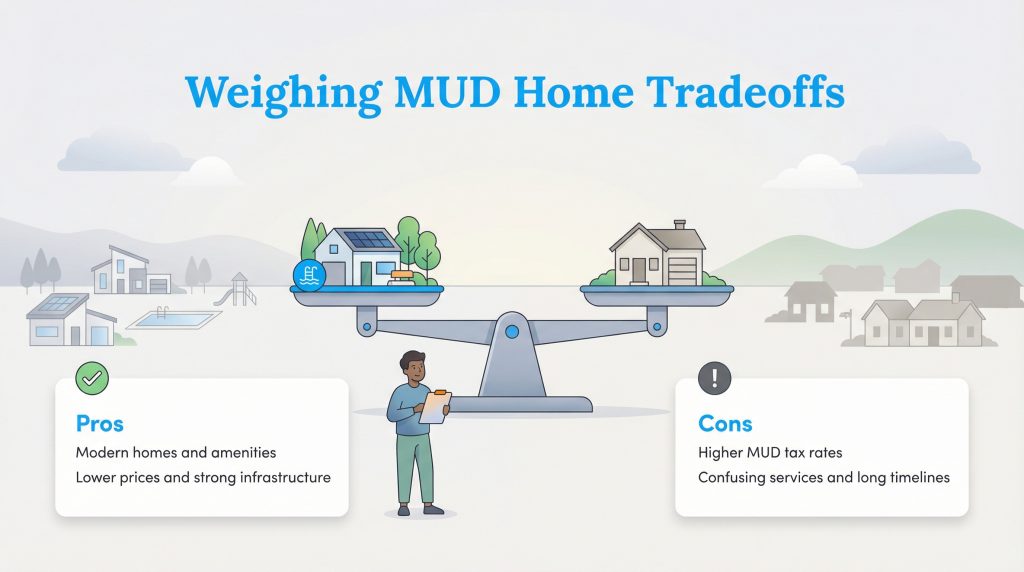
Deciding on buying a house in a developing district involves balancing immediate financial costs against long-term lifestyle benefits. One of the biggest variables to consider when weighing the cons of living in a MUD is the lifecycle of the district itself. Because these districts are often temporary entities designed for early development, a growing city might eventually annex the neighborhood, completely replacing the MUD tax with a standard city tax.
To help you evaluate if this type of suburban living aligns with your personal goals, here is a breakdown of the primary advantages and disadvantages:
Pros:
- Modern Infrastructure: Access to beautifully modern homes, energy-saving building standards, and brand-new community designs.
- Premium Amenities: High-quality, reliable infrastructure and luxurious perks like competition-sized pools and paved trails directly funded by the district.
- Better Affordability: Potentially lower initial home purchase prices and greater square footage compared to properties in aging, dense city centers.
Cons:
- Higher Tax Rates: Noticeably higher overall property tax rates in the early years of development needed to service the heavy infrastructure bonds.
- Billing Confusion: Frequent frustration when trying to decipher the separation between annual MUD taxes and monthly utility usage bills.
- Annexation Uncertainty: Lingering uncertainty regarding future annexation timelines and how a sudden city takeover might affect your long-term housing costs.
Debunking Common Misconceptions About MUDs
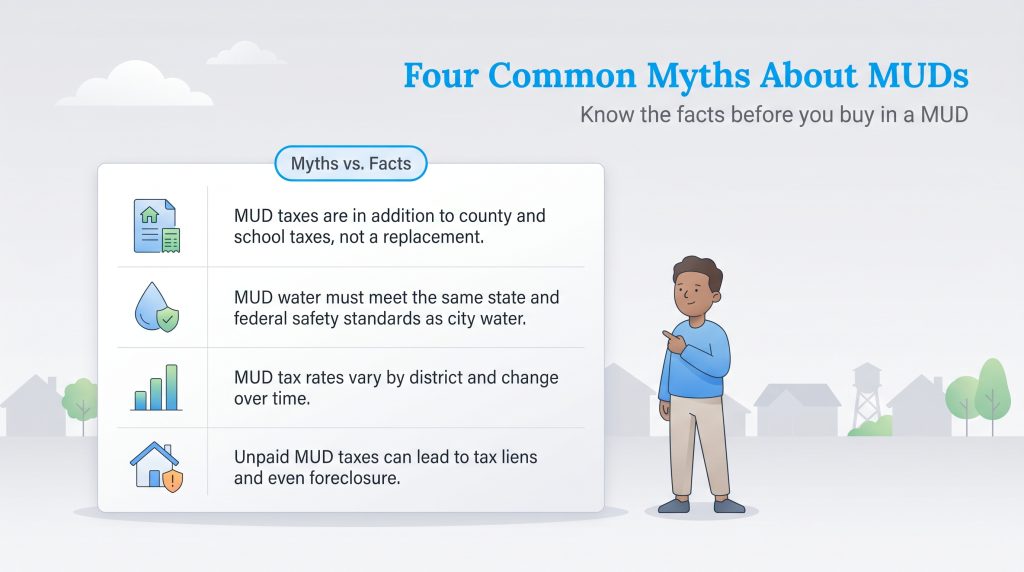
When evaluating these tradeoffs, it is crucial not to fall for common misconceptions. For instance, MUD taxes absolutely do not replace your county or school taxes; they are a completely separate, additional line item. Furthermore, unpaid MUD taxes can absolutely result in foreclosure, making it essential to accurately budget for this expense when you are planning a move and tackling your moving utilities checklist.
Verifying Your Property MUD Status
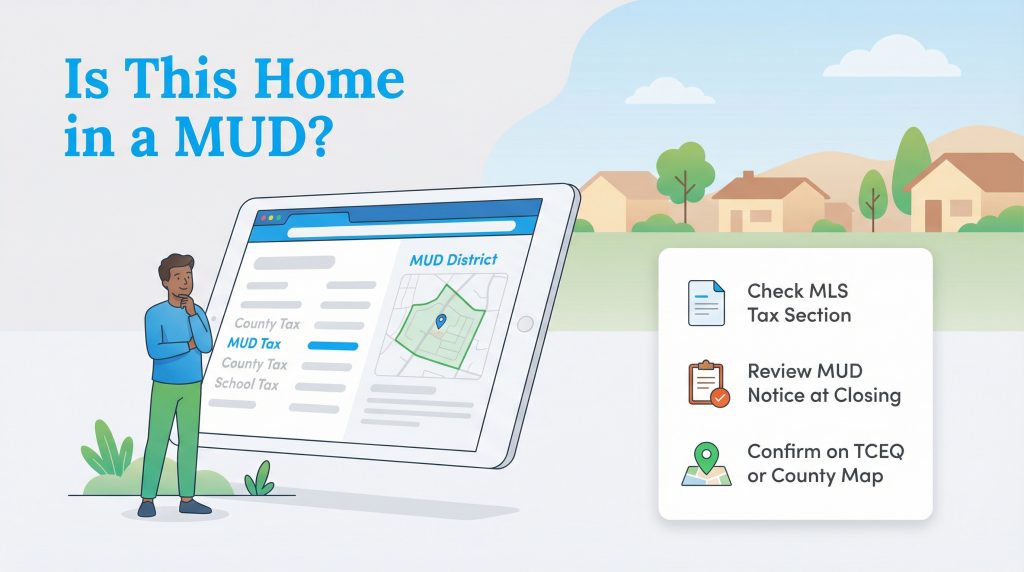
Before analyzing your long-term return on investment, you must verify the exact tax standing of your prospective home. You can easily do this by using the state’s environmental regulatory tools, such as the Texas Commission on Environmental Quality (TCEQ) interactive map viewer, to confirm your exact district boundaries and verify the property is indeed inside a MUD.
Impact on Property Value and Resale
Once you know your district, you can accurately assess its impact on your home’s equity. The financial implications of MUD property taxes play a significant role in long-term ROI. In a brand-new development, the initial MUD tax rate is historically at its highest because the district is actively paying down the massive upfront bond debt. While this higher tax burden can impact immediate resale affordability by deterring highly budget-conscious buyers, the financial narrative shifts over time.
As the district matures, more homes are built, and the initial bond debt is aggressively paid down, the overall tax rate typically decreases. A decreasing MUD tax rate over the district’s lifecycle ultimately increases property equity and buyer appeal. Homes in established, mature districts often boast highly stable tax rates while still offering uninterrupted access to the premium amenities that originally made the neighborhood desirable.
Preparing to Buy a Home in a Municipal Utility District
Stepping into homeownership in a special purpose district doesn’t have to be intimidating. By completing a few critical due diligence tasks during your option period, you can avoid hidden moving costs and feel incredibly confident about your real estate investment.
If you are seriously considering a property within a district’s boundaries, follow this actionable 5-step checklist before closing:
- 1. Verify the MUD Tax History: Check the county appraisal records for the past five years to ensure the tax rate shows a downward or stable trend, indicating responsible debt management.
- 2. Review the Notice to Purchaser Form: Legally mandated prior to closing, this document outlines the exact current tax rate, authorized bond debt, and any imminent city annexation plans.
- 3. Compare Utility Providers: Call the district’s management company to ask for their current fee schedule for monthly water and sewer consumption.
- 4. Calculate Your Total Monthly Burden: Add the estimated monthly utility usage costs to the prorated monthly MUD tax amount to ensure it comfortably fits your mortgage escrow budget.
- 5. Inspect District Amenities: Tour the parks, pools, and trails funded by the district to guarantee the premium amenities justify the additional property tax investment.
Making an Informed Decision About Your MUD Home
Understanding the deep operational and financial nuances of a Municipal Utility District empowers you to make a highly confident real estate decision without the lingering fear of hidden neighborhood costs. While the extra tax line item might seem understandably daunting at first glance, it is the deliberate financial trade-off for enjoying high-quality utilities, stable infrastructure, and rich community perks in a rapidly growing area. By utilizing the mapping tools available, verifying the tax rates upfront, and reviewing the district’s long-term operational plans, you can integrate the true cost of suburban living into a rock-solid homebuying strategy.
Frequently Asked Questions About Municipal Utility Districts
What is the difference between a MUD and city utilities?
How do I set up and pay my MUD water bill?
What is the difference between a MUD and a PID?
Can I opt out of a municipal utility district?
Do MUD districts have their own police force?
How do I find the current MUD tax rate for a specific address?
Do MUD taxes ever go away?
Can a MUD foreclose on my home?
Is living in a MUD more expensive than living in the city?
Can a neighborhood have both a MUD and an HOA?
Are MUD taxes tax-deductible?
About the Author

David has been an integral part of some of the biggest utility sites on the internet, including InMyArea.com, HighSpeedInternet.com, BroadbandNow.com, and U.S. News. He brings over 15 years of experience writing about, compiling and analyzing utility data.

LaLeesha has a Masters degree in English and enjoys writing whenever she has the chance. She is passionate about gardening, reducing her carbon footprint, and protecting the environment. She also recently served as President of the Board for City Sprouts (a community garden).