
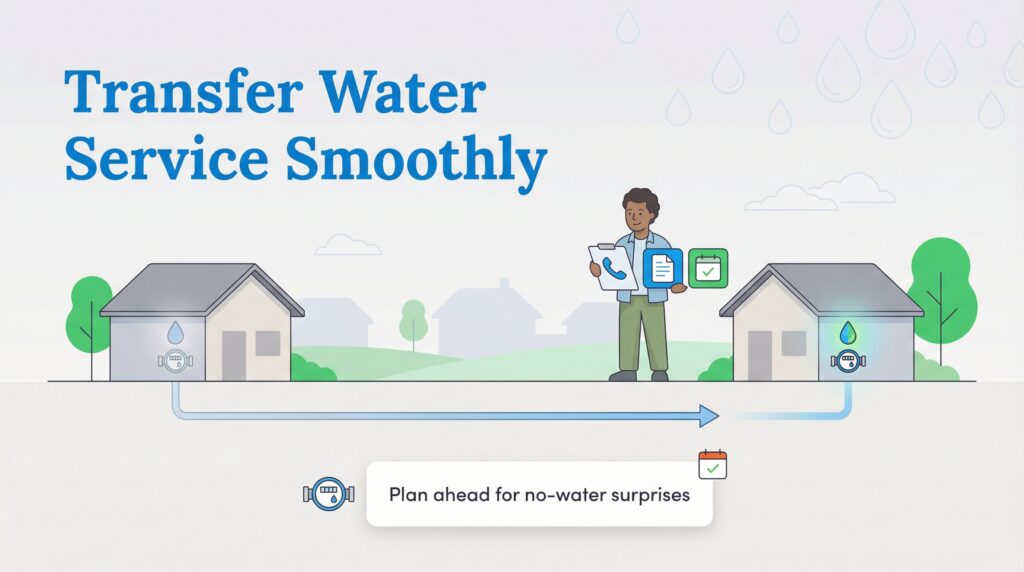
Plan ahead to prevent service interruptions and ensure you have running water the moment you step into your new home.
Key Takeaways
- Contact your current and future water providers at least two weeks before your move to schedule service changes.
- Gather essential documents early, as water departments often require proof of ownership, a lease agreement, or a photo ID to open an account.
- Always request a final meter reading at your old address to ensure you aren’t billed for water usage after you leave.
Moving to a new home involves juggling countless logistical tasks, and figuring out how to transfer water service to a new address often falls to the bottom of the list until you turn on a dry faucet. Between varying municipal business hours, strict document requirements, and confusing localized rules, you need a solid plan to prevent frustrating shutoffs during a busy relocation. Whether you are coordinating high-speed internet or scheduling electric installations, learning how to transfer water utility service efficiently should always take priority. We created this comprehensive guide to walk you through exactly how to transfer utilities when moving, outlining the essential paperwork you need, standard fee expectations, and a chronological checklist to ensure a hot shower is waiting for you after a long day of unpacking.
Your Water Transfer Timeline: When to Take Action
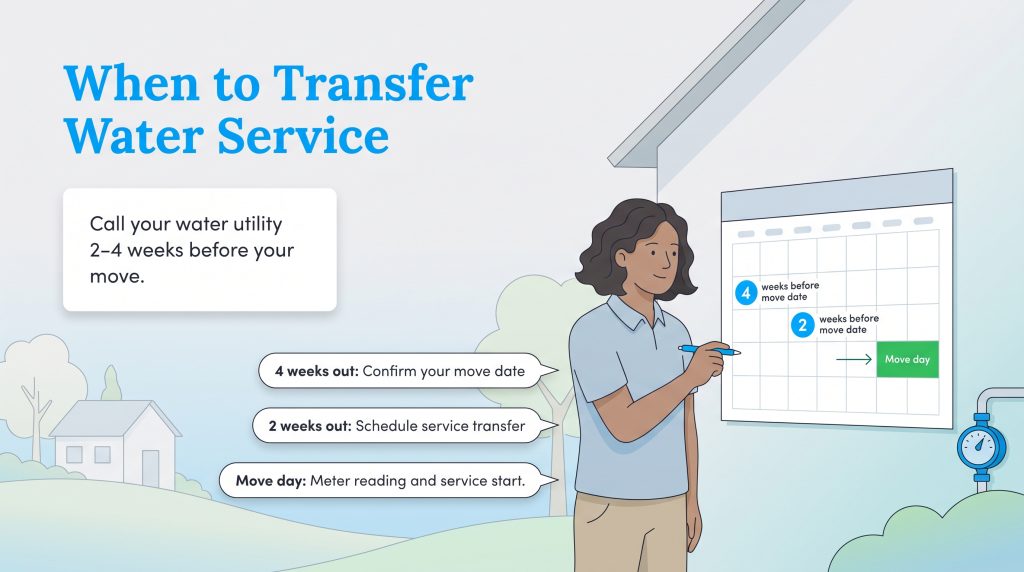
Transferring municipal utilities requires significantly more foresight than setting up standard subscription services. Unlike private telecommunications companies that can flip a digital switch on a Sunday afternoon, local water departments typically operate during strict weekday business hours and require human technicians to physically interact with your localized meter. Because of these constraints, establishing a concrete timeline is the absolute best way to manage your transition without any unwanted interruptions.
To keep your relocation on track, follow this chronological checklist leading up to moving day:
- 2 to 4 Weeks Before Moving: This is the ideal time to coordinate how you will stop and start water service between properties. Research your incoming utility provider, gather all mandatory identification documents, and formally submit your new service application to the municipal clerk. Booking this far in advance guarantees your name gets on the physical dispatch schedule.
- 1 Week Before Moving: Follow up with both water departments by phone. Verify that your disconnection order is actively in the system for your old address, and confirm that your new account is approved and scheduled for activation. Make sure any required security deposits have cleared processing.
- Moving Day: Document everything. Take a clear, time-stamped photo of the physical water meter at your old home before handing over the keys. Once you arrive at your new residence, test the major plumbing fixtures immediately to verify that the municipal supply is flowing properly.
4 Steps to Transfer Water Service to a New Address
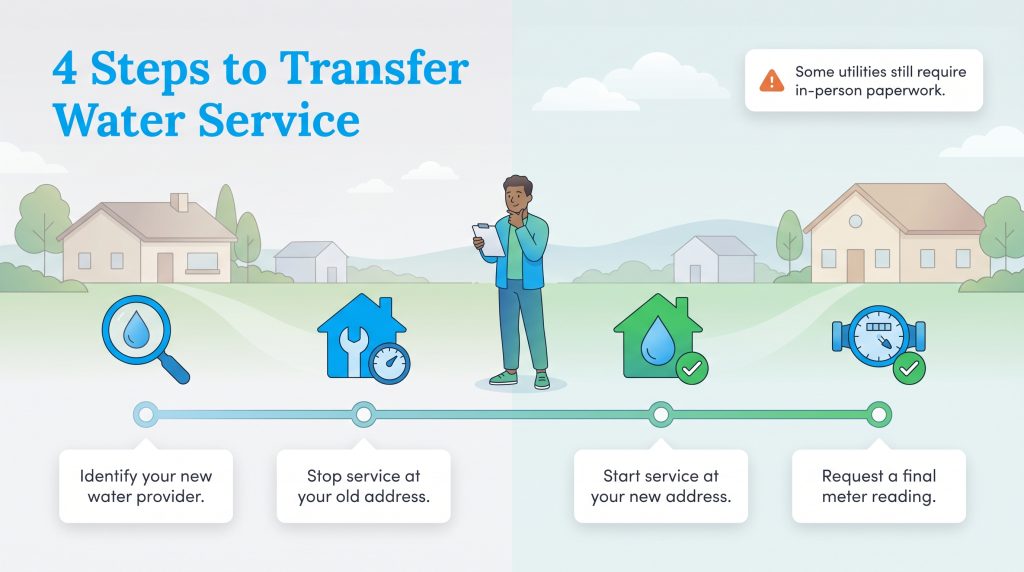
Navigating a municipal utility transfer does not have to be overwhelming if you break the massive project down into a logical, structured sequence. By handling each administrative requirement one at a time, you protect yourself from overlapping billing cycles and administrative delays. Here is exactly how you can easily manage the transition without missing a beat:
- Identify your new water provider. Because utility service is strictly tied to a specific city or geographic district, you generally cannot shop around for competing companies. You must determine the exact local government agency or municipal district responsible for treating and distributing water to your specific street.
- Stop service at your old address. Call your current utility company to cancel water service moving forward, scheduling the official disconnection for the morning after your move-out date. Always explicitly provide the clerk with a reliable forwarding address so your final prorated invoice does not get lost in the mail and accrue aggressive late penalties.
- Start service at your new address. Contact the incoming provider to register your brand-new account, scheduling the physical connection for the day before you actually arrive. This strategic 24-hour buffer gives you plenty of time to troubleshoot any localized mechanical issues before you start unloading heavy boxes into the house.
- Schedule the final meter reading. Demand a final water meter reading right before you permanently hand over your old keys. Securing this definitive cutoff metric formally establishes how much water you personally consumed, heavily protecting you from being financially penalized if the incoming resident leaves a hose running all weekend.
How to Find Your New Municipal Water Provider
If you are struggling to find municipal water provider details for your upcoming relocation, you are certainly not alone. Discovering who handles your utilities is often the biggest pain point for out-of-district movers, largely because the administrative naming conventions for local water utilities are wildly inconsistent. Some areas are serviced directly by a city’s “Department of Public Works,” while neighboring suburbs might rely on obscurely named, privately managed Municipal Utility Districts (MUDs). Since you cannot choose your provider, you must play detective to pinpoint who legally controls the pipes underneath your new home.
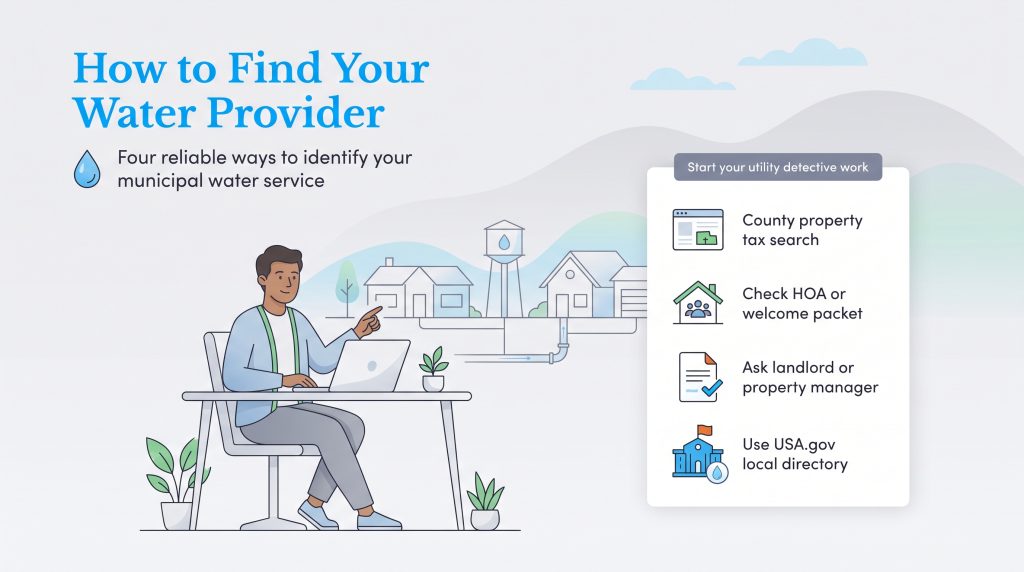
If a simple internet search leaves you confused about who services your new neighborhood, try these four reliable methods to uncover your provider:
- Check the county property tax website: Public tax records are a goldmine of information. Search your new address in the local county appraisal or tax portal. The detailed property assessment will almost always list the specific utility districts and municipal entities levying taxes on the lot.
- Consult the Homeowners Association (HOA): If you are moving into a managed neighborhood, the HOA board or welcome committee can immediately provide a comprehensive list of all required utility contacts.
- Ask the landlord or property manager: For renters, the physical lease agreement should explicitly state which utility companies you are required to contact. If the documentation is vague, simply email your property manager for the exact contact details before you move in.
- Use the USA.gov local government directory: Visit the official search tool at USA.gov/local-governments to locate the primary administrative office for your new city or county. A quick call to the main civic switchboard can usually point you toward the correct water department.
Documents You Need for a Water Service Transfer
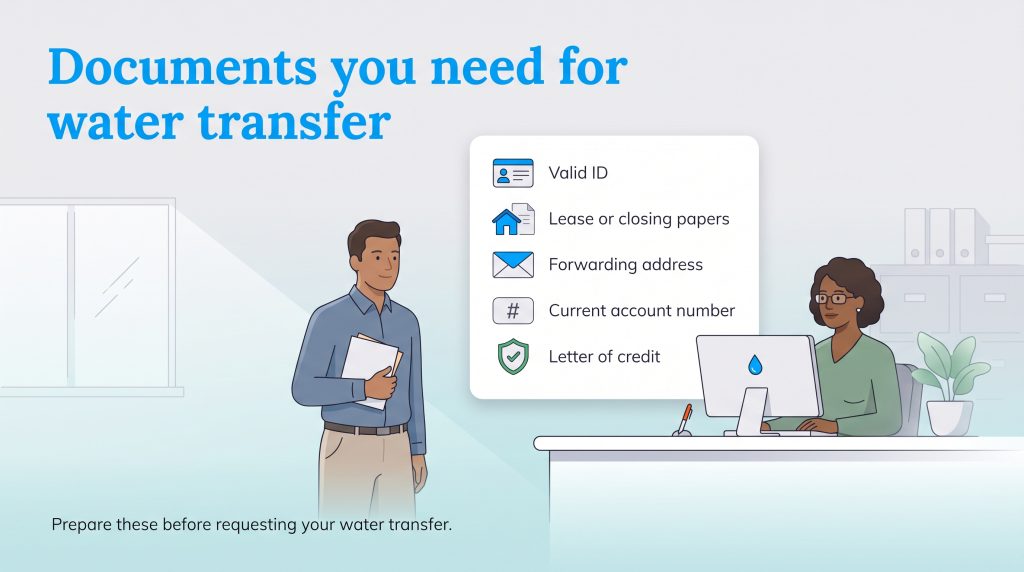
Water departments are notoriously strict regarding their documentation requirements compared to private telecommunications companies. Because unpaid municipal bills can occasionally result in a tax lien placed directly against the physical real estate, city clerks must diligently verify your identity and confirm your legal right to occupy the residence. If they simply allowed anyone to start service over the phone, the city would face massive fraud and uncollected revenue. Gathering your essential paperwork in advance is the absolute best way to speed up your utility setup and prevent administrative delays.
Be prepared to provide the following items to quickly and efficiently establish your municipal account:
| Document Type | Why the Utility Requires It |
|---|---|
| Valid Government-Issued ID | A current driver’s license, federal passport, or state ID verifies your primary identity and prevents fraudulent account creation under your name. |
| Copy of Lease or Final Settlement Statement | This acts as your mandatory proof of residency, explicitly demonstrating that you legally rent or own the property and have the right to request utility changes. |
| Forwarding Address | You must provide a reliable mailing address so the city can accurately send your final prorated invoice or mail a physical refund check for your previous security deposits. |
| Current Account Number | If you are transferring service within the same municipal district, having your old account number handy significantly accelerates the internal transition and consolidates billing. |
| Letter of Credit | Providing an official letter of credit from a previous utility company can occasionally be used to waive mandatory new security deposits by proving your reliable payment history. |
Transferring Within the Same City Versus Moving to a New District
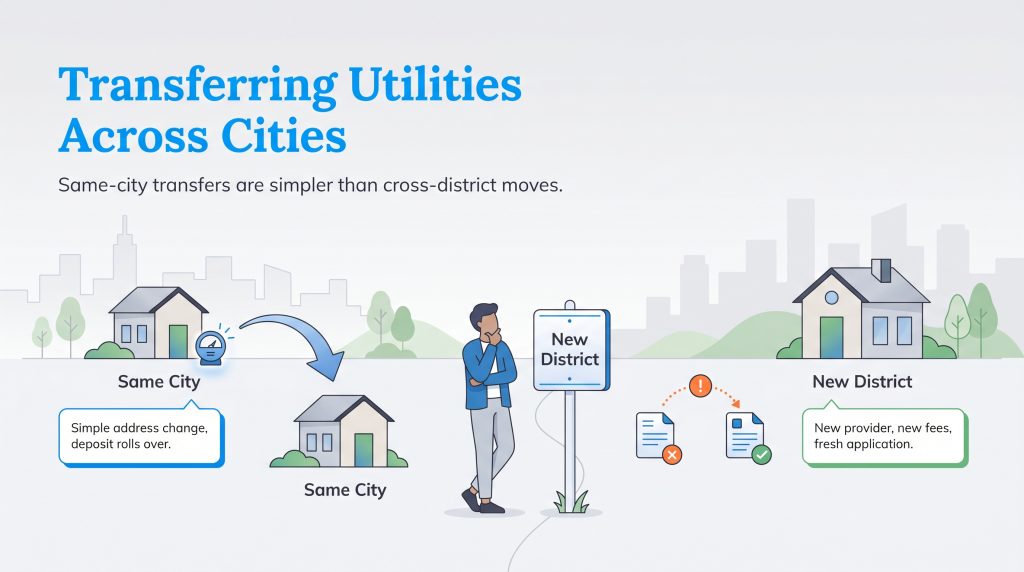
The administrative complexity of your move depends heavily on whether you are relocating locally or crossing county lines. Understanding these strict jurisdictional boundaries dictates exactly how you should initiate the request to transfer city water service, as municipal rules vary wildly from one town to the next.
Staying Within the Same Municipality
If your new home successfully falls under the jurisdiction of your current provider, the process is generally straightforward. You can typically perform a simple address change on your existing account by contacting customer service over the phone or utilizing their digital portal. The city will systematically transfer your internal profile, seamlessly roll your current security deposit over to the new property, and arrange for simultaneous stop and start dates. This highly efficient process keeps your billing consolidated under one convenient profile and prevents you from having to pay brand-new application fees.
Moving Out of District
Relocating to an entirely different city or a new municipal district requires a completely clean break from your old utility company. Because your new town operates on a fundamentally separate administrative and financial system, you cannot simply forward your existing account. Instead, you must submit a formal request to permanently stop your current service and go through the entire application process to start fresh with the new governing entity. This means you will need to submit new identity documentation, await a refund check for your old deposit in the mail, and pay entirely distinct connection fees to the incoming local government.
What to Expect: Setup Fees, Deposits, and Outstanding Balances
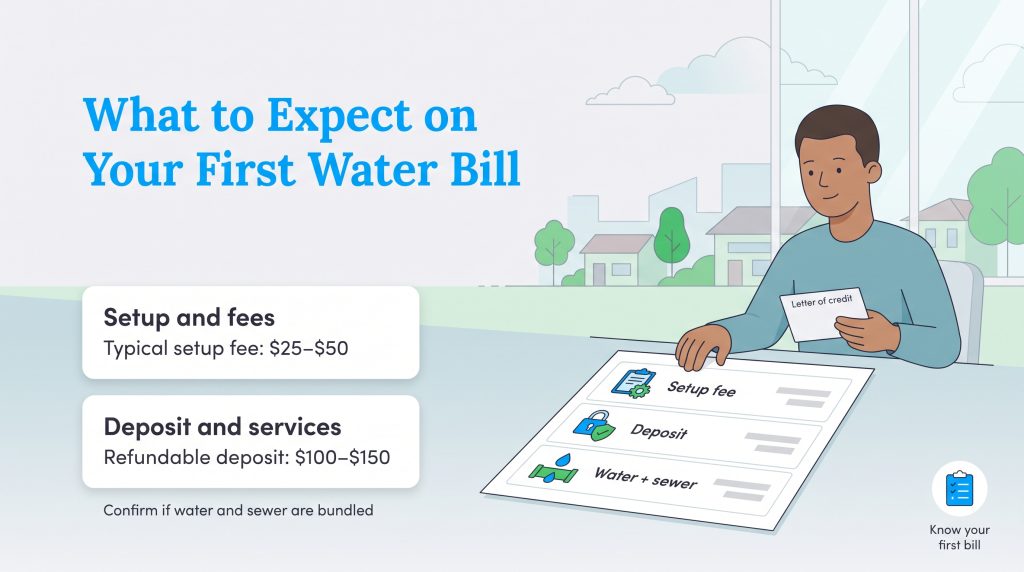
Thoroughly budgeting for a major relocation means accounting for the standard water utility transfer fee that municipal governments charge to establish new accounts. Before you can successfully transfer a bill to a new address, local governments demand a perfectly clean financial slate. Once you are approved, you should anticipate a slightly higher initial invoice during your first month of occupancy to cover administrative onboarding costs.
When establishing your new account, you also need to confirm exactly what services are included in your monthly bill. Different municipalities operate under different bureaucratic structures, and it pays to know what you are agreeing to pay for.
- Set up water and sewer new home: Municipalities frequently bundle these two distinct services together. The underlying sewer rate is usually calculated based on water consumption. Understanding your water bill and these interconnected rates upfront prevents total sticker shock when your first comprehensive bill finally arrives in the mail.
Renting Versus Buying: Who Handles the Water Transfer?
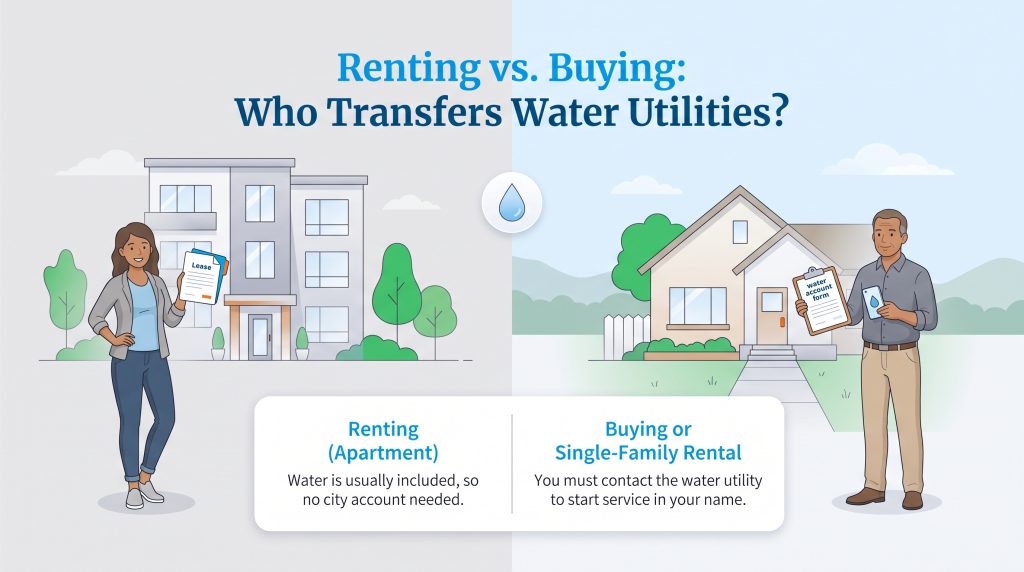
When you purchase real estate, the complicated closing process often intersects directly with your local municipal utilities. Professional title companies generally handle the complex logistics required to settle existing municipal balances at the closing table. Because unpaid water bills remain legally attached to the physical property rather than the individual person, the title agency will systematically pull the seller’s final balance and pay it off directly from the escrow funds. However, buyers must remember that title companies only handle the financial payoff; you are still personally responsible for contacting the local water department to proactively establish the brand-new utility account in your own name before moving day.
Renters face a slightly different administrative process when they organize services for a new lease. In many large multi-family apartment complexes, master-metered water is automatically included in the monthly rent, meaning you will never need to interact with the city or set up an individual account. However, if you are relocating into a single-family rental home or a townhome with private meters, you must manually contact the utility provider with your signed lease agreement in hand. Landlords typically require tenants to formally transfer the utilities entirely into their own names before handing over the front door keys to ensure they are not held financially liable for a tenant’s excessive water usage.
Setting Up Your Plumbing for Moving Day
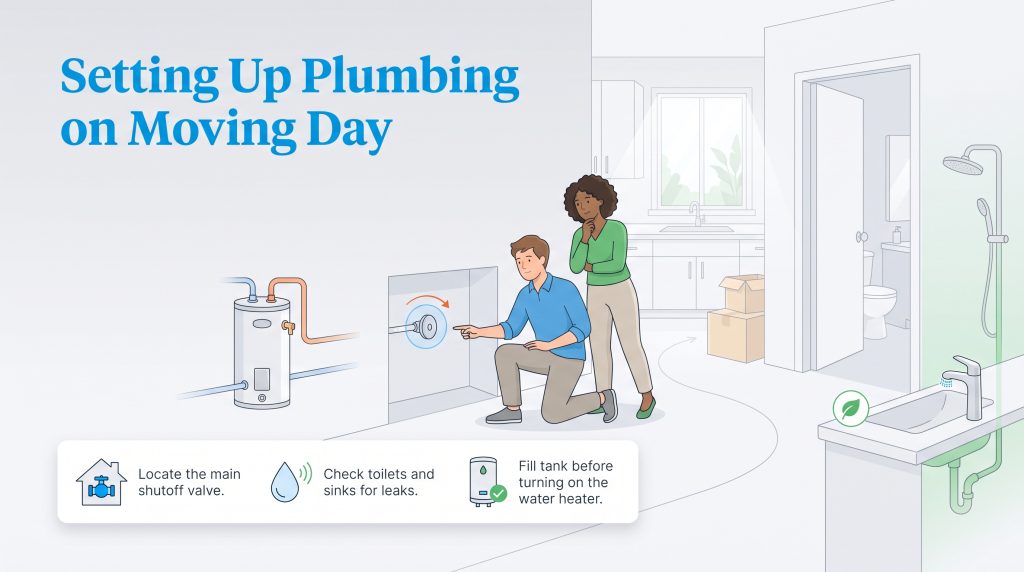
Once you arrive at your new residence, take a brief moment to visually inspect the interior plumbing before you start endlessly unpacking your kitchenware. Moving day is the absolute perfect time to spot mechanical issues that could quickly cost you hundreds of dollars in wasted utilities. If the home has been sitting vacant during the closing process, seals can dry out and unexpected issues can surface the moment the city restores pressure to the lines.
Take ten minutes to run through this immediate arrival checklist to protect your home and your wallet:
- Locating the main shutoff valve: Find exactly where the water enters your home — typically in a basement, garage, or utility closet. Knowing how to halt the flow of water immediately can save you from catastrophic damage in the event of a sudden pipe burst.
- Checking for phantom leaks: Listen closely to toilets to ensure they do not run continuously after flushing, and check underneath all bathroom sinks for aggressive dripping. Even a seemingly small drip can waste dozens of gallons of water per day.
- Turning on the water heater: Ensure the main water supply is flowing and the tank is completely full before you flip the breaker or ignite the pilot light on your water heater. Turning on a dry water heater can permanently destroy the internal heating elements within minutes.
For more valuable resources on pinpointing and fixing silent leaks, you can explore our comprehensive water service hub or check out the official EPA WaterSense Fix a Leak Week events.
Settle Into Your New Home With Confidence

Successfully navigating a utility transition does not have to be a major headache as long as you plan ahead and gather your necessary municipal documents early. By securing your exact connection dates well in advance and carefully inspecting your home’s plumbing on day one, you ensure your household runs smoothly from the moment you step through the front door. Review your initial municipal invoice closely to verify that all setup fees are accurate, consider establishing automatic payments to avoid future late penalties, and finally relax and enjoy the comfort of your wonderful new home.
Frequently Asked Questions About Transferring Water Service
How long does it take to transfer water service?
Can I transfer my water bill to a new address online?
Does the title company handle water utility transfers?
What happens if I forget to stop my water service before moving?
Does the water company also transfer sewer service?
Do I need a new security deposit if I transfer water service within the same city?
How do I transfer a water bill to a new owner?
Can I move water service to a new house on the weekend?
Do I need an inspection before I can start water service at a new address?
About the Author

Claudio is a sustainability-focused writer with a background in Anthropology and Psychology from NC State University. He has spent over 15 years working in writing, interpretation, and translation, driven by a deep interest in how human culture shapes the environment. Today, he shares his curiosity with readers by writing about sustainable living solutions and the connection between everyday choices and environmental impact.