

Planning Your Utility Transfer Four Weeks in Advance Ensures You Won’t Be Left in the Dark on Moving Day
Key Takeaways
- Gather necessary documents like account numbers and your new lease or deed before calling providers.
- Schedule service transfers at least four weeks prior to your move date to avoid gaps in coverage and secure preferred technician appointments.
- Conduct a final meter reading on moving day to prevent paying for energy usage after you officially leave the property.
Relocating to a new residence is universally recognized as one of life’s most demanding transitions, but you can entirely avoid the administrative nightmare of dealing with your power, water, and internet at the last possible second. This moving utilities checklist transforms a chaotic chore into a streamlined, predictable process, ensuring the lights are glowing and the Wi-Fi is actively running the moment you step through the front door of your new property. Whether you need a simple apartment utilities checklist for a local lease or a comprehensive list of utilities for a house across state lines, adopting these proactive steps guarantees your new space will be comfortable, highly efficient, and fully functional on day one.
1. Download Our Printable Moving Utilities Checklist PDF
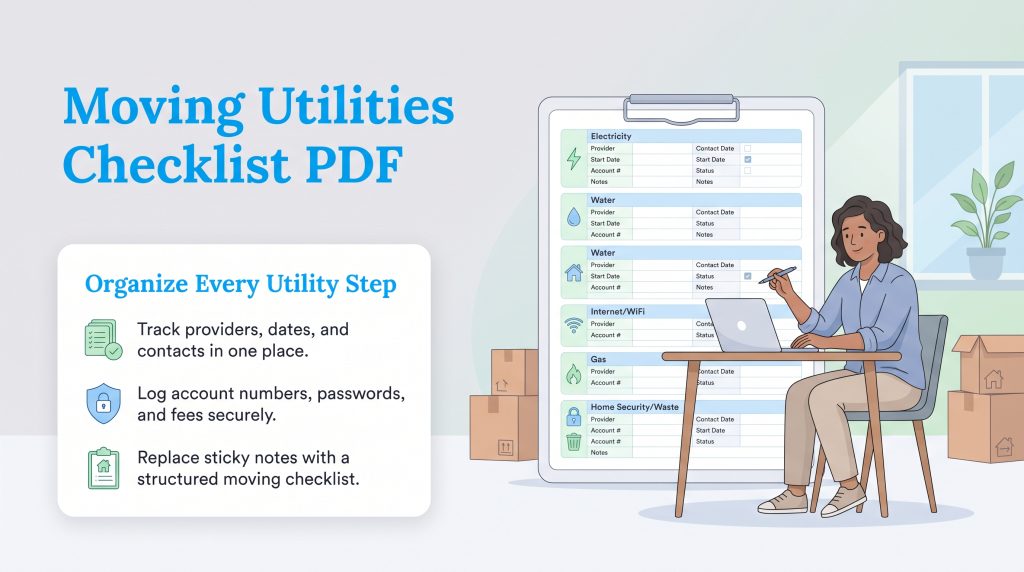
Relying solely on your memory during a highly stressful relocation almost guarantees an essential service will be completely forgotten. As you figure out how to transfer utilities when moving, you need a centralized location to map out your necessary calls, track specific connection dates, and identify exactly who you need to contact. We designed a comprehensive digital resource to help you document every step of your transition without losing track of your essential account numbers.
This interactive formatting tool acts as your ultimate home services transfer guide. It replaces disorganized sticky notes with a highly structured grid that covers every logistical detail of your move. Inside the resource, you will find:
- Master utility transfer checklist for all service providers.
- Account number organization and password tracking charts.
- Provider contact directory with customer service phone numbers.
- Disconnection and activation date tracking calendars.
- Setup fee, activation cost, and security deposit logs.
- Hardware tracking sheets for equipment return receipts.
2. The 4-Week Moving Utilities Timeline
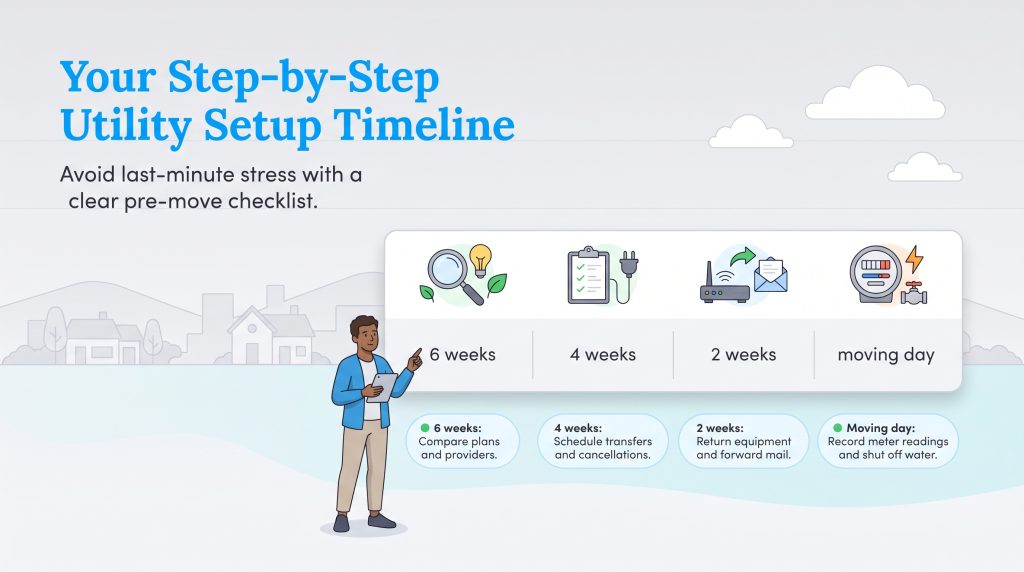
Managing your residential accounts does not have to be a panic-inducing scramble that leaves you waiting on hold for hours while the moving truck sits in your driveway. By expanding your planning phase into a comprehensive moving utilities timeline, you can methodically tackle each individual task, secure competitive energy rates, and entirely sidestep unexpected gaps in coverage. Refer to the data table below for a quick snapshot of your critical logistics, then read on for the specific scripts and strategies required for each phase.
| Timeframe | Required Task | Provider to Contact |
|---|---|---|
| 6 Weeks Out | Audit current energy plans and compare regional rates to find cost-saving options. | Current providers, competitive energy suppliers |
| 4 Weeks Out | Formally schedule exact transfer, disconnection, and activation dates. | All municipal and private utility companies |
| 2 Weeks Out | Return leased equipment safely and officially forward your mailing address. | Telecom companies, USPS, Home Security |
| Moving Day | Take final meter readings and shut off the main water supply valves. | Moving team, personal records, landlord |
Crucial Steps for Your Timeline Success
Executing your timeline requires precise communication with your current and future providers. Navigating the logistics of transferring vs. setting up new utilities starts at the six-week mark. This is when you should conduct a full audit of your current service plans — including your electric, natural gas, water, and internet accounts. Use this time to research which specific providers service your new address and figure out exactly when to cancel utilities after moving.
At the four-week mark, focus your attention on setting up utilities for a new home by paying off all outstanding balances in full. You must proactively request a formal “Letter of Credit” from your current provider, which serves as undeniable proof of your on-time payment history. When speaking to representatives to finalize your disconnection dates, use this straightforward script to avoid any miscommunication:
“Hello, I am officially moving out of [Current Address] on [Date]. Please safely disconnect my service on [Date + 1 Day], send my finalized bill to [New Address], and email me a formal confirmation number for this cancellation request.”
When you hit the two-week mark, turn your fierce attention toward tracking down leased modems, Wi-Fi routers, or cable boxes. Consult a comprehensive change of address checklist and officially forward your mail via the USPS Change of Address portal so you do not miss important final bills. To ensure you process your tech returns correctly, call your provider and ask:
“Please provide the exact physical address of the nearest authorized return center, and confirm what specific documentation I need to secure a tracking receipt for my dropped-off hardware.”
3. How to Transfer Specific Home Services
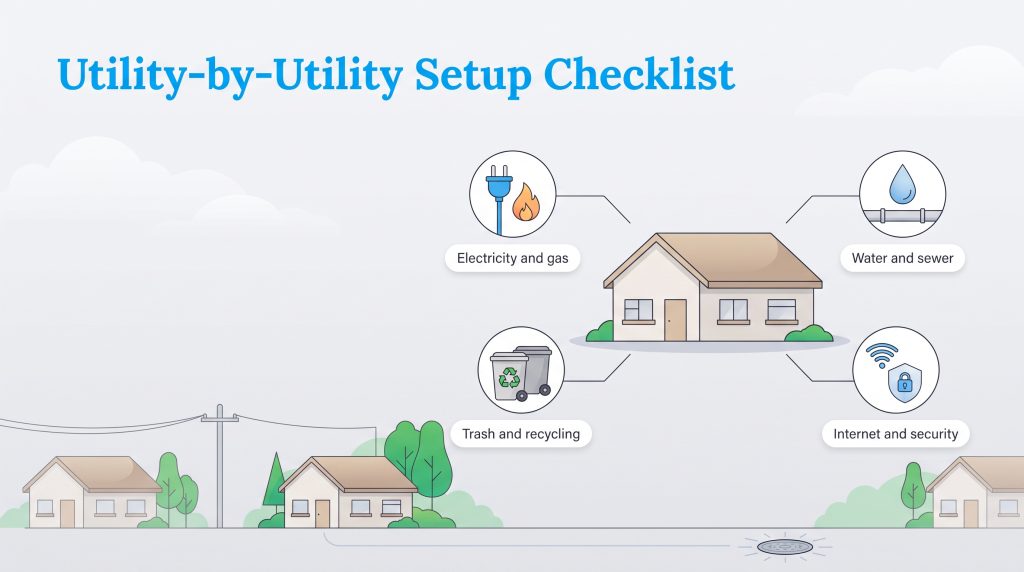
Every distinct type of utility possesses rigid connection protocols that require specialized attention. Mastering these exact procedures will effectively shield you from frustrating moving-day delays, unexpected installation roadblocks, and surprise activation fees. Use the sub-checklists below to tackle each major utility category with absolute confidence.
Electricity
Securing reliable power is the most critical step in making your new residence safely habitable. Depending on where you relocate, you may have the power to choose your own electric provider or you might be required to use the regional utility monopoly.
- Required Documents: Government-issued ID, new lease or closing documents, and your previous account number.
- Lead Time Needed: Two to three weeks (up to four weeks during peak summer moving seasons).
- Key Actions:
- Compare regional plans: If you move to a state with a deregulated energy market, compare competitive plans to select a renewable energy option that lowers your monthly bills and reduces your carbon footprint.
- Check the natural gas lines: Schedule an in-person technician visit for your natural gas connection to ensure a mandatory visual inspection of the physical pipes and service valves.
- Audit for safety: Ensure the provider conducts a meticulous safety inspection to check for dangerous carbon monoxide leaks before they leave your new premises.
Water
Unlike electricity or internet services, you cannot shop around for competitive water rates. Municipal water and sewer departments strictly govern specific geographic zones, meaning you must adhere to your local government’s unique application process.
- Required Documents: Property deed or signed lease agreement, social security number, and secondary identification.
- Lead Time Needed: One to two weeks.
- Key Actions:
- Contact your municipality: Call your local municipal public works office directly, as water and sewer services are almost universally managed by local city or county monopolies.
- Submit your documents: Submit your new lease or property deed and pay any required upfront municipal security deposits to establish the vital service in your name.
- Verify your account: Verify your municipal account status at least a week before moving day to ensure your water will be flowing the moment you arrive.
Internet
In our highly connected digital era, prolonged internet downtime is unacceptable — especially if you work from home. Transferring internet services requires proactive coordination, as you may need to upgrade from older coaxial cables to modern fiber-optic lines at the new property.
- Required Documents: Previous account number, updated billing address, and your preferred installation window.
- Lead Time Needed: Three to four weeks.
- Key Actions:
- Book early appointments: Book your installation appointment early if your new home requires a technician to drill new coaxial or fiber lines into your living room.
- Update your address: Contact your monitoring provider immediately to update your physical address and maintain accurate 911 emergency dispatch protocols.
- Check hardware range: Verify that your existing wireless cameras and window sensors possess the necessary range to operate effectively within your new, potentially larger floor plan.
Trash
Do not let piles of broken-down moving boxes consume your new garage. Setting up your waste management services early ensures you have the necessary recycling and garbage bins ready for post-move cleanup.
- Required Documents: Closing disclosure or rental agreement, and your preferred bin sizes.
- Lead Time Needed: One to two weeks.
- Key Actions:
- Consult local authorities: Consult with your new city municipality or Homeowners Association to determine if residential waste management is automatically bundled into your property taxes.
- Contract private services: Contract independently with a private local disposal company if you are moving into a more rural or sprawling suburban area.
- Clarify bulk pickup rules: Request your rolling bins as early as possible and clarify the bulk pickup rules for your massive piles of broken-down cardboard moving boxes.
4. Utility Setup Deposits and Fees: What to Expect
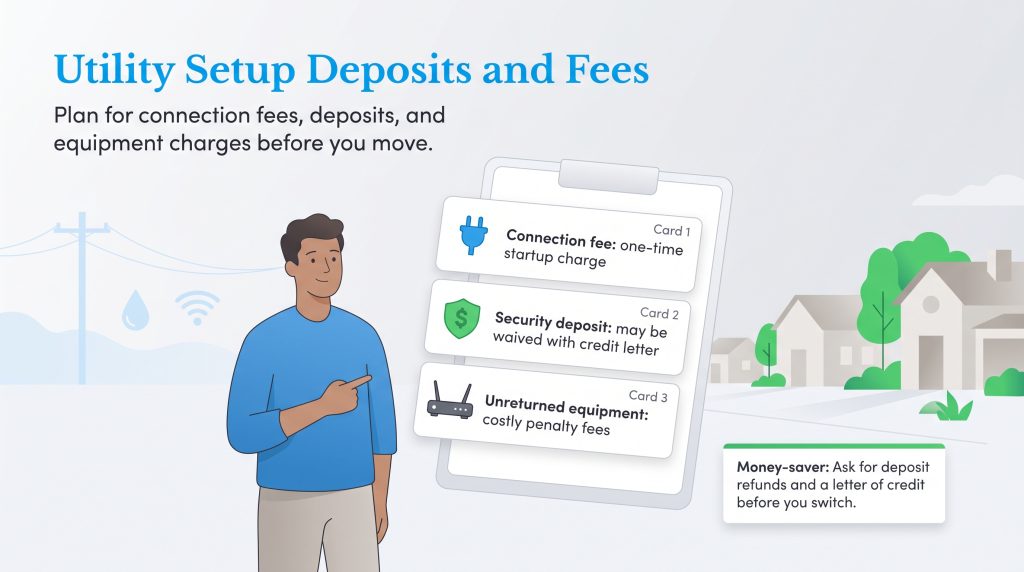
Budgeting for a move goes far beyond renting a truck and buying cardboard boxes. When establishing utility disconnection and connection services, you will inevitably encounter a variety of administrative costs designed to protect the provider from default. Anticipating these utility setup deposits and fees prevents unexpected financial strain during an already expensive transition.
- Connection fees: These are non-refundable administrative charges applied to your first billing cycle. They cover the physical labor and backend processing required to establish a brand-new account in your name.
- Security deposits: Providers mandate these upfront funds if you lack established credit or possess a poor payment history. The company holds this money in escrow to cover potential future unpaid balances.
- Unreturned equipment fees: You will face massive penalty charges if you fail to return leased hardware like internet modems, cable boxes, or specialized satellite dishes to your previous provider within their rigid 14-day window.
To entirely bypass expensive security deposits, you can proactively request a formal Letter of Credit from your previous provider. This critical document serves as undeniable proof of your on-time payment history over the last 12 months. When you contact your new utility company to establish service, immediately submit this letter to their billing department. Most providers will instantly waive the upfront deposit requirement upon receiving verified proof of your excellent financial standing, keeping hundreds of dollars in your pocket.
5. Apartment Utilities Checklist Vs Single-Family Homes
Relocating into an apartment complex presents entirely different administrative challenges compared to purchasing a sprawling single-family home. Before calling local providers, you must thoroughly review your signed lease agreement to see if the landlord explicitly covers essential services in your base rent. Understanding these nuanced property distinctions ensures you never accidentally pay double for a service your property manager already handles.
| Service Type | Apartment / Multi-Family Unit | Single-Family Home |
|---|---|---|
| Water and Sewer | Typically landlord-covered (included in base rent) or billed via RUBS. | Tenant-covered; requires a direct account with municipal public works. |
| Trash and Recycling | Landlord-covered; property utilizes shared commercial dumpsters. | Tenant-covered; requires a municipal or private local subscription. |
| Electricity | Tenant-covered; requires an individual sub-meter registered in your name. | Tenant-covered; requires a direct account with the local power company. |
| Internet and Cable | Tenant-covered; occasionally bulk-billed by the property manager. | Tenant-covered; fully independent provider selection and installation. |
| Natural Gas | Rarely tenant-covered unless the unit features a private gas stove or heater. | Tenant-covered; requires an independent account and mandatory safety inspection. |
- Ratio Utility Billing System (RUBS): If you are moving into a large corporate apartment complex, your property manager might mathematically divide the building’s master water or gas usage among tenants. Instead of using individual sub-meters to track your exact usage, they calculate your monthly bill based on your unit’s square footage or the number of occupants.
6. Eco-Conscious Upgrades for Your New Home

Once you successfully execute your new house utility setup checklist and confirm your essential services are fully operational, use this fresh start to implement meaningful, highly sustainable upgrades. Moving into a blank slate offers the perfect opportunity to ditch outdated, energy-draining habits. Focus on this fast post-move checklist to easily integrate an eco-conscious alternative into your daily routine:
- Swap to ENERGY STAR-Certified LEDs: Replace old incandescent bulbs with ENERGY STAR–certified LED light bulbs across your entire house, as a standard 60-watt incandescent bulb can easily be replaced by a 9-watt LED to drastically cut power consumption.
- Install a Programmable Smart Thermostat: Mount a Wi-Fi-enabled smart thermostat to automatically adjust the HVAC temperatures when you leave the house. This serves as a highly effective energy-saving option by utilizing geofencing and learning your family’s daily schedule.
- Upgrade to High-Efficiency Appliances: Search for the blue ENERGY STAR label on refrigerators, washing machines, and dishwashers to ensure top-tier performance and significantly reduced water usage over the lifespan of the machine.
- Attach Low-Flow Water Fixtures: Swap out outdated, high-pressure showerheads and standard bathroom faucet aerators with low-flow alternatives to instantly reduce your daily municipal water use without sacrificing basic comfort.
These environmentally mindful choices will lower your household carbon footprint and permanently reduce your long-term monthly expenses. For more room-by-room strategies on maximizing your home’s efficiency, check out our in-depth guide on how to save on your electric bill.
7. Verifying Your Utility Setup After Move-In
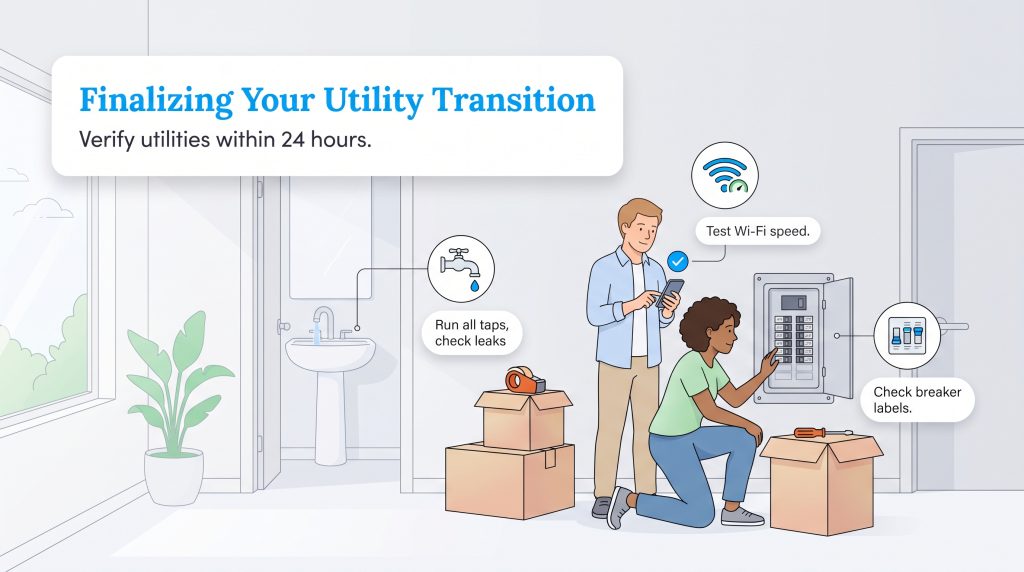
Completing your home services transfer guide ensures your new residence is ready for action, but your task requires one final push. Execute these three critical verifications immediately upon arrival to guarantee a flawless transition and avoid costly repair emergencies during your first week.
- Run the water taps: Turn on every sink, run every shower, and flush every toilet to verify steady water pressure and actively check for hidden leaks beneath the cabinets.
- Test the Wi-Fi speed: Connect your primary smartphone to the new network and run a dedicated speed test in multiple rooms to ensure your internet connection meets the bandwidth you are paying for.
- Check the electrical panel physically: Open your main breaker box to confirm each switch is clearly labeled and operating correctly so you aren’t fumbling in the dark during a future neighborhood power outage.
8. Enjoy Your Fully Functional New Space
By refusing to leave your vital services up to chance and diligently following this moving utilities checklist, you earn the unparalleled peace of mind that comes with confidently checking every necessary box. Instead of spending your first weekend arguing with customer service representatives over disconnected services, you can focus on unpacking boxes, arranging furniture, and settling into your vibrant new community. Enjoy your beautiful new space knowing your home is perfectly safe, hyper-efficient, and fully optimized from the very first night.
Frequently Asked Questions About Moving Utilities
How do I transfer utilities to a new owner?
Contact your current providers to schedule a formal service disconnection for the day after your move-out date. You cannot technically transfer an account directly to someone else. The new owner must independently establish brand new accounts in their own name, as utility companies require fresh credit checks and assume legal liability for the new occupants.
What is the earliest I should set up utilities for a new home?
Begin comparing energy rates six weeks in advance, but formally call to schedule the physical connection four weeks before your move-in date. This 28-day window gives utility companies a comfortable buffer to dispatch technicians for specialized installations, ensuring you secure a preferred time slot during busy summer relocation seasons.
How do I find out who the current utility providers are at my new house?
The easiest method is to directly ask the previous owner, your new landlord, or your real estate agent, as they possess the most accurate historical records. Alternatively, check your local county website for municipal water details and utilize your state’s Public Utility Commission portal to identify regional electric and natural gas companies assigned to your specific zip code.
Can I have utilities active at two homes during my move?
Yes, most utility companies gladly allow an administrative overlap for customers transitioning between properties. Schedule your old home’s disconnection for the day after you move out and the new home’s connection for the day before you arrive to ensure uninterrupted power, climate control, and running water during the chaotic moving process.
What happens if I forget to cancel my utilities before moving?
If you fail to request a formal shut-off, your existing accounts will remain completely open, leaving you legally and financially responsible for all subsequent usage. You could easily end up paying for the new tenant’s excessive electricity or water consumption for several months until you realize the massive error and formally close the account.
Do I have to pay a deposit when setting up utilities for the first time?
Providers typically require an upfront security deposit for brand new accounts to protect themselves against potential defaults. However, you can frequently bypass this costly fee by having a parent co-sign your application, proving a strong credit score, enrolling in automatic payments, or submitting a formal Letter of Credit from a previous utility provider.
How do I return utility equipment if I am moving out of state?
Pack your leased modems, routers, and cable boxes to return directly to a local retail store before you leave town, ensuring you collect a physical receipt. Alternatively, you can request prepaid shipping labels to mail the hardware back via certified mail, securing a firm tracking number to prevent unwarranted unreturned equipment fees from hitting your final bill.
What is the easiest way to transfer all my utilities at once?
Utilize a comprehensive moving utilities checklist to organize your account numbers, passwords, and provider details in one central location. While you cannot technically transfer them all with a single phone call, consolidating your documentation streamlines the repetitive process and significantly reduces the total amount of time you spend waiting on hold.
Do I need to contact utility providers if I am moving within the same city?
Yes, you still must contact your current providers to explicitly transfer your service to the new physical address. Even highly localized moves require you to formally update your billing details, finalize your current meter readings, and meticulously schedule a connection date to ensure the lights turn on at the new property.
How long does it take for Wi-Fi to be activated in a new home?
If your new home already features functional wiring and recent internet service, remote Wi-Fi activation can easily occur within 24 to 48 hours using self-installation kits. However, if the property requires new coaxial or fiber lines to be physically drilled into the walls, scheduling an in-person installation technician may take two to four weeks.
Should I turn off my current utilities on moving day or the day after?
You should always schedule your service disconnection for the day after your official moving date. This 24-hour buffer guarantees your moving crew will have adequate lighting, running water, and climate control while loading heavy furniture, preventing you from sweating in the dark during the final exhausting hours of your relocation.
How much notice do utility companies need for a move?
Most standard utility companies require a minimum of two weeks’ notice to seamlessly process a service transfer or disconnection request. However, to guarantee your preferred activation dates and secure highly coveted technician appointments, you should supply at least four weeks of advanced notice to your providers.
About the Author

Claudio is a sustainability-focused writer with a background in Anthropology and Psychology from NC State University. He has spent over 15 years working in writing, interpretation, and translation, driven by a deep interest in how human culture shapes the environment. Today, he shares his curiosity with readers by writing about sustainable living solutions and the connection between everyday choices and environmental impact.

David has been an integral part of some of the biggest utility sites on the internet, including InMyArea.com, HighSpeedInternet.com, BroadbandNow.com, and U.S. News. He brings over 15 years of experience writing about, compiling and analyzing utility data.