

Save Time And Avoid Stress By Updating Your Address With These Essential Organizations Before You Pack The First Box
Key Takeaways
- Notify essential utilities and government agencies at least two weeks before your move date to ensure seamless service.
- Update your address with financial institutions and insurance providers to prevent potential coverage gaps or identity theft risks.
- Don’t forget digital services and subscriptions, including online shopping profiles, streaming accounts, and smart home location settings.
If you are wondering who to notify when you move: the complete change of address list below will serve as your ultimate guide to avoiding missed bills, lapsed policies, and sudden service interruptions. We created this comprehensive resource to ensure you cover every essential base, from the local power company and federal government agencies to your favorite streaming services. Follow these actionable steps to smoothly navigate your transition and focus on settling into your new space with absolute confidence.
When Should You Start Changing Your Address?
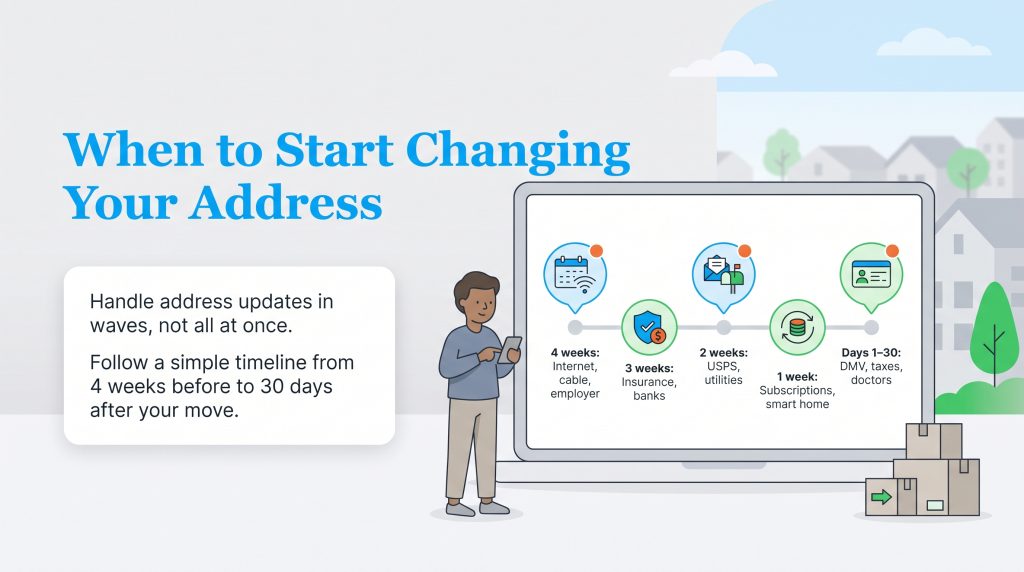
A successful relocation relies heavily on precise timing, so understanding the standard post office change of address timeline ensures your critical services are active the exact moment you turn the key. Follow this digital moving address update checklist to prioritize your outreach efficiently so nothing slips through the cracks.
| Entity | When to Notify | How to Notify |
|---|---|---|
| USPS | 2 weeks before | Online via moversguide.usps.com |
| Utilities | 2 to 3 weeks before | Call or use provider’s online portal |
| Bank & Credit Cards | 1 week before | Mobile app or local branch |
| DMV | Within 30 days after | State DMV portal or in person |
| Insurance Providers | 1 to 2 weeks before | Call agent to adjust policy |
- Four weeks before: Contact your internet and cable providers, and formally notify your employer.
- Three weeks before: Reach out to your insurance providers and financial institutions to protect your most sensitive assets.
- Two weeks before: File your postal forwarding request and contact your electricity, natural gas, and water companies.
- One week before: Update your recurring subscriptions, smart home technology settings, and personal network.
- Immediately after (Days 1 — 30): Visit the local license bureau, update federal tax agencies, notify the Social Security Administration, and coordinate with all medical professionals.
Free Downloadable Change Of Address Checklist PDF
Tracking dozens of different utility providers and government agencies can feel overwhelming as your relocation date approaches. To make this process completely foolproof, we created a comprehensive document that you can print out and keep on your clipboard. Grab our complete change of address checklist pdf below. It is entirely free, meticulously organized, and fully printable for moving day.
1. Government And Public Agencies
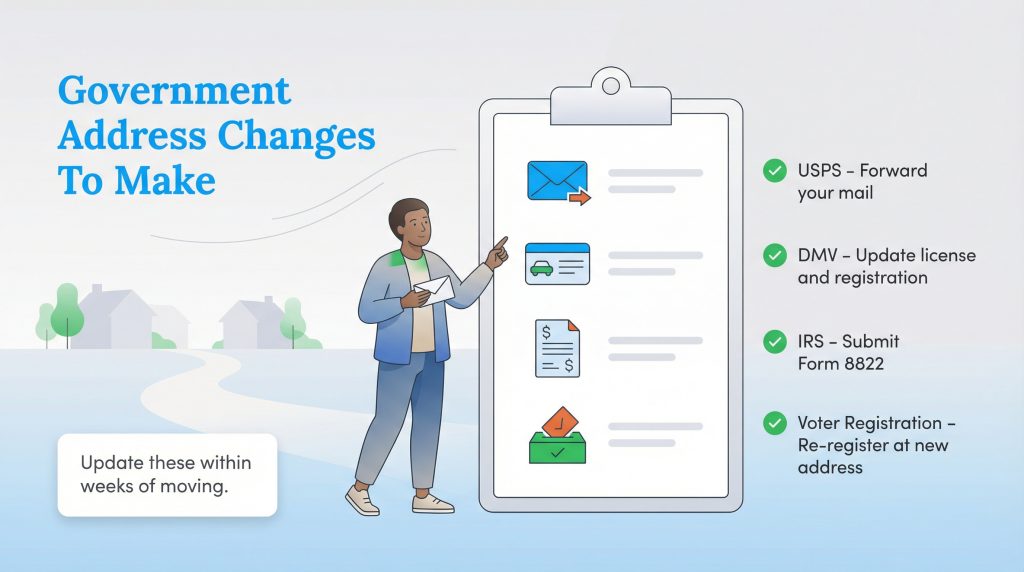
Once your immediate home services are officially scheduled, shift your focus directly to official government records. Updating your information here is a strict legal requirement, ensuring you receive highly sensitive tax documents, vote in the correct local district, and maintain a valid form of identification. Keeping a dedicated address update checklist for moving will help you smoothly track these vital federal and state updates without missing a deadline.
USPS Mail Forwarding
You need to submit your postal mail forwarding request to catch any straggling letters and packages. Set this up one to two weeks before your move date so routing starts strictly on time. While you can fill out the official USPS change of address form (PS Form 3575) in person at your local post office, utilizing the official USPS Change of Address website is significantly faster, highly secure, and much more efficient.
IRS And State Tax Agencies
You must notify the federal government of your physical location to ensure you receive tax refunds, stimulus checks, and vital correspondence. Relying entirely on the post office to forward government checks is a risky gamble. Instead, filing an IRS form 8822 change of address is the gold standard way to officially update your records before the busy tax season begins. In addition to federal taxes, remember to explicitly notify your specific state’s department of revenue.
DMV (Department Of Motor Vehicles)
Many states fiercely mandate that you update your driver’s license and vehicle registration within 30 days of relocating. Check your specific state timeline to avoid hefty traffic fines or a suspended license. If you are changing address on driver’s license out of state, you will likely need to visit the local branch in person to take a new photograph, surrender your old license, and pass a brief vision exam.
Social Security, Medicare, And Voter Registration
Handling your social security change of address is critical to avoid missed benefit payments or permanently lost Medicare statements. The fastest way to update your information securely is through your “my Social Security” account portal at ssa.gov. Additionally, you need to handle your voter registration as soon as you know your new ZIP code, keeping in mind any strict cutoff dates before local or national elections to ensure your voice is heard in your new community.
Passports, TSA PreCheck, And Global Entry
You must update your physical location in the Trusted Traveler Program (TTP) portal if you regularly fly domestically or internationally. While you do not need to update the physical address on your actual passport until it is time for renewal, active Global Entry and TSA PreCheck accounts strictly require current residency information to remain valid.
2. Utilities And Home Services
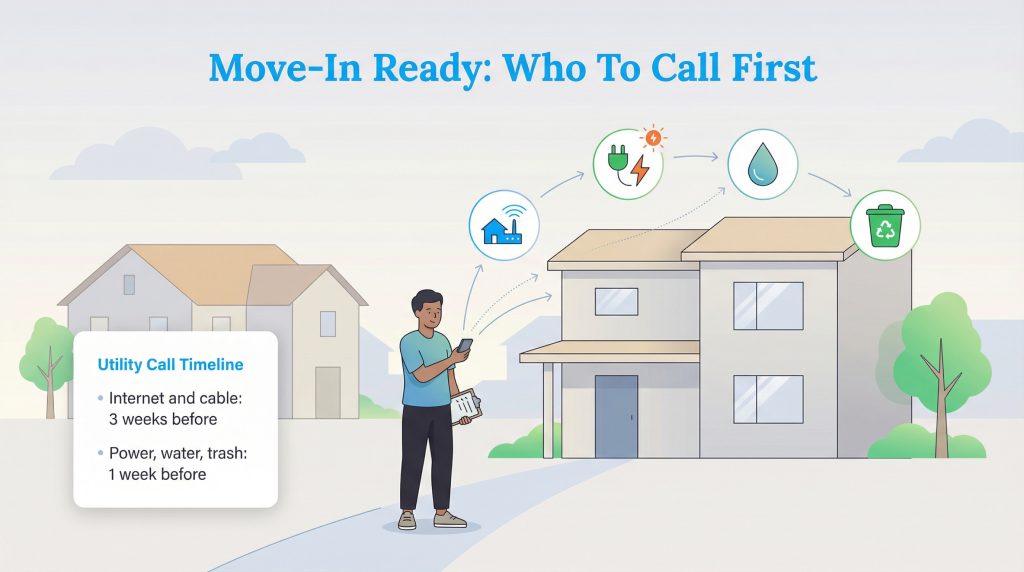
Getting your lights, heat, and internet running is undeniably the most critical step in the relocation process. Knowing exactly how to transfer utilities when moving actively prevents frustrating service outages on your first night in an unfamiliar house.
Essential Utilities (Power, Gas, Water)
Whether you are smoothly transferring your current service or opening a brand new account, contact your electricity and natural gas providers at least one week in advance. If you are moving to a deregulated energy market, this transition period offers the perfect opportunity to shop around for an environmentally mindful choice, such as a plan that utilizes a high percentage of wind or solar power. For municipal water, sewer, and waste services, notify your local government office to schedule a final physical reading at your old home and initiate municipal service at the new address.
For more detailed help on setting up these services seamlessly, check out our in-depth guides on electric and internet service setup, as well as our comprehensive moving utilities checklist and timeline for setting up utilities for a new home.
Internet, Cable, And Smart Home Security
Call your internet and cable providers at least three weeks before your move. Technician appointments fill up incredibly fast, and you don’t want to wait weeks for broadband connectivity if you work from home. For home security systems, alert your provider to professionally transfer your monitoring service and ensure your external cameras are effectively connected to the new local network. If your new home features active solar panels, contact the leasing company or installer to securely transfer warranty information, system app access, and net metering credits directly into your name.
3. Financial Institutions And Lenders
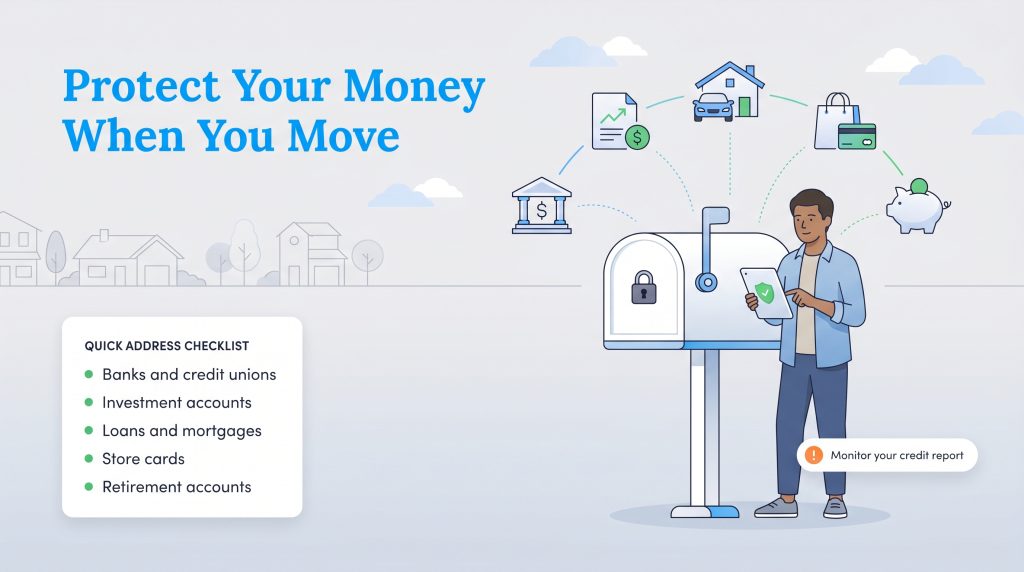
Your money and your vital safety nets need to move with you securely. Failing to execute a prompt bank change of address is a remarkably common mistake that can have serious, long-lasting consequences for your credit file. Sensitive financial documents delivered to an unsecured old mailbox are an absolute goldmine for identity thieves looking to actively exploit your chaotic transition.
Make sure you explicitly contact the following financial institutions to safeguard your assets:
- Banks, Credit Unions, and Retail Accounts: Update the billing address for all of your checking accounts, savings accounts, store credit lines, and active credit cards to prevent declined transactions and correctly flag potential fraud.
- Investment Brokerages: Protect your wealth management portfolios by notifying your brokers. This ensures sensitive monthly statements, tax documents, and trade confirmations reach the right mailbox.
- Loan Providers: Notify lenders for student loans, auto loans, and personal mortgages to ensure you never accidentally miss a required payment notification.
- Retirement Accounts: Don’t lose track of your long-term savings. Update your digital profile with your 401(k), pension, and IRA administrators.
4. Insurance Providers
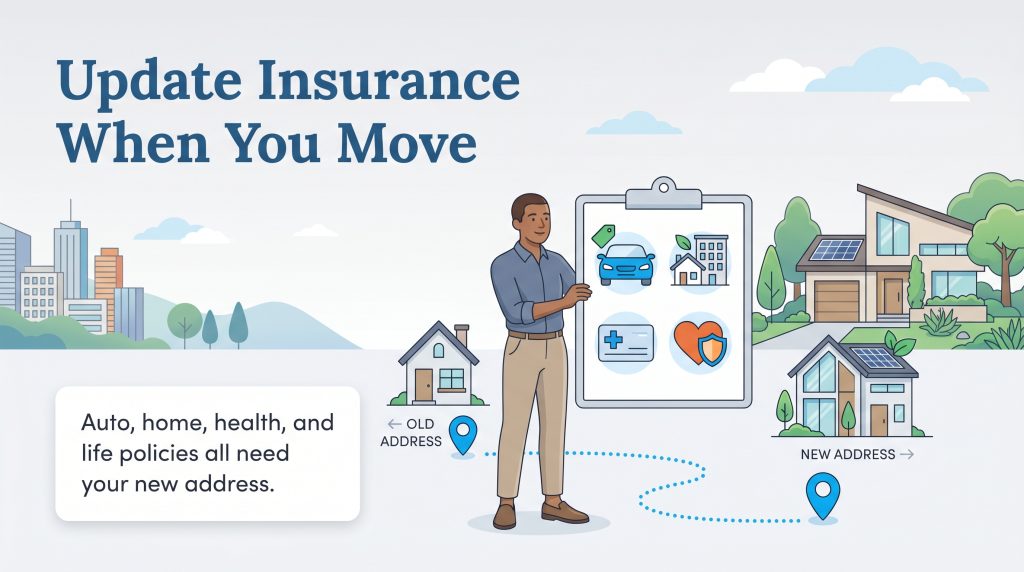
Managing an address change for insurance is one of the most critical steps during any relocation. Because insurance premiums are heavily tied to your exact physical location, your rates and specific coverage requirements will undoubtedly shift. Failing to strictly update your insurance provider can easily result in severely delayed payouts or outright denied claims if a disaster or emergency occurs at your new residence. You should gather all your policy numbers into one centralized list of places to change address so you can systematically call each agent.
- Auto Insurance: Auto insurance premiums naturally fluctuate based on your new ZIP code, local traffic density, and neighborhood property crime rates. Update your policy immediately to ensure you remain fully protected on the road, but be completely prepared for your monthly rate to change.
- Homeowners or Renters Insurance: You need to explicitly establish a new, robust policy for your upcoming residence. This transition is a fantastic time to ask your agent about unique discounts for eco-conscious upgrades, like having energy-efficient appliances or sustainable building materials in your new home.
- Health Insurance: If you are moving to a completely new state or stepping out of your current provider’s local network, you may need to secure an entirely new plan. Update your details early to maintain seamless access to essential, life-saving care.
- Life Insurance: Protect your designated beneficiaries by keeping your contact information completely current. Lapsed communication can easily delay eventual payouts or cause you to inadvertently miss vital premium renewal notices.
If you are moving to a brand new state or region, utility rates and local insurance regulations might vary significantly. For more practical resources on settling in securely, check out our essential checklist of the 10 things you must do before moving into a new house.
5. Health, Wellness, And Professional Services
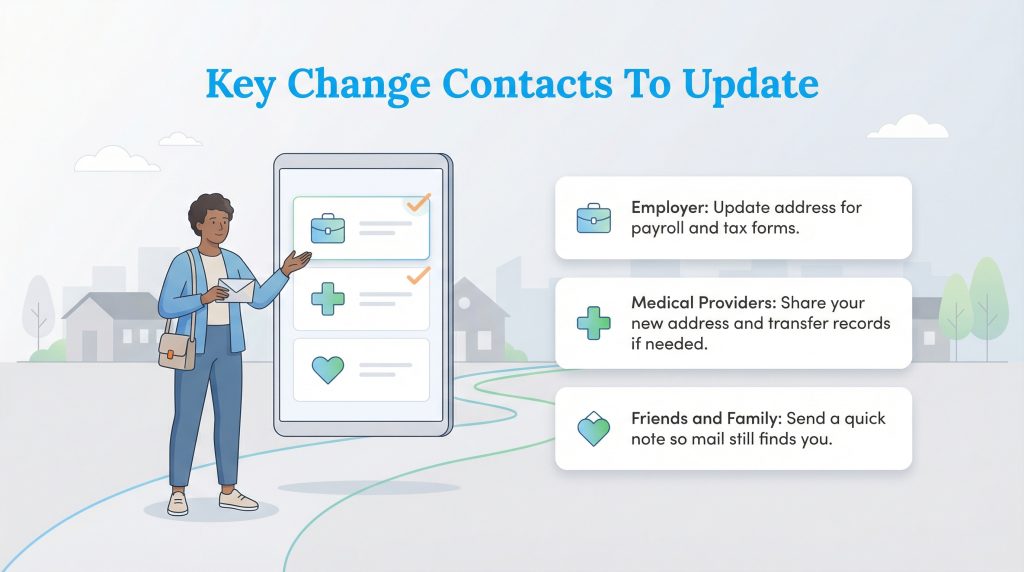
Maintaining immediate access to your historical medical data and personal support network is absolutely vital for your family’s ongoing well-being. Before you pack up the truck and leave town, you must proactively request formal record transfers if you are moving out of the local area. Taking this necessary step ensures your new providers and daily contacts have the exact historical information they need to function without a hitch.
Medical And Dental Providers
Notify your primary care physician, pediatricians, specialists, and dental clinic well in advance of your relocation. Request that your medical files, long-term treatment plans, and x-rays be forwarded securely to your new practitioners to avoid repeating expensive medical tests or experiencing gaps in your prescription refills. If you have pets, transfer their vaccination records and overall medical history so your new local veterinarian is fully prepared for their very first post-move checkup. Don’t forget to log into your pet’s microchip registry online to update your new address immediately, preventing a lost animal from being permanently displaced during the chaos of moving day.
Employers, HR, And Payroll
You must formally notify your current employer of your move so human resources has your new address for processing payroll correctly and successfully mailing critical end-of-year tax forms like your W-2 or 1099s. If you are relocating across state lines, updating your HR department immediately ensures they adjust your state income tax withholdings to comply with your new legal residency. This is especially important for remote workers who might unknowingly trigger complex tax liabilities or labor law changes by working from a completely new jurisdiction without notifying their company leadership.
Professional Licenses And Certifications
Nurses, real estate agents, lawyers, financial advisors, and skilled tradespeople must notify their respective state licensing boards immediately to avoid lapsing credentials or facing stiff non-compliance penalties. Transferring professional certifications across state lines often requires significant lead time, rigorous background checks, and sometimes even passing secondary local examinations. Initiate this process early to legally practice your profession in your new location without an unexpected gap in your career. Check your specific governing body’s website for their official change of address forms and required documentation.
6. Subscriptions, Retailers, And Memberships
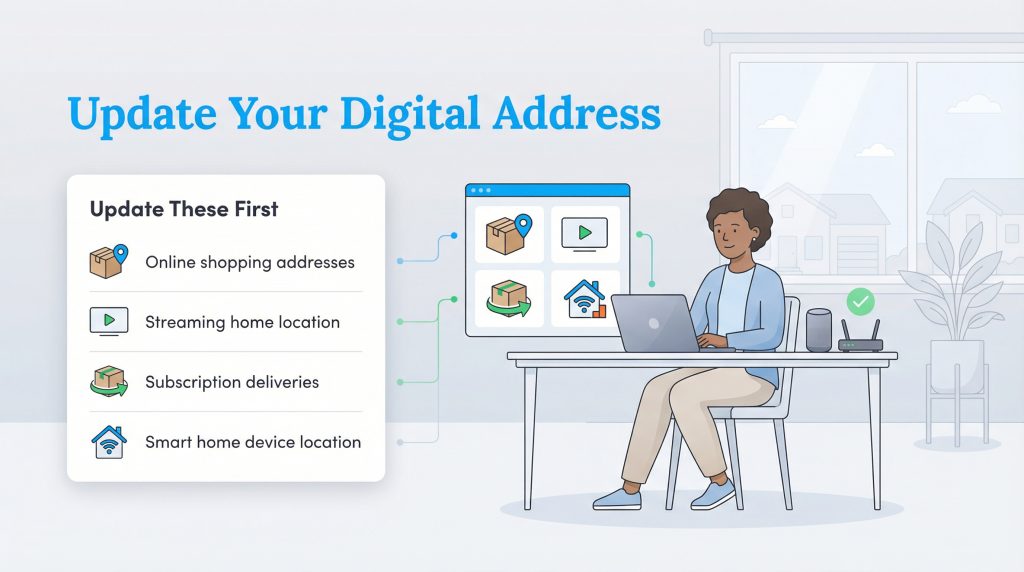
In our highly connected era, your digital footprint is almost as important as your physical brick-and-mortar residence. Many people frustratingly overlook this crucial category until an expensive package arrives at the wrong doorstep or a smart thermostat blindly attempts to cool a house they no longer own. Adding these active accounts to your list of places to change your address when you move actively prevents logistical frustration.
- E-commerce Platforms: Update your default shipping address on Amazon, Wayfair, and eBay immediately to avoid catastrophic shipping errors and the hassle of recovering misdelivered goods.
- Streaming Services: Platforms like Netflix actively track your household IP location, so update your primary network settings to avoid sudden service interruptions on family movie night.
- Meal Kits and Deliveries: Pause or redirect shipments for recurring meal kits and pet supplies well in advance so perishable food does not spoil on your old porch.
- Gym Memberships: Transfer your national gym membership to a closer location, or formally cancel your local boutique studio contract to firmly stop recurring monthly charges.
- Smart Home Tech: Changing your device location inside your smart speaker and security camera settings ensures you get accurate local weather alerts while keeping your home automation running as a highly efficient energy-saving option.
Preparing For Move-In Day

Handling your change of address notifications does not have to be a frantic scramble on moving day. By breaking the intimidating process down into manageable chunks — starting with your essential utilities and concluding with your digital subscriptions — you actively protect yourself from missed bills, sudden service lapses, and severe security risks. Remember to also share your new contact information with friends, family, and past property managers so they know exactly where to reach you for deposit returns or holiday cards.
Utilizing a comprehensive moving notifications checklist early in the process allows you to walk through the front door of your new residence focused entirely on unpacking and celebrating your next chapter rather than waiting on hold with customer service. When you prioritize these logistical details and officially notify who needs your new address, you set a solid, highly secure foundation for a stress-free transition. Welcome home!
Frequently Asked Questions About Moving Notifications
Who to contact when moving out of state first?
What is the most efficient way to execute a household change of address checklist?
Do I need to update my address on my passport when I move?
How much does it cost to change your address with the USPS?
How long does mail forwarding last after I submit a USPS change of address form?
Can I change my address for all my utilities at once?
Do I need to notify my auto insurance if I move within the same state?
About the Author

David has been an integral part of some of the biggest utility sites on the internet, including InMyArea.com, HighSpeedInternet.com, BroadbandNow.com, and U.S. News. He brings over 15 years of experience writing about, compiling and analyzing utility data.

LaLeesha has a Masters degree in English and enjoys writing whenever she has the chance. She is passionate about gardening, reducing her carbon footprint, and protecting the environment. She also recently served as President of the Board for City Sprouts (a community garden).