

Prioritize safety, efficiency, and peace of mind with these critical steps before your first night in the new home.
Key Takeaways
- Secure your new home immediately by changing locks and resetting garage codes before moving your belongings inside.
- Schedule utility transfers early to ensure electricity, water, and internet are active and optimized for energy efficiency on moving day.
- Locate emergency shut-offs for water and electricity during your initial walkthrough to prevent future disasters.
Holding the keys to a new property marks an exciting milestone, but executing the 10 Things You Must Do Before Moving Into a New House is essential to guarantee a smooth, secure transition. Transitioning into a completely empty space presents a rare opportunity to overhaul your home’s security, establish eco-conscious utility infrastructure, and execute messy renovations without navigating around heavy furniture. Approach your relocation with a tactical mindset, commanding contractors, deep cleaning teams, and utility providers well before the moving truck backs into your driveway. By taking control of this logistical process early, you transform an empty structure into a highly optimized, welcoming environment from the very first night.
Why Proper Pre-Move Planning Saves You Money
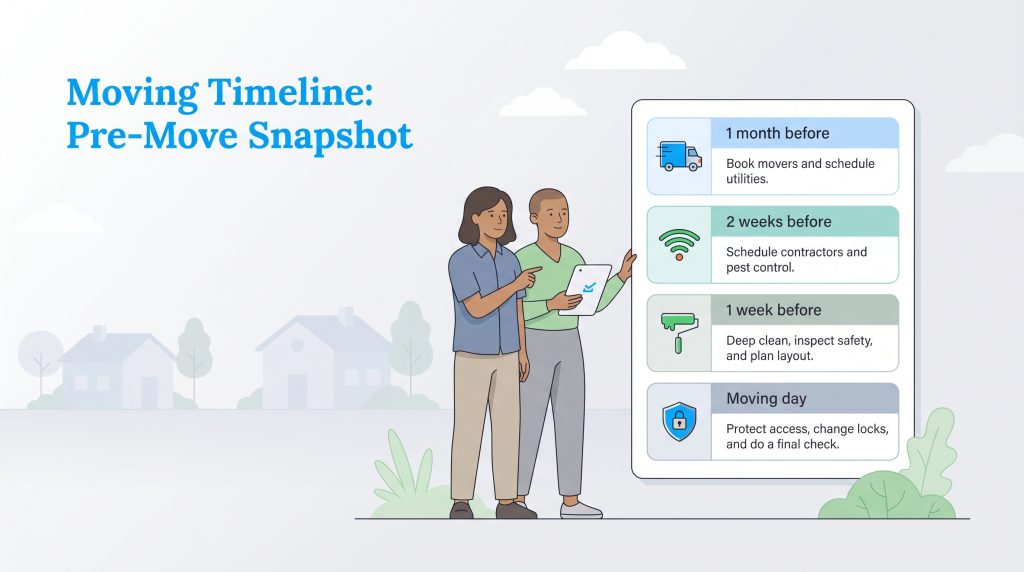
Organizing your prep work into a highly structured timeline prevents moving week chaos and ensures contractors have unfettered access to the property. Planning ahead is the most effective way to protect your budget, as rushing to coordinate services at the last minute often forces you into premium pricing and limited choices. Taking proactive steps gives you the leverage to negotiate rates and compare environmentally mindful choices without a strict deadline breathing down your neck.
When buyers skip a comprehensive new home move-in checklist, they frequently fall victim to unexpected hidden moving costs and expensive missteps. Avoid these three common, costly mistakes:
- Ignoring HVAC filters: Running a strained air system through dusty vents severely restricts airflow, spiking your monthly energy bills and risking a costly compressor failure.
- Waiting to set up high-speed internet: Booking an installation on moving day often means a week-long delay, which can cost remote workers valuable hours of productivity.
- Failing to rekey the locks: Relying on the old hardware leaves your valuables vulnerable to anyone who retained a spare key, potentially leading to theft and denied insurance claims.
| 1 Month Before | 2 Weeks Before | 1 Week Before | Moving Day | |
|---|---|---|---|---|
| Book professional movers and finalize transit logistics. | Schedule internet installation and transfer core utilities. | Conduct a comprehensive deep clean of the empty house. | Secure the perimeter and immediately change all locks. | |
| Activate home insurance policies for the new address. | Schedule contractors for interior painting and flooring upgrades. | Hire an exterminator for a preventative pest control sweep. | Locate shut-offs and finish labeling the electrical panel. | |
| Map out your furniture layout and floor plan. | Submit your USPS change of address moving request. | Service the HVAC system and conduct a DIY energy audit. | Test all smoke and CO detectors; establish fire safety protocols. | Pack your moving day essentials box for instant access. |
| Research neighborhood regulations and HOA guidelines. | Map out your digital infrastructure and smart home connectivity. | Conduct a final walkthrough to check for leaks and drafts. |
1. Transfer and Set Up Your Utilities
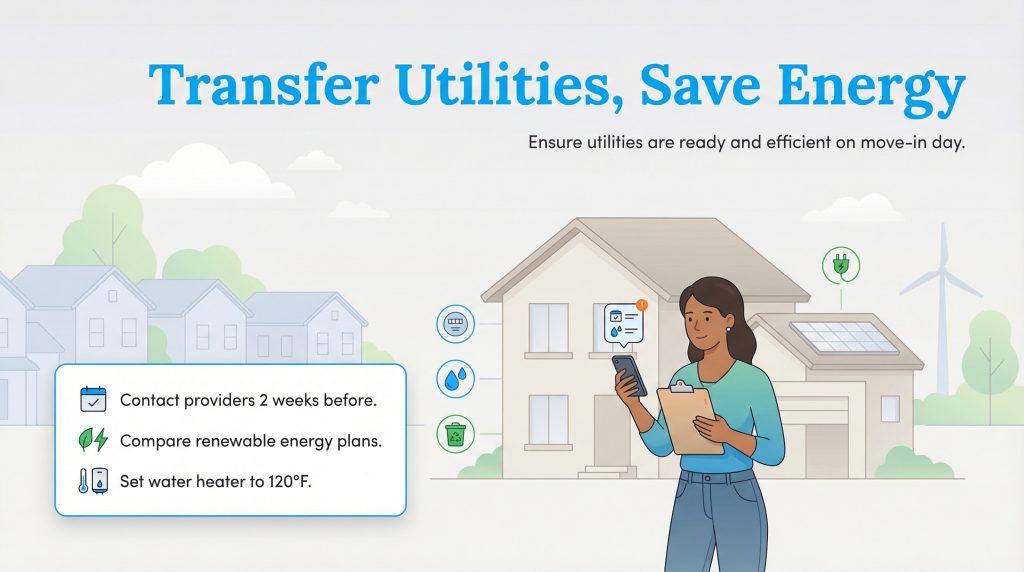
Nothing stalls a seamless move faster than arriving at a dark, freezing house with no running water. To successfully set up utilities for your new home, you must engage your utility providers at least two weeks before your move date. Schedule hard transfers for electricity, natural gas, municipal water, and waste management to guarantee no gap in service. Setting up utilities before moving ensures your living environment is safe, climate-controlled, and completely functional upon arrival.
If you are moving to a deregulated energy market, seize this opportunity to compare electricity rates and select a provider that aligns with your household budget and eco-conscious values. Look for retail energy providers offering fixed-rate plans powered by renewable sources like wind or solar. Upgrading to a smart thermostat immediately grants you superior climate control and reduces utility expenses. Consult our moving utilities checklist for more specific provider nuances.
| Utility Type | When to Call | Information Needed |
|---|---|---|
| Water and Sewer | 2 to 3 weeks before moving | New address, closing date, government-issued ID |
| Electricity | 2 weeks before moving | Service start date, current account number (if transferring) |
| Natural Gas | 2 weeks before moving | Address, requested start date, social security number for credit check |
| Trash Collection | 1 to 2 weeks before moving | New address, preferred bin sizes, HOA guidelines |
- Action Step: Create a master spreadsheet listing all utility account numbers, provider contact information, and confirmed activation dates to reference on moving day.
2. Change the Locks and Update Security
Security is the absolute first step you must take the moment you gain access to your new property. You cannot possibly know who possesses a copy of the old keys. Previous owners, extended family members, former contractors, and real estate agents may still have unrestricted access to your space. Executing a home security setup before moving your valuable electronics and furniture inside guarantees ultimate peace of mind.
Before moving in, you must decide whether to rekey or entirely replace your lock hardware. Rekeying a lock involves a locksmith changing the internal pins of the existing cylinder so the old key no longer works, which typically costs $20 to $50 per cylinder. Replacing a lock means removing the entire hardware mechanism to install a brand-new system, which averages $80 to $300 per door depending on the hardware quality. If the existing hardware is sturdy, rekeying is the most cost-effective and environmentally mindful choice, as it reduces metal waste. Changing locks on new house perimeters ensures you maintain total access control.
Beyond traditional keys, you must secure the digital perimeter. Execute a total reset of the property’s electronic access points to draw a firm line between the home’s past occupants and your new life. Consult the motor’s manual to clear the existing memory and physically reprogram garage door codes for all exterior keypads. Establish a new account with the existing alarm monitoring company, assign fresh administrator PINs, and update your emergency dispatch contacts.
- Action Step: Command a professional locksmith to rekey or replace the internal cylinders of every exterior door immediately upon closing.
3. Forward Your Mail and Update Your Address
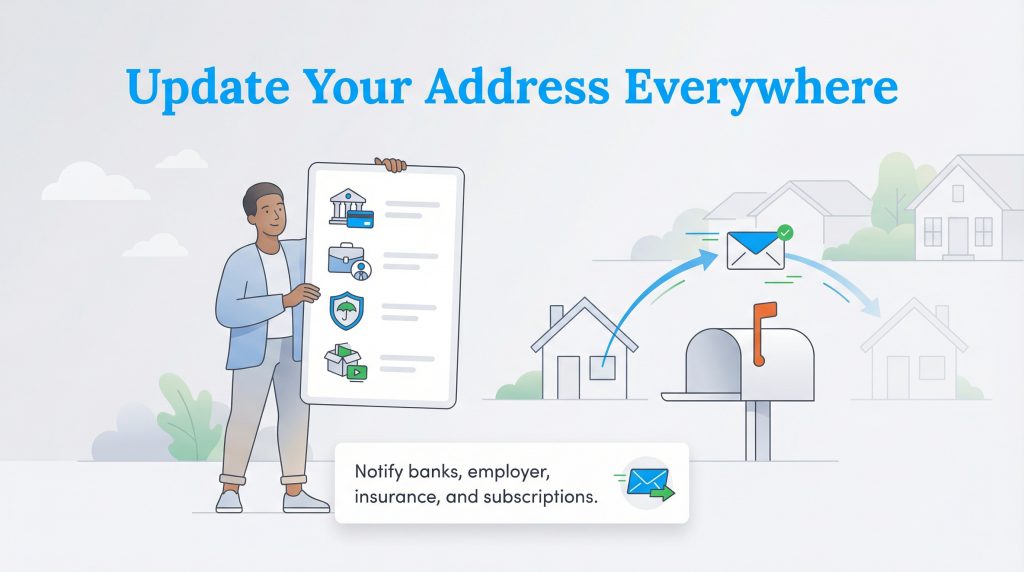
To avoid severe administrative chaos and prevent sensitive financial documents from falling into the wrong hands, you must update your address the moment you have a finalized closing date. Forwarding mail to new address locations ensures that critical utility bills, legal notices, and bank statements do not pile up in your former mailbox.
The administrative burden of relocation extends far beyond notifying casual friends and family members; you must meticulously determine who to notify when you move, including every federal, financial, and private institution that requires your new location on file. Command your personal administration by directly contacting your primary bank, auto insurance providers, current employer, and all digital subscription services. You must also update your vehicle registration and voter registration through your local municipal channels.
Finally, execute your mail forwarding protocol by visiting the official USPS Change of Address website. Submitting your detailed request through their secure digital portal guarantees that any crucial correspondence sent to your former residence rapidly catches up with you at your brand-new property.
- Action Step: Submit your official USPS mail forwarding request at least two weeks prior to moving day to prevent vital correspondence from being lost in transit.
4. Deep Clean While the House Is Empty

You must execute a rigorous strategy to sanitize the property, as it is infinitely easier to eradicate dirt and lingering odors when rooms sit completely vacant. Before bringing a single cardboard box over the threshold, aggressively target the spaces that will become permanently obscured by heavy appliances and bulky furniture. If managing an intensive scrub-down sounds overwhelming amid your packing duties, hire highly rated move in cleaning services to tackle the heavy lifting.
Command your cleaning crew to use plant-based, eco-conscious cleaning agents to strip away historic grime without injecting harsh chemicals into your indoor air supply. Because this is one of the most vital things to do before unpacking, you should follow these move-in deep cleaning tips for easily missed areas:
- Baseboards and molding: Wipe down all trim with a damp microfiber cloth to remove layers of accumulated dust and pet dander.
- Inside kitchen and bathroom cabinets: Vacuum out the drawer tracks and scrub the interior shelving with a non-toxic degreaser before lining them with fresh contact paper.
- Refrigerator coils and appliance nooks: Pull all major appliances away from the wall to aggressively vacuum the exposed coils, which instantly improves energy efficiency and prevents electrical fire hazards.
Once the property is pristine, hire a professional exterminator to aggressively treat baseboards, attics, basements, and the exterior perimeter. Establishing this protective barrier before introducing your own cardboard boxes prevents existing insect colonies from invading your belongings.
- Action Step: Replace all toilet seats and sanitize the bathroom fixtures before you unpack your belongings to guarantee optimal hygiene from day one.
5. Locate the Main Water Shut-Off Valve and Circuit Breaker
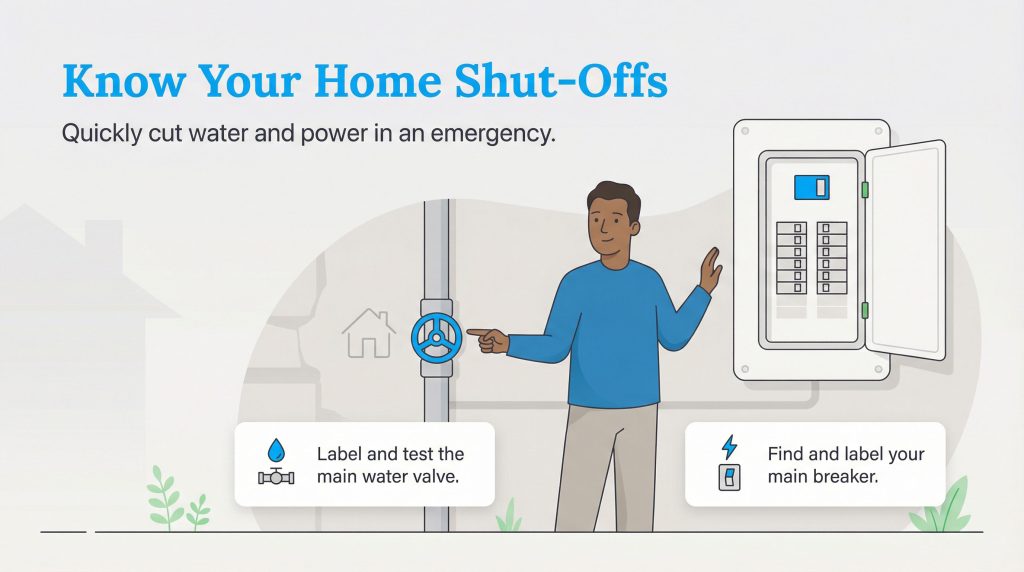
When a pipe suddenly bursts or an outlet heavily sparks, your reaction time dictates the severity of the damage. You cannot afford to frantically search for the utility panels while water rapidly floods your new hardwood floors. During your initial walkthrough of the empty home, you must actively locate emergency shut-off valves for your municipal water supply and natural gas lines.
Test the main water shut-off valve immediately to check for severe rust or seizing caused by years of disuse. If the valve refuses to turn, schedule a licensed plumber to replace the hardware before a catastrophic leak occurs. Additionally, verify if your street-level water meter requires a specialized water key to turn off the flow, and purchase one if necessary.
Next, grab a partner and command the process of accurately identifying your home’s electrical circuits. Physically label all switches in the breaker box using clear, highly visible markers. Integrating effective labeling strategies eliminates dangerous guesswork during a severe storm, ensuring you instantly know which switch kills the power to the kitchen appliances versus the primary HVAC unit.
- Action Step: Purchase high-visibility labels and clearly map out every breaker switch on the electrical panel to ensure you can rapidly cut power during an emergency.
6. Test All Smoke Detectors and Carbon Monoxide Alarms
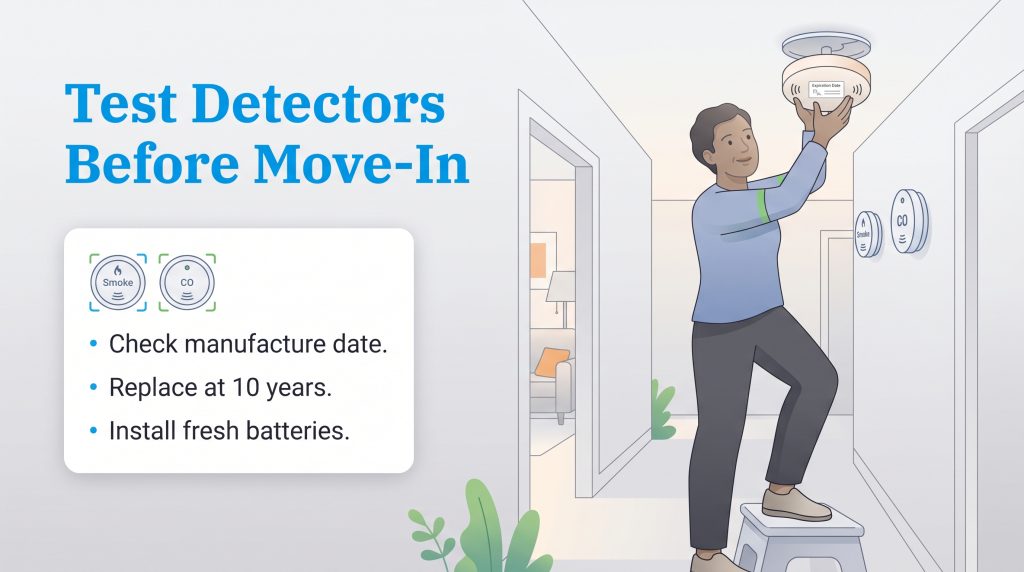
Life-saving safety hardware frequently falls into disrepair when a property sits dormant on the real estate market. Securing your environment requires hands-on verification before your first night in the house. Do not simply press the test button on a smoke alarm to hear a chirp; physically detach the devices from the ceiling and check the explicit expiration date printed on the back.
Standard smoke and carbon monoxide sensors heavily degrade over time and absolutely must be replaced if older than 10 years. If the current units remain within their safe operational lifespan, install brand-new lithium batteries to establish a dependable maintenance baseline. For comprehensive guidelines on proper detector placement, consult the authoritative resources provided by the National Fire Protection Association (NFPA).
- Action Step: Physically inspect the back of every smoke and CO detector to verify the manufacture date, and replace any unit that exceeds its 10-year lifespan.
7. Change HVAC Filters and Inspect Vents
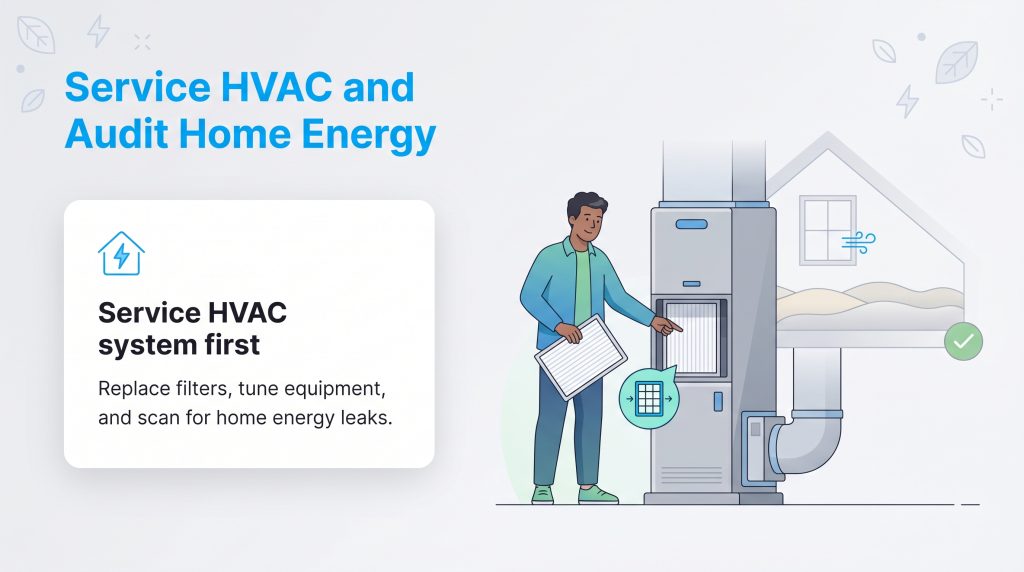
Core mechanical systems require immediate attention to guarantee energy efficiency before you fully settle into the new property. Operating a central air system with a severely clogged filter heavily restricts vital airflow, forces the blower motor to strain, and rapidly inflates your monthly power bills. Before turning on the central air, rigorously vacuum all visible dust from the floor and ceiling vents, then install a brand-new, high-efficiency HEPA filter.
If the external condenser looks battered, schedule an immediate professional tune-up. Optimizing your HVAC system is a premier strategy for saving on heating and cooling bills. Furthermore, command a DIY energy audit by inspecting your attic insulation depths, testing appliance ENERGY STAR ratings, and checking all primary window seals for drafts.
- Action Step: Vacuum all return vents and install a brand-new, high-MERV air filter to instantly improve indoor air quality and protect your HVAC system.
8. Complete Necessary Painting and Flooring Upgrades
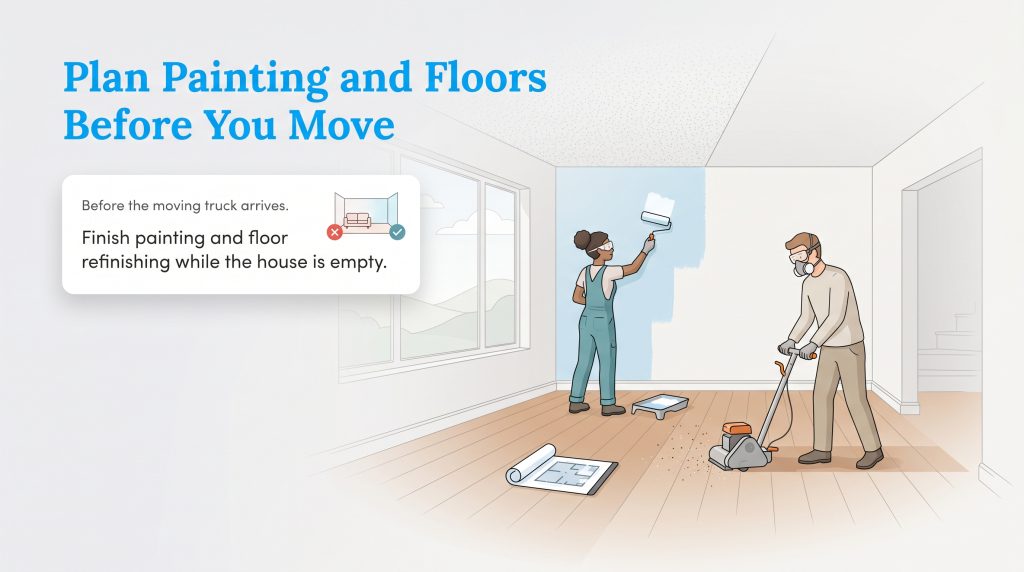
Executing interior renovations is exponentially faster, cheaper, and safer when the house is entirely empty. If you plan to update the aesthetics of your new property, schedule these specific contractors immediately after closing and strictly before the moving truck arrives.
Projects like comprehensive interior painting, hardwood floor refinishing, and ceiling texture removal require vast amounts of open space. Scraping outdated popcorn ceilings generates heavy, hazardous dust that easily infiltrates upholstery and ruins sensitive electronics. Furthermore, refinishing hardwood floors requires powerful sanding equipment and produces volatile organic compounds (VOCs). The heavy polyurethane coats require days of proper ventilation to off-gas safely before humans and pets can comfortably occupy the space.
Command your painters and flooring specialists to complete their work while there is zero furniture to maneuver around or protect. Tackling these massive visual upgrades while the property sits vacant prevents severe disruptions to your daily routine later and instantly transforms the house into a space that reflects your personal style.
- Action Step: Map out your scaled floor plan measurements and complete all high-dust renovations, such as sanding floors or removing ceiling textures, before moving any furniture inside.
9. Set Up High-Speed Internet and Wi-Fi
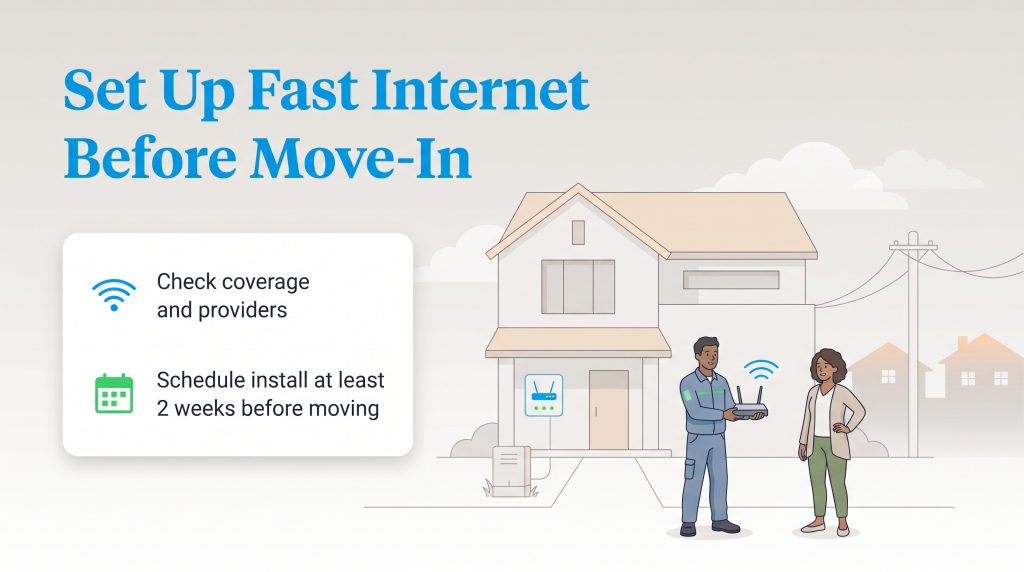
Establishing a strong digital infrastructure is just as vital as turning on the water and electricity. To begin transferring internet to new home addresses, use the FCC’s National Broadband Map or your high-speed internet provider’s online portal to verify network coverage at your specific location. Because broadband options vary drastically block by block, you must determine whether your current Internet Service Provider (ISP) offers comparable speeds at the new house or if you need to terminate your existing contract and hire a new local provider.
Whether you are transferring vs. setting up utilities, prepare the correct documentation to expedite the process. If you are starting a brand-new account, providers typically require a government-issued ID, your Social Security number for a soft credit check, and proof of residency, such as a signed lease or closing disclosure. Conversely, transferring an existing service is much simpler; you only need your current account number, your new service address, and the exact date you want the connection to go live.
- Action Step: Schedule your router installation or equipment transfer at least two weeks in advance to avoid long wait times and guarantee immediate Wi-Fi access on move-in day.
10. Document Pre-Existing Damage for Insurance
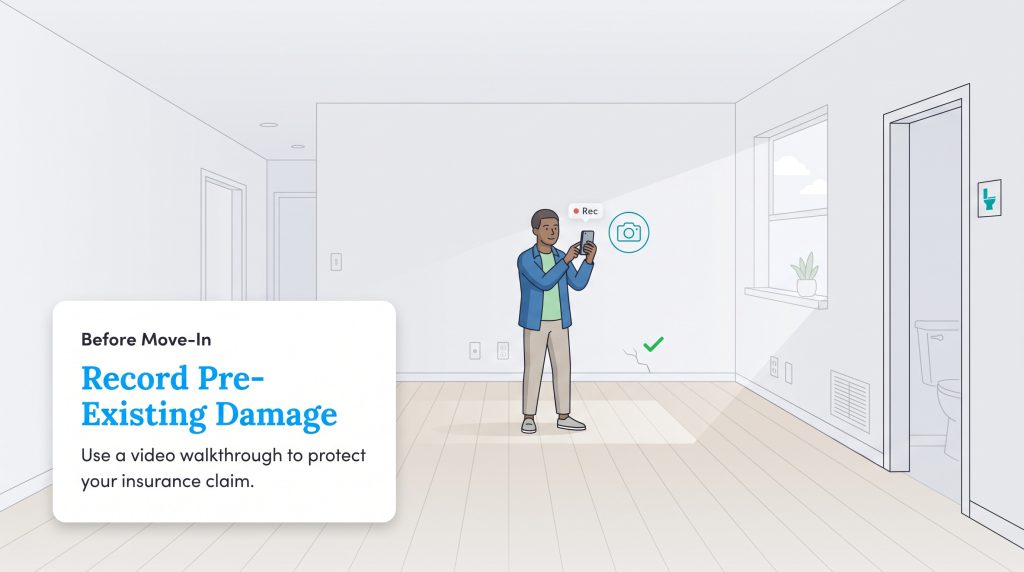
Before you command the movers to cart the first heavy sofa over the threshold, pull out your new homeowner checklist and rigorously execute one final, hyper-focused walkthrough of the completely empty space. Walk room by room and thoroughly scrutinize the property. Flush every toilet, run every faucet to check for slow drips, and test the power outlets.
It is vastly easier to properly document glaring issues, capture high-resolution photos of fresh floor scratches, or identify severe drafting issues while the house remains devoid of clutter. Catching these problems early allows you to instantly deploy weatherstripping or dispatch a contractor before your personal belongings obstruct access to the area. Executing pre-move home inspection repairs ensures that you accurately record pre-existing damage, protecting you from unwarranted liability claims and smoothing out any future insurance disputes.
- Action Step: Use your smartphone to record a continuous video walkthrough of the empty house, capturing the exact condition of the floors, walls, and fixtures for your insurance records.
Preparing for Move-In Day
Executing a comprehensive relocation strategy demands immense physical endurance and intense organizational focus. However, fiercely front-loading these high-priority logistical and safety tasks protects you from massive operational headaches later. This highly actionable protocol acts as the ultimate firewall between a chaotic moving disaster and a seamlessly orchestrated transition.
As the final hours tick down, rely on this quick “Day-Before” mini-checklist to keep your momentum steady:
- Confirm the exact arrival window and parking logistics with your professional moving crew.
- Withdraw cash to properly tip your movers and any final contractors.
- Verify that your homeowner’s insurance policy is officially active.
Determining exactly what to pack for the first night in a new home dictates your comfort level once the exhausting relocation process concludes. By the exact moment the moving crew unloads the final piece of heavy furniture, you will be entirely too exhausted to frantically slice open dozens of heavily taped boxes in search of a simple phone charger or a fresh towel. To preserve your sanity, you must strategically pack a dedicated essentials box.
Command your logistics by ensuring this highly critical box travels exclusively in the backseat of your personal vehicle, never buried deep within the commercial moving truck. Load this survival kit with high-priority items: toilet paper, antibacterial hand soap, heavy-duty paper towels, durable trash bags, vital daily medications, basic toiletries, a fresh change of clothes, and all necessary electronic chargers.
Once the moving truck pulls away from the curb, stop unpacking the standard boxes. Unpack your first-night essentials box, secure the newly reprogrammed locks, and order takeout from a local restaurant. You successfully engineered the difficult groundwork and optimized the critical utilities. Simply eat your meal, take a hot shower, and get a restful night of sleep so you can confidently start building a beautiful life in your pristine new home tomorrow.
Frequently Asked Questions About Moving Into a New House
What is the very first thing to do when moving into a new house?
The absolute first step is to aggressively secure the property. Change the locks on all exterior doors, upgrade the hardware, and reset any digital garage door codes or keypad entries. Because you simply do not know who might still possess keys from the previous ownership, executing this step guarantees your family’s safety and privacy immediately upon taking possession.
How far in advance should I set up utilities for a new house?
You must contact your primary utility providers at least two full weeks before your target move-in date. Provide your new service address and requested activation dates to your electricity, water, and natural gas providers. This robust lead time provides grid operators ample opportunity to process the connection order, ensuring you never face a day without critical utilities.
When should I activate my homeowner’s insurance policy?
Your homeowner’s insurance policy must be fully active the exact day you sign the final closing documents and take legal possession of the property. Do not wait until you physically move your furniture inside. If a pipe bursts or a severe storm damages the roof before moving day, an active policy ensures you are financially protected from day one.
What should I pack for the first night in a new home?
Your dedicated essentials box must contain every item required to comfortably survive 24 hours without opening a single taped moving box. Command this step by packing heavy-duty toilet paper, antibacterial hand soap, critical daily medications, vital phone chargers, a fresh change of clothes, basic bedding, simple toiletries, non-perishable snacks, and durable trash bags. Keep this box in your personal vehicle.
What is the first thing to clean before moving in?
You should immediately clean the hidden spaces that will be obstructed by furniture and appliances later. Focus on deep-cleaning your baseboards, the interior of all kitchen and bathroom cabinets, and the nooks where the refrigerator and stove will reside. Addressing these zones while the house is completely vacant saves immense time and effort.
Should I deep clean an empty house before moving in?
Yes, executing a deep clean while the house is completely vacant is essential. Even if a property appears visually tidy during the walkthrough, surface-level cleaning frequently ignores deep-seated allergens, historical pet dander, and built-up grease on top of the kitchen cabinetry. It is infinitely easier to thoroughly scrub baseboards and sanitize carpets before your heavy furniture obstructs the floorplan.
Should I change the locks before or after moving in?
You must change or rekey the locks immediately after closing, entirely before you move any personal belongings inside. Previous owners, real estate agents, or contractors could still have copies of the original keys. Securing the perimeter before you officially move in ensures your family and your property are completely protected from unauthorized access.
About the Author

LaLeesha has a Masters degree in English and enjoys writing whenever she has the chance. She is passionate about gardening, reducing her carbon footprint, and protecting the environment. She also recently served as President of the Board for City Sprouts (a community garden).

Claudio is a sustainability-focused writer with a background in Anthropology and Psychology from NC State University. He has spent over 15 years working in writing, interpretation, and translation, driven by a deep interest in how human culture shapes the environment. Today, he shares his curiosity with readers by writing about sustainable living solutions and the connection between everyday choices and environmental impact.