

Identifying And Preparing For The Surprise Fees That Often Accompany A Local Or Long-Distance Move
Key Takeaways
- Request a binding estimate from your moving company to ensure the price you see is the price you pay.
- Budget for hidden utility costs associated with setting up utilities for a new home, including connection fees, deposits, and service overlaps.
- Review your insurance coverage to determine if you need third-party liability protection or full value protection for your belongings.
Moving to a new home is an exciting milestone, but the financial reality of the transition often hits much harder than the physical heavy lifting. While you have likely budgeted for the obvious expenses like a moving truck and the first month’s rent, the final price tag routinely swells due to over 20 overlooked fees and situational surcharges. From technical industry terminology like long carry fees to the everyday lifestyle costs of living in transition, these unexpected moving expenses can quickly drain your wallet if you aren’t thoroughly prepared. By understanding exactly where these hidden moving costs lurk across professional services, DIY rentals, and residential utilities, you can build an accurate moving budget and avoid painful surprise fees on moving day.
Why Do Hidden Moving Costs Happen?
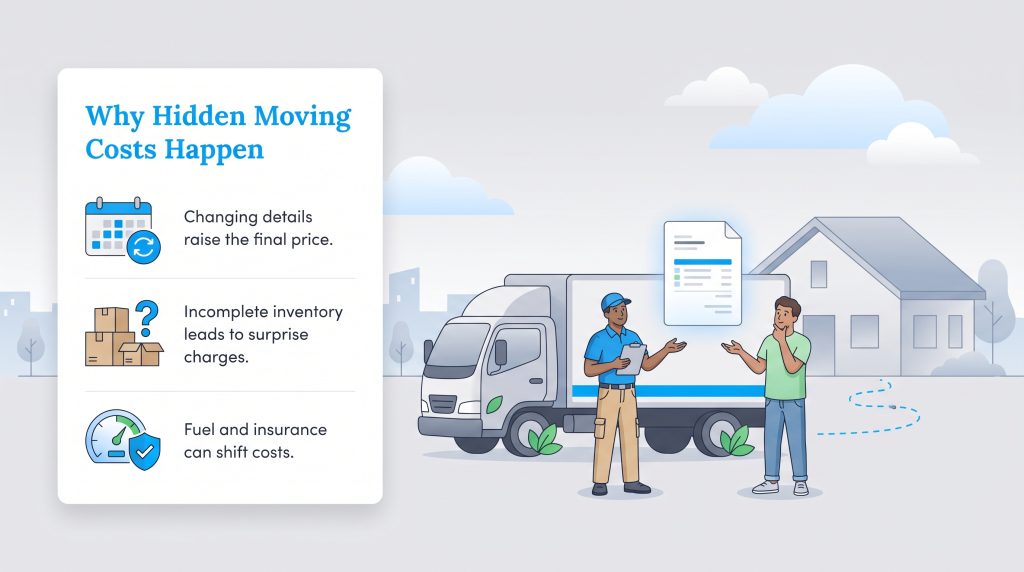
Before diving into the specific line items that inflate your invoice, it helps to understand why hidden moving costs happen in the first place. While a small fraction of rogue movers intentionally bury fees in confusing contracts to squeeze more money out of customers, the vast majority of unexpected moving expenses actually occur due to poor upfront communication and shifting logistics. Moving quotes are based on a snapshot of information provided weeks or even months in advance. If that snapshot is incomplete or conditions change on the ground, the final price naturally adjusts to reflect the new reality.
For example, failing to mention access restrictions like narrow neighborhood streets, significantly underestimating your total box count, or encountering sudden logistical hurdles at the destination property can immediately trigger extra labor or equipment requirements. When a moving crew has to pivot from their original, carefully scheduled plan, those logistical challenges translate directly into additional charges. Furthermore, moving is a highly regulated industry heavily impacted by external economic factors, such as volatile diesel fuel prices and fluctuating insurance premiums. Recognizing that a moving quote is a living document rather than a fixed retail price empowers you to communicate clearly with your provider, accurately describe your inventory, and lock in a more reliable final number.
7 Professional Mover Surcharges To Watch For
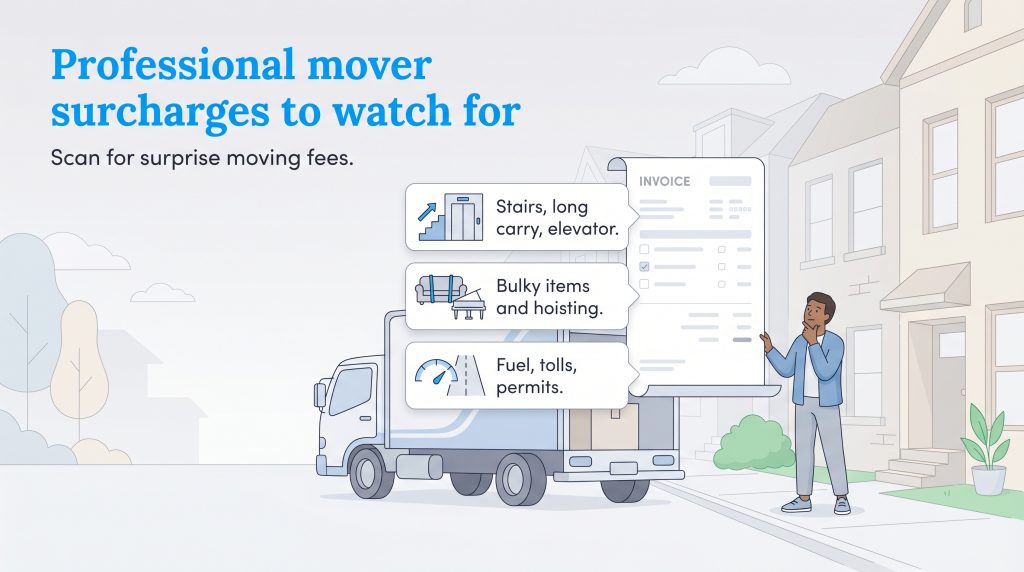
When you hire professional movers, the base quote usually covers the primary actions: loading your boxes, driving the truck to the destination, and unloading your belongings into your new residence. However, moving companies routinely apply a variety of moving company surcharges for conditions that make the job more labor-intensive or time-consuming. These fees compensate the crew for extra physical effort, the use of specialized protective equipment, and the increased risk of property damage. Keep an eye out for these seven common upcharges.
1. Long Carry And Shuttle Fees
Access is everything when it comes to moving logistics. A long carry fee applies when the moving truck cannot safely park close to your front door, forcing the crew to haul heavy items over an excessive distance — typically 75 feet or more from the tailgate to your entrance. Depending on the company, this can add $75 to $150 to your bill, sometimes charged per extra 50 feet. Furthermore, if your new street is too narrow, winding, or weight-restricted for an 18-wheeler semi-truck, the moving company might charge a shuttle fee. This involves renting a smaller box truck to transfer your goods from the main van parked miles away to your actual home. Shuttle fees are notoriously expensive, often ranging from $200 to $500 based on your total cargo volume.
2. Stair And Elevator Surcharges
Navigating vertical obstacles adds significant time and physical strain to the move. Movers routinely charge extra for carrying items up multiple flights of stairs, which is usually billed per flight after the first floor. Even if your high-rise apartment features a dedicated freight elevator, you might face an elevator fee of $50 to $100. Moving crews assess this fee to cover the extra time spent waiting for access, sharing the lift with other busy tenants, or navigating complex building security protocols just to reach your floor.
3. Furniture Disassembly And Bulky Item Hoisting
Professional moving crews operate on tight schedules and expect your smaller belongings to be boxed up and ready to load. If they arrive and have to dismantle a massive sectional couch, unbolt a complicated heavy bed frame, or break down an intricate modular shelving unit, you will be charged for furniture disassembly and reassembly fees. Certain oversized belongings require specialized handling and unique equipment. For example, moving a standard upright piano might cost an extra $100 to $150. If an item is simply too large to fit through a standard doorway or navigate down a narrow spiral staircase, you may encounter hoisting charges. This occurs when movers must physically lower furniture out of a window or rig a complex pulley system over a balcony — a highly specialized risk that can easily add $100 to $300 per item.
4. Fuel Surcharges And Route Deviations
Fuel costs are one of the most volatile and unpredictable expenses in the commercial transportation industry. To protect themselves against fluctuating gas prices between the time you book and the time you move, moving companies calculate a fuel surcharge. This is usually based on the current national average for diesel fuel published by the Department of Energy, adding 5% to 10% to your final bill. Additionally, standard estimates assume a direct, toll-free route. If you request the moving truck to make a deliberate detour to drop off heirloom pieces at a family member’s house or pick up furniture from a separate storage unit, you will be hit with an extra stop fee. Each route deviation adds extra labor time and mileage, often costing $75 to $100 per additional stop.
5. Expedited Or Guaranteed Delivery Dates
Standard long-distance moves usually provide a delivery spread or window — often ranging from two to 14 days — rather than a precise, guaranteed delivery date. This is because carriers consolidate multiple households onto one massive trailer to keep freight costs down. If you need your belongings to arrive on a very specific date to accommodate a tight work schedule or a strict lease commencement, you will need to request expedited or guaranteed delivery. Locking in this specific date forces the moving company to adjust their entire logistics chain, potentially dedicating a single truck exclusively to your household. This premium service is incredibly convenient but can dramatically increase your total moving cost by hundreds or even thousands of dollars depending on the total distance traveled.
6. Full Value Protection Insurance Upgrades
You must carefully consider the complex topic of moving liability. For interstate moves, federal law requires movers to offer two distinct liability options: Released Value Protection and Full Value Protection. Released Value Protection is usually included at no extra charge but offers minimal coverage — typically around 60 cents per pound per article. If your brand-new, 50-pound flat-screen TV is shattered in transit, you would only receive a dismal $30 in compensation. Upgrading to Full Value Protection requires an upfront premium, which usually sits between 1% to 2% of the total estimated value of your goods. While it represents a significant hidden cost upfront, paying this premium ensures the mover becomes fully liable for the true replacement value of lost or damaged items.
7. Tipping Movers
While not a contractual fee written into your binding estimate, tipping your moving crew is an expected industry standard that significantly impacts your day-of cash budget. Moving heavy furniture is backbreaking, grueling work, and crews rely on gratuity for a job well done. As a general rule, plan to tip between 15% to 20% of your total moving bill for a local move, or calculate $20 to $50 per mover, per day for long-distance or incredibly strenuous jobs. It is highly recommended to withdraw cash in advance and hand the tip directly to each individual mover at the end of the day to ensure fair distribution, rather than giving a lump sum to the foreman.
5 Hidden Costs Of DIY Truck Rentals And Containers
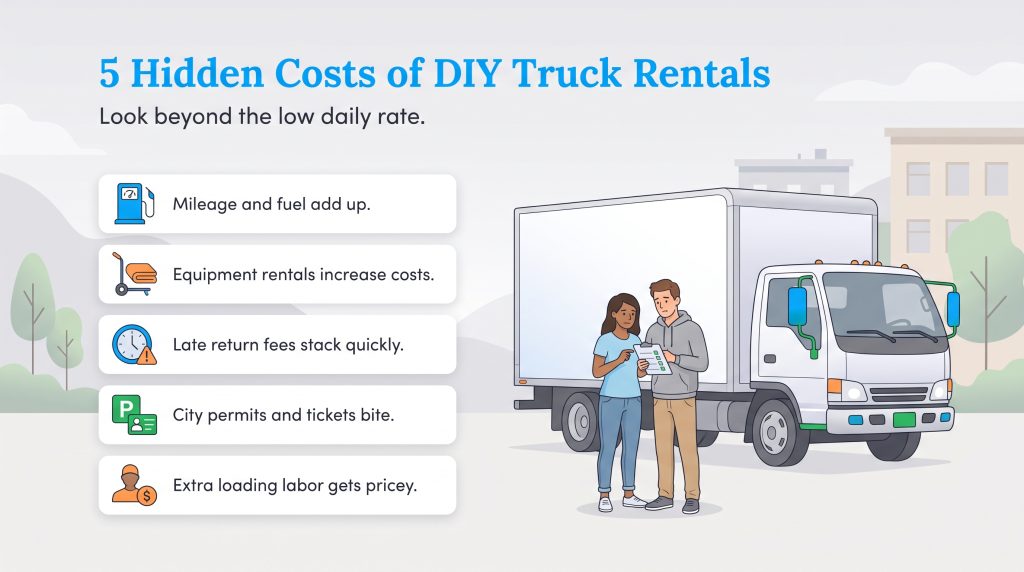
Opting for a do-it-yourself move is widely viewed as the ultimate budget hack for thrifty families. While taking the wheel yourself absolutely eliminates expensive professional labor rates, it introduces a completely different set of DIY truck rental hidden costs. When you see a surprisingly low daily rate advertised in giant letters on the side of a rental van, remember that the sticker price does not include the operational reality of hauling your life across town.
8. Mileage Overages And Fuel Replenishment
DIY movers are entirely responsible for their own fuel. A fully loaded 26-foot commercial box truck rarely gets more than 8 to 10 miles per gallon. Failing to return the rental truck with the exact amount of gas specified in the original contract will trigger exorbitant refueling penalties, often billed at double the local market rate for diesel. You must also watch out for mileage overages. If your specific route is longer than the strictly allotted distance in your contract, you will pay a steep per-mile fee ranging from $0.40 to over $1.00 per mile.
9. Equipment Rental Add-Ons (Dollies, Blankets)
That attractive $29.95 daily rental rate only secures the empty vehicle itself. To safely move heavy appliances and protect your fragile furniture from scratches, you need proper tools. Rental agencies frequently tack on extra daily fees for essential moving equipment. Renting an appliance dolly can add $15 to $20 a day, while a stack of protective moving blankets and ratcheting tie-down straps will add another $20 to $30. These minor equipment add-ons compound rapidly, especially on a multi-day trip.
10. Late Return Penalties
Rental companies operate on incredibly tight turnaround schedules to satisfy their next customer. If you hit unexpected traffic, experience a flat tire, or simply underestimate how long it takes to unload a three-bedroom house, you might miss your drop-off window. Late returns are strictly enforced and can incur severe penalty fees of $50 to $100 per day, plus any additional daily insurance premiums you previously signed up for.
11. Municipal Parking Permits
If your new home or apartment is situated on a busy city street, you cannot simply park a massive moving truck or portable container in a loading zone and hope for the best. Municipalities require specialized street parking permits or temporary street closure permits to legally occupy public parking spaces with a commercial vehicle or container. Securing these municipal parking permits is almost always your responsibility. Depending on your city, acquiring these permits can cost $50 to $100 per day. Failing to secure them can result in devastating consequences: your rental truck could be heavily ticketed or even towed.
12. Independent Loading Labor
Many people opt for a “hybrid move,” where they rent the commercial truck themselves but hire independent, local laborers to do the heavy lifting via third-party gig apps. While this saves your back, it introduces a hidden cost that is often miscalculated. Most independent labor contractors require a mandatory two-hour minimum booking, regardless of whether the job only takes 45 minutes. Furthermore, these independent crews charge hourly rates ranging from $40 to $80 per worker, and you may still be responsible for covering their travel time or tipping them at the end of the shift.
To help you navigate these differing approaches, use this breakdown to understand where hidden expenses typically emerge across the three primary moving methods.
| Expense Category | DIY Rental Trucks | Portable Containers | Full-Service Movers |
|---|---|---|---|
| Fuel & Tolls | You pay entirely out of pocket for all diesel and tolls. High risk of steep refueling penalties. | Included in the company’s flat rate. No surprise fuel costs at the pump. | Factored into the base rate or added as a highly variable percentage surcharge. |
| Equipment Rentals | Extra daily fees for renting dollies, furniture pads, and ratcheting straps ($20-$50+). | You are typically required to rent or purchase your own blankets and tie-downs. | Included. Movers provide all necessary commercial protective equipment. |
| Labor | Free (or the cost of pizza for friends), but comes with a high physical toll and injury risk. | You do the heavy lifting yourself or must hire third-party hourly labor to load. | Fully included. Professional, insured handling of all heavy and bulky items. |
| Insurance | Must purchase supplemental truck damage coverage. Limited cargo protection available. | Basic content protection is available for an extra monthly premium. | Basic valuation is included; Full Value Protection requires a hefty premium. |
4 Preparation And Property Damage Costs

The weeks leading up to your move involve significant out-of-pocket spending, specifically to prepare and protect both your belongings and your physical property. Many people completely underestimate the sheer volume of materials required to pack up an entire household or the financial devastation that a single dropped dresser can cause to a hardwood floor.
13. The True Cost Of Packing Materials
A typical three-bedroom home demands hundreds of dollars in physical packing supplies. To build an accurate budget, you must account for these average price ranges for essential packing materials:
- Tape guns and heavy-duty packing tape: $15 to $25
- Heavy-duty mattress bags: $10 to $20 per bag
- Bubble wrap rolls (100 feet): $20 to $35
- Specialty wardrobe boxes with hanging bars: $15 to $25 each
To reduce waste and minimize out-of-pocket costs, consider renting reusable plastic moving bins. This eco-conscious alternative often costs less than buying new cardboard, diverts single-use materials from local landfills, and entirely eliminates the hassle of breaking down dozens of boxes after you finally unpack.
14. Storage-In-Transit (SIT) And Facility Fees
When move-in dates misalign and you cannot accept delivery of your items immediately, moving storage fees come into play. Storage-in-transit (SIT) costs occur when the moving company has to hold your items on their truck or at their local distribution warehouse for a short period. SIT costs are usually billed weekly and can add $100 to $200 per week to your bill. If the delay extends longer, you may face long-term facility storage fees, which involves the extra labor of physically unloading your belongings into a separate, climate-controlled storage unit and reloading them months later.
15. Floor And Wall Damage Repair
Of all the unexpected expenses associated with relocation, physical damage to your home is arguably the most frustrating. Sliding a heavy refrigerator without proper protection can create massive scratches that require sanding and refinishing the entire room to fix properly. If you are renting, these damages will be aggressively deducted from your security deposit. To mitigate these risks and tackle one of the crucial 10 things you must do before moving into a new house, prioritize purchasing this preventative equipment:
- Neoprene floor runners: Create safe, non-slip walking paths over hardwood and tile ($30 to $60).
- Self-adhesive carpet protection film: Prevent muddy boots from ruining high-traffic rugs ($20 to $40).
- Padded door jamb scuff shields: Wrap tight doorframes to prevent gouges when maneuvering wide couches ($15 to $25).
16. Move-Out Cleaning Services
Cleaning and repair costs often catch movers by surprise at the eleventh hour. If you are renting, securing your full security deposit refund requires a rigorous deep clean that goes far beyond a quick sweep with a broom. You might need to hire professional cleaners to steam carpets, scrub greasy appliances, and polish fixtures to meet strict lease requirements. Professional move-out cleaning services typically run between $150 to $300 for a standard apartment. If you are selling a home, closing contracts often stipulate the property must be left entirely free of debris, which occasionally requires hiring a junk removal service to haul away unwanted items.
4 Unexpected Transition And Lifestyle Expenses

The sheer chaos of moving week disrupts your normal, cost-effective daily routine. When your kitchen is packed in taped boxes and your commute is upended, you inevitably end up paying a premium for convenience. These indirect moving expenses are often the most surprising because they happen in small, easily justified increments that ultimately add up to a massive sum.
17. HOA And Condominium Move-In Fees
Moving into a managed community introduces a unique set of bureaucratic fees. If you are moving into a condominium complex or a neighborhood governed by a Homeowners Association (HOA), you may be required to pay HOA moving fees. These organizations frequently demand non-refundable administrative fees to cover the wear and tear of move-in day, alongside refundable damage deposits that can easily range from $200 to $500. You are also typically required to formally reserve the building’s freight elevator for a specific time slot, which may carry its own separate usage fee.
18. Hidden Utility Setup And Connection Fees
Setting up your digital infrastructure, energy grid, and municipal services frequently triggers hidden setup fees that are entirely missed in the average moving budget. Moving to a new address almost always triggers a new account setup, even if you are deciding between transferring vs. setting up new utilities with the exact same provider. Expect electric connection fees of $25 to $75, water setup fees of $30 to $100, and broadband activation costs of $50 to $100. Furthermore, if you have a thin credit history, providers may legally require a security deposit before turning on your critical services.
When coordinating how to cancel utilities after moving, remember that residential leases and real estate closing dates rarely align perfectly. You will likely pay for electric, natural gas, and internet at two properties simultaneously for several days. This necessary double-billing overlap ensures you have the lights on for cleaning the old place and unpacking in the new one, but it inflates your transition expenses significantly. Take this opportunity to make an environmentally mindful choice by looking for utility providers that offer time-of-use rate plans or robust renewable energy credits, which can drastically lower long-term costs following a comprehensive moving utilities checklist.
19. Pet Boarding And Childcare
Moving day is a chaotic, noisy, and potentially dangerous environment for small children and anxious pets. Professional movers carry impossibly heavy objects, navigate tight corners blindly, and frequently leave exterior doors propped wide open to the street. To keep your family safe and entirely out of the crew’s way, you will likely need to arrange for off-site care. Hiring a trusted babysitter for the day or booking a reputable kennel for pet boarding can easily cost $50 to $150, creating yet another out-of-pocket lifestyle expense.
20. Restocking The Pantry And Takeout Meals
It is rarely practical or safe to transport half-empty bottles of ketchup, open bags of flour, or an entire freezer full of perishable goods across state lines. Most families end up throwing away or donating a significant portion of their kitchen staples before loading the truck. Replacing all those basic condiments, expensive spices, and essential cleaning supplies during your very first grocery run at the new house can easily run you hundreds of dollars. Because cooking is nearly impossible during transit and your pots and pans are buried in boxes, you will rely heavily on takeout and delivery services, severely inflating your daily food budget for several days.
How To Spot Hidden Fees In Moving Quotes

You can protect yourself from predatory pricing and frustrating billing surprises by meticulously reviewing your moving estimates before signing anything. A trustworthy, reputable moving company provides total transparency, but it is ultimately your responsibility as a consumer to ask the right questions, verify the math, and demand clarity on industry jargon. Use this guide to spot hidden fees and lock in your rate:
- Binding Estimate: This is the gold standard for budget-conscious movers. A Binding Estimate legally locks in your price for the specific services and inventory listed on the document. Even if your shipment ends up weighing slightly more than expected, you will not pay an extra dime.
- Non-Binding Estimate: Proceed with extreme caution here. A Non-Binding Estimate simply provides a rough projection of costs. The final price you pay will fluctuate based on the actual, verified weight of the truck on moving day and the exact hours worked. This is where unexpected weight surcharges frequently spike.
- Not-To-Exceed Estimate: Also known as a guaranteed maximum price, a Not-To-Exceed Estimate combines the best of both worlds. You pay the quoted price or less if the total weight of your belongings comes in under the estimate, but you will never pay more than the maximum agreed-upon cap.
- Demand an Itemized List: Never accept a vague, lump-sum quote. Ask the moving coordinator to provide a written, heavily itemized list of all potential surcharges, explicitly detailing the long carry rates, elevator fees, and bulky item charges.
- Insist on a Visual Survey: Never accept a binding quote negotiated entirely over the phone without a virtual or in-person walk-through. Movers need to physically see your bulky items and assess your home’s access points to provide an accurate bid.
Finalizing Your Relocation Budget Strategy
Moving is an undeniable investment in your future, and while the core transportation services are inherently expensive, the shock of hidden costs is largely avoidable with proactive planning. The best defense against unexpected moving expenses is building a well-rounded, realistic budget that automatically incorporates a 10% to 15% contingency fund. This vital emergency cushion protects your finances if the movers have to park further away than expected, national diesel prices suddenly spike, or you have to cover a few unexpected nights in a local hotel due to delayed closings.
By asking the right logistical questions early, meticulously analyzing the differences between your binding and non-binding estimates, and optimizing your utility setup to avoid overlapping bills, you keep financial stress at bay. Do not let the exhaustion of packing blind you to the administrative details of your relocation. Once the cardboard boxes are finally unpacked, the protective floor runners are rolled up, and your new home is comfortably settled, you can relax with the profound peace of mind that you managed your hard-earned money just as effectively as your heavy furniture.
Frequently Asked Questions About Hidden Moving Costs
What are the most common hidden costs in residential moves?
How much should you tip professional movers?
What is the difference between a binding and non-binding moving estimate?
Are moving company fuel surcharges negotiable?
Are storage costs considered a hidden moving expense?
What is a long carry fee in moving?
Does my renters or homeowners insurance cover moving damage?
About the Author

LaLeesha has a Masters degree in English and enjoys writing whenever she has the chance. She is passionate about gardening, reducing her carbon footprint, and protecting the environment. She also recently served as President of the Board for City Sprouts (a community garden).

Claudio is a sustainability-focused writer with a background in Anthropology and Psychology from NC State University. He has spent over 15 years working in writing, interpretation, and translation, driven by a deep interest in how human culture shapes the environment. Today, he shares his curiosity with readers by writing about sustainable living solutions and the connection between everyday choices and environmental impact.