

Choose the right water filter to protect your health, save money, and reduce your household’s environmental footprint.
Key Takeaways
- Test your local municipal or well water first to understand exactly which contaminants you need to filter before purchasing a system.
- Compare the upfront and long-term expenses, including annual filter replacements and maintenance, to determine the true cost of a water filtration system.
- Opt for an environmentally mindful choice to eliminate single-use plastic bottles and minimize the wastewater generated by your home.
Moving into a new place brings a wave of important decisions, and prioritizing your daily tap water quality is just as crucial as setting up your internet or electricity. Unfamiliar residential plumbing and diverse local water sources can introduce unexpected tastes, foul odors, or hidden contaminants right into your drinking glass, making water filtration systems a critical upgrade for any modern residence. In this comprehensive guide, you will learn how to accurately test your water quality, weigh the pros and cons of whole house versus point-of-use setups, compare top filtration technologies, and confidently choose the perfect solution to protect your family’s health while supporting a sustainable lifestyle.
Why You Need a Home Water Filtration System
When you are busy setting up utilities in your new home, it is easy to assume the kitchen tap water is perfectly fine to drink right out of the gate. Municipal water treatment facilities do an excellent job of managing the basic safety of your supply, but that treated water still has to travel miles through an extensive, often aging infrastructure to eventually reach your sink. While most municipal water is strictly regulated, older home plumbing frameworks and environmental shifts can easily introduce secondary contaminants into your glass. Before searching for the best water filtration system for home use, you need to understand the modern plumbing challenges facing everyday consumers.
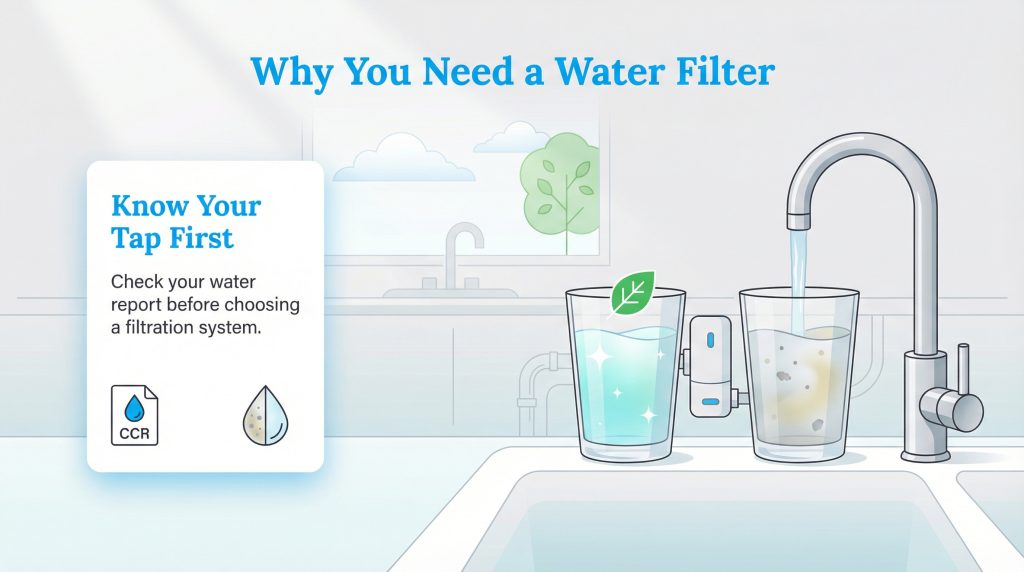
If you notice strange metallic tastes, stubborn hard water scale on your showerheads, or strong chemical odors, your household is likely dealing with one of several common water quality disruptors. Today’s homeowners are increasingly installing filtration systems to combat the following modern plumbing challenges:
- Aging Infrastructure: Millions of homes still receive water through legacy lead service lines or deteriorating cast-iron city mains. As these pipes corrode, heavy metals and rust particles flake off and travel directly into your residential plumbing.
- Agricultural Runoff: Heavy rains easily wash commercial pesticides, herbicides, and excessive nitrates into local reservoirs and underground aquifers, severely impacting both well water vs city water filters and the local supply.
- Microplastics: Microscopic plastic fibers from synthetic clothing, degraded packaging, and industrial waste have thoroughly infiltrated the global water cycle, making their way past standard municipal treatment screens.
- Chemical Disinfectants: Cities rely on heavy doses of chlorine and chloramines to keep water biologically safe during transit. Unfortunately, this leaves your tap water smelling like a public swimming pool and can dry out your skin and hair during showers.
Investing in a high-quality water filtration system provides an immediate barrier against these hidden threats. By actively stripping out harsh minerals and abrasive sediment, you prevent thick scale buildup from destroying your expensive water heater and dishwasher. More importantly, removing heavy chlorine and excess sulfur ensures your morning coffee and home-cooked meals taste incredibly fresh, all while eliminating your family’s reliance on environmentally damaging single-use plastic bottles.
How to Test Your Water Quality First
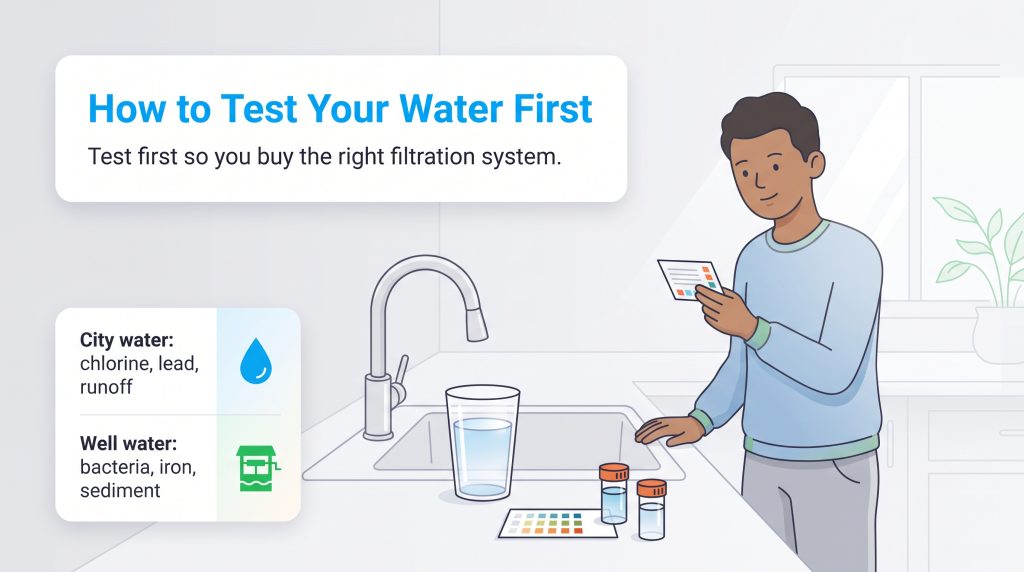
If you want a truly accurate picture of your home’s water quality, you must conduct your own testing before purchasing any equipment. Reviewing your local Consumer Confidence Report is a fantastic starting point, but municipal reports only tell you what leaves the treatment plant — not what your water picks up in the specific pipes leading directly to your kitchen tap.
Furthermore, city water and well water demand completely different filtration technologies. City water typically needs treatment for residual chlorine, lead, and industrial runoff, while private well water often demands robust solutions for coliform bacteria, high iron, and heavy sediment. Conducting an at-home water test captures the crucial, top-of-funnel information you need to avoid overpaying for unnecessary hardware. Review the comparison table below to match the right testing method to your specific household needs.
| Testing Method | Estimated Cost | Accuracy Level | Best For |
|---|---|---|---|
| DIY Test Strips | $15 – $30 | Basic / Low | Instant checks for water hardness, pH levels, and total chlorine presence. |
| First-Draw Lead Test | $30 – $60 | High | Older homes built before 1986 suspected of having lead plumbing fixtures. |
| Well Water Coliform Test | $40 – $80 | High | Annual monitoring for dangerous living bacteria in private, unregulated wells. |
| State-Certified Lab Test | $100 – $300 | Very High | Comprehensive breakdowns of heavy metals, VOCs, and precise mineral counts. |
| EPA-Method PFAS Test | $250 – $400 | Extreme Precision | Detecting industrial “forever chemicals” down to parts-per-trillion levels. |
🚩 Heads Up: If your new property relies on a private well, you are completely responsible for your own water testing and purification since federal agencies do not regulate private ground water sources.
Match Your Top Concern to the Right Technology
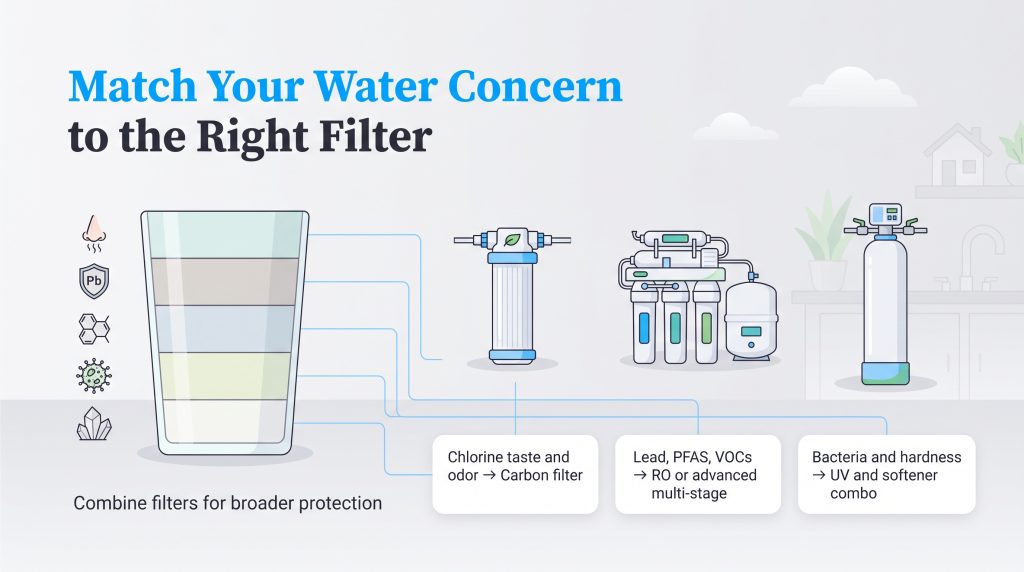
Once you receive your test results, choosing the right water filter depends entirely on what is actively circulating in your supply. As the matrices below illustrate, there is no universal, one-size-fits-all solution. Comparing your primary concern to the corresponding treatment method ensures you make a highly informed purchase.
| Water Source & Primary Concern | Recommended Filtration Setup | Estimated Effectiveness |
|---|---|---|
| City water with chlorine taste and odor | Standard carbon filter + sediment pre-filter | Removes 95% to 99% of chlorine and aesthetic odors. |
| Older home with known lead risk | Point-of-use system with certified lead reduction | Removes up to 99% of dissolved and particulate lead. |
| PFAS (“forever chemicals”) and VOCs | Reverse osmosis or advanced multi-stage carbon | Removes 95% to 99% of targeted industrial chemicals. |
| Well water with potential bacteria risk | Sediment filter + carbon + UV disinfection | Neutralizes 99.9% of living biological threats. |
| Hard water with heavy mineral scale | Water softener + optional carbon filtration | Removes 100% of damaging calcium and magnesium ions. |
| Contaminant | Activated Carbon | Reverse Osmosis (RO) | Ion Exchange |
|---|---|---|---|
| Chlorine |  | |  |
| Lead | | | |
| Mercury | | | |
| PFAS (“Forever Chemicals”) | | | |
| Pesticides/Herbicides | | | |
| Pharmaceuticals | | | |
| Nitrates/Nitrites | | | |
| Arsenic | | | |
| Calcium/Magnesium (Hardness) | | | |
| Bacteria/Parasites | | | |
| Sediment/Rust | | | |
| Fluoride | | | |
| VOCs (e.g., Benzene) | | | |
* Ion exchange can remove heavy metals like lead and mercury if designed for it (e.g., some premium water softeners). However, standard systems focus strictly on removing hardness minerals to protect your plumbing.
💡 Pro Tip: Many households combine filters (e.g., carbon plus RO) for broad protection across their entire property.
Whole House Versus Point-of-Use Water Filtration Systems
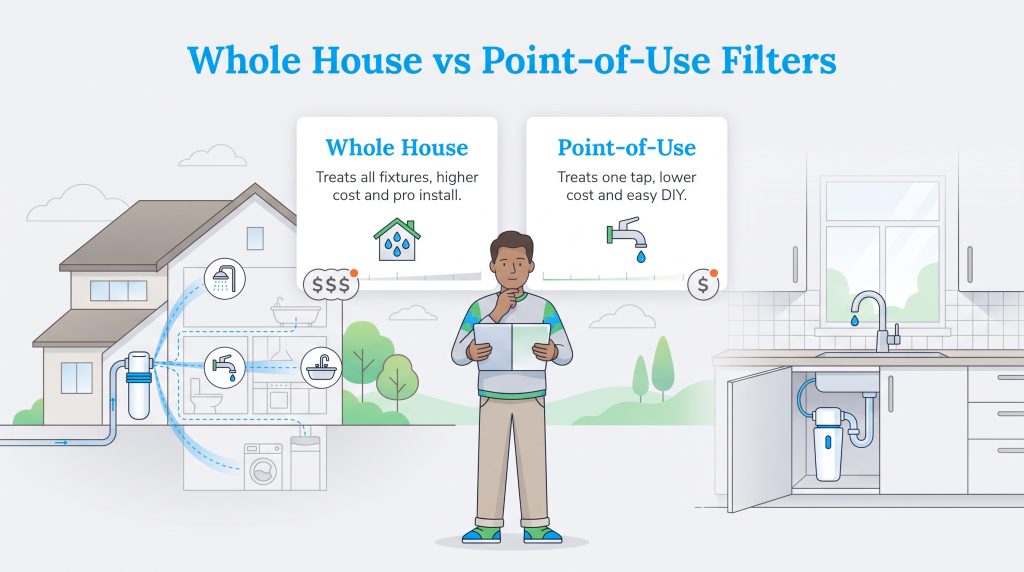
Once you understand your specific water profile, you face a major structural decision: Should you treat the water for your entire home, or just the water you drink? Filtration systems generally fall into two distinct structural categories, each catering to very different household needs, budgets, and physical living situations.
Whole house water filters, technically known as point-of-entry systems, connect directly to your main incoming water line. This means every single drop flowing into your home is thoroughly treated before it ever reaches your bathroom faucets, showers, or washing machine. These heavy-duty setups are the ultimate choice for homeowners looking to protect their expensive internal plumbing infrastructure from mineral scale or those dealing with severe, whole-property water issues like sulfur odors.
Conversely, point-of-use water filters provide localized purification at a single specific location. If you install an under sink water filtration system in your kitchen, you are only treating the water dispensing from that specific tap. These systems are incredibly popular because they require significantly less upfront capital, offer targeted purification for drinking water, and are highly renter-friendly since many models require absolutely zero permanent plumbing modifications.
| Feature | Whole House (Point-of-Entry) | Point-of-Use (Under Sink/Countertop) |
|---|---|---|
| Average Cost | $1,000 – $3,500+ (High) | $50 – $500 (Low to Moderate) |
| Installation Difficulty | Professional Plumber Usually Required | Easy DIY Installation |
| Coverage Area | 100% of the Home (All fixtures and appliances) | Single Location (Kitchen sink, showerhead, etc.) |
| Best Use Case | Homeowners fighting hard water scale, well water contamination, or whole-home chlorine odors. | Renters, budget-conscious buyers, or those who only want purified drinking and cooking water. |
Five Main Types of Water Filtration Systems
Navigating the busy home improvement market can feel completely overwhelming once you decide to actively manage your home’s water quality. You will quickly discover several categories of filters, with each design meticulously engineered to solve specific plumbing problems. Review our straightforward breakdown of the most popular technologies available today to see which mechanism perfectly aligns with your test results.
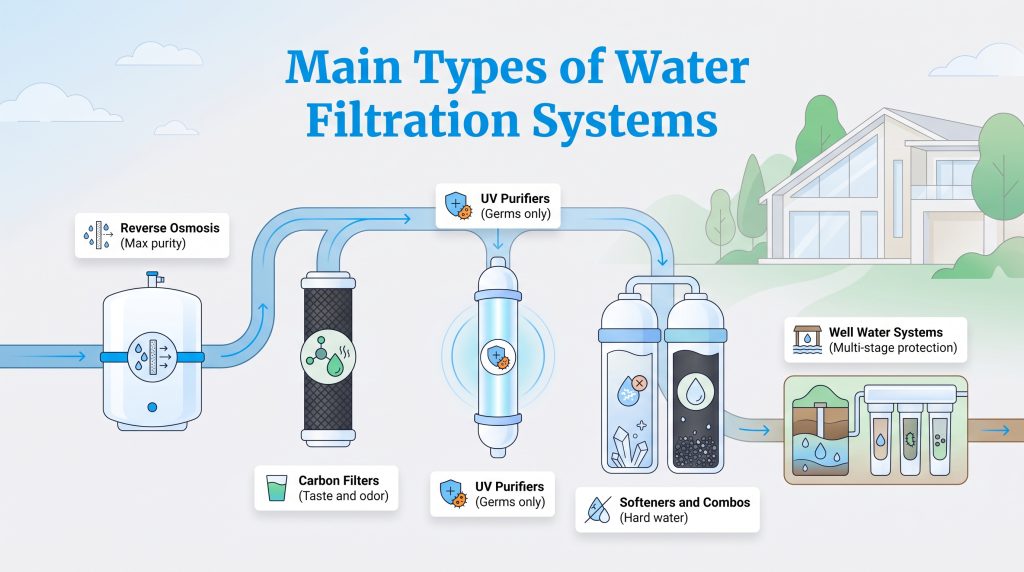
Reverse Osmosis (RO) Systems
When unparalleled purity is your absolute top priority, nothing quite matches the daily performance of a reverse osmosis water filter. Household water pressure forces regular tap water through a microscopic, semipermeable membrane that successfully strips away dissolved solids and hazardous toxins like heavy metals, arsenic, and forever chemicals (PFAS). Because standard RO systems produce noticeable wastewater, often sending four gallons of water down the drain for every one gallon of clean water, many eco-conscious homeowners look for modern, high-efficiency RO models equipped with permeate pumps that drastically lower the waste to a 1:1 ratio. These systems are most commonly installed as under-sink units for drinking water.
Activated Carbon Filters
Activated carbon water filters are the workhorses of the residential water treatment industry. Utilizing highly porous carbon blocks, these systems act exactly like a sponge, efficiently trapping chlorine, chloramines, volatile organic compounds (VOCs), and agricultural pesticides. If your main complaint is that your municipal tap water tastes metallic or smells heavily of disinfectants, an activated carbon filter is your most cost-effective and immediate solution. You will easily find this technology powering everything from simple countertop pitcher filters to massive whole-house tanks.
UV Water Purifiers
Ultraviolet (UV) purification is a highly specialized technology focused entirely on microbiological safety. By exposing water to powerful UV light, these systems scramble the DNA of coliform bacteria, dangerous parasites, and viruses, rendering them completely harmless. Keep in mind that UV light does not remove chemicals, heavy metals, or sediment. In fact, UV systems require perfectly clear water to function effectively, making proper sediment pre-filtration absolutely essential so floating dirt particles do not cast microscopic shadows that shield the bacteria from the sterilizing light.
Water Softener and Filter Combos
Technically speaking, standard water softeners are not traditional filters; they use an ion-exchange process to swap damaging calcium, magnesium, and hardness minerals for harmless sodium ions. However, a water softener and filter combo merges this essential conditioning process with heavy-duty carbon media to simultaneously scrub out heavy chlorine and foul odors. These dual-action systems provide the ultimate residential luxury: beautifully soft water that prevents showerhead crusting paired directly with chemical-free, great-tasting water at every tap.
Multi-Stage Well Water Filtration Systems
If you rely on a private well, a standard big-box store pitcher filter will not be enough to ensure your family’s long-term safety. Advanced well water filtration systems require a comprehensive, multi-stage treatment chain to tackle unique rural contaminants. This usually starts with a heavy-duty sediment spin-down filter to catch heavy sediment, sand, and dirt particles, followed by specialized oxidation media beds. These specialized stages successfully eliminate the frustrating rust-colored stains and rotten egg smells caused by iron, manganese, and hydrogen sulfide.
How to Properly Size and Certify Your Water Filtration System
One of the biggest mistakes homeowners make when purchasing a whole house water filter is severely underestimating their required flow rate, measured in gallons per minute (GPM). If you install a massive filtration tank that inherently restricts your home’s natural GPM, you will experience a highly frustrating drop in water pressure whenever multiple fixtures run simultaneously — imagine trying to take a comfortable shower while someone flushes a toilet and runs the dishwasher downstairs.
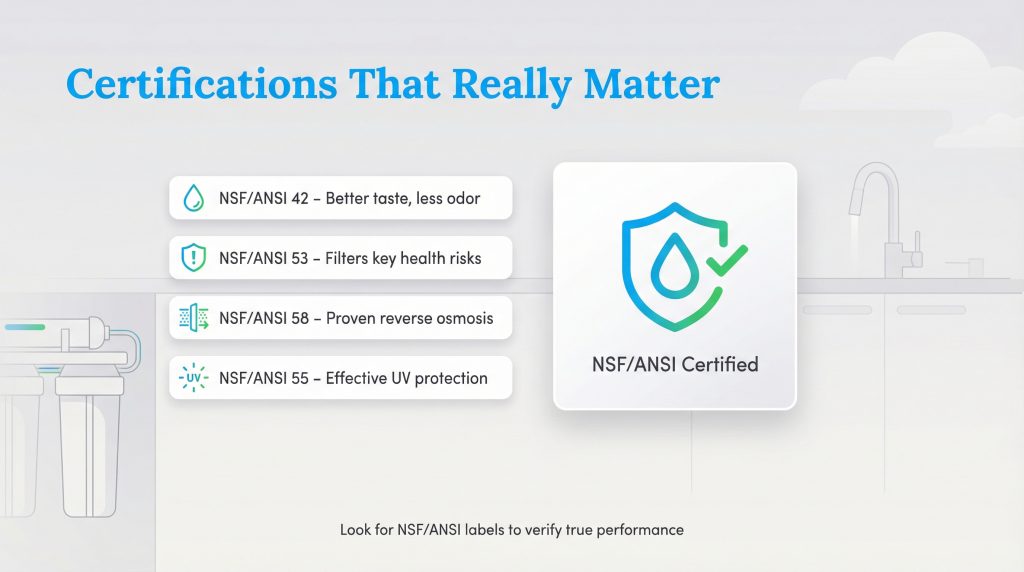
Before doing the math on your system size, you should verify the quality of the filter housing and media. The most reliable way to ensure a system actually performs as advertised and won’t leak under high pressure is to check for specific third-party certifications. The National Sanitation Foundation (NSF) and the American National Standards Institute (ANSI) set the strict industry benchmarks for water treatment:
- NSF/ANSI 42: Covers aesthetic effects, ensuring the system effectively reduces non-health-related contaminants like heavy chlorine taste and foul odors.
- NSF/ANSI 53: Certifies that the filter successfully reduces specific health-related contaminants, such as lead, asbestos, and certain volatile organic compounds (VOCs).
- NSF/ANSI 58: The standard specifically designed for reverse osmosis systems, verifying their ability to safely reduce total dissolved solids and dangerous impurities.
- NSF/ANSI 55: Applies to ultraviolet (UV) microbial water treatment systems, confirming they effectively neutralize dangerous bacteria.
Once you verify the certifications, you must calculate your household’s peak water demand. To accurately determine the system GPM you need, count up all the water-dispensing fixtures in your home and apply this basic formula during your busiest time of day: Shower GPM + Dishwasher GPM + Toilet GPM = Required System GPM.
An average showerhead uses about 2.5 GPM, a standard dishwasher uses roughly 3 GPM, and flushing a toilet briefly pulls another 2 to 3 GPM. If your morning routine involves two people showering simultaneously while the kitchen sink runs, you are easily demanding 7 to 8 GPM all at once. Review the sizing chart below to find your baseline requirement.
| Household Size | Number of Bathrooms | Simultaneous Fixtures Running | Minimum Recommended GPM |
|---|---|---|---|
| 1 to 2 People | 1 to 1.5 Baths | 2 to 3 fixtures | 7 to 10 GPM |
| 3 to 4 People | 2 to 2.5 Baths | 3 to 4 fixtures | 10 to 12 GPM |
| 5+ People | 3+ Baths | 4+ fixtures | 15+ GPM |
Purchasing an undersized unit to save a few dollars upfront will dramatically bottleneck your daily routine. Always round up when sizing your whole house water filter to guarantee comfortable, uninterrupted water pressure throughout your entire property.
Top Water Filtration Brands to Consider
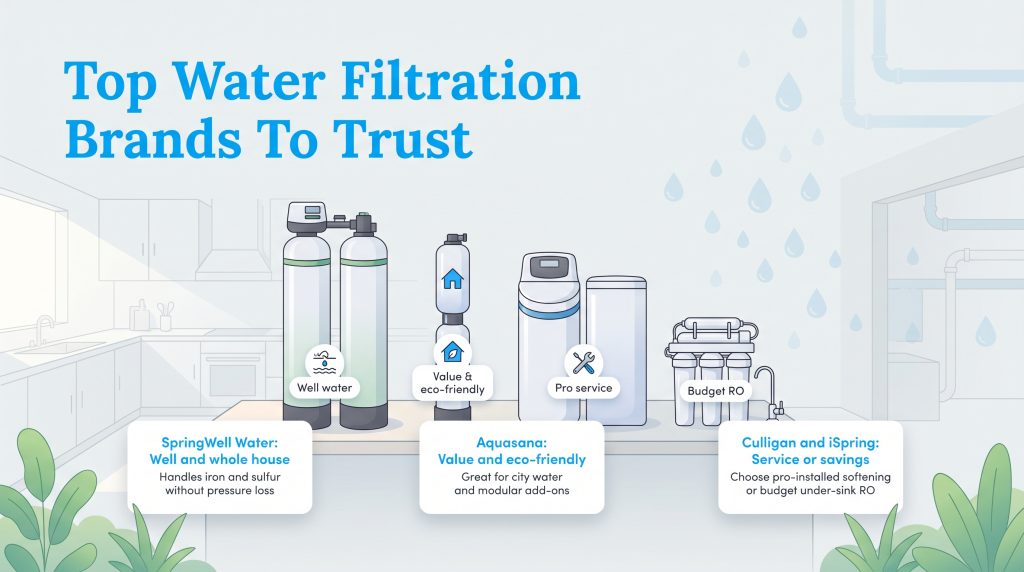
Choosing a reliable manufacturer is just as critical as choosing the right filtration technology. The residential water treatment market is flooded with generic overseas products that lack proper certifications, leading to cracked housings, premature media failure, and potential flooding. If you want peace of mind, focus your search on established, reputable brands that build their hardware to last.
SpringWell Water (Best for Well Water and Whole House Systems)
SpringWell is a massive player in the direct-to-consumer space, highly regarded for their heavy-duty whole home setups and proprietary ActivFlo technology, which maximizes the contact time between your water and the filtration media. Their multi-stage well water filtration systems are specifically engineered to tackle extreme iron and hydrogen sulfide without reducing your home’s water pressure, making them a top choice for rural properties.
Aquasana (Best for Value and Eco-Friendly Options)
For city dwellers looking to effectively eliminate heavy chlorine and dangerous forever chemicals, Aquasana provides incredibly popular, highly certified point-of-entry and point-of-use systems. Their famous Rhino whole house water filter is celebrated for its accessible price point and modular design, allowing homeowners to easily bolt on a UV purifier or a salt-free water conditioner. They also focus heavily on eco-friendly, high-efficiency designs.
Culligan (Best for Professional Service and Hard Water)
If you are not interested in DIY maintenance and prefer a white-glove, professionally managed experience, Culligan operates an extensive network of local dealerships. While you will pay a premium for their hardware and labor, Culligan excels at water softener and filter combos. A local technician will test your water, install the system, and even deliver the heavy bags of salt to your door on a recurring schedule.
iSpring (Best for Budget Under-Sink RO)
For renters or homeowners specifically seeking an under sink water filtration system, iSpring offers phenomenal value. They dominate the budget-friendly reverse osmosis market with their highly certified multi-stage units. iSpring is heavily praised for their exceptional customer service and highly detailed installation manuals, making their complex RO systems accessible even for absolute plumbing beginners.
Installation Options for DIY Versus Professional Plumbers
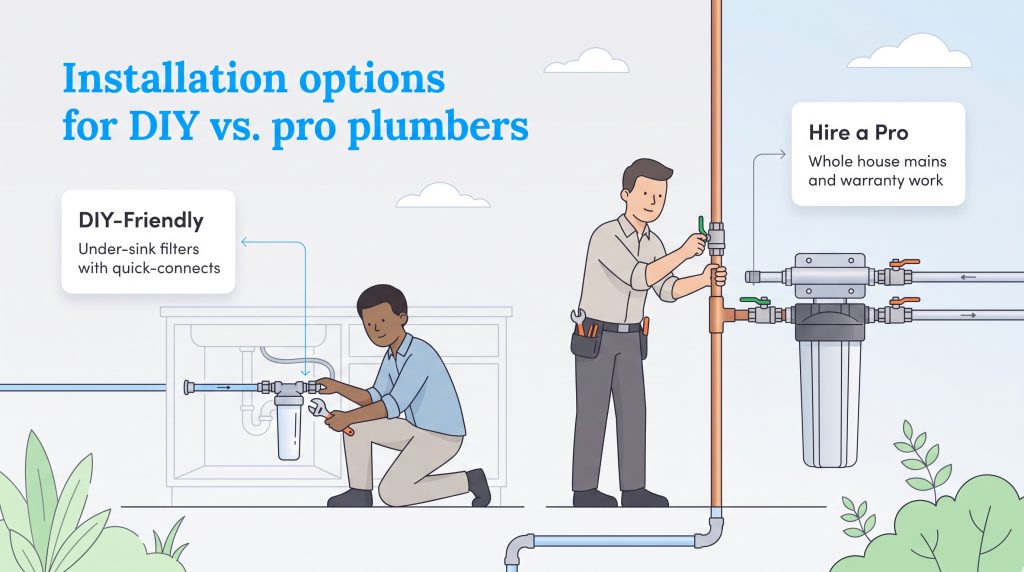
Determining how to install your new hardware often dictates your final budget. While tackling a home improvement project yourself is highly rewarding, water filtration system installation comes with significant risks. A botched electrical job trips a breaker, but a botched plumbing job easily causes tens of thousands of dollars in catastrophic water damage.
If you are purchasing a point-of-use under sink water filtration system, you can easily handle the installation yourself in a single afternoon. These systems typically use simple quick-connect fittings and easily tap into your existing cold water line under the cabinet. If you plan to DIY a larger system, make sure you have the following essential plumbing tools ready before you shut off your main valve:
- Heavy-duty pipe cutter (specifically sized for PEX or copper)
- Teflon tape (plumber’s tape) to seal threaded connections
- Push-to-connect fittings (e.g., SharkBite) or a copper soldering kit
- Two adjustable wrenches for tightening large housing components
- A five-gallon bucket and several towels to catch residual pipe water
However, when dealing with heavy-duty whole house water filters, the rules change drastically. The definitive rule of thumb is this: If your installation requires cutting into your home’s primary copper main line, permanently soldering pipes, or if the manufacturer’s warranty explicitly states that DIY installation voids your coverage, you must hire a licensed professional plumber.
Licensed plumbers ensure the system is physically supported correctly so heavy, water-filled tanks do not snap your main pipes. Furthermore, modifying your main water line often requires pulling a local municipal permit, a complex bureaucratic step a local professional will easily handle on your behalf.
Understanding True Maintenance and Upfront Costs
Budgeting for a major home utility upgrade involves a necessary combination of your initial purchase, skilled labor fees, and ongoing seasonal upkeep. Far too many homeowners buy an affordable system only to be completely blindsided by the expensive proprietary replacement filters they have to buy every six months.
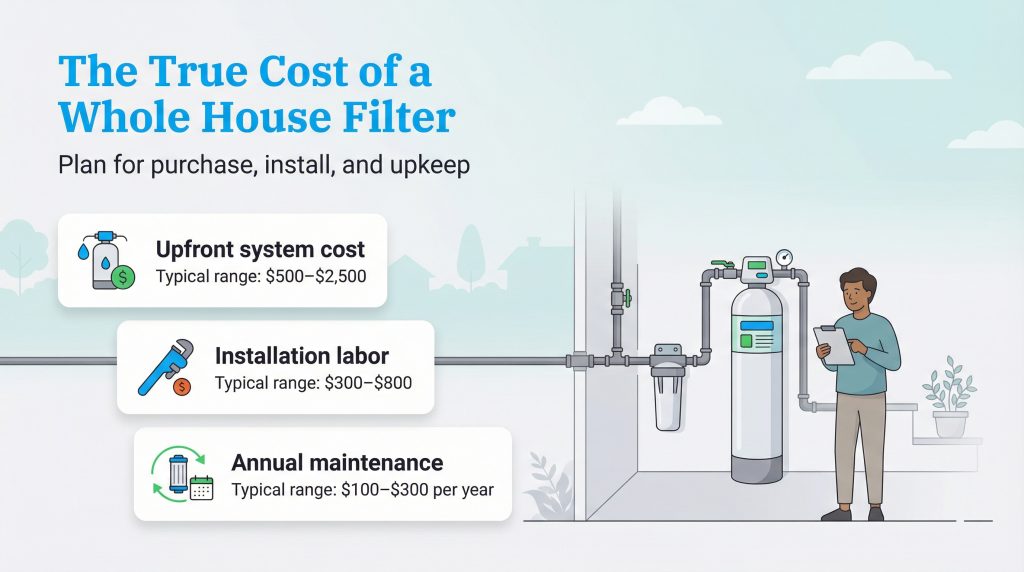
A basic under-sink carbon filter is incredibly affordable, typically costing between $100 and $350 for the hardware with a $0 DIY installation. Conversely, advanced well water filtration setups or massive whole-home tanks easily run between $1,500 and $3,500 for the specialized equipment, plus an additional $300 to $800 in professional plumbing labor. You must carefully weigh your options so there are no unexpected financial surprises down the road.
To help you accurately forecast your budget, review our explicit cost breakdown below. This table separates your heavy first-year investment from the long-term annual recurring costs.
| System Type | Year 1 Total Cost (Hardware + Install) | Annual Recurring Cost (Filters/Media) |
|---|---|---|
| Under Sink Reverse Osmosis | $200 – $600 (DIY Friendly) | $80 – $150 (Pre-filters and membrane) |
| Standard Carbon Filter (Point-of-Use) | $100 – $350 (DIY Friendly) | $50 – $100 (Cartridge replacements) |
| Whole House Carbon Filter | $1,200 – $2,500 (Pro Install Required) | $100 – $300 (Sediment filters and media) |
| UV Water Purifier | $600 – $1,200 (Pro Install Recommended) | $80 – $120 (Annual UV lamp and sleeve) |
| Water Softener System | $1,500 – $3,500 (Pro Install Required) | $150 – $250 (Monthly salt bags and servicing) |
💸 Money-Saver: Purchase your routine replacement filters in bulk directly from the manufacturer or securely subscribe to an auto-delivery program to significantly cut down on your long-term maintenance costs.
Eco-Friendly Benefits of Home Water Filtration
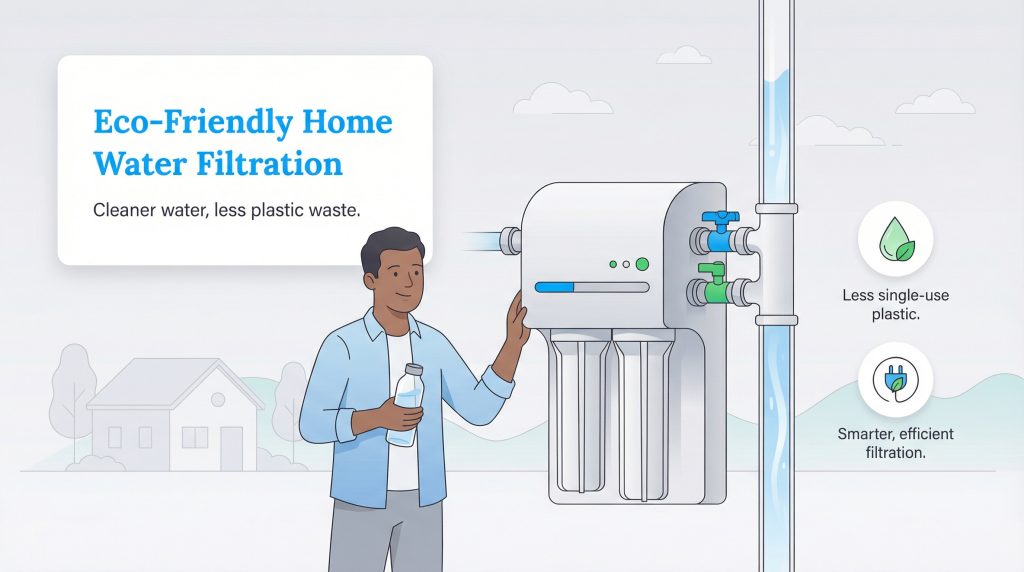
When tackling sustainable home upgrades, installing a permanent water filter is a monumental victory for your personal carbon footprint because it actively eliminates the thousands of single-use plastic water bottles an average family consumes each year. Furthermore, intentionally filtering out abrasive sediment and harsh minerals acts as an incredibly energy-saving option for your home; preventing thick scale buildup effectively helps your vital water heater and ENERGY STAR certified appliances operate at peak energy efficiency, simultaneously lowering your monthly electric bills and preventing premature, wasteful appliance replacements.
Action Plan for Purchasing Your Ideal Setup
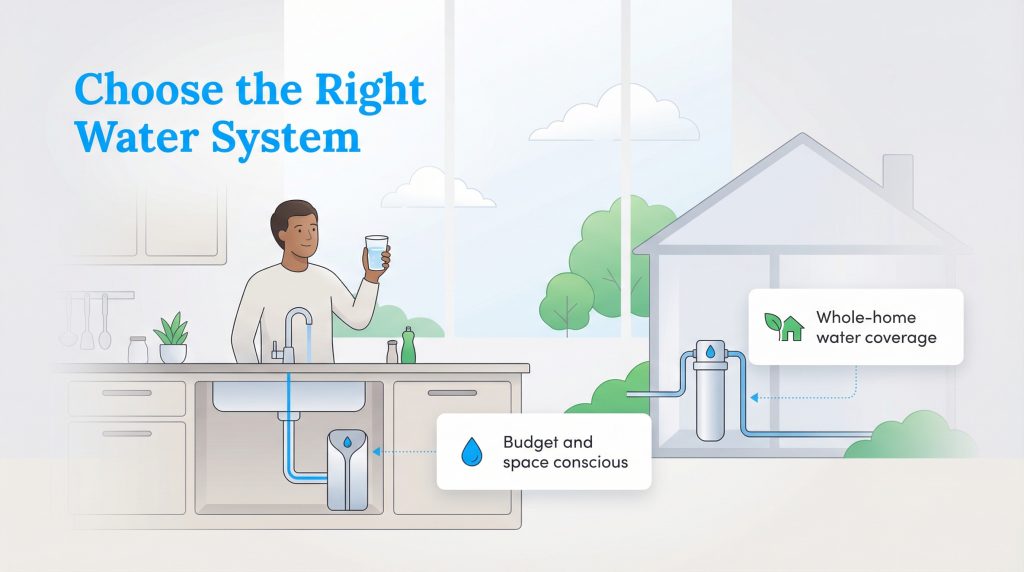
Taking full ownership of the water flowing freely from your taps brings an incredible sense of security to your family’s daily routine. You are no longer crossing your fingers and merely hoping the municipal supply is perfectly optimized for your neighborhood. Instead, you are actively deciding exactly what goes into your body and your home’s complex plumbing framework. To confidently purchase the best system without feeling overwhelmed by the technical specifications, follow this straightforward chronological checklist:
- Test Your Water Quality First: Never guess what is in your water. Order a mail-in lab test or read your local municipal report to establish a factual baseline of contaminants.
- Calculate Your Peak Flow Rate: Count your bathrooms and apply the GPM formula so you do not accidentally bottleneck your home’s daily water pressure.
- Choose Your Filtration Technology: Match your specific contaminants to the right media. Treat heavy mineral scale with softeners, tackle municipal chlorine with carbon blocks, and address well water bacteria with robust UV purifiers.
- Compare the Top Brands: Look exclusively for NSF/ANSI certifications, generous lifetime warranties, and transparent annual filter replacement costs.
- Plan Your Installation Method: Decide upfront if you possess the plumbing skills required to DIY an under-sink unit, or if you need to budget an extra $500 to hire a licensed plumber for a massive whole-house tank.
Trust your thorough research and carefully check your local water data. You will easily enjoy the remarkably refreshing taste of pure, clean hydration for years to come.
See our List of Top Water Filters
Frequently Asked Questions About Water Filtration Systems
How much does it cost to install a whole house water filtration system?
Do I need a water filter if I have municipal city water?
What is the difference between a water softener and a whole house water filter?
How often do I need to change the filters in my system?
Do water filtration systems remove PFAS or forever chemicals?
How much wastewater does a reverse osmosis system produce?
Can I install a water filtration system if I rent an apartment?
What is the best water filtration system for well water?
Do water filtration systems reduce water pressure in the home?
Can a water filtration system remove microplastics?
About the Author

David has been an integral part of some of the biggest utility sites on the internet, including InMyArea.com, HighSpeedInternet.com, BroadbandNow.com, and U.S. News. He brings over 15 years of experience writing about, compiling and analyzing utility data.

LaLeesha has a Masters degree in English and enjoys writing whenever she has the chance. She is passionate about gardening, reducing her carbon footprint, and protecting the environment. She also recently served as President of the Board for City Sprouts (a community garden).