
Understanding the Science Behind the Most Effective Home Water Filtration Method
Key Takeaways
- Reverse osmosis systems use high pressure to force water through a semi-permeable membrane, removing a high percentage of many common contaminants like lead and chlorine.
- Most residential systems rely on multi-stage filtration, including carbon pre-filters and post-filters, to protect the membrane and polish the water’s taste.
- While highly effective, these systems produce “brine” or wastewater, though modern eco-conscious features like permeate pumps can significantly reduce this impact.
If you are wondering exactly how reverse osmosis water filters work to purify your home’s drinking supply, you have come to the right place. These powerful under-sink and whole-home setups are widely considered the gold standard for residential water purification, capable of removing up to 99% of harmful dissolved solids and microscopic impurities. By forcing pressurized tap water through an ultra-fine semipermeable membrane, this robust mechanical filtration method meticulously strips away heavy metals, harsh municipal chemicals, and organic matter. Whether you are dealing with aging city pipes or questionable private well water, installing one of these systems ensures your family enjoys crisp, laboratory-grade hydration straight from the kitchen faucet.
What Is a Reverse Osmosis Water Filter?
Walking down the plumbing aisle at your local hardware store can feel incredibly overwhelming, but a reverse osmosis water filter is surprisingly straightforward once you break down its core mechanics. Rather than relying solely on chemical absorption, this advanced technology uses ultra-fine mechanical separation to deep-clean your household drinking supply. When exploring what is reverse osmosis, it helps to understand the basic concept:
- The Microscopic Screen Door: The semipermeable membrane acts like an incredibly tight screen, allowing pure water molecules to pass through easily.
- Physical Blocking: Dissolved solids, dangerous heavy metals, and hardened natural minerals act like coarse sand that bounces off the screen.
- Continuous Flushing: Instead of trapping all the heavy debris, the system actively flushes those rejected contaminants away down your plumbing drain.
Beyond residential under-sink systems, this robust filtration method serves a massive role on the global stage. Reverse osmosis is heavily utilized worldwide for large-scale seawater desalination, industrial manufacturing processes, and rigorous laboratory purification, proving it is an exceptionally trustworthy and scalable technology.
The Science: Osmosis Vs. Reverse Osmosis
Regular osmosis is a natural biological phenomenon where water instinctively moves from a less concentrated solution to a more concentrated one to perfectly balance things out across a cellular boundary. This is exactly what happens when thirsty plant roots naturally soak up essential moisture from the surrounding soil.
Reverse osmosis aggressively flips this passive process on its head to separate clean water from dangerous contaminants. By applying significant physical pressure from your home’s municipal plumbing lines, the equipment entirely overcomes the natural osmotic pressure. It forces highly concentrated, dirty tap water through the ultra-fine membrane, isolating a pure supply of H2O on the other side. Because you are actively fighting against the laws of nature, maintaining adequate mechanical water pressure is absolutely critical for success.
Permeate Vs. Concentrate Water
When discussing how these systems manage fluid dynamics, plumbing professionals rely on two highly specific industry terms to describe the resulting liquid. Understanding permeate vs concentrate water is essential to grasping the complete reverse osmosis filtration process.
- Permeate Water: This is the highly sought-after, purified drinking water that successfully passes through the microscopic pores of the membrane and flows directly to your specialized kitchen faucet.
- Concentrate (Brine) Water: This is the rejected wastewater that failed to pass through the tight membrane. It carries away all the blocked heavy metals and dissolved solids straight to your household drain.
The Core Components of an RO System
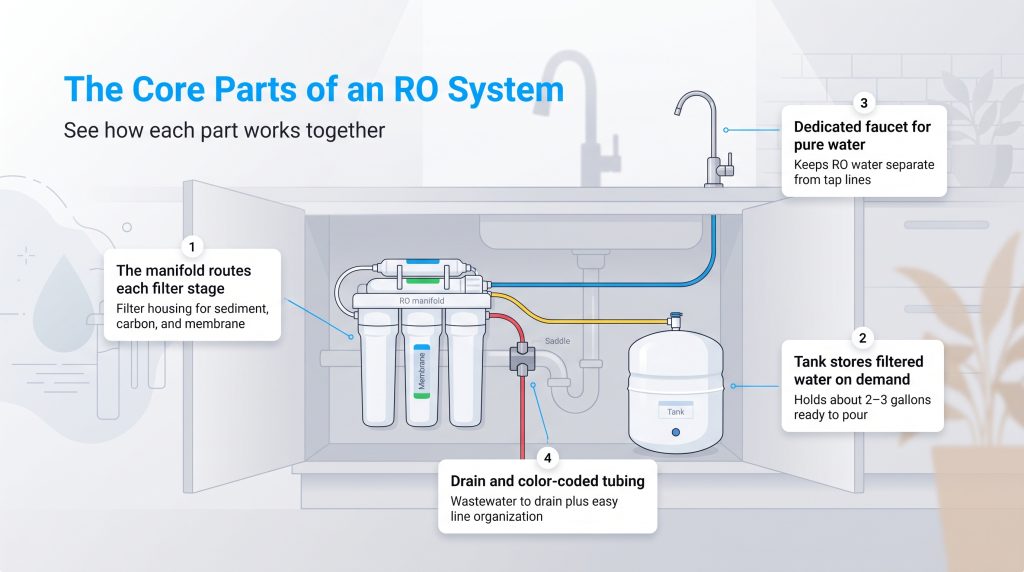
A modern reverse osmosis unit is not just a single, standalone cartridge. It is a synchronized collection of specialized plumbing components designed to guide your tap water through a rigorous purification journey.
- The RO Manifold (Filter Housing): This central command center securely holds the individual filter cartridges and sequences the water flow. It carefully routes your supply from one stage to the next without leaking.
- Pressurized Storage Tank: Standard systems include a pressurized storage bladder that safely holds two to three gallons of purified water. This ensures a clean supply is instantly available when you turn on the tap.
- Dedicated Faucet: An RO system utilizes a smaller, specialized dispenser mounted directly onto your kitchen sink. This ensures your purified water never cross-contaminates with the unfiltered tap water.
- Drain Saddle: This specialized clamp attaches firmly to your existing PVC drainpipe to dispose of rejected impurities. It allows the resulting wastewater to seamlessly wash away without splashing or backing up.
- Color-Coded Tubing: High-quality systems use a network of flexible, color-coded polyethylene tubing to connect all components. This visual system guarantees you attach the incoming tap water, storage tank, drain line, and faucet to their correct ports.
- Permeate Pump: This eco-friendly device harnesses the natural hydraulic energy of wastewater to boost pressure into the storage tank. Adding a permeate pump drastically reduces the amount of water sent down the drain.
The 5 Stages of the Reverse Osmosis Filtration Process
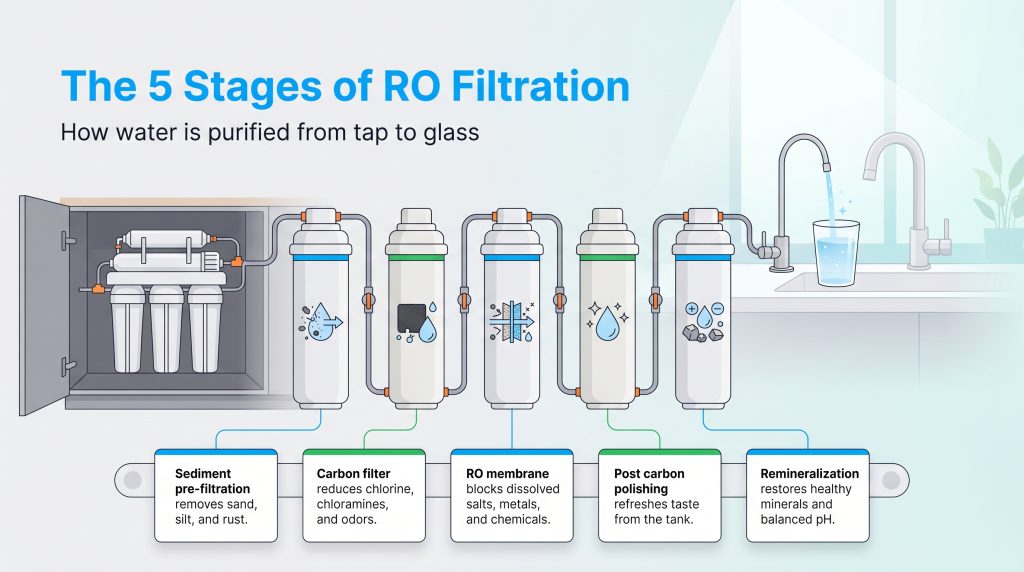
When you finally install an RO system in your home, you are essentially constructing a highly efficient, miniature water treatment plant right inside your dark kitchen cabinet. Most standard under-sink units utilize a sequential, multi-stage process to ensure the final product is spotless, safe, and tastes incredibly fresh.
Stage 1: Sediment Pre-Filtration
The very first line of defense is the rugged sediment pre-filter. As raw tap water eagerly enters the system, it passes through this dense, tightly spun, sponge-like cartridge designed specifically to catch all the big, abrasive particles floating in the supply. We are talking about sharp rust flaking off old municipal city pipes, microscopic dirt, heavy silt, and stray sand. If these larger, rougher particles made it any further into the delicate system, they would easily tear or prematurely clog the expensive RO membrane.
Stage 2: Carbon Filtration
Once the rough sediment is successfully cleared away, the water flows straight into an activated carbon block filter. This stage is absolutely crucial because modern municipal city water is heavily treated with harsh chlorine and chloramines to kill off dangerous bacteria during transit. While this chemical treatment is fantastic for broad public sanitation, chlorine acts incredibly much like battery acid on a synthetic semipermeable RO membrane, degrading its sensitive structure rapidly. The carbon filter acts like a chemical sponge to neutralize these additives.
Stage 3: The Semipermeable RO Membrane
This stage is the undisputed heart and soul of the entire filtration operation. After being carefully prepped by the first two filters, the highly pressurized water is forcefully pushed against the semipermeable RO membrane. With microscopic pores sized at a staggering 0.0001 microns, it allows almost nothing but pure water molecules to physically squeeze through to the other side. Heavy metals, dissolved salts, excess fluoride, microscopic organic compounds, and dangerous forever chemicals are entirely blocked and swiftly flushed away down the drain line.
Stage 4: Post-Filtration (Polishing)
Because the physical reverse osmosis process works quite slowly, the resulting clean water is typically stored in an RO water storage tank. When you finally lift the handle on your dedicated kitchen faucet, the water leaves the pressurized tank and passes through one last carbon post-filter. Often referred to by plumbers as a “polishing” filter, this crucial final stage easily removes any stagnant, slightly rubbery tastes or odd odors the water might have unfortunately picked up while sitting quietly inside the pressurized storage bladder.
Alternatively, many eco-conscious homeowners are now upgrading to tankless reverse osmosis systems. These sleek, compact units completely eliminate the bulky pressurized storage bladder from under your sink, utilizing an internal electric booster pump to force water through the ultra-fine membrane on demand.
Stage 5: Remineralization Filter
The RO membrane is so exceptionally good at its rigorous job that it completely removes healthy, naturally occurring minerals alongside the dangerous contaminants. This intense stripping process can unfortunately leave the resulting water tasting slightly flat or overly acidic. An alkaline remineralization filter perfectly solves this common issue by carefully introducing a measured, healthy dose of beneficial minerals back into the purified water just before it hits your drinking glass.
💡 Pro Tip: Most reverse osmosis systems require a dedicated faucet installed at your sink. If you currently have a redundant soap dispenser or an unused sprayer hole in your countertop, you can easily repurpose that existing space to avoid permanently drilling a brand new hole for the RO faucet.
What Do Reverse Osmosis Filters Remove?
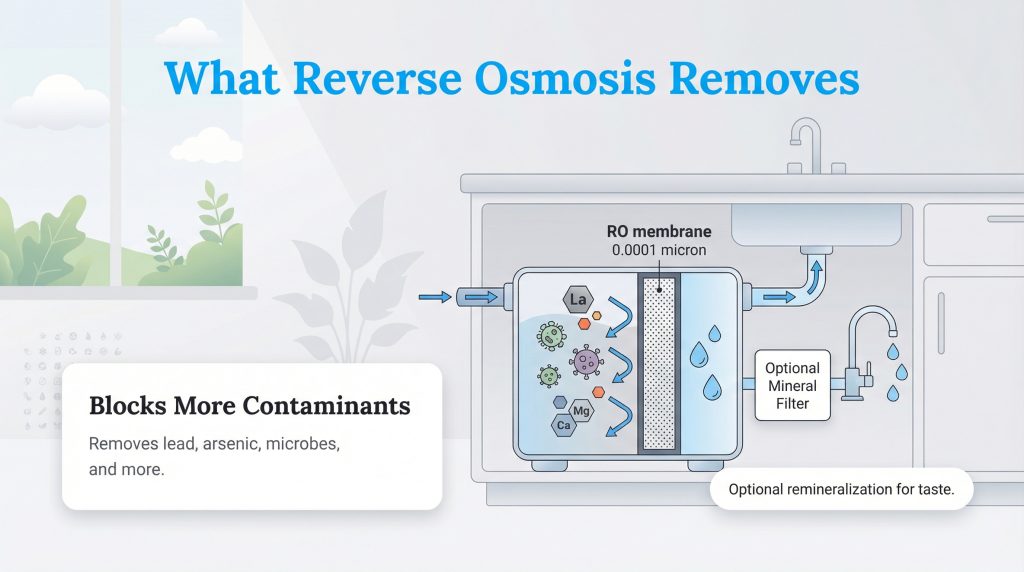
The primary reason safety-conscious homeowners actively choose this advanced technology is its unparalleled ability to strip out a vast, terrifying spectrum of impurities from their daily drinking supply. Basic plastic pitcher filters simply cannot catch the microscopic dissolved solids that a high-quality RO membrane effortlessly blocks. Because the mechanical filtration screens particles down to 0.0001 microns, it acts as a phenomenal, reliable safety net.
Below is a detailed breakdown of common household contaminants and exactly how effectively an RO system typically removes them, alongside the regulatory limits set to keep your family safe:
| Contaminant | Estimated Removal Rate | EPA Maximum Contaminant Level (MCL) |
|---|---|---|
| Lead | Typically 95% – 98% | 0 mg/L (Action Level: 0.015 mg/L) |
| Fluoride | Typically 90% – 95% | 4.0 mg/L |
| Arsenic | Typically 95% – 99% | 0.010 mg/L |
| Chlorine | 98%+ | 4.0 mg/L (MRDL) |
| Sodium | Typically 90% – 95% | None (Advisory: 20 mg/L) |
| PFAS (Forever Chemicals) | Estimated 90% – 99% | 4.0 ppt (PFOA/PFOS) |
Here is a quick, comprehensive look at what a residential point of use RO system typically removes versus what it unfortunately leaves behind:
What is Removed:
- Heavy metals (Lead, Arsenic, Copper)
- Total Dissolved Solids (TDS)
- Excess Fluoride and Chlorine
- PFAS and industrial chemical runoff
- Harmful Nitrates and Sulfates
What is NOT Removed:
- Certain dissolved gases (like radon or foul-smelling hydrogen sulfide)
- Some Volatile Organic Compounds (if the carbon pre-filters are completely exhausted)
- 100% of all aggressive bacteria and viruses (unless specifically paired with a specialized ultraviolet purifier)
Find a Reverse Osmosis System for Your Home
Benefits of Reverse Osmosis Water Filtration
If you are actively debating whether an upgrade is worth the investment, examining the long-term benefits of reverse osmosis can quickly clarify your decision. These systems do far more than just marginally improve the flavor of your afternoon iced tea. Here are the core advantages of upgrading your household water supply:
- Removes 99% of Dissolved Solids: The ultra-fine mechanical membrane rigorously screens out heavy metals, forever chemicals, and toxic runoff that standard filters easily miss.
- Requires No Electricity: Traditional under-sink models perfectly utilize your home’s natural plumbing pressure to filter water, saving energy and functioning during power outages.
- Saves Money on Bottled Water: Generating premium, laboratory-grade hydration directly at your kitchen sink drastically cuts your household’s ongoing reliance on expensive plastic bottles.
- Improves Taste and Odor: By deeply neutralizing municipal chlorine and stripping away hardened minerals, the resulting purified water tastes incredibly crisp and refreshing.
Reverse Osmosis Vs. Carbon Filters: Which Is Better?
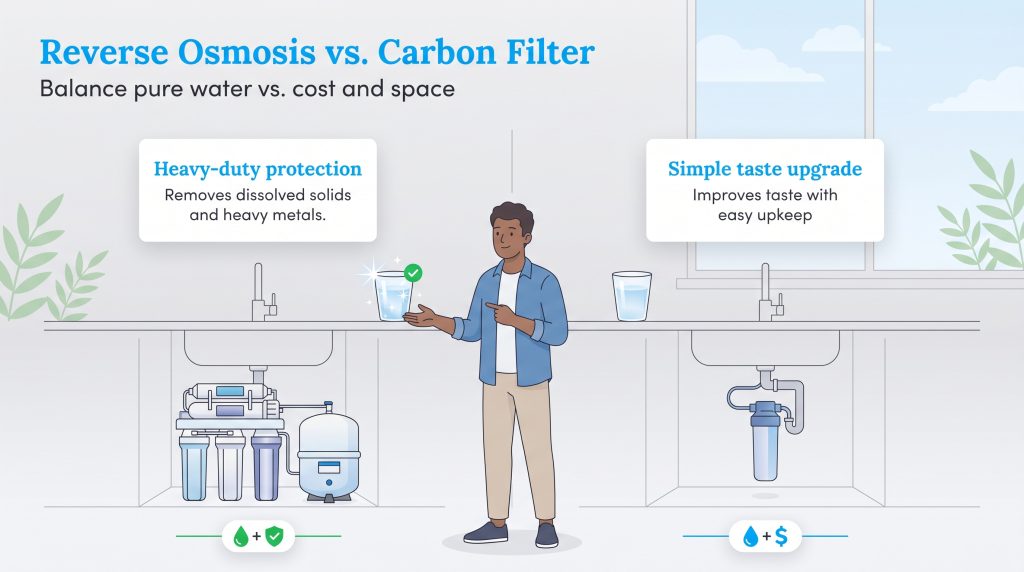
When weighing a reverse osmosis vs carbon filter, you might logically wonder if the extra bulk, initial expense, and installation time are genuinely worth the hassle. Standard carbon filters act like excellent chemical sponges, efficiently absorbing specific impurities like chlorine to dramatically improve your tap water’s taste. However, they simply cannot mechanically block heavy dissolved solids, leaving dangerous metals and trace pharmaceuticals untouched.
| Feature | Reverse Osmosis System | Standard Carbon Filter |
|---|---|---|
| Contaminants Removed | Removes 99% of dissolved solids, heavy metals, fluoride, and chlorine. | Primarily removes chlorine, bad tastes, odors, and large sediment. |
| Cost | Higher initial cost ($200–$500) plus ongoing multi-filter replacements. | Lower initial cost ($50–$150) and cheaper replacement cartridges. |
| Maintenance | Requires swapping 3–5 filters at different intervals and sanitizing the tank. | Very simple; usually requires changing one single cartridge every six months. |
| Wastewater Production | Produces a reject stream (brine) during the physical filtration process. | Produces zero wastewater; every drop that enters the filter goes to your tap. |
To help you seamlessly choose the best functional fit for your family’s unique kitchen needs, review these specific use cases:
Choose a Carbon Filter if…
- You want to eliminate harsh chlorine tastes and foul odors.
- Your municipal water is well-regulated and completely safe.
- You want a budget-friendly option with minimal maintenance.
- You have strictly limited under-sink cabinet space.
Choose a Reverse Osmosis System if…
- You are constantly dealing with untested private well water.
- You have an older home with potential lead in the pipes.
- You want to rigorously block heavy metals and PFAS.
- You demand laboratory-grade purification for total peace of mind.
Pros and Cons of Reverse Osmosis Systems
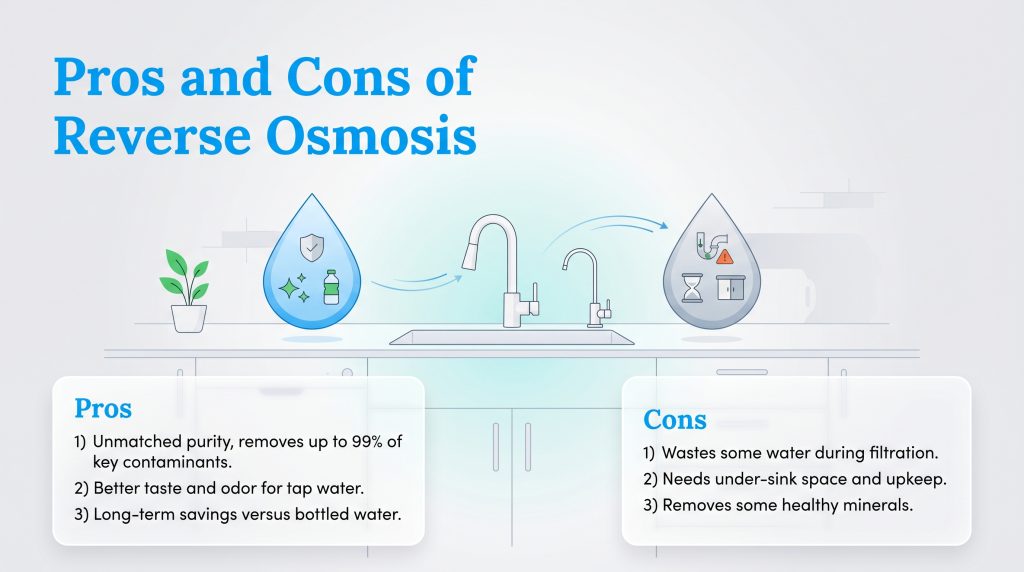
Deciding to upgrade your home’s plumbing with advanced filtration is a major commitment. While reverse osmosis offers unparalleled purification benefits that easily outshine basic pitcher filters, you will need to carefully balance the profound health benefits against the spatial demands and routine maintenance responsibilities.
| The Pros of RO Systems | The Cons of RO Systems |
|---|---|
| Blocks up to 99% of heavy metals and dissolved solids. | Produces a necessary reject water stream to clean the membrane. |
| Delivers crisp, bottled-quality water directly to your tap. | Traditional systems demand significant cabinet space for tanks and manifolds. |
| Reduces household reliance on single-use plastic water bottles. | Strips natural minerals, requiring an optional remineralizer for improved taste. |
| Highly customizable with specialized UV purifiers or alkaline boosters. | Dispenses water significantly slower than your main kitchen tap. |
Ultimately, the overwhelming advantages massively outweigh the disadvantages for most safety-conscious homeowners. If you are willing to sacrifice a little bit of cabinet space beneath your sink and handle an easy filter swap a couple of times a year, your family’s daily hydration is entirely worth the minor trade-offs.
Managing Reverse Osmosis Wastewater
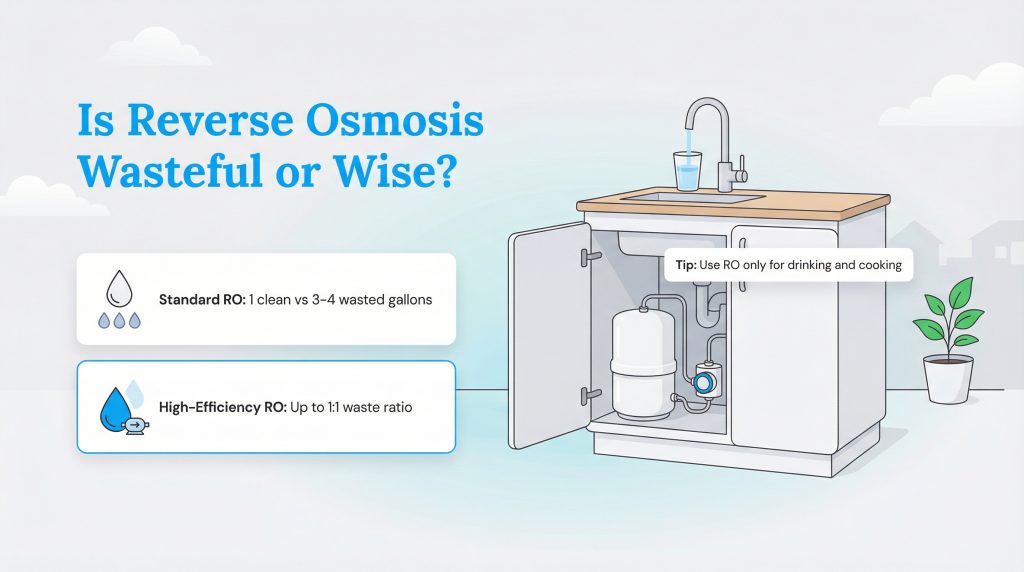
To keep the delicate, ultra-fine membrane from becoming hopelessly clogged with the heavily rejected solids, the system continuously uses a portion of the incoming tap water to wash dangerous contaminants down the drain. This absolutely necessary functional wastewater is commonly referred to in the plumbing industry as the “reject stream” or “brine.”
In older, completely standard residential systems, for every single gallon of pure drinking water actively produced, up to four gallons might tragically go straight down the drain (a disappointing 4:1 ratio). For modern, eco-conscious homeowners aggressively aiming to reduce their overall utility footprint, this incredibly lopsided reverse osmosis wastewater ratio is understandably concerning.
Fortunately, high-efficiency RO systems now frequently come equipped with a specialized permeate pump. This clever, non-electric option actively uses the natural hydraulic energy of the wastewater to powerfully boost water pressure into the storage tank, dramatically improving the ratio down to a highly respectable 1:1. By proactively choosing modern, efficient equipment and purposefully repurposing the runoff for non-potable uses like watering your robust outdoor garden, you can easily enjoy pristine drinking water without the heavy burden or guilt of excessive waste. For more brilliant insights on properly managing your home’s daily utility usage, check out our comprehensive guide to residential water services.
🌱 Eco Edge: Always look for a modern filtration system equipped with a built-in “permeate pump” or purchase an aftermarket kit that actively helps redirect your reject water. These brilliant technologies recycle the natural pressure created by the wastewater to power the system, which can heavily reduce water waste by as much as 80% compared with some outdated standard models, depending on your home’s unique plumbing and incoming water pressure.
How to Maintain Your RO Water System
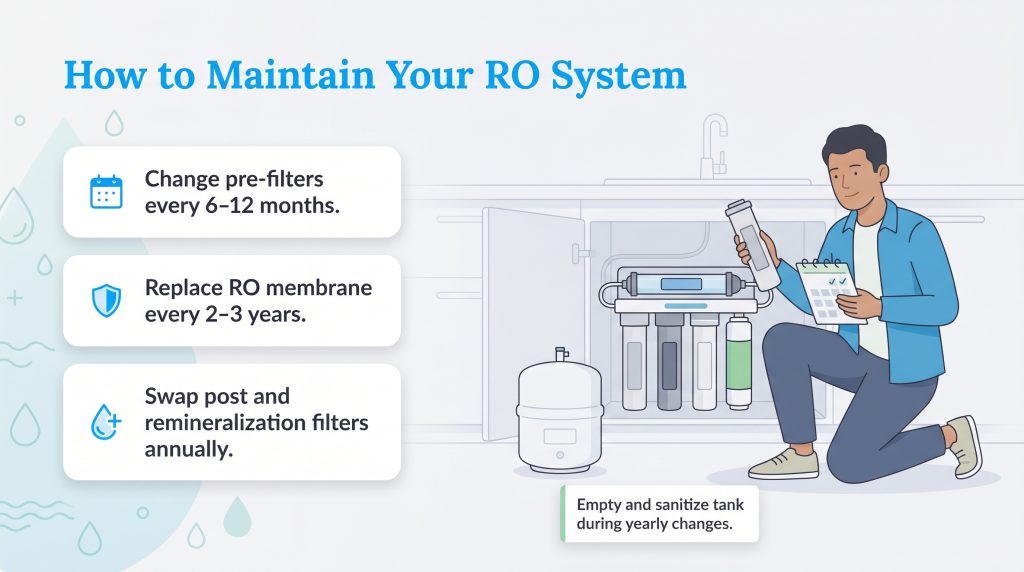
Installing an advanced purification setup is only the very first step in securing clean drinking water; properly maintaining it over the years is what guarantees its long-term success. Because the water moves sequentially through various filters, neglecting the early stages will rapidly destroy the more expensive components down the line. To keep your water tasting incredibly crisp and your hardware functioning perfectly, you need to follow a strict replacement timeline.
| Component | Replacement Timeline | Average Cost |
|---|---|---|
| Sediment Pre-Filter | Every 6 to 12 Months | $10 – $20 |
| Carbon Block Pre-Filter | Every 6 to 12 Months | $15 – $25 |
| RO Membrane | Every 2 to 3 Years | $50 – $90 |
| Carbon Post-Filter (Polishing) | Every 12 Months | $15 – $25 |
| Alkaline Remineralization Filter | Every 6 to 12 Months | $20 – $40 |
As you can quickly see from the table above, your routine reverse osmosis water system maintenance is fairly affordable and generally predictable. On average, a diligent homeowner can expect to spend roughly $60 to $100 annually on standard replacement cartridges. The most critical event on your calendar will be swapping the main membrane. While it has an impressive 2-to-3-year lifespan, protecting that longevity entirely depends on you consistently changing the cheaper sediment and carbon pre-filters every single year.
📌 Quick Fact: When you perform your annual filter swaps, it is highly recommended to completely empty the pressurized storage tank and sanitize the inside with an approved hydrogen peroxide solution. This quick, 10-minute step effectively prevents microscopic bacterial buildup inside the dark bladder over the years.
Preparing Your Home for Installation
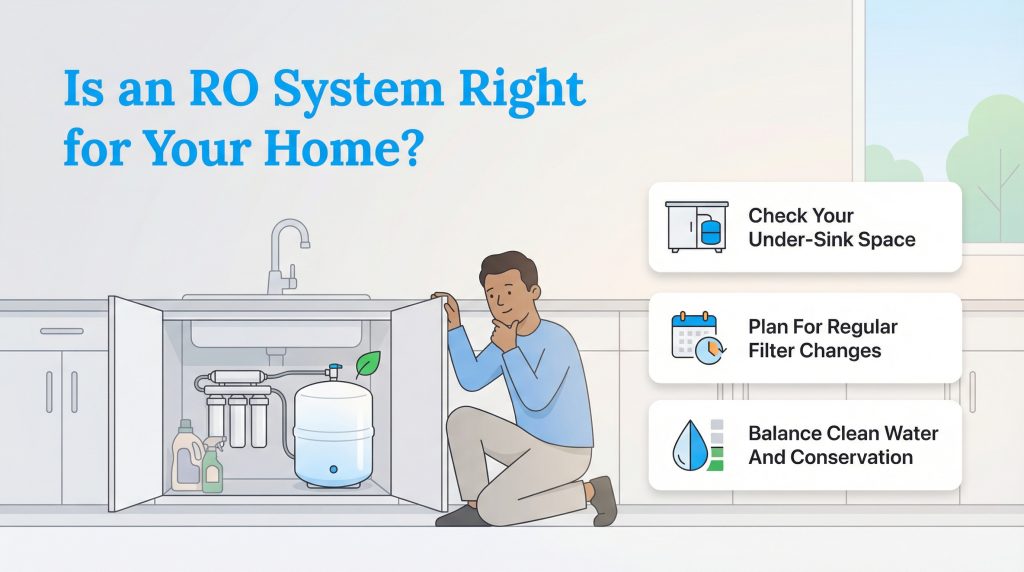
Before you completely clear out your collection of kitchen cleaning supplies and boldly start drilling a new hole in your expensive granite countertop, it heavily pays to properly evaluate your physical space. Installing an undersink RO system is generally considered a highly straightforward weekend DIY project, but it absolutely requires a bit of thoughtful, proactive prep work to ensure it seamlessly fits your family’s daily lifestyle.
First, you must carefully measure your available under-sink cabinet volume. The traditional RO water storage tank is roughly the size of a standard basketball, and the plastic filter manifold itself will aggressively take up a significant chunk of the side cabinet wall. Check your home’s overall incoming water pressure as well. Because the system physically forces tap water through a stubborn membrane, you desperately need a minimum incoming pressure of exactly 40 PSI (pounds per square inch).
Finally, honestly evaluate your home’s overall water hardness levels. If you happen to have extremely hard water full of heavy calcium and magnesium, it will rapidly scale up and completely destroy the delicate RO membrane prematurely. Homeowners with severely hard well water should strongly consider having a traditional whole-house water softener installed upstream of the RO unit. Interestingly, if you are actively on a strict, doctor-mandated sodium-restricted diet, an RO system is actually a fantastic, life-saving investment because it perfectly removes the heavy trace salt added by those whole-home water softeners. Speaking of whole-home utility setups, you can confidently learn more about setting up utilities in a new home to ensure all your foundational water systems are fully optimized from day one.
💸 Money-Saver: While the initial hardware cost of an RO system can easily range from $200 to $500, it financially pays for itself surprisingly quickly if you currently buy cases of bottled water. A modern family drinking roughly 3 gallons a day can confidently save hundreds of hard-earned dollars annually just by switching to under-sink RO.
Learn more about Water Filtration Systems for your Home
Securing Cleaner Drinking Water for Your Home
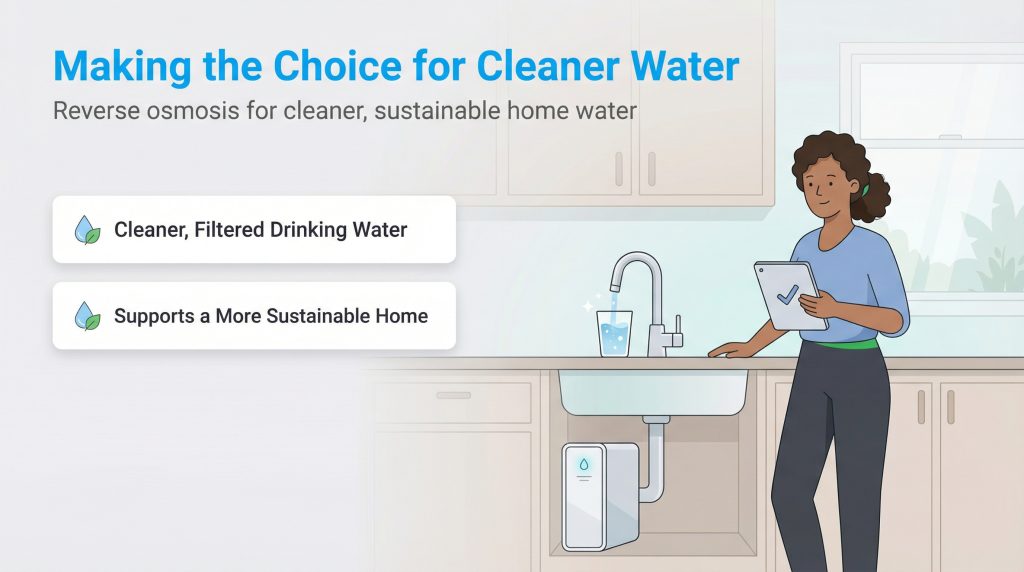
Taking the highly proactive, health-conscious step to install a reverse osmosis filter is an incredibly powerful way to seize absolute control of your family’s daily hydration. While the complex multi-stage setup admittedly demands a bit more cabinet real estate and occasional routine maintenance than a basic fridge pitcher, the ultimate peace of mind it delivers is entirely unmatched. You are effectively putting a tireless, microscopic security guard right at your kitchen sink.
By carefully weighing your household’s unique water conditions, prioritizing modern eco-friendly permeate pumps, and strictly staying on top of scheduled multi-filter changes, you can confidently secure delicious, laboratory-grade drinking water for your loved ones for many years to come.
Get a Reverse Osmosis System for your Home
Frequently Asked Questions About Reverse Osmosis
Do reverse osmosis systems remove healthy minerals from water?
Yes, the membrane strips away beneficial minerals like calcium alongside contaminants. Since we get most minerals from food, this is safe. If you prefer the taste of natural mineral water, an inline remineralization filter easily adds healthy calcium back before you drink.
Do I need a reverse osmosis remineralization filter?
You do not strictly need one for safety. However, the rigorous filtration process makes the water slightly acidic, which can taste flat. Adding a remineralizer improves the flavor profile and balances the pH, giving your water a premium spring water taste.
How often do I need to replace the semipermeable RO membrane?
The core RO membrane typically lasts two to three years under normal household use. To hit that extended lifespan, you must replace the cheaper sediment and carbon pre-filters every six to 12 months to prevent abrasive dirt and chlorine from destroying it.
What is a tankless reverse osmosis system?
A tankless system eliminates the bulky storage bladder beneath your sink. Instead, these compact models use an internal electric booster pump to rapidly push tap water through the ultra-fine membrane on demand, providing a continuous flow of pure water while saving cabinet space.
Is reverse osmosis water the same as distilled water?
No, the physical processes are completely different. Distilled water is created by actively boiling tap water into steam and condensing it back into liquid. Reverse osmosis achieves extreme purity through a purely mechanical filtration method, forcing water through a microscopic membrane using high pressure.
Is reverse osmosis water good for you?
Absolutely. Reverse osmosis water is widely recognized by health professionals as a highly safe, exceptionally purified option because it successfully eliminates dangerous contaminants like heavy metals, toxic agricultural nitrates, and waterborne parasites. In fact, the Centers for Disease Control and Prevention (CDC) clearly notes that RO systems are highly effective at physically blocking dangerous protozoa like Cryptosporidium and Giardia from entering your family’s cups.
What is the difference between reverse osmosis and a carbon filter?
A standard carbon filter acts like a chemical sponge to absorb chlorine and improve taste. However, it cannot physically remove heavy dissolved minerals or metals like lead. Reverse osmosis violently pushes water through a membrane to completely block and wash away those dissolved solids.
Are countertop reverse osmosis water filters as effective as under-sink models?
Yes, high-quality countertop units utilize the exact same multi-stage membrane technology to deeply purify your water. Because they are freestanding and plug into a wall outlet, they require absolutely zero plumbing installation, making them a fantastic choice for renters.
Can I install a reverse osmosis system myself?
Yes, installing a standard under-sink system is a highly manageable DIY project if you are comfortable with basic hand tools. It involves connecting a feed adapter, attaching a drain saddle, and occasionally drilling a sink hole, which comfortably takes about two hours.
How much water does a reverse osmosis system waste?
Older standard models can waste up to four gallons for every single gallon purified. However, modern high-efficiency systems equipped with a permeate pump dramatically improve this reverse osmosis wastewater ratio to an eco-conscious 1:1, significantly reducing your home’s environmental impact.
Can reverse osmosis remove PFAS (forever chemicals)?
Yes, a properly maintained reverse osmosis membrane is highly effective at physically blocking up to 99% of harmful PFAS and industrial chemical runoff. The microscopic pores effortlessly screen out these stubborn forever chemicals, safely flushing them down your home’s drain.
Do reverse osmosis systems require electricity to work?
Traditional under-sink models with storage tanks do not require electricity, relying entirely on your home’s natural plumbing pressure. However, tankless reverse osmosis systems and models equipped with certain booster pumps do require a standard electrical outlet to power the system on demand.
About the Author

LaLeesha has a Masters degree in English and enjoys writing whenever she has the chance. She is passionate about gardening, reducing her carbon footprint, and protecting the environment. She also recently served as President of the Board for City Sprouts (a community garden).