

Understanding the Activated Carbon Filtration Process Helps You Choose the Best System for Safe, Great-Tasting Water at Home
Key Takeaways
- Activated carbon filters use an adsorption water filter process, acting like a molecular magnet to permanently trap chemical contaminants.
- These robust systems excel at capturing chlorine, VOCs, and synthetic organic chemicals (SOCs) while preserving healthy dissolved minerals.
- Choosing the right setup requires balancing your household flow rate and identifying your ideal empty bed contact time (EBCT) for maximum purification.
Whether it sits quietly in a refrigerator pitcher or operates as a dedicated drinking water purification system beneath your sink, an activated carbon water filter is your home’s primary defense against unpleasant tastes and harmful plumbing chemicals. You have probably noticed the fine black specks inside a new replacement cartridge and wondered exactly how carbon water filters work behind that plastic casing. It isn’t magic that turns cloudy, foul-smelling tap water into something crisp and refreshing — it relies on a powerful, naturally occurring chemistry process. By understanding activated carbon water purification on a microscopic level, you can make smarter, eco-conscious decisions for your home, save money on unnecessary utility expenses, and confidently ditch expensive, single-use plastic water bottles for good.
What Is a Carbon Water Filter?
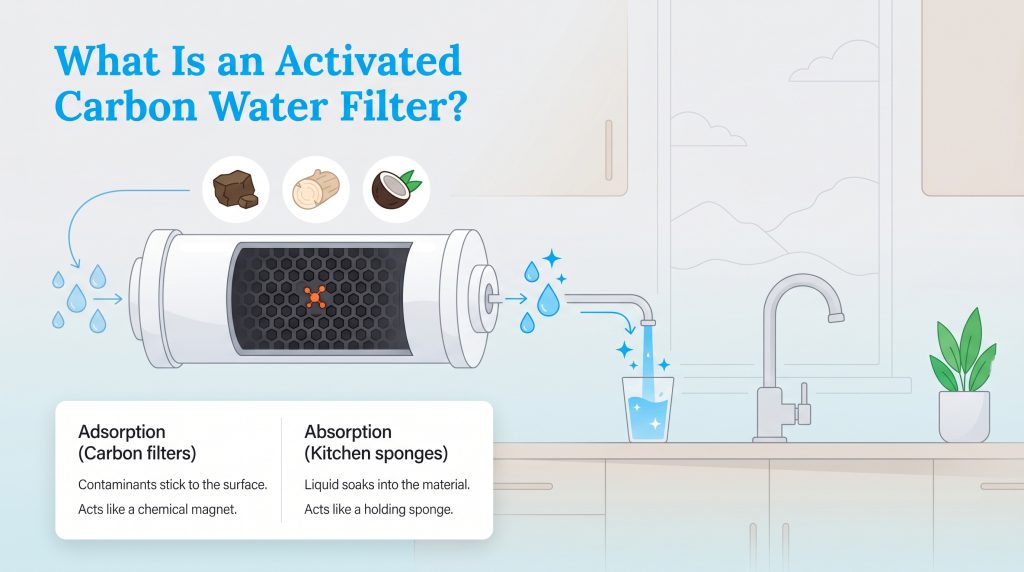
An activated carbon water filter is a highly specialized water treatment device designed to capture organic chemicals and disinfectants before they reach your glass. Manufacturers cannot simply grind up standard barbecue briquettes and expect them to clean your home’s municipal water supply. The filter media must be derived from specific, carbon-rich source materials — most commonly coconut shells, wood, or bituminous coal. These raw materials are put through an extreme thermal or chemical treatment process to become “activated.” This intense activation blasts open the physical structure of the carbon, creating an incredibly dense, highly porous network filled with millions of microscopic nooks and crannies.
The specific source material directly dictates the filter’s ideal use case within residential plumbing. Coconut shell carbon is a renewable, environmentally mindful choice that features an incredibly tight porous structure, making it the gold standard for point-of-use drinking water systems. Bituminous coal-based carbon offers slightly larger pore sizes, creating a highly durable media that handles massive water volumes for large-scale whole-house setups. Finally, wood-based carbon features exceptionally large macropores, which is excellent for specialty decolorizing or treating specific private well water issues.
The physical result of this activation process is a material with a staggering amount of surface area. In fact, just one single gram of activated carbon possesses a surface area of over 32,000 square feet. This massive internal maze provides more than enough room to capture and hold chemical contaminants as water flows through your pipes.
The Science: Adsorption vs. Absorption
To understand the activated carbon mechanism, you must recognize the distinct scientific difference regarding adsorption vs absorption in water filters. Absorption is a physical or chemical process where a fluid completely permeates or dissolves into a solid. The liquid is drawn completely inside the structural fibers and held internally.
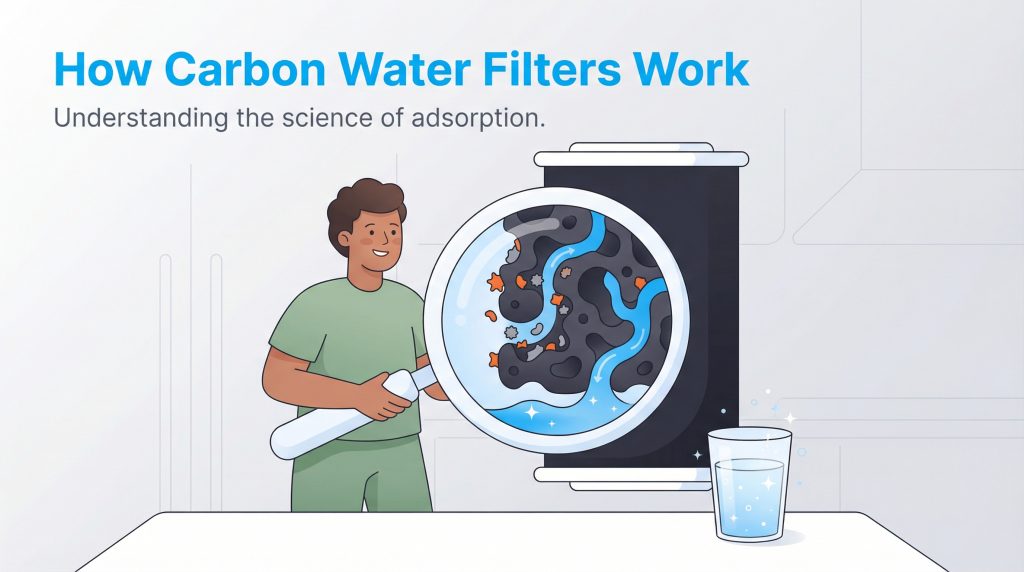
Conversely, adsorption is a strictly surface-level chemical process where atoms, ions, or molecules from a liquid or gas strongly adhere to the outside surface of a solid media. It acts exactly like iron shavings snapping onto a powerful magnet. Carbon water filters do not absorb impurities; they rely entirely on the adsorption process to pull volatile elements out of your drinking water.
As tap water navigates the complex, twisting maze of microscopic pores within the carbon cartridge, chemical impurities are naturally drawn to the carbon’s massive surface area. Because of the strong chemical attraction, these volatile compounds stick tightly to the pore walls. Meanwhile, the clean, purified water molecules pass right through the maze and out of your faucet. This elegant natural mechanism improves your home water quality without introducing harsh chemical additives.
What Do Carbon Water Filters Remove?
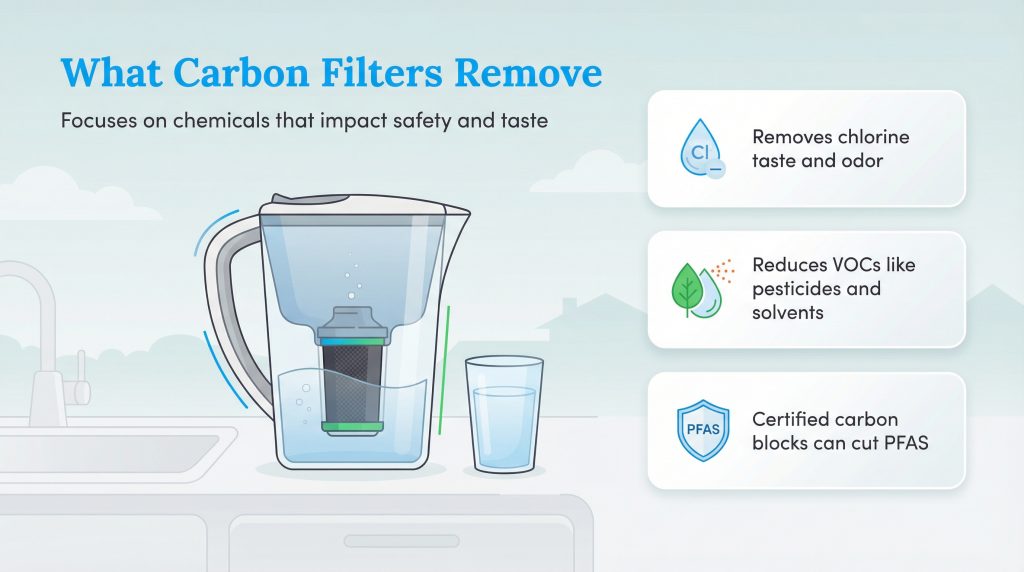
Carbon filters are the undisputed heavyweights of residential water treatment, but what do carbon water filters remove exactly? They target the specific organic chemicals that ruin the safety, smell, and taste of your tap water, leaving behind clean, refreshing hydration. When you install an appropriately sized system, you can expect massive improvements in water quality. Here is a definitive look at what stays permanently trapped inside those microscopic carbon pores:
- Chemicals (Chlorine and Chloramine): Municipal water plants rely heavily on chemical disinfectants, which leave a harsh swimming-pool taste and noticeable odor. Does activated carbon remove chlorine? Yes, carbon strips this out instantly on contact. Specialized catalytic carbon can also efficiently break down the chemical bonds of chloramine.
- Volatile Organic Compounds (VOCs): These dangerous gases and industrial solvents frequently leach into local groundwater reserves. A volatile organic compounds (VOCs) water filter that utilizes carbon adsorption is widely considered the most trusted method for VOC removal. Tightly woven carbon blocks that undergo strict independent testing can also reliably reduce PFAS, the “forever chemicals” increasingly found in municipal lines. To check local regulations and threats, review the latest guidance from the EPA on drinking water contaminants.
- Aesthetics (Taste and Odor): Carbon dramatically improves the aesthetic profile of your water. It easily captures synthetic organic chemicals (SOCs) and persistent man-made compounds — such as benzene, toluene, and agricultural pesticides — that cause muddy, metallic, or bitter flavors.
🌱 Eco Edge: Installing a carbon filter at home can replace thousands of single-use plastic bottles a year. Check if your specific filter cartridge brand offers a recycling take-back program to further reduce your household waste!
What Carbon Filters Cannot Remove
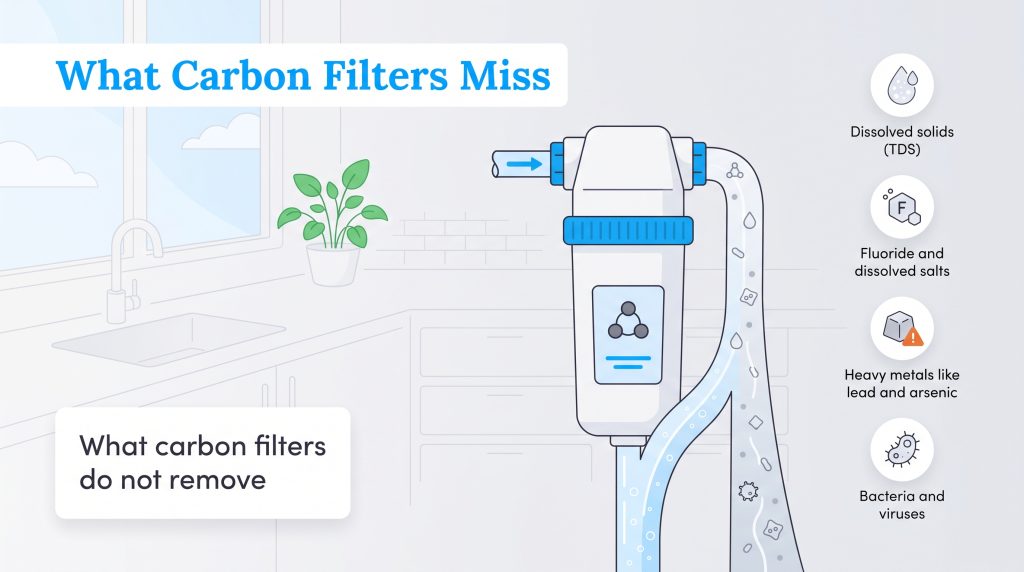
While carbon filters excel at chemical adsorption, they are not a universal cure-all for every plumbing woe. Understanding their exact limitations prevents you from expecting results they physically cannot deliver. A standard activated carbon filter will generally let the following pass through untreated:
- Dissolved solids (TDS): Carbon cannot grab dissolved calcium and magnesium. If you are dealing with aggressive chalky scale buildup on your faucets and showerheads, you need dedicated hard water solutions like a traditional ion-exchange water softener.
- Fluoride: Inorganic substances, dissolved salts, and municipal fluoride additions are virtually unaffected by standard carbon adsorption.
- Heavy metals (lead and arsenic): Do carbon filters remove heavy metals? Elements like lead, arsenic, and copper usually pass right through standard carbon. You need a specially formulated carbon block with specific heavy-metal reduction additives to catch these threats safely.
- Biological pathogens (bacteria and viruses): If your private well or water source is biologically unsafe, carbon will not protect you. It cannot trap or neutralize dangerous bacteria and viruses. You must pair it with a complementary physical or biological barrier system, such as a UV purifier.
Types of Carbon Filters: GAC vs. Carbon Block vs. Catalytic
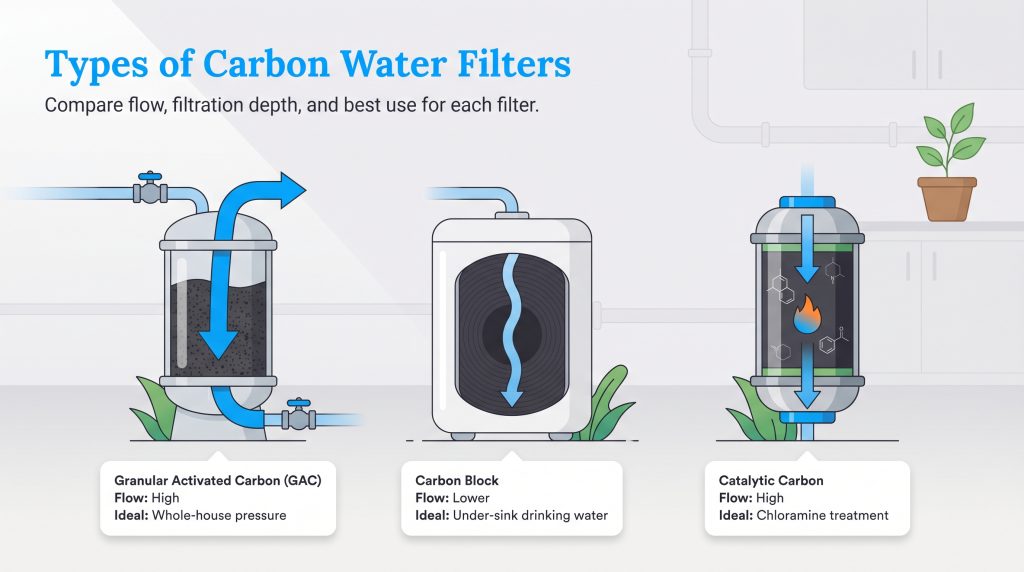
Not all carbon filters perform identically under pressure. The physical form of the activated carbon drastically alters how the filter behaves in your plumbing system. Let’s contrast the three primary configurations you will encounter when shopping for a home water filtration system.
| Granular Activated Carbon (GAC) | Carbon Block | Catalytic Carbon |
|---|---|---|
| Flow rate: High (Fast water flow) | Flow rate: Low (Slower water flow) | Flow rate: Moderate to high |
| Contaminant reduction capability: Moderate (Susceptible to channeling) | Contaminant reduction capability: Exceptional (Maximum contact time) | Contaminant reduction capability: Specialized for tough disinfectants |
| Best home use case: Whole-house systems needing high pressure | Best home use case: Under-sink drinking water purification | Best home use case: Municipal water treated with chloramines |
Granular Activated Carbon (GAC): A granular activated carbon filter contains loose carbon granules that allow water to flow freely with minimal physical resistance. This high flow rate makes it perfect for main water lines where you cannot sacrifice shower pressure, though the loose nature can sometimes cause channeling.
Carbon Block: A solid carbon block filtration system compresses that same activated carbon dust into a dense, solid core. This physical resistance guarantees maximum contact time and eliminates channeling entirely, offering vastly superior removal of microscopic chemicals.
Catalytic Carbon: Catalytic carbon systems undergo an advanced manufacturing process that alters the surface structure of the media, significantly enhancing its capacity to promote chemical reactions. The primary catalytic carbon filter benefits include the rapid breakdown of chloramines, a stubborn municipal disinfectant that easily slips through standard carbon filters.
The Role of Empty Bed Contact Time (EBCT)
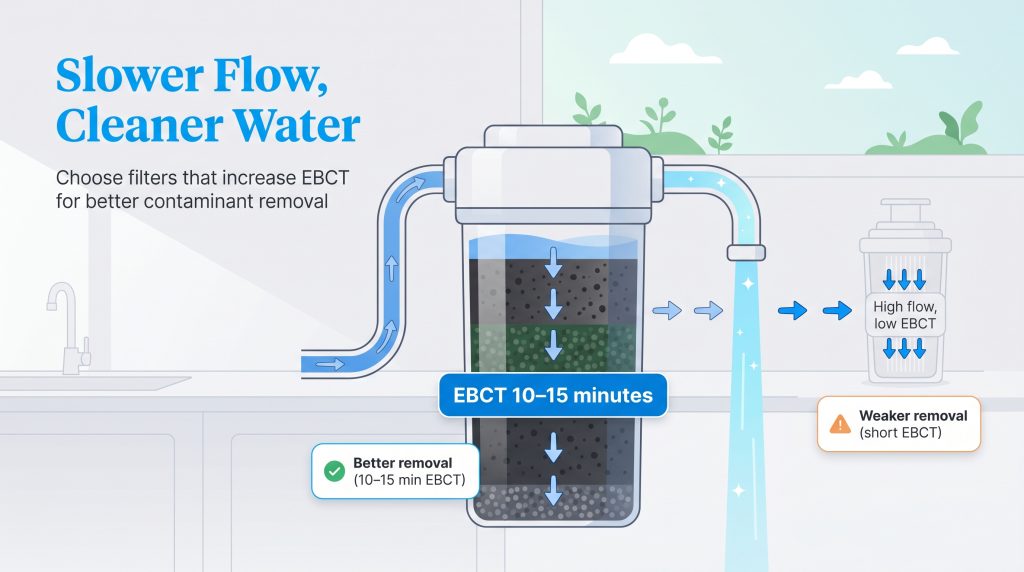
To truly master your home’s water quality, you have to look past the marketing jargon and focus on a vital engineering metric known as empty bed contact time (EBCT). Empty bed contact time refers to the exact amount of time your water physically sits inside the carbon media before exiting the filter. Adsorption is not an instantaneous magic trick; it requires adequate time for the chemical reactions to successfully lock the contaminants onto the carbon’s surface.
The amount of contact time between your water supply and the carbon directly dictates the overall filtration quality. For maximum contaminant reduction, water treatment engineers generally state that 10 to 15 minutes of EBCT is required, particularly when targeting difficult compounds like chloramines or severe VOCs. If you push 15 gallons of water per minute through a tiny carbon cartridge designed to handle only five gallons, the water rushes past the media entirely too fast. The EBCT drops drastically, allowing harsh chemicals to blow right past the carbon and out of your faucet.
📌 Quick Fact: Slower is almost always better when it comes to carbon filtration. If you want the cleanest possible drinking water, choose a filter that intentionally restricts the flow rate to maximize the empty bed contact time.
How Long Do Carbon Filters Last?
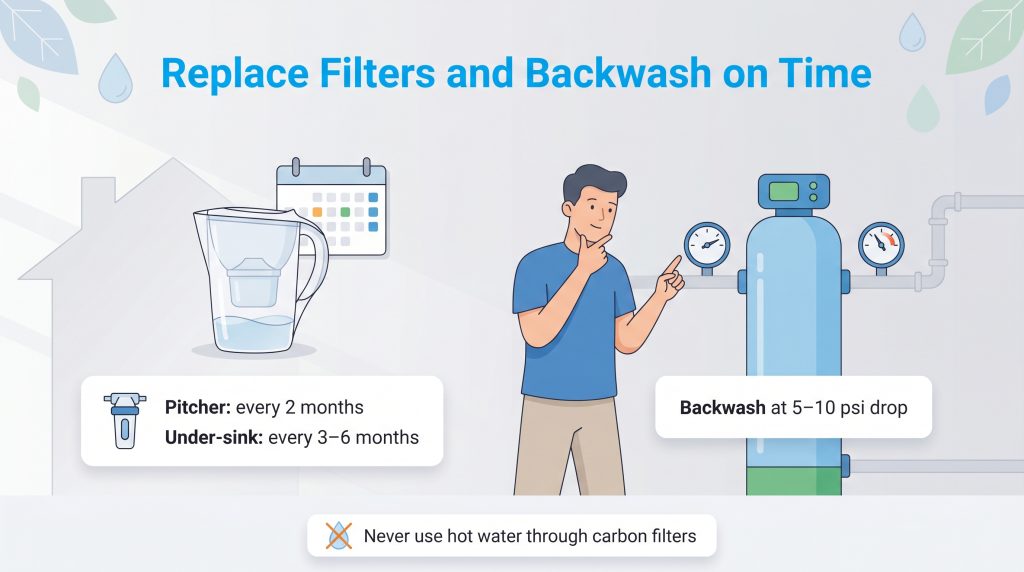
Carbon filters are reliable, but they do not last forever. Eventually, those millions of microscopic pores will hit their maximum capacity. Once all the adsorption sites are entirely occupied by trapped chemicals, the filter stops working and can quickly become a breeding ground for bacteria. So, exactly how long do carbon filters last? It depends heavily on the physical size of the system and your family’s daily water usage.
You should plan to replace standard pitcher filters roughly every two months. Larger under-sink cartridges generally need swapping out every three to six months to maintain peak water quality.
If you invest in a large whole-house tank system, the carbon media lasts significantly longer — often three to five years — but requires routine maintenance known as backwashing. Because a large tank collects significant sediment over time, the physical debris blocks the carbon media and lowers your home’s water pressure. You must perform a backwash when the pressure difference between the inlet and outlet drops by roughly 5–10 psi. Activating the backwash cycle physically reverses the flow of water, pushing it up from the bottom of the tank. This lifts the carbon bed, breaks up channeling, and washes trapped dirt safely down the drain.
💡 Pro Tip: Never run hot water through your carbon filter! Hot water can severely damage the filter housing and actually reverse the adsorption process, causing the carbon to release all those trapped chemicals right back into your drinking glass.
Selecting the Best Filtration Setup for Your Home
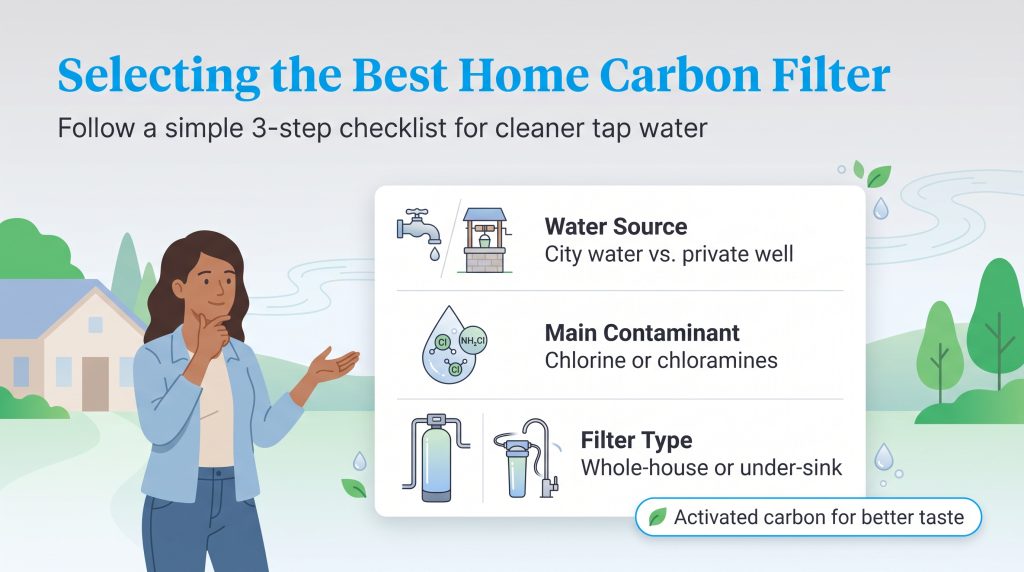
Finding the perfect activated carbon water filter depends entirely on what is lurking in your local plumbing and how much water your family uses daily. Use this actionable three-step checklist to pinpoint exactly what you need to install:
- Identify your home’s water source: Determine whether you rely on city municipal water or a private well. City water heavily requires carbon adsorption to remove disinfectants. Well water often demands comprehensive hybrid systems that handle heavy metals, sulfur, and bacteria before the water ever hits a carbon stage.
- Determine your primary municipal contaminant: Pull your local Consumer Confidence Report to see exactly what your water treatment plant uses to disinfect the lines. If they use standard chlorine, a GAC or carbon block works beautifully. If they use chloramines, you must purchase a catalytic carbon system.
- Match your household flow rate to the correct carbon filter type: Decide if you need point-of-use or whole-house protection. If you want to protect your skin from chlorine in every shower without losing water pressure, choose a high-flow whole-house GAC unit. If you prioritize pure drinking water at a single kitchen sink, install a dense under-sink solid carbon block.
Activated carbon filtration is one of the most cost-effective and dependable choices you can make to elevate your home’s daily water quality. While it isn’t a silver bullet for every single inorganic contaminant like heavy metals or hard water scale, it absolutely dominates at stripping out the harsh chemicals and organic compounds that make tap water taste awful. By understanding the science of adsorption, prioritizing a solid empty bed contact time, and choosing the exact filter type for your family’s needs, you can guarantee clean, refreshing water straight from the faucet while greatly reducing your environmental footprint.
Frequently Asked Questions About Carbon Water Filters
What do carbon filters remove from tap water?
Do carbon water filters remove heavy metals like lead?
What is the difference between carbon block and granular activated carbon (GAC)?
Does a carbon filter reduce water pressure in my home?
Do carbon filters remove bacteria from water?
How long do carbon filters last before needing replacement?
What is the difference between activated carbon and charcoal?
Can you clean and reuse a carbon filter?
Does activated carbon remove fluoride from tap water?
Why do I see black specks in my water?
What is empty bed contact time (EBCT) in carbon filtration?
Does a carbon water filter reduce hard water scale?
Will a carbon filter remove sulfur or “rotten egg” smells from my tap water?
About the Author

David has been an integral part of some of the biggest utility sites on the internet, including InMyArea.com, HighSpeedInternet.com, BroadbandNow.com, and U.S. News. He brings over 15 years of experience writing about, compiling and analyzing utility data.

Claudio is a sustainability-focused writer with a background in Anthropology and Psychology from NC State University. He has spent over 15 years working in writing, interpretation, and translation, driven by a deep interest in how human culture shapes the environment. Today, he shares his curiosity with readers by writing about sustainable living solutions and the connection between everyday choices and environmental impact.