

Everything You Need to Know About Scheduling, Transferring, and Budgeting for Utilities Before Move-In Day
Key Takeaways
- Check your lease first to see which utilities are included in your rent and which are your sole responsibility.
- Schedule service activation at least two weeks before your move-in date to avoid power outages or rush connection fees.
- Ask providers about connection fees and deposits upfront so you can accurately budget for immediate out-of-pocket costs.
Moving is undeniably stressful, and arriving at a dark, cold apartment because you forgot to activate the electricity will instantly ruin your move-in day. Between packing endless boxes, organizing logistics, and coordinating a rental truck, it is far too easy to overlook the invisible services that actually make a house livable. That is exactly why we created this comprehensive Renters Utility Setup Guide to serve as your ultimate resource. We will help you navigate the process of how to set up utilities for an apartment, handle required deposits, securely share bills with roommates, and seamlessly transfer your services, so you can focus entirely on unpacking your belongings instead of waiting on hold with the cable company.
What Utilities Do Renters Need to Set Up?
If you are tackling a first-time renter utility setup, the sheer number of companies you need to contact can feel overwhelming. Knowing exactly what utilities do I need for an apartment is the crucial first step in building your moving budget. While your specific needs will vary slightly depending on your property and location, nearly every standard residential rental unit requires the following core services to function properly.
- Electricity: This is the non-negotiable lifeline of your apartment. Electricity powers your lighting, your refrigerator, your wall outlets, and in many modern units, your central heating and cooling systems.
- Natural Gas: Not every apartment utilizes natural gas, but older buildings or homes with specific amenities often rely on it to power water heaters, cooking stoves, and winter heating furnaces.
- Water & Sewer: These twin services manage the fresh water flowing into your sinks and showers, as well as the wastewater draining out of your unit safely into the municipal system.
- Trash & Recycling: Waste management ensures your household garbage is collected weekly. Depending on your building, this might be a municipal service you coordinate, or a private valet trash company managed directly by the property.
- Internet/Cable: While technically considered a luxury by utility standards, high-speed broadband internet is an absolute necessity for remote work, streaming entertainment, and daily communication.
Step 1: Establish Landlord vs Tenant Utility Responsibility
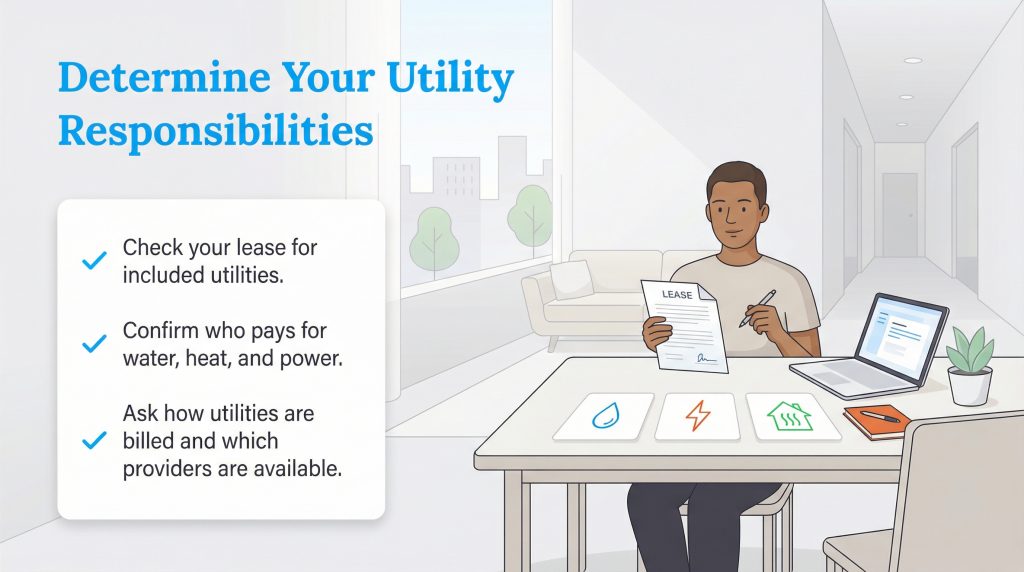
Before you pick up the phone to contact any providers, you need to know exactly what you are legally required to pay. Utility arrangements vary wildly depending on the type of property you are moving into, and making assumptions can lead to unexpected expenses. Establishing clear landlord vs tenant utility responsibility guarantees you don’t face sudden shut-offs or duplicate billing.
Check your lease agreement carefully for common utility clauses before your move-in date. When reviewing your contract, look closely for these specific stipulations:
- Default Clauses: Dictates what happens if you fail to transfer the electricity or water into your name by the lease start date, which often results in landlords charging heavy daily administrative fees.
- Provider Restrictions: Explains whether you have the freedom to choose your own high-speed internet or if you are locked into a designated building provider through an exclusive complex contract.
- Trash and Recycling Mandates: Outlines whether you need to set up municipal waste collection yourself or if the property management mandates a monthly valet trash service fee.
- Utility Addendums: A separate multi-page document strictly outlining how water, sewer, and gas are metered and billed to you throughout your tenancy.
Understanding the All-Bills-Paid Apartment
One of the most common scenarios renters encounter is the all-bills-paid apartment meaning the landlord actively covers the cost of all essential utilities. In this setup, services like electricity, water, sewer, and natural gas are rolled directly into your single monthly rent check. While an all-inclusive lease sounds incredibly convenient, it is essential to weigh the long-term advantages against the drawbacks.
- Pro: Ultimate budget predictability. You write one single check each month, protecting your wallet from wild seasonal price spikes during peak summer or freezing winter months.
- Pro: No utility deposits or connection fees. Because the accounts remain securely in the landlord’s name, you bypass the credit checks and upfront security deposits normally required by local utility companies.
- Con: Higher overall base rent. Landlords take on massive financial risk by paying for your unlimited usage, so they inherently bake a substantial premium into the base rent to cover potential excess consumption.
- Con: Lack of climate control. In many all-bills-paid older properties, the building operates on a central boiler system. This means the property manager decides when the heat turns on in the fall and when the air conditioning becomes available in the spring.
Navigating Submetered Utilities
If you are not moving into an all-inclusive unit, you will likely encounter standard direct billing or submetering. Navigating renting submetering utilities can seem slightly confusing for a first-time renter, but the financial concept is straightforward once you break it down.
Submetering occurs when a landlord installs individual property meters for water, gas, or electricity behind the main municipal master meter. Instead of paying the city provider directly, a third-party billing company reads your specific apartment’s submeter and sends you an invoice strictly for your exact usage. This system highly rewards eco-conscious habits, as you only pay for the energy or water you actively consume during the month.
Conversely, many older properties utilize a Ratio Utility Billing System (RUBS). Under RUBS, the landlord takes the entire building’s master water bill and divides it among the tenants using a mathematical formula based on unit square footage or occupancy. While RUBS provides a way to split shared costs, it entirely lacks the precision of true submetering — meaning your bill might unfairly go up if your neighbor takes excessively long showers.
🚩 Heads Up: Watch for Admin Fees. When dealing with submetering or RUBS, the third-party company processing the bills almost always charges a monthly “administrative” or “service” fee. Check your lease to see if these fees are capped, as they can quickly add an extra $5 to $15 to your monthly expenses.
Step 2: The Connect Utilities Moving Checklist and Setup Timeline
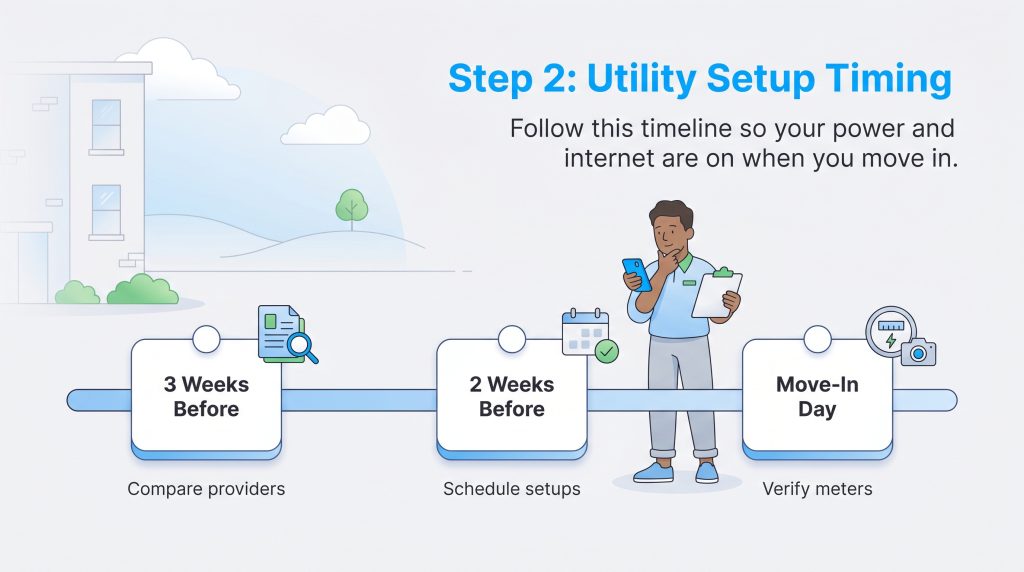
Timing is absolutely critical when connecting residential services for a new home. Leaving this essential task until the final 48 hours frequently results in massive rush-connection fees or spending your first weekend without internet access. Follow this highly scannable connect utilities moving checklist and setup timeline to stay organized and entirely stress-free.
3 Weeks Before: Compare Providers
- Identify infrastructure owners: Determine which local municipal utility owns the physical water and gas lines, as you rarely have a choice in providers for these specific municipal services.
- Shop for energy suppliers: If you are moving to a deregulated state, aggressively compare retail energy providers to find competitive long-term rates or eco-friendly power plans.
- Evaluate internet options: Check which broadband companies actually service your specific building. Compare fiber-optic speeds versus traditional cable packages, and explore available high-speed internet options to see which setup best fits your streaming needs.
2 Weeks Before: Schedule Apartment Utility Setup
- Lock in a start date: Call your chosen providers or use their online portals to formally establish your service start date. Request activation for the day before you actually move in to create a helpful timing buffer.
- Plan your disconnects: When scheduling the disconnect at your old apartment, purposefully instruct the provider to leave your old utilities running for 48 hours after you officially vacate so you have ample lighting for deep cleaning.
- Review local rates: Check out our electricity guide if you need extra assistance understanding how local rate structures will immediately impact your first billing cycle.
Move-In Day: Verify Meters
- Locate the hardware: As soon as you enter the unit, actively search for your electric, natural gas, and water meters if they are safely accessible to tenants.
- Document the numbers: Take clear, date-stamped photos of the current meter readings with your smartphone, ensuring the digital readout is perfectly legible in the frame.
- Save for your records: Store these photos securely, as they serve as objective proof of exactly where your personal energy consumption began in case of future billing disputes.
Step 3: How to Transfer Utilities to a New Apartment
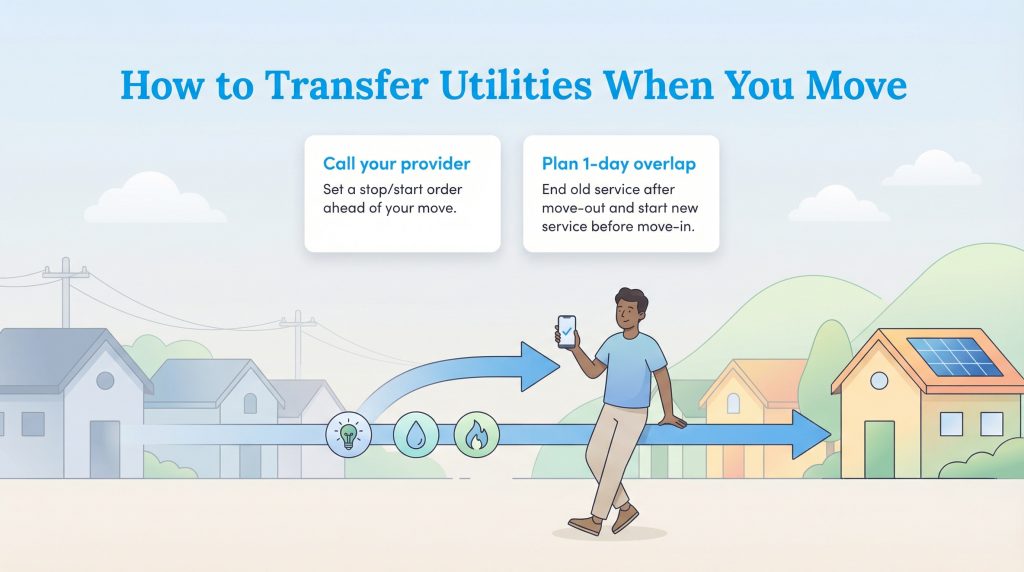
If you are moving locally and sticking with your current providers, you might be able to seamlessly carry your accounts over to the new address. However, successfully executing a plan to transfer utilities to a new apartment is never an automatic process. You still need to actively contact each company well in advance to initiate the transition. Learn more about the nuances of this process by exploring our resources on transferring utilities to a new rental and our general moving resources.
When transferring utilities to a new apartment, your primary goal is to arrange a seamless one-day service overlap. This means scheduling your new service to start the day before you move in, and keeping your old service active until the day after you leave. To execute this, contact each provider and specifically request a “Stop/Start” service order. This strategic move ensures you have continuous power while you clean your old place and unpack at the new one, completely preventing any inconvenient outages during the moving chaos.
Essential Documents Needed for First-Time Renter Utility Setup

If you have never registered an account in your own name before, tackling a first-time renter utility setup requires some upfront preparation. Before you dial the customer service line or attempt to log into a provider portal, you must gather your official paperwork. Having these details directly in front of you prevents frustrating delays, long hold times, and application rejections.
Utility companies are incredibly strict about identity verification to prevent account fraud. Build an apartment utility checklist containing these essential items before you begin:
- Government-Issued ID: You need a valid driver’s license, state ID card, or passport number. Providers require this for strict identity verification to prevent fraudulent account takeovers.
- Social Security Number (SSN): Almost all utility companies use your SSN to run a soft credit check before activating services at a brand-new address.
- Exact Lease Start Date: You need this specific date to definitively dictate the exact day your billing liability begins at the new property. Do not guess on this date.
- Proof of Residency: Keep a digital copy of your fully signed lease agreement handy. If your credit history is thin, a provider may request this document to prove you legally have the right to connect services at that address.
- Previous Address: This is absolutely necessary to formally close out any old accounts and ensure your final prorated bill is forwarded to the correct, updated location.
Preparing for an Apartment Utility Deposit and Credit Check

When budgeting for a move, keep a sharp eye out for financial requirements that go well beyond your monthly usage. Utility companies operate on a post-paid model — meaning you consume the electricity or water for an entire month before actually paying for it. Because of this inherent financial risk, providers frequently require an upfront security deposit to open a new account securely.
Your specific utility deposit for an apartment is heavily dependent on your personal credit history. When you apply for service, the provider will run a soft credit check. Unlike a hard inquiry from a mortgage or credit card application, this soft pull will not negatively impact your credit score. It simply gives the utility company a reliable snapshot of your general payment habits. If you have an excellent credit score, this deposit is usually waived entirely.
If you are a first-time renter with no credit history, an international transplant, or someone whose score is currently recovering, you might be asked to pay a mandatory deposit ranging from $100 to $300 per service.
💸 Money-Saver: You can often bypass this hefty fee by providing a Letter of Good Standing from a previous utility provider. As long as this official letter proves you made 12 consecutive, on-time payments at your last residence, most new providers will gladly waive the deposit requirement, keeping that cash securely in your pocket.
Managing Utilities with Roommates
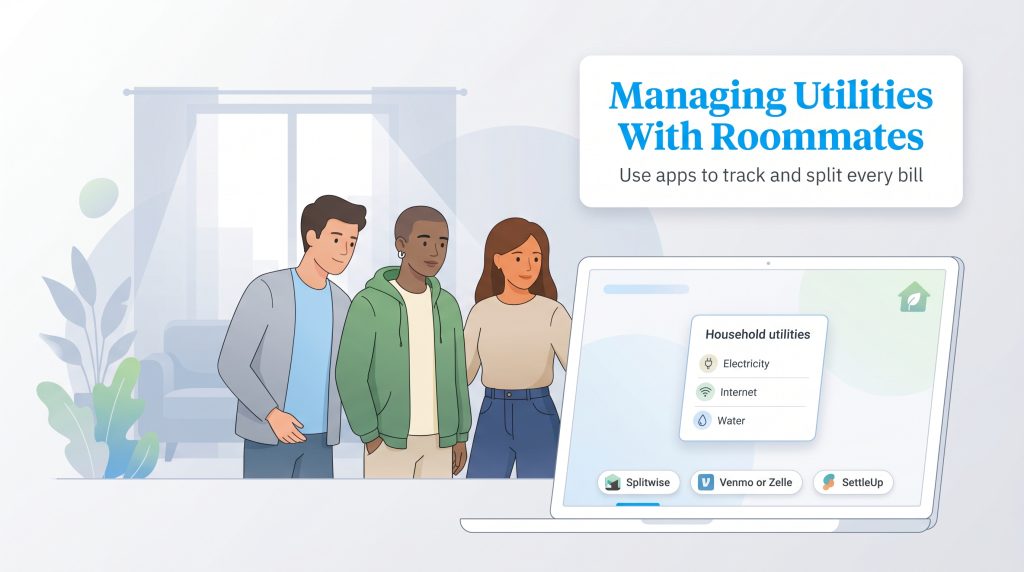
Moving into a shared apartment introduces an entirely new layer of complexity: deciding who actually takes legal responsibility for the essential services. Managing utilities with roommates requires clear, upfront communication and a solid financial plan established long before the first bill ever arrives in the mailbox.
Generally, utility companies only allow one primary name to reside on a residential account. The person who registers their name and Social Security Number formally becomes the “Primary Account Holder.” This specific individual is legally responsible for ensuring the bill is paid in full and on time every single month, regardless of whether their roommates have actually contributed their share. A late payment will directly and negatively impact the primary holder’s credit score. To mitigate this intense financial risk, some roommates choose a smart strategy: dividing the accounts. One person puts the electricity in their name, while another takes on the internet and water. This approach spreads the credit liability evenly across the entire household.
Once the accounts are actively established, you need a frictionless way to track expenses and collect funds. Relying on casual verbal agreements is a fast track to resentment. Instead, utilize digital tools to keep everyone highly accountable. Consider using these recommended bill-splitting applications to manage your shared household costs smoothly and fairly:
- Splitwise: This popular app is perfect for ongoing household expenses. It allows you to enter the utility bills exactly as they arrive, and the app mathematically balances who owes what over time, effectively minimizing the number of actual transactions needed.
- Venmo or Zelle: Ideal for immediate, direct cash transfers. The primary account holder can request the exact owed amount from each roommate the exact moment the utility statement hits their email inbox.
- SettleUp: A highly capable alternative that handles complex financial splits beautifully, especially if one roommate has a significantly larger bedroom and agrees to pay a slightly higher percentage of the heating or cooling costs.
Using Third-Party Utility Connection Services
If the thought of researching providers, comparing rates, and waiting on hold for hours makes you want to cancel your move altogether, you are certainly not alone. In recent years, an entire specialized industry has sprung up to alleviate this exact headache for busy renters. Using a third-party utility connection service — often referred to casually as a utility concierge — is a fantastic way to save valuable time and significantly streamline your transition into a new property.
A utility concierge service acts directly as a helpful middleman between you and the local service providers. Instead of calling the electric company, the water district, and the internet provider separately, you simply input your new address and move-in date into the concierge’s secure platform. The service then identifies the available providers in your area, presents you with bundled options, and handles the actual account setup on your behalf. Many of these concierge services are completely free for the renter to utilize, as they generate their revenue through affiliate commissions paid directly by the utility companies themselves.
While utilizing a concierge undeniably saves hours of tedious administrative work, there are a few distinct drawbacks to keep firmly in mind. First, you are inherently sharing your personal, highly sensitive data — including your Social Security Number and direct contact details — with an additional third party. Second, these services occasionally prioritize providers that offer them the absolute highest commission, meaning you might accidentally miss out on a hyper-local internet provider or a smaller, eco-friendly energy supplier that doesn’t partner with the concierge network. Always do a quick cross-check of their recommendations to ensure you are truly securing the best available rate for your new apartment.
Average Apartment Utility Costs: What to Expect
Budgeting for a new place inherently involves much more than just calculating the base rent. Understanding your average apartment utility costs depends heavily on the square footage of your unit, the severity of the local climate, and the overall energy efficiency of the building’s infrastructure. However, having a baseline estimate significantly helps you plan ahead and avoid nasty financial surprises.
According to extensive research from the U.S. Energy Information Administration (EIA), power-hungry factors like robust air conditioning systems and electric water heating will heavily impact your monthly totals. Use this breakdown to gauge your estimated expenses:
| Utility Type | Estimated Monthly Cost |
|---|---|
| Electricity | $50 to $100 (1 bed) / $100 to $150+ (2 beds) |
| Natural Gas | $20 to $50 |
| Internet | $50 to $90 |
| Water & Sewer | $20 to $50 |
| Trash & Recycling | $10 to $30 |
| Administrative/RUBS Fees | $3 to $15 |
Keep an eye out for sneaky equipment rental fees regarding your broadband connection, which can add another $15 to your monthly statement if you don’t purchase your own router. Check out our water utility guide for practical, actionable daily conservation habits that directly shrink your bill.
💡 Pro Tip: Ask for History. In some competitive real estate markets, you can formally request the previous tenant’s average utility costs directly from the landlord or the local utility provider. Even if it is not a strict legal requirement in your state, asking the property manager or casually chatting with a current neighbor is a brilliantly smart move to avoid sudden bill shock.
In addition to understanding your baseline historical costs, you can actively reduce your daily consumption by upgrading the technology inside your apartment.
🌱 Eco Edge: Use a Smart Thermostat. You can dramatically lower these average electric costs by installing a smart thermostat. These clever devices learn your daily schedule and automatically adjust the temperature when you are away at work, trimming unnecessary energy waste and saving you roughly 10% to 15% annually.
Understanding Options in Deregulated Energy Markets

If you are moving to a deregulated energy state like Texas, Pennsylvania, Ohio, or Illinois, you might encounter what the power industry refers to as “Energy Choice.” This unique regulatory setup fundamentally changes exactly how you buy power. It means that while a local, state-mandated utility company physically delivers the electricity through the neighborhood powerlines and responds to regional outages, you actually have the distinct legal right to choose the private retail company that supplies the electricity to your apartment.
This open, free-market competition frequently leads to significantly lower supply rates, much better customer service, or unique perks designed specifically to attract new residential customers. You should absolutely use this opportunity to shop around. You are never permanently stuck with the standard, often highly variable utility rate unless you actively choose to do nothing. By carefully shopping the market, you can confidently lock in a highly predictable fixed-rate contract for 12, 24, or even 36 months. A fixed rate brilliantly protects your household budget from the wild seasonal price spikes that frequently happen during intense summer heat waves or sudden winter freezes.
🌱 Eco Edge: Choose Green Power. In deregulated areas, many innovative suppliers offer 100% renewable energy plans sourced entirely from regional wind or solar farms. Choosing an environmentally mindful choice is one of the easiest, most impactful ways to lower your carbon footprint without altering your daily lifestyle.
Preparing for a Seamless Move-In Day
Setting up your essential services is an unavoidable rite of passage for absolutely every renter, whether you are leasing a tiny downtown studio or a sprawling suburban home. While it undeniably involves a few initial phone calls, organizing paperwork, and deciphering confusing lease agreements, tackling these chores early guarantees an incredibly smooth transition. By closely following a structured timeline, utilizing digital apps to manage your roommates, and understanding your local market options, you effectively eliminate the stressful guesswork from the moving process.
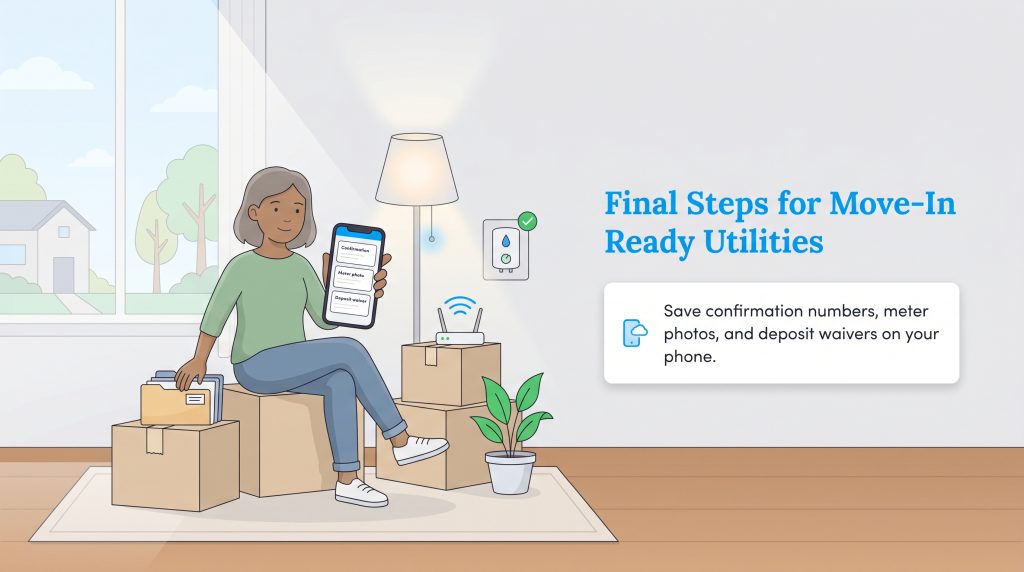
To finalize your move, take charge the moment you arrive. Locate the breaker box to ensure all internal switches are correctly flipped on, take those essential date-stamped photos of the utility meters, and verify your internet connection before the movers leave. Keep digital copies of your setup confirmation numbers and your deposit waivers stored securely on your phone. Once the lights hum to life and the hot water flows on that very first night, you can finally relax and make your new apartment truly feel like home.
Frequently Asked Questions About Setting Up Utilities for a Rental Home
Do I need to set up utilities before I sign the lease?
How do I find out who the local utility providers are for my apartment?
What is the difference between setting up new utilities and transferring them?
How long does it take to set up utilities?
Who is responsible for setting up utilities for a rental home?
How do I know if I have an all-bills-paid apartment?
Can I set up internet before moving in?
What is the average apartment utility cost?
Can I choose my own internet provider in an apartment?
Do I need a credit check to set up utilities?
What happens if I forget to set up electricity before moving in?
Is water usually included in the rent?
Can landlords charge extra administrative fees for submetered utilities?
Can I change electricity providers in the middle of a lease?
About the Author

LaLeesha has a Masters degree in English and enjoys writing whenever she has the chance. She is passionate about gardening, reducing her carbon footprint, and protecting the environment. She also recently served as President of the Board for City Sprouts (a community garden).

David has been an integral part of some of the biggest utility sites on the internet, including InMyArea.com, HighSpeedInternet.com, BroadbandNow.com, and U.S. News. He brings over 15 years of experience writing about, compiling and analyzing utility data.