

Mastering Your Home’s Water Meter Is The First Step Toward Lower Utility Bills And A More Sustainable Household
Key Takeaways
- Locating your meter safely is the crucial first step, as many are housed in ground-level boxes that can be heavy or difficult to open.
- Reading the display varies by device, requiring different methods for analog dials versus modern digital screens.
- Checking for leaks using the flow indicator is a simple skill that can prevent water damage and wasted money.
Reading a water meter is the quickest way to catch expensive hidden leaks, dispute an unusually high utility bill, and take control of your household’s daily consumption. Instead of crossing your fingers every month, learning how to decode your water meter gives you the exact data needed to lower your costs and monitor your environmental footprint. We have put together this step-by-step water meter reading guide to help you locate, read, calculate, and troubleshoot your device so you can manage your water utilities with absolute confidence.
Where Is My Water Meter Located?
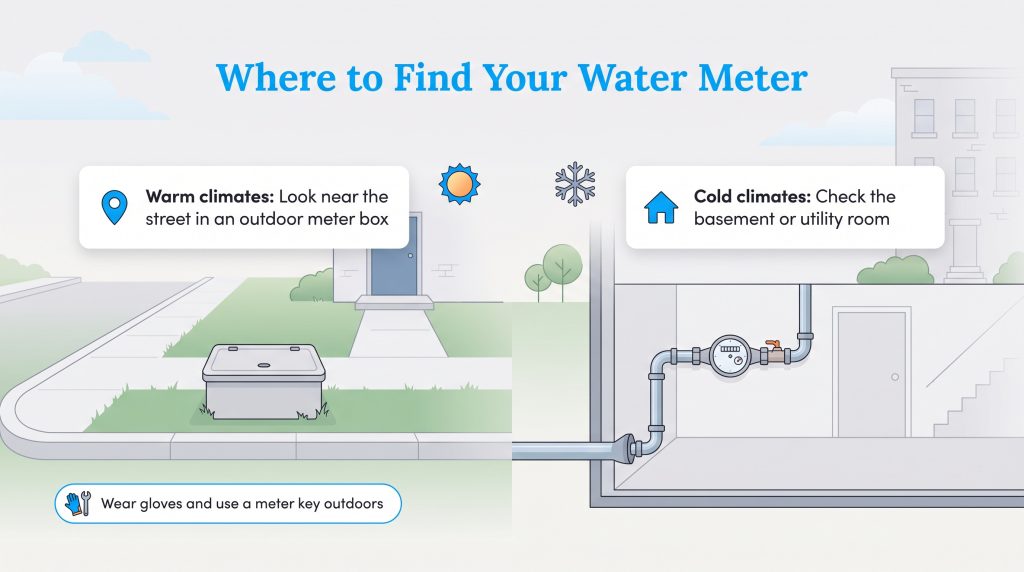
Before you can dive into the numbers, you need to find the physical device. If you find yourself asking where is my water meter located, the answer depends heavily on your regional climate, the type of property you live in, and your landscaping setup. Let’s break down the most common installation locations.
Single-Family Homes (Warm Vs. Cold Climates)
For standalone houses, the climate dictates where the utility provider installs your equipment. In warmer, southern climates where the ground never freezes, meters are housed outside in concrete or durable plastic boxes near the street curb or property line. In colder northern regions prone to freezing temperatures, meters are safely tucked indoors to prevent burst pipes. You will usually find these indoor units in a basement, crawlspace, or utility room right where the main water line enters your home’s foundation.
Accessing an outdoor meter requires strict safety precautions. The lids on these ground-level pits are surprisingly heavy, tightly secured, and occasionally home to pests. We explicitly mandate the use of a specialized water meter key to open the vault. This affordable, T-shaped metal tool securely grips the lid’s keyhole, allowing you to lift the cover without pinching your fingers or straining your back. Never use your bare hands or flimsy, improvised tools that could slip and cause serious injury.
Multi-Family Dwellings And Apartments
If you rent a condo or apartment, your setup looks a bit different. Depending on your building’s plumbing architecture, you might share a master meter with the entire building, or you may have a sub-meter tracking your exact unit. Condo and apartment renters should check communal hallway meter closets, basements, or shared mechanical rooms to locate their equipment. Your specific sub-meter will usually feature a permanent metal tag or a bold sticker identifying your apartment number.
Separate Irrigation Meters
Homes with complex landscaping, built-in sprinkler systems, or large swimming pools often feature a secondary unit known as an irrigation meter. This device sits adjacent to your primary residential meter but only measures the water sent to your yard. It is crucial to identify and read this irrigation meter separately from the main house meter to avoid calculating unnecessary wastewater treatment charges. Because sprinkler water absorbs into the earth rather than washing down a drain, utility companies do not apply standard sewer and wastewater fees to this secondary device.
Analog Vs. Digital Water Meters: What’s The Difference?
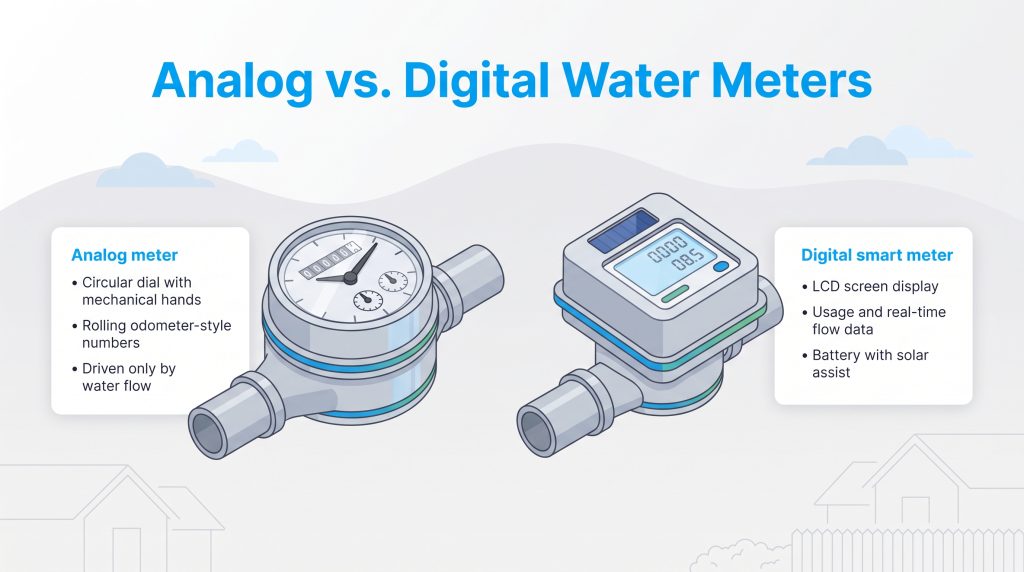
Once you have eyes on the device, take a moment to identify your specific equipment. While all meters accurately track the liquid flowing into your home, they display that information quite differently. Understanding whether you have an analog vs digital water meter improves your troubleshooting experience, allowing you to skip straight to the relevant reading instructions.
| Analog Water Meters | Digital Smart Meters |
|---|---|
| Visual Display: Features a circular face resembling a classic car speedometer or a clock with moving mechanical hands. | Visual Display: Features a modern LCD screen similar to a smart thermostat or a digital watch. |
| Data Format: Displays cumulative usage via mechanical rolling numbers on an odometer. | Data Format: Alternates between showing total historical usage and current real-time flow rate. |
| Power Source: Mechanically driven by the physical flow of water pushing through internal gears. | Power Source: Powered by a long-lasting internal battery, often equipped with a built-in solar sensor. |
How To Read An Analog Water Meter
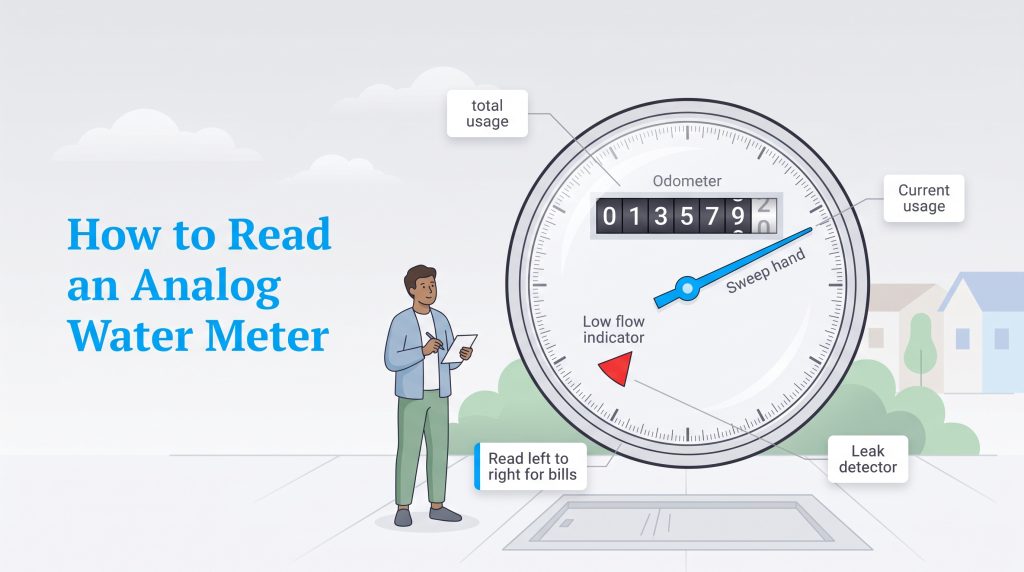
Because they rely entirely on internal gears and physical parts, knowing how to read water meter dials can feel intimidating at first glance. However, decoding the faceplate is a simple and straightforward process once you understand the three main components guiding your usage data.
The Odometer (Total Usage)
The odometer is the prominent row of mechanical numbers positioned directly in the center of the dial. It functions exactly like a mileage counter in a vehicle, representing your total historical water usage since the meter was originally installed. To accurately log your consumption, read the numbers from left to right. You can generally ignore any stationary painted zeros or black numbers printed on a red background at the far right, as municipal utility companies bill in larger bulk units.
The Sweep Hand (Current Usage)
The water meter sweep hand looks and acts much like a clock’s second hand. It measures exact, real-time consumption, with each full rotation typically representing one precise unit of water (either a single gallon or a cubic foot). Monitoring the sweep hand is incredibly helpful when determining exactly how much water a specific appliance — like your high-efficiency washing machine or dishwasher — uses during a single cycle.
The Low Flow Indicator (Leak Detector)
The low flow indicator is your best defense against unexpected plumbing emergencies and skyrocketing bills. This small mechanical dial typically takes the visual appearance of a tiny red triangle, a silver wheel, or a star shape. It is highly sensitive and spins rapidly when even the smallest volume of water moves through the internal pipes. If you notice the low flow indicator moving while all fixtures in the home are completely shut off, it explicitly indicates an active, hidden leak on your property.
How To Read A Digital (Smart) Water Meter
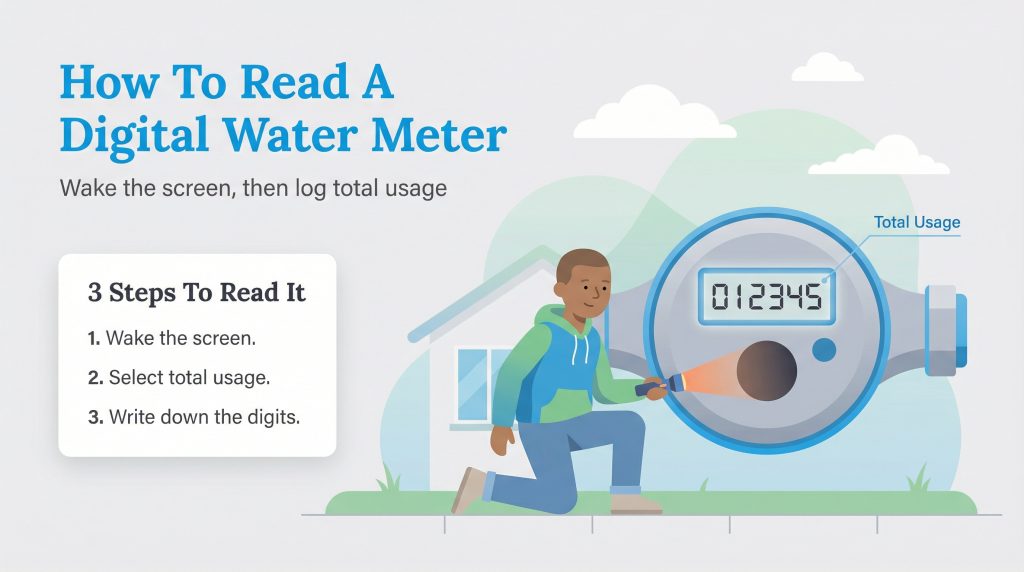
A smart water meter digital display is rapidly becoming the modern industry standard, and decoding its glowing numbers is incredibly easy once you successfully activate the screen. To conserve long-term battery life, the LCD display on a digital unit automatically goes into a protective sleep mode when not in active use. If the screen is completely blank when you pop open the vault lid, do not panic; the hardware is just resting.
Most modern digital meters feature an integrated light sensor and can be quickly woken up by shining a bright smartphone flashlight directly onto the glass faceplate. Once the smart screen powers up, the display will usually alternate between different diagnostic modes. You will typically see your “Total Usage” (the primary historical number your utility company uses for monthly billing) and a “Flow Rate” (the volume of water actively moving through your pipes in gallons per minute). Watch the screen for a few seconds to let it naturally cycle to the correct mode, then record the main line of digits for your records.
Understanding Water Meter Units: Gallons Vs. CCF
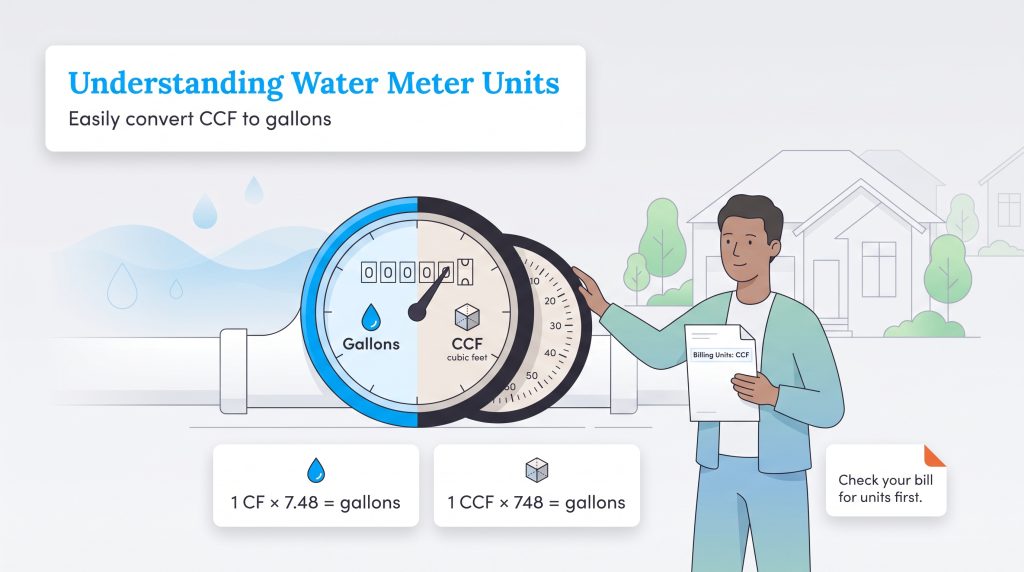
Water utility companies have varying standards when it comes to preferred billing units. Depending on your local municipal provider, your household will be billed either in thousands of gallons, cubic meters, or in Centum Cubic Feet (abbreviated as CCF). While measuring volume in gallons is universally understood by homeowners, reading a water meter in cubic feet can feel abstract because most consumers do not naturally visualize liquid volumes in spatial terms.
Thankfully, standardizing your personal data is a breeze. Use our fast-reference conversion table below to understand exactly how your meter’s base units translate into recognizable metrics.
| Starting Unit | Abbreviation | Conversion Multiplier |
|---|---|---|
| Cubic Foot | CF | Multiply by 7.48 to get Gallons |
| Centum Cubic Foot | CCF | Multiply by 748 to get Gallons |
| Kiloliter | KL | Equals 1 Cubic Meter (M3) |
| Megaliter | ML | Equals 1,000 Cubic Meters (M3) |
If your utility tracks usage in units of cubic feet, you can quickly translate that metric into gallons. Just plug your numbers into this exact mathematical equation:
Total CCF Used × 7.48 = Total Gallons Used
For example, if your meter shows you used 10 units of volume, simply remember that 1 Cubic Foot = 7.48 Gallons. By multiplying 10 by 7.48, you reveal that your family consumed exactly 74.8 gallons of water. This quick conversion empowers you to convert CCF to gallons so you can track your daily habits clearly.
How To Read A Water Meter For Leaks
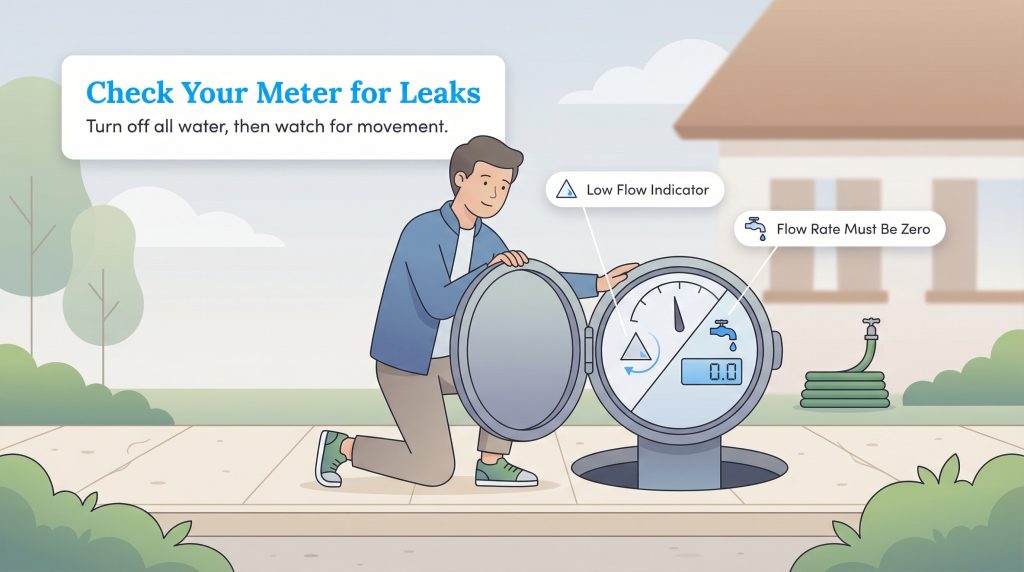
Perhaps the most valuable reason to open your utility box is to diagnose unexpected spikes in your monthly costs. A slow drip inside your drywall or a constantly running toilet can silently waste thousands of gallons a month. By taking the time to check water meter for leaks, you can catch these plumbing issues before they cause catastrophic property damage, especially when paired with the best water leak alarms for continuous monitoring.
To detect a water leak at the meter, perform this foolproof diagnostic test using our highly actionable four-step guide:
- Turn off all water sources: Ensure every single fixture inside and outside the home is completely shut off. This includes washing machines, dishwashers, and all indoor faucets. Crucially, you must shut off irrigation systems and outdoor spigots prior to the 30-to-60-minute waiting period to ensure an accurate test.
- Record the current data: Open your meter box and write down the exact numbers displayed on the odometer. If you have an older analog meter, pay special attention to the position of the sweep hand and the low flow indicator.
- Wait 30 to 60 minutes: Step away from the meter and strictly ensure absolutely no water is flushed, poured, or used anywhere on the property during this waiting period.
- Re-check the digits: Return to the meter box. If the odometer numbers have increased, or if the low flow indicator is actively spinning while everything in the house is off, you have a confirmed active leak that requires a professional plumber’s immediate attention.
Calculating Your Water Bill From The Meter Reading
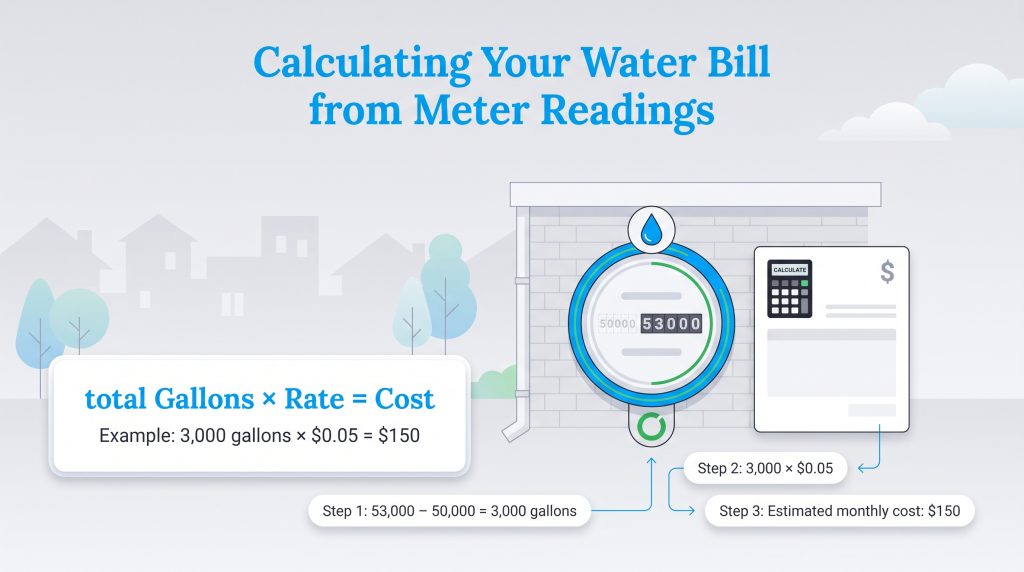
Estimating your upcoming utility costs doesn’t have to be a frustrating guessing game. Once you know how to decode your numbers and translate your volume units, understanding your water bill and accurately calculating your next statement before it even arrives in the mail becomes incredibly straightforward.
Here is a simple math example to show the exact process in action. Let’s assume your local utility provider charges a flat, standard rate of $0.05 per gallon of water used:
- Step 1: Find the difference. Subtract your previous month’s reading from your current reading. If last month’s odometer read 50,000 and today’s reading is 53,000, your household consumed exactly 3,000 gallons during this billing cycle.
- Step 2: Multiply by your rate. Take that 3,000-gallon difference and multiply it by your specific municipal utility rate ($0.05).
- Step 3: Calculate the total. In this fictional scenario, you can calculate water bill from meter reading data to find that your estimated base water usage cost for the month would be $150 (plus any standard municipal fees, sewer charges, or taxes).
Performing this simple calculation regularly is an excellent way to set a realistic household budget or measure the financial success of new plumbing upgrades designed to save on your water bill.
Troubleshooting A Defective Water Meter
Like any mechanical or digital device exposed to the harsh outdoor elements, your water meter can eventually fail. A broken meter usually results in wildly inaccurate billing — either charging you for water you never used or failing to log your consumption entirely. Being able to spot defective hardware early protects you from sudden billing disputes with your local provider.
Here are three obvious signs your water meter requires an immediate professional inspection:
- The mechanical odometer digits never change, despite obvious heavy water usage inside your home.
- The low flow indicator spins erratically or backwards even when the main municipal shut-off valve is closed.
- The smart digital LCD screen remains completely blank or displays a cryptic error code even after prolonged exposure to bright flashlight beams.
If you observe any of these symptoms, take swift action. Pick up the phone and call the customer service number listed on your most recent water bill. State clearly that you suspect a mechanical failure and request a municipal technician be dispatched to test the hardware immediately. Do not attempt to dismantle, fix, or tamper with the meter yourself, as this can result in hefty tampering fines and legal trouble with your city.
Taking Control Of Your Household Water Usage
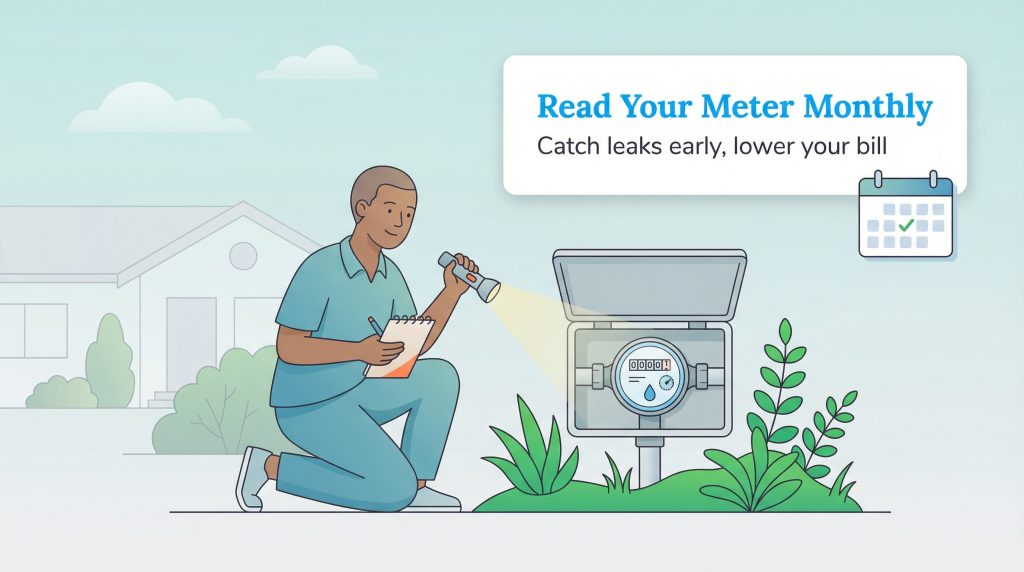
Consistently checking your water meter is a proactive maintenance routine that pays off in tangible monthly savings. By logging your data frequently, you establish a baseline for your family’s normal usage, allowing you to instantly spot abnormal spikes that could signal a costly plumbing emergency. We highly encourage you to add these three actionable tracking habits to your monthly maintenance schedule to keep your usage optimized:
- Log your numbers on the first of every month: Keeping a dedicated notepad near your front door makes it easy to track your monthly metrics and establish a seasonal consumption baseline.
- Perform a leak test after winter freezes: Conduct a 60-minute leak test immediately following the first hard freeze of the winter to catch cracked underground pipes before they thaw entirely.
- Cross-reference your bills: Always compare your manual meter readings against the usage graph on your digital utility portal to catch administrative billing errors before they compound.
Grabbing a bright flashlight and familiarizing yourself with this equipment is an empowering step that keeps your budget on track while supporting eco-conscious conservation efforts, such as installing rain barrels.
Frequently Asked Questions About Reading Water Meters
Do I read my water meter from left to right?
What does the red triangle on my water meter mean?
How do I convert CCF to gallons on my water bill?
Why is my digital water meter screen blank?
What should I do if my digital water meter screen won’t turn on?
Does a running toilet show up on a water meter?
Can a water meter give a false reading?
Where is the water meter usually located?
How do I know if my water meter is broken?
Do I read the red or black numbers on my water meter?
About the Author

LaLeesha has a Masters degree in English and enjoys writing whenever she has the chance. She is passionate about gardening, reducing her carbon footprint, and protecting the environment. She also recently served as President of the Board for City Sprouts (a community garden).

David has been an integral part of some of the biggest utility sites on the internet, including InMyArea.com, HighSpeedInternet.com, BroadbandNow.com, and U.S. News. He brings over 15 years of experience writing about, compiling and analyzing utility data.