

Learn the difference between CCF and therms to verify your usage and spot potential savings on your monthly statement
Key Takeaways
- Natural gas is measured by volume (how much space it takes up) but typically billed by energy content (how much heat it produces).
- Common billing units include CCF and therms, and understanding the conversion between them is key to reading your bill accurately.
- Reading your own gas meter allows you to track real-time usage and detect potential leaks or billing errors before they cost you money.
Setting up gas service in your new home involves plenty of paperwork, and opening your first utility bill often feels like reading a confusing alphabet soup of acronyms. However, understanding exactly how natural gas measurements work is the secret to decoding your monthly statement and keeping your household expenses in check. Your utility provider relies on specific natural gas billing units to track what you use and determine exactly how much to charge you each month. This comprehensive guide breaks down these common terms, explains why the physical space your gas occupies is billed differently from the heat it produces, and shows you how to verify your consumption so you never overpay for your home’s comfort.
How Is Natural Gas Measured? Volume Vs. Energy
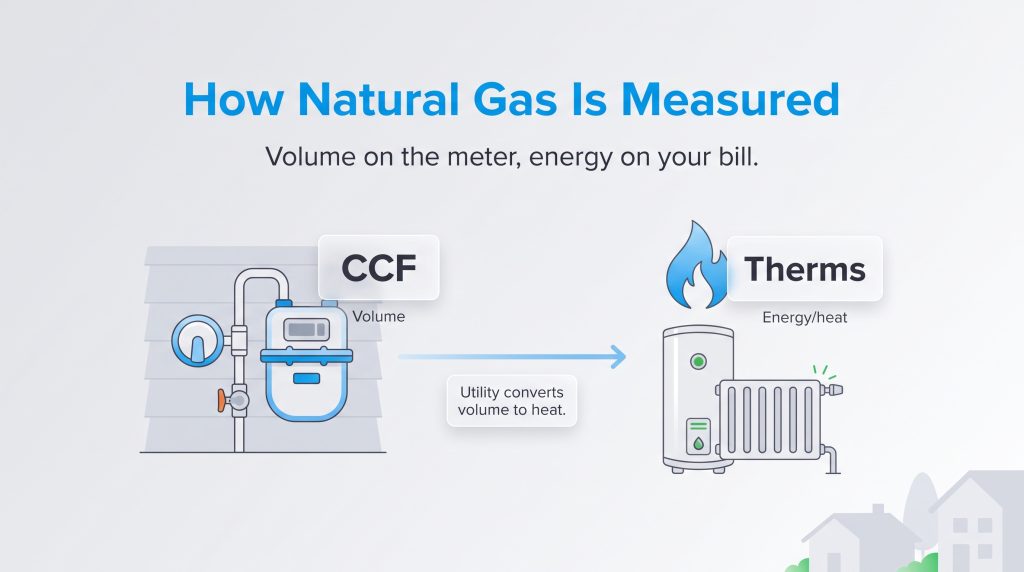
When figuring out how is natural gas measured, the most important concept to grasp is the distinction between measuring physical space and measuring heating power. Natural gas utilities actually use both types of measurements to generate an accurate monthly bill. Your home’s gas meter measures physical volume, which is simply the amount of space the gas occupies as it travels through the pipes. However, your utility provider ultimately bills you for energy, representing the actual heat that gas produces to warm your living room, run your stove, and heat your water.
To guarantee fairness and accuracy, gas companies record the physical volume flowing into your property and run a mathematical calculation to convert it into a heat equivalent. This extra step guarantees you pay for the precise warmth you receive rather than just the empty space the fuel takes up in the pipeline.
Volume Measurements (Cubic Feet, CCF, MCF)
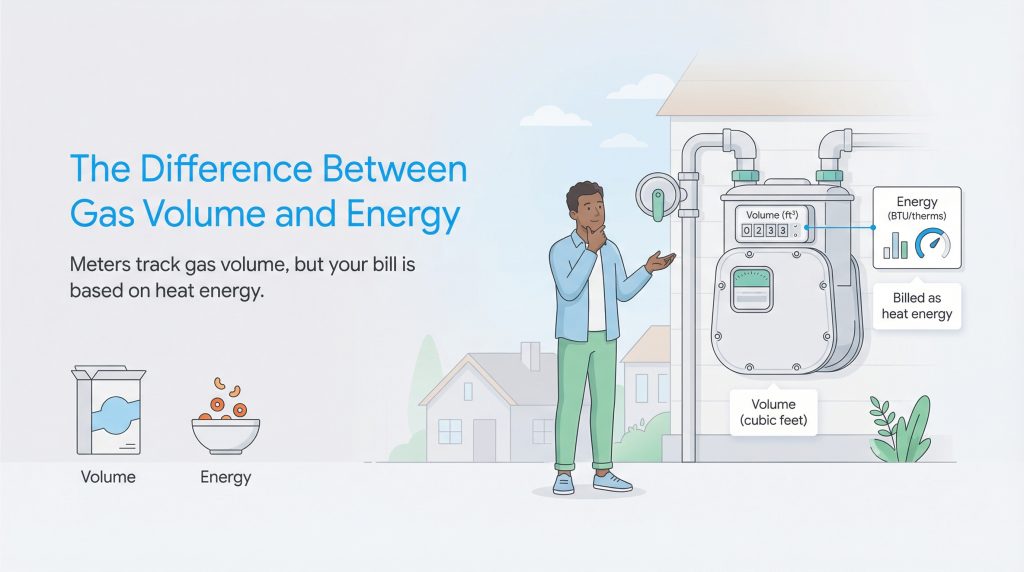
To track how much space the gas takes up, mechanical residential meters measure the flow in cubic feet. Depending on the size and scope of your property, you will encounter a few different acronyms to represent this physical space on your bill.
- CCF (100 Cubic Feet): This metric stands for 100 cubic feet and is the absolute industry standard for residential homes. Utilities use it so you can track your daily household consumption without getting overwhelmed by an excessive number of zeroes on your statement.
- MCF (1,000 Cubic Feet): Standing for 1,000 cubic feet, an mcf natural gas measurement is primarily used for commercial billing. You will rarely see this on a standard home bill unless you manage an industrial facility or a massive residential estate that requires a significantly higher volume of fuel to operate.
Energy Content Measurements (BTUs, Therms, Gigajoules)

While meters track physical volume, you are ultimately opening your wallet for the heat that volume generates. Gas quality naturally varies depending on where it was extracted and its unique chemical composition. Because of this variance, a cubic foot of gas from one pipeline might burn slightly hotter than a cubic foot from another. Energy content measurements level the playing field so you never overpay for low-quality fuel.
- BTU (British Thermal Unit): This is the foundational unit of heat energy. One btu natural gas unit is roughly equal to the heat produced by burning a single wooden match. Since billing a modern household in single matches would result in astronomical numbers, providers bundle these into larger units.
- Therms: If you are wondering about therms vs cubic feet, a therm is the standard billing unit that represents actual heat energy rather than physical space. One therm equals exactly 100,000 BTUs. When calculating your final utility costs, this is the metric your provider multiplies by their pricing rate.
- Gigajoules (GJ): While rarely seen on residential statements in the U.S., gigajoules are the standard unit for measuring natural gas energy in Canada and many international markets. One gigajoule is equivalent to about 0.948 therms.
Natural Gas Measurement Conversion Chart
Once you understand the basic definitions, you can easily verify your bill by running a few simple calculations yourself. Using a structured natural gas measurement chart makes it exceptionally easy to convert natural gas volume to energy charges printed on your statement. Below is a standard formula table used across the energy industry to bridge the gap between physical space and heat equivalents.
| Volume Unit | Energy Equivalent (Approximate) | Best Used For |
|---|---|---|
| 1 CCF (100 cubic feet) | ~1.037 Therms | Standard residential billing and daily household budgeting. |
| 1 MCF (1,000 cubic feet) | ~1.037 MMBtu (1,037,000 BTUs) | Commercial properties and large-scale industrial facilities. |
| 1 Therm | 100,000 BTUs | Calculating exact heat output and end-user utility costs. |
If you are trying to understand international metrics or technical specifications, you might also need to convert between alternative units using this secondary chart.
| Alternate Metric | Equivalent Value |
|---|---|
| 1 Cubic Meter | ~35.3 Cubic Feet |
| 1 Gigajoule (GJ) | ~0.948 Therms |
| 1 MMBtu | ~1.055 Gigajoules |
How To Read Your Gas Meter Accurately
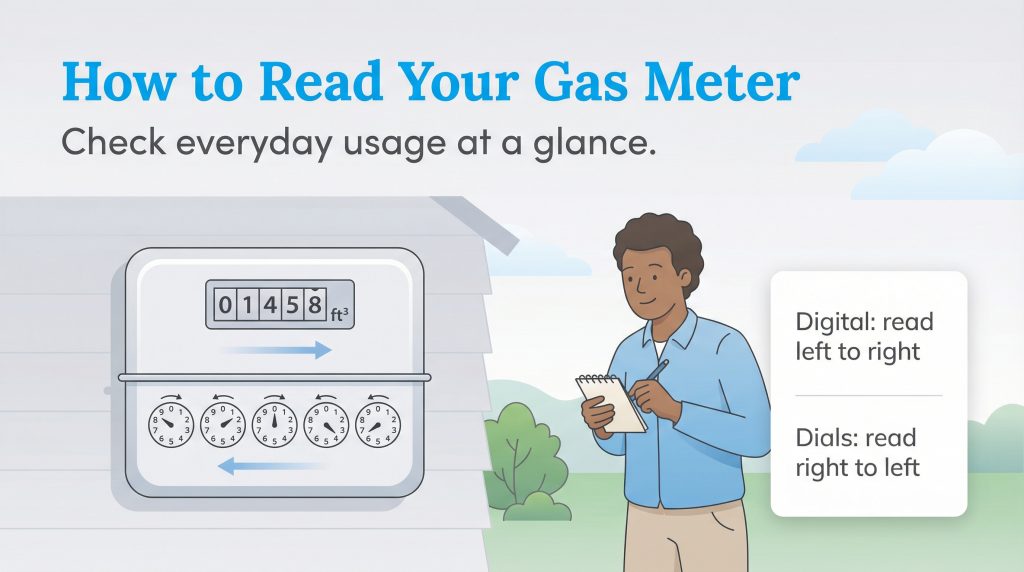
Learning how to read a gas meter is the single best way to monitor your household’s efficiency in real-time. Keep in mind that residential meters exclusively track physical volume, not energy. When you learn to read gas meter ccf numbers, you can check your exact usage whenever you want rather than blindly waiting a full month for your bill.
- Determine Your Meter Type: Check the equipment outside your home to see if it features a digital electronic screen or traditional clock-like dial faces.
- Read the Numbers: For a digital display, simply read the numbers exactly as they appear on the screen from left to right. For a traditional dial meter, read the dials strictly from left to right, noting the lower number each pointer has just passed. (The only exception is if the hand sits between 9 and 0; in that case, 0 represents 10, so you record the 9).
- Calculate Your Total Usage: Subtract your previously recorded reading from your current reading. The difference between these two numbers reveals the exact CCF volume of gas you consumed during that timeframe.
Translating Measurements To Your Monthly Gas Bill
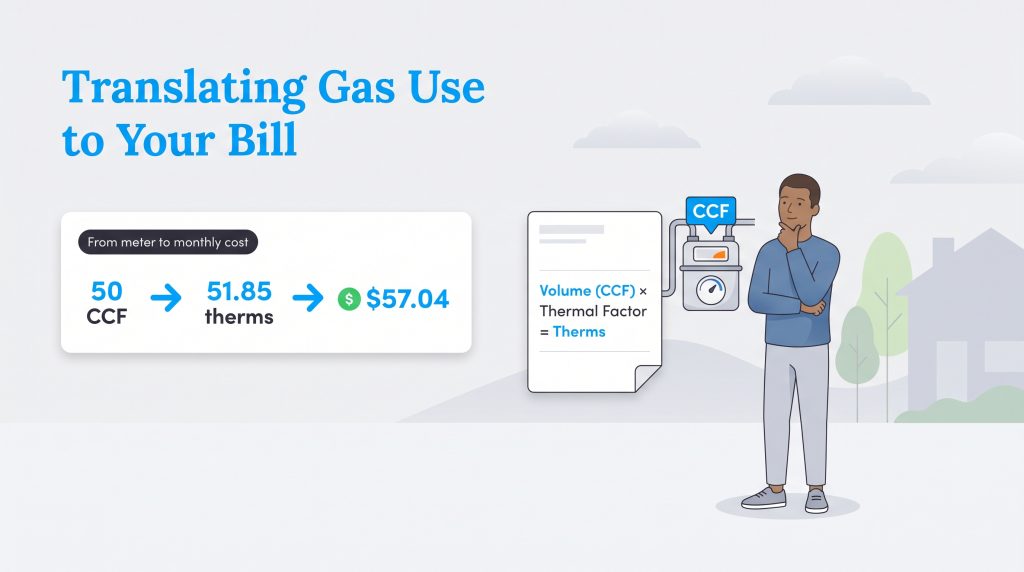
When reviewing your next statement, it helps to understand the precise math your provider uses to finalize your costs. Your utility company takes the raw volume metric (CCF) from your meter and applies a multiplier — known as a thermal factor — to convert it into the billable energy metric (therms).
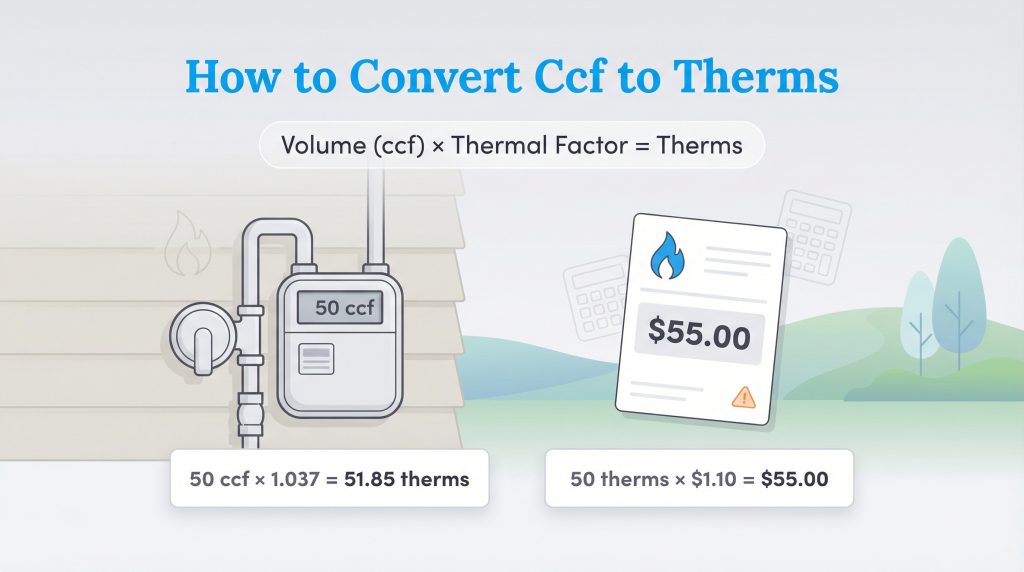
The primary formula for a ccf to therms conversion on your bill is straightforward: Volume (CCF) x Thermal Factor = Energy (Therms).
In many U.S. regions, the thermal factor hovers around 1.037, but you should always check your specific factor printed on your statement since regional gas quality fluctuates throughout the year. If your meter shows you used 50 CCF of gas last month, you would multiply 50 by 1.037 to get 51.85 therms. To see how this math impacts your monthly budget directly, consider this example: If your provider charges a supply rate of $1.10 per therm, your final supply charge would be roughly $57.04.
| Volume Reading (CCF) | Estimated Energy (Therms) | Estimated Cost (@ $1.10/therm) |
|---|---|---|
| 50 CCF | 51.85 therms | $57.04 |
| 100 CCF | 103.70 therms | $114.07 |
| 150 CCF | 155.55 therms | $171.11 |
Taking Control Of Your Gas Utility Costs

If you notice a sudden spike in your monthly statement, you are likely consuming more therms due to home inefficiencies rather than a drastic change in your personal habits. When you rely on outdated appliances, you have to burn a significantly higher volume of fuel to achieve the exact same indoor comfort level. For example, many older furnaces only operate at 60% to 70% efficiency, meaning a massive chunk of the heat you pay for simply vents outside.
Upgrading to an eco-conscious alternative, like ENERGY STAR-certified equipment, ensures that every therm you purchase translates directly into a warmer home. Additionally, drafty windows and poor attic insulation force your heating system to work overtime. Sealing air leaks is a highly effective way to support sustainable living while helping you save on your gas bill permanently. Mastering your natural gas unit of measurement gives you the confidence to verify your usage, hold your utility provider accountable, and track the real-world financial benefits of your home conservation efforts.
Frequently Asked Questions About Natural Gas Measurements
What is the standard natural gas unit of measurement?
How do you calculate a CCF to therms conversion on a gas bill?
Why is my meter measured in cubic feet but my bill charges in therms?
What is the difference between an MCF and an MMBtu?
What is the difference between CCF and MCF on a gas meter?
How do I convert natural gas usage to an electricity equivalent (kWh)?
Can I switch my natural gas provider?
About the Author

David has been an integral part of some of the biggest utility sites on the internet, including InMyArea.com, HighSpeedInternet.com, BroadbandNow.com, and U.S. News. He brings over 15 years of experience writing about, compiling and analyzing utility data.

Claudio is a sustainability-focused writer with a background in Anthropology and Psychology from NC State University. He has spent over 15 years working in writing, interpretation, and translation, driven by a deep interest in how human culture shapes the environment. Today, he shares his curiosity with readers by writing about sustainable living solutions and the connection between everyday choices and environmental impact.