
Ensure a Warm Welcome by Scheduling Your Natural Gas Connection Before Moving Day
Key Takeaways
- Start the process at least three weeks before you move to avoid service gaps or rush fees.
- Gather necessary documents like your lease, ID, and Social Security Number before calling providers to avoid administrative delays.
- Check if you live in a deregulated energy market to potentially save money by choosing your own renewable gas supplier.
Moving into a different house is stressful enough without taking your first shower in freezing water. Navigating your gas service setup for new homeowners requires a strategic timeline, specific paperwork, and a thorough understanding of your local utility market. By tackling this process efficiently, you will learn exactly when to call your provider, how to bypass expensive security deposits, and what critical safety inspections to expect on move-in day. Use this step-by-step checklist to establish your connection seamlessly, coordinate with technicians, and ensure your property is safe and comfortable from the moment you unlock the front door.
1. Existing Home vs New Construction Setup Requirements
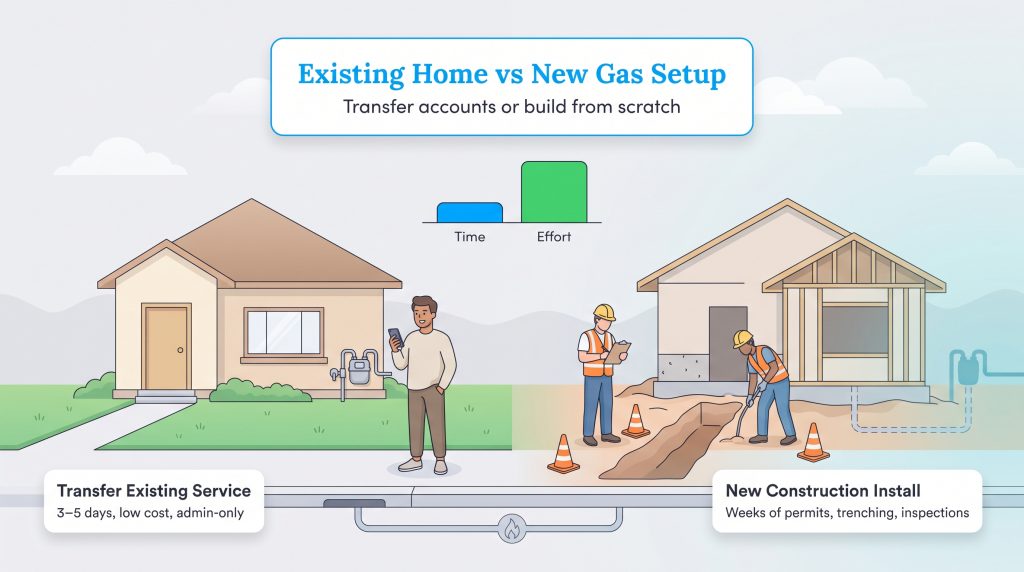
There is a massive difference between setting up utilities for a pre-owned property and establishing a connection for a brand-new build. If you are buying an existing home, the underground pipes and the meter are already in place. In this scenario, figuring out how to transfer gas service to new owner simply involves an administrative swap. You flip the account into your name, and the company will read the gas meter to ensure you aren’t wrongfully charged for the previous resident’s energy usage.
Conversely, a new construction gas line installation is a highly physical, time-consuming process. It requires significant coordination between your general contractor, local municipal inspectors, and utility engineers. This process involves trenching a physical path from the main line at the street up to your home’s foundation, pulling city permits, and passing strict municipal safety tests before a single drop of fuel is delivered. Review the comparison below to understand the distinct differences between these two scenarios.
| Feature | Transferring Existing Service (Pre-Owned Home) | New Construction Installation (New Build) |
|---|---|---|
| Time Required | 3 to 5 business days | 4 to 8 weeks (heavily dependent on local permits) |
| Average Cost | $20 to $50 connection fee | Hundreds to thousands of dollars (for trenching and lines) |
| Physical Requirements | Meter is already permanently attached to the house | Requires digging, pipe laying, and strict pressure tests |
| Who Coordinates? | Homeowner and a standard customer service agent | Homeowner, general contractor, and utility engineers |
2. 3 Weeks Out: Research Providers and Renewable Options
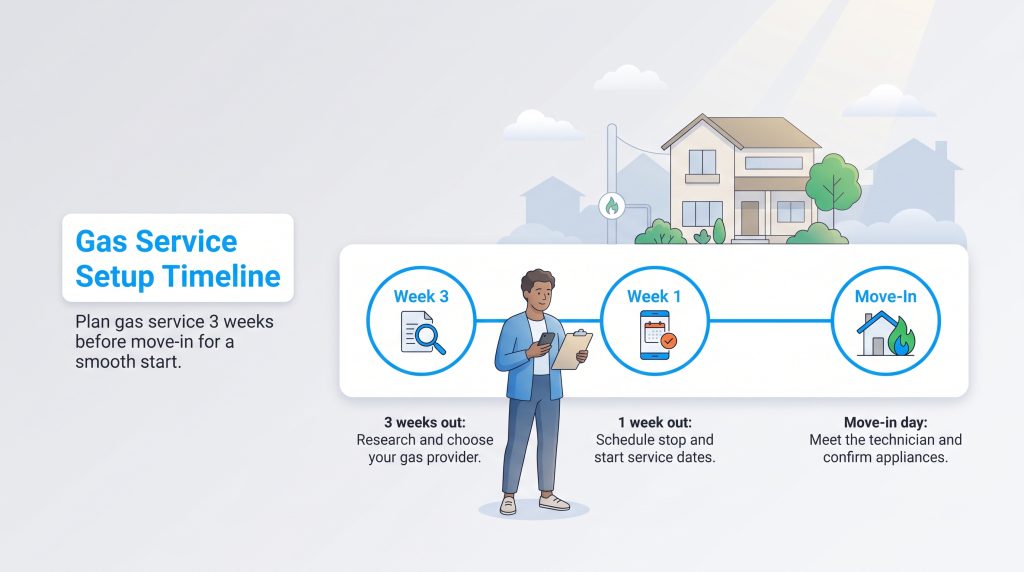
At the three-week mark, your primary goal is pure information gathering. Timing is everything when coordinating home utilities. Calling too late can leave you without central heating, while calling too early might mean paying for energy you aren’t actively using. Before making any phone calls, you must understand the specific rules of your local energy market.
Depending on where your new home is located, you might have more choices than you realize. A deregulated natural gas market setup completely changes how you shop for energy. Review the table below to see how regulated and deregulated territories differ, as this determines whether you are assigned a provider or can actively shop around.
| Market Structure | How It Works for New Homeowners |
|---|---|
| Regulated Energy Market | A single municipal or investor-owned utility handles everything. They buy the fuel, maintain the infrastructure, and set your rates. You cannot choose a different provider. |
| Deregulated Energy Market | The local utility still owns the pipes and delivers the gas safely, but you have the power to shop around for a separate supplier to get the best rate and choose your own natural gas plan. |
If you aren’t sure who is servicing your address, check your local municipality website, speak to your real estate agent, or ask the previous homeowner. Once you identify your market type, you can start looking into plans that fit both your budget and your environmental values.
🌱 Eco Edge: Are you looking to reduce your household’s carbon footprint? If you live in a deregulated territory, you can filter your supplier search to prioritize renewable natural gas plans or plans that include comprehensive carbon offsets. These green-certified options capture methane from landfills and agricultural sites, repurposing it for residential use. We highly recommend pairing your new eco-friendly utility setup with a smart thermostat installation to maximize your long-term efficiency.
3. Essential Documents to Open a New Gas Account
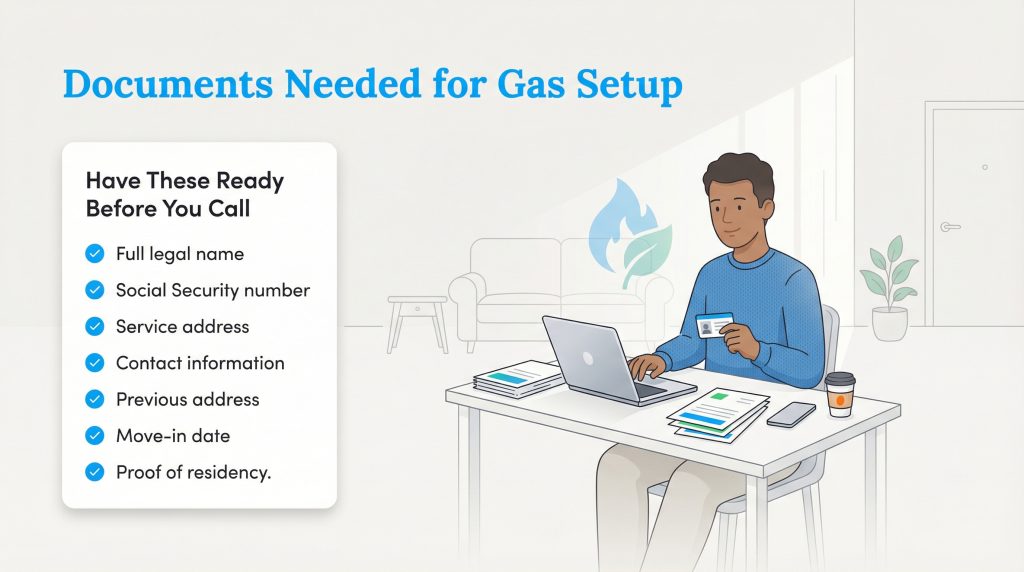
Preparation is your best friend when looking to setup natural gas utilities. Calling a provider without the proper paperwork readily available will only result in delays and frustration. Customer service agents are legally mandated to verify your identity and assess your financial standing before activating a potentially hazardous utility in your name.
Before you pick up the phone or log onto the provider’s online portal, make sure you have gathered the following essential items:
- Government-issued ID: Keep your driver’s license or passport on hand to provide your full legal name exactly as it appears on official documents.
- Social Security Number (SSN) or Tax ID: Utilities use this to run a soft credit check and determine your deposit requirements. You must temporarily lift any active credit freezes before applying, otherwise the utility company cannot process your account request.
- Exact service address: Note the full physical address of your new home, paying close attention to specific unit, apartment, or lot numbers.
- Lease or closing documents: Have a digital or physical copy of your signed agreement available. The provider may require this to formally prove you are legally authorized to start service at that location.
- Preferred start date: Know the specific day you officially take possession of the property so the agent can properly align the technician’s schedule.
4. 1 Week Out: Schedule Your Activation and Avoid Setup Fees
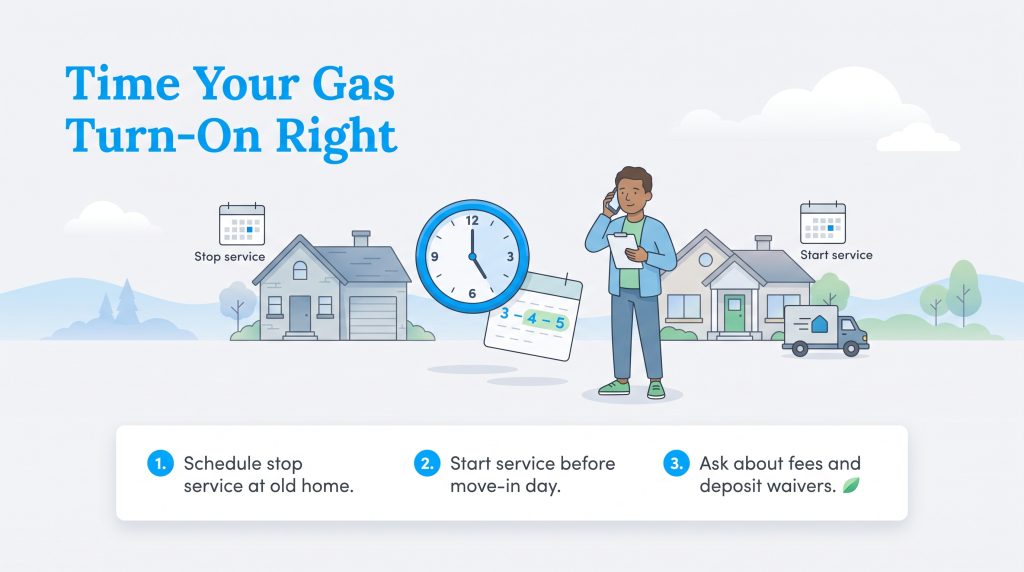
Seven days before your move, it is time to make things official. If you are wondering how long does it take to turn on gas, standard connections generally take three to five business days. However, during busy summer moving seasons, appointment slots fill up rapidly. Reach out to your provider to finalize the logistics and officially start natural gas service at your new property.
Follow these exact steps to ensure a seamless transition of power:
- Schedule your “Stop Service” order: Instruct your current utility provider to terminate service at your old home for the day after you move out.
- Set up your “Start Service” order: Request activation at your new address for the day before you physically arrive with your moving truck.
- Confirm technician requirements: Ask the customer service representative if a technician needs to enter the property. Unlocking a meter at a vacant house frequently requires an adult to be present.
During this phone call, you will also handle upfront costs. Most providers charge a mandatory natural gas activation fee ranging from $20 to $50 to cover administrative processing. Depending on your soft credit check, you might also face a gas utility deposit for new customers, which acts as insurance against missed payments and typically costs between $50 and $250.
Fortunately, you don’t always have to pay this out of pocket. You can typically request a deposit waiver using one of these three reliable tactics:
- Set up auto-pay: Agree to have your monthly bill automatically drafted from your checking account or credit card.
- Enroll in paperless billing: Opt to receive all your statements electronically, which saves the provider administrative costs.
- Provide a letter of good credit: Request a formal letter from your previous utility provider proving you have a flawless 12-month payment history.
If finances are exceptionally tight during the move, check if you qualify for state programs like the Low Income Home Energy Assistance Program (LIHEAP). This federally funded initiative can occasionally assist with bills and deposits or reconnection fees for qualifying households.
5. Move-In Day: Technician Visits and Safety Verifications
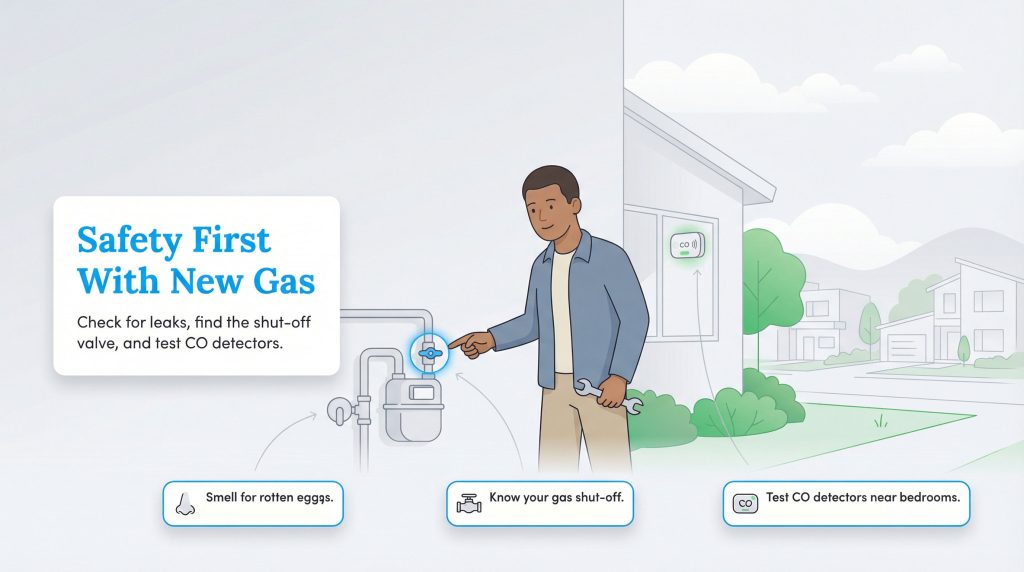
Once your move-in day arrives, conducting a strict move-in day gas safety check is absolutely crucial. If the gas meter is located inside a basement, or if the service has been physically locked at the street by the city, an adult who is at least 18 years old must be present to grant access. A reputable gas company will never restore service if the property is completely empty.
During the appointment, the certified technician will perform a pressure test on the lines to ensure there are no active leaks hiding behind your drywall. Once the system is verified as safe, follow this three-step verification process to secure your new home:
- Verify your pilot lights: Ask the technician to manually light the standing pilot lights on your older water heater and furnace. Never attempt to light a lingering standing pilot yourself unless you are highly experienced.
- Understand the sniff test: Natural gas is naturally odorless, but utilities add a harmless chemical called mercaptan that smells strongly of rotten eggs to alert you to danger. If you ever smell gas, do not use electrical switches, cell phones, or lighters. Evacuate the house immediately and call 911.
- Test your alarms: Install fresh batteries in all Carbon Monoxide (CO) detectors before spending your first night in the house. This invisible gas is a byproduct of combustion appliances, making functional alarms non-negotiable.
🚩 Heads Up: Never attempt to turn on the main gas valve yourself if it has been physically locked or sealed by the utility company. Tampering with utility equipment is incredibly dangerous and illegal. Always wait for a certified technician to remove the lock and test the line pressure.
6. Preparing Your Home for Long-Term Energy Efficiency
Setting up your utility accounts early is arguably one of the most critical steps in turning a cold, empty house into a welcoming home. By handling your paperwork ahead of time, leveraging strategies to waive upfront deposit costs, and prioritizing move-in day safety checks, you guarantee that your first week in the new place is memorable for all the right reasons. Keep your new account documents filed in a safe location, establish an online payment profile to avoid late fees, and relax knowing your home is warm, functional, and secure.
Establishing service is just the beginning of your journey as a homeowner. Make an environmentally mindful choice by eventually upgrading to highly efficient certified heating appliances, sealing drafty windows to prevent heat loss, and reading up on how to save on your gas bill. With a bit of strategic foresight, you will stay incredibly comfortable while being perfectly positioned to keep your energy usage firmly in check for years to come.
Frequently Asked Questions About Gas Service Setup
How long does it take to turn on gas service at a new house?
Generally, you should allow three to five business days for a standard connection at an existing home. However, during peak moving seasons like summer and early fall, technician appointment slots fill up rapidly. We recommend calling at least three weeks in advance to secure your preferred date. While some utilities can accommodate same-day or next-day start service, you will typically be required to pay an expedited rush fee.
Can I waive the natural gas activation fee and deposit?
While standard activation fees (usually $20 to $50) are generally mandatory to cover administrative processing, you can frequently waive the security deposit. Utility companies often allow new customers to bypass the $50 to $250 deposit by enrolling in auto-pay, signing up for paperless billing, or providing a formal letter of good credit from a previous utility provider.
Do I have to be home when the utility technician turns on the gas?
If the gas is currently shut off at the meter and locked, yes. A technician generally requires an adult who is 18 or older to be present inside the home. They must inspect the indoor appliances, run a pressure test to ensure there are no active leaks, and safely light the pilot lights on your furnace or water heater before leaving the system active.
Can I turn on the natural gas meter myself?
No, you should never attempt to turn on a locked natural gas meter yourself. Tampering with utility equipment is illegal and highly dangerous. If the service is disconnected, you must schedule an appointment with a certified technician to properly unlock the valve and verify the home’s safety.
Can I transfer my gas service to another person?
Yes, you can often transfer gas service to a new owner or a roommate, but policies vary heavily by company. In many situations, such as a divorce or roommates parting ways, the utility will mandate that the old account be closed and a completely new one opened to clearly establish ongoing financial liability.
What if my new home has gas appliances but no service is active?
If the service has been disconnected for an extended period — typically more than six to 12 months — the main line may be capped or locked. You will likely need to hire a professional to perform a thorough safety inspection and run a pressure test on the lines before the utility agrees to unlock the meter and restore the flow of gas.
About the Author

Claudio is a sustainability-focused writer with a background in Anthropology and Psychology from NC State University. He has spent over 15 years working in writing, interpretation, and translation, driven by a deep interest in how human culture shapes the environment. Today, he shares his curiosity with readers by writing about sustainable living solutions and the connection between everyday choices and environmental impact.