

Learning How to Decode Your Water Bill Helps You Catch Hidden Plumbing Leaks, Understand Your Local Rates, and Take Control of Your Monthly Utility Budget
Key Takeaways
- Most water bills separate base fees from volumetric usage, meaning you pay a fixed amount for the connection alongside the costs for what you actually consume.
- Usage is typically measured in CCF or gallons, with one CCF (hundred cubic feet) equaling about 748 gallons of water.
- Sudden spikes in your water bill often point to silent leaks, which you can easily diagnose using a simple 15-minute water meter test.
Opening a utility envelope that has unexpectedly doubled in price can be an incredibly frustrating experience, especially when the invoice is packed with confusing municipal jargon and complex rate structures. However, mastering the process of understanding your water bill is the very first step toward taking permanent control of your monthly household budget. By breaking down exactly what you are paying for — from fixed service charges to variable environmental fees — you transition from blindly paying a mystery amount to actively managing your daily consumption. We are going to demystify those complex line items, translate confusing volumetric measurements like CCF into plain English, and show you exactly how to spot hidden plumbing leaks before your next billing cycle hits your mailbox.
The Anatomy of a Standard Water Bill
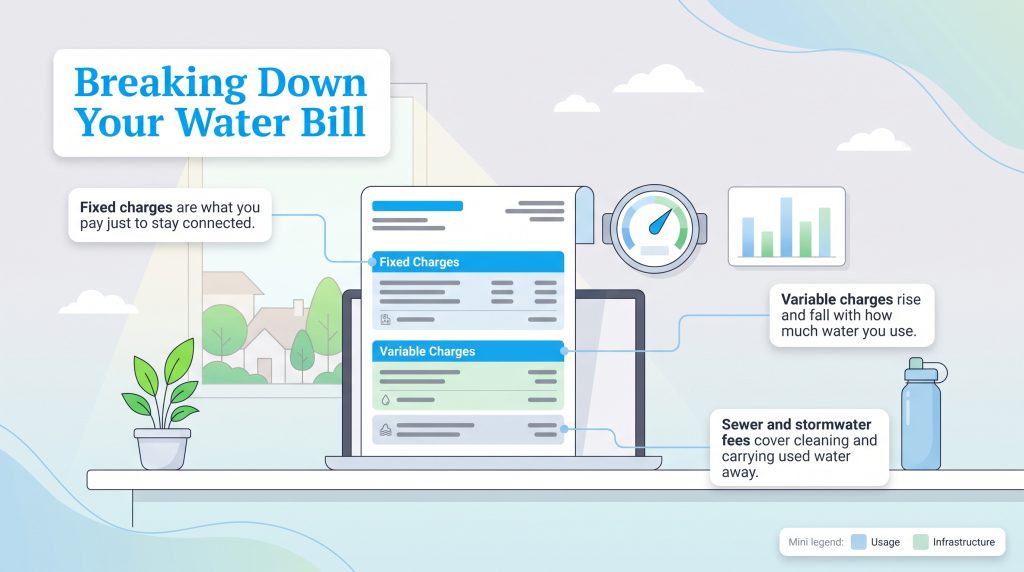
Figuring out how to read municipal invoices might feel like studying a foreign language at first glance. Local utility companies design their statements differently, utilizing varying layouts, unique billing cycles, and specific regional codes depending on where you live. Despite these visual differences, almost every municipal statement you receive is fundamentally divided into two primary categories: fixed costs and variable costs. You pay a specific amount just to keep the municipal pipes connected to your property, and another fluctuating amount based entirely on how much natural resources actively flow through your faucets.
To help you decode your statement quickly and accurately, here is a helpful glossary of the most common line items you will encounter on a standard invoice:
- Base Fee or Service Charge: A fixed monthly cost to maintain public pipes, operate local water treatment plants, and provide round-the-clock utility access.
- Volumetric or Usage Charge: The variable cost calculated directly from the actual gallons or cubic feet of water your household consumed during the billing cycle.
- Sewer or Wastewater Fee: The cost to safely transport and process the dirty water that flows down your indoor drains and back into the municipal sewer system.
- City Franchise Fees: Local taxes and municipal surcharges that fund essential regional infrastructure, such as public fire protection networks and hydrant maintenance.
- Stormwater Fees: A dedicated municipal fee used to manage rain runoff. This specific fund pays for the maintenance of storm drains, gutters, and retention ponds to prevent local neighborhood flooding during heavy rainstorms.
Fixed Charges Vs Variable Charges
When analyzing your statement, understanding the nuance of your water bill base charge vs usage costs is essential for setting realistic budget expectations. Your base charge is the foundational cost of your municipal service. This fixed price guarantees you have direct, uninterrupted access to the grid, funding essential infrastructure maintenance, administrative costs, and customer service operations. Even if you completely shut off your home’s main valve and went on a month-long vacation, you would still receive an invoice for this base charge because the connection itself must be maintained.
In contrast, the volumetric usage charge fluctuates entirely based on your actual, real-world consumption. This variable portion of the bill is where your daily habits — like taking long showers or running the backyard sprinklers — directly impact your wallet. By separating these two costs, municipalities guarantee they have steady funding to maintain aging public pipes while charging you fairly for the exact amount of natural resources you actively use.
Sewer Charges and Environmental Fees
Many new homeowners are incredibly surprised to discover they pay almost as much to dispose of water as they do to receive it. A sewer charge on water bill statements appears because utilities rightfully assume the vast majority of the water flowing into your home eventually washes down the drain. Treating raw sewage, filtering out harmful bacteria, and safely returning clean water to the natural environment is an expensive, energy-intensive process that requires highly specialized facilities. Managing your indoor water usage directly influences these wastewater costs. To learn more about how regional infrastructure impacts your local rates, you can explore our resources on local water and sewer utilities.
Step-By-Step: Reading Your Water Bill Document
If you have a physical copy of your utility invoice or a digital PDF open on your computer screen, navigating the document is much easier once you know exactly where to look. While formatting varies heavily by city, almost all utility providers include five core sections that tell the full story of your household’s usage. Follow this step-by-step breakdown to learn exactly how to read your water bill:
- Account Information and Dates: Typically located in the top right or left corner, this section displays your unique account number, service address, and the exact dates of the billing cycle (e.g., June 1 to June 30). You will need your account number handy if you want to set up an automated payment portal or contact customer service about a dispute.
- Meter Reading Summary: Found just below your account details, this area shows your “Prior Reading” and your “Current Reading.” The utility company simply subtracts the prior number from the current number to calculate your exact consumption for the month. It will also explicitly indicate if the reading was actual or estimated.
- Historical Usage Graph: Most modern bills include a small bar chart near the bottom or side margin. This helpful visual graph compares your current month’s usage to your usage from the exact same month last year. It is the quickest visual way to determine if your family’s consumption habits have drastically changed over time.
- Itemized Current Charges: This is the meat of your bill, usually located dead center in the document. Here you will find the comprehensive line-by-line breakdown of base fees, volumetric usage tiers, sewer charges, stormwater fees, and any local municipal taxes applied to your account.
- Total Amount Due and Payment Options: Located at the very bottom (and often printed on a perforated tear-off slip), this section prominently displays the final balance owed and the strict due date. It will also detail accepted payment methods, mailing addresses, and potential late fee penalties.
Decoding Water Measurements: CCF Vs Gallons
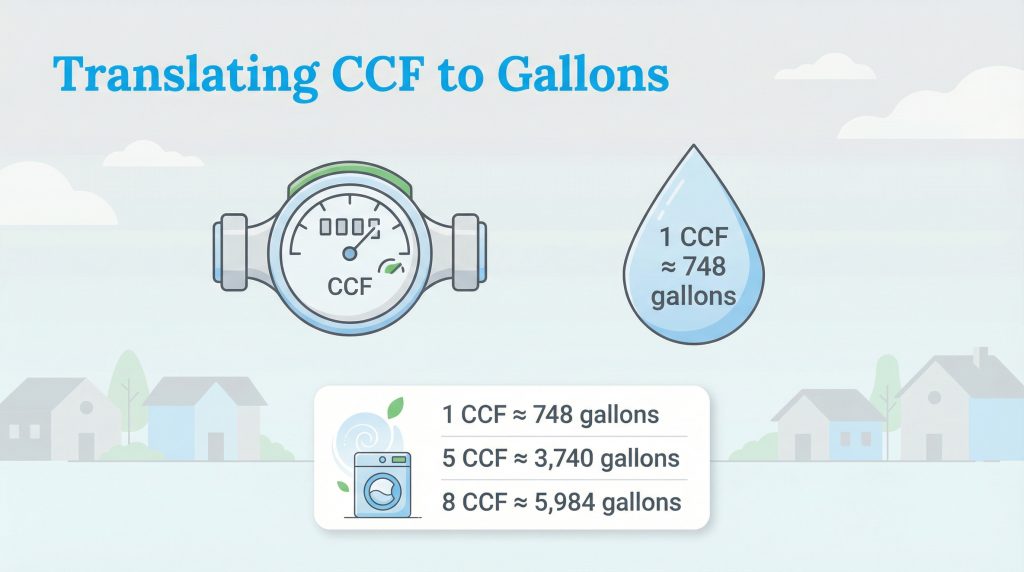
Decoding your statement requires a firm understanding of the measurement units your utility provider chooses to use. While we typically measure everyday liquids by the gallon or ounce, many municipal meters actually track usage by the cubic foot. To quickly translate these metrics and fully grasp a water bill ccf vs gallons conversion, you simply need to remember one strict rule: 1 CCF = 748 gallons of water.
Seeing an invoice noting that you consumed “8 units” might not sound like a massive amount, but once you do the mathematical conversion, it translates to nearly 6,000 gallons of water. Grasping this conversion is essential for tracking your family’s true environmental footprint and keeping your utility budget grounded in reality. Use the simple conversion table below to quickly visualize how those seemingly small CCF units add up in everyday gallons.
| Usage in CCF (Hundred Cubic Feet) | Equivalent in Gallons |
|---|---|
| 1 CCF | 748 Gallons |
| 5 CCF | 3,740 Gallons |
| 10 CCF | 7,480 Gallons |
| 15 CCF | 11,220 Gallons |
Understanding Tiered Water Rates
As you dive deeper into your billing statement’s itemized charges, you may notice that the price you pay per gallon is not always a flat, consistent rate. When having tiered water rates explained, it is easiest to think of it like climbing a staircase — the higher you climb in overall volume usage, the more expensive each individual step becomes. Under a tiered or “inclining block” rate system, the price per CCF increases dramatically as your consumption crosses specific volume thresholds deliberately set by the city.
The first tier usually provides enough inexpensive water to comfortably cover essential human needs, such as drinking, cooking, and basic indoor hygiene for a standard family. However, if you water a massive lawn during the summer or decide to fill a backyard swimming pool, your usage quickly climbs into the second, third, or even fourth tier. In these upper tiers, the cost per gallon is significantly higher. Municipalities use this pricing structure intentionally to discourage excessive water waste during drought seasons and to financially reward homeowners who practice strict conservation habits.
Winter Averaging and Sewer Calculations
If you live in a region that applies winter water averaging, understanding this calculation can save you a tremendous amount of money throughout the entire year. Winter averaging is a specialized billing method municipalities use to calculate your fixed monthly sewer charge. Because utility providers cannot easily install a second meter directly on your sewer line, they assume that all the water you use during the colder winter months goes straight down your indoor drains. During the winter, homeowners are generally not watering their lawns, filling pools, or running outdoor sprinklers.
Your utility provider will closely monitor your exact water consumption over two or three consecutive winter billing cycles (typically December, January, and February). They average that specific usage and lock it in as your fixed monthly wastewater fee for the entire upcoming year. This means that if you aggressively minimize your water usage during those critical winter months, you guarantee a significantly cheaper annual wastewater bill, completely insulating yourself from expensive sewer charges when your outdoor summer watering inevitably increases.
Why Is My Water Bill So High?
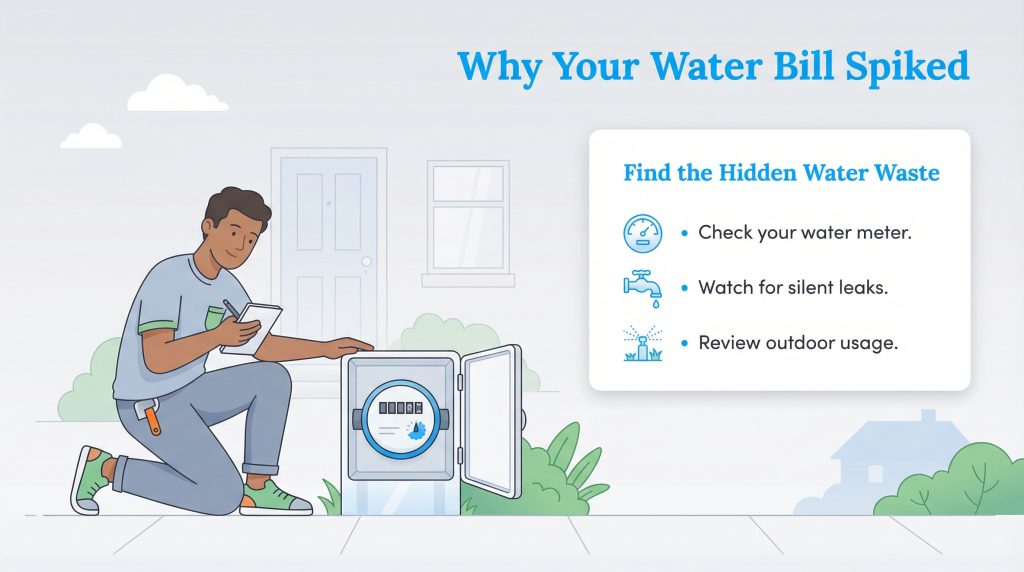
Opening an unusually steep utility invoice often sparks the immediate, panicked question: why is my water bill so high? It is incredibly frustrating to feel like you are bleeding money without changing your daily routines or spending habits. Barring obvious intentional uses like establishing new spring landscaping or power washing your driveway, a sudden price spike usually points to a hidden mechanical issue on your property or an unexpected billing catch-up from the utility provider. Here is a quick look at the most common culprits responsible for sudden bill spikes:
- Silent Running Toilets: A deteriorating rubber flapper inside your toilet tank can silently waste hundreds of gallons daily without spilling a single drop onto your bathroom floor.
- Underground Irrigation Leaks: Cracked sprinkler lines or loose joints in drip irrigation systems can soak deep into your lawn’s soil without leaving obvious surface puddles, wasting water for weeks before discovery.
- Estimated Billing Catch-Ups: If the utility company severely underestimated your usage during previous months, a true physical meter reading will generate a one-time spike to reclaim the unbilled water.
Silent Plumbing Leaks
If you suspect a plumbing issue is driving up your costs, your outdoor water meter is your absolute best diagnostic tool. You can quickly perform a water meter leak test to check for a running toilet flapper, a dripping faucet, or a hidden pinhole pipe leak. Simply turn off all water sources inside and outside your home — making sure washing machines, ice makers, and dishwashers are not currently running. Next, go outside and look closely at your meter’s main display. If any of the dials or digital numbers are actively moving while everything on the property is completely shut off, you have an active leak that requires immediate plumbing attention to stop the financial bleeding.
Estimated Vs Actual Readings
As mentioned in our list of common culprits, understanding the difference between estimated and actual charges is crucial for avoiding invoice shock. If the utility company could not safely access your meter during a previous billing cycle — perhaps due to a parked car positioned over the meter box, a locked fence gate, or severe winter weather — they likely issued an estimated bill based heavily on your historical seasonal data. If that automated estimate was far too low, your next actual physical meter reading will automatically include all the unbilled gallons from the previous month. This creates a temporary but startling spike in your total amount due that will typically level out and normalize in the following billing cycle.
Prorated Charges, Grace Periods, and Late Fees
Your final balance can also look unusually high or low depending on administrative billing mechanics. A prorated water bill typically occurs when you transfer water service to a new address right in the middle of a billing cycle. Instead of charging you for a full month, the utility provider calculates a partial daily rate covering only the exact number of days the account was actively in your name. Additionally, it is important to realize that standard billing cycles generally range anywhere from 28 to 32 days. A cycle that covers 32 days naturally results in slightly higher volumetric usage and base fees compared to a shorter 28-day cycle, which often causes minor but confusing monthly price fluctuations.
If you miss a payment deadline, you will often trigger punitive late fees that carry over into the next cycle. Fortunately, most municipal utility providers offer a grace period — usually five to 10 days past the official due date — where you can submit a payment without incurring penalties. On the flip side, if you overpaid a previous invoice or successfully filed a leak adjustment form, you might notice an account credit. Utility providers typically display these credits either with a minus sign or enclosed completely in parentheses (e.g., ($45.00)). Knowing how to spot these credits ensures you never double-pay on your monthly balance.
Average Water Usage Per Person
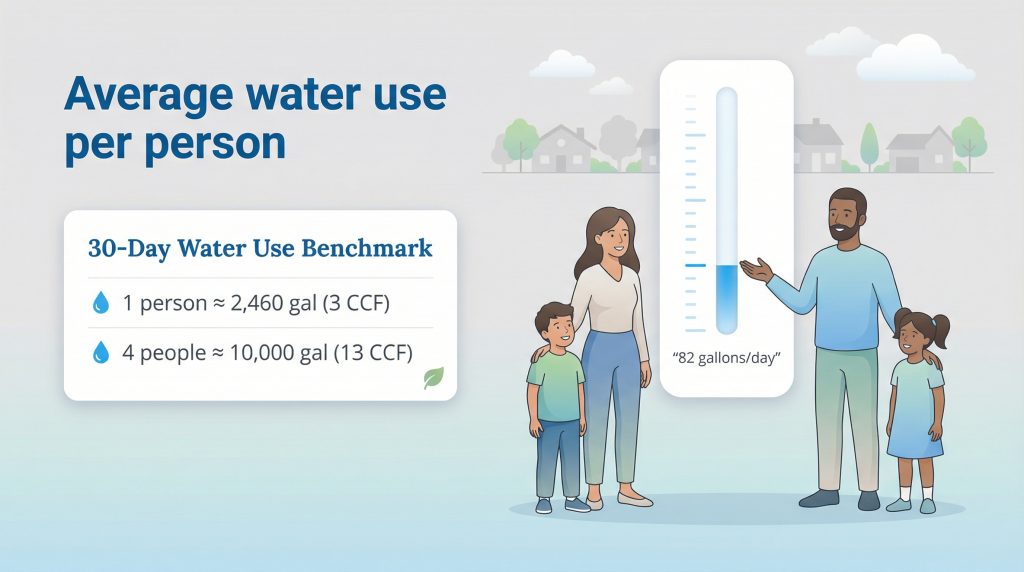
To determine if your monthly charges are reasonable, you first need to establish a solid baseline for standard household consumption. Understanding this baseline is the absolute best way to figure out if your average water bill cost aligns with typical municipal expectations. According to the Environmental Protection Agency (EPA), the average daily household water consumption for an American is estimated to be about 82 gallons per day at home. This baseline can naturally shift depending on your local climate and outdoor irrigation needs, making spring yard water conservation tips vital for homeowners with large, thirsty lawns.
When you extrapolate that 82-gallon metric across a standard 30-day billing cycle, you can easily spot if your household is consistently over-consuming. Use the benchmark table below to quickly compare typical usage expectations based on the exact number of people currently living in your home.
| Household Size | Average Daily Usage | Average Monthly Usage (Gallons) | Average Monthly Usage (CCF) |
|---|---|---|---|
| 1 Person | 82 Gallons | 2,460 Gallons | ~3.3 CCF |
| 2 People | 164 Gallons | 4,920 Gallons | ~6.6 CCF |
| 3 People | 246 Gallons | 7,380 Gallons | ~9.9 CCF |
| 4 People | 328 Gallons | 9,840 Gallons | ~13.1 CCF |
How to Read Your Water Meter
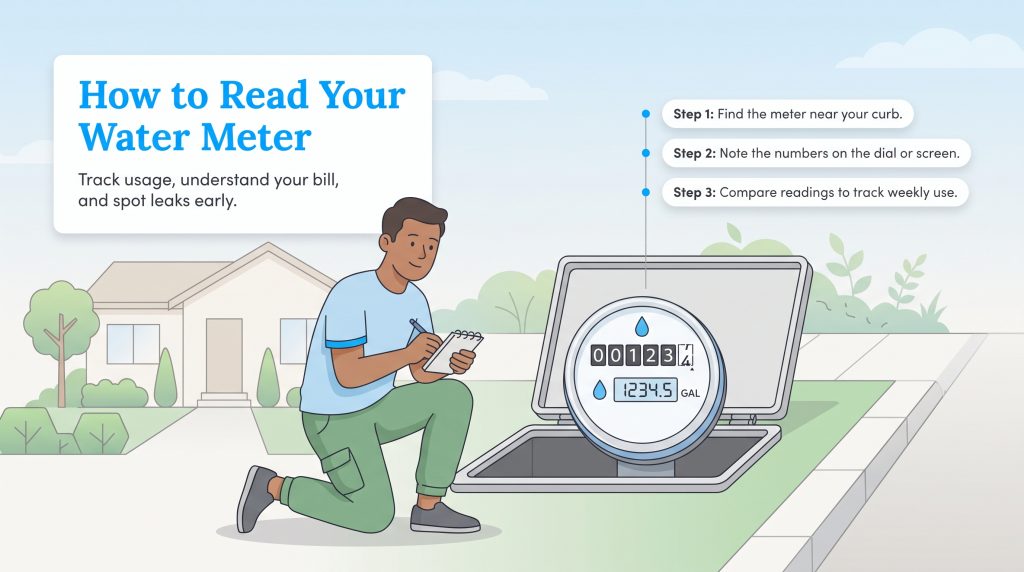
Taking the time to proactively learn how to read a water meter to track usage and spot leaks is a vital skill for any homeowner looking to slash their utility budget. Your water meter features a low-flow indicator dial — often shaped like a small triangle, a red sweeping hand, or a silver star — which spins to detect even the smallest active leaks on your property. Knowing how to read these dials empowers you to calculate your current daily usage without having to wait anxiously for the municipal invoice to arrive in the mail. Follow these simple steps to actively track your household’s consumption:
- Locate the water meter: Check the heavy concrete or plastic utility box near your front curb, sidewalk, or property line. In colder, freeze-prone climates, your meter may be securely located indoors inside a basement or dedicated utility closet.
- Read the dials or digital display: Analog meters display a series of numbers much like a traditional car odometer, reading straight from left to right. Digital or smart meters may require you to shine a bright flashlight directly onto the solar panel screen to “wake it up” before you can read the total volume.
- Calculate current usage: Write down the exact numbers displayed today in a designated notebook. Check the meter again in exactly seven days at the same time, and subtract the previous number from the new number. This quick math reveals your precise weekly household usage.
Water Bill Assistance Programs
If you are struggling to keep up with rising utility costs, there are robust federal and local assistance options designed specifically to help low-income households. You do not have to face devastating utility shutoffs or insurmountable debt completely alone. One of the most valuable resources is the Low Income Household Water Assistance Program (LIHWAP), a federally funded initiative that provides emergency grants to help families pay off past-due water and wastewater bills without the threat of immediate disconnection.
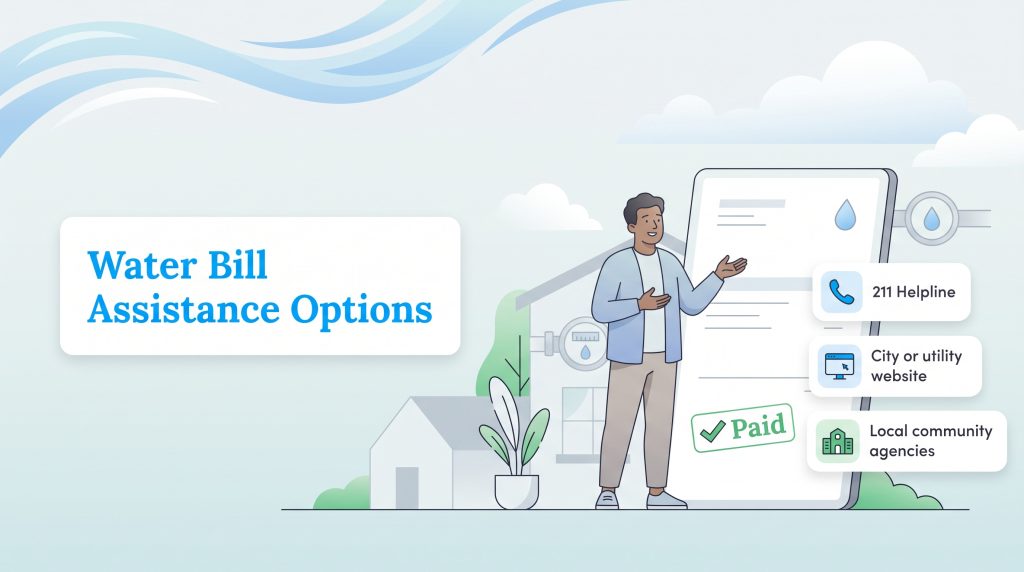
In addition to broad federal aid, many local municipalities offer their own targeted relief programs, senior citizen tiered rate discounts, or highly flexible payment plans. We highly recommend utilizing the following methods to find local financial help immediately:
- Dial 211: Call this free, confidential service to get connected directly with local utility assistance programs available right in your specific ZIP code.
- Check the municipal website: Many utility providers list hardship programs, payment deferral plans, and leak forgiveness forms directly on their online billing portals.
- Contact Community Action Agencies: Local non-profits often receive regional grants dedicated entirely to helping households prevent utility shutoffs during extreme weather seasons. Community Action Agencies are incredibly effective at interceding on your behalf before a disconnection occurs.
Preparing for Your Next Billing Cycle
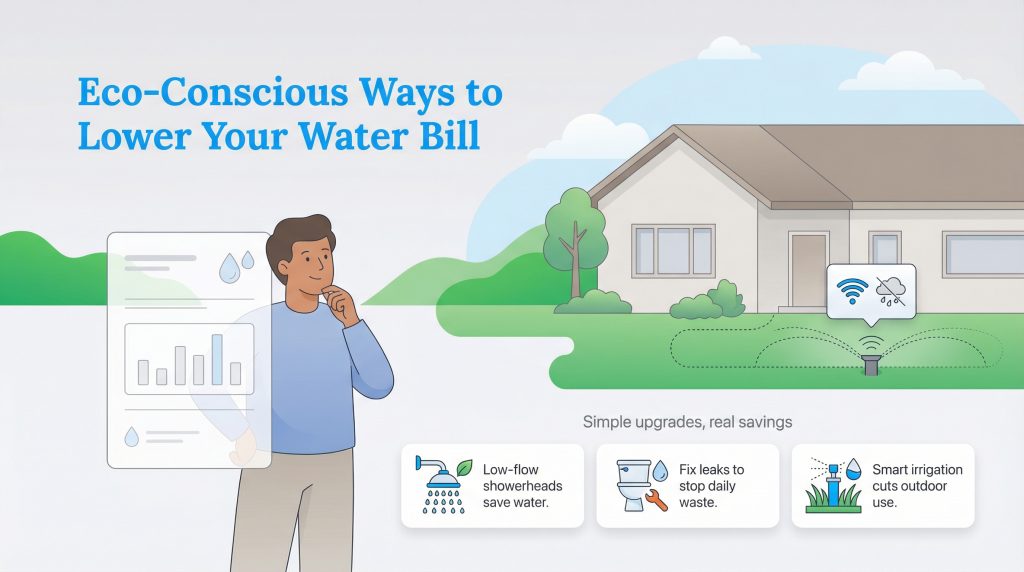
Demystifying the complex math and municipal jargon on your invoice offers a distinct sense of financial empowerment. Implementing simple, environmentally mindful choices protects critical local reservoirs while keeping your household budget completely intact. By utilizing ENERGY STAR certified appliances and paying close attention to EPA WaterSense estimates, you can drastically reduce the amount of gallons you consume indoors on a daily basis. To save on your water bill and proactively lower your upcoming charges this month, commit to installing water-saving aerators on all your faucets, fixing running toilets immediately, and tracking your weekly meter readouts to catch anomalies early.
You no longer have to view your monthly statement as an unpredictable, stressful mystery charge. By clearly understanding the critical differences between fixed base fees, variable volumetric usage, and complex tiered pricing limits, you can pinpoint exactly where your hard-earned money is going. Take a few moments this week to review your latest statement, calculate your daily usage, and implement smarter, eco-conscious conservation habits before the next billing cycle begins.
Frequently Asked Questions About Understanding Your Water Bill
Navigating the intricacies of a municipal utility statement can bring up plenty of specific situational questions. Whether you are dealing with unexplained charges after a vacation or wondering how a mid-month move affects your balance, having the right answers helps you manage your account confidently. Here are some of the most common questions homeowners ask about their monthly statements.
What is a stormwater fee on my water bill?
A stormwater fee is a localized municipal charge used to fund the public management of rain runoff and melting snow. Because heavy storms can rapidly overwhelm city infrastructure, this fee pays for the ongoing maintenance of storm drains, public street gutters, and retention ponds that prevent dangerous neighborhood flooding and protect local natural waterways from pollution.
How do I dispute a high water bill?
If you experience an unexplained, massive price spike, you can immediately dispute the charges by contacting your utility provider’s customer service department directly. If the high bill was caused by a verified plumbing issue, ask the representative how to submit a formal water bill leak adjustment form. You will typically need to provide concrete documentation, such as a hardware store receipt for replacement parts or a professional invoice from a licensed plumber, to prove the leak was officially fixed before the utility company will successfully credit your account for the wasted water.
Why did my water bill double in one month?
A water bill that doubles overnight is almost always the result of a sudden mechanical leak, a drastic change in outdoor watering habits, or an estimated billing catch-up from a previous cycle. A silent running toilet flapper can easily waste enough water to double a standard monthly invoice without you ever noticing a puddle. Additionally, entering the hot summer months often pushes households into higher, much more expensive tiers of water pricing due to increased lawn irrigation.
Why does my water bill show high usage even when I was on vacation?
Receiving a high bill after a lengthy vacation is a classic symptom of a continuous hidden leak on your property. A running toilet or a constantly dripping outdoor hose bib can waste thousands of gallons while you are away. Alternatively, an automated irrigation system programmed to water excessively during your absence will also drive up your usage costs dramatically, even if you never turned on an indoor faucet.
How do I know if I have a credit on my water bill?
If you overpaid your previous balance, successfully applied for a leak forgiveness adjustment, or received an assistance grant, the utility company will apply a credit directly to your account. You can identify this credit in the total amount due section of your invoice. Credits are typically displayed with a minus sign in front of the number or enclosed entirely in parentheses, such as ($35.00), meaning the company owes you that amount toward future usage.
What does it mean if my water bill is prorated?
A prorated bill simply means you are only being charged for the exact number of days your account was active, rather than a full monthly billing cycle. This typically happens when you first move into a new home or finalize a move-out process right in the middle of a standard cycle. The utility provider calculates a precise daily rate for your base fees so you never pay for days when you did not legally occupy the property.
Do water billing cycles always cover exactly 30 days?
No, standard water billing cycles do not always cover exactly 30 days. Depending on weekends, municipal holidays, and manual meter reading schedules, your billing cycle can easily range anywhere from 28 to 32 days. This variation explains why you might see minor fluctuations in your total base charges and usage costs from one month to the next, even if your daily consumption habits remained completely consistent.
Does my water bill include trash collection?
In many municipalities across the country, residential utility bills are fully consolidated for administrative convenience. It is very common for city-run services to bundle your water, sewer, stormwater, and solid waste (trash and recycling) collection into one single monthly invoice. You can quickly check the itemized current charges section of your document to see exactly which city services are grouped together on your balance.
What does a multiplier mean on a water bill?
Because some older mechanical meters are not designed to digitally display every single gallon that flows through the system, utility companies apply a multiplier to your final reading. By multiplying the meter’s display digit by a set numerical factor, such as x10 or x100, the provider can accurately calculate your total billed consumption for the month without needing to manufacture a massive display screen on the physical meter.
Are water rates more expensive in the summer?
While the fixed base rates usually stay consistently priced year-round, your total costs frequently surge during the hot summer months. This happens because watering lawns and gardens pushes your household consumption into higher, significantly more expensive tiers of usage. By implementing smart summer water conservation tips, you can avoid these hefty seasonal penalties and keep your bill manageable.
How do I know if my water bill is estimated?
You can usually tell if your water bill is merely an estimate by looking closely at the section that displays your specific meter readings. Utility companies will typically print an “E” for Estimated or an “A” for Actual right next to the current reading number. If the provider could not physically or digitally access your meter during the billing cycle, they calculate an estimate based heavily on your past seasonal consumption trends.
Why am I charged for sewer when I only use water outdoors?
Most standard residential properties use a single meter to track all volumetric water consumption, so the utility company automatically assumes a massive percentage of that water ultimately enters the sewer system. If you do a lot of heavy outdoor watering, you are unfortunately paying expensive sewer fees on water that naturally evaporates or soaks into the ground. To permanently avoid this, some proactive homeowners choose to install a separate irrigation meter that solely tracks outdoor usage without attaching the costly wastewater fees.
About the Author

David has been an integral part of some of the biggest utility sites on the internet, including InMyArea.com, HighSpeedInternet.com, BroadbandNow.com, and U.S. News. He brings over 15 years of experience writing about, compiling and analyzing utility data.

LaLeesha has a Masters degree in English and enjoys writing whenever she has the chance. She is passionate about gardening, reducing her carbon footprint, and protecting the environment. She also recently served as President of the Board for City Sprouts (a community garden).