
Default Natural Gas Rates Are Surging for Major Ohio Utilities, but Smart Steps Can Lower Your Bills
Key Takeaways
- Major Ohio utilities like Duke Energy, CenterPoint, and Columbia Gas are raising default natural gas supply rates starting June 1, 2026.
- You can easily avoid these price hikes by switching to a competitive fixed-rate plan or joining a community aggregation program.
- Adopting simple energy-saving habits and installing a smart thermostat will help protect your monthly budget from high delivery charges.
If you live in Ohio, opening your utility mail is about to get a bit more stressful. Starting June 1, 2026, the state’s three largest natural gas utility companies (Duke Energy, CenterPoint Energy, and Columbia Gas of Ohio) are implementing significant increases to their default natural gas rates. Because our mission at UtilitiesForMyHome.com is to help you navigate your household setup and keep your hard-earned money in your pocket, we have compiled everything you need to know about these rising rates, how they will affect your monthly bills, and the simple, eco-conscious steps you can take to lower your energy costs today.
Why Your Ohio Natural Gas Rates Are Going Up
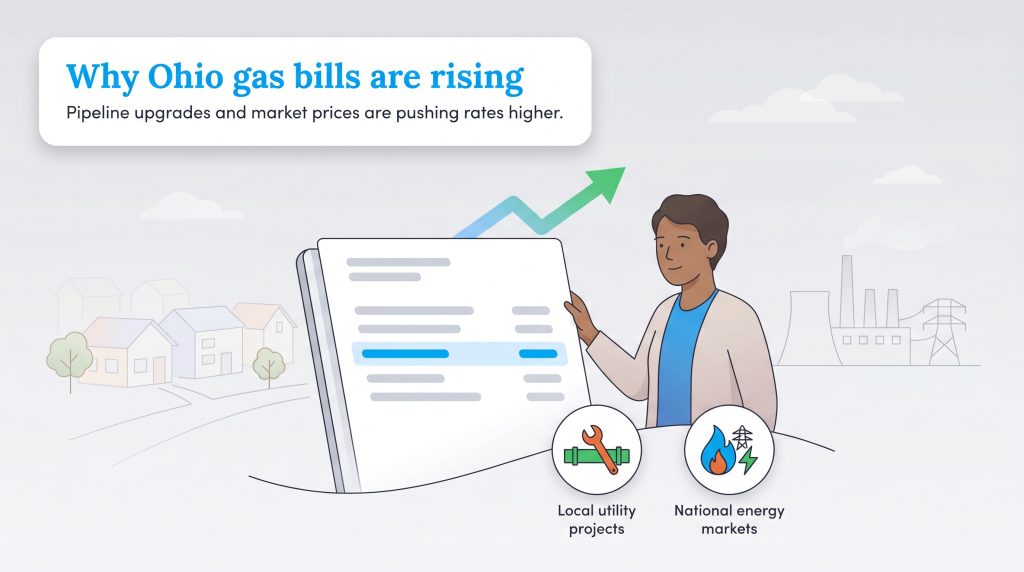
If you are wondering why your natural gas rates are climbing during the warm summer months, the answer lies in a mix of major local utility projects and national energy market forces. Regulated utilities in Ohio do not make a profit on the actual natural gas commodity they sell to you; they simply pass the wholesale fuel costs directly through to your bill. However, when market conditions fluctuate or companies upgrade their physical delivery systems, those costs eventually filter down to the customer.
Local Distribution Upgrades and Regulatory Decisions
For Duke Energy Ohio, the main driver is a series of long-term investments in southwest Ohio. The company is recovering $1.4 billion that was spent over a 10-year period to upgrade regional pipeline networks, balance pressure, and improve safety. State regulators at the Public Utilities Commission of Ohio approved a $48.8 million annual revenue increase to cover these infrastructure updates. This includes the construction of the 14-mile Central Corridor Pipeline in Hamilton County, an above-ground regulator station in College Hill, and the replacement of 3.5 miles of a vintage 1948 pipe along Kellogg Avenue.
Global and Regional Wholesale Market Pressures
For CenterPoint and Columbia Gas of Ohio, the rate increases starting June 1, 2026, are tied to monthly wholesale market adjustments. These companies use a Standard Choice Offer (SCO) supply system, which resets every month based on the national market settlement prices. Additionally, regional electric grid operator PJM Interconnection recently experienced a 22% spike in its capacity auction, which is putting pressure on natural gas because gas-fired power plants are heavily relied upon to meet regional electric demands. High grid capacity demand creates a feedback loop that drives up wholesale commodity costs for retail natural gas customers.
How the Rate Hikes Will Impact Your Monthly Bill
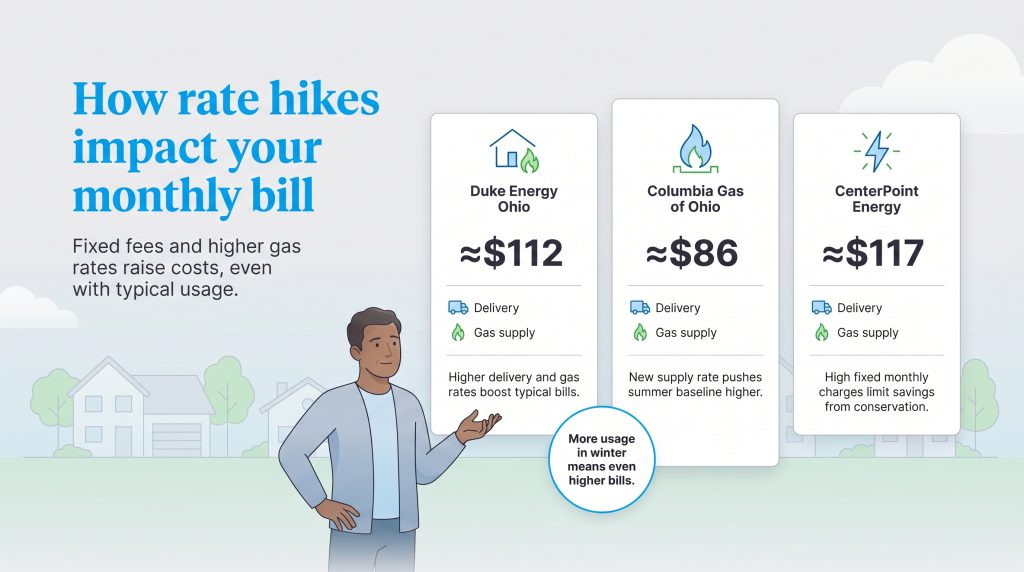
The impact on your monthly budget will depend heavily on your local utility and how much gas your household consumes. While natural gas usage is typically lower during the summer, these changes will establish a higher baseline cost for the cooler autumn and winter months ahead. If you remain on your utility’s default supply plan, your bill is split into distribution fees (delivery) and commodity costs (the actual gas).
| Utility Company | Rate Before June 1, 2026 (per Ccf) | New Rate on June 1, 2026 (per Ccf) | Percentage Increase |
| Duke Energy Ohio | $0.7586 | $0.9850 | 29.84% |
| CenterPoint Energy | $0.4388 | $0.4903 | 11.74% |
| Columbia Gas of Ohio | $0.4809 | $0.5290 | 10.00% |
Duke Energy Ohio Bill Breakdown
If you are a typical Duke Energy customer using an average of 57 Ccf of natural gas per month, your delivery fees already increased by $6.08 in May, raising your typical monthly distribution-only charges to $96.22. Combined with the default GCR supply charge of $0.9850 per Ccf, your new standard monthly total bill will rise to approximately $112.16. Keep in mind that if your household uses more than 400 Ccf in a single billing cycle during the freezing winter months, your volumetric distribution fee will automatically step up from $0.032728 to $0.097278 per Ccf, compounding seasonal costs.
CenterPoint Energy Bill Breakdown
For CenterPoint customers on Rate A, you will face a high fixed monthly charge of $62.32 (inclusive of taxes and riders). When you add the new SCO supply charge of $0.4903 per Ccf and a volumetric delivery rate of $0.06799 per Ccf, a moderate usage of 100 Ccf in a month will result in a total bill of approximately $117.19. Because CenterPoint’s baseline fixed charge exceeds $61 even with zero gas usage, you are exposed to a heavy monthly fixed cost regardless of your conservation efforts.
Columbia Gas of Ohio Bill Breakdown
According to utility projections, the Columbia Gas SCO rate increase to $0.5290 per Ccf will bring the estimated June monthly bill for an average residential customer to $85.88 (calculated with standard county sales taxes and a 4.987% Gross Receipts Tax on non-gas charges). This represents a $16.21 increase compared to the average June bill of $69.67 in the previous year, which highlights how steadily rising supply and delivery fees are chipping away at household budgets.
Major Ohio Cities and Areas Affected by the New Tariffs
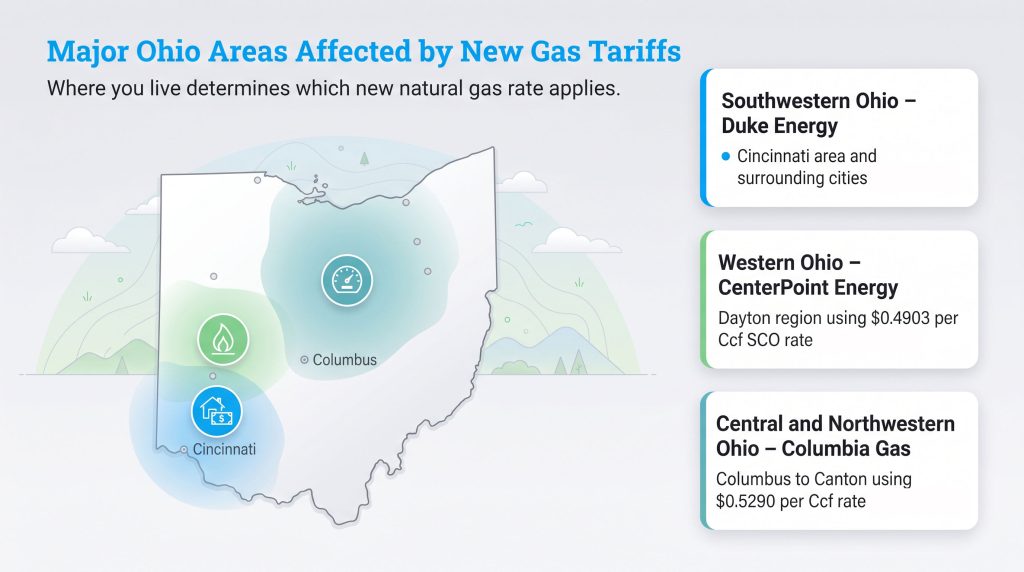
The upcoming rate increases — scheduled to take effect on June 1, 2026 — will affect millions of households across western, central, and southwestern Ohio. Because utilities operate within sprawling service territories, your specific rates are tied to where you live, not necessarily your city limits. We have mapped out the primary metropolitan areas and surrounding municipalities that will see rates adjust.
Southwestern Ohio (Duke Energy)
Duke’s territory covers about 3,000 square miles in southwest Ohio, concentrated in the Cincinnati tristate area. Major municipalities affected include Cincinnati, Norwood, Fairfield, and Middletown.
Western Ohio and Dayton (CenterPoint Energy)
CenterPoint Energy’s natural gas delivery network operates primarily in western and southwestern Ohio. The major cities affected by the $0.4903 per Ccf SCO rate include Dayton, Springfield, Fairborn, and Xenia.
Central and Northwestern Ohio (Columbia Gas)
Columbia Gas has a massive footprint, serving 1.4 million customers across central and northwestern regions. Major areas facing the $0.5290 per Ccf rate include the Columbus metropolitan area (including Westerville, Dublin, Grove City, Hilliard, and Powell), Canton, and Alliance.
Smart Ways to Avoid Rising Rates and Protect Your Budget
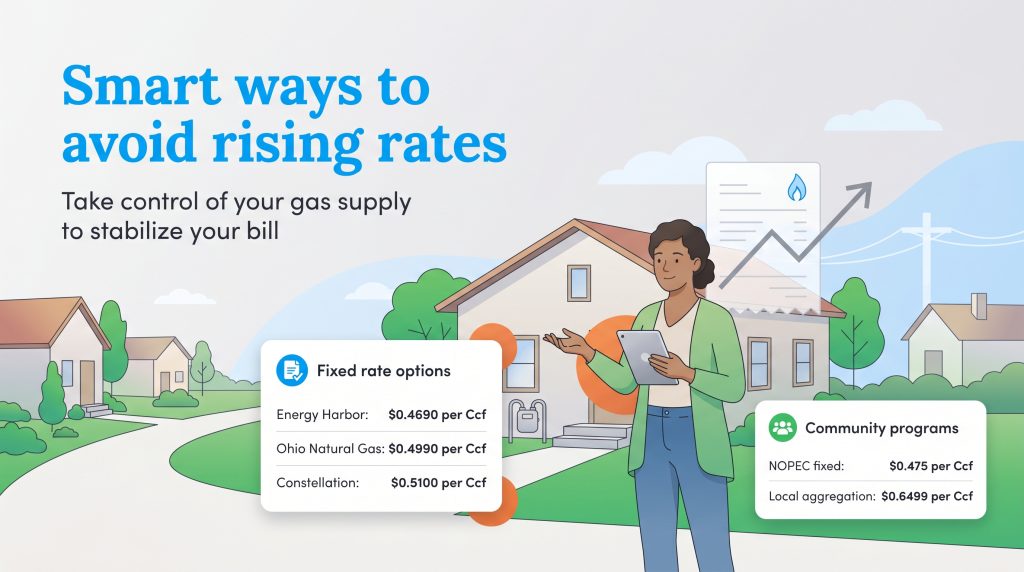
Because Ohio is an energy choice state, you are never forced to stay on your utility’s default supply plan. You can actively shop around, compare retail suppliers, or join a community program to find a stable price that fits your budget. Taking control of your utility supply charges is one of the easiest ways to protect your household from volatile monthly bill swings.
Comparing and Switching Retail Suppliers
By using the state-operated Energy Choice Ohio comparison portal, you can browse fixed-rate offers from certified retail suppliers and compare them against your utility’s price to compare. For example, if you are a Duke Energy customer facing a default GCR rate of $0.9850 per Ccf, switching to a fixed contract can yield immediate savings:
- Energy Harbor LLC: Offers a 12-month fixed rate of $0.4690 per Ccf with no early termination fee.
- Ohio Natural Gas: Offers a 12-month fixed rate of $0.4990 per Ccf with a $25 early termination fee.
- Constellation: Offers a 12-month fixed rate of $0.5100 per Ccf with a $150 early termination fee.
If you are a CenterPoint customer, you can lock in a 12-month fixed contract with Ohio Natural Gas at $0.5390 per Ccf, while Columbia Gas customers can consider a 12-month contract with Santanna Energy at $0.5009 per Ccf. Always read the terms closely: avoid variable introductory plans that spike after the first month, and pay attention to early termination fees that could cost you up to $150 if you switch plans early.
Joining Community and Municipal Aggregation Programs
Many Ohio communities use bulk purchasing power to negotiate competitive, fixed rates for their residents. These opt-out programs automatically enroll eligible households unless you actively return a paper form to opt out. If you live in a community served by NOPEC (Northeast Ohio Public Energy Council), you can access summer-fall rates effective through December 2026. For Columbia Gas customers, NOPEC’s Standard Program rate is $0.635 per Ccf, but you can choose a highly competitive 24-month fixed rate of $0.475 per Ccf with no early termination penalties.
In southwest Ohio, communities like Fairfield and Union Township have secured a natural gas aggregation rate of $0.6499 per Ccf through AEP Energy, which runs through October 2026. This is a highly stable, competitive fixed rate that shields you from Duke’s variable $0.9850 per Ccf rate during high-use seasonal swings.
Eco-Conscious Energy Options and Bill Assistance
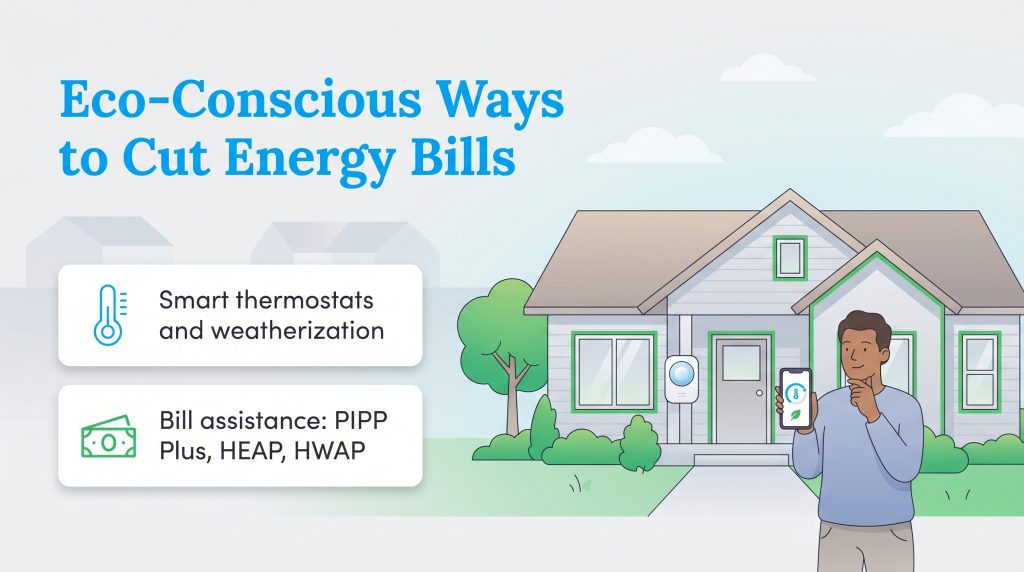
If you are looking for long-term solutions, reducing your actual natural gas consumption is the most environmentally mindful choice. The cheapest unit of energy is the one you never use, and saving energy directly shrinks both your utility bills and your carbon footprint. Whether you are standardizing a new home or looking to retroactively improve your current residence, several programs and technologies can help you optimize your consumption.
Energy-Saving Technologies and Weatherization
Investing in a programmable or smart thermostat is an excellent energy-saving option that helps you automate your home’s heating schedules. Columbia Gas of Ohio offers online rebates of $75 on certified smart thermostats and $25 on programmable models, which are excellent tools to help you lower your volumetric consumption. Additionally, you can target drafts around windows, doors, and foundational vents to stop expensive heat from escaping during the colder months. You can also look for appliances backed by Energy Star to ensure you are selecting products with top-tier efficiency ratings.
State and Federal Assistance Programs
For income-eligible households facing heavy utility burdens, several state-mandated programs are available to help keep costs manageable:
- PIPP Plus (Percentage of Income Payment Plan): If your household income is up to 175% of the federal poverty guidelines, you can pay a consistent, capped percentage of your gross monthly income (usually 5% for gas and 5% for electricity) rather than paying market-based volumetric utility rates.
- HEAP (Home Energy Assistance Program): This federally funded program provides a once-yearly direct credit to your utility account to help offset winter heating or summer cooling costs.
- HWAP (Home Weatherization Assistance Program): This program provides free home energy audits and weatherization remedies, such as attic insulation, air sealing, and furnace tune-ups, to permanently lower your volumetric energy demand.
Taking Control of Your Energy Future
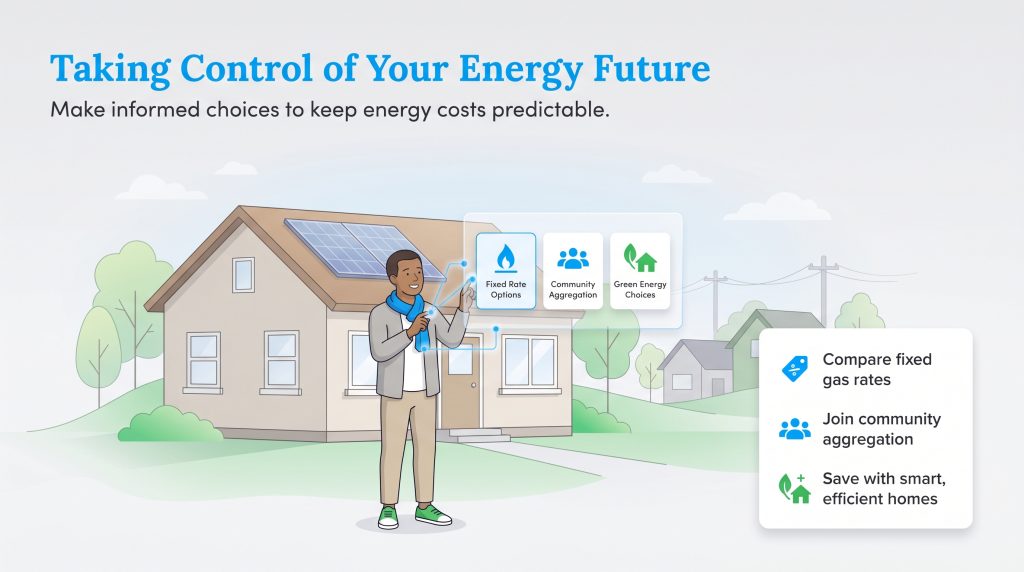
Navigating the shifting landscape of Ohio’s natural gas rates can feel like a daunting task, but you have more power than you might realize. Rising default tariffs are a strong reminder of the importance of being an active, engaged energy consumer. By comparing competitive fixed rates, utilizing community aggregation, and adopting environmentally mindful choices like home weatherization and smart thermostats, we can work together to keep our utility costs predictable, affordable, and sustainable.
Frequently Asked Questions About Rising Natural Gas Rates
Why is my Ohio natural gas delivery rate going up?
Can I avoid paying new utility delivery charges if I switch suppliers?
What is the difference between a fixed-rate and a variable-rate natural gas plan?
What should I look out for when choosing a new natural gas supplier?
About the Author

Claudio is a sustainability-focused writer with a background in Anthropology and Psychology from NC State University. He has spent over 15 years working in writing, interpretation, and translation, driven by a deep interest in how human culture shapes the environment. Today, he shares his curiosity with readers by writing about sustainable living solutions and the connection between everyday choices and environmental impact.