
Read our comprehensive 2026 review of Sunrun Solar to discover true costs, coverage areas, payment plans, and real customer experiences before signing a contract.
Key Takeaways
- Sunrun is the largest residential solar installer in the United States, offering highly accessible $0 down lease and PPA options alongside standard system purchases.
- They partner with leading brands like Tesla and Ford to provide advanced home battery storage and smart electric vehicle charging integration.
- Customer reviews are heavily mixed, highlighting praise for predictable energy bills but noting frequent complaints regarding installation delays and post-sale support.
Sunrun is the largest residential solar installer in the U.S., actively serving well over one million homes as an A+ BBB-accredited company since its launch in 2007. Their primary mission is to help you take decisive control of rising utility costs while significantly boosting your home’s resilience and sustainability against unpredictable grid outages. By offering flexible financing options for residential panel and battery installations—including the Sunrun Subscription Plan, cash purchases, and solar loans—they make adopting renewable energy a highly accessible, environmentally mindful choice for the everyday household consumer.
How Sunrun Solar Works
💡 Bottom Line: Sunrun scores points for making clean energy highly accessible with zero-down financing and top-tier equipment partnerships. Their primary benefit is hassle-free leasing, as they handle all maintenance and monitoring for up to 25 years. However, their primary drawback is a significant volume of negative customer reviews citing frustrating communication gaps, lengthy installation delays, and aggressive third-party sales tactics.
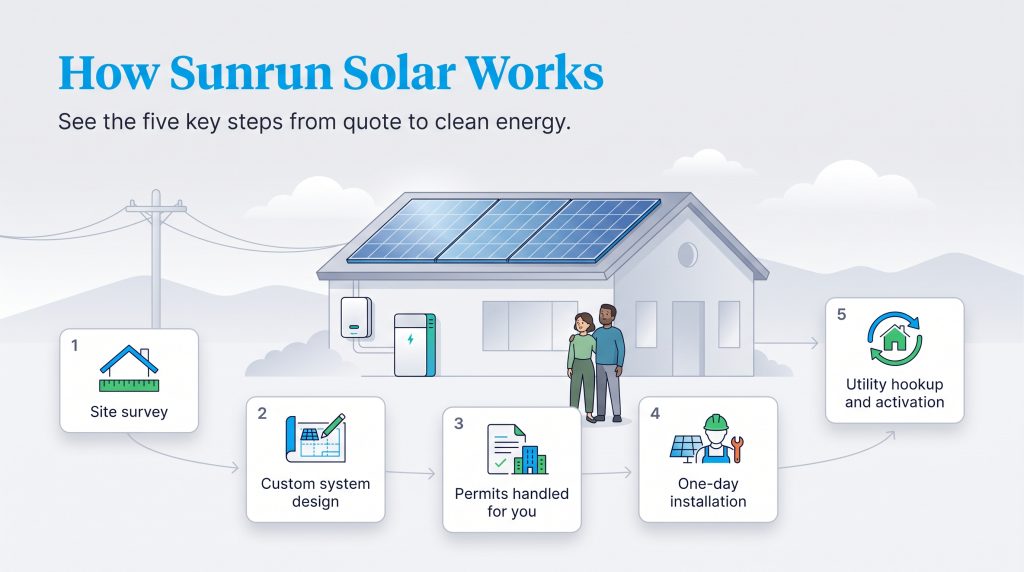
The journey begins with a free quote based on your zip code and average monthly electricity bill, which immediately prompts a consultation call from a solar advisor. Following this initial conversation, Sunrun takes over the entire project management pipeline from start to finish. The Sunrun solar installation process breaks down into five distinct steps to ensure a smooth transition to renewable energy.
- Site Survey: A specialized technician visits your property to meticulously measure your roof, evaluate its structural condition, and assess your home’s overall solar generation potential.
- System Design: Based on the physical survey data, Sunrun engineers create a custom system blueprint. You will review and officially approve the layout and specific hardware choices.
- Permitting: Sunrun handles all the complex local paperwork and permit filings required by your city. This administrative step can routinely take up to eight weeks, depending entirely on your local municipality’s backlog.
- Installation: Typically completed in a single day by a professional crew, this hands-on step involves securely mounting the panels, placing the inverter, running the necessary wiring, and setting up any battery storage units.
- Utility Hookup and Activation: Your city and local utility provider conduct a final inspection to grant Permission to Operate (PTO). This final step often involves swapping your standard utility meter for a bidirectional net meter so you can officially turn your system on.
Sunrun Pricing and Payment Plans
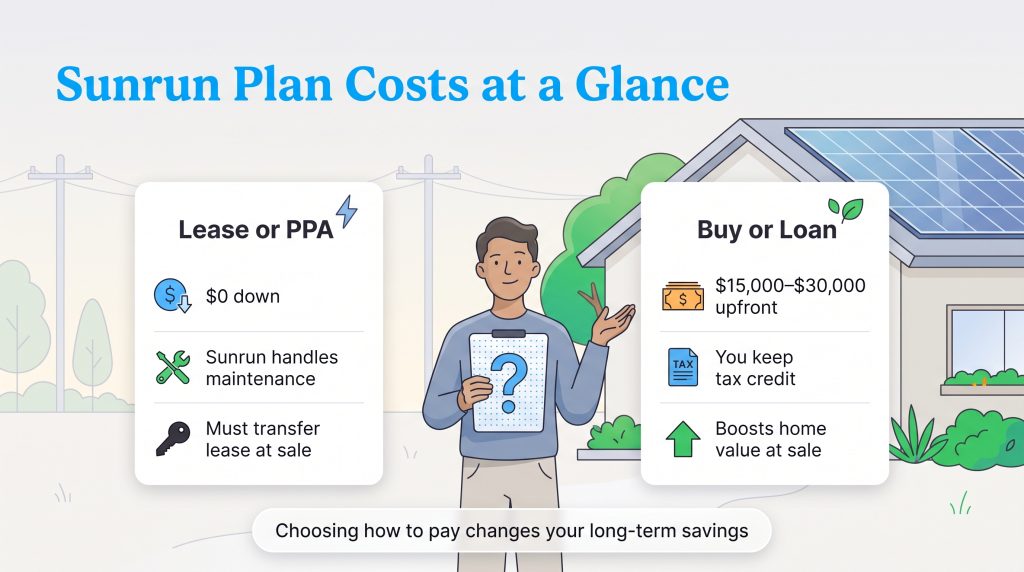
Understanding the financial commitment is absolutely crucial before you sign a 20- or 25-year solar contract. Sunrun offers excellent flexibility to match different household budgets, but you must firmly grasp the exact differences between their specific payment models to make an informed choice.
The highly popular Sunrun Subscription Plan functions as a solar lease or a Power Purchase Agreement (PPA). This arrangement allows you to adopt an energy-saving option with absolutely $0 down. With a standard lease, you pay a fixed monthly fee to simply “rent” the system. With a PPA, you agree to buy the actual electricity the panels produce at a set per-kWh rate. While this rate is typically lower than your local utility’s pricing, PPA contracts often include an annual escalator clause that increases your per-kWh rate slightly each year.
Alternatively, purchasing the system outright or securing a solar loan requires a larger upfront investment but yields the absolute highest long-term financial return. Depending on your home size, specific energy needs, and regional labor rates, an outright solar installation generally averages $15,000 to $30,000 before applying any local or federal incentives.
| Plan Feature | Sunrun Subscription Plan (Lease/PPA) | Outright Purchase or Solar Loan |
|---|---|---|
| Upfront Cost | $0 down | $15,000 to $30,000 (Average) |
| Maintenance Responsibility | Handled entirely by Sunrun | Handled by the homeowner |
| Tax Credit Eligibility | No (Sunrun claims the credit) | Yes (Homeowner claims the credit) |
| Impact on Home Sale | Contract must be transferred to the new buyer or bought out | Increases property value and sells seamlessly with the home |
Deals, Incentives, and Tax Credits
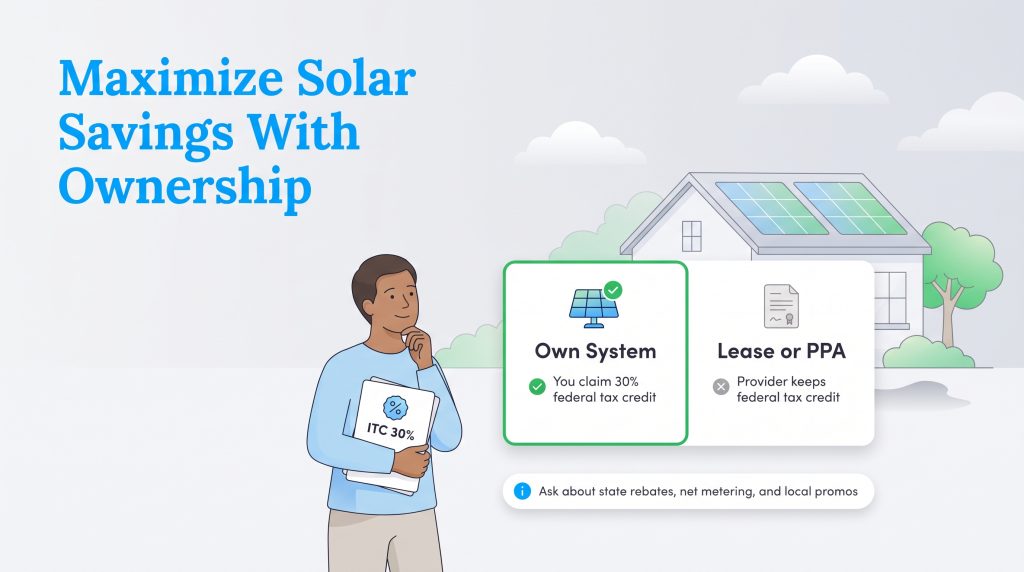
To heavily sweeten the financial appeal of going green, homeowners who purchase their system outright or finance it with a solar loan can take full advantage of the Federal Solar Investment Tax Credit (ITC). This highly lucrative federal incentive allows you to deduct 30% of your total installation costs directly from your federal taxes, significantly slashing the overall price tag of your new home upgrade.
It is incredibly important to note that federal and local tax credits only apply if you technically own the system. If you opt for the Sunrun Subscription Plan (Lease/PPA), Sunrun remains the legal owner of the equipment. Consequently, Sunrun claims the federal tax credit, not you. Beyond federal incentives, you should always ask your local solar advisor about specific state-level rebates, local net-metering programs, and any current seasonal promotions available in your immediate zip code.
Sunrun Coverage Area
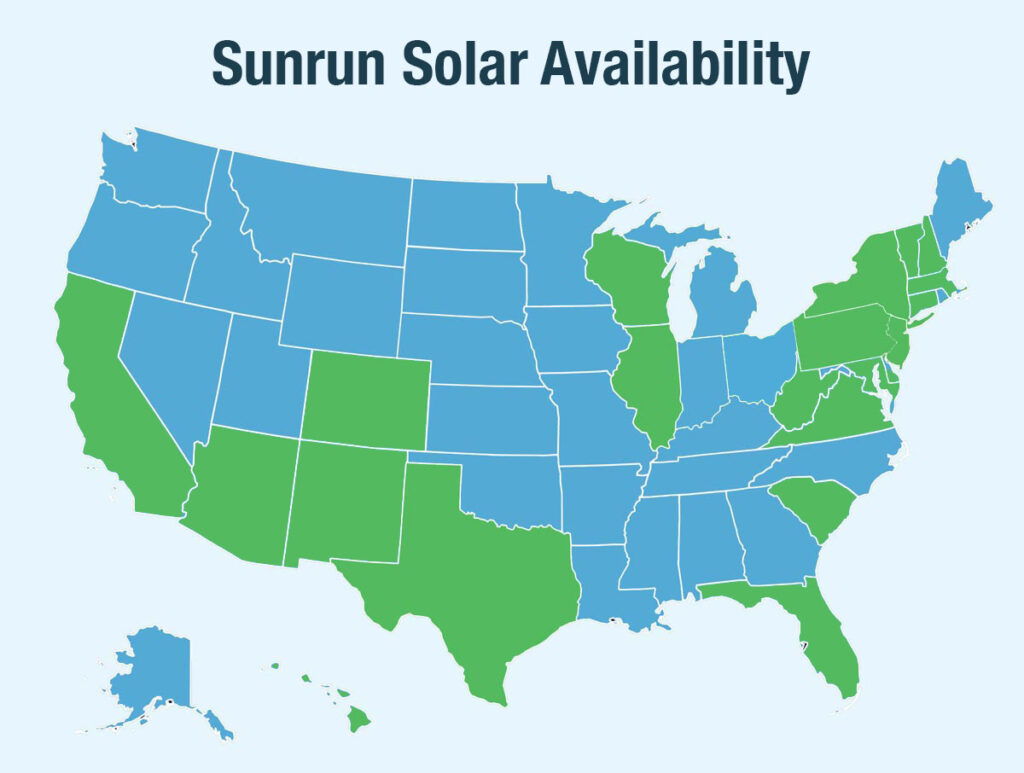
Sunrun currently operates across 20 states, Washington D.C., and Puerto Rico. While their national footprint is massive, their installer network presence is especially concentrated in major metropolitan areas featuring favorable state-level energy policies and high sunshine averages.
Before committing to a consultation, verify that your specific zip code is eligible for full installation and ongoing support services. Below is the current list of covered regions.
- Arizona
- California (Sacramento, San Diego, San Francisco)
- Colorado
- Connecticut
- Florida (Miami, Orlando)
- Hawaii
- Illinois
- Maryland
- Massachusetts
- Nevada
- New Hampshire
- New Jersey
- New Mexico
- New York
- Pennsylvania
- Puerto Rico
Equipment and Battery Storage Options
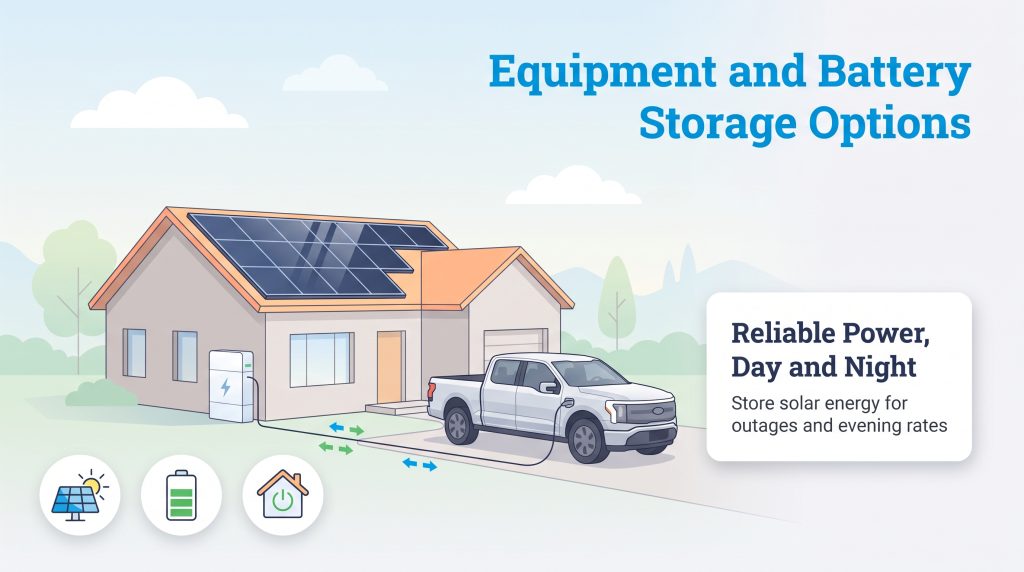
To ensure your energy system performs flawlessly for decades, Sunrun sources high-efficiency, Tier-1 premium monocrystalline panels from industry-leading manufacturers. Depending on local availability, their hardware lineup frequently includes top-tier panel brands such as JA Solar, Jinko, LG, Longi, and Panasonic. Their system inverters rely on respected names like SolarEdge to guarantee optimal direct-current to alternating-current energy conversion for your home.
For homeowners seeking true energy independence, Sunrun battery storage is an absolute game-changer. They offer premium residential backup systems from top manufacturers, prominently featuring the highly sought-after Tesla Powerwall, alongside the LG Chem RESU and Lunar Energy battery options. Adding a battery backup powerfully protects your household against unpredictable grid outages by securely keeping your refrigerator running and essential lights on during emergencies.
A home battery also allows you to store excess daytime solar energy for nighttime use. By tapping into your stored power when the sun goes down, you actively avoid expensive time-of-use (TOU) utility rates during evening peak hours. Sunrun strongly supports modern electric vehicle integration as well, notably partnering with Ford to turn the F-150 Lightning into an emergency bidirectional backup power source for your entire house.
📌 Quick Fact: Battery add-ons like the Tesla Powerwall are expanding rapidly but remain somewhat limited to select high-demand states, including California, Texas, Florida, Puerto Rico, Hawaii, New York, Massachusetts, and Colorado.
Sunrun Mobile App and System Monitoring
Modern utility management requires intuitive digital tools, and the mySunrun mobile app delivers a comprehensive energy dashboard right to your smartphone. Designed for everyday users rather than strictly tech enthusiasts, the app is an essential part of the post-installation experience.
Through the mySunrun digital interface, you can effortlessly track your real-time solar energy production, allowing you to see exactly how much clean power your roof is generating at any given moment. If you have a battery system installed, the app lets you closely monitor your home battery storage levels, giving you total peace of mind during unexpected grid outages.
The app also streamlines your overall account administration. You can quickly review your historical power usage charts, download essential contract documents, and automatically pay your monthly bills directly through the mobile platform.
Sustainability and Green Energy Initiatives
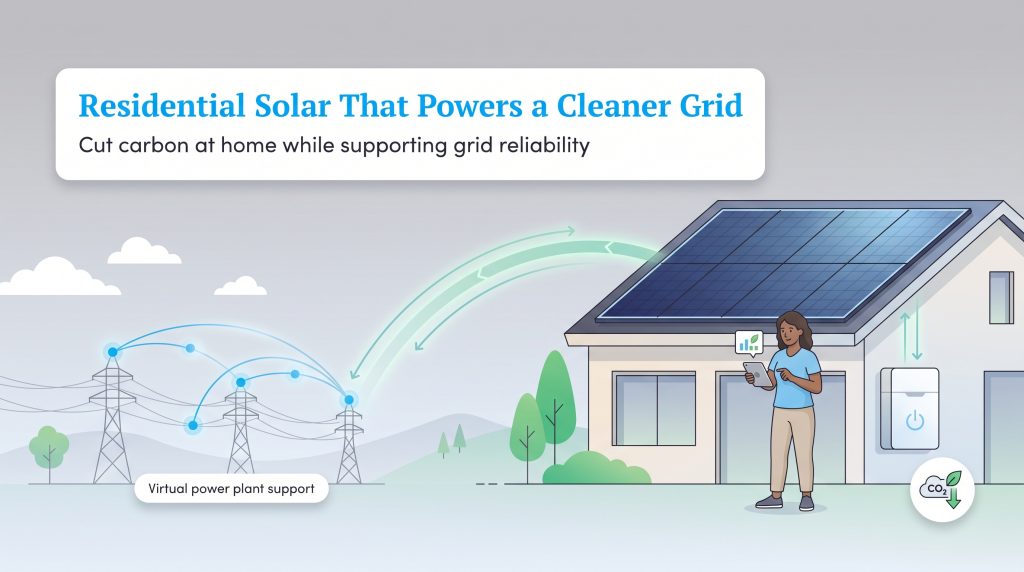
Aligning perfectly with modern eco-conscious values, choosing residential solar drastically reduces a household’s carbon footprint. Sunrun contributes significantly to clean energy adoption nationwide by helping homeowners seamlessly replace heavily polluting fossil fuels with sustainable, emission-free power. Transitioning to a standard home solar system can reliably offset several tons of carbon dioxide emissions annually — providing an environmental impact roughly equivalent to planting over a hundred trees each year.
Sunrun is also pioneering innovative virtual power plant (VPP) initiatives across the country. These highly advanced programs network thousands of individual home batteries together to actively stabilize local electrical grids during periods of extreme peak demand. By participating in a VPP, your home directly supports the broader community by dispatching stored clean energy exactly when the regional grid needs it most, which significantly reduces the local utility’s reliance on dirty, inefficient “peaker” power plants.
Sunrun Solar Customer Reviews
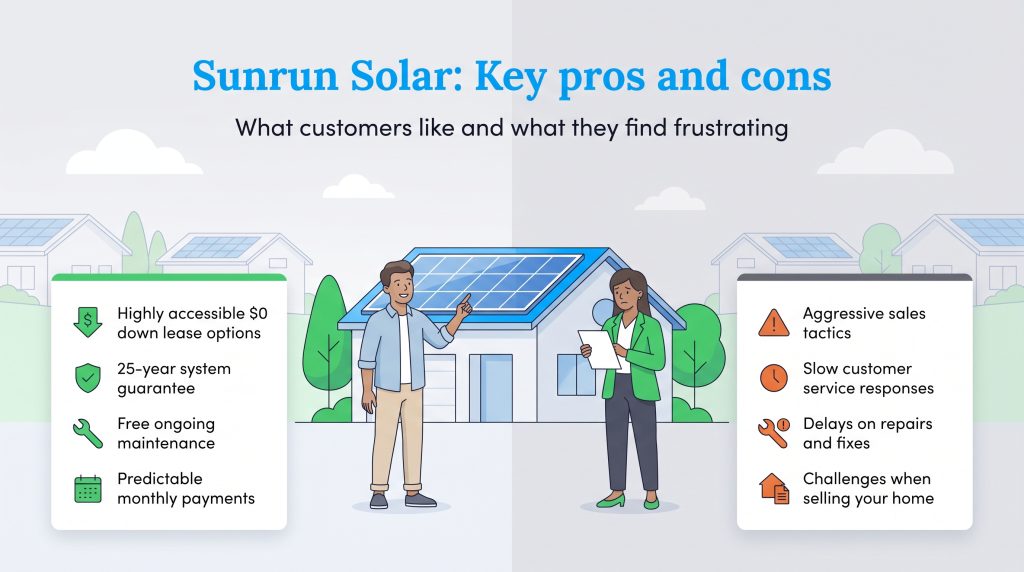
When evaluating any major residential utility provider, understanding the aggregate customer sentiment is just as important as reviewing the technical specifications. Sunrun’s reputation is heavily mixed across third-party review sites like the Better Business Bureau (BBB), Consumer Affairs, and Reddit, accurately reflecting the sheer logistical challenges of managing a massive, nationwide network of independent regional contractors.
To help you weigh the benefits and drawbacks, we have compiled an objective summary of what current customers frequently report regarding their daily experiences with the brand.
Common Customer Praise
- Highly accessible $0 down lease options: Many customers love getting immediate utility bill relief without taking out a massive personal loan.
- Comprehensive 25-year system guarantee: Homeowners appreciate the profound peace of mind that comes with long-term production and roof-leak coverage.
- Free ongoing maintenance: Lease and PPA customers frequently highlight how hassle-free the experience is since Sunrun covers all physical repairs.
- Predictable monthly billing: Users heavily value the strict financial predictability of fixed monthly lease payments compared to violently fluctuating utility rates.
Frequent Customer Complaints
- Aggressive sales tactics: Prospective buyers frequently complain about overly pushy, door-to-door sales representatives pushing unrealistic financial savings.
- Long wait times for customer service: A large portion of negative feedback centers around severely frustrating communication gaps when attempting to reach corporate support.
- Delayed roof repairs and maintenance: Homeowners regularly report agonizingly slow response times when waiting for a technician to fix underperforming panels or faulty inverters.
- Complications when selling a home: Customers often note that transferring a strict 25-year lease to a new homebuyer can occasionally delay or complicate a real estate transaction.
Deciding If Sunrun Is Right for Your Home
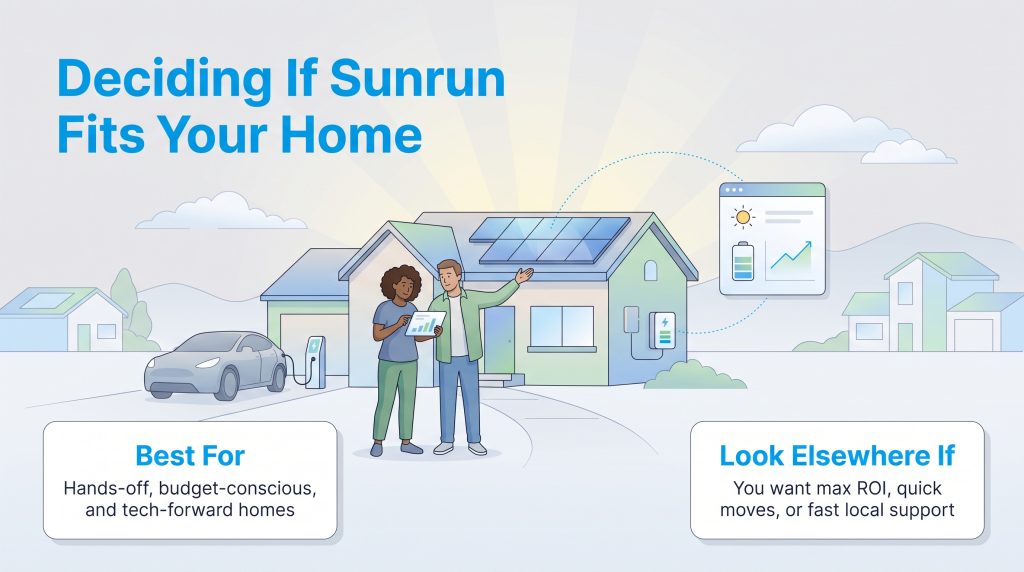
If you are looking for an established, reputable provider with incredibly flexible, low-risk entry paths into renewable energy, Sunrun shines brightly. Their highly polished app monitoring, inclusive roof-leak warranties, and cutting-edge integrations with home batteries offer a distinctly future-ready setup. Because they heavily rely on third-party regional contractors to execute the physical work, your specific experience may vary wildly depending entirely on your zip code. To help you make the absolute best decision, we have broken down exactly who makes a good candidate for this solar giant.
Who Sunrun is Best For:
- Hands-off consumers: If you strongly prefer a “set it and forget it” approach where the provider remotely monitors the system and includes all physical maintenance for free.
- Budget-conscious homeowners: If you want immediate utility bill relief without steep upfront costs, their $0 down lease or PPA options are highly appealing.
- Tech-forward households: If you currently drive an electric vehicle or deeply want seamless Tesla Powerwall backup integration fully managed from a single, intuitive app.
Who Should Look Elsewhere:
- Maximum ROI seekers: If your absolute primary goal is maximizing your long-term financial returns through federal tax credits, outright system ownership, and immediate property value increases.
- Short-term residents: If you actively plan to move within the next five years, navigating the transfer of a 25-year leased solar system to a new buyer can be an unnecessary headache.
- Customer service sticklers: If you naturally demand rapid, localized customer support and immediate technical responses, Sunrun’s notoriously slow corporate resolution times will likely frustrate you.
Whether your ultimate goal is to completely own your system or simply ease into an eco-conscious lifestyle with a low-risk subscription, Sunrun caters comprehensively to both avenues. We strongly recommend carefully analyzing your specific contract details, comparing the upfront costs against local regional competitors, and reading real reviews specifically for the assigned installers in your immediate area before signing on the dotted line.
Frequently Asked Questions About Sunrun Solar
Is Sunrun a legitimate company?
Yes, Sunrun is a highly legitimate, publicly traded company. Since its initial founding in 2007, it has grown exponentially to become the largest residential solar and battery storage installer in the United States, actively servicing well over one million homes.
What is the Sunrun Subscription Plan?
The Sunrun Subscription Plan is a flexible financial agreement that functions as either a solar lease or a Power Purchase Agreement (PPA). It allows you to adopt clean energy with exactly $0 down. Sunrun retains ownership of the equipment, and you simply pay for the power the system produces or a flat monthly fee to rent the panels.
Does Sunrun put a lien on my house?
No, Sunrun does not place a traditional property lien on your house. Instead, they file a Uniform Commercial Code (UCC-1) financing statement on the title of your home. This document simply alerts anyone doing a title search that Sunrun officially owns the solar equipment attached to the property. It is not a debt lien, but it may require temporary lifting if you decide to refinance your mortgage.
Can I buy my Sunrun system outright?
Yes. The purchase option lets you confidently pay for the system upfront or through a solar loan. By owning the panels, you fully qualify for the 30% federal tax credit and independently keep all energy savings, offering the absolute highest long-term return on investment.
Can I sell my home if I have a Sunrun lease or PPA?
Yes, you can easily sell your home. Sunrun employs a dedicated Service Transfers team to help you seamlessly transfer your ongoing solar agreement directly to the new homeowner. Alternatively, you always have the option to buy out the remainder of the contract and simply include the paid-off system in the final sale price of your home.
How much does Sunrun charge per kWh?
The exact per-kWh rate Sunrun charges under a Power Purchase Agreement (PPA) heavily depends on your location, local utility rates, and specific system size. While it is explicitly designed to be cheaper than your standard utility rate, PPA contracts typically include an annual escalator — often ranging from 2% to 4% — which slowly increases your rate over time to match inflation.
Does Sunrun offer the Tesla Powerwall?
Yes. Sunrun strongly partners with Tesla to offer the highly advanced Tesla Powerwall as a premium home battery storage option. This allows you to securely store excess daytime solar energy to power your home during unexpected grid outages or expensive evening utility peaks.
How do I cancel a Sunrun solar contract?
You generally have a very short legal cancellation window — usually three to ten days, depending heavily on your specific state laws — after initially signing to back out completely without any penalties. If you attempt to formally cancel after physical installation begins or mid-contract, you will likely face severe early termination fees or be strictly required to buy out the remainder of the agreement.
Does Sunrun cover roof leaks caused by installation?
Yes. Sunrun provides a comprehensive roof penetration warranty. This vital coverage lasts for 10 years if you completely purchase your system and powerfully extends up to 25 years for lease and PPA customers, explicitly covering any repairs if their installation work directly causes a roof leak.
What happens if my panels underproduce?
Sunrun explicitly guarantees your leased system will steadily produce at least 90% of its originally estimated output for 25 years. If it noticeably underperforms, they are contractually obligated to fix it entirely for free or properly reimburse you for the resulting energy shortfall.
How do I contact Sunrun customer service to report an outage or underperforming panels?
You can rapidly report system issues directly through the mySunrun mobile app interface or by calling their main national customer care line. If your digital dashboard displays an inverter error or communication loss, submitting a ticket immediately through the app is often the fastest way to initiate a technician dispatch.
About the Author

LaLeesha has a Masters degree in English and enjoys writing whenever she has the chance. She is passionate about gardening, reducing her carbon footprint, and protecting the environment. She also recently served as President of the Board for City Sprouts (a community garden).