
- Free Xfinity Mobile Line for 1 year
- Free Peacock Premium*
- Free WiFi Equipment for 24 months
- $100 Visa Prepaid Cards for students
Quick Utility Facts
- The electric and natural gas utility is PG&E. Most residents are automatically enrolled in CleanPowerSF for electricity.
- You have the right to choose a different natural gas supplier and plan that is best for your home.
- Internet service from Xfinity and AT&T Fiber is widely available in the city.
- The cheapest internet plan in SF is $30.00/month from Xfinity.
- Water and sewer services are provided by San Francisco Water Power and Sewer.
- Trash and recycling collection is provided by Recology.
Top 2 Electric Providers in San Francisco
San Francisco Water Power Sewer
EnergySage
- Service
- Home solar
- Quotes
- Free
Electricity across the City by the Bay is delivered through a dual-entity framework consisting of Pacific Gas and Electric (PG&E) — which owns the physical power lines, meters, and grid infrastructure — and CleanPowerSF, the city’s municipal Community Choice Aggregation (CCA) program operated by the San Francisco Public Utilities Commission (SFPUC). New residential accounts are automatically enrolled in CleanPowerSF’s default Green tier (sourcing 50 percent renewable energy) or can opt up to SuperGreen (100 percent renewable energy), while PG&E continues to handle customer billing and physical distribution. Due to statewide grid hardening, wildfire mitigation investments, and transmission overhauls, electricity rates in San Francisco are among the highest in the nation, with bundled rates averaging 39 to 41 cents per kWh. Standard residential plans default to Time-of-Use schedules (such as Plan E-TOU-C), where power consumed during peak evening hours (4:00 PM to 9:00 PM daily) carries heavy surcharges, making smart thermostat pre-cooling and late-night appliance load shifting vital for household budgeting.


Top 10 Natural Gas Providers in San Francisco

- Monthly charge
- —
- Rate lock
- 12 Months
- Guarantee
- —

- Monthly charge
- —
- Rate lock
- 1-24 Months
- Guarantee
- —

- Monthly charge
- —
- Rate lock
- —
- Guarantee
- —
IGS Energy
- Monthly charge
- —
- Rate lock
- —
- Guarantee
- —
Tiger Natural Gas
- Monthly charge
- —
- Rate lock
- —
- Guarantee
- —
Vista Energy Marketing
- Monthly charge
- —
- Rate lock
- —
- Guarantee
- —

Big Tree Energy
- Monthly charge
- —
- Rate lock
- —
- Guarantee
- —

National Gas & Electric
- Monthly charge
- —
- Rate lock
- —
- Guarantee
- —
Peak 6
- Monthly charge
- —
- Rate lock
- —
- Guarantee
- —
- Monthly charge
- —
- Rate lock
- —
- Guarantee
- —
Natural gas service across San Francisco is delivered physically by PG&E, which owns, operates, and maintains the city’s underground gas pipeline network and handles emergency leak responses. Because California’s natural gas market operates under a deregulated retail framework overseen by the California Public Utilities Commission (CPUC), residential customers are not required to buy fuel directly from PG&E. Through the state’s Core Gas Aggregation Service (CGAS), you have the option to contract your natural gas supply through an independent third-party Core Transport Agent (CTA) or remain on PG&E’s default regulated core commodity supply rate. Regardless of whether you select a CTA or stick with PG&E’s default gas supply, PG&E continues to transport the gas, read your meter, and charge mandatory pipeline delivery rates alongside a fixed monthly customer charge. Because fuel usage drops significantly during mild fog-bound summer months, volumetric gas costs vary seasonally; however, PG&E’s fixed monthly customer access charge ensures your statement maintains a persistent baseline cost year-round, even when space-heating systems sit idle.


Top 10 Internet Providers in San Francisco

Xfinity
- Speeds up to
- 2 Gbps
- Type
- Cable & Fiber
- Data cap
- Unlimited
- Availability
- 98.14%

AT&T Fiber
- Speeds up to
- 5 Gbps
- Type
- Fiber
- Data cap
- Unlimited
- Availability
- 97.25%

Starlink
- Speeds up to
- 400 Mbps
- Type
- Satellite
- Data cap
- Unlimited
- Availability
- 100%

Verizon 5G Home Internet
- Speeds up to
- 300 Mbps
- Type
- 5G
- Data cap
- Unlimited
- Availability
- 89.24%

T-Mobile 5G Home Internet
- Speeds up to
- 498 Mbps
- Type
- 5G
- Data cap
- 1.2 TB
- Availability
- 53.44%

AT&T Air
- Speeds up to
- 300 Mbps
- Type
- 5G
- Data cap
- Unlimited
- Availability
- 59.32%

- Speeds up to
- 150 Mbps
- Type
- Satellite
- Data cap
- 150-850 GB
- Availability
- 100%

- Speeds up to
- Varies
- Type
- Fiber, Cable, 5G, & Satellite
- Data cap
- Varies
- Availability
- 95%

- Speeds up to
- 8 Gbps
- Type
- Fiber
- Data cap
- Unlimited
- Availability
- 4.78%

Spectrum
- Speeds up to
- 7 Gbps**
- Type
- Cable & Fiber
- Data cap
- Unlimited
- Availability
- Limited
Broadband and digital communications across San Francisco represent a competitive, high-speed data battlefield featuring a strong presence from local independent fiber provider Sonic, an expanding multi-gigabit footprint from AT&T Fiber, a near-universal cable network from Xfinity, fixed wireless from local provider Monkeybrains, and Astound Broadband. Symmetrical fiber connections deliver exceptional low-latency bandwidth ideal for remote tech work and high-definition streaming. However, physical line availability is heavily influenced by neighborhood architecture. If you are moving into a historic Victorian “Painted Lady,” an Edwardian flat, or a pre-war building in neighborhoods like the Mission, Pacific Heights, Haight-Ashbury, or Richmond, thick plaster walls, historic facade protections, and overhead utility line constraints can complicate fiber drops. Furthermore, modern high-density condo towers in SoMa, Mission Bay, or the Financial District frequently feature exclusive corporate property marketing agreements that dictate unit-level broadband access paths.
Water & Sewage Providers in San Francisco


Water, sewer, and urban stormwater utilities are managed by the San Francisco Public Utilities Commission (SFPUC), which delivers pristine, high-purity drinking water sourced directly from the Hetch Hetchy Reservoir in Yosemite National Park. Billed on a single monthly municipal statement, water and sewer charges reflect a multi-year rate increase (climbing roughly 12.6 percent) to fund major seismic retrofits and treatment plant upgrades across aging Gold Rush-era infrastructure. Water usage is billed on a tiered volumetric scale starting at $12.20 per Ccf (748 gallons) for single-family homes. However, wastewater treatment forms the vast majority of your bill, assessed at a steep $20.74 per Ccf of discharged water, alongside a dedicated parcel-based Stormwater Fee. Because sewer charges scale directly with incoming water volume, indoor plumbing leaks or unaddressed running toilets generate immediate financial penalties.
Top 8 Trash and Recycling Providers in San Francisco
Solid waste, recycling, and organic composting services are operated by Recology San Francisco under a long-standing municipal franchise agreement. Recology utilizes a famous three-cart “pay-as-you-throw” system featuring a gray cart for landfill garbage, a blue cart for single-stream recycling, and a green cart for organic food scraps and yard waste. Your monthly trash bill is directly tied to the size of your gray landfill bin (e.g., ~$50.56 per month for a 32-gallon cart), giving households a direct financial incentive to downsize trash capacity. San Francisco enforces strict mandatory composting and recycling laws: all food scraps, coffee grounds, meat bones, and food-soiled paper products must go into the green cart loose or inside certified compostable bags. Placing plastic bags inside the blue or green bins will prompt Recology crews to issue contamination warning notices and bypass your collection.
Utilities Summary for San Francisco, CA
| Electric Companies: | 2 |
| Natural Gas Companies: | 10 |
| Water & Sewage Providers: | 1 |
| Garbage, Trash & Recycling Providers: | 8 |
| Municipal Electricity: | Yes |
Connect your Home to San Francisco Utilities
Moving to San Francisco means stepping into a vibrant mix of historic charm and modern innovation. With its iconic cable cars, diverse neighborhoods, and tech-forward culture, the City by the Bay offers a one-of-a-kind lifestyle. Understanding the local utility services will help make your transition smoother, especially since some providers also offer rebates, green energy options, and financial assistance programs to make city living more manageable.
Electricity in San Francisco
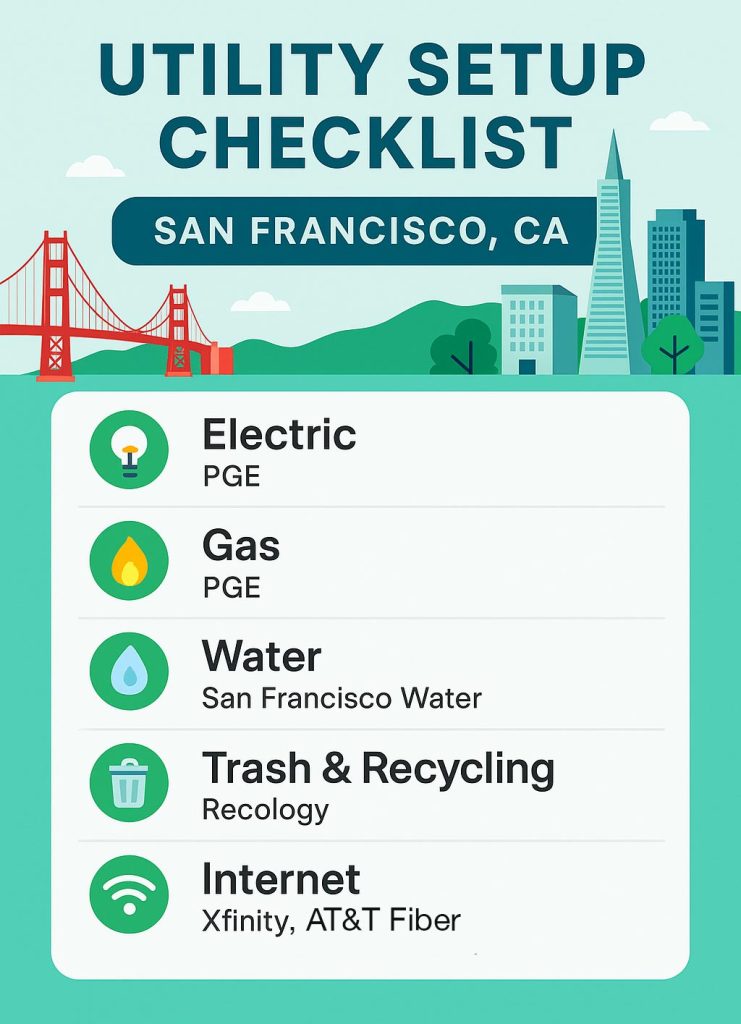
San Francisco’s electricity is primarily provided by Pacific Gas and Electric (PG&E), one of the largest combined natural gas and electric utilities in the U.S. PG&E serves nearly all residential customers in the city and is known for its investments in renewable energy, grid modernization, and safety.
Key facts about PG&E’s electric service
- Service Type: Regulated, no retail competition for electricity in SF
- Green Energy: PG&E’s power mix includes over 40% renewable sources
- Billing: Tiered pricing and Time-of-Use plans available
Energy Efficiency Rebates
PG&E offers extensive energy-saving programs and rebates through its Savings Programs, including:
- Rebates on smart thermostats, insulation, and efficient appliances
- Home Energy Checkups
- Demand Response programs to lower usage during peak times
PG&E participates in Community Choice Aggregation (CCA), so some San Francisco residents are automatically enrolled in CleanPowerSF, a greener alternative that sources more electricity from renewable resources while still using PG&E infrastructure.
Natural Gas in San Francisco
PG&E also supplies natural gas to most homes in San Francisco. However, California has a deregulated natural gas market, allowing residents to choose third-party gas suppliers through Core Gas Aggregation Service (CGAS). While PG&E remains the default provider, switching is possible depending on availability and cost preferences.
Alternative suppliers (availability may vary)
- Vista Energy
- Commercial Energy
- Realgy Energy Services
Tips for Choosing a Supplier
- Compare rates carefully; savings may vary based on usage.
- Read contract terms, especially around cancellation fees.
Rebates and Efficiency
PG&E offers rebates for:
- High-efficiency gas furnaces and water heaters
- Weatherization upgrades
- Appliance recycling programs
Water and Sewer Services
Water and sewer services in San Francisco are managed by the San Francisco Public Utilities Commission (SFPUC). The city’s water is sourced from the Hetch Hetchy Reservoir in the Sierra Nevada, renowned for its quality and cleanliness.
Key SFPUC Features
- Service Area: Entire city of San Francisco
- Water Quality: Excellent, with rigorous testing
- Billing: Bimonthly for most residential customers
Conservation Programs
- Free water-saving kits (showerheads, aerators)
- Rebates for high-efficiency toilets and clothes washers
- Graywater system rebates for laundry-to-landscape setups
San Francisco was one of the first major cities in the U.S. to ban the sale of bottled water on city property, showcasing its commitment to sustainable water use.
Trash, Recycling, and Compost
San Francisco’s waste management is one of the most advanced in the country, with an ambitious goal of zero waste.
Service Provider: Recology San Francisco
Services Included
- Weekly trash, recycling, and compost pickup
- Free bulky item pickup (twice per year)
- Special services for electronics, hazardous waste, and construction debris
Interesting Programs
- Mandatory composting and recycling since 2009
- Discounts for low-income households and seniors
- Recology’s “Artist in Residence” program uses landfill materials to create art
Best Internet Providers in San Francisco
San Francisco is well-served by a range of internet providers, from cable to fiber to 5G wireless. The best provider for your household depends on your speed needs, budget, and address-specific availability.
Top Internet Providers:
- Xfinity
- Cable internet with speeds up to 2 Gbps
- Widely available throughout the city, over 97% availability
- Bundles with TV and mobile options
- AT&T Fiber
- Fiber-optic internet with speeds up to 5 Gbps
- Expanding footprint in San Francisco, now covering around 97% of the city
- Great for streamers and remote workers
- Starry Internet
- Fixed wireless with fast, symmetrical speeds
- Only available in select buildings
Check each provider’s availability using your specific street address. Also, be on the lookout for new fiber expansions, San Francisco is constantly upgrading.
Conservation and Green Energy Initiatives
San Francisco is a national leader in sustainability and climate policy. Whether you’re looking to reduce your carbon footprint or take advantage of eco-friendly programs, the city offers numerous opportunities.
Green Programs and Options:
- CleanPowerSF (default CCA program): Offers two tiers, Green (50% renewable) and SuperGreen (100% renewable)
- Solar Incentives: Through GoSolarSF, the city provides rebates for installing solar panels
- Electric Vehicle (EV) Support: Rebates for EV chargers and extensive public charging networks
- Energy audits and home weatherization offered through PG&E and local nonprofits
Homeowner Tips:
- Combine solar with battery storage for resilience during outages
- Enroll in demand response programs to earn credits for conserving power during peak hours
Financial Assistance Programs for Utilities in San Francisco
If you’re concerned about managing utility bills, San Francisco and the state of California offer several financial assistance programs for eligible households.
Electric & Gas Assistance (PG&E):
- CARE (California Alternate Rates for Energy): 20–35% off your utility bill
- FERA (Family Electric Rate Assistance): Discount for families with slightly higher incomes
- LIHEAP (Low-Income Home Energy Assistance Program): One-time help with bills or weatherization
Water Assistance (SFPUC):
- Community Assistance Program (CAP): 15% discount on water/sewer bills for income-qualified residents
- Emergency Customer Assistance Program: Available for those experiencing financial hardship
Trash Assistance (Recology):
- Discounted rates for seniors and low-income households upon request
- Flexible payment plans
How to Apply:
- Visit each provider’s website for online application portals
- Have income documentation and a recent bill ready
- Call 311 for general help with accessing city services
About the Author

David has been an integral part of some of the biggest utility sites on the internet, including InMyArea.com, HighSpeedInternet.com, BroadbandNow.com, and U.S. News. He brings over 15 years of experience writing about, compiling and analyzing utility data.
San Francisco Internet Connectivity
Fastest Internet Providers in San Francisco
| Provider | Connection Type | Download Speed |
|---|---|---|
| Xfinity | Cable & Fiber | 2 Gbps |
| AT&T Fiber | Fiber | 5 Gbps |
| Starlink | Satellite | 400 Mbps |
| Verizon 5G Home Internet | 5G | 300 Mbps |
| T-Mobile 5G Home Internet | 5G | 498 Mbps |
| AT&T Air | 5G | 300 Mbps |
| Viasat | Satellite | 150 Mbps |
| Earthlink | Fiber, Cable, 5G, & Satellite | Varies |
| Google Fiber | Fiber | 8 Gbps |
| Spectrum | Cable & Fiber | 7 Gbps |
*Not all speeds available in all areas
Utilities in Nearby Cities
Frequently Asked Questions
What is CleanPowerSF and why is it on my bill?
In San Francisco, we have a “Community Choice Aggregation” program. While PG&E delivers your electricity, CleanPowerSF is the default provider that sources the energy from renewable places like wind and solar. You don’t have to do a thing to sign up, it’s automatic, and it’s a great way to reduce your carbon footprint without lifting a finger!
How far in advance should I schedule my PG&E transfer?
We recommend giving PG&E at least five business days of lead time. You can easily do this online or over the phone. If you’re moving into an older Victorian, it’s also a smart move to ask for a free gas safety check when you start your service.
What should I do if I smell gas?
Safety is our top priority! If you smell a “rotten egg” odor, stop what you are doing, leave the building immediately, and do not use any electronic devices. Once you are safely away, call 911 and PG&E at (800) 743-5000.
Is San Francisco's tap water really that good?
It sure is! Most of our water comes from the Hetch Hetchy Reservoir in the Sierra Nevada, and it’s some of the highest-quality tap water in the country. Because we live in a drought-prone state, we always encourage residents to be water-wise.
Can I get free water-saving tools for my new home?
Absolutely. The SFPUC is a great neighbor and offers free “Water-Wise Kits” that include high-efficiency showerheads and faucet aerators. You can even request a free Home Water Audit to help you identify leaks and save money on your monthly bill.
How do I set up my water account?
You can open your account online via the SFPUC website. If you are renting, your landlord usually handles the water bill, but it is always a good idea to confirm who is responsible for the “Clean Water” and “Sewer” charges before you sign your lease.
Why do I have three different trash bins?
San Francisco is on a mission to reach “Zero Waste,” which means we take our sorting seriously! Your black bin is for landfill, blue is for recycling, and green is for compost (food scraps and yard waste). Composting is actually mandatory here, so we recommend keeping a small bin on your kitchen counter to make it easy.
What should I do with all my moving boxes?
Welcome to the neighborhood! Once you’ve unpacked, you can break down your cardboard boxes and place them in (or next to) your blue recycling bin. If you have a mountain of boxes, you can schedule a Bulky Item Recycling pickup with Recology. Every residential account gets two free pickups per year!
Who are the best internet providers in the city?
While big names like Xfinity and AT&T Fiber are everywhere, San Francisco has some fantastic local options. We often recommend checking out Sonic or Monkeybrains, they are local companies that offer blazing-fast speeds and are known for great customer service.
How soon should I book my installation?
Since so many people are moving in and out of the city, technicians can get booked up fast. We suggest scheduling your installation at least two weeks before your move-in date to ensure you aren’t stuck using your phone’s hotspot on your first night in the new place.
Are there ways to lower my utility bills?
Definitely. If you are looking to save, check if you qualify for the CARE or FERA programs through PG&E, which can provide a discount of 18% to 35% on your monthly energy bill. For water, the SFPUC offers a Customer Assistance Program (CAP) for low-income households to help keep those essential services affordable.
How do I lower my Recology bill by downsizing my black cart?
Recology charges monthly rates based on the volume of your gray landfill cart. Because weekly blue recycling and green compost cart pickup are bundled into the service, diverting all food scraps, paper, and recyclables out of the trash allows you to request a smaller gray cart (such as a 20-gallon mini-cart), lowering your monthly utility overhead.
Why are SFPUC sewer charges so much higher than drinking water charges?
While clean drinking water comes from the Hetch Hetchy Reservoir ($12.20 per Ccf), wastewater processing ($20.74 per Ccf) requires expensive regional treatment, combined sewer overflow management, and climate-hardening infrastructure upgrades. Because sewer fees match your incoming water volume, repairing running toilets and water leaks immediately is essential to avoid severe bill inflation.
How does Core Gas Aggregation (natural gas choice) work in California?
Under CPUC regulations, natural gas supply is deregulated for residential customers. You can buy your gas commodity from a third-party Core Transport Agent (CTA) under a custom contract or buy default gas directly from PG&E. In either scenario, PG&E remains responsible for reading your meter, delivering the gas through its physical pipes, and responding to gas leak emergencies.