Is AT&T Internet Right For Your Home?

Discover if AT&T Internet is the right choice for your home with our deep dive into plans, pricing, real-world speeds, and coverage availability.

Key Takeaways
- AT&T Fiber offers symmetrical speeds up to 5 Gbps with no data caps or annual contracts, giving you premium reliability.
- AT&T Internet Air provides flexible 5G connectivity with an easy plug-and-play setup for homes outside the fiber network footprint.
- Bundling internet with AT&T Wireless is one of the most effective ways to lower your monthly bill, saving you up to 20%.
AT&T isn’t just your grandma’s telephone company anymore. They’ve evolved into a connectivity powerhouse, especially renowned for their fiber-optic network, which consistently dominates speed tests and customer satisfaction rankings. In fact, AT&T Fiber was named the fastest ISP of 2025 by Ookla and tied for best provider nationwide with Verizon Fios. We appreciate how they focus on transparent pricing (meaning no sneaky rate hikes after 12 months), 99% network reliability, and bundling perks that make their services affordable and flexible. Plus, their customer support shines in the South and North Central U.S., earning top marks from J.D. Power.
Pros and Cons of AT&T Internet
Before diving into the detailed AT&T internet pricing and plan structures, here is a quick overview of where this provider excels and where it might fall short depending on your location. Knowing these advantages and disadvantages can help you decide if it perfectly matches your household needs and budget.
| Pros | Cons |
|---|---|
| ✅ AT&T Fiber delivers ultra-fast, symmetrical speeds | ❌ AT&T Fiber is not yet available in all neighborhoods |
| ✅ AT&T Internet Air offers seamless, no-drill installation | ❌ AT&T Internet Air speeds fluctuate based on 5G signal strength |
| ✅ No annual contracts or data caps on fiber and 5G plans | ❌ Professional installation may be required for new fiber setups |
| ✅ Excellent bundling discounts if you use AT&T Wireless | ❌ Higher starting prices compared to some budget competitors |
| ✅ Strong promotional rewards and advanced equipment included | ❌ Legacy DSL plans are outdated and slowly being phased out |
| ✅ Generous low-income and community support programs | ❌ Customer service wait times can occasionally be lengthy |
AT&T Availability and Coverage Map
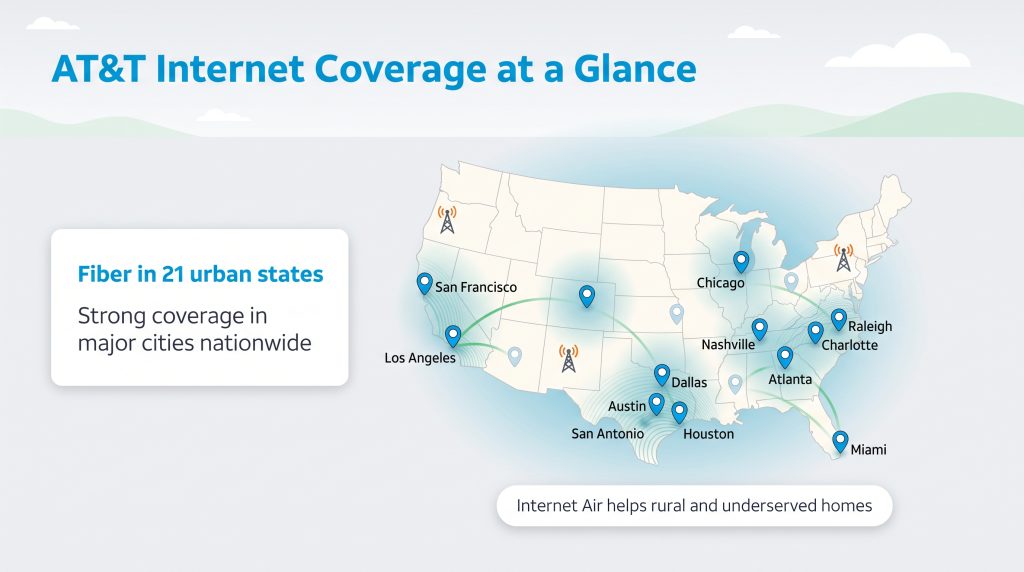
Wondering if you fall within the AT&T internet availability map? AT&T Internet and Fiber are widely accessible in urban and suburban areas across 21 states. The company’s reach continues to grow rapidly in new metro zones, with billions of dollars being poured into sustainable infrastructure upgrades every year to expand their energy-efficient fiber-optic footprint.
Major cities with robust AT&T Fiber availability include:
- Atlanta, GA
- Austin, TX
- Charlotte, NC
- Chicago, IL
- Dallas, TX
- Houston, TX
- Los Angeles, CA
- Miami, FL
- Nashville, TN
- Raleigh, NC
- San Antonio, TX
- San Francisco, CA
Even if you live just outside these major metropolitan hubs, AT&T Internet Air is actively bridging the digital divide. By utilizing modern cellular towers, it brings fixed wireless AT&
AT&T Internet Plans and Pricing Breakdown
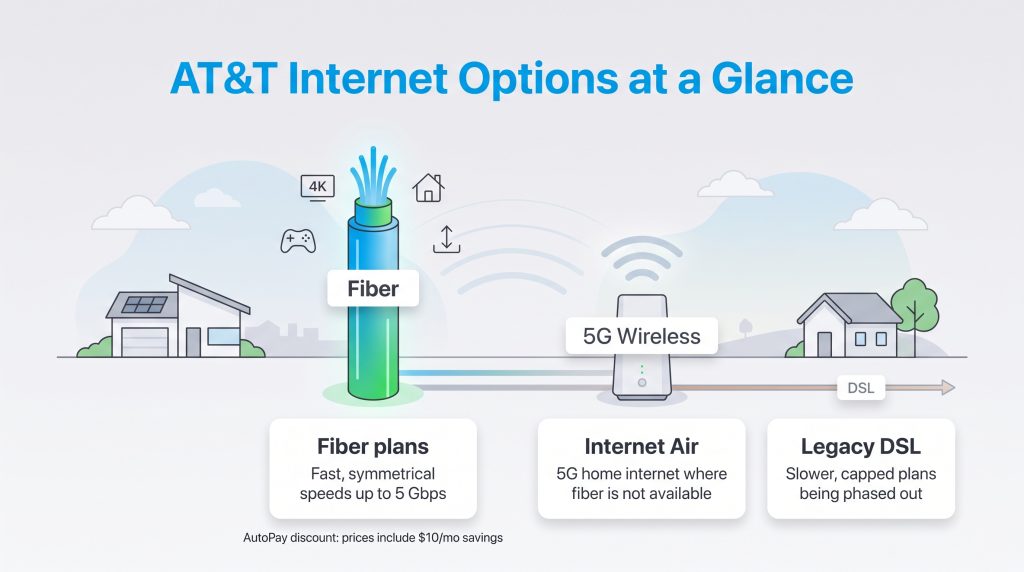
AT&T provides multiple connectivity solutions designed to match your location, data needs, and budget. It is important to note that all AT&T internet plans and advertised prices explicitly include a $10 per month discount for enrolling in AutoPay and paperless billing. If you choose to pay manually each month, your bill will be $10 higher than the rates listed below. The core of their modern service is the fiber-optic network, but they also offer robust wireless options for those outside the immediate fiber footprint.
| Plan Name | Price | Download Speeds | Connection Type | |
|---|---|---|---|---|
| Internet 100 | $60 /month | Up to 100 Mbps | DSL | Check Availability |
| Internet 300 | $35 /month | Up to 300 Mbps | Fiber | Check Availability |
| Internet Air | $40 /month | Up to 300 Mbps | 5G | Check Availability |
| Internet 500 | $50 /month | Up to 500 Mbps | Fiber | Check Availability |
| Internet 1000 | $50 /month | Up to 1000 Mbps | Fiber | Check Availability |
| Internet 5000 | $125 /month | Up to 5 Gbps | Fiber | Check Availability |
*Pricing and speeds may vary by location.
Hidden Fees, Contracts, and Guarantees
One of the most frustrating parts of shopping for a new internet service provider is uncovering hidden costs after you have already committed to a lengthy plan. Fortunately, AT&T internet pricing is relatively transparent and straightforward compared to many legacy cable competitors. Here is a detailed breakdown of the fees, contract terms, and optional add-ons you should know about:
- No Annual Contracts: AT&T Fiber and Internet Air plans do not require a long-term commitment. You are entirely free to cancel anytime without worrying about steep standard early termination fees.
- No Data Caps: Both AT&T Fiber and Internet Air provide unlimited data. You will not face throttle speeds or surprise overage charges regardless of how much you stream, game, or download.
- AT&T HomeTech Protection: For an additional $25 per month, you can opt into this add-on plan. It covers repairs and 24/7 technical support for your eligible home electronics (like laptops, smart TVs, and tablets) extending far beyond just your basic internet equipment.
- Equipment Non-Return Fees: If you eventually cancel your service, you must return your leased gateway and any extenders within 21 days. Failure to do so will result in an unreturned equipment fee of up to $150 per device.
- 14-Day Satisfaction Guarantee: AT&T offers a helpful grace period for new customers. If you cancel within the first 14 days of service, you will not be billed for your first month of service or any activation fees (though you must still return the hardware).
- Late Payment Fees: Missing a billing cycle will typically incur a late payment charge of around $9.25, depending on your state of residence.
Access From AT&T (Low-Income Internet)
For families managing a tight budget, the Access from AT&T program provides a highly affordable pathway to high-speed connectivity. This specialized AT&T low income internet tier costs a flat rate of $30 per month and includes completely free installation and Wi-Fi equipment, ensuring there are no barriers to getting online. To qualify, at least one resident in your household must currently participate in an eligible government assistance program. This includes the Supplemental Nutrition Assistance Program (SNAP), the National School Lunch Program (NSLP), or Supplemental Security Income (SSI) for California residents. Applying is simple — just visit the official AT&T Access portal online, upload digital proof of your program participation, and schedule your fast setup once approved.
Network Reliability and Real-World Speeds
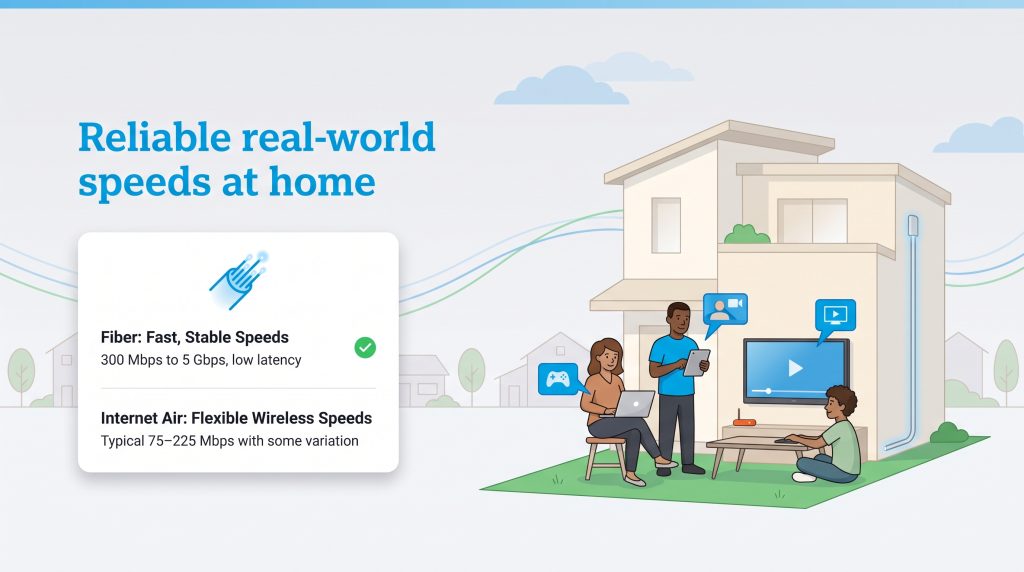
Speed on a marketing brochure is one thing, but how does the AT&T network perform when your entire family is streaming, downloading massive files, and video conferencing at the exact same time? Real-world testing across the country shows that AT&T consistently delivers a premium, high-performance internet experience, particularly if you are lucky enough to have access to their direct fiber network.
With fiber plans ranging from a sturdy 300 Mbps to a staggering 5 Gbps, users report ultra-low latency — typically hovering around an impressive 17 to 25 milliseconds. This makes it an absolute dream for competitive online gamers and remote workers who rely on real-time video calls without embarrassing lag. Furthermore, AT&T Fiber boasts a phenomenal 99% network uptime, ensuring you stay securely connected during peak evening hours when neighborhood congestion usually slows down traditional shared cable internet lines.
On the wireless side, AT&T Internet Air holds its own beautifully for everyday web browsing and standard high-definition streaming. However, because it relies on overlapping cell towers rather than a direct physical line to your home, speeds can naturally fluctuate depending on your proximity to the nearest tower and the overall cellular network traffic in your zip code. Most users average a comfortable 75 Mbps to 225 Mbps during regular daily use.
Installation, Equipment, and the Smart Home Manager App
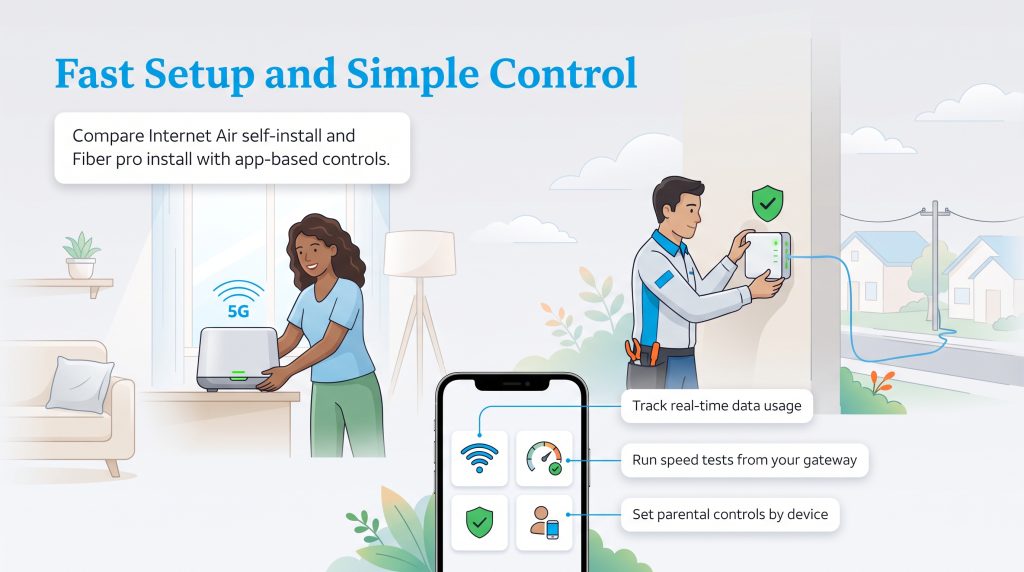
Getting your AT&T home internet setup is a unique experience depending entirely on the type of service you order. If you are opting for AT&T Internet Air, the process is incredibly seamless with a fast, plug-and-play self-installation model. Because it relies on 5G cellular signals rather than buried underground cables, you can get your home online in a matter of minutes without waiting around for a service technician.
Here is the simple three-step self-installation workflow for Internet Air:
- Unbox and Position: Take your new AT&T All-Fi Hub out of the box and place it near a window on an elevated surface to capture optimal cellular reception.
- Plug It In: Connect the power cord to a standard wall outlet and wait a few moments for the indicator lights on the front panel to turn solid green.
- Scan to Connect: Use your smartphone’s camera to scan the convenient QR code on the back of the hub, which will automatically link your device to your secure new Wi-Fi network.
In contrast, AT&T Fiber generally requires a mandatory professional installation. If your home has not previously been wired for AT&T Fiber, a certified technician will need to run the specialized fiber-optic line directly from the street to an Optical Network Terminal (ONT) installed safely inside your residence. This professional install typically costs around $99, takes four to six hours, and requires someone 18 or older to be present. The company provides a powerful AT&T Smart Wi-Fi Gateway (usually the BGW320 model equipped with Wi-Fi 6 capabilities) at absolutely no extra monthly charge. Even better, this gateway explicitly includes AT&T ActiveArmor advanced security, which actively blocks malicious threats, phishing attempts, and suspicious network traffic to keep your connected devices safe around the clock.
Once your hardware is up and running, managing your daily network activity is incredibly intuitive thanks to the AT&T Smart Home Manager app. This mobile application essentially acts as your personal IT department in your pocket. You can use it to track your real-time data usage, reboot your router remotely if the connection feels sluggish, run active speed tests directly from the gateway, and easily manage parental controls by setting healthy screen-time limits for specific devices.
How to Check for AT&T Internet Outages and Contact Customer Service
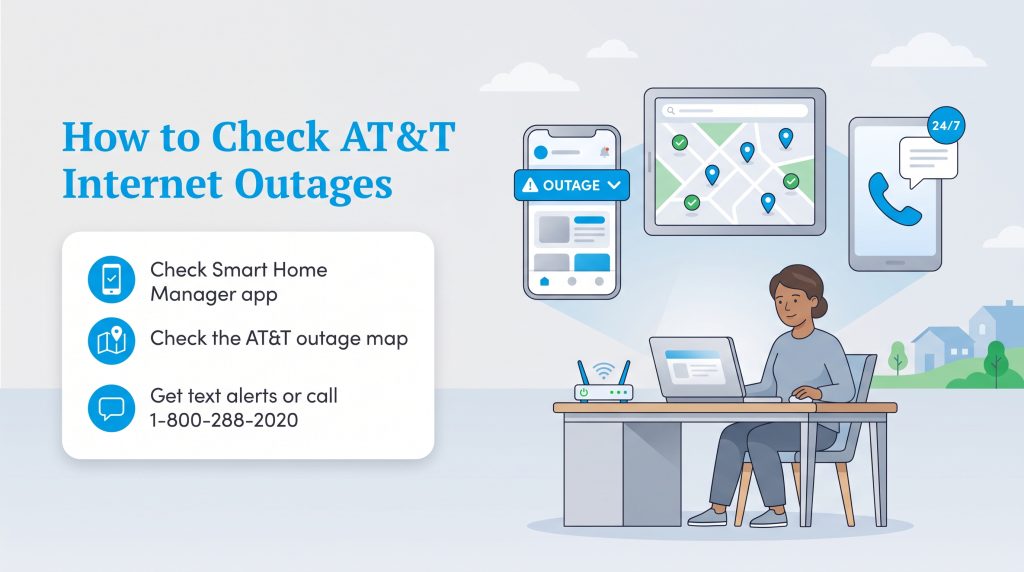
Even the most reliable and highly rated fiber networks occasionally experience unexpected hiccups. When your connection drops, it is incredibly helpful to know exactly how to check for an outage and quickly access reliable AT&T internet customer service. Rather than instantly unplugging your gateway and simply hoping for the best, you can verify localized service disruptions through a few intuitive, stress-free channels.
If you suspect an outage in your area, follow these simple steps to verify your network status:
- Use the Smart Home Manager App: Open the AT&T Smart Home Manager application on your mobile device using your cellular data. If there is a known service disruption impacting your neighborhood, a prominent alert will automatically display on the main dashboard alongside an estimated restoration time.
- Check the AT&T Outage Webpage: Navigate to the official AT&T Outage site on your smartphone’s web browser. Simply sign in to your account or enter your home ZIP code to review a real-time availability map showing affected regional areas.
- Sign Up for Text Alerts: You can proactively opt into SMS notifications through your main AT&T account dashboard online. This ensures you receive automatic text updates the moment a network disruption is detected and when it is successfully resolved.
If your local area shows no reported outages, the connection issue might be isolated to your specific hardware. In these scenarios, contacting technical support directly is your most effective route. You can reach AT&T customer service by calling 1-800-288-2020. Dedicated technical support representatives are available 24/7 to help you troubleshoot your connection, whereas general billing and account management teams operate Monday through Friday from 8:00 a.m. to 7:00 p.m. local time, and Saturdays from 8:00 a.m. to 5:00 p.m.
What Customers Are Saying (Reviews and Ratings)
When analyzing widespread AT&T internet reviews, customer sentiment remains overwhelmingly positive when it comes to their premium fiber-optic product, but slightly more mixed regarding their cellular wireless offerings. Over on popular community forums like Reddit’s r/ATT and third-party tracking sites like BroadbandNow, subscribers frequently praise AT&T Fiber for delivering highly consistent symmetrical speeds that rarely drop, even during neighborhood peak hours. Gamers and remote workers in these communities repeatedly highlight the ultra-low latency and daily reliability as major competitive advantages over their local cable providers.
On the flip side, feedback surrounding an average AT&T internet air review reveals a slightly different daily experience. While users genuinely appreciate the ease of setup and the predictable flat-rate pricing, several note that variable ping and latency can be a frustrating issue for competitive gaming. Because 5G home internet heavily relies on cellular towers, your connection speed can fluctuate depending on environmental factors, weather conditions, and peak cell phone usage in your area. If you live in a deep valley or far from a central tower, you might experience occasional video buffering.
From a corporate standpoint, AT&T maintains a solid A+ rating with the Better Business Bureau (BBB). Though, like any massive international telecom company, they do receive their fair share of billing and customer service complaints. Overall, if true fiber is available at your address, the national consensus is that AT&T is undoubtedly one of the premier connectivity choices on the market today.
AT&T Internet vs. Top Competitors
Shopping for internet rarely happens in a vacuum. Chances are, you are actively comparing AT&T against the traditional cable powerhouses dominating your specific region. Here is a quick breakdown of how AT&T Fiber stacks up against two of its largest and most aggressive competitors: Xfinity and Spectrum.
| Provider | Starting Price | Data Caps | Connection Type |
|---|---|---|---|
| AT&T Fiber | $55.00/mo | None | 100% Fiber-Optic |
| Xfinity | $20.00/mo – $35.00/mo_ | 1.2 TB (on most plans) | Cable (Coaxial) & Partial Fiber |
| Spectrum | $49.99/mo – $50.00/mo_ | None | Cable (Coaxial) & Partial Fiber |
*Starting promotional prices. Rates typically increase after 12–24 months.
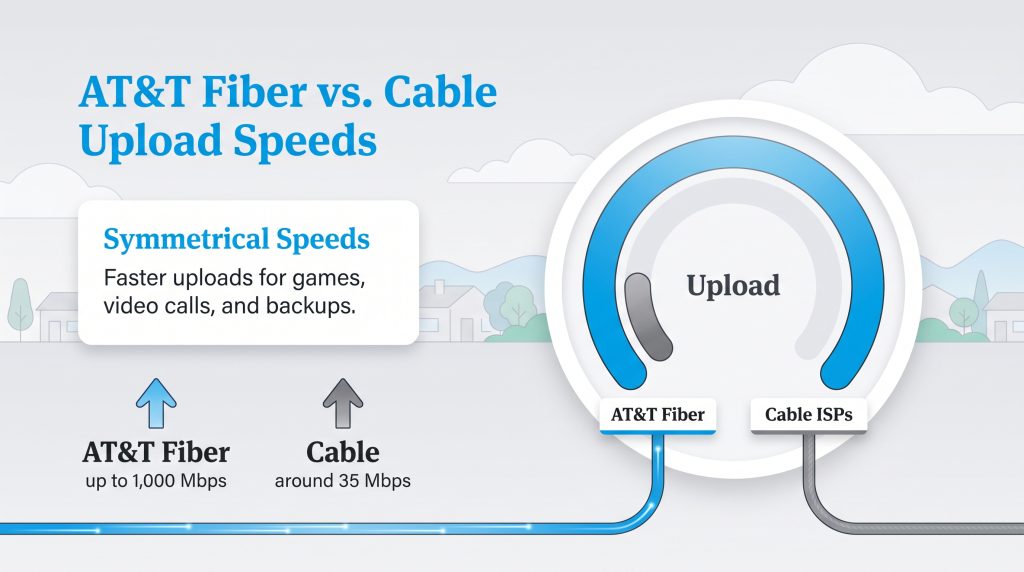
The single most significant advantage AT&T holds over its legacy cable competitors is its vastly superior upload speeds. Because traditional cable companies like Xfinity and Spectrum rely on coaxial cables originally designed just to download television signals, their aging networks inherently throttle upload bandwidth. This is why you might see a cable plan offering 1,000 Mbps download but only an underwhelming 35 Mbps upload. AT&T Fiber, on the other hand, delivers a dedicated, symmetrical connection. If you pay for 1,000 Mbps down, you get exactly 1,000 Mbps up. This makes a massive, noticeable difference if you regularly back up large files to the cloud, stream video games on Twitch, or participate in high-definition video conferences from your home office.
Top AT&T Comparisons
For more detailed, head-to-head matchups, check out our full comparison guides below:
Sustainability and Green Energy Initiatives
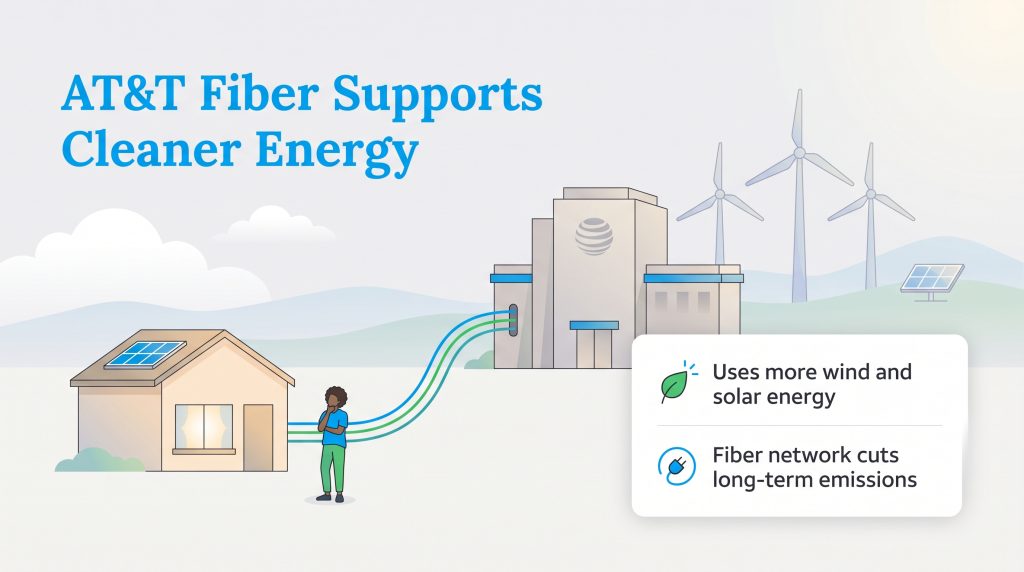
For readers looking for an environmentally mindful choice when setting up their essential home utilities, AT&T stands out with incredibly robust, verifiable sustainability goals. The telecommunications giant has made a firm corporate commitment to achieving complete carbon neutrality across its entire global operations by 2035. This isn’t just a vague “green” marketing promise; the company is taking measurable, daily steps to transform its massive network footprint and energy consumption.
Upgrading from legacy copper networks to a modern fiber-optic infrastructure is a major part of this eco-conscious alternative. Fiber optic cables inherently require significantly less electricity to transmit data over long distances compared to traditional coaxial or copper wiring. Furthermore, AT&T actively integrates energy-saving cooling systems at their large data centers and deliberately purchases millions of megawatt-hours of renewable energy annually through wind and solar power agreements. This massive offset reduces the electricity demands of their broadband network infrastructure. By choosing AT&T Fiber over older tech, you are financially supporting a network actively working to reduce its long-term carbon footprint.
Evaluating If AT&T Fits Your Household
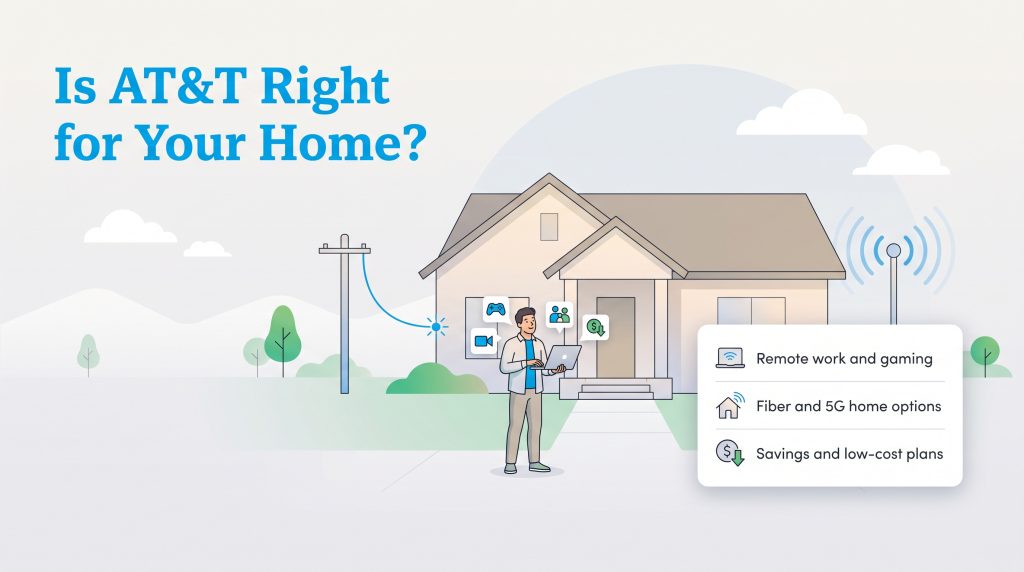
When it comes down to making a final decision for your home, AT&T brings together unmatched speed, unwavering reliability, and modern flexibility in one incredibly compelling package. The lack of restrictive annual contracts, the complete removal of data caps on their primary plans, and the inclusion of high-quality Wi-Fi equipment without monthly rental fees make this provider highly competitive against the rest of the market. If AT&T Fiber is actively available at your residential address, it is easily one of the best internet investments you can make today. Even if you fall slightly outside the fiber map, AT&T Internet Air remains a flexible, commitment-free alternative worth serious consideration.
- Remote Workers and Gamers: AT&T Fiber’s symmetrical speeds and ultra-low latency are perfect for heavy zoom calls, large file uploads, and competitive online gaming without lag.
- Rural and Suburban Homes: AT&T Internet Air offers an easy, plug-and-play 5G solution that bypasses slow satellite internet for households outside the main fiber infrastructure.
- Budget-Conscious Households: With a permanent $10 AutoPay discount, 20% wireless bundling savings, and the $30/mo Access program for low-income families, AT&T provides multiple pathways to lower your monthly bills.
Frequently Asked Questions About AT&T Internet
How much does AT&T internet cost per month?
Does AT&T offer 5G home internet?
Do AT&T internet plans have data caps or contracts?
What’s the difference between AT&T Fiber and AT&T Internet Air?
Does AT&T charge monthly rental fees for the Wi-Fi gateway?
How do I apply for AT&T low-income internet (Access from AT&T)?
Is professional installation required for AT&T internet?
Offers may not be combined with certain other promotional offers on the same services and may be modified or discontinued at any time without notice. Other conditions may apply to all offers.
About the Author

LaLeesha has a Masters degree in English and enjoys writing whenever she has the chance. She is passionate about gardening, reducing her carbon footprint, and protecting the environment. She also recently served as President of the Board for City Sprouts (a community garden).