

Choosing Between AT&T Fiber and Optimum Depends Heavily on Whether You Prioritize Symmetrical Upload Speeds and Reliability or Flexible, Low-Cost Introductory Cable Plans
Key Takeaways
- AT&T Fiber offers symmetrical upload and download speeds, which make it highly reliable for heavy remote work, competitive gaming, and smart home ecosystems.
- Optimum features flexible introductory pricing across both its traditional Optimum Cable and emerging Optimum Fiber networks, though long-term costs often increase.
- Selecting energy-efficient routers and paperless billing with either provider easily reduces your household’s digital carbon footprint and may slightly lower your home’s electricity use.

- 5 Gbps
- Fiber
- Unlimited
- $35.00/mo

- 8 Gbps
- Cable & Fiber
- Unlimited
- $25.00/mo
*Not all internet providers and speeds available in all areas.
Moving into a new residence brings a mountain of logistics, and securing a reliable broadband connection sits right at the top of that demanding to-do list. When searching for the best internet for new home setups, residents in overlapping service areas often find themselves choosing between AT&T and Optimum. However, Optimum can mean two vastly different things depending on your exact address: traditional Optimum Cable or their rapidly expanding Optimum Fiber service. If you can access Optimum Fiber, the matchup is incredibly competitive and offers comparable speeds. But if your choice comes down to Optimum cable vs AT&T fiber, AT&T stands out as the definitively stronger pick for sheer speed, lower latency, and long-term network reliability.
AT&T Fiber vs Optimum: At a Glance
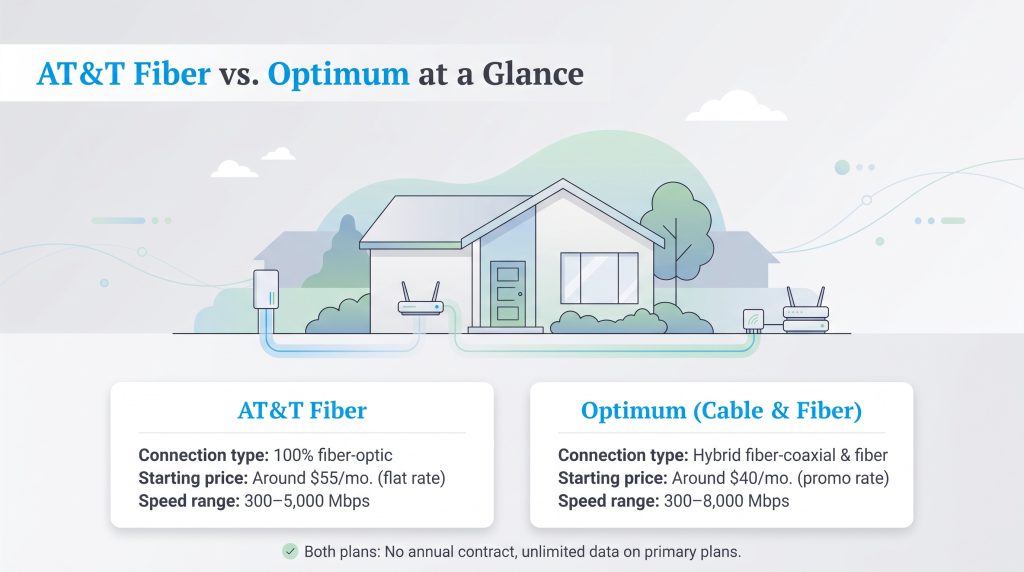
Understanding the immediate differences between these two telecommunications giants helps clarify which network will best support your daily household routines. This side-by-side comparison highlights the fundamental network limits, starting costs, and contract requirements for both providers.
| Feature | AT&T Fiber | Optimum (Cable & Fiber) |
|---|---|---|
| Connection Type | 100% Fiber-Optic | Hybrid Fiber-Coaxial & Fiber |
| Starting Price | Around $55/mo. (Flat Rate) | Around $40/mo. (Promo Rate) |
| Speed Range | 300 Mbps – 5,000 Mbps | 300 Mbps – 8,000 Mbps |
| Data Caps | Unlimited | Unlimited (on primary plans) |
| Contract Requirements | No annual contract | No annual contract |
Network Technology: Fiber-Optic vs Hybrid-Coaxial
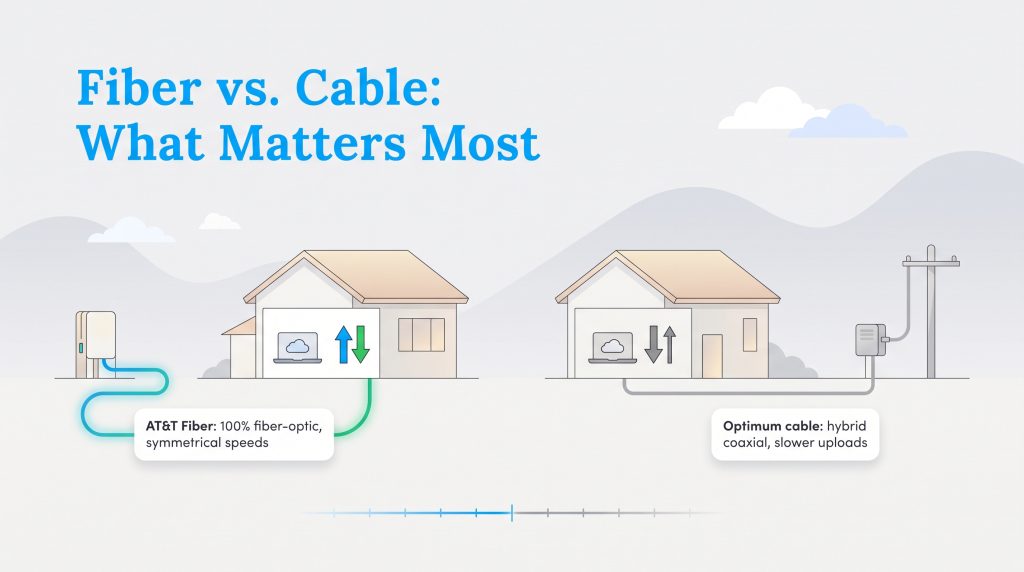
To make an informed choice, you need to grasp the foundational network differences between both service providers. When comparing AT&T fiber vs Optimum fiber, both modern networks rely on pulses of light to transmit data over incredibly thin glass strands. This advanced infrastructure delivers symmetrical upload speeds, meaning your network can push data up to the cloud just as fast as it pulls data down. Symmetrical speeds are an absolute game-changer for digital professionals, allowing you to breeze through massive cloud backups and host flawless, high-definition video calls without annoying buffering delays.
However, many Optimum customers still receive their internet through a traditional hybrid fiber-coaxial network. This older infrastructure relies on copper wires originally designed decades ago for television broadcasts. While a hybrid fiber-coaxial network provides excellent download speeds for streaming your favorite shows, it suffers from significantly slower upload capacities that can quickly bottleneck modern, data-heavy households. Because these fundamental technologies perform so differently, checking the exact connection type available at your doorstep remains the most important step in your research.
Pricing, Plans, and Hidden Fees
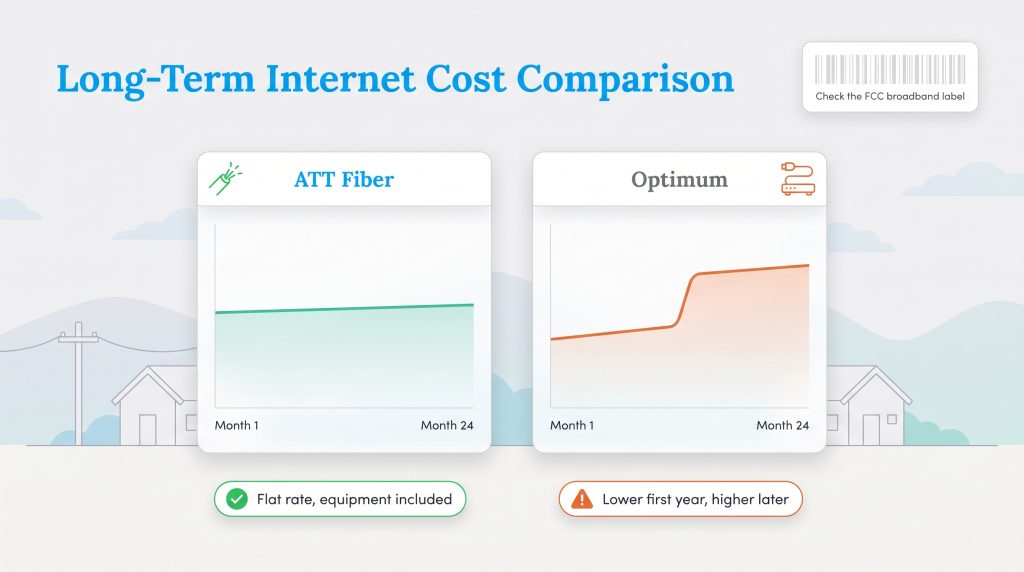
Sorting out Optimum vs AT&T internet pricing requires looking past the flashy promotional banners and analyzing your actual long-term monthly costs. AT&T shifted its business model to transparent, flat-rate pricing, meaning the price you see is exactly what you pay. Their fiber plans generally don’t utilize annual contracts or restrictive data caps, and the Wi-Fi hardware is included in the base rate. Optimum takes a different approach, attracting new movers with incredibly low introductory rates. While these promotions look great during your first 12 months, those prices often increase sharply once the promotional period expires, and you may face additional hardware rental fees.
Head-to-Head Speed Tier Pricing
| Speed Tier | AT&T Fiber Pricing | Optimum Pricing |
|---|---|---|
| 300 Mbps | Around $55/mo. (Flat Rate) | Around $40/mo. (Promo) |
| 500 Mbps | Around $65/mo. (Flat Rate) | Around $60/mo. (Promo) |
| 1 Gbps (1,000 Mbps) | Around $80/mo. (Flat Rate) | Around $80/mo. (Promo) |
Prices, taxes, fees, installation options, and promotional terms can change by address. Confirm the current broadband label before ordering.
Interpreting this matchup reveals the true cost of connectivity over time. Optimum definitely wins the first-year budget battle for many households, making it a compelling option for short-term renters. However, potential equipment rentals and second-year price hikes can quickly erase those early savings. AT&T gives you a highly predictable flat rate, included hardware, and stronger overall upload performance, making it a more secure long-term investment.
AT&T Plans & Pricing
| Plan Name | Price | Download Speeds | Connection Type | |
|---|---|---|---|---|
| Internet 100 | $60 /month | Up to 100 Mbps | DSL | Check Availability |
| Internet 300 | $35 /month | Up to 300 Mbps | Fiber | Check Availability |
| Internet Air | $40 /month | Up to 300 Mbps | 5G | Check Availability |
| Internet 500 | $50 /month | Up to 500 Mbps | Fiber | Check Availability |
| Internet 1000 | $50 /month | Up to 1000 Mbps | Fiber | Check Availability |
| Internet 5000 | $125 /month | Up to 5 Gbps | Fiber | Check Availability |
Optimum Plans & Pricing
| Plan Name | Price | Download Speeds | Connection Type | |
|---|---|---|---|---|
| Optimum FASTPASS | $25 /month | Up to 200 Mbps | Cable | Check Availability |
| Optimum 300 | $30 /month | Up to 300 Mbps | Cable | Check Availability |
| 300 Mbps Fiber | $30 /month | Up to 300 Mbps | Fiber | Check Availability |
| Optimum 500 | $40 /month | Up to 500 Mbps | Cable | Check Availability |
| Fiber 500 Mbps | $40 /month | Up to 500 Mbps | Fiber | Check Availability |
| Optimum 1 Gig | $25 /month | Up to 1000 Mbps | Cable | Check Availability |
| Fiber 1 Gig | $25 /month | Up to 1000 Mbps | Fiber | Check Availability |
| Fiber 2 Gig | $60 /month | Up to 2 Gbps | Fiber | Check Availability |
| Fiber 5 Gig | $75 /month | Up to 5 Gbps | Fiber | Check Availability |
| Fiber 8 Gig | $120 /month | Up to 8 Gbps | Fiber | Check Availability |
Installation Process and Equipment
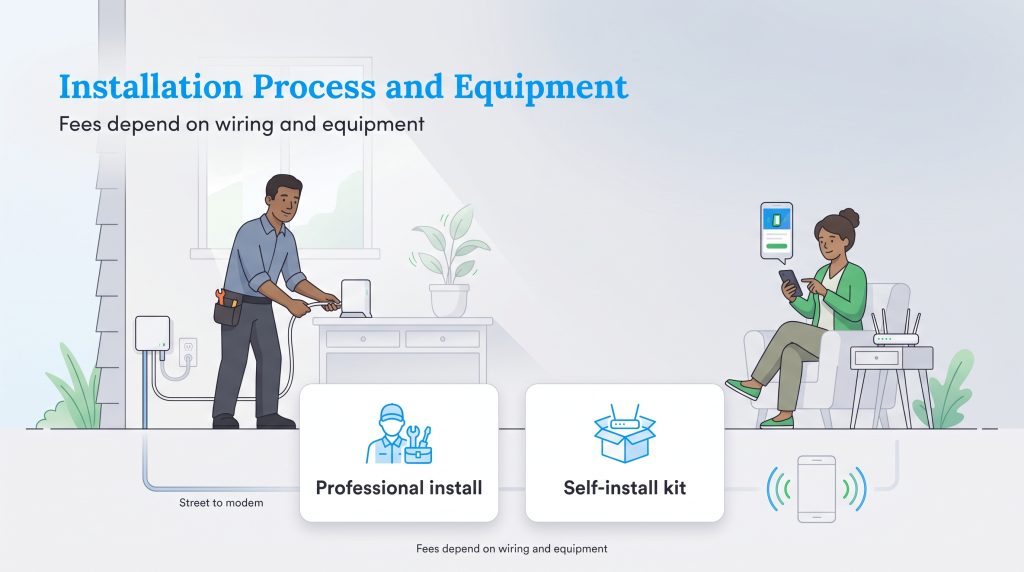
Setting up utilities during a hectic move requires a smooth, predictable installation process. Both providers offer distinct pathways to getting your network up and running, but their setup requirements and hardware costs differ significantly depending on the existing wiring in your home.
- Professional Installation: If your new residence lacks an existing Optical Network Terminal (ONT) for fiber or the necessary coaxial wiring for cable, you will need a technician to physically run the line to your house. Professional installation ensures your connection is properly configured from the street directly to your modem.
- Self-Installation: For homes previously wired for service, both AT&T and Optimum offer convenient self-installation kits. These kits typically ship directly to your door, allowing you to plug in the gateway and activate the service via a smartphone app in just a few minutes.
- Equipment and Setup Fees: AT&T bundles its advanced Wi-Fi gateway directly into the monthly price, simplifying your budget. They also frequently waive the standard AT&T internet installation fee during online promotional events. Optimum’s equipment policies vary widely; some promotional tiers include the gateway for free, while others impose a monthly rental fee for the modem and router.
Gaming, Streaming, and Working From Home
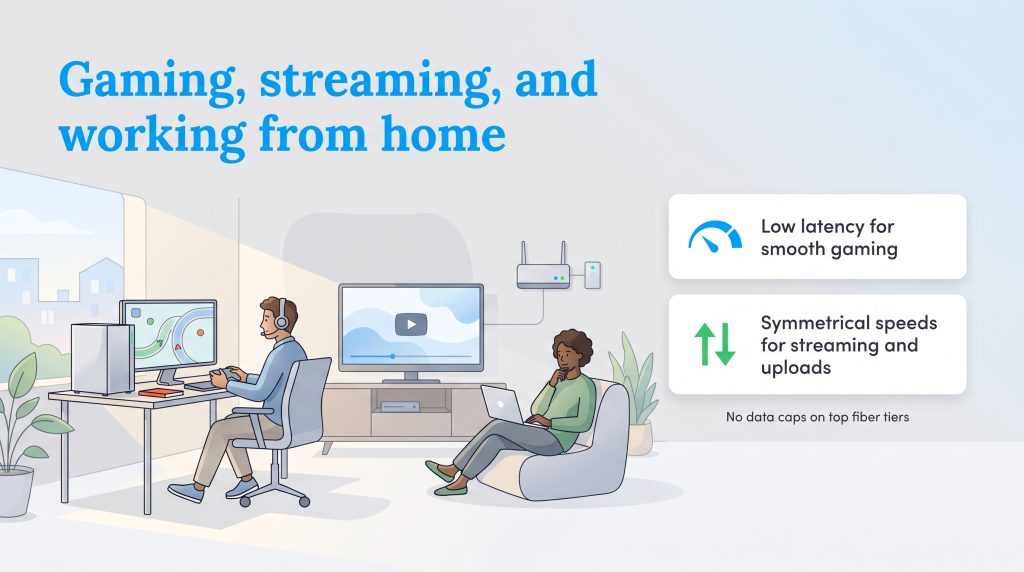
High-bandwidth households require networks that can handle continuous, heavy data loads without faltering. When analyzing these providers for competitive gaming and livestreaming, latency and ping times become the deciding factors for a frustration-free experience. Fiber connections typically deliver lower and more consistent latency than cable, especially during busy evening hours. Traditional cable internet performance can be more drastically affected by neighborhood congestion, leading to sudden lag spikes when everyone on your street logs on after work.
Furthermore, robust upload capacities empower you to stream on Twitch or upload massive video files seamlessly while roommates or family members watch 4K movies in the next room. Neither provider enforces restrictive data caps on their upper-tier plans, giving you the complete freedom to download massive console updates without staring down expensive overage charges.
Customer Satisfaction and Network Reliability
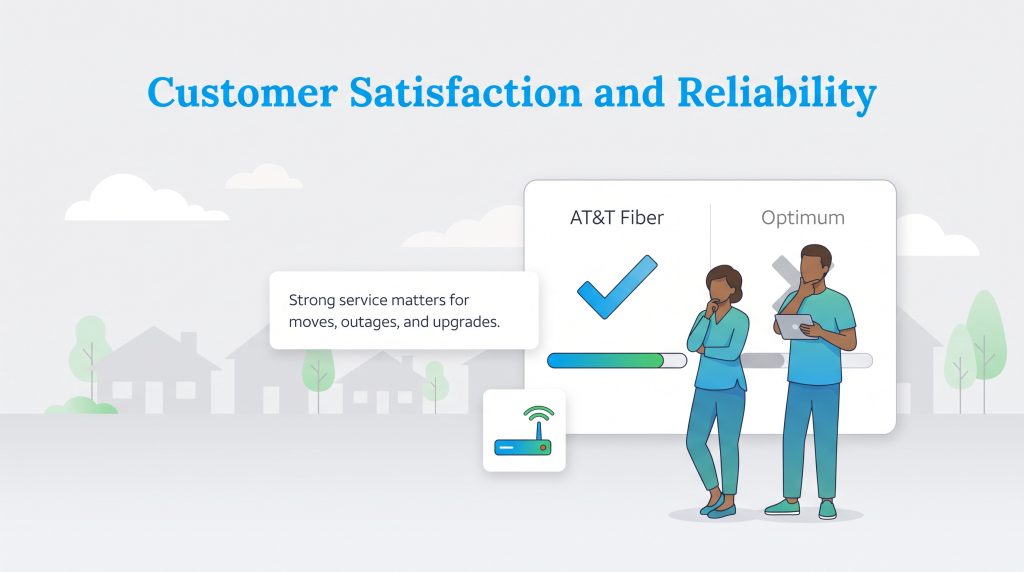
If you are wondering whether one provider outperforms the other on a daily basis, customer satisfaction data is the best place to find objective answers. Internet provider satisfaction varies slightly by region, but comprehensive third-party studies consistently rate AT&T Fiber ahead of Optimum. The American Customer Satisfaction Index telecommunications study has historically ranked AT&T Fiber at or near the very top of the industry for reliability, while Optimum often lands in the lower tiers for overall satisfaction.
Excellent AT&T internet customer service translates into easier scheduling for moving day, faster technician dispatches during unexpected neighborhood outages, and smoother hardware upgrades. When your home office depends entirely on a stable connection, investing in a provider with a proven track record of support offers invaluable peace of mind.
Availability and Coverage Areas
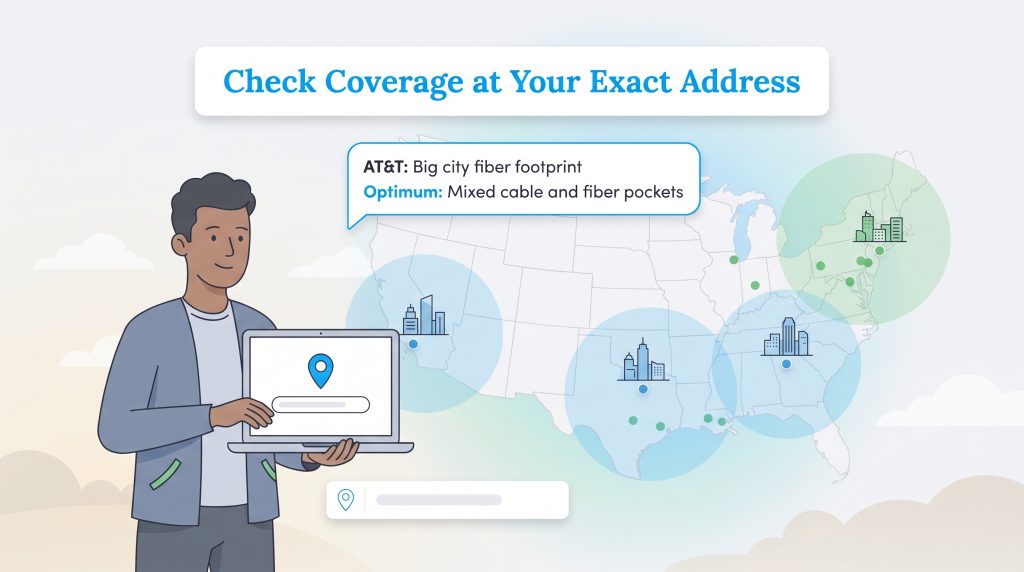
Finding the perfect internet plan doesn’t matter much if the provider hasn’t built out the physical infrastructure to reach your new neighborhood. AT&T Fiber boasts a massive network that covers 21 states, heavily concentrated across the South, Midwest, and West, particularly in major metropolitan areas like Dallas, Atlanta, and Los Angeles.
Optimum also provides service across 21 states, but its footprint is uniquely distributed. The company’s traditional cable and fiber services dominate the New York tri-state area, while its acquired networks serve specific rural and suburban pockets of Texas, Louisiana, and the Midwest. Because their physical network footprints rarely overlap on a street-by-street level, checking Optimum fiber availability at your specific address is the only way to know if you can tap into their fastest symmetrical speeds or if you will be limited to their legacy cable tiers.
Choosing Your Next Internet Utility
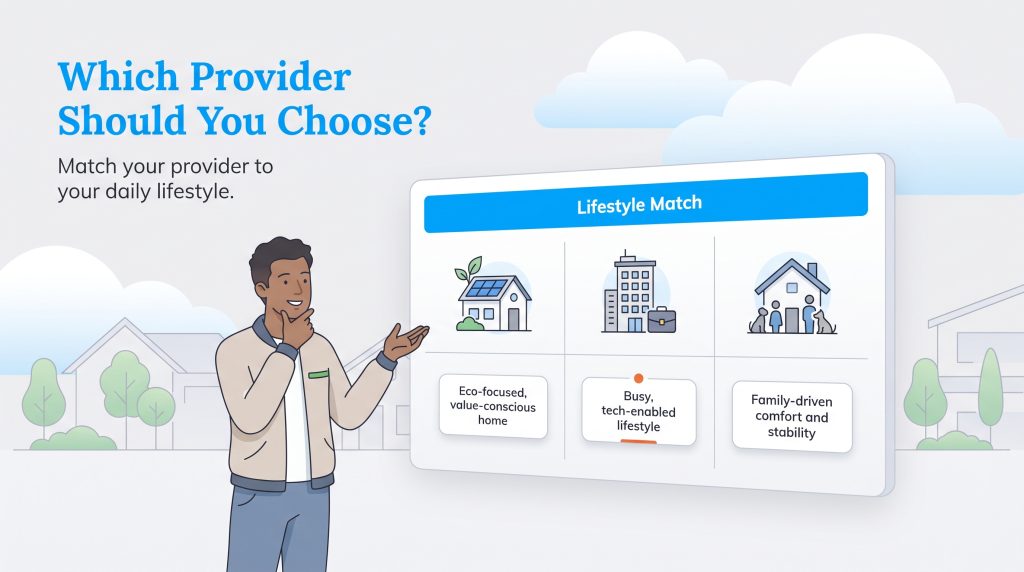
We built this straightforward decision matrix to help you match a provider directly to your specific daily lifestyle. Consider which profile best aligns with your household needs:
| Household Need | Better Pick | Why |
|---|---|---|
| Remote work | AT&T Fiber | Symmetrical upload speeds help with video calls and file sharing. |
| Gaming | AT&T Fiber | Fiber usually has lower, steadier latency. |
| Short-term rental | Optimum | Promo pricing may save money if you move before rates increase. |
| Basic browsing and streaming | Either | Choose the lower confirmed price at your address. |
| If Optimum Fiber is available | Compare closely | Optimum Fiber may narrow the performance gap significantly. |
Eco-Conscious Internet Setup Tips
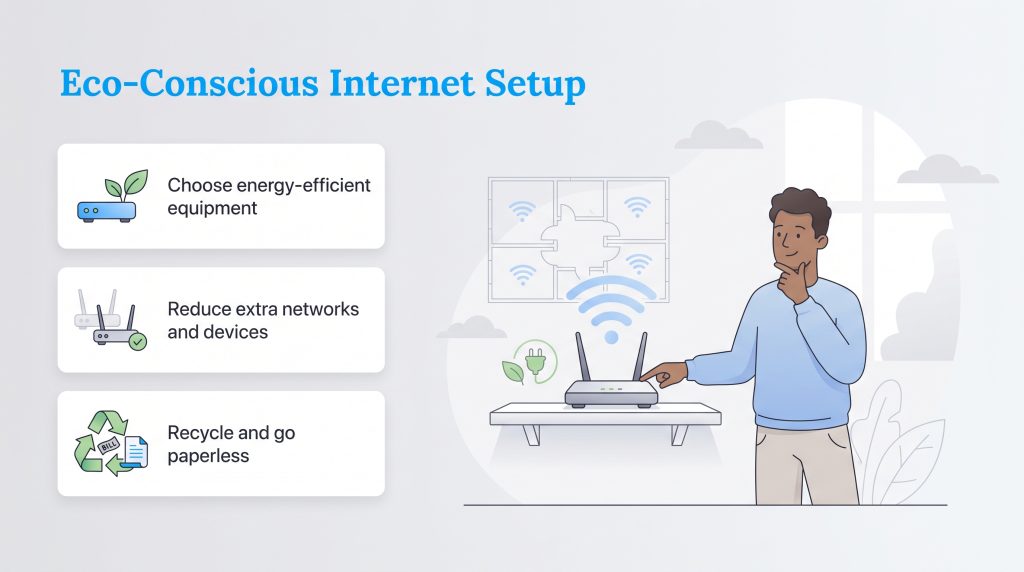
Powerful home networks continuously draw electricity, but making mindful choices limits this phantom power load and supports an environmentally mindful approach. When setting up your home internet, request energy-efficient routers from your provider. Energy-efficient equipment, paperless billing, and recycling old devices can reduce waste and may slightly lower your home’s electricity use.
You can use a single, centrally located router instead of multiple mesh nodes if your new home is relatively small, and turn off guest networks when not needed. Additionally, avoid replacing perfectly functioning equipment unless a hardware upgrade actively solves a real coverage or speed issue in your home.
How to Switch Providers Without Losing Service
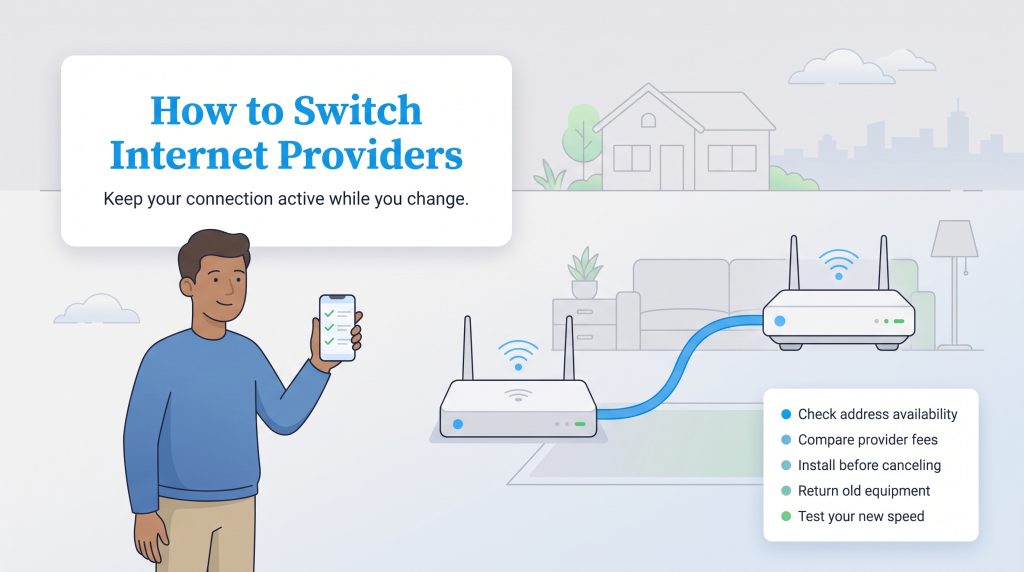
A thoughtful approach minimizes disruptions to your daily routine. If you are moving into a new home or simply looking to change your current service, follow these streamlined steps to manage a seamless transition without unexpected downtime:
- Check availability at your exact address: If you’re moving to an overlapping service area, compare local utility availability before scheduling installation.
- Compare broadband labels: Review the fees, monthly rates, and data caps for both providers.
- Schedule new installation before canceling old service: Keep your existing network active until the new one is physically installed and running.
- Return old equipment and keep the receipt: Avoid unreturned equipment fees by saving your return confirmation receipt for at least 90 days.
- Run a speed test after installation: Ensure you are actually receiving the speeds you signed up for before the technician leaves your driveway.
Securing the Best Broadband Connection for Your New Residence
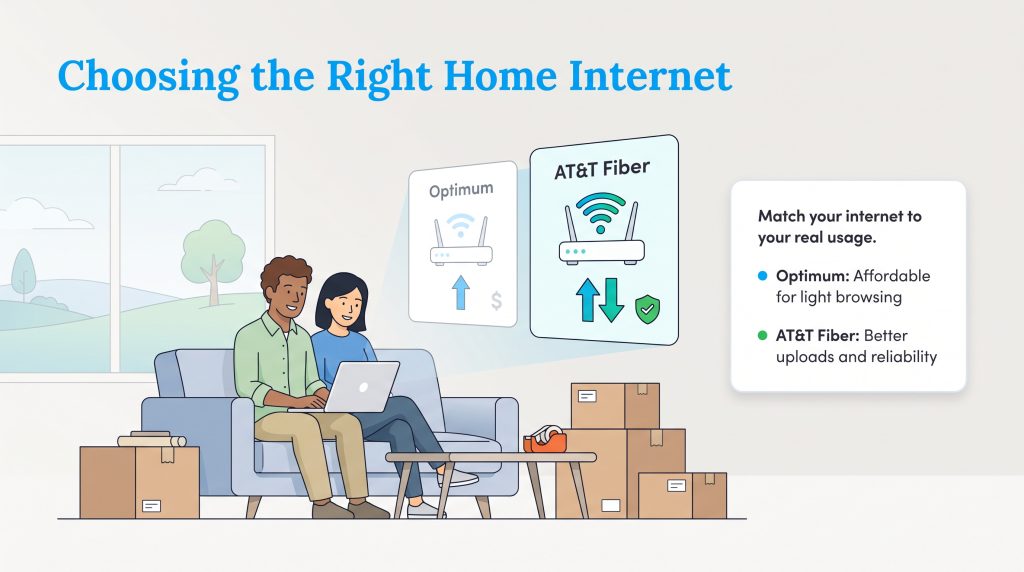
Establishing reliable utilities paves the way for a comfortable, modern living space. Optimum serves as a highly capable, budget-friendly option for light web browsing and casual streaming, particularly during your first year in a new place. However, AT&T Fiber remains the better long-term fit for most households, delivering stronger upload performance, transparent pricing without surprise hikes, and superior network reliability. By aligning your internet choice with your household’s actual data needs, you ensure a seamlessly connected home from the exact moment you unpack your first box.
Frequently Asked Questions About AT&T Fiber vs Optimum
These quick answers cover the most common questions people ask when comparing AT&T Fiber and Optimum for a new home. Always confirm plan details at your exact address before ordering.
Can I switch from Optimum to AT&T Fiber without losing internet access?
Does Optimum offer fiber internet, or just cable?
Is Optimum fiber the exact same technology as AT&T Fiber?
Which provider is better for a work-from-home setup?
Does AT&T Fiber charge a mandatory installation fee for a new home?
Which internet provider offers better gaming latency?
Do AT&T or Optimum charge for a Wi-Fi router?
Can I use my own energy-efficient modem and router with these providers?
Will my internet bill increase after the first year with either provider?
Are there data caps to worry about when choosing between these two?
About the Author

David has been an integral part of some of the biggest utility sites on the internet, including InMyArea.com, HighSpeedInternet.com, BroadbandNow.com, and U.S. News. He brings over 15 years of experience writing about, compiling and analyzing utility data.

LaLeesha has a Masters degree in English and enjoys writing whenever she has the chance. She is passionate about gardening, reducing her carbon footprint, and protecting the environment. She also recently served as President of the Board for City Sprouts (a community garden).