

Compare AT&T and Spectrum Plans, Long-Term Pricing, and Connection Reliability to Choose the Best Internet for Your Household Needs
Key Takeaways
- AT&T Fiber offers superior, symmetrical speeds and straightforward pricing, but it has limited availability compared to Spectrum’s widespread cable network.
- Spectrum does not enforce data caps on its standard internet plans, while certain AT&T DSL and fixed-wireless plans may have restrictions.
- Watch out for Year 2 price hikes with both providers, and always factor in hidden costs like Spectrum’s monthly equipment rental fees before switching.
Getting your utilities connected in a new home is stressful enough without having to decipher confusing telecommunications marketing jargon. If you are stuck deciding between AT&T and Spectrum, this straightforward guide cuts through the noise to help you identify the most reliable and affordable connection. We are comparing these two major internet service providers based on real-world speeds, equipment fees, mobile bundling options, and overall availability so you can pick the perfect plan for your household.

- 5 Gbps
- Fiber
- Unlimited
- $35.00/mo

- 7 Gbps
- Cable & Fiber
- Unlimited
- $30.00/mo
*Not all internet providers and speeds available in all areas.
Quick Comparison: AT&T vs Spectrum
When choosing your next internet plan, the best choice usually comes down to what type of connection is actually wired to your address. Comparing AT&T vs Spectrum reveals distinct strengths depending on whether you need heavy-duty upload bandwidth for remote work or a widespread, easily accessible network for standard daily browsing. We converted the physical infrastructure data into a scannable comparison below to highlight how these two telecom giants stack up at a glance.
| Feature | AT&T (Fiber) | Spectrum (Cable) |
| Primary Network Type | Fiber-Optic | Coaxial Cable |
| Download Speeds | Up to 5,000 Mbps | Up to 1,000 Mbps |
| Upload Speeds | Symmetrical (matches download) | Asymmetrical (significantly slower) |
| Year 2 Base Price Hikes | None on fiber plans | Increases after 12 and 24 months |
| Wi-Fi Equipment Fees | Included for free | ~$7/month router rental |
| Availability | Regional (expanding) | Nationwide (highly accessible) |
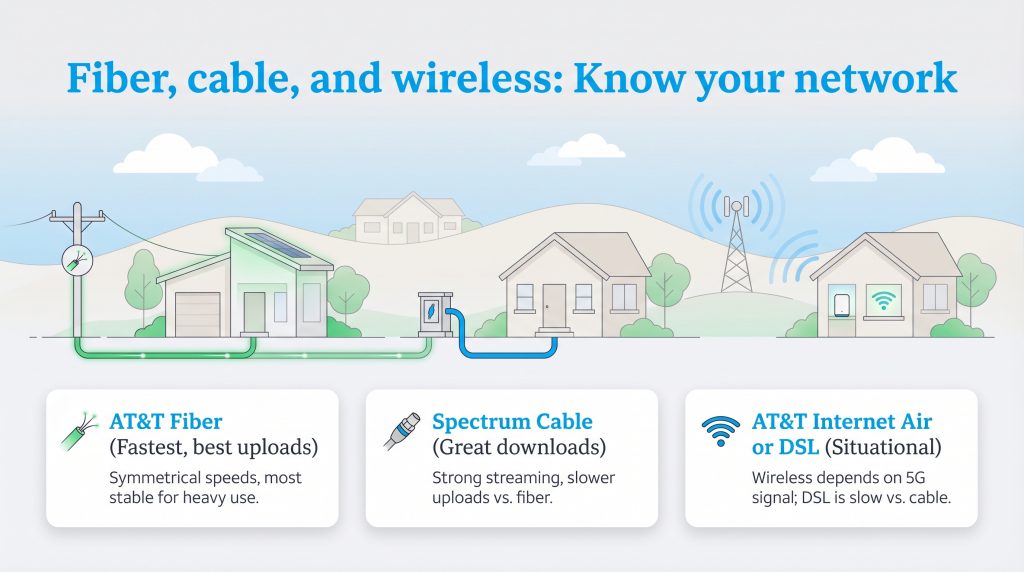
Your ultimate decision should rely on a quick process of elimination. Review this simple decision tree to see which provider truly aligns with your family’s digital habits.
- Is AT&T Fiber available at your address? If yes, this is usually the absolute best choice for symmetrical speeds, zero price hikes, and heavy network usage.
- If fiber is unavailable, is Spectrum an option? Spectrum Cable is highly accessible and typically beats older AT&T DSL lines for reliable download speeds and video streaming.
- Are you deciding between Spectrum and AT&T Internet Air? Choose Spectrum if you need consistent latency for competitive gaming or remote work, but opt for Internet Air if you want a simple, plug-and-play setup without drilling holes for physical wires.
Speeds and Network Types: Fiber vs Cable vs DSL
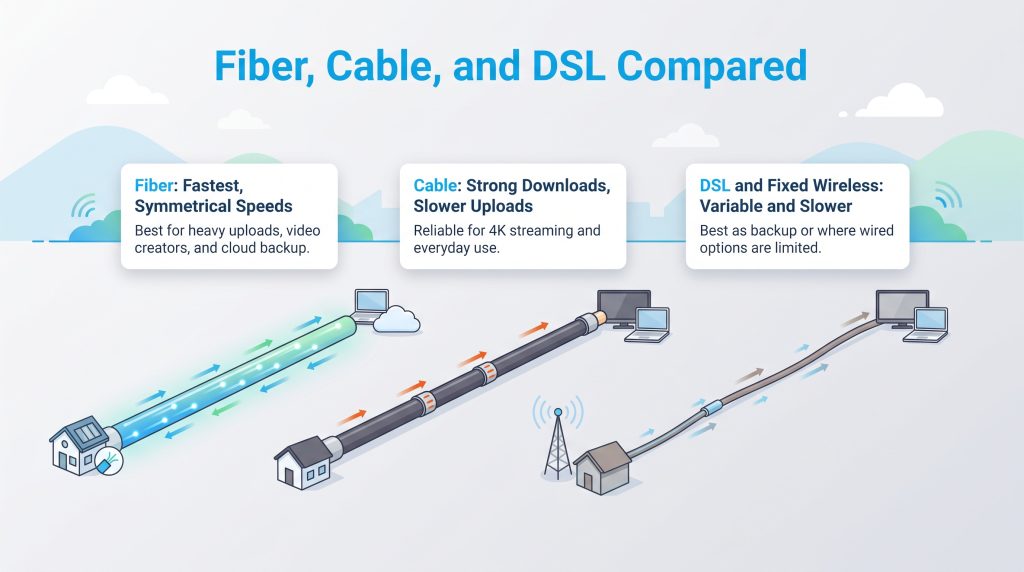
Not all internet is created equal, and the physical infrastructure running through your neighborhood heavily dictates your daily speed and reliability. AT&T relies on a mix of cutting-edge fiber optics, legacy copper lines, and fixed-wireless towers. Spectrum, on the other hand, operates almost entirely on a coaxial cable network. Understanding this difference is vital because comparing AT&T vs Spectrum speeds is a totally different ballgame depending on the exact connection wired to your house. If you are unsure where your household falls, checking the recommended broadband speeds from the FCC can help you identify a reliable baseline.
AT&T Fiber vs Spectrum Cable
AT&T Fiber represents the gold standard for home connectivity, delivering incredible bandwidth utilizing light pulses. When comparing AT&T Fiber vs Spectrum, fiber holds a massive advantage in upload capability. Fiber offers symmetrical speeds, meaning your upload rates match your lightning-fast download rates. If you frequently upload large video files, back up data to the cloud, or stream live on Twitch, fiber is a massive benefit that will drastically improve your workflow.
Spectrum operates a robust coaxial cable network originally designed for television. While Spectrum Internet excels at delivering fast download speeds that effortlessly handle 4K streaming and daily browsing, it provides asymmetrical bandwidth. This means your upload speeds are significantly slower than your download speeds. If your digital life requires pushing large amounts of data out to the web, the coaxial limitations of Spectrum might bottleneck your performance compared to a pure fiber connection.
Learn more about Fiber vs. Cable Internet
AT&T Internet Air vs Spectrum
As telecommunications companies race to fill connectivity gaps, fixed-wireless home internet has emerged as a popular alternative. AT&T Internet Air vs Spectrum is an increasingly common debate for renters or homeowners who want to skip the hassle of a traditional coaxial installation. Internet Air utilizes AT&T’s 5G cellular network to beam service directly to a wireless receiver inside your home. Setup is as simple as plugging the device into a wall outlet.
While the plug-and-play convenience is fantastic, it comes with a few physical trade-offs. Fixed-wireless reliability fluctuates based on cellular tower congestion, distance from the nearest node, and physical obstructions like heavy foliage. If you live in an area with a pristine 5G signal, Internet Air is a breeze. However, high-demand households with multiple gamers or remote workers will generally experience much better stability with Spectrum’s physical cable lines.
AT&T DSL vs Spectrum Cable
If you look up your address and discover you only have access to AT&T’s legacy DSL network, Spectrum is almost always the superior choice. DSL relies on aging copper telephone lines that max out at much slower speeds, constantly struggling to keep up with modern smart home demands. In this specific matchup, Spectrum easily wins by offering drastically faster, more reliable performance for a very similar monthly price.
Pricing and Hidden Fees Comparison
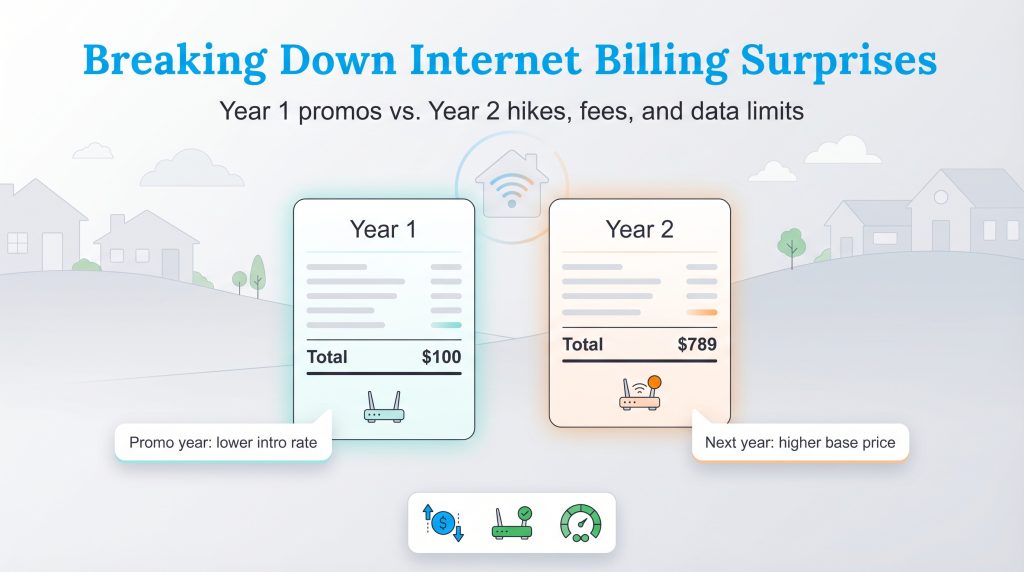
Navigating promotional rates is essential for effectively managing your home internet costs over the long haul. Both of these providers advertise enticing entry-level numbers, but you need to budget for what the bill looks like after the honeymoon phase ends. Evaluating AT&T vs Spectrum pricing requires looking closely at those inevitable second-year increases.
AT&T Internet Plans & Pricing
| Plan Name | Price | Download Speeds | Connection Type | |
|---|---|---|---|---|
| Internet 100 | $60 /month | Up to 100 Mbps | DSL | Check Availability |
| Internet 300 | $35 /month | Up to 300 Mbps | Fiber | Check Availability |
| Internet Air | $40 /month | Up to 300 Mbps | 5G | Check Availability |
| Internet 500 | $50 /month | Up to 500 Mbps | Fiber | Check Availability |
| Internet 1000 | $50 /month | Up to 1000 Mbps | Fiber | Check Availability |
| Internet 5000 | $125 /month | Up to 5 Gbps | Fiber | Check Availability |
Spectrum Plans & Pricing
| Plan Name | Price | Download Speeds | Connection Type |
|---|
*not all plans available in all areas
Year 1 vs Year 2 Pricing Hikes
The most common complaint we hear from movers is the dreaded post-promotional price shock that hits after 12 to 24 months of service. Internet providers frequently dangle cheap introductory rates to win your business, only to quietly hike the monthly rate once that agreement expires.
AT&T recently moved toward more straightforward pricing for its fiber tiers, meaning you secure a flat rate without complex promotional cliffs at the 12-month mark. Spectrum, however, relies heavily on promotional deals. A standard Spectrum connection that starts at $49.99 per month frequently experiences an expected increase of $20 to $25 per month once your initial 12-month promotion expires. If you stay for a second year, the 24-month cliff can push your standard rate even higher, sometimes topping $80 to $90 per month for basic cable service.
Equipment and Installation Costs
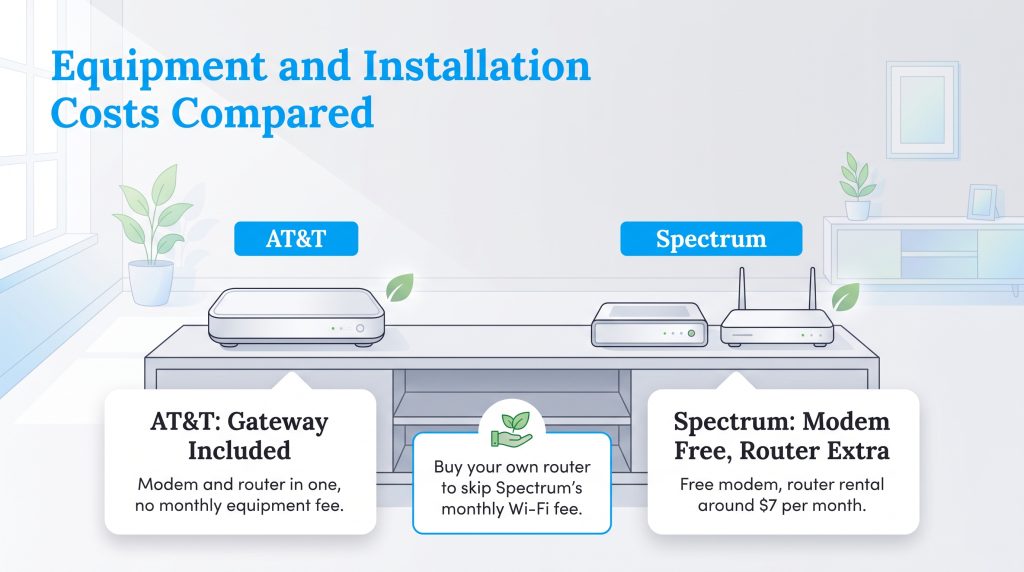
When budgeting for a move, those upfront setup costs and hidden hardware fees add up quickly. Comparing Spectrum vs AT&T equipment fees uncovers a few critical differences in how these companies bill for the physical devices powering your home Wi-Fi network.
- AT&T Hardware Costs: AT&T simplifies things by including their Wi-Fi gateway — a combination modem and router unit — entirely for free. It is baked directly into your flat monthly rate.
- Spectrum Hardware Costs: Spectrum provides the standard cable modem for free. However, if you want them to supply the actual Wi-Fi router to broadcast the signal around your home, they charge a recurring monthly fee, typically around $7 per month.
- Installation Fees: Both companies push self-installation kits if your address is already wired for service. Spectrum generally charges a low self-activation fee (around $30) or a standard professional installation fee (around $65). AT&T frequently waves activation fees for online orders, but if you require a technician to run a new fiber line to your home, professional installation usually runs about $99.
Data Caps and Contracts
Data allowances are a critical factor for cord-cutters who stream everything in high definition. Fortunately, Spectrum does not impose hidden data caps on its standard residential internet plans. This unlimited data freedom is a massive win if you have a family constantly downloading large video games or binge-watching shows.
AT&T Fiber also offers unlimited data with no overage charges. However, if you find yourself forced onto certain AT&T DSL plans, you might be subject to strict 1.5TB monthly data limits. Similarly, fixed-wireless Internet Air users might experience network management policies or fair-use throttling during times of heavy local tower congestion.
As for commitments, the industry has largely shifted away from restrictive multi-year agreements. Neither AT&T nor Spectrum typically forces residential customers into aggressive long-term contracts. You are generally free to cancel or switch your service at any time without facing exorbitant early termination penalties — just remember to return your rented equipment promptly to avoid non-return fees.
Mobile Bundling: AT&T Wireless vs Spectrum Mobile
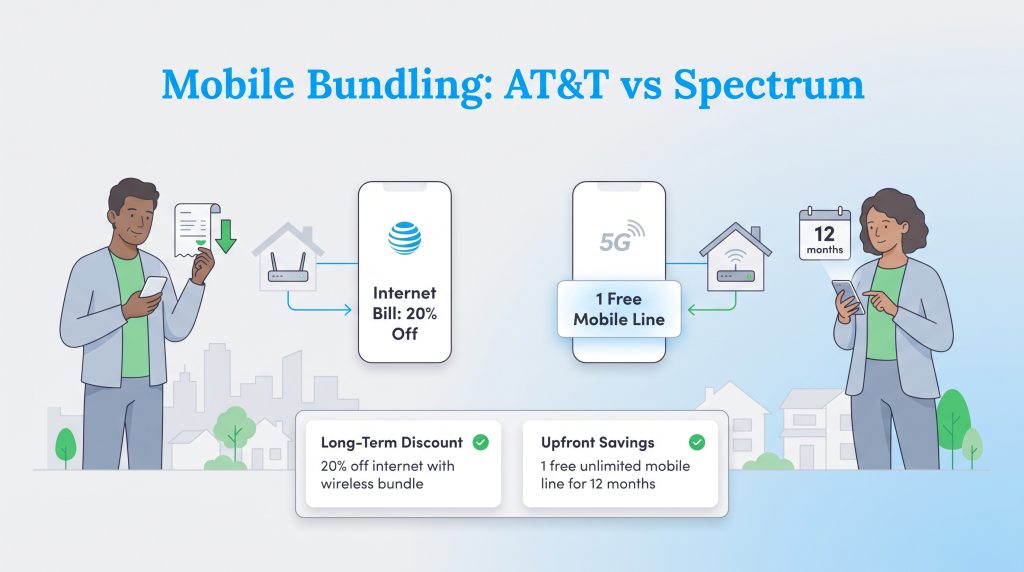
Bundling your home internet with your mobile phone service is a highly effective way to drastically reduce your monthly telecommunications expenses. Both providers lean heavily into offering massive incentives for customers who combine their cellular and home networks onto a single bill. If you want to maximize your utility savings, evaluating these mobile packages is essential.
Spectrum takes a highly aggressive promotional approach with its popular Spectrum One bundle. This package provides new internet customers with one free unlimited mobile line (running on Verizon’s 5G network) for an entire year. This translates to substantial upfront savings, though you must budget for the standard line rate once the 12-month promotion expires.
AT&T offers a straightforward, long-term bundle discount. When you combine AT&T Fiber internet with an eligible AT&T Wireless unlimited plan, the company rewards you with a flat 20% discount on your monthly home internet bill. This percentage discount stays active as long as you maintain both services, making it highly predictable for long-term household budgeting.
Customer Service and Reliability
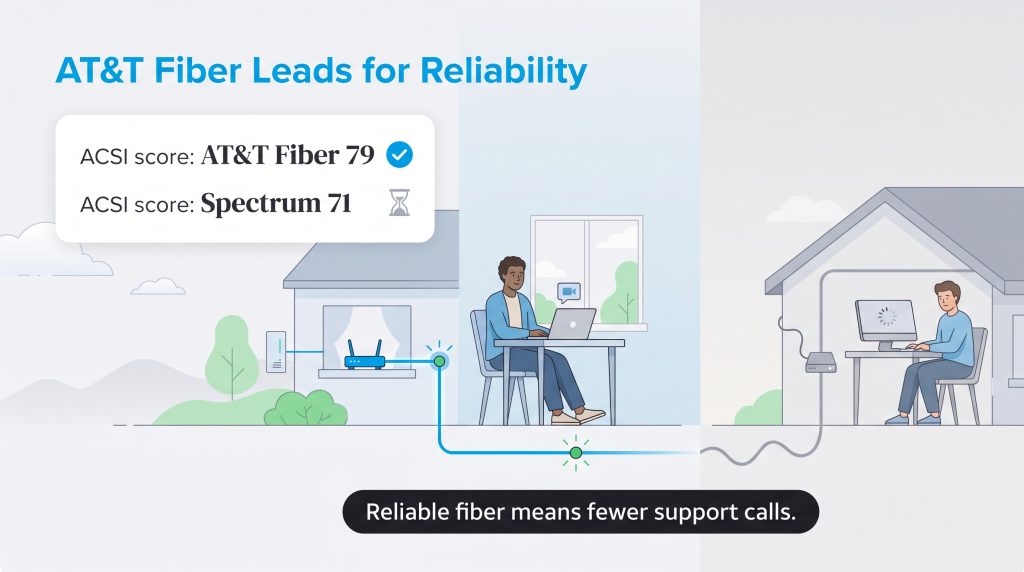
Telecommunications companies are rarely famous for stellar customer service, but independent, third-party scoring helps reveal who actually answers the phone and resolves issues efficiently. When evaluating AT&T vs Spectrum customer service, AT&T holds a statistical advantage, primarily driven by the exceptional physical stability of its modern network.
According to the 2026 American Customer Satisfaction Index (ACSI) Telecommunications Study, AT&T Fiber ranks near the top of the industry with an impressive score of 79. Meanwhile, Spectrum trails in the non-fiber category at 71. Similarly, J.D. Power’s 2025 U.S. Residential Internet Service Provider Satisfaction Study ranks AT&T highest in multiple regions for wired internet satisfaction.
This customer service gap largely stems from infrastructure. Fiber technology is inherently less susceptible to weather disruptions and peak-hour neighborhood congestion. Because the light-based lines do not degrade the same way aging copper wires do, customers experience fewer outages, which inherently results in far fewer frustrated calls to technical support.
Spectrum still provides adequate support and reliable cable speeds, but customers frequently express frustration with the long wait times and the lack of clarity regarding promotional rate expirations. If you work from home and simply cannot afford unexpected downtime, AT&T Fiber is historically the more reliable choice.
Availability and Coverage Maps
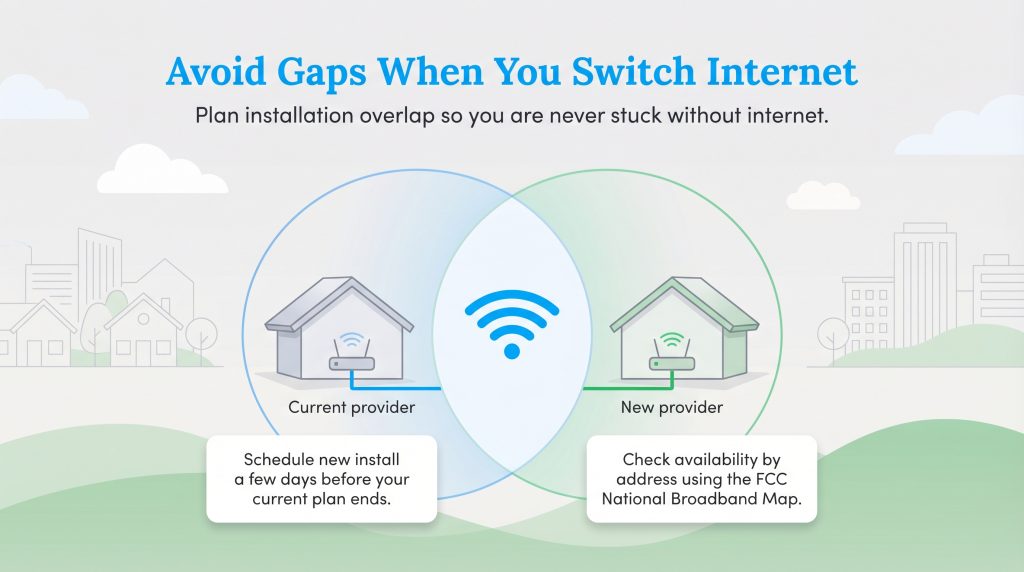
Your final options will ultimately be decided by geographical availability. When viewing an AT&T vs Spectrum coverage map, you will immediately notice that Spectrum covers a significantly larger national footprint. Because Spectrum utilizes established coaxial cable TV lines that have run through neighborhoods for decades, their high-speed internet is widely accessible across vast portions of the United States.
AT&T Fiber requires a completely new infrastructure rollout. Because laying new fiber-optic lines is expensive and time-consuming, their fastest speeds remain highly regional and are often limited to specific urban zones or newly constructed housing developments. You cannot rely on a general zip code search to confirm availability, as fiber lines often stop abruptly halfway down a street.
Before making any concrete decisions or canceling your current plan, use tools like the FCC National Broadband Map to check official broadband availability using your exact street address. This ensures you know exactly which tier of service each provider can actually connect to your home.
Selecting Your Next Internet Service Provider
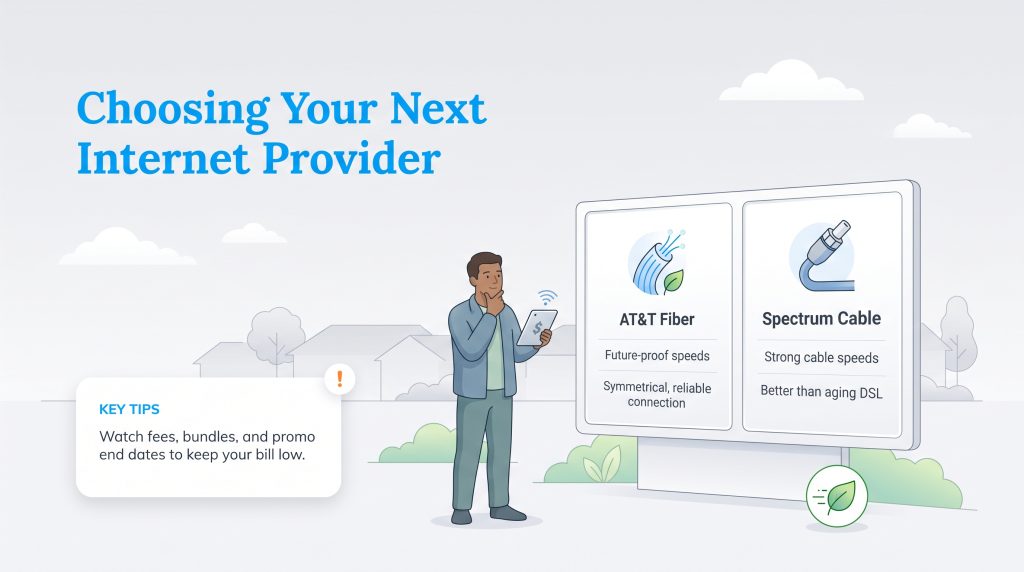
Deciding between these two telecommunications giants requires weighing your budget against your need for upload speed and daily reliability. If AT&T Fiber is wired to your specific address, it is definitively the best overall choice. It delivers symmetrical gigabit speeds, includes your Wi-Fi equipment for free, and skips the frustrating promotional price hikes that plague the cable industry.
Fiber is also an environmentally mindful choice, operating far more efficiently than legacy copper networks and supporting your household’s eco-conscious utility goals. Using energy-saving network equipment like smart plugs can even help lower your monthly electric bill. However, if your address is restricted to AT&T DSL, Spectrum Cable easily takes the crown. Spectrum offers widespread accessibility, incredibly fast download speeds for 4K streaming, and fantastic initial bundle deals with Spectrum Mobile.
We know dealing with utility setups can feel like a chore, but optimizing your broadband plan is one of the quickest ways to take control of your monthly expenses. By keeping an eye out for hidden equipment fees, maximizing mobile bundle discounts, and matching the physical network technology to your household’s actual digital habits, you secure a reliable connection that supports your home for years to come.
Frequently Asked Questions About AT&T vs Spectrum
Is AT&T better than Spectrum?
Does Spectrum or AT&T have hidden data caps?
Is AT&T Internet Air as fast as Spectrum Cable?
Does Spectrum or AT&T offer a better price for seniors or low-income households?
Can I use my own router with AT&T and Spectrum?
Will AT&T pay off my Spectrum contract if I switch?
Do I need to hire a professional to install my new internet service?
Does AT&T or Spectrum have faster upload speeds?
Is Spectrum or AT&T more reliable for working from home?
Can I bundle my cell phone plan with AT&T or Spectrum?
About the Author

David has been an integral part of some of the biggest utility sites on the internet, including InMyArea.com, HighSpeedInternet.com, BroadbandNow.com, and U.S. News. He brings over 15 years of experience writing about, compiling and analyzing utility data.

LaLeesha has a Masters degree in English and enjoys writing whenever she has the chance. She is passionate about gardening, reducing her carbon footprint, and protecting the environment. She also recently served as President of the Board for City Sprouts (a community garden).