Discover If Trinity Solar’s Regional Expertise, Comprehensive Services, And Financing Options Make Them The Right Choice For Your Home
Key Takeaways
- Trinity Solar operates across 10 East Coast states, bringing over 30 years of family-owned experience to local renewable energy installations.
- Customers can choose from comprehensive solar, battery, and roofing packages, though you should carefully weigh your financing options and potential escalator clauses.
- In-house installation teams ensure better quality control, giving you reliable service from the initial consultation through activation.
Deciding to switch to solar energy is a major investment, and choosing the right provider can often feel like navigating a complicated maze of high-pressure sales tactics and complex financing terms. With so many national giants dominating the headlines, it is refreshing to find a robust, family-owned regional player like Trinity Solar that focuses on a specific geographic footprint. Whether you are looking to dramatically lower your monthly electric bill, secure reliable backup power for severe weather, or reduce your carbon footprint with an environmentally mindful choice, this seasoned company has likely installed systems for someone in your exact neighborhood. We are breaking down everything you need to know — from equipment quality and precise cost breakdowns to real, unfiltered customer reviews — so you can make a smart, sustainable, and financially sound decision for your home.
About Trinity Solar
Trinity Solar has been family-owned and operated since 1994, blending three decades of expertise with personalized service. Rather than acting as a faceless national corporation in an industry filled with fly-by-night operators, they emphasize local relationships. Their installers live in the communities they serve, and they have built strong ties with regional utilities, inspectors, and regulators to smooth out the complicated permitting process. Headquartered in New Jersey and proudly privately held, the company employs over 3,000 in-house staff members. Your project manager might just live down the street, providing a level of localized care that is hard to find.
Because they are not beholden to Wall Street shareholders in the same way publicly traded solar companies are, Trinity can focus heavily on steady regional expansion rather than hyper-aggressive national growth. Here is a quick look at the foundation of their business and how they stack up across major consumer rating platforms:
| Company Metric | Details & Ratings |
|---|---|
| Year Founded | 1994 |
| Headquarters | Wall Township, New Jersey |
| Service Area Size | 10 states primarily across the East Coast |
| Better Business Bureau (BBB) | A+ Rating |
| EnergySage Score | 4/5 Stars (Average based on user quotes) |
| Average Yelp Rating | 2.5/5 Stars (Varies heavily by regional branch) |
Trinity Solar Plans, Pricing, and Ways to Save
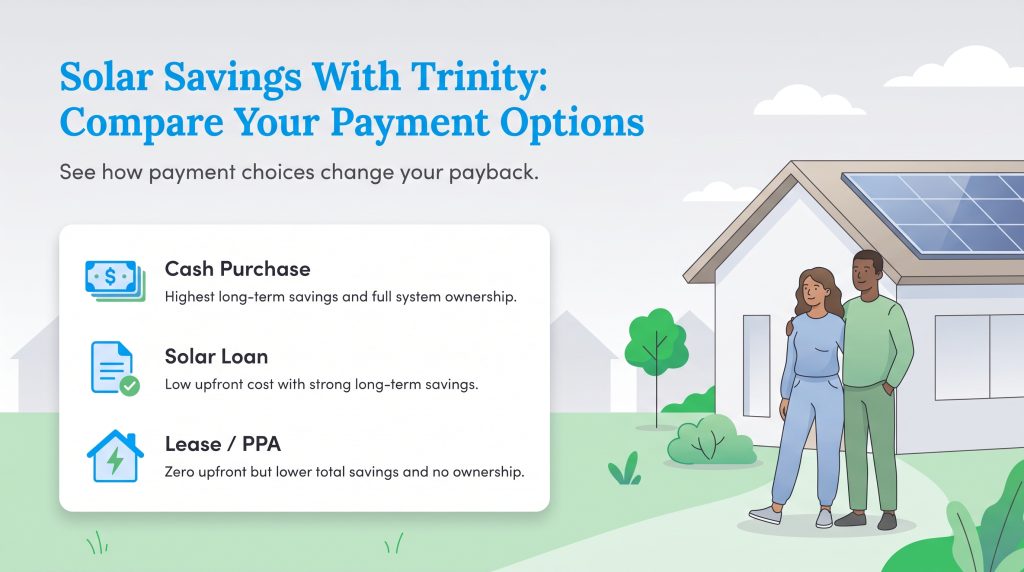
How you pay for your system is just as crucial as the hardware itself. Solar pricing is highly localized, but we can look at historical averages to give you a clear baseline of what to expect during your consultation. Trinity provides multiple pathways to system activation, allowing you to prioritize long-term savings or lower upfront costs. Customers routinely report 50% to 70% reductions in their electric bills, depending heavily on their local net metering policies and household energy consumption habits.
Here is a breakdown of the typical cost expectations when working with Trinity Solar:
- Average Cost Per Watt: Installations generally range from $2.50 to $3.12 per watt before applying state or federal incentives.
- Total System Cost: An average 8kW setup translates to roughly $20,000 to $25,000 upfront.
- Post-Tax Credit Cost: After applying the 30% federal solar tax credit, that same $24,960 system effectively drops to around $17,472.
| Financing Method | Upfront Cost | Long-Term Savings Potential | System Ownership |
|---|---|---|---|
| Cash Purchase | High ($20k–$25k before tax credits) | Highest (no interest or escalating monthly fees) | Yes |
| Solar Loans | Low ($0-down options available) | High (monthly payments offset by energy savings) | Yes |
| Leases / PPAs | Zero ($0 upfront) | Moderate to Low (administered by Sunnova with annual escalators) | No (owned by third party) |
If you choose to purchase your system with cash or a standard solar loan, you unlock access to substantial financial incentives. The 30% federal tax credit significantly slashes your total out-of-pocket expenses. Additionally, because Trinity operates in progressive East Coast energy markets, their consultants can help you leverage state-specific solar renewable energy certificates (SRECs) and localized net metering programs, which credit you for sending excess power back to the grid. By utilizing a cash purchase or an aggressive loan strategy, typical systems in states like New Jersey, New York, or Massachusetts see a full payback period in just six to 12 years.
Watch Out for PPA and Lease Pitfalls
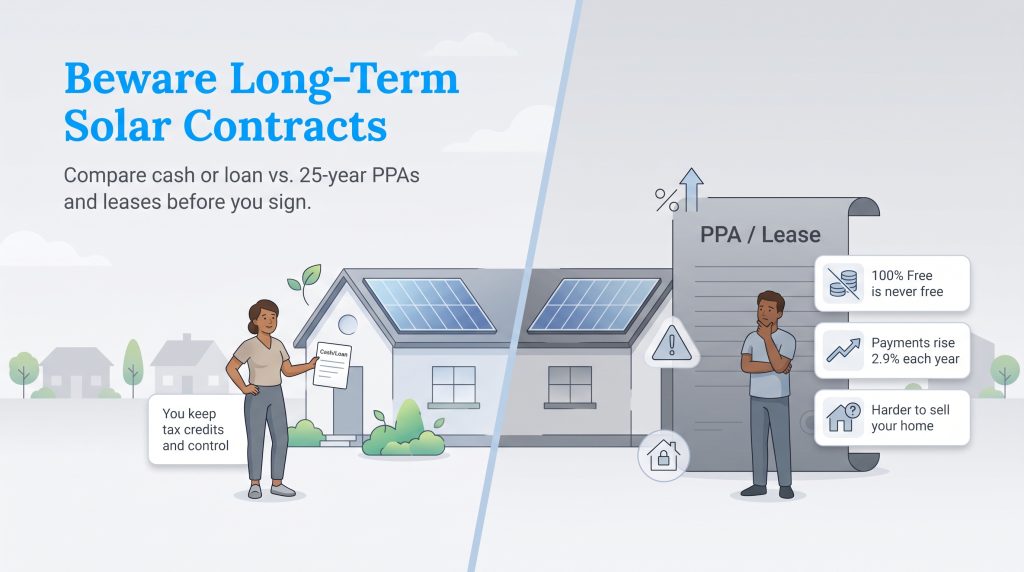
While purchasing a system with cash or a loan puts you in full control of your energy future, you need to exercise extreme caution if a sales representative pushes you toward a Power Purchase Agreement (PPA) or a solar lease. In a PPA, you do not buy the solar panels — you simply buy the electricity they produce at a locked-in rate from a third-party financier, which in Trinity’s case is often Sunnova. While the idea of “$0 down” sounds incredibly appealing, these contracts are fraught with long-term financial hazards.
Before you sign a 25-year lease agreement, be fully aware of these critical red flags:
- The “100% Free” Scam Tactic: Be incredibly wary of any door-to-door salesperson claiming that a government program is giving away “free solar panels.” The hardware is never free. You are simply signing a multi-decade contract to buy the energy those panels generate, often at rates that benefit the leasing company more than your household.
- The 2.9% Annual Escalator Clause: PPAs almost always feature an escalator clause. This means the supposedly low price you pay per kilowatt-hour (kWh) will increase by an average of 2.9% every single year. Over a 25-year term, this compounding increase drastically eats into your savings, sometimes making your solar power nearly as expensive as standard grid energy by the end of the contract.
- Selling Your Home Becomes Difficult: When you lease solar panels, the leasing company places a Uniform Commercial Code (UCC-1) fixture filing on your home. If you want to move, you must convince the new homebuyer to assume your remaining 15 or 20 years of PPA payments. Many prospective buyers refuse to take on this debt, forcing you to buy out the entire contract out-of-pocket just to close the sale of your house.
- You Lose Out On Tax Credits: Because you do not actually own the equipment under a lease or PPA, the third-party financier claims the massive 30% federal tax credit and any localized state rebates. You miss out entirely on the most lucrative financial incentives in the renewable energy sector.
Consumer Advocate Tip: Always demand a cash and loan quote alongside any PPA proposal. Comparing the long-term numbers side-by-side will quickly reveal how much wealth you are forfeiting to a leasing company over a 25-year period.
Trinity Solar Coverage Area
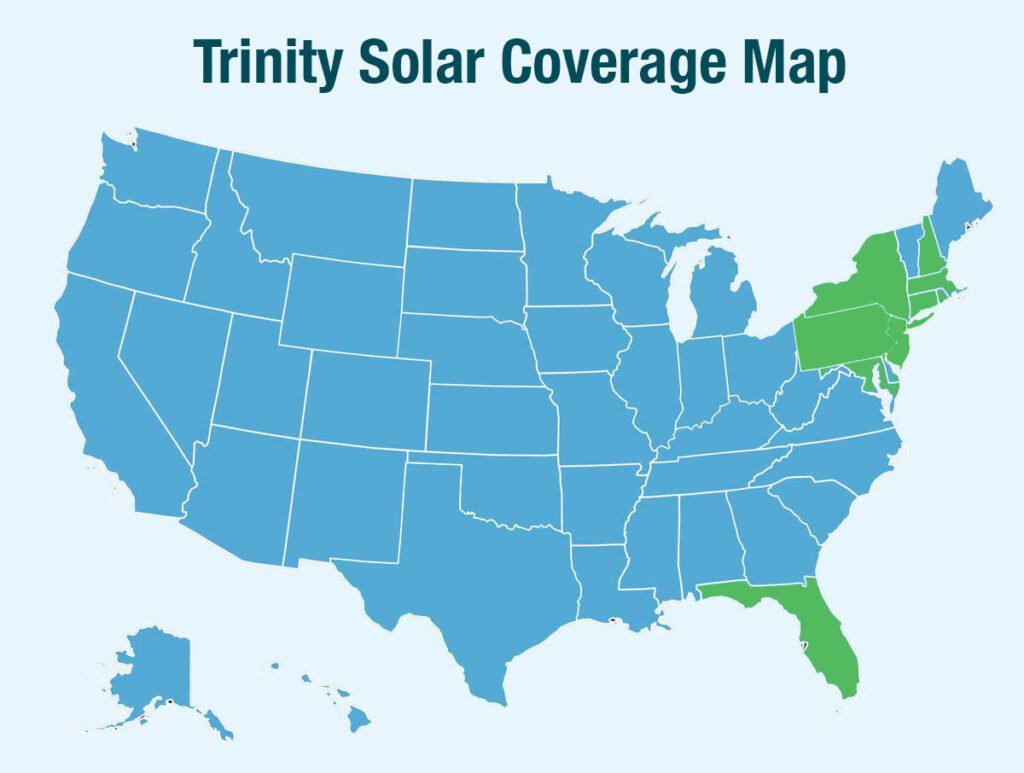
Trinity Solar operates entirely in 10 states, primarily clustered in the Northeast and Mid-Atlantic, alongside a rapidly growing presence in Florida. They act as a regional powerhouse rather than a sprawling national player like Sunrun. By condensing their geographic footprint, they maintain tighter quality control over their local fleets, navigate regional utility regulations much faster, and dispatch repair crews with better efficiency than competitors spread too thin across the country.
- Connecticut
- Delaware
- Florida
- Maryland
- Massachusetts
- New Hampshire
- New Jersey
- New York
- Pennsylvania
- Rhode Island
Major Cities Covered:
- New Jersey: Newark, Jersey City, Trenton
- New York: NYC (all boroughs), Long Island, Albany
- Massachusetts: Boston, Springfield, Worcester
- Pennsylvania: Philadelphia, Pittsburgh, Allentown
- Florida: Orlando, Tampa, Jacksonville
Heads Up: They don’t serve California, Texas, or the Midwest. If you live outside the East Coast or Florida, you will need to explore alternative providers.
Equipment Offered: Panels and Batteries
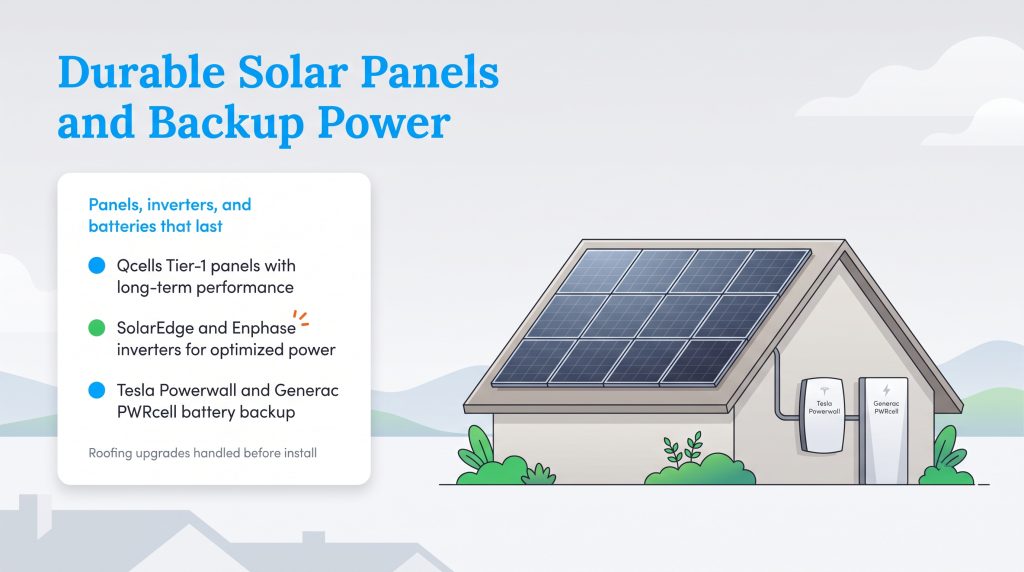
When you invest in an eco-conscious alternative for your home, you want hardware that is built to last through decades of rain, snow, and extreme heat. Trinity focuses heavily on industry-standard, Tier-1 equipment known for absolute reliability over cutting-edge but unproven exotic options. Tier-1 manufacturers invest heavily in research and development, ensuring their panels degrade at a much slower rate than budget competitors.
Beyond the actual panels, they also offer crucial roofing services — meaning if your roof needs repair or a complete replacement before the array goes on, Trinity handles the entire project seamlessly so you don’t have to hire a third-party contractor.
| Equipment Category | Supported Brands | Key Features and Specifications |
|---|---|---|
| Solar Panels | Qcells | High-efficiency ratings (~20.6%–21.4%); backed by an excellent 86% output guarantee at year 25, meaning they hold their power well over time. |
| Inverters | SolarEdge & Enphase | Includes advanced power optimizers or microinverters for maximum array efficiency, ensuring one shaded panel doesn’t drag down the rest. |
| Solar Batteries | Tesla Powerwall & Generac PWRcell | Ideal for whole-home backup power during severe storms or for maximizing self-consumption during peak utility rate hours. |
Trinity Solar Mobile App and Monitoring
Fulfilling the modern homeowner’s need for instant data and control, the Trinity Solar monitoring experience relies on the sophisticated software of their chosen inverter partners. Depending on the specific hardware you select during your design consultation, you will track your system using either the SolarEdge or Enphase mobile application.
Both platforms give you a highly detailed, real-time look into your home energy ecosystem. You can effortlessly track your daily energy production down to the individual panel, monitor real-time household consumption to see which appliances drain the most power, and confirm exactly how much juice is stored in your battery. In the event of a grid failure or severe weather event, these apps will immediately notify you of utility outages and seamlessly transition your home to backup power if you have a battery installed. This level of granular transparency ensures you are always fully in command of your energy usage.
Warranty, Fees, and Guarantees
Protecting your massive home investment means paying close attention to the fine print. Trinity backs their installations with comprehensive coverage, though it is incredibly important to understand the distinct difference between manufacturer protections and in-house labor terms. Reviewing these warranty details ensures you are fully protected in the event of unexpected equipment failure.
Equipment Guarantees
- Solar Panels: 25-year product and performance warranties guaranteed by Qcells.
- Inverters: 12 years out of the box (extendable up to 25 years for SolarEdge products for an additional fee).
- Batteries: 10 years for both Tesla and Generac backup systems, which is the standard ceiling for lithium-ion storage.
Workmanship Guarantees
- Labor & Workmanship: Only five to 10 years depending on your state. This falls slightly below the modern industry average of 10 to 25 years, though lease and PPA customers receive full coverage for the complete duration of their agreement.
- Roof Penetration Warranty: 10 to 25 years against leaks, ensuring your underlying property remains completely protected from water damage.
We also strongly advise reading the fine print regarding potential hidden fees before letting an installer on your roof. If you opt for a lease or PPA, pay close attention to the steep cancellation fees if you attempt to break the contract early or sell your home without successfully transferring the agreement to the new buyer. These penalties can easily run into the thousands of dollars.
The Solar Installation Process
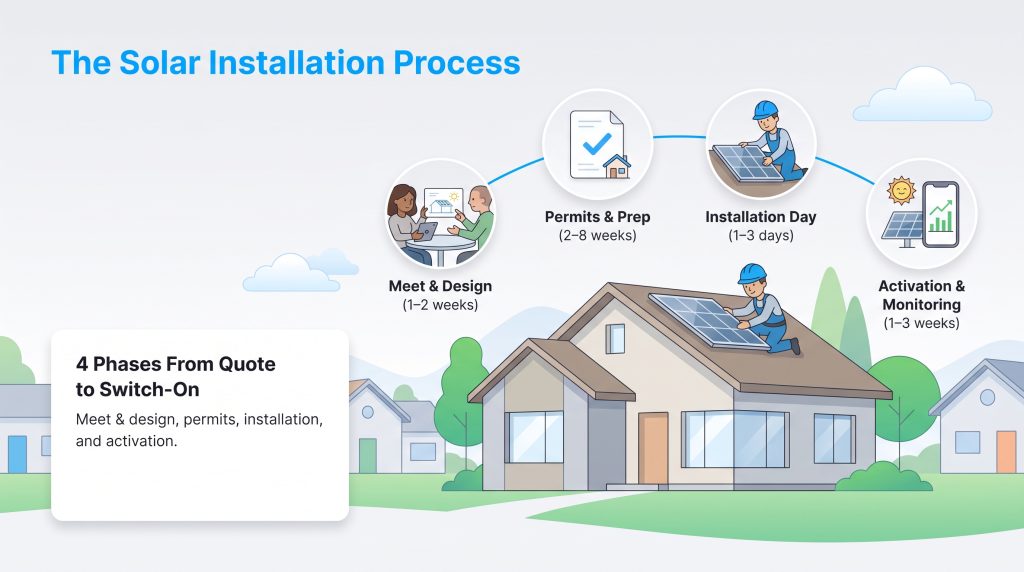
Transitioning to clean energy shouldn’t feel like a second full-time job. Trinity’s quoting journey starts with a free, 60-minute consultation aimed to be casual yet highly informative. A Trinity Solar expert will visit your home or connect virtually to outline available incentives, inspect your roofline, and measure your sun exposure with absolutely no obligation to buy. Once the contract is signed, the process flows smoothly through four distinct phases:
- Meet & Design (1–2 weeks): Their engineering team creates a customized system design based on your historical energy goals, taking into account any future additions like an electric vehicle or a hot tub.
- Pre-Installation Prep (2–8 weeks): Trinity handles all local permitting, rigorous HOA approvals, and utility paperwork — lifting a major administrative headache entirely off your shoulders.
- Installation Day (1–3 days): A professional, in-house Trinity crew arrives early to mount the hardware. Customers frequently highlight their incredible tidiness, efficiency, and respect for the property.
- Activation & Monitoring (1–3 weeks): After the physical installation is complete, Trinity coordinates directly with your local utility for the final town inspections. You cannot turn the system on until you receive official “Permission to Operate” (PTO) from your utility provider.
Real Customer Reviews, Ratings, and Complaints
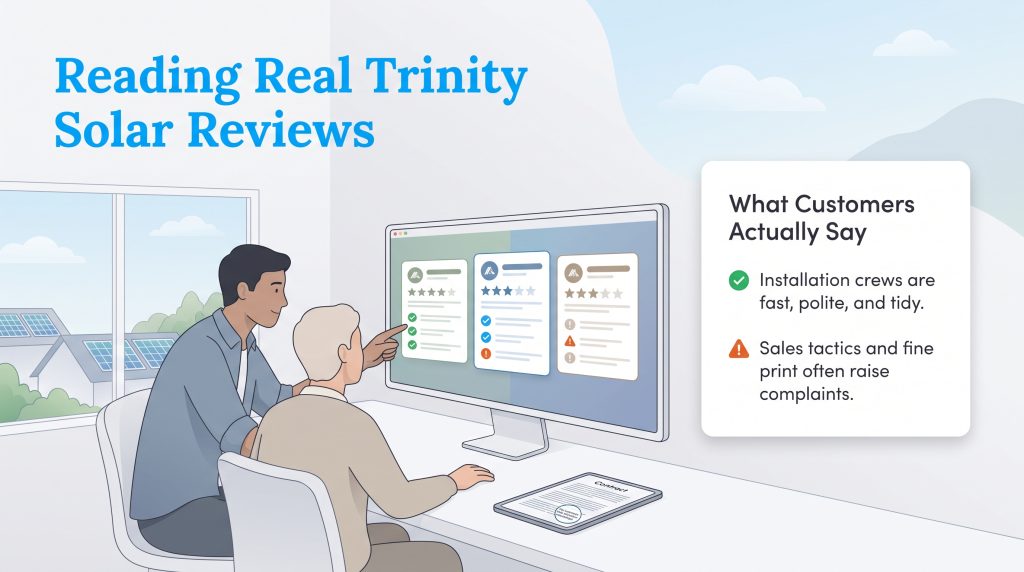
Establishing genuine trust in a provider means looking far beyond glossy marketing brochures and digging deeply into real customer sentiment. Across third-party consumer advocacy sites like the Better Business Bureau, Consumer Affairs, and active local subreddits, homeowners paint a generally positive but highly nuanced picture of their experience with Trinity.
On the positive side, customers consistently and overwhelmingly praise Trinity’s actual installation crews. Because they utilize over 3,000 in-house staff members rather than leaning heavily on unpredictable third-party subcontractors, the on-site quality control is highly regarded. Homeowners frequently note how polite, fast, and respectful the workers are on installation day, leaving properties entirely free of debris.
However, no company is without significant friction points, and Trinity has a few recurring issues that demand your attention. A substantial number of complaints center around hyper-aggressive door-to-door sales tactics. Multiple users on Reddit and the BBB have reported sales representatives acting overly persistent or glossing over the long-term financial implications of PPAs. Furthermore, there are alarming reports of customers being asked to sign digital documents on a tablet without being given adequate time to read the contract terms, only to later discover the 2.9% annual escalator clause buried in the fine print.
Additionally, post-installation customer service often leaves much to be desired. Homeowners routinely note lengthy delays in receiving basic repairs for minor warranty hiccups. If your inverter loses its cellular connection or your monitoring app stops updating, securing a timely response from the customer support desk can involve multiple unreturned phone calls and frustrating wait times.
Comparing Trinity Solar to Top Competitors
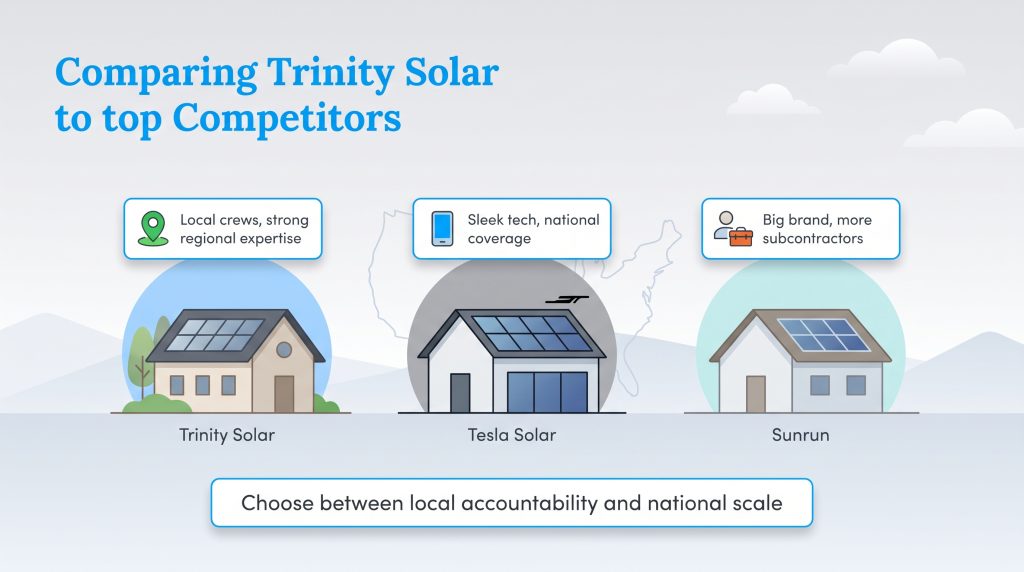
To truly know if Trinity is the right choice, you have to see how they stack up against the heavyweights of the industry. Capturing the nuances of regional installers versus massive national brands helps clarify what matters most for your specific home.
| Provider Feature | Trinity Solar | Sunrun | Tesla Solar |
|---|---|---|---|
| Service Area Size | Regional (10 States) | National (19+ States) | National (All 50 States) |
| Workmanship Warranty | 5 to 10 Years | 10 Years | 10 Years |
| Main Panel Brands | Qcells | Longi, Enphase | Tesla (Proprietary) |
| In-House Installation | Yes (Primarily) | Mixed (Uses subcontractors) | Mixed (Uses subcontractors) |
| Customer Service Focus | Localized & Regional | Highly Corporate | Often Difficult to Reach |
Choosing between a regional installer like Trinity and a national brand like Tesla or Sunrun ultimately comes down to your preference for localized accountability. National brands often provide sleeker digital experiences and potentially lower baseline pricing due to massive bulk purchasing power. However, they frequently rely on a rotating carousel of third-party subcontractors, which can lead to unpredictable installation quality. Trinity’s strength lies in its specialized knowledge of East Coast building codes, localized in-house crews, and an intimate understanding of regional utility net metering laws.
Green Energy and Sustainability Initiatives
If you are exploring residential solar panels, you likely care deeply about the environmental footprint of your household. According to the U.S. Energy Information Administration (EIA), reducing residential reliance on fossil fuels is critical to modern grid stability. Trinity operates under an “Energy with Integrity” philosophy, which naturally extends into substantial corporate sustainability practices. Their overarching mission is to help Northeast and Mid-Atlantic communities drastically reduce their reliance on aging, fossil-fuel-heavy electrical grids that pollute local communities.
By prioritizing long-lasting Tier-1 equipment, Trinity ensures significantly fewer defective panels end up in landfills prematurely. As the renewable sector grows rapidly, Trinity is also increasingly mindful of end-of-life panel recycling processes. They partner with regional waste management facilities to ensure decommissioned hardware is carefully stripped for valuable silicon, glass, and aluminum rather than thoughtlessly discarded. Choosing an environmentally mindful choice like a home battery further enhances these green energy initiatives by allowing your home to run entirely on stored sunshine during peak evening hours, rather than pulling dirty energy from the local utility grid when fossil fuel plants are firing on all cylinders.
Evaluating the Pros and Cons
To help you effectively weigh the decision, here is a comparative look at the distinct advantages and notable drawbacks of choosing Trinity. Understanding these strengths and weaknesses side-by-side will help you determine if their specific offerings align seamlessly with your household energy goals.
| The Advantages | The Drawbacks |
|---|---|
| 30+ years in business with well over 100,000+ successful regional installs | Only offers a five to 10-year workmanship warranty, which lags behind competitors |
| Relies on in-house certified installers instead of unpredictable third-party subcontractors | Geographically limited — operates only in 10 East Coast states and Florida |
| Offers comprehensive solar, roofing, and battery solutions under one single contract | Consistent reports of slow post-installation service delays for monitoring updates |
| Features solid equipment warranties and maintains a stellar A+ BBB rating | PPA options carry steep annual escalators that heavily limit your total lifetime savings |
| Competitive pricing structures compared to peers, featuring highly accessible $0-down options | Pushy door-to-door sales tactics frequently noted by unhappy prospective customers |
Determining if Trinity Solar Is Right for Your Home
If you want a highly trusted, historically grounded solar provider that handles complex permitting, roof replacements, and battery installation all under one roof, Trinity Solar delivers an exceptional full-service package. Their large-scale regional operation gives you accountability, professionalism, and localized expertise that national giants simply cannot match. However, it is absolutely vital to know exactly what you are signing up for, particularly when navigating their financing options.
Who this provider is best for:
- ✅ Homeowners on the East Coast looking for a seasoned, highly reliable installer with deep local roots.
- ✅ Those who need full-service project support, including complex roof replacements prior to installation.
- ✅ Buyers prioritizing the safety and accountability of in-house installation crews over third-party subcontractors.
Who should avoid them:
- ❌ Residents living in the Midwest, West Coast, or Texas, as they fall completely outside the service territory.
- ❌ Homeowners who strictly demand a 25-year workmanship warranty to perfectly match the length of the panel warranty.
- ❌ Consumers who are understandably wary of aggressive door-to-door sales tactics or entering long-term leases with built-in annual escalator clauses.
Ultimately, Trinity Solar is an incredibly strong pick for homeowners ready to invest in an energy-saving option through a cash purchase or a standard loan. If you are seeking a stress-free, professional installation experience backed by decades of comprehensive support — and you are careful to avoid the financial pitfalls of their PPA offerings — they are absolutely worth a closer look for your home energy needs.
Frequently Asked Questions About Trinity Solar
How long has Trinity Solar been in business, and are they reputable?
What solar panels and inverters does Trinity use?
How much does a Trinity Solar system cost?
Does Trinity Solar offer financing, leases, or PPAs?
How do Trinity Solar’s PPA escalator clauses work?
Will Trinity Solar replace my roof if needed?
Does Trinity Solar use subcontractors for installation?
How do I cancel a Trinity Solar PPA or lease?
Is Trinity Solar a door-to-door sales company?
How do I contact Trinity Solar customer service?
Are Trinity Solar panels actually free?
About the Author

LaLeesha has a Masters degree in English and enjoys writing whenever she has the chance. She is passionate about gardening, reducing her carbon footprint, and protecting the environment. She also recently served as President of the Board for City Sprouts (a community garden).