


A home battery backup provides energy security and peace of mind during grid outages, and you don’t always need solar panels to reap the benefits.
Key Takeaways
- A typical professionally installed home battery backup system costs between $10,000 and $20,000 before incentives, though federal tax credits can significantly reduce your final price.
- You do not need solar panels to use a home battery, as modern units can charge directly from the electrical grid to provide emergency backup power.
- A single battery usually powers essential appliances like a refrigerator and Wi-Fi router for 12 to 24 hours, rather than backing up the entire house for days.
Losing power during a nasty storm or unannounced rolling blackout is frustrating, leaving you sweating in the dark while the food in your fridge spoils, but a robust home battery backup system offers immediate grid outage protection and strategic Time-of-Use shifting to lower your monthly bills. Finding the best solar batteries 2026 has to offer can feel incredibly overwhelming, especially with the rapid advancement of lithium iron phosphate (LFP) technology. We want to help you cut through the technical jargon, compare top-tier models side-by-side, and build a practical, realistic energy storage setup that directly meets your family’s household needs.
What Is a Home Battery Backup System?
At its core, a home battery backup system is a large-scale energy storage unit directly wired into your home’s main electrical panel. These smart battery systems act as a silent guardian for your property, constantly monitoring the utility grid. When they detect a voltage drop, they automatically take over — often in a fraction of a second — keeping your most vital circuits running smoothly without you ever lifting a finger.
As homeowners increasingly seek eco-conscious alternatives to loud, maintenance-heavy gas generators, the market has exploded with sleek, highly capable options. Choosing to install a home battery backup system means prioritizing an environmentally mindful choice that effortlessly blends reliability with quiet operation. You completely eliminate the need to store volatile fuels in your garage, perform messy oil changes, or try to yank a pull-cord in the middle of a torrential downpour.
📌 Quick Fact: Unlike traditional gas generators, home battery backups operate near-silently and produce no on-site exhaust during operation, making them a cleaner and safer alternative for many households — an environmentally mindful choice that works even in strict HOA neighborhoods.
How to Choose the Best Home Battery Backup System for Your Home
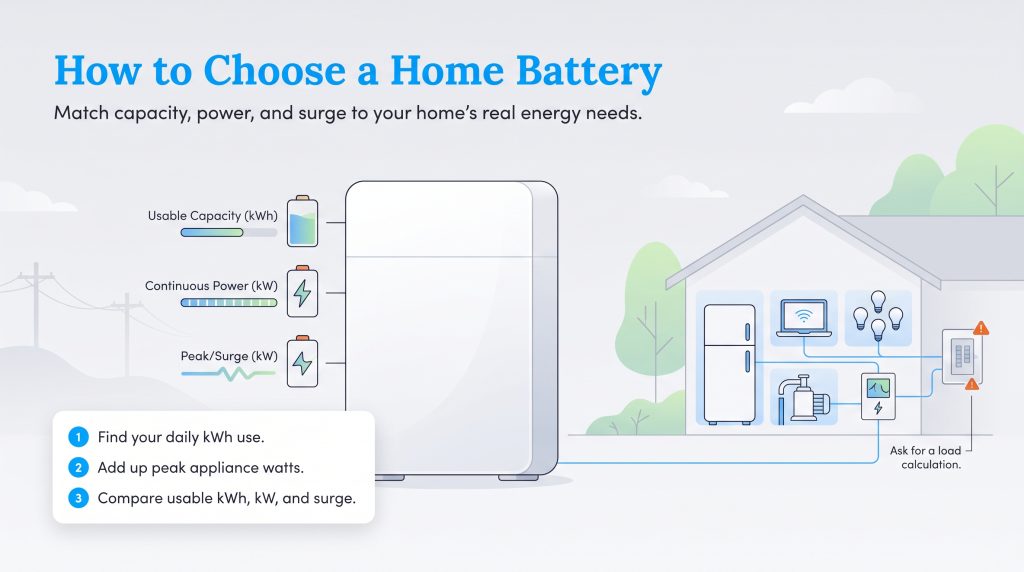
Choosing the perfect hardware demands a strategic review of your daily lifestyle, your budget, and the specific limitations of your home’s electrical panel. Treating this process as a strict buying criteria guide ensures you don’t overspend on capacity you will never use, nor underpower your house when the grid goes dark. When comparing quotes from certified installers, force them to explain exactly how the equipment ranks against these three crucial specifications:
- Usable Capacity (kWh): This metric defines the “size of the fuel tank.” Measured in kilowatt-hours, usable capacity dictates how many total hours your lights, fridge, and router will stay on during a blackout. Ignore total capacity numbers; only focus on the usable portion the manufacturer guarantees.
- Continuous Power Output (kW): This acts as the “horsepower” of your battery. Measured in kilowatts, continuous output determines how many appliances can run simultaneously. If you want to run a refrigerator, a well pump, and a microwave at the exact same time, you need a high continuous output rating.
- Peak/Surge Output (kW): Certain appliances — especially those with electric motors like air conditioners or sump pumps — require a massive, temporary spike of electricity to turn on. The peak output rating tells you if the battery can handle that split-second surge without tripping the internal breakers and shutting down.
See our list of Best Battery Backup Systems
Battery Capacity Sizing and Output
You cannot blindly guess your battery capacity sizing. To build a system that won’t fail you, you must calculate your household’s daily kWh consumption and peak kW demand. Start by looking at your last utility bill to find your average monthly kilowatt-hour usage. Divide that number by 30 to get your daily average. If your home uses 900 kWh a month, you consume roughly 30 kWh a day.
If your goal is to survive a 24-hour outage without any solar panels recharging the system, you mathematically need 30 kWh of battery storage. If you prioritize only the essentials, you can easily cut that demand in half. Next, calculate your peak kW demand by adding up the starting wattage of the crucial appliances you want wired to the backup panel.
Let’s look at a realistic example for a standard three-bedroom home. Suppose you want to back up a modern refrigerator (800 watts), your home office setup and Wi-Fi (200 watts), a water well pump (1,500 watts), and a few LED lighting circuits (100 watts). Your concurrent peak demand is 2,600 watts, or 2.6 kW. Every single top-tier battery we reviewed above easily handles a 2.6 kW continuous load. However, if you try to add a 4,000-watt central air conditioning compressor into that mix, your demand jumps to 6.6 kW, immediately ruling out smaller single-unit setups like the Enphase IQ 5P unless you purchase multiple blocks.
💡 Pro Tip: When in doubt, ask your electrician to perform a formal “load calculation” on your main panel. This detailed audit guarantees you purchase a system capable of handling your home’s unique energy footprint.
How Much Does a Whole House Battery Backup Cost?
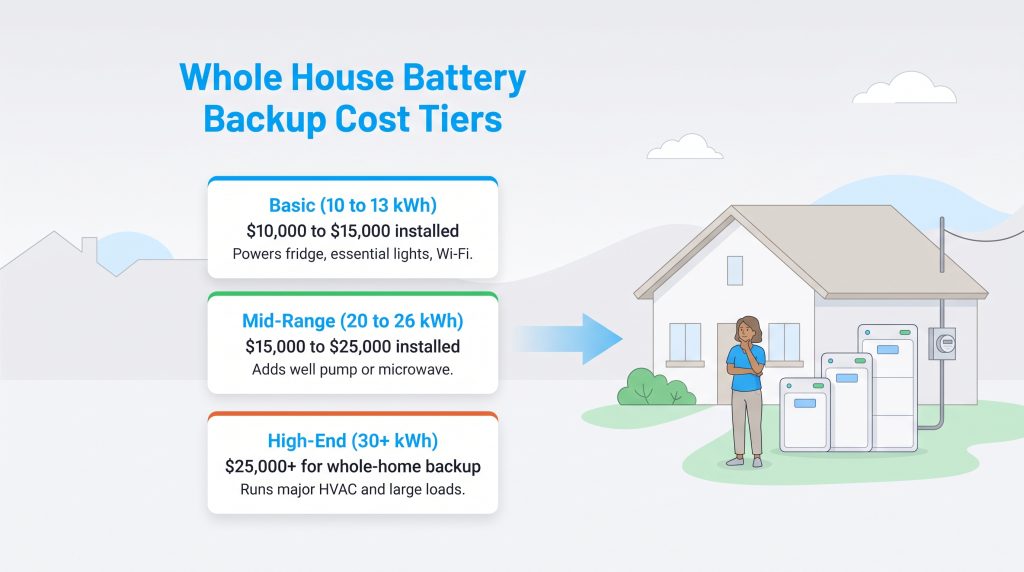
Figuring out a realistic whole house battery backup cost requires understanding the three main price drivers: total battery capacity, the type of inverter technology used, and the brand premium attached to the equipment. A professionally installed home battery backup system often lands in the $10,000 to $20,000 range before incentives. While hardware-only prices may start around $7,000 for an entry-level unit, the necessary installation labor, permitting fees, and electrical panel upgrades can quickly add thousands of dollars to your final bill.
We need to set clear expectations right away — running your entire sprawling property for several days strictly on battery power is a massive luxury investment. A true whole-home setup requires linking multiple high-capacity batteries together, pushing total project costs past the $25,000 mark. Most families find that backing up just the essential circuits provides maximum peace of mind without draining their savings accounts.
Realistic Cost Tiers for Homeowners
| System Tier | Estimated Installed Cost Before Incentives | What It Powers |
|---|---|---|
| Basic (10 to 13 kWh) Ex: Two Enphase IQ 5P units | $10,000 to $15,000 | Powers fridge, essential lights, and Wi-Fi router. |
| Mid-Range (13 to 20 kWh) Ex: Single Tesla Powerwall 3 | $15,000 to $25,000 | Powers essentials plus a well pump or microwave. |
| High-End (27+ kWh) Ex: Dual FranklinWH aPower 2 units | $25,000+ | True whole-home backup, including heavy-draw HVAC systems. |
How Long Does a Home Battery Backup Last?
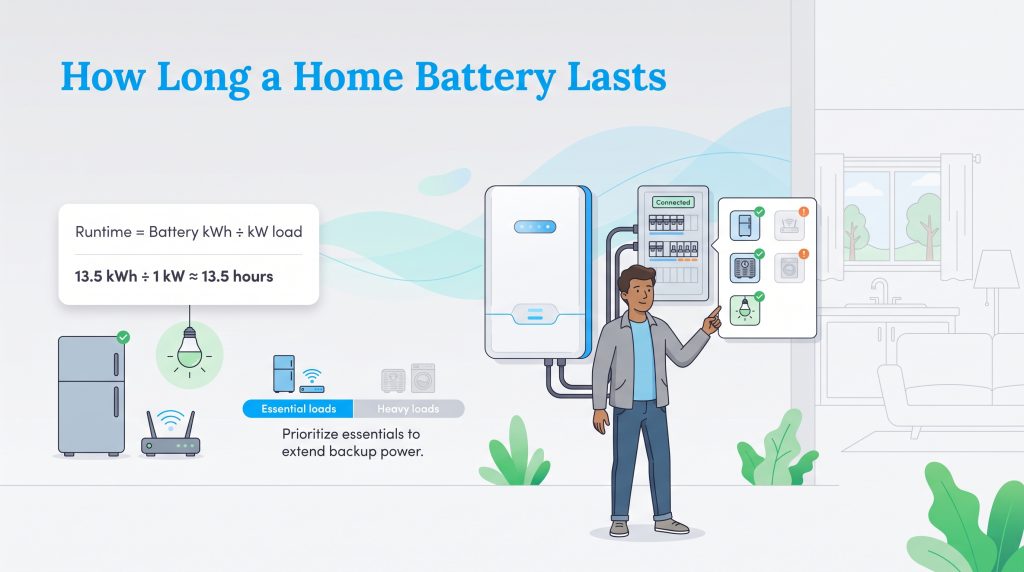
A standard single-unit battery generally provides 12 to 24 hours of backup power if you carefully manage your energy usage. When trying to calculate exactly how long a home battery backup will last, you simply take the battery’s total usable capacity and divide it by your home’s active wattage draw. For example, if you have a 13.5 kWh battery and your essential appliances continuously pull 1,000 watts (1 kW), your stored power will deplete in roughly 13.5 hours.
💡 Pro Tip: You can drastically extend your battery runtime by installing a smart electrical panel, like a SPAN panel. These modern upgrades automatically shed non-essential loads — like your electric dryer or hot tub — the second the grid goes down, ensuring your stored power goes exactly where it is needed most.
Estimated Appliance Loads and Runtime Impact
To better understand how fast your battery will drain, it helps to know how much power your devices actually consume during an outage.
| Appliance or Circuit | Approximate Power Draw | Backup Priority |
|---|---|---|
| Refrigerator | 100 to 800 watts while cycling | High |
| Wi-Fi router and modem | 10 to 30 watts | High |
| LED lights | 5 to 15 watts each | Medium |
| Sump pump | 800 to 1,500 watts while running | High in flood-prone homes |
| Central AC | 2,000 to 5,000+ watts | Usually not ideal for single-battery backup |
| Electric oven or dryer | 3,000 to 5,000+ watts | Usually avoid during outages |
To put this into perspective, the average U.S. residential customer uses about 29 kWh per day. That means a typical 13.5 kWh unit simply wont power your entire house for a full 24 hours without strict rationing. You have to actively prioritize what stays on, choosing cold food and basic connectivity over running the washing machine or baking in an electric oven.
Can You Install a Home Battery Backup Without Solar?
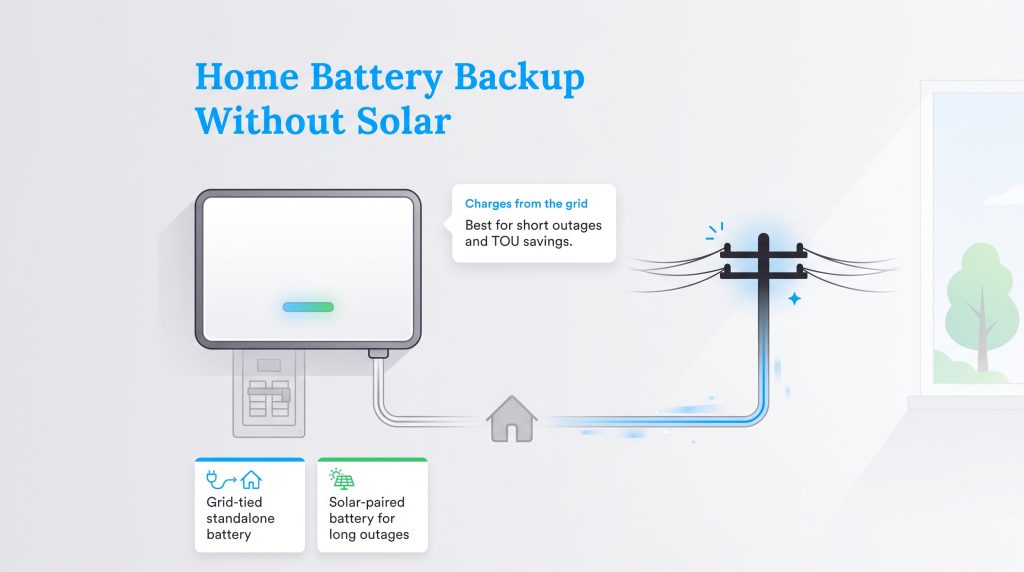
Yes, you absolutely can install a home battery backup without solar panels. These intelligent standalone units monitor your electrical feed, charging themselves entirely from the utility grid while power is flowing normally. They sit quietly in standby mode, holding that stored grid energy until an unannounced power outage occurs, at which point they instantly discharge into your essential circuits.
The Case for Standalone Batteries
Skipping the expensive rooftop panels entirely is often the smartest move for many households. Standalone setups make perfect sense in a variety of challenging situations:
- You experience frequent but relatively short electrical utility grid interruptions that last just a few hours.
- Your strict HOA, complex roof design, or heavy mature tree coverage makes a solar installation physically impossible or too ugly to approve.
- You rent an apartment or house, making a portable power station the only realistic choice for energy security.
When Pairing with Solar Makes Sense
If your primary goal is surviving multi-day outages after a major hurricane or devastating winter storm, a standalone battery eventually becomes an empty box. You absolutely need a renewable energy source to refill the depleted battery capacity every single morning. In extended disasters, pairing a battery with solar ensures you can recharge your stored energy endlessly, keeping your essential circuits running indefinitely.
| Setup Type | How It Charges | Best Use Case |
|---|---|---|
| Grid-Tied Standalone Batteries | Pulls directly from the local utility grid. | Short-term weather outages and daily TOU rate shifting. |
| Solar-Paired Batteries | Charges via rooftop solar panels (and the grid). | Long-term disaster resilience and maximum grid independence. |
Time-of-Use Shifting and Bill Savings
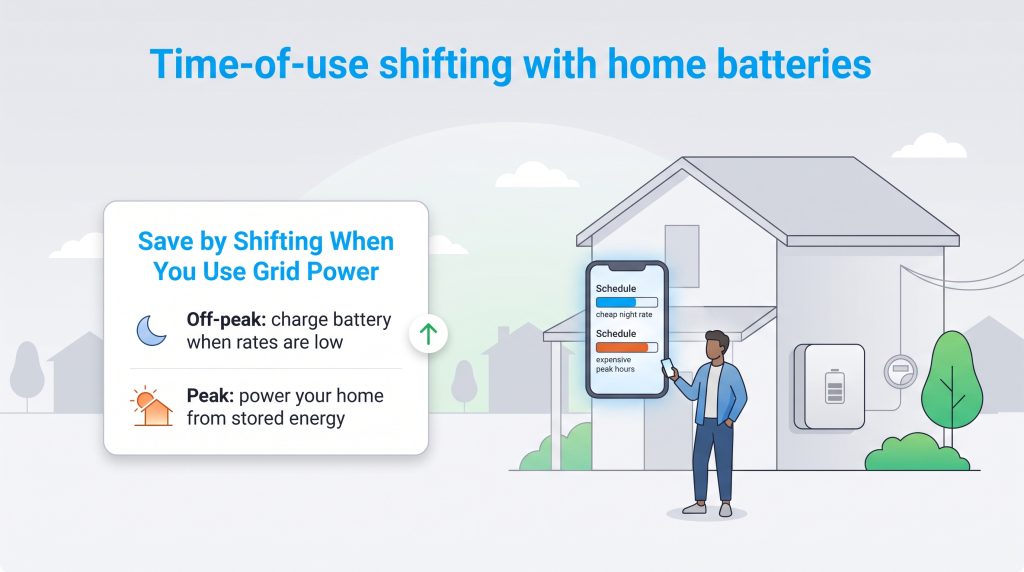
Investing in a massive wall battery isn’t just about preparing for the worst-case disaster scenario; it is also a powerful financial tool you can use every single day. If you live in an area with fluctuating utility rates, your energy company likely charges you significantly more for electricity during peak evening hours when everyone is home cooking dinner and running their air conditioners. This rate structure creates a prime opportunity for a strategy known as Time-of-Use shifting.
Time-of-Use shifting, often called TOU arbitrage, allows you to strategically lower your electric bill without changing your daily habits. You simply use the smartphone app provided by Tesla, Enphase, or FranklinWH to tell the battery to charge itself overnight when grid electricity is incredibly cheap. Then, when the expensive peak hours hit — typically between 4:00 p.m. and 9:00 p.m. — the battery automatically discharges that cheap stored energy into your home. Your house effectively unplugs from the grid during the most expensive part of the day.
This automated rate shifting generates tangible financial returns, especially if your local utility offers meaningful off-peak discounts. Over a 10-year lifespan, those daily savings can add up to thousands of dollars, helping the battery system pay for itself even if you rarely experience severe storms.
💸 Money-Saver: Always call your utility provider before purchasing a battery to confirm they offer a “Time-of-Use” rate plan. Without a wide gap between peak and off-peak pricing, the financial benefits of daily battery cycling are significantly reduced.
Emerging Alternatives: EV Charging and Portable Stations
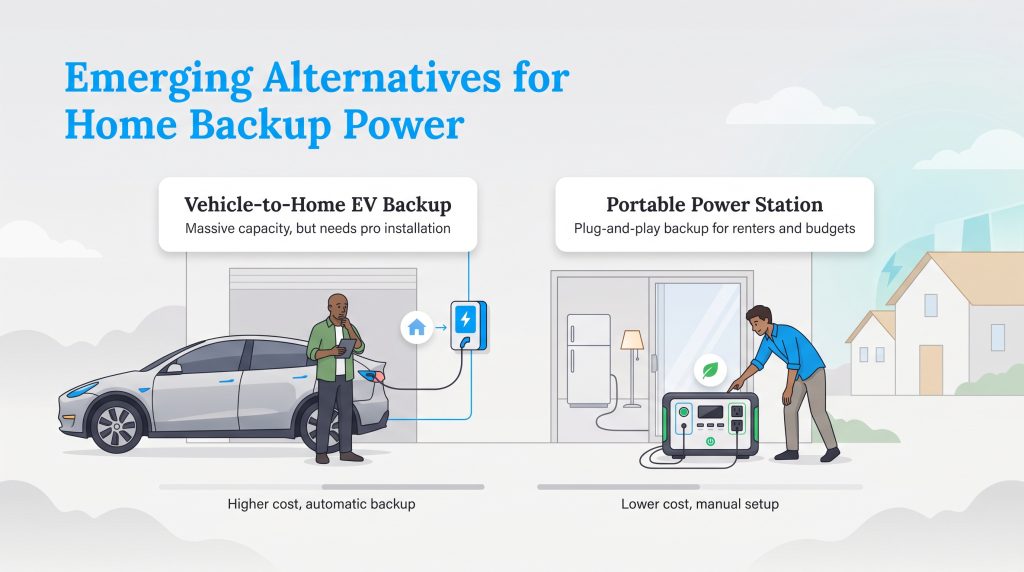
The technology landscape for home energy storage is evolving rapidly, bringing innovative options far beyond traditional wall-mounted boxes. One of the most exciting developments is bi-directional electric vehicle charging, universally referred to as Vehicle-to-Home (V2H) technology. With compatible equipment, EVs like the Ford F-150 Lightning can provide backup power directly to your home’s circuits during a massive outage. If properly configured, an EV’s massive internal battery capacity absolutely dwarfs standard home installations, offering days of emergency power.
If you need a highly capable, budget-friendly alternative immediately, heavy-duty portable power stations are reshaping the entire market. These robust, plug-and-play LFP units don’t require expensive permits, utility interconnection agreements, or hardwiring. They stand out as the ideal, accessible solution for apartment renters or anyone who simply wants an environmentally mindful choice to keep the refrigerator running until the local utility company restores service.
Portable Power Station Versus Home Battery Backup
Deciding between a permanent hardwired system and a modular portable alternative depends entirely on your current housing situation and available budget.
| Option | Best For | Typical Cost Range | Installation Needed | Main Limitation |
|---|---|---|---|---|
| Permanent Home Battery | Homeowners seeking seamless, automatic backup. | $10,000 to $20,000+ | Permits, electrician, and utility approval. | High upfront cost and strict property requirements. |
| Portable Power Station | Renters or budget-conscious buyers running a few devices. | $500 to $3,500 | None; simply plug devices into the unit. | Requires manual setup and offers limited capacity. |
Home Battery Backup Versus Gas Generator
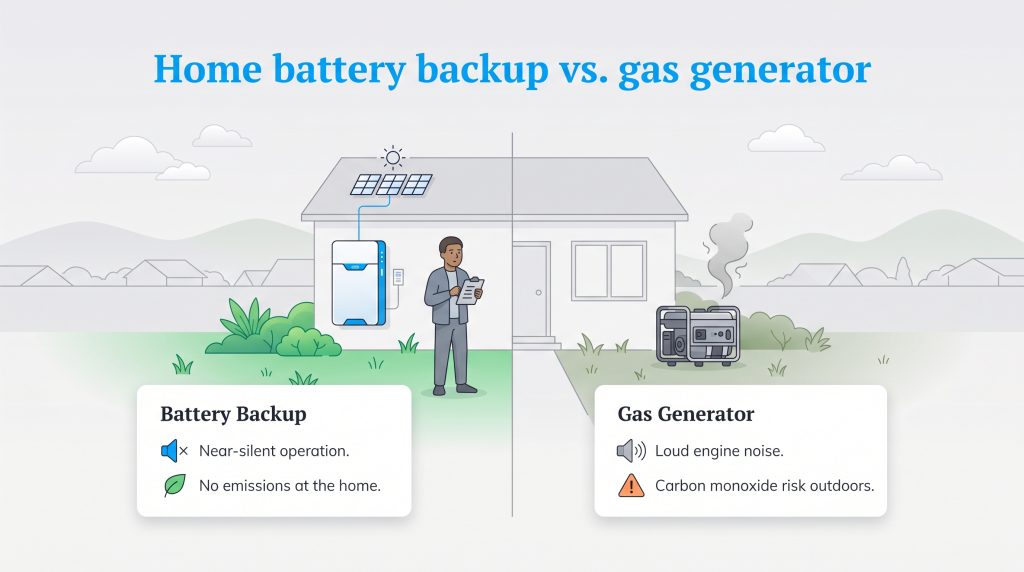
Many homeowners find themselves torn between installing a sleek battery system and relying on a traditional gas-powered generator. While both options provide critical emergency relief, they operate under completely different philosophies and maintenance expectations.
| Feature | Home Battery Backup | Gas Generator |
|---|---|---|
| Noise Level | Near-silent operation. | Loud, continuous engine noise. |
| Maintenance | Virtually zero maintenance. | Requires oil changes, fuel stabilization, and testing. |
| Emissions and Safety | No localized emissions; safe for indoor installation. | Produces dangerous carbon monoxide; must be used outdoors. |
| Fuel Supply | Recharges via solar panels or grid power. | Requires constant refueling with gasoline or propane. |
| Upfront Cost | High initial investment. | Much lower initial purchase price. |
DIY Versus Professional Home Battery Backup System Installation
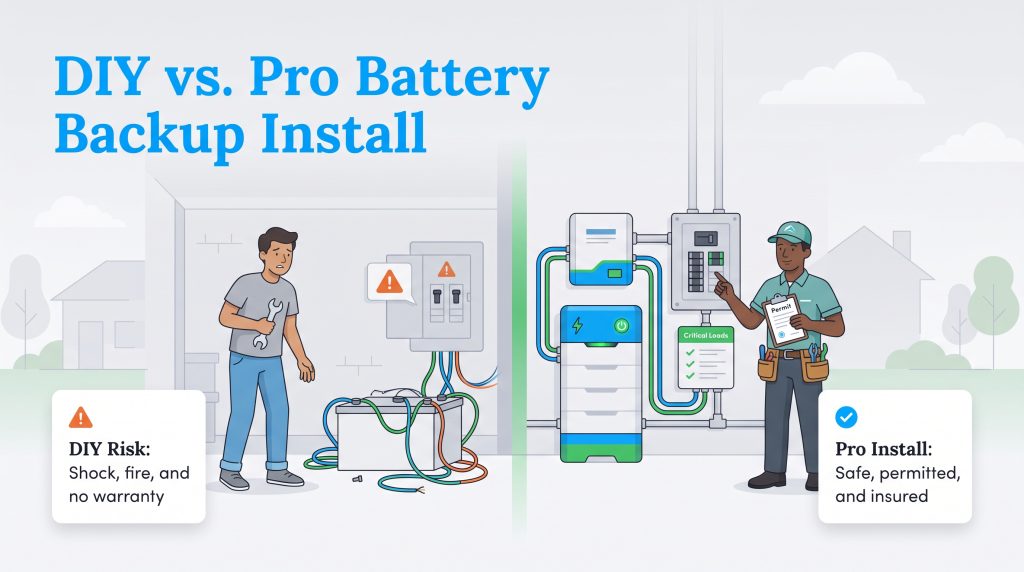
Tackling a DIY home battery backup system installation might seem like a clever way to bypass high labor costs, but it is a highly dangerous endeavor that we strongly discourage for permanent, hardwired setups. You are dealing directly with significant high-voltage electricity that poses serious electrocution and fire risks if mismanaged. We urge you to rely exclusively on certified, licensed electricians who understand the complex load calculations and safety protocols required to properly integrate energy storage into a main electrical panel.
Important Installation Safety Standards
Working alongside a seasoned professional helps ensure your new system meets rigorous fire and safety regulations. When vetting local installation crews, firmly ask these essential questions to protect your expensive investment:
- Are the battery and inverter units properly UL-listed for residential safety?
- Will the installation team handle all local city permitting and inspections?
- Do they manage the incredibly tedious utility interconnection paperwork?
- Does your specific home layout require a separate critical-load panel?
- Will the final setup comply with all strict local electrical codes?
Beyond the physical dangers of electrocution, a professional home battery backup system installation guarantees you smoothly navigate the frustrating maze of local permitting requirements. Major hardware manufacturers enforce incredibly strict warranty clauses. If a certified technician doesn’t formally sign off on the commissioning process, your expensive equipment is at risk of losing all warranty coverage against future hardware failures.
🚩 Heads Up: Attempting a DIY installation on a permanent home battery system can immediately void your manufacturer warranties and may violate your local building codes or homeowner’s insurance policy.
Federal Tax Credits and Ways to Save Money
The upfront price tag of premium battery storage can certainly induce sticker shock, but the Inflation Reduction Act (IRA) dramatically improved the financial landscape for everyday consumers. You can confidently claim a 30% federal tax credit for standalone battery storage installations, provided the physical unit has a capacity of 3 kWh or more. The most exciting part is that this federal incentive applies strictly to the battery hardware and labor, meaning you qualify even if you don’t install solar panels alongside it. Keep in mind that the federal credit is nonrefundable, meaning it reduces the actual tax you owe the government rather than providing a direct cash refund check in the mail.
This 30% tax credit effectively slashes thousands of dollars off your final bill, transforming a premium purchase into an accessible, practical home upgrade. Always remember to search for additional state-level incentives or localized utility rebates before signing a final contract. Many forward-thinking local governments stack their own tax exemptions directly on top of the federal credit, further reducing your total out-of-pocket expenditure.
🌱 Eco Edge: Many local utility companies offer “Virtual Power Plant” programs, which compensate you through monthly bill credits in exchange for allowing them to pull a tiny amount of clean power from your battery during peak grid demand, helping the community avoid firing up dirty fossil fuel plants.
Securing Your Home’s Energy Independence
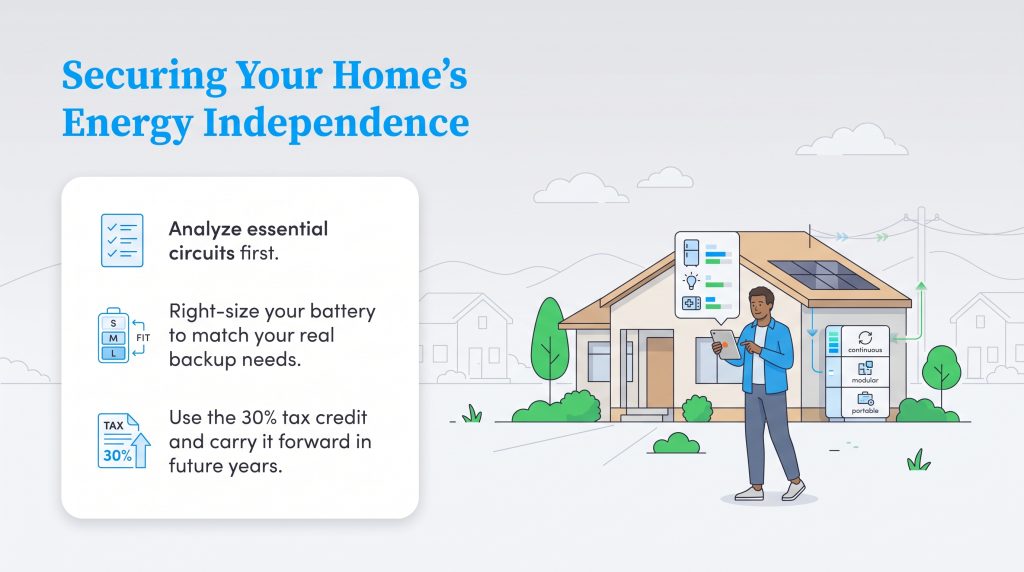
Investing in robust battery storage requires a substantial financial commitment, but the added resilience it delivers during unpredictable weather is undeniably worth the effort. Assessing your actual power needs — rather than instinctively buying the absolute largest system on the market — ensures you secure the perfect level of protection without overspending.
Whether you choose the unparalleled continuous power of the Tesla Powerwall 3, the brilliant modularity of the Enphase IQ 5P, or the portable versatility of the EcoFlow DELTA Pro Ultra, the financial transition is smoother than ever thanks to modern tax incentives. By leveraging the IRA incentives, you lock in the following benefits:
- A massive 30% reduction in your total equipment and labor costs.
- Eligibility for the credit even if you skip a solar panel installation entirely.
- The ability to carry forward unused tax credit amounts to future tax years.
You now possess the practical knowledge to evaluate unit capacities, understand distinct pricing tiers, and confidently decide between a grid-tied standalone unit or a full solar-paired setup. Taking control of your home’s energy resilience is a powerful, proactive step forward. Start by analyzing your essential circuits today, and gather quotes from certified local installers to build a safeguard that keeps your life running flawlessly, no matter what chaos hits the electrical grid.
Frequently Asked Questions About Home Battery Backup Systems
Navigating energy storage options often sparks a lot of highly specific questions about daily usage, capacity sizing, and long-term viability. We gathered the most common inquiries to help clarify exactly how these systems operate in real-world residential conditions.
How many batteries do I need to power my house for 24 hours?
What is the difference between a solar battery and a home battery backup?
Do home battery backup systems require regular maintenance?
Are home battery backup systems worth the investment?
Can a home battery backup run an air conditioner?
What is the lifespan of a home battery backup?
Do I need internet access for a home battery system to work?
How long does it take to install a home battery backup?
Can I add a home battery backup system later if I install solar first?
Is a home battery backup better than a generator?
About the Author

David has been an integral part of some of the biggest utility sites on the internet, including InMyArea.com, HighSpeedInternet.com, BroadbandNow.com, and U.S. News. He brings over 15 years of experience writing about, compiling and analyzing utility data.

Jared Evans is a licensed electrician and the owner of Full Circuit Electric in Omaha, Nebraska. As an expert reviewer for UtilitiesForMyHome.com, Jared uses his 10+ years of hands-on experience to ensure our electrical advice is safe, accurate, and easy to follow. Whether he's troubleshooting a complex wiring issue or sharing tips on green energy upgrades, Jared is dedicated to helping you power your home efficiently — and safely.

LaLeesha has a Masters degree in English and enjoys writing whenever she has the chance. She is passionate about gardening, reducing her carbon footprint, and protecting the environment. She also recently served as President of the Board for City Sprouts (a community garden).