

Knowing how to reset a tripped breaker safely can help you restore power quickly while reducing the risk of electrical overloads.
Key Takeaways
- Locating your electrical panel and identifying the tripped switch is the first step to safely restoring your home’s power.
- A “fully off, then on” motion is required to successfully reset a tripped breaker and re-engage the circuit.
- Preventing future trips often involves balancing your electrical load and upgrading to energy-efficient appliances.
Losing power in a specific room or experiencing a sudden blackout while running your vacuum can be frustrating, but knowing how to reset a circuit breaker is a simple and essential skill for any homeowner or renter moving into a new home. Your electrical panel protects your home’s wiring by automatically cutting off electricity whenever a line becomes overloaded or shorted. Fortunately, getting the lights back on usually just takes a few seconds and a firm flick of a switch, provided there are no warning signs like heat, buzzing, or scorch marks. In this guide, we walk you through the exact steps to locate and reset your breaker safely, explain why it tripped in the first place, and share practical, eco-conscious tips to keep your circuits running smoothly.
Step-by-Step Guide: How to Reset a Tripped Breaker
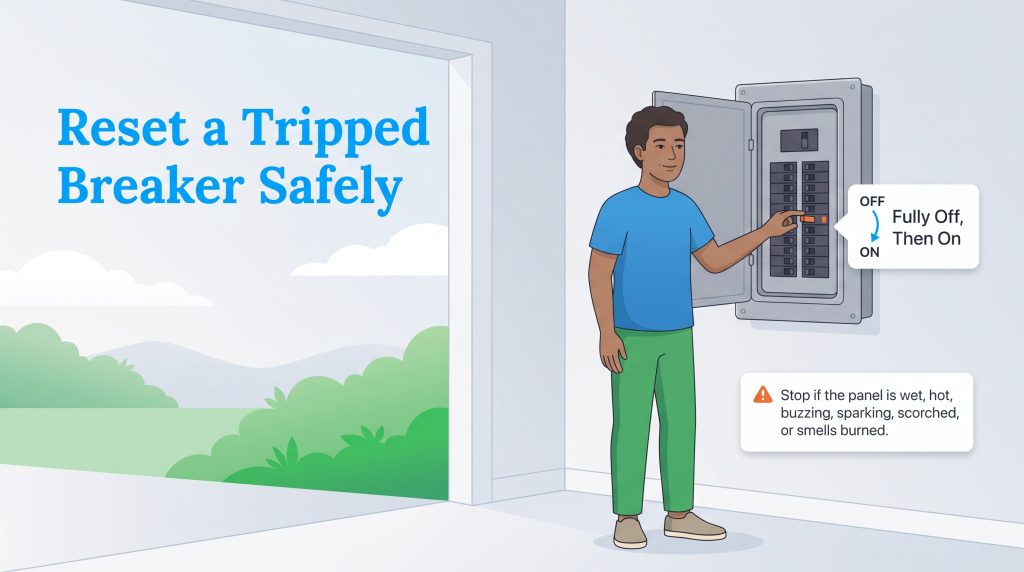
Before you even touch the panel, remember that electrical safety is always your top priority. Make sure your hands are completely dry, and stand slightly to the side of the metal box rather than directly in front of it when flipping switches. If you need to know how to reset a tripped breaker, following a calm, sequential method keeps you safe while restoring your electricity.
🚩 Heads Up: Don’t reset a breaker if the panel is wet, hot, buzzing, sparking, scorched, or smells like burning plastic. Step away and call a licensed electrician or emergency service.
Safety Checklist Before You Touch the Panel
- Make sure your hands are completely dry.
- Stand on a dry surface (wearing rubber-soled shoes adds extra protection).
- Don’t open the panel if you see moisture or standing water nearby.
- Never remove the inner dead-front metal panel cover that hides the wiring.
- Stop immediately if the panel smells burned, feels hot, buzzes, sparks, or shows scorch marks.
The 5-Step Breaker Reset Process
- Turn off appliances and lights: Switch off wall switches and explicitly unplug high-draw appliances (like space heaters, vacuums, and microwaves) in the affected room to eliminate the electrical load before the circuit comes back on.
- Locate your electrical panel: Search common areas like basements, garages, utility hallways, laundry rooms, closets, or exterior walls for the gray metal service box. In many homes, the main breaker sits at the top or bottom of the main panel, though some homes have a separate main disconnect outside near the electric meter or feeds leading to a smaller subpanel.
- Find the tripped switch: Knowing how to find a tripped circuit breaker comes down to spotting the switch that sits slightly off-center in a neutral middle position compared to the others. Some modern panels also feature a small red or orange indicator window to clearly highlight the tripped circuit.
- Push to the “Fully Off” position: When learning how to reset circuit breaker switches, the secret is moving the handle all the way to the “Off” position before turning it back “On.” Firmly flip the misaligned switch toward the “Off” side, pushing past the internal spring resistance until it clicks. This is the step people most often miss: the handle must move completely off to re-engage the internal latch.
- Push back to the “On” position: Firmly flip the switch back to the active “On” position until it clicks securely into place, signaling that the circuit is re-engaged and power is restored.
💡 Pro Tip: Always keep a working, battery-operated flashlight stored safely near or directly on top of your electrical panel box so you aren’t fumbling around in the dark during a sudden outage.
How to Reset Different Types of Breakers (Standard, GFCI, AFCI, and Main)
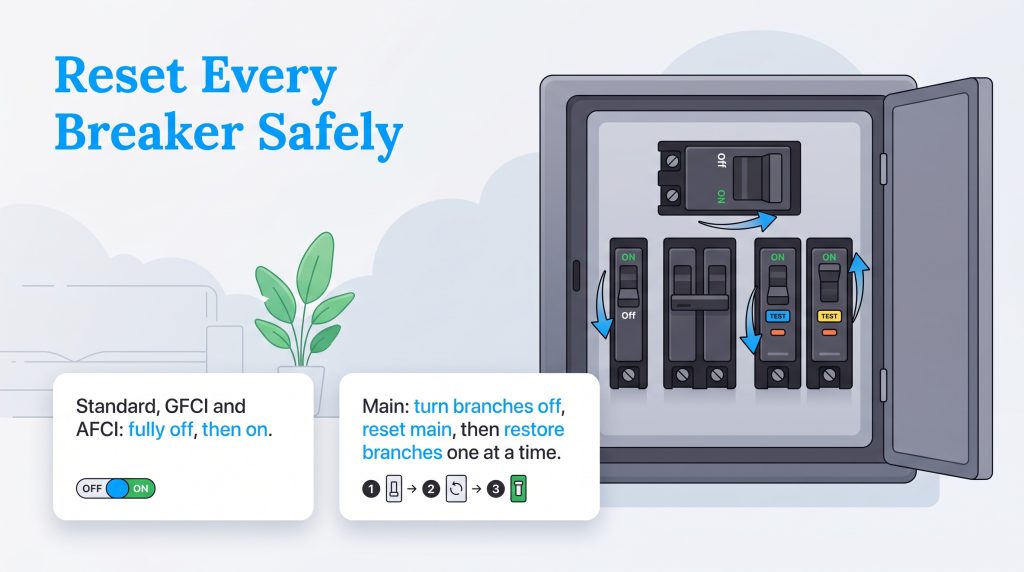
When you open your breaker box door, you will quickly notice that not all switches look alike. Modern electrical panels house several specialized breaker designs that monitor different types of electrical hazards and voltage levels. Understanding what each switch controls — and how an AFCI vs GFCI breaker reset works compared to a standard toggle — ensures you restore power properly without damaging your appliances.
- Standard Single-Pole and Double-Pole Breakers: Single-pole breakers are slim, individual switches that supply 120 volts of electricity to everyday household lighting and standard wall outlets, usually rated for 15 or 20 amps. Double-pole breakers are twice as wide and feature two switches tied together by a single handle bar. They supply 240 volts of heavy-duty power (typically 30 to 50 amps) to major appliances like your central air conditioner, electric clothes dryer, water heater, or kitchen range. Both types reset with the exact same firm “fully off, then on” motion, though a double-pole handle takes a bit more thumb pressure to flip.
- GFCI and AFCI Circuit Breakers: You can easily spot Ground Fault Circuit Interrupter (GFCI) and Arc Fault Circuit Interrupter (AFCI) breakers inside the panel by their small, colored “TEST” buttons (often yellow, white, green, or blue). GFCI breakers protect against shock hazards in damp areas like bathrooms, kitchens, and outdoor outlets, while AFCI breakers detect dangerous sparking inside living room and bedroom walls. To reset either one, flip the main handle completely to “Off” and then firmly back to “On.” Some modern dual-function breakers also feature a tiny LED light that flashes for a few seconds after a reset to tell you whether an overload, ground fault, or arc fault caused the trip. Electricians recommend pressing the “TEST” button once or twice a year to verify the internal safety mechanism still trips properly, then resetting the handle back to “On.”
- Main Circuit Breaker: If your entire house loses power while your neighbors’ lights are still shining, you may need to reset main circuit breaker switches. The main disconnect is typically a large 100-amp to 200-amp double switch isolated at the very top or bottom of your breaker box, or housed inside an exterior weatherproof box next to your utility meter. Before you flip a tripped main breaker back on, turn every individual branch circuit breaker in the panel to the “Off” position first, following a proper emergency power shutoff procedure. Once all smaller switches are off, push the thick main handle forcefully to “Off” and then back to “On.” Finally, flip your individual branch breakers back on one at a time. This crucial step prevents a massive electrical surge from hitting all your appliances simultaneously when power returns.
What Causes a Circuit Breaker to Trip?
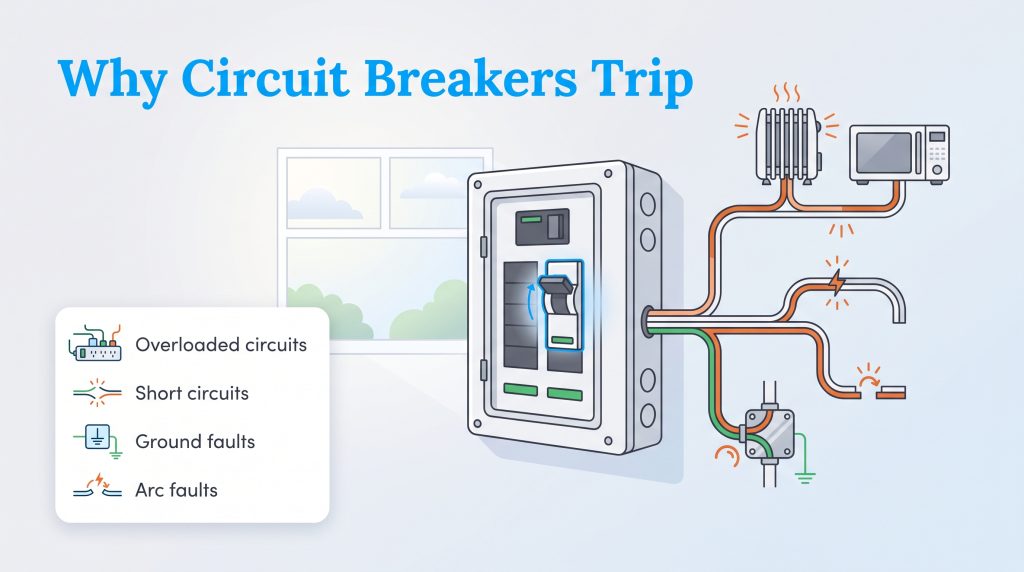
When the power suddenly cuts out mid-afternoon, it is easy to feel annoyed, but your electrical panel is actually doing its job. A tripped switch acts as a vital safety gatekeeper that prevents your home’s hidden wiring from overheating and starting an electrical fire. If your circuit breaker keeps tripping, one of these four underlying electrical issues is almost always to blame.
- Overloaded circuits: This is the most common culprit and happens when you pull too many amps through a single wire line, like running a high-wattage space heater and a microwave simultaneously on the same shared circuit.
- Short circuits: A more serious fault where an active “hot” wire unexpectedly touches a neutral wire inside an outlet, appliance cord, or wall box, creating an instant, massive surge of current that trips the breaker immediately.
- Ground faults: Similar to a short circuit, this occurs when a hot wire touches the bare copper ground wire, a metal electrical box, or moisture, creating an unintended pathway that could shock someone if the breaker doesn’t cut the power.
- Arc faults: When wiring becomes loose at an outlet terminal, gets pinched behind furniture, or suffers damage from a stray picture-hanging nail, electricity can jump — or “arc” — across the gap. These superheated sparks easily ignite surrounding wood studs and insulation, which is why modern AFCI breakers are designed to sense the irregular current and shut the circuit down immediately.
Learning what causes a circuit breaker to trip goes hand-in-hand with managing your home’s energy usage. Spreading out your heavy appliance usage prevents the localized strain that forces your panel to intervene.
Common High-Draw Appliances and Circuit Limits
Understanding simple household math and measuring electric usage makes it much easier to prevent an overloaded circuit. Standard 120-volt household branch circuits come in two sizes: 15-amp circuits, which handle a maximum capacity of 1,800 watts, and 20-amp circuits, which max out at 2,400 watts. However, for safety reasons, the National Electrical Code enforces an 80% continuous load rule (for devices running three hours or more), meaning you should ideally keep sustained usage under 1,440 watts on a 15-amp line and 1,920 watts on a 20-amp line.
Anything that produces heat or runs a powerful motor gulps down wattage rapidly. As you can see in the Common Appliance Wattage Guide below, plugging two heat-producing gadgets into the same circuit will almost instantly push your wiring past its breaking point.
| Appliance | Average Wattage | Circuit Load Impact |
|---|---|---|
| Space Heater | 1,500W | Uses 83% of a 15A circuit; cannot share the circuit with other high-draw appliances |
| Hair Dryer | 1,200W–1,800W | Maxes out a 15A circuit on high heat; easily trips breakers if lights or curling irons are running |
| Microwave | 1,000W–1,500W | Consumes up to 83% of a 15A circuit; will trip if run alongside a toaster or coffee maker |
| Vacuum Cleaner | 1,000W–1,400W | High startup surge; often trips living room circuits if plugged into the same line as a TV and gaming PC |
| Coffee Maker | 900W–1,200W | Uses 50%–67% of a 15A circuit; safe alone, but overloads kitchen circuits when paired with a microwave |
| Window AC Unit | 900W–1,500W | Continuous heavy load; exceeds the 1,440W safe continuous limit on a 15A circuit if other devices are on |
Troubleshooting When a Breaker Won’t Reset
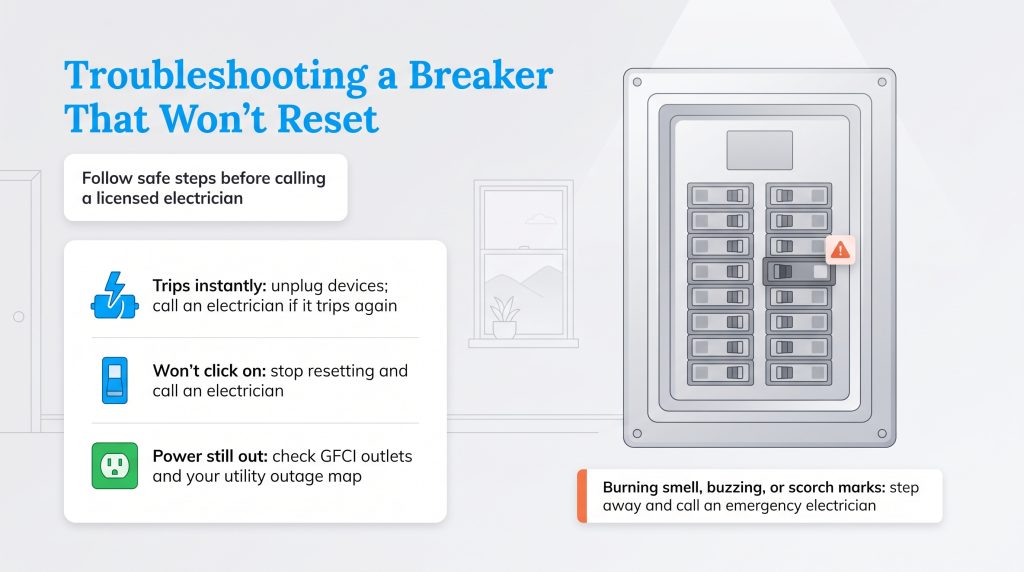
Discovering your breaker won’t reset can quickly turn a minor inconvenience into a genuine household headache. Sometimes, you push the switch back to the “On” position, only for it to snap right back to the middle or refuse to catch at all. If you reset breaker switches and still have no power, never try to hold the handle in place or tape it down. Forcing a switch overrides its internal trip mechanism and creates a severe fire hazard. If the breaker clicks into place normally but your outlets stay dead, walk through your kitchen, bathrooms, garage, basement, or exterior walls and press the “Reset” button on any GFCI wall outlets, as a single tripped GFCI outlet can cut power to several downstream receptacles.
When basic troubleshooting fails, it is time to step back and call a licensed professional, especially if you suspect a dead short in the wall or a failing panel. If your home has older wiring, looking into upgrading your electrical panel ensures your system can handle modern electrical loads safely.
- Advice for Renters: If you rent your home or apartment and a breaker trips repeatedly, feels hot, buzzes, or refuses to reset, notify your landlord or property manager immediately. While flipping a standard tripped switch is completely fine for a tenant, you should never attempt deeper electrical troubleshooting, replace switches, or remove the panel cover yourself.
| Problem | Likely Cause | What You Should Do |
|---|---|---|
| Breaker trips immediately | Overload, short circuit, or faulty appliance | Unplug devices and call an electrician if it trips again |
| Breaker won’t click into place | Faulty breaker or panel issue | Stop resetting and call a licensed electrician |
| Power is still out after reset | GFCI outlet, main breaker, outage, or wiring issue | Check nearby GFCI outlets and your utility outage map |
| Breaker feels spongy or loose | Worn internal spring mechanism (bad breaker) | Do not force; hire an electrician to replace the breaker switch |
🚩 Heads Up: If you notice a burning plastic smell, see scorch marks near the panel, or hear distinct buzzing and hissing sounds, step away immediately and call an emergency electrician.
How to Prevent Future Trips and Improve Energy Efficiency
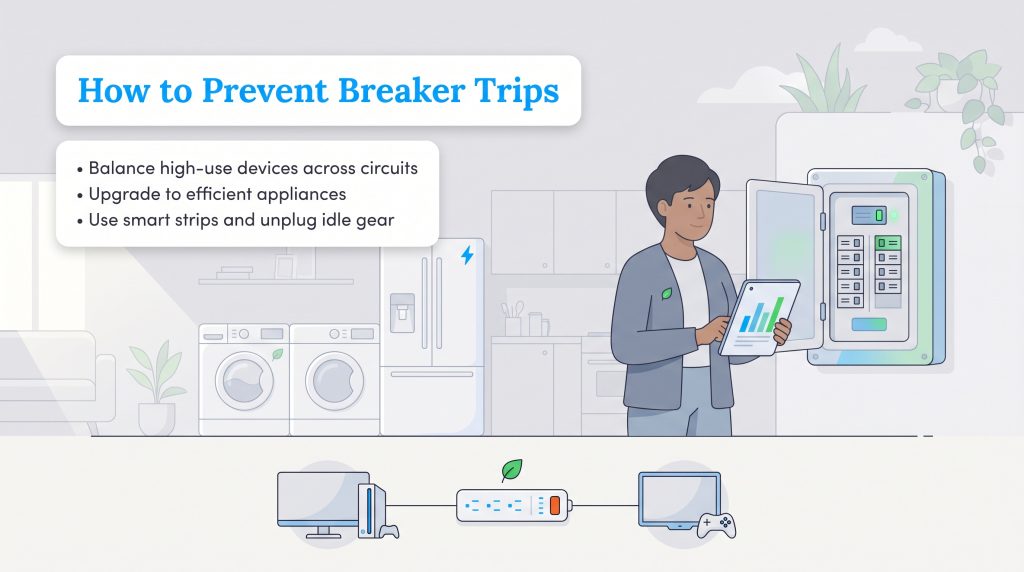
Stopping those frustrating mid-week power drops usually comes down to smarter electricity habits and modernizing how your home draws power. Older appliances often pull significantly more wattage than newer models, and clustering high-draw devices in one room will quickly overwhelm a shared 15-amp or 20-amp circuit. You can take the pressure off your panel by plugging portable heaters or window AC units into dedicated wall outlets on separate circuits and using smart power strips for home offices and entertainment centers.
To keep your circuits well below their trip thresholds, consider upgrading to energy-efficient appliances that deliver the same performance using far fewer watts. Replacing an aging refrigerator, window air conditioner, or space heater with an ENERGY STAR-certified model is an energy-saving option that trims both your peak circuit load and your monthly electric bill. If your home already has natural gas hookups, utilizing gas-powered appliances for heavy heating tasks can also free up substantial capacity inside your electrical box. For an environmentally mindful choice, weigh your total utility costs, appliance efficiency ratings, and local renewable electricity options when upgrading your home equipment.
🌱 Eco Edge: Lowering your overall electrical load by unplugging phantom energy drains not only prevents annoying breaker trips but also actively reduces your carbon footprint and monthly utility costs.
Keeping Your Home’s Electrical Panel Safe and Efficient
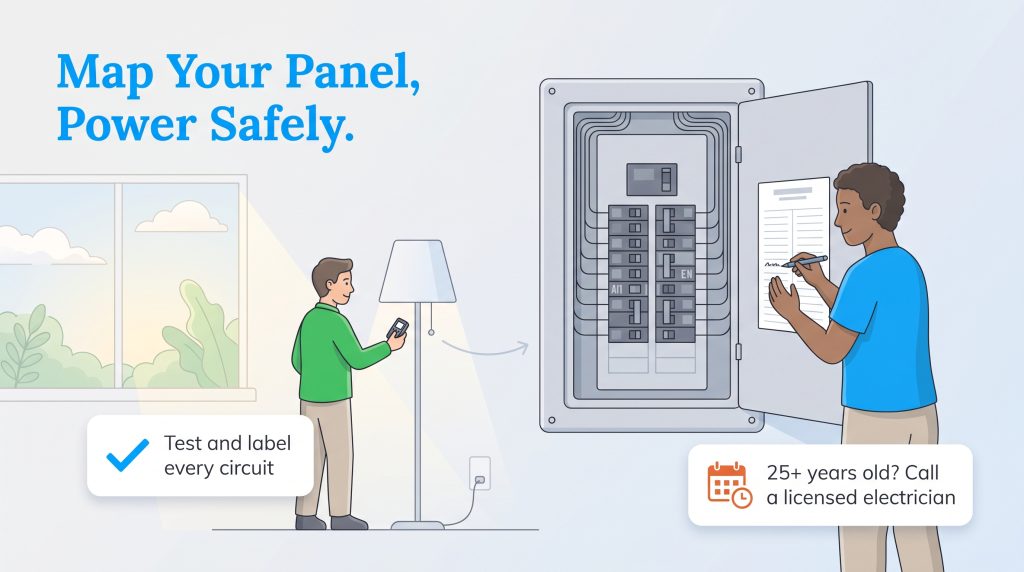
Once your power is back on, take 15 minutes with a helper to test and clearly label the directory map inside your breaker box door so you know exactly which switch controls every room and major appliance. Having an accurate panel map saves valuable time during future outages and helps you distribute high-wattage devices across different circuits. Finally, if your home’s electrical panel is more than 25 years old or struggles to keep up with modern appliances, schedule a preventive inspection with a licensed electrician to ensure your switches, bus bars, and wiring remain safe and efficient for years to come.
Frequently Asked Questions About Resetting Circuit Breakers
These quick answers cover the most common questions homeowners and renters have after a breaker trips. If a switch repeatedly trips or shows signs of heat, damage, or burning, stop troubleshooting and call a licensed electrician.
Why did I reset my breaker but still have no power?
How do I find a tripped circuit breaker in the dark?
What are the signs of a bad circuit breaker?
Is it dangerous to reset a circuit breaker yourself?
What is the difference between resetting a GFCI outlet and a circuit breaker?
How many times can a circuit breaker trip before it goes bad?
How much does it cost for an electrician to replace a bad circuit breaker?
About the Author

Jared Evans is a licensed electrician and the owner of Full Circuit Electric in Omaha, Nebraska. As an expert reviewer for UtilitiesForMyHome.com, Jared uses his 10+ years of hands-on experience to ensure our electrical advice is safe, accurate, and easy to follow. Whether he's troubleshooting a complex wiring issue or sharing tips on green energy upgrades, Jared is dedicated to helping you power your home efficiently — and safely.

David has been an integral part of some of the biggest utility sites on the internet, including InMyArea.com, HighSpeedInternet.com, BroadbandNow.com, and U.S. News. He brings over 15 years of experience writing about, compiling and analyzing utility data.