

Determining The Right Solar Array Size To Power Your Daily Commute And Maximize Savings
Key Takeaways
- Between 6 and 12 solar panels are typically required to fully charge the average electric vehicle, depending on your daily mileage and the car’s overall efficiency.
- Smart EV chargers are essential for solar setups because they allow you to prioritize charging only when your rooftop panels are producing excess energy.
- Charging your EV with home solar power is significantly cheaper than using utility grid electricity or public charging networks over the lifespan of your system.
Imagine lowering your daily commute costs simply by parking in your driveway. Using solar power to charge electric vehicle batteries is a highly effective way for homeowners to eliminate expensive fuel trips and drastically cut grid-based utility costs entirely. If you are tired of fluctuating gas prices and unexpected electric rate hikes, setting up a dedicated rooftop array gives you total control over how you power your transportation. We are here to help you cut through the technical jargon, properly calculate the exact system size you need for your driving habits, and confidently start running your car on pure sunshine.
Can You Really Charge An EV With Solar Panels?
Yes, absolutely. Making the leap from traditional power sources to a dedicated rooftop array provides immediate, tangible benefits for your home and lifestyle. Homeowners successfully charge electric vehicle with solar panels every single day, completely bypassing the gas station. Here is exactly why you should consider making the switch:
- You unlock massive financial ROI. Tapping into your own home solar system means you pay a fraction of what grid electricity or public charging stations cost over the 25-year lifespan of your panels.
- You gain true grid independence and energy resilience. Generating your own power shields your household from volatile utility rate hikes, peak demand charges, and unexpected grid outages.
- You maximize your environmental impact. Using renewable solar energy ensures your zero-emission vehicle is genuinely running on clean power as an environmentally mindful choice, rather than drawing from a utility grid that may still rely on burning fossil fuels (unless you specifically utilize a 100% green plan from a provider like Green Mountain Energy).
How Many Solar Panels Does It Take To Charge An EV?
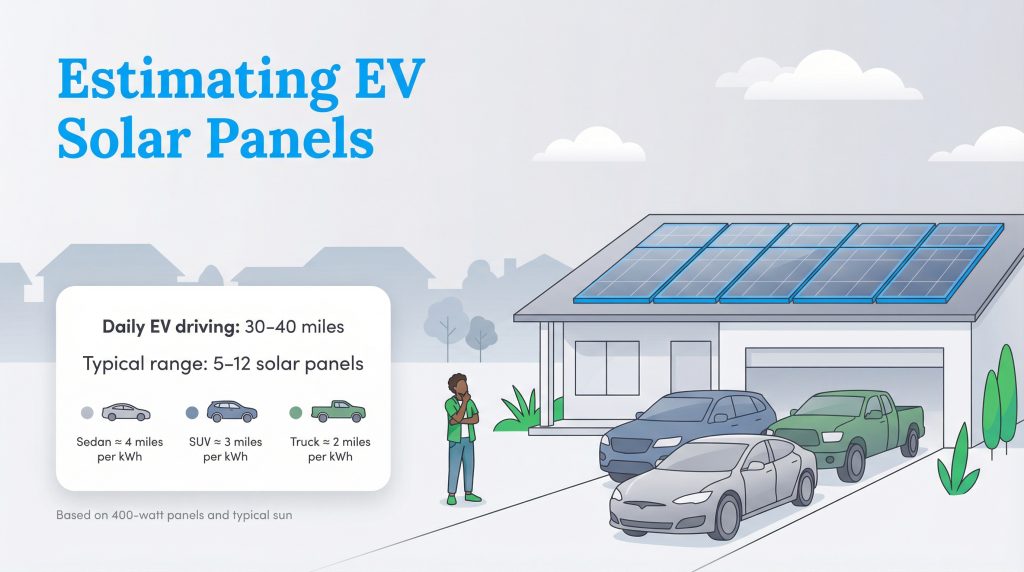
An average EV requires 5 to 12 solar panels to charge, depending on your specific driving habits and the selected panel wattage. If you are wondering exactly how many solar panels to charge an EV efficiently, you must realize that the exact number will fluctuate based on a few distinct factors unique to your household and lifestyle.
🚩 Heads Up: If you try to cut corners, you will be disappointed. A single 100-watt solar panel would take well over 60 hours of direct, uninterrupted sunlight to fully charge an EV. This mathematical reality highlights why a properly sized, multi-panel rooftop array is absolutely critical for practical daily use.
- Solar panel wattage: Higher-efficiency panels (such as 400W or 450W models) produce significantly more energy per square foot, meaning you will need fewer panels overall to generate the necessary electricity for your commute.
- EV battery capacity and overall efficiency: A large electric truck with a massive battery pack will naturally require a much larger solar array to recharge fully compared to a highly efficient, lightweight commuter sedan.
For the calculations outlined below, we have assumed standard 400-watt solar panels and average North American sunlight conditions. Keep in mind that these panel counts cover just the energy for your vehicle. If you also want to offset your home’s lighting, air conditioning, and appliances, you will need to determine a larger home solar system size for EV integration.
| Vehicle Type | Daily Miles Driven | Annual kWh Needed | Estimated Panels (400W) |
|---|---|---|---|
| Small Sedan (e.g., Tesla Model 3) | 30 miles | ~2,700 kWh | 5–6 Panels |
| Small Sedan (e.g., Tesla Model 3) | 50 miles | ~4,500 kWh | 8–9 Panels |
| Mid-Size SUV (e.g., Ford Mustang Mach-E) | 30 miles | ~3,600 kWh | 7–8 Panels |
| Mid-Size SUV (e.g., Ford Mustang Mach-E) | 50 miles | ~6,000 kWh | 11–12 Panels |
| Large Truck (e.g., Ford F-150 Lightning) | 30 miles | ~5,400 kWh | 10–11 Panels |
| Large Truck (e.g., Ford F-150 Lightning) | 50 miles | ~9,100 kWh | 16–18 Panels |
These estimates assume an average efficiency of roughly 4 miles per kWh for sedans, 3 miles per kWh for SUVs, and 2 miles per kWh for trucks. Panel counts assume standard 400-watt panels receiving about 4.5 peak sun hours per day.
The EV Solar Math Calculating Your Array Size
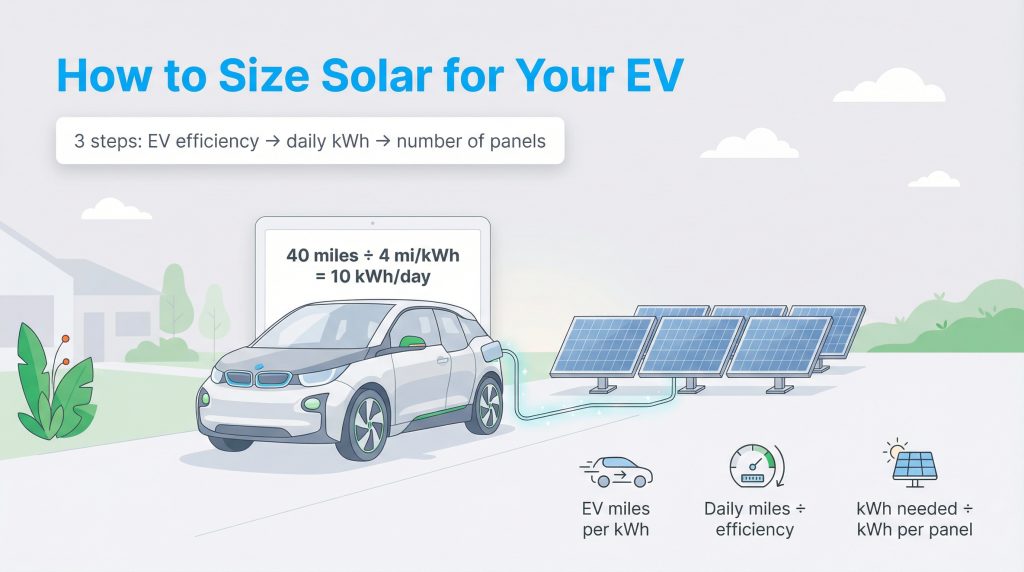
If you want to handle the exact mathematics yourself, you can pinpoint your hardware requirements using a straightforward, proven formula. Determining your precise energy needs ensures you never overpay for unnecessary equipment while guaranteeing you generate enough electricity to comfortably power your commute through every season.
- Calculate Total kWh Needed: First, determine your efficiency rating in miles per kWh. You can usually find this EV miles per kWh figure on your dashboard screen or inside your car’s mobile app. Take your annual driving mileage and divide it by this efficiency number to find your total yearly energy consumption.
Formula: (Annual Mileage / EV Miles per kWh) = Total kWh Needed - Calculate Annual Production per Panel: Look up the average peak sun hours for your region (most of the U.S. averages around 4.5 hours daily). Multiply your panel wattage by those sun hours, and then multiply by 365 days to see exactly what a single panel generates in a year.
Formula: (Panel kW × Daily Sun Hours × 365) = Annual Panel kWh - Divide for Total Panels: Finally, divide your total energy requirement by the yearly production of a single panel.
Formula: (Total kWh Needed / Annual Panel kWh) = Panels Required
Real-World Math Example: Let’s say you drive 10,000 miles per year, and your electric sedan gets an average of 3.5 miles per kWh. You plan to install 400-watt (0.4 kW) panels in an area receiving 4.5 peak sun hours daily.
- 10,000 miles / 3.5 efficiency = 2,857 kWh needed annually.
- 0.4 kW panel × 4.5 sun hours × 365 days = 657 kWh produced per panel annually.
- 2,857 kWh / 657 kWh = 4.34 panels (always round up to 5 panels).
📌 Quick Fact: Always size your system with a buffer. We recommend adding 10% to 20% more capacity to account for excessively cloudy weeks, natural battery degradation over time, or unexpected road trips that demand extra charging.
Essential Equipment For A Home Solar EV Charging Station
Building a highly efficient home solar EV charging station requires a careful selection of specialized hardware working in tandem. You absolutely cannot connect bare solar wiring directly into a vehicle’s charging port. Attempting to bypass proper hardware is incredibly dangerous, will void warranties instantly, and can severely damage your vehicle. Instead, you need four distinct components: the solar array, the solar inverter, your home’s electrical service panel, and a smart EV charger for solar optimization.
Level 1 Versus Level 2 EV Charger Solar Integration
The speed at which your vehicle accepts power from your roof is dictated by the charger type. A Level 1 charger simply plugs into a standard 120-volt wall outlet and trickles in roughly 3 to 5 miles of range per hour. While this is acceptable for small plug-in hybrids, it is far too slow to capture the brief, potent window of peak afternoon solar production effectively.
Mastering Level 2 EV charger solar integration is the gold standard for homeowners. Operating on a robust 240-volt circuit, a Level 2 unit delivers 15 to 40 miles of range per hour, meaning it can easily and rapidly soak up your roof’s maximum energy output during those critical afternoon hours before the sun begins to set.
| Charger Type | Voltage | Charging Speed | Solar Integration Quality |
|---|---|---|---|
| Level 1 (Standard Outlet) | 120V | 3-5 miles per hour | Poor – Too slow to capture the peak midday solar production window. |
| Level 2 (Dedicated Circuit) | 240V | 15-40 miles per hour | Excellent – Rapidly absorbs excess solar power before sunset. |
Solar-Ready Inverters And Smart Chargers
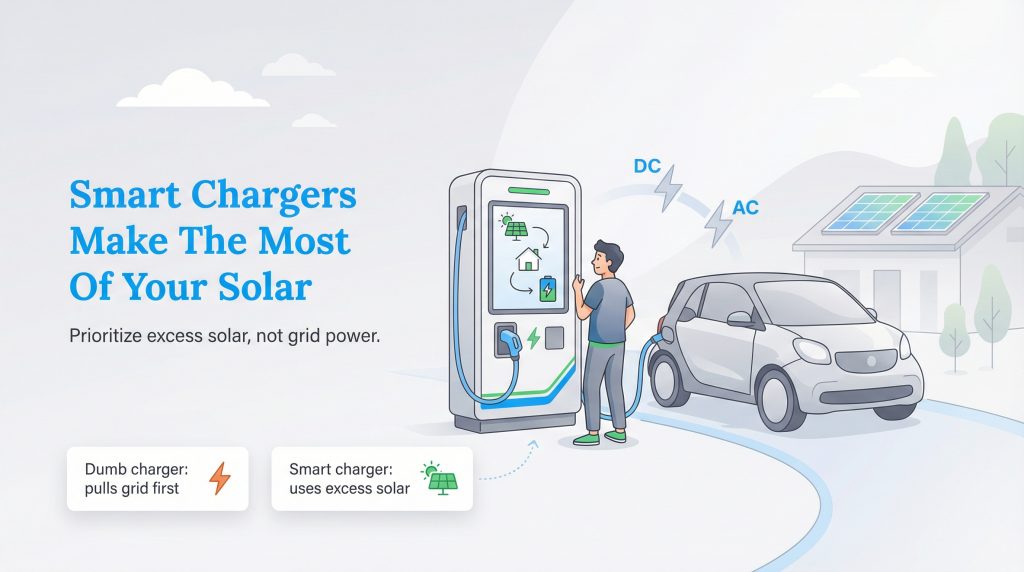
The energy generated by your roof is strictly Direct Current (DC) electricity, but your home and your Level 2 charger operate on Alternating Current (AC). To make this power usable, a solar inverter for EV charging setups is required. This device sits securely between your roof array and your main electrical panel, seamlessly converting the raw DC energy into a smooth, safe AC flow for your house.
Once the power reaches the electrical panel, a “Solar-Ready” smart EV charger for solar steps in. These intelligent units utilize solar diversion technology — meaning they actively monitor your home’s current energy consumption and throttle the car’s charging speed on the fly to match exactly what your roof is producing.
Smart Charging Managing Excess Solar Energy And Export Limits
One of the biggest mistakes new solar owners make is assuming their utility company will pay them handsomely for the extra power their panels generate. In reality, many utility providers enforce strict grid “export limits” or offer severely reduced feed-in tariffs, meaning they pay you pennies on the dollar for your exported energy. This makes self-consumption — using every drop of power you generate on your own property — the most financially rewarding strategy.
This is where managing your hardware becomes crucial. By utilizing a smart charger, you can automatically capture using excess solar energy for EV charging. Rather than sending your surplus power to the utility grid for a meager credit, the smart charger redirects that exact amount of energy into your car’s battery. It acts as an automated sponge for your excess electricity.
When shopping for equipment, look for smart chargers that feature a dedicated “Solar-Only Mode.” This setting forces the charger to pause the session if a thick cloud rolls over, ensuring it never accidentally pulls expensive electricity from the municipal grid. When the sun returns, the charger instantly ramps back up, keeping your charging strictly off-grid and financially optimized.
The Best Time Of Day To Charge Your EV
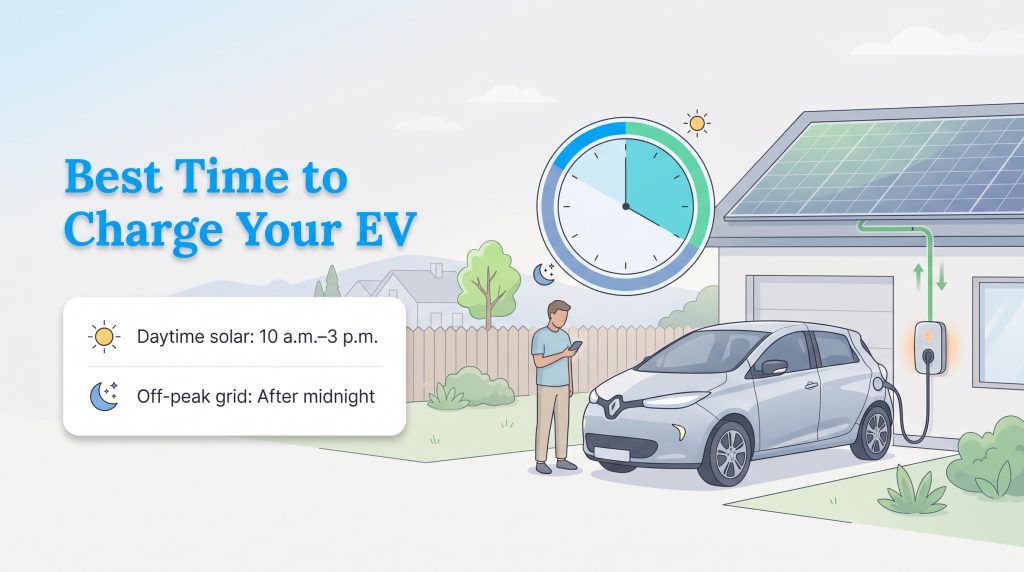
To maximize the return on your solar investment, timing is everything. Mathematically, the most efficient time to charge your vehicle is right in the middle of the day — typically between 10:00 a.m. and 3:00 p.m. During this peak production window, your solar panels are generating maximum output, and you can route that raw energy directly into your vehicle without relying on the grid or draining an expensive home battery system.
However, we understand that daily life rarely revolves around ideal solar curves. If you commute to an office Monday through Friday, your car won’t be sitting in the driveway during peak sun hours. So, how do you handle this? The most actionable strategy for commuters is weekend binge-charging. By leaving your car plugged in at home during the daytime on Saturday and Sunday, you can absorb enough free solar energy to cover a large portion of your weekday commute.
If you absolutely must charge during the week, you will need to leverage your smart charger’s scheduling features. You can program the system to wait until midnight to pull power from the grid during cheaper, off-peak utility hours, while saving your solar generation to power your home’s air conditioning and appliances during the afternoon.
Nighttime Charging Solar Battery Storage Versus Net Metering
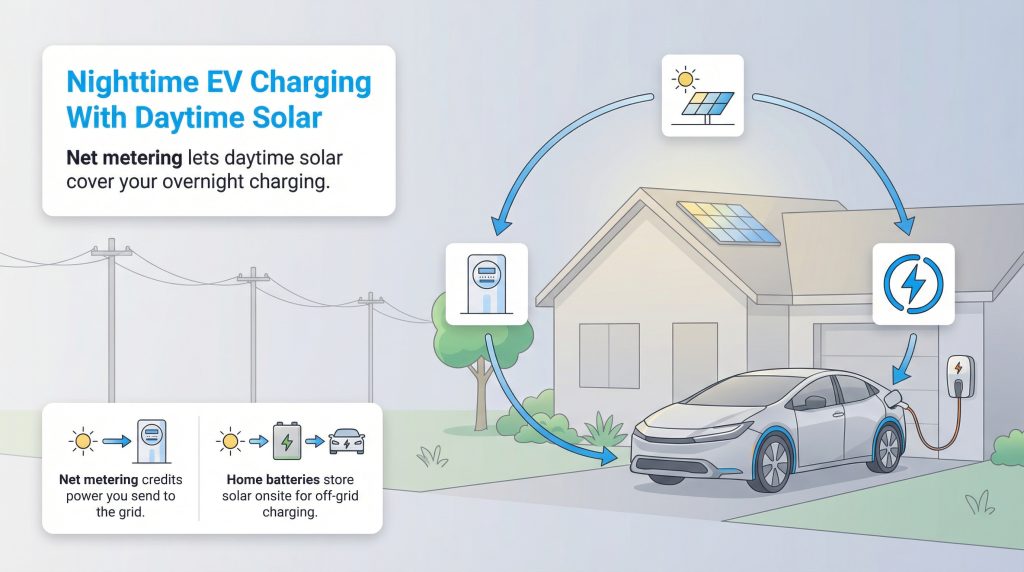
A frequent challenge for daily commuters is that their solar panels hit maximum production right in the middle of the afternoon when their car is parked miles away. If you rely solely on live rooftop power, your panels will go dormant just as you arrive home to plug in.
If you live in a supportive utility market, grid-tied net metering solves this elegantly. Net metering allows you to send all your excess daytime energy to the utility company and reclaim it at night via 1:1 statement credits. You will want to check your local utility policies—or explore specialized solar buyback plans from retail providers like TXU Energy and Rhythm Energy—to ensure you receive favorable credit ratios.
For homes without excellent net metering policies, investing in solar battery storage for EV charging bridges the gap entirely. Advanced home battery setups safely capture your surplus daytime production on your property. When you plug your car in at 6:00 p.m., the system discharges that stored solar energy directly into your vehicle. Furthermore, the industry is now introducing bidirectional EV charging configurations, where your car’s massive battery can actually power your home during an evening blackout, turning your vehicle into the ultimate backup generator.
Cost Comparison Solar Versus Grid Versus Gas
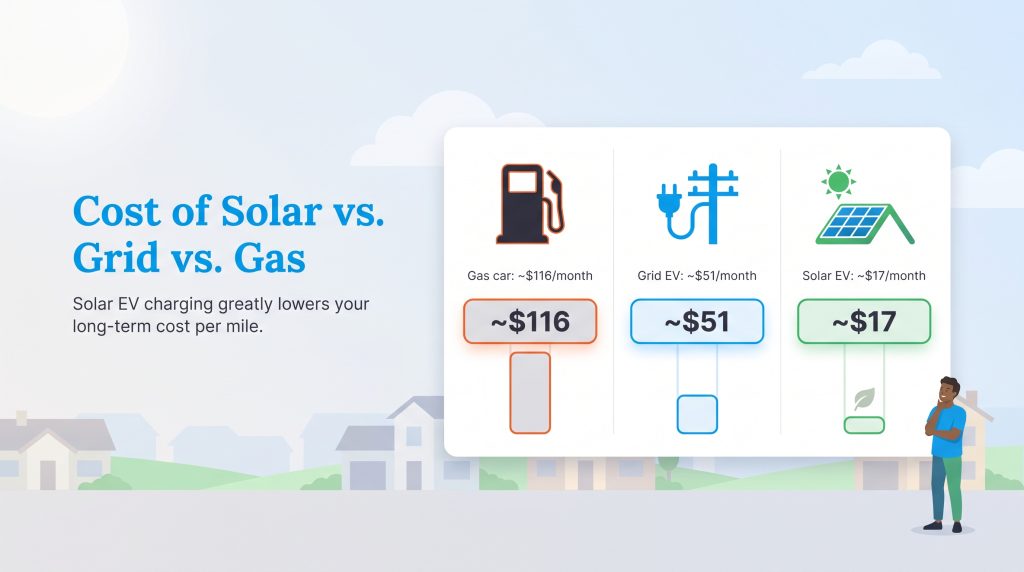
While the upfront cost of charging EV with solar power involves a significant initial equipment investment, the long-term mathematical payoff is undeniable. When you look at your true “fuel” costs over a full decade, producing your own electricity consistently outperforms the frustrating fluctuations of traditional utility bills and global gasoline prices.
When charging directly from the utility grid, you pay the standard retail rate for electricity. The national average in 2026 sits around 18 cents per kWh, and much higher in some coastal states. Conversely, the “Levelized Cost of Energy” (LCOE) for a residential solar array — which calculates the total installation cost spread out over the system’s 25-year lifespan — often drops down to an incredible 6 cents per kWh. Let’s compare exactly what these figures mean for an average driver covering 1,000 miles a month.
| Fuel Source | Cost per kWh / Gallon | Cost to Drive 1,000 Miles | Upfront Equipment Cost |
|---|---|---|---|
| Gasoline Vehicle (30 MPG) | $3.50 / Gallon | ~$116.00 | $0 (Vehicle Only) |
| EV Grid Charging | $0.18 / kWh | ~$51.00 | $500 – $1,500 (Charger) |
| EV Solar Charging (LCOE) | $0.06 / kWh | ~$17.00 | $4,000 – $8,000 (Array + Charger) |
| Off-Grid Solar EV Charging | $0.12 / kWh (w/ Battery LCOE) | ~$34.00 | $10,000+ (Array + Batteries) |
The upfront equipment cost for solar includes the price of adding 6 to 10 additional panels strictly to support the vehicle’s demand. If you pursue full off-grid solar EV charging, your cost per kWh rises slightly because you must factor in the lifespan and cost of home battery storage. While that initial hurdle is higher, operating your car for a mere $17 to $34 a month makes an incredible difference to household budgets. For more proven strategies to reduce your monthly expenses beyond your driveway, be sure to check out our comprehensive guide on how to save on your electric bill.
Preparing Your Home For Solar EV Charging Integration
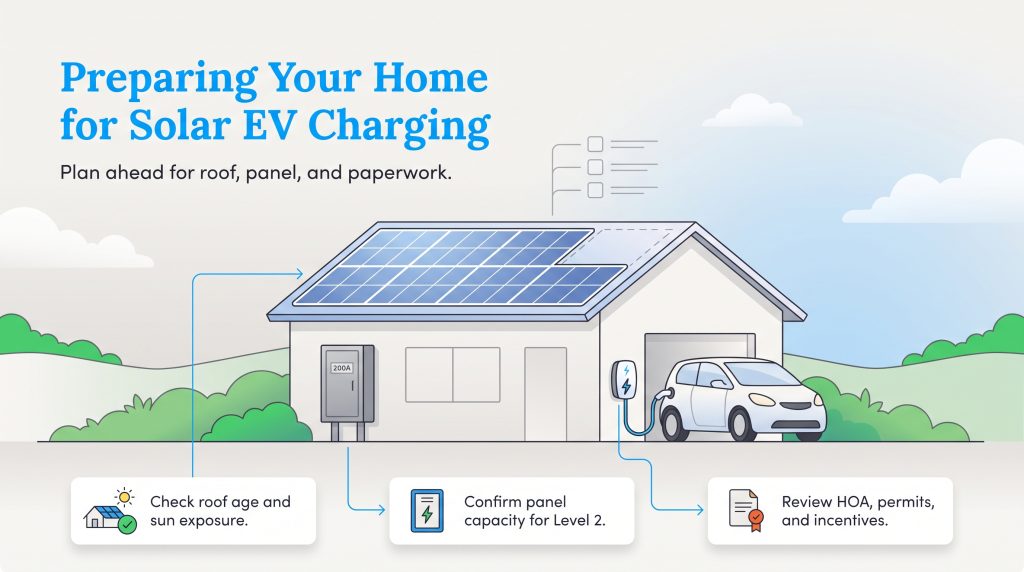
Deciding to invest in a robust solar EV charging system setup is an exciting proposition, but evaluating your specific property is an essential first step. This upgrade is a major financial commitment and requires careful physical and electrical preparation to ensure safety and peak performance.
- Roof Space and Condition: You ideally need a sturdy roof with excellent, unshaded southern or western exposure. If your roof is nearing the end of its lifespan, you must replace the shingles before bolting panels to the decking.
- Electrical Panel Amperage: You need to confirm that your home’s main electrical panel has the required capacity. A Level 2 charger can pull 40 to 60 amps continuously. For many older homes, a service upgrade to a modern 200-amp panel is required to safely handle this heavy draw alongside your air conditioning and ovens.
- HOA and Permitting: Before signing any contracts, review your Homeowners Association guidelines and local municipal codes. A licensed solar installer will typically handle pulling the necessary structural and electrical permits on your behalf.
Additionally, investigate local and federal incentives that make this eco-conscious option vastly more affordable. The U.S. Department of Energy outlines powerful federal tax credits that can significantly lower the total cost of a residential solar installation by as much as 30%. Combining federal tax benefits, state incentives, and local utility rebates lowers your overall barrier to entry immensely.
Driving Toward A Cleaner Energy Future
Powering your electric vehicle directly with a home solar system is easily one of the most impactful choices you can make for both your monthly household budget and the broader environment. While the initial equipment research and required mathematical calculations might feel a bit demanding, the long-term freedom of producing your own clean transportation fuel is entirely worth the effort.
This setup is ultimately best for homeowners who drive frequently, plan to stay in their current residence for the foreseeable future, and want true independence from utility rate hikes. By sizing your array properly, investing in a high-quality smart charger, and taking full advantage of federal tax incentives, you can confidently turn every sunny afternoon into thousands of miles of low-cost, zero-emission driving.
Frequently Asked Questions About Solar EV Charging
How many solar panels does it take to charge an EV?
The average driver commuting roughly 30 to 40 miles per day will need between 5 and 12 standard 400-watt solar panels strictly dedicated to their vehicle. This precise number depends heavily on how efficient your specific car is and how many direct sun hours your roof receives.
Do I need a special solar inverter for EV charging?
You do not strictly need a highly specialized inverter, as a standard home solar inverter converts DC power to AC power perfectly well for your EV charger to utilize. However, combining a standard inverter with a specialized “solar-aware” smart charger is highly recommended to prioritize efficiency and ensure you strictly utilize self-generated power rather than pulling from the grid.
Can you charge an electric car with solar panels off-grid?
Yes, off grid solar EV charging is entirely possible, but it requires significantly more hardware. Because you have no municipal grid as a backup, you must install an oversized solar array and invest in multiple high-capacity home battery units to store enough energy to weather cloudy stretches and safely supply the massive power load required to fill a vehicle.
Can I really charge my EV at home using only solar panels?
Yes, but it almost always requires a combination of solar panels and either a utility grid connection or substantial home battery storage. Since you likely plug your car in at night when the panels are not actively producing power, you will typically use accumulated grid credits (via net metering) or drawn battery power to fill your car.
Can I plug a solar panel directly into my electric car?
No, you cannot safely plug a raw solar panel directly into a vehicle. Solar panels generate unregulated Direct Current (DC) electricity, while your vehicle’s charging system requires a steady, carefully regulated current. You must route the solar energy through an inverter and a proper Level 2 EV charging station.
What happens if I plug in my car when it is cloudy?
If your solar panels are not currently producing enough power to meet the car’s demand due to dense cloud cover or nighttime hours, your home’s electrical system will automatically pull electricity from the municipal grid or your home battery to seamlessly make up the difference. You will never be stuck without a charge, but you may pay the utility company’s standard rate for that energy.
What is the best smart EV charger for solar?
The best smart EV chargers for solar are units that feature dedicated solar diversion technology. These chargers communicate directly with your home energy monitor and dynamically adjust their charging speed based on how much excess sunlight your roof is producing, ensuring you never accidentally buy expensive power from the grid.
Can I use an existing solar panel system to charge my EV?
Yes, you can utilize your current rooftop array, but adding an electric vehicle will dramatically increase your household’s overall electricity consumption. If your existing solar system was originally sized just to offset your home’s daily lighting and appliance usage, you will likely need to hire an installer to expand the array to comfortably handle the new charging demands.
How much does a dedicated home solar EV charging station cost?
While standard Level 2 chargers typically cost between $500 and $1,500, a complete home solar EV charging station setup (including adding 6 to 10 additional solar panels specifically to cover the vehicle’s usage) generally ranges from $4,000 to $8,000 before applying federal tax credits or local rebates.
About the Author

David has been an integral part of some of the biggest utility sites on the internet, including InMyArea.com, HighSpeedInternet.com, BroadbandNow.com, and U.S. News. He brings over 15 years of experience writing about, compiling and analyzing utility data.

Jared Evans is a licensed electrician and the owner of Full Circuit Electric in Omaha, Nebraska. As an expert reviewer for UtilitiesForMyHome.com, Jared uses his 10+ years of hands-on experience to ensure our electrical advice is safe, accurate, and easy to follow. Whether he's troubleshooting a complex wiring issue or sharing tips on green energy upgrades, Jared is dedicated to helping you power your home efficiently — and safely.